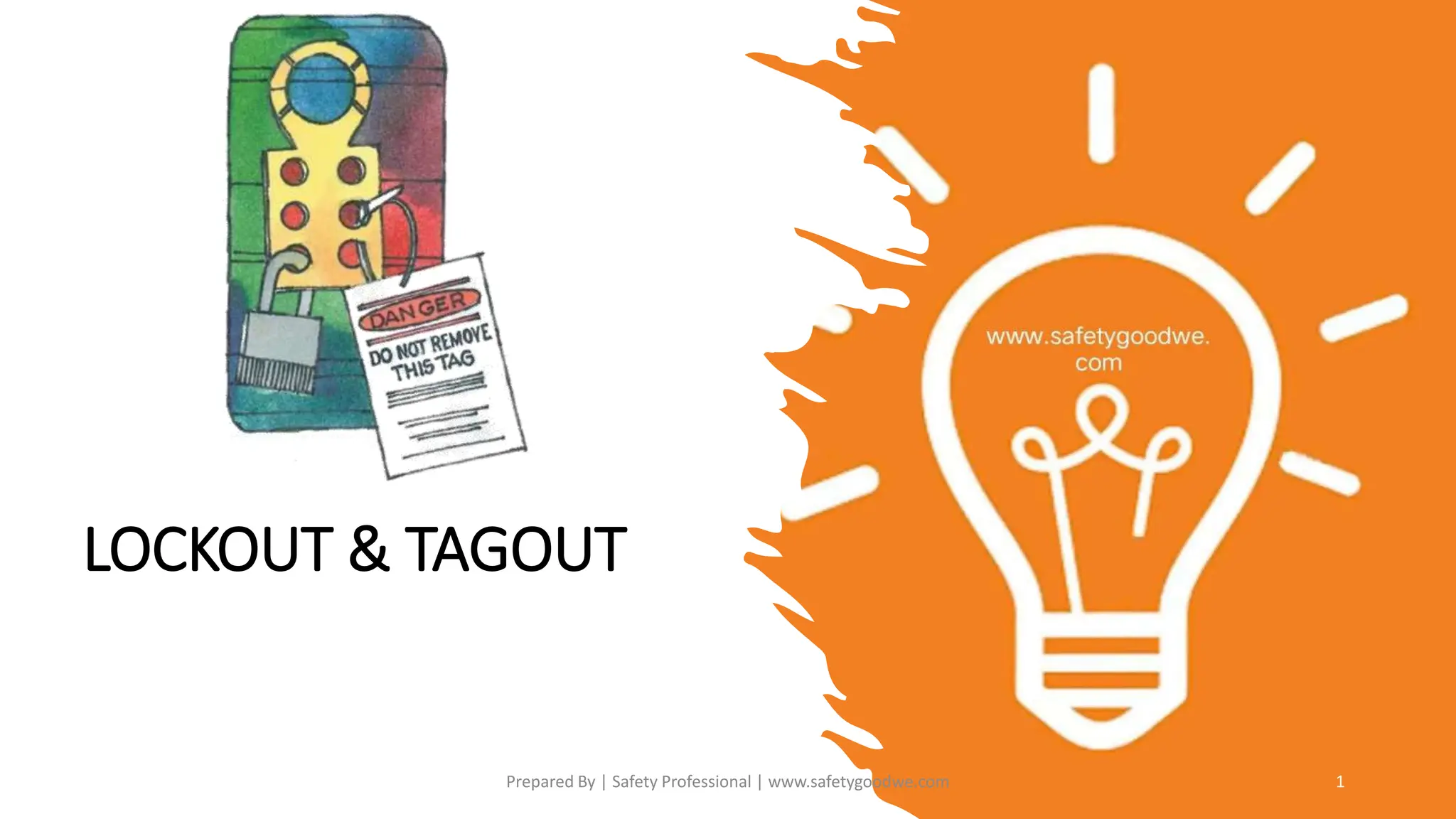
LOCKOUT & TAGOUT
Prepared By | Safety Professional | www.safetygoodwe.com 1
Hazardous energy
sources
• Evaluate machines, equipment,
and processes
• Develop energy control plan
• Look for all sources of energy
• Identify secondary and stored
energy sources
Prepared By | Safety Professional | www.safetygoodwe.com 2
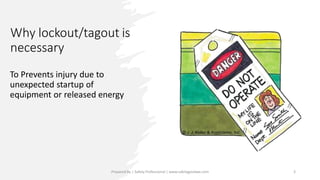
Why lockout/tagout is
necessary
To Prevents injury due to
unexpected startup of
equipment or released energy
Prepared By | Safety Professional | www.safetygoodwe.com 3
Functions
covered by
lockout/tagout
Servicing of machines and
equipment
Performing maintenance on
equipment and machinery
Normal operations
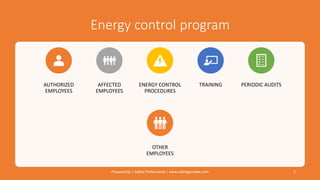
Energy control program
Prepared By | Safety Professional | www.safetygoodwe.com 5
AUTHORIZED
EMPLOYEES
AFFECTED
EMPLOYEES
ENERGY CONTROL
PROCEDURES
TRAINING PERIODIC AUDITS
OTHER
EMPLOYEES
Preparation for
shutdown
• Locate all energy sources
• Inform all affected persons
Prepared By | Safety Professional | www.safetygoodwe.com 6
Shutdown procedure
Prepared By | Safety Professional | www.safetygoodwe.com 7
Each piece of equipment or machine
must be shutdown according to
written energy control procedures
Orderly shutdown avoids additional
or increased hazards
Use shutdown procedures that are
established for the machine
Isolating machinery
from its energy
sources
Prepared By | Safety Professional | www.safetygoodwe.com 8
TYPE OF
DEVICES TO
BE USED
PLACEMENT
OF ISOLATING
DEVICES
Application of
lockout/tagout
devices
Prepared
By
|
Safety
Professional
|
www.safetygoodwe.com
9
Positioning of
lockout/tagout devices
Only authorized
employees can attach
the devices
Releasing stored energy
• Check for and relieve:
• Electrical energy capacitors
• Residual pressure in
lines and pipes
Prepared By | Safety Professional | www.safetygoodwe.com 10
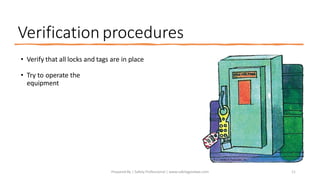
Verification procedures
• Verify that all locks and tags are in place
• Try to operate the
equipment
Prepared By | Safety Professional | www.safetygoodwe.com 11
Restoring energy to the equipment/machine
Prepared By | Safety Professional | www.safetygoodwe.com 12
Remove tools from the area, replace guards
Ensure that employees are safely positioned or
removed from the area
The employee who applies the lock is the only one
who can remove it
Special requirements for testing and positioning
equipment
Lockout devices
Prepared By | Safety Professional | www.safetygoodwe.com 13
Types used
Standardized for easy recognition
Never use someone else’s lockout device
The lock must identify the person who applied it
Tags
• Types used
• Standardized for easy
recognition
Prepared By | Safety Professional | www.safetygoodwe.com 14
Tags
The attachment means for a
tag must be:
• non-reusable
• attached by hand
• self-locking and non-
reusable with locking
strength of 50 pounds
• equivalent to a one-
piece, all-
environment-tolerant
nylon cable tie
Prepared By | Safety Professional | www.safetygoodwe.com 15
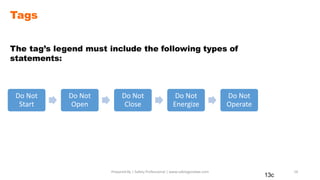
Tags
The tag’s legend must include the following types of
statements:
13c
Prepared By | Safety Professional | www.safetygoodwe.com 16
Do Not
Start
Do Not
Open
Do Not
Close
Do Not
Energize
Do Not
Operate
Group lockouts
Prepared By | Safety Professional | www.safetygoodwe.com 17
Uses group lockout devices (hasps) to
accommodate all locks
Each authorized employee must affix a personal
lockout or tagout device to the group lockout
device when he/she begins work
Each authorized employee must remove those
devices when he/she stops working on the
machine/equipment
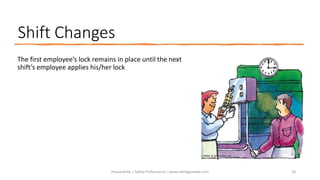
Shift Changes
The first employee’s lock remains in place until the next
shift’s employee applies his/her lock
Prepared By | Safety Professional | www.safetygoodwe.com 18
Removing a
lock
If an employee is not available to remove a lock, the employer must:
• verify that the employee is not in the facility
• make reasonable efforts to contact the employee
• inform the employee of the removal beforehe/she resumes
work
Prepared By | Safety Professional | www.safetygoodwe.com 19
Conclusion.. Its just beginning
QUESTIONS
Prepared By | Safety Professional | www.safetygoodwe.com 20

08._SGW-_Lockout__Tagout (Importance).pptx

  • 1.
    LOCKOUT & TAGOUT PreparedBy | Safety Professional | www.safetygoodwe.com 1
  • 2.
    Hazardous energy sources • Evaluatemachines, equipment, and processes • Develop energy control plan • Look for all sources of energy • Identify secondary and stored energy sources Prepared By | Safety Professional | www.safetygoodwe.com 2
  • 3.
    Why lockout/tagout is necessary ToPrevents injury due to unexpected startup of equipment or released energy Prepared By | Safety Professional | www.safetygoodwe.com 3
  • 4.
    Functions covered by lockout/tagout Servicing ofmachines and equipment Performing maintenance on equipment and machinery Normal operations
  • 5.
    Energy control program PreparedBy | Safety Professional | www.safetygoodwe.com 5 AUTHORIZED EMPLOYEES AFFECTED EMPLOYEES ENERGY CONTROL PROCEDURES TRAINING PERIODIC AUDITS OTHER EMPLOYEES
  • 6.
    Preparation for shutdown • Locateall energy sources • Inform all affected persons Prepared By | Safety Professional | www.safetygoodwe.com 6
  • 7.
    Shutdown procedure Prepared By| Safety Professional | www.safetygoodwe.com 7 Each piece of equipment or machine must be shutdown according to written energy control procedures Orderly shutdown avoids additional or increased hazards Use shutdown procedures that are established for the machine
  • 8.
    Isolating machinery from itsenergy sources Prepared By | Safety Professional | www.safetygoodwe.com 8 TYPE OF DEVICES TO BE USED PLACEMENT OF ISOLATING DEVICES
  • 9.
  • 10.
    Releasing stored energy •Check for and relieve: • Electrical energy capacitors • Residual pressure in lines and pipes Prepared By | Safety Professional | www.safetygoodwe.com 10
  • 11.
    Verification procedures • Verifythat all locks and tags are in place • Try to operate the equipment Prepared By | Safety Professional | www.safetygoodwe.com 11
  • 12.
    Restoring energy tothe equipment/machine Prepared By | Safety Professional | www.safetygoodwe.com 12 Remove tools from the area, replace guards Ensure that employees are safely positioned or removed from the area The employee who applies the lock is the only one who can remove it Special requirements for testing and positioning equipment
  • 13.
    Lockout devices Prepared By| Safety Professional | www.safetygoodwe.com 13 Types used Standardized for easy recognition Never use someone else’s lockout device The lock must identify the person who applied it
  • 14.
    Tags • Types used •Standardized for easy recognition Prepared By | Safety Professional | www.safetygoodwe.com 14
  • 15.
    Tags The attachment meansfor a tag must be: • non-reusable • attached by hand • self-locking and non- reusable with locking strength of 50 pounds • equivalent to a one- piece, all- environment-tolerant nylon cable tie Prepared By | Safety Professional | www.safetygoodwe.com 15
  • 16.
    Tags The tag’s legendmust include the following types of statements: 13c Prepared By | Safety Professional | www.safetygoodwe.com 16 Do Not Start Do Not Open Do Not Close Do Not Energize Do Not Operate
  • 17.
    Group lockouts Prepared By| Safety Professional | www.safetygoodwe.com 17 Uses group lockout devices (hasps) to accommodate all locks Each authorized employee must affix a personal lockout or tagout device to the group lockout device when he/she begins work Each authorized employee must remove those devices when he/she stops working on the machine/equipment
  • 18.
    Shift Changes The firstemployee’s lock remains in place until the next shift’s employee applies his/her lock Prepared By | Safety Professional | www.safetygoodwe.com 18
  • 19.
    Removing a lock If anemployee is not available to remove a lock, the employer must: • verify that the employee is not in the facility • make reasonable efforts to contact the employee • inform the employee of the removal beforehe/she resumes work Prepared By | Safety Professional | www.safetygoodwe.com 19
  • 20.
    Conclusion.. Its justbeginning QUESTIONS Prepared By | Safety Professional | www.safetygoodwe.com 20