THE	
  IPAD	
  AS	
  A	
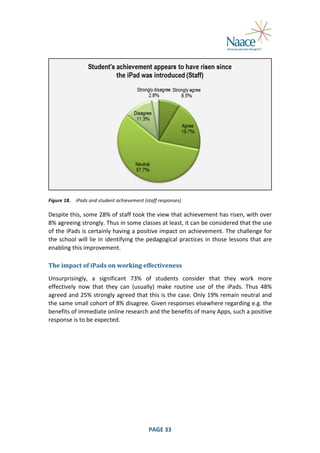
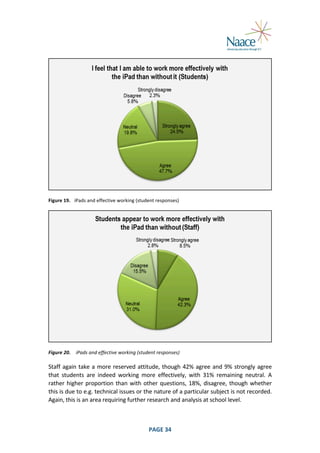
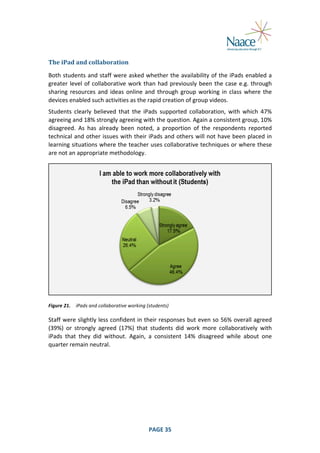
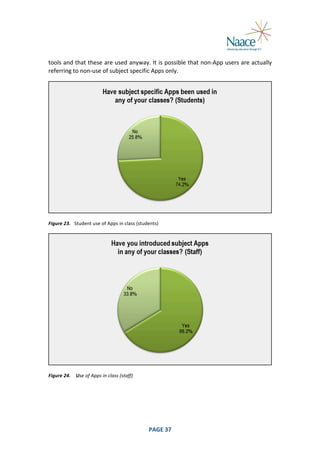
  TOOL	
  FOR	
  
EDUCATION	
  
A	
  study	
  of	
  the	
  introduction	
  of	
  iPads	
  
at	
  Longfield	
  Academy,	
  Kent	
  

This	
  study	
  was	
  undertaken	
  on	
  behalf	
  of	
  Naace	
  (The	
  ICT	
  
Association)	
  and	
  supported	
  by	
  9ine	
  Consulting	
  Ltd	


“The	
  iPads	
  have	
  revolutionised	
  teaching”	
  
—LONGFIELD	
  ACADEMY	
  TEACHER	


Paul	
  Heinrich	
  BEd	
  (Oxon)	
  MPhil	
  DipRSA	
  
Paul	
  Heinrich	
  &	
  Co	
  Ltd	
  (Education	
  Consultants)	
  
12	
  Braeside	
  Close	
  
Winchester	
  
SO22	
  4JL	
  
paul@paulheinrich.co.uk	
  
www.paulheinrich.co.uk	


About	
  
This	
  research	
  was	
  jointly	
  commissioned	
  by	
  NAACE	
  and	
  9ine	
  Consulting	
  to	
  assess	
  the	
  
impact	
   of	
   iPads	
   at	
   Longfield	
   Academy.	


Longfield	
  Academy	
  
Longfield	
  Academy	
  is	
  an	
  oversubscribed	
  mixed	
  non	
  selective	
  secondary	
  school	
  for	
  students	
  
aged	
   11-­‐18.	
  	
   It	
   is	
   situated	
   near	
   Darford	
   in	
   Kent	
   and	
   forms	
   part	
   of	
   the	
   Leigh	
   Academies	
   Trust.	
  
The	
  current	
  role	
  is	
  around	
  970	
  students	
  with	
  around	
  160	
  of	
  these	
  in	
  the	
  sixth	
  form.	
  	
  
The	
   Academy	
   comprises	
   of	
   3	
   Colleges	
   and	
   each	
   College	
   has	
   its	
   own	
   Principal.	
   Results	
   over	
  
the	
  past	
  3	
  years	
  have	
  improved	
  significantly	
  and	
  the	
  Academy	
  was	
  described	
  by	
  OFSTED	
  in	
  
May	
  2011	
  as	
  Good	
  with	
  outstanding	
  features.	
  

Naace	
  (The	
  ICT	
  Association)	
  
Naace	
  is	
  the	
  ICT	
  association.	
  We	
  are	
  a	
  community	
  of	
  educators,	
  consultants,	
  school	
  leaders,	
  
technologists	
  and	
  policy	
  makers	
  from	
  all	
  phases	
  of	
  UK	
  education,	
  who	
  share	
  a	
  vision	
  for	
  the	
  
role	
   of	
   technology	
   in	
   advancing	
   education.	
   We	
   represent	
   the	
   education	
   technology	
  
community	
  and	
  support	
  it	
  through	
  conferences,	
  courses	
  and	
  the	
  dissemination	
  of	
  resources,	
  
research	
  and	
  reflection.	
  We	
  play	
  a	
  key	
  role	
  in	
  members’	
  professional	
  development	
  through	
  
the	
  challenge	
  and	
  support	
  of	
  a	
  community	
  of	
  practice,	
  the	
  development	
  of	
  the	
  profession	
  as	
  
a	
  whole	
  and	
  through	
  sharing	
  innovation	
  and	
  expertise.	
  
Naace	
   -­‐	
   PO	
   Box	
   6511,	
   Nottingham	
   NG11	
   8TN	
   -­‐	
   Phone:	
   0115	
   945	
   7235	
   Email:	
  
office@naace.co.uk	
  

9ine	
  Consulting	
  –	
  www.9ine.uk.com	
  
9ine	
   is	
   an	
   integrated	
   consultancy	
   providing	
   services	
   and	
   solutions	
   to	
   education	
  
organisations.	
  Our	
  business	
  is	
  fundamentally	
  different	
  from	
  any	
  other	
  consultancy	
  operating	
  
within	
   the	
   Education	
   market.	
   We	
   manage	
   the	
   full	
   ICT	
   operations	
   life	
   cycle	
   from	
   cradle	
   to	
  
grave.	
  	
   This	
   encompasses	
   technology	
   consultancy,	
   curriculum	
   integration,	
   solutions	
  
architecture,	
   management	
   of	
   project	
   delivery,	
  embedding	
   the	
   solution	
   and	
   delivering	
  
through	
   efficient	
   operations	
   management.	
   This	
   unique	
   different	
   means	
   we	
   can	
   talk	
   about	
  
current	
   and	
   future	
   technology	
   and	
   advise	
   on	
   the	
   implementation	
   of	
   those	
   technologies	
  
within	
  a	
  live	
  environment.	
  
We	
  have	
  supported	
  Longfield	
  Academy	
  since	
  2009	
  in	
  the	
  development	
  of	
  the	
  iPad	
  scheme.	
  We	
  
provide	
   technical	
   consultancy,	
   change	
   management	
   and	
   project	
   management	
   to	
   Schools,	
  
Academies,	
   Universities	
   and	
   commercial	
   organisations	
   in	
   the	
   UK	
   and	
   internationally	
   on	
   the	
  
integration	
   of	
   iPads	
   and	
   other	
   emerging	
   or	
   new	
   technologies.	
   www.9ine.uk.com	


LIST	
  OF	
  CONTENTS	
  
Executive	
  Summary	
  

4	
  

Abstract	
  

5	
  

Introduction	
  and	
  Background	
  

6	
  

Insights	
  from	
  the	
  Literature	
  

7	
  

Background	
  to	
  the	
  Longfield	
  Academy	
  iPad	
  project	
  

12	
  

Methodology	
  

13	
  

Findings	
  

14	
  

Discussion	
  

50	
  

Conclusion	
  

52	
  

Bibliography	
  

53	


PAGE	
  1	


LIST	
  OF	
  FIGURES	
  
Figure	
  1.	
  

Responses	
  by	
  year	
  group	
  

14	
  

Figure	
  2.	
  

Use	
  of	
  iPads	
  in	
  each	
  key	
  stage	
  as	
  reported	
  by	
  staff	
  

15	
  

Figure	
  3.	
  

Level	
  of	
  use	
  in	
  lessons	
  (Staff)	
  

16	
  

Figure	
  4.	
  

Level	
  of	
  use	
  in	
  lessons	
  (Students)	
  

16	
  

Figure	
  5.	
  

Subject	
  use	
  (students)	
  

17	
  

Figure	
  6.	
  

Subject	
  use	
  (teachers)	
  

17	
  

Figure	
  7.	
  

Main	
  uses	
  of	
  iPads	
  (students)	
  

19	
  

Figure	
  8.	
  

Main	
  uses	
  of	
  iPads	
  (staff)	
  

20	
  

Figure	
  9.	
  

Student	
  use	
  of	
  iPads	
  beyond	
  school	
  

26	
  

Figure	
  10.	
  

Staff	
  requirement	
  for	
  student	
  use	
  of	
  iPads	
  beyond	
  school	
  

27	
  

Figure	
  11.	
  

iPads	
  and	
  student	
  motivation	
  (student	
  responses)	
  

28	
  

Figure	
  12.	
  

iPads	
  and	
  student	
  motivation	
  (staff	
  responses)	
  

28	
  

Figure	
  13.	
  

iPads	
  and	
  student	
  work	
  quality	
  (student	
  responses)	
  

29	
  

Figure	
  14.	
  

iPads	
  and	
  student	
  work	
  quality	
  (staff	
  responses)	
  

30	
  

Figure	
  15.	
  

iPads	
  and	
  student	
  progress	
  (student	
  responses)	
  

31	
  

Figure	
  16.	
  

iPads	
  and	
  student	
  progress	
  (staff	
  responses)	
  

31	
  

Figure	
  17.	
  

iPads	
  and	
  student	
  achievement	
  (student	
  responses)	
  

32	
  

Figure	
  18.	
  

iPads	
  and	
  student	
  achievement	
  (staff	
  responses)	
  

33	
  

Figure	
  19.	
  

iPads	
  and	
  effective	
  working	
  (student	
  responses)	
  

34	
  

Figure	
  20.	
  

iPads	
  and	
  effective	
  working	
  (student	
  responses)	
  

34	
  

Figure	
  21.	
  

iPads	
  and	
  collaborative	
  working	
  (students)	
  

35	
  

Figure	
  22.	
  

iPads	
  and	
  collaborative	
  working	
  (staff)	
  

36	
  

Figure	
  23.	
  

Student	
  use	
  of	
  Apps	
  in	
  class	
  (students)	
  

37	
  

Figure	
  24.	
  

Use	
  of	
  Apps	
  in	
  class	
  (staff)	
  

37	
  

Figure	
  25.	
  

The	
  value	
  of	
  Apps	
  in	
  helping	
  learning	
  (students)	
  

39	


PAGE	
  2	


Figure	
  26.	
  

The	
  value	
  of	
  Apps	
  in	
  helping	
  teaching	
  (staff)	
  

39	
  

Figure	
  27.	
  

Willingness	
  to	
  use	
  iPads	
  regularly	
  for	
  learning	
  (students).	
  

40	
  

Figure	
  28.	
  

Willingness	
  to	
  use	
  iPads	
  regularly	
  for	
  teaching	
  (staff).	
  

41	
  

Figure	
  29.	
  

Ease	
  of	
  integration	
  of	
  iPads	
  in	
  classroom	
  contexts	
  (staff)	
  

43	
  

Figure	
  30.	
  

iPad	
  ease	
  of	
  use	
  (students)	
  

44	
  

Figure	
  31.	
  

iPad	
  ease	
  of	
  use	
  (staff)	
  

44	
  

Figure	
  32.	
  

Technical	
  issues	
  (Students)	
  

45	
  

Figure	
  33.	
  

Technical	
  issues	
  (Staff)	
  

46	


PAGE	
  3	


EXECUTIVE	
  SUMMARY	
  
This	
   study,	
   one	
   of	
   the	
   most	
   extensive	
   yet	
   regarding	
   the	
   use	
   of	
   tablet	
   devices	
   finds	
  
that	
   with	
   the	
   majority	
   of	
   pupils	
   at	
   the	
   school	
   now	
   having	
   iPads	
   there	
   has	
   been	
   a	
  
significant	
  and	
   very	
   positive	
   impact	
   on	
   learning	
   together	
   with	
   further	
   significant	
  and	
  
still	
  developing	
  changes	
  in	
  pedagogy.	
  In	
  particular	
  it	
  was	
  found	
  that:	


•
•
•
•

The	
  overwhelming	
  majority	
  of	
  teachers	
  regularly	
  use	
  iPads	
  in	
  their	
  teaching	
  
iPad	
  use	
  is	
  particularly	
  strong	
  in	
  English,	
  Maths	
  and	
  Science	
  
There	
  is	
  high	
  demand	
  from	
  students	
  for	
  iPad	
  use	
  to	
  be	
  extended	
  further	
  
Teachers	
   have	
   identified	
   significant	
   benefits	
   for	
   their	
   workload	
   and	
   have	
   also	
  
identified	
  cost	
  savings	
  
• Use	
   of	
   the	
   iPads	
   is	
   increasingly	
   being	
   developed	
   for	
   homework	
   and	
   beyond	
  
school	
  activities	
  
• Students	
  are	
  more	
  motivated	
  when	
  using	
  iPads	
  
• The	
  quality	
  and	
  standard	
  of	
  pupil	
  work	
  and	
  progress	
  is	
  rising	
  
• Both	
  staff	
  and	
  student	
  feel	
  they	
  can	
  work	
  more	
  effectively	
  with	
  iPads	
  
• Levels	
  of	
  collaborative	
  working	
  have	
  improved	
  
• Appropriate	
  use	
  of	
  Apps	
  aids	
  learning	
  
• All	
  find	
  the	
  iPad	
  easy	
  to	
  use	
  
• Minor	
  technical	
  issues	
  have	
  arisen,	
  often	
  due	
  to	
  user	
  error,	
  but	
  are	
  readily	
  dealt	
  
with	
  
• Effective	
   project	
   management	
   has	
   been	
   critical	
   to	
   the	
   success	
   of	
   this	
  
development.	


The	
   outcomes	
   at	
   Longfield	
   clearly	
   demonstrate	
   the	
   value	
   of	
   the	
   iPad	
   as	
   an	
  
educational	
  tool	
  and	
  the	
  role	
  that	
  it	
  can	
  play	
  in	
  learning	
  and	
  teaching.	


PAGE	
  4	


ABSTRACT	
  
The	
  iPad	
  as	
  a	
  Tool	
  for	
  Education:	
  
A	
  study	
  of	
  the	
  introduction	
  of	
  iPads	
  at	
  Longfield	
  Academy	


This	
   study	
   reviews	
   the	
   impact	
   on	
   learning	
   and	
   teaching	
   of	
   the	
   introduction	
   of	
   iPad	
  
devices	
   at	
   Longfield	
   Academy,	
   Kent	
   since	
   September	
   2011.	
   It	
   finds	
   that	
   with	
   the	
  
majority	
   of	
   pupils	
   now	
   having	
   the	
   devices,	
   there	
   has	
   been	
   a	
   significant	
   and	
   very	
  
positive	
   impact	
   on	
   learning,	
   as	
   well	
   assignificant	
   and	
   still	
   developing	
   changes	
   in	
  
pedagogy.	
  Students	
  are	
  very	
  positive	
  about	
  the	
  devices	
  and	
  the	
  impact	
  they	
  have	
  on	
  
their	
   motivation,	
   ability	
   to	
   research,	
   communicate	
   and	
   collaborate,	
   while	
   staff	
  
increasingly	
   exploit	
   the	
   range	
   of	
   educational	
   Apps	
   made	
   available.	
   While	
   some	
  
technical	
  issues	
  have	
  been	
  identified,	
  these	
  are	
  dealt	
  with	
  through	
  excellent	
  project	
  
management.	
  The	
  outcomes	
  at	
  Longfield	
  clearly	
  demonstrate	
  the	
  value	
  of	
  the	
  iPad	
  as	
  
an	
  educational	
  tool.	


PAGE	
  5	


INTRODUCTION	
  AND	
  BACKGROUND	
  
Although	
   use	
   of	
   conventional	
   computers	
   including	
  
laptops	
   and	
   netbooks	
   is	
   well	
   established	
   in	
   schools	
  
and	
   a	
   considerable	
   body	
   of	
   literature	
   confirms	
   their	
  
value	
   and	
   impact,	
   the	
   integration	
   of	
   tablet	
   devices	
  
such	
  as	
  the	
  iPad	
  is	
  still,	
  in	
  early	
  2012,	
  at	
  the	
  innovation	
  
stage	
   of	
   development.	
   There	
   is	
   currently	
   only	
   limited	
  
published	
   research	
   on	
   the	
   impact	
   of	
   such	
   devices	
   on	
  
learning	
  and	
  teaching,	
  although	
  the	
  work	
  of	
  Melhuish	
  
&	
   Falloon	
   (2010)	
   and	
   Smith	
   (2011)	
   demonstrate	
   the	
  
benefits	
   and	
   innovative	
   practice	
   engendered.	
   This	
   is	
  
further	
   supported	
   by	
   reports	
   in	
   non-­‐academic	
   blogs	
  
such	
   as	
   those	
   at	
   http://www.ipadinschools.com	
   and	
  
http://www.ipadineducation.co.uk	
  .	
  
However,	
  considerable	
  debate	
  remains	
  regarding	
  the	
  educational	
  benefits	
  of	
  tablet	
  
and	
   other	
   personal	
   devices	
   for	
   learners.	
   Most	
   studies	
   to	
   date	
   have	
   involved	
   trials	
  
with	
   class	
   sets	
   of	
   tablets	
   rather	
   than	
   the	
   pupils	
   using	
   their	
   own	
   personal	
   devices.	
  
While	
   clearly	
   demonstrating	
   benefits	
   of	
   the	
   technology,	
   the	
   shared	
   nature	
   of	
   the	
  
trials	
  raised	
  its	
  own	
  problems.	
  
Thus	
   the	
   recent	
   introduction	
   of	
   iPads	
   throughout	
   Longfield	
   Academy	
   provides	
   an	
  
excellent	
  opportunity	
  for	
  a	
  small	
  scale	
  research	
  study	
  of	
  the	
  initial	
  impact	
  of	
  the	
  iPad	
  
on	
  learning	
  and	
  teaching	
  throughout	
  the	
  school	
  and	
  the	
  social	
  and	
  technical	
  issues	
  
arising.	
  There	
  is	
  also	
  scope	
  for	
  a	
  more	
  significant	
  longitudinal	
  study	
  of	
  these	
  aspects.	
  
We	
   are	
   at	
   a	
   point	
   in	
   the	
   evolution	
   of	
   technology	
   where	
   the	
   personal	
   tablet	
   device	
  
postulated	
   by	
   Hepple	
   (1998)	
   is	
   becoming	
   a	
   reality.	
   However,	
   we	
   do	
   not	
   yet	
  
understand	
   how	
   access	
   to	
   and	
   use	
   of	
   these	
   devices	
   will	
   change	
   learning	
   and	
  
teaching.	
  Without	
  such	
  understanding	
  we	
  are	
  left	
  with	
  an	
  inadequate	
  analysis	
  that	
  
creates	
   the	
   conditions	
   for	
   ill-­‐informed	
   policy	
   decisions	
   at	
   both	
   school	
   and	
   national	
  
level	
  and	
  a	
  self-­‐sustaining	
  cycle	
  of	
  misunderstanding	
  and	
  doubt.	
  
This	
   study	
   will	
   address	
   a	
   gap	
   in	
   the	
   literature	
   by	
   examining	
   the	
   impact	
   on	
   learning	
  
and	
  teaching	
  in	
  an	
  innovative	
  school	
  that	
  already	
  has	
  a	
  strong	
  commitment	
  to	
  ICT.	
  In	
  
particular,	
   it	
   will	
   focus	
   on	
   changes	
   in	
   teaching	
   and	
   learning	
   styles,	
   impact	
   on	
  
standards	
   and	
   on	
   pupil’s	
   attitudes	
   to	
   learning	
   with	
   the	
   devices,	
   together	
   with	
   any	
  
whole-­‐school	
  technical	
  and	
  management	
  issues	
  arising.	


PAGE	
  6	


INSIGHTS	
  FROM	
  THE	
  LITERATURE	
  
Several	
  studies	
  of	
  the	
  use	
  of	
  the	
  iPad	
  as	
  an	
  educational	
  tool	
  have	
  been	
  undertaken	
  
since	
   the	
   introduction	
   of	
   this	
   product,	
   together	
   with	
   others	
   relating	
   to	
   tablet	
  
computers	
  in	
  general.	
  However,	
  the	
  focus	
  of	
  most	
  has	
  been	
  on	
  the	
  iPad	
  due	
  to	
  the	
  
functionality	
  of	
  the	
  tool	
  compared	
  to	
  some	
  others,	
  the	
  range	
  of	
  apps	
  available	
  and	
  
the	
  attractiveness	
  and	
  street	
  credibility	
  of	
  the	
  iPad	
  to	
  young	
  people.	
  
Researchers	
  have	
  explored	
  the	
  impact	
  of	
  iPads	
  in	
  a	
  number	
  of	
  situations	
  to	
  date,	
  though	
  
mostly	
   where	
   small	
   scale	
   trials	
   of	
   the	
   device	
   have	
   taken	
   place	
   as	
   in	
   that	
   reported	
   by	
  
Glicksman	
  (2011)	
  on	
  the	
  website	
  iPads	
  for	
  Education	
  and	
  also	
  by	
  Garcia	
  and	
  Friedman	
  
(2011)	
  in	
  a	
  study	
  in	
  a	
  United	
  States	
  history	
  classroom.	
  Other	
  similar	
  studies	
  have	
  taken	
  
place	
   in	
   Germany	
   at	
   Kaiserin	
   Augusta	
   Schule,	
   where	
   a	
   six	
   month	
   evaluation	
   with	
   600	
  
students	
  was	
  reported	
  by	
  Spang	
  (2011)	
  at	
  http://ipdkas.wordpress.com	
  and	
  by	
  Learning	
  
Exchange	
  (2011)	
  in	
  Australia.	
  
In	
   the	
   above	
   examples,	
   the	
   devices	
   were	
   owned	
   by	
  
and	
   managed	
   by	
   the	
   school,	
   yet	
   it	
   must	
   be	
  
remembered	
  that	
  iPads	
  and	
  similar	
  tablet	
  devices	
  are	
  
designed	
   as	
   personal	
   devices	
   and	
   thus	
   ‘will	
   cause	
  
significant	
   shifts	
   in	
   the	
   idea	
   of	
   ownership,	
   the	
  
ownership	
   of	
   technology	
   and	
   knowledge.’	
   (Traxler	
  
2010).	
   It	
   is	
   only	
   recently	
   that	
   schools	
   such	
   as	
  
Longfield	
  have	
  begun	
  to	
  equip	
  the	
  majority	
  of	
  pupils	
  
with	
   a	
   personal	
   iPad,	
   thus	
   enabling	
   the	
   full	
   impact	
   of	
  
the	
   device	
   to	
   be	
   evaluated	
   both	
   in	
   a	
   snapshot	
   view	
  
and	
  potentially	
  as	
  part	
  of	
  a	
  longitudinal	
  study.	
  
However,	
   there	
   is	
   considerable	
   convergence	
   in	
   the	
   findings	
   of	
   these	
   various	
   studies	
  
which,	
   while	
   highlighting	
   considerable	
   benefits	
   of	
   iPads,	
   also	
   highlight	
   a	
   number	
   of	
  
technical,	
   pedagogical	
   and	
   management	
   issues	
   that	
   schools	
   will	
   need	
   to	
   address.	
   The	
  
results	
  from	
  the	
  Longfield	
  study,	
  using	
  similar	
  research	
  methodologies,	
  serve	
  to	
  further	
  
confirm	
  the	
  significant	
  potential	
  of	
  tablet	
  devices	
  as	
  ubiquitous	
  tools	
  for	
  learning.	
  
It	
  is	
  useful	
  here	
  to	
  consider	
  the	
  nature	
  and	
  potential	
  of	
  mobile	
  devices	
  in	
  education	
  
identified	
   by	
   researchers	
   thus	
   far,	
   while	
   noting	
   that	
   the	
   situation	
   regarding	
  
ownership	
   of	
   a	
   range	
   of	
   personal,	
   net	
   connected	
   devices	
   is	
   expanding	
   rapidly.	
   For	
  
example,	
  a	
  study	
  by	
  the	
  Speak	
  Up	
  National	
  Research	
  Project	
  (2011),	
  with	
  a	
  sample	
  of	
  
416	
   000	
   US	
   3rd	
   to	
   12th	
   grade	
   students,	
   found	
   that	
   by	
   of	
   secondary	
   age	
   pupils	
   50%	
  
owned	
   Smartphones	
   and	
   21%	
   personal	
   tablets.	
   The	
   level	
   of	
   ownership	
   is	
   likely	
   to	
  
have	
   increased	
   since	
   then	
   as	
   prices	
   generally	
   become	
   more	
   competitive	
   as	
   the	
  
technology	
  matures.	
  
As	
  ownership	
  of	
  devices	
  increases,	
  so	
  does	
  student	
  demand	
  to	
  use	
  them	
  in	
  school	
  and	
  
in	
  parental	
  acceptance	
  of	
  such	
  devices	
  in	
  school.	
  However,	
  the	
  Speak	
  Up	
  research	
  also	


PAGE	
  7	


notes	
   that,	
   as	
   is	
   evident	
   in	
   the	
   UK,	
   school	
   management	
   is	
   reluctant	
   to	
   allow	
   such	
   use!	
  
Curiously	
   only	
   40%	
   of	
   parents	
   see	
   value	
   in	
   ubiquitous	
   Internet	
   access	
   in	
   a	
   modern	
  
school,	
   a	
   view	
   totally	
   at	
   odds	
   with	
   exploiting	
   the	
   benefits	
   of	
   personal	
   devices.	
  
Students,	
  conversely,	
  find	
  the	
  filtering	
  restrictions	
  on	
  school	
  networks	
  frustrating.	
  
Current	
   research	
   findings	
   from	
   Melhuish	
   and	
   Falloon	
   (2010),	
   Gliksman	
   (2011),	
  
Learning	
   Exchange	
   (2011)	
   and	
   Spang	
   (2011)	
   all	
   demonstrate	
   educational	
   value	
   and	
  
positive	
   learning	
   outcomes	
   from	
   the	
   use	
   of	
   iPads,	
   as	
   does	
   this	
   writer’s	
   study	
   at	
  
Longfield	
  Academy.	
  There	
  are	
  however	
  some,	
  such	
  as	
  Traxler	
  (2010),	
  who	
  continue	
  
to	
   urge	
   caution	
   and	
   express	
   reservations	
   about	
   the	
   convergence	
   of	
   multiple	
  
technologies	
  in	
  modern	
  smart	
  devices.	
  He	
  expresses	
  concern	
  that	
  we	
  have	
  yet	
  to	
  see	
  
the	
   emergence	
   of	
   a	
   generic	
   converged	
   device	
   and	
   that,	
   “an	
   architecture	
   based	
   on	
  
dedicated	
   closed	
   boxes	
   means	
   that	
   this	
   situation	
   will	
   not	
   change”.	
   While	
   true	
   of	
  
Apple	
   technology,	
   this	
   ignores	
   the	
   wide	
   range	
   of	
   devices	
   based	
   on	
   variants	
   of	
   the	
  
Android	
  operating	
  system	
  now	
  available.	
  Traxler	
  (2010)	
  further	
  notes	
  that,	
  “devices	
  
owned	
  by	
  students	
  will	
  be,	
  at	
  best,	
  poorly	
  suited	
  for	
  learning,	
  different	
  and	
  changing,	
  
often	
   for	
   reasons	
   that	
   are	
   not	
   technical,	
   not	
   educational,	
   and	
   probably	
   not	
   even	
  
rationale	
  and	
  foreseeable.”	
  This	
  view	
  does,	
  indeed,	
  have	
  some	
  validity	
  at	
  the	
  time	
  of	
  
writing	
  since	
  early	
  adopter	
  schools	
  are	
  adapting	
  what	
  is	
  essentially	
  a	
  device	
  created	
  
for	
   individual	
   personal	
   use	
   into	
   a	
   ubiquitous	
   classroom	
   tool.	
   The	
   technology	
   is	
   still	
  
developing	
  rapidly	
  and	
  this	
  poses	
  its	
  own	
  problems	
  for	
  schools,	
  such	
  as	
  ensuring	
  that	
  
there	
  is	
  a	
  commonality	
  of	
  platform	
  and	
  Apps.	
  However,	
  where	
  the	
  school	
  recognises	
  
the	
   personal	
   nature	
   of	
   the	
   device	
   and	
   adapts	
   its	
   approach	
   and	
   pedagogy	
   to	
   suit,	
   it	
   is	
  
possible,	
  as	
  at	
  Longfield	
  Academy,	
  to	
  integrate	
  iPads	
  as	
  just	
  another	
  tool	
  for	
  learning.	
  
Indeed,	
   Traxler	
   (2010)	
   note	
   that	
   mobile	
   technologies	
   are	
   difficult	
   to	
   ignore	
   as	
   they	
  
are,	
   “woven	
   into	
   all	
   times	
   and	
   places	
   of	
   students’	
   lives”,	
   something	
   that	
   can	
   only	
  
increase	
  as	
  devices	
  become	
  more	
  affordable	
  and	
  powerful.	
  
Melhuish	
  and	
  Falloon	
  (2010)	
  lead	
  us	
  to	
  a	
  consideration	
  of	
  how	
  mobile	
  technologies	
  
are	
  redefining	
  what	
  constitutes	
  a	
  learning	
  space,	
  one	
  that	
  is	
  no	
  longer	
  fixed	
  in	
  time	
  
but	
   based	
   on	
   connecting	
   people	
   with	
   each	
   other	
   and	
   information	
   through	
   virtual	
  
collaborative	
  spaces	
  and	
  communities.	
  Such	
  use	
  is	
  evident	
  at	
  only	
  a	
  low	
  level	
  in	
  the	
  
Longfield	
   study,	
   where	
   much	
   use	
   is	
   classroom	
   based.	
   However,	
   there	
   is	
   evidence	
  
from	
   both	
   pupil	
   interviews	
   and	
   questionnaires	
   indicating	
   that	
   some,	
   but	
   not	
   all	
  
students,	
   are	
   using	
   their	
   iPads	
   in	
   just	
   this	
   way.	
   In	
   this	
   respect	
   the	
   findings	
   reflect	
  
those	
  of	
  the	
  Speak	
  Up	
  2011	
  study.	
  
Exploring	
  the	
  issues	
  
While	
   these	
   recent	
   studies	
   are	
   demonstrating	
   the	
   benefits	
   of	
   personal	
   devices,	
   their	
  
introduction	
   does	
   give	
   rise	
   to	
   many	
   issues:	
   technical,	
   pedagogical	
   and	
   in	
  
management.	
   However,	
  lessons	
   are	
   being	
   learned	
   from	
   the	
   early	
   adopters,	
   though	
  
not	
  always	
  by	
  the	
  manufacturers.	


PAGE	
  8	


Traxler	
   (2010)	
   considers	
   current	
   mobile	
   technologies	
   are	
   not	
   designed	
   for	
  
educational	
  use	
  and	
  are	
  poorly	
  suited	
  to	
  learning.	
  However,	
  this	
  is	
  a	
  generalisation	
  
and	
  takes	
  little	
  account	
  of	
  the	
  speed	
  of	
  development	
  over	
  the	
  last	
  two	
  years	
  during	
  
which	
   the	
   iPad	
   has	
   become	
   the	
   dominant	
   tool	
   and	
   the	
   technology	
   of	
   choice	
   in	
  
schools.	
  There	
  are	
  clear	
  reasons	
  for	
  this,	
  the	
  most	
  important	
  being	
  the	
  consistency	
  
of	
  the	
  operating	
  system	
  and	
  interface	
  and	
  the	
  availability	
  of	
  educational	
  apps.	
  This	
  is	
  
simply	
   not	
   (yet)	
   the	
   case	
   with	
   other	
   systems.	
   Speirs	
   (2012)	
   notes	
   in	
   his	
   blog	
   that	
  
while	
   iOS	
   5	
   is	
   deployed	
   in	
   the	
   vast	
   majority	
   of	
   iOS	
   devices	
   in	
   the	
   field,	
   the	
   main	
  
competition,	
   Android	
   platforms,	
   are	
   largely	
   using	
   the	
   outdated	
   Android	
   2.x,	
   with	
  
little	
   likelihood	
   of	
   upgrade.	
   Further,	
   there	
   are	
   no	
   Android	
   Apps	
   equivalent	
   to	
   e.g.	
  
GarageBand,	
  Keynote,	
  ArtRage	
  etc.	
  As	
  ever,	
  it	
  is	
  the	
  availability	
  of	
   educational	
  tools,	
  
as	
   well	
   as	
   issues	
   of	
   security,	
   backup	
   and	
   restore	
   and	
   lifecycle	
   support	
   that	
   are	
  
important	
  to	
  school	
  users.	
  Currently	
  only	
  the	
  iPad	
  provides	
  all	
  of	
  these.	
  
As	
   noted	
   above,	
   the	
   iPad	
   and	
   similar	
   products	
   are	
  
produced	
  and	
  marketed	
  as	
  personal	
  devices	
  and	
  as	
  such	
  
are	
  not	
  designed	
  for	
  educational	
  use.	
  Thus	
  Traxler	
  (2010)	
  
considers	
   typical	
   student	
   owned	
   devices	
   to	
   be,	
   “poorly	
  
suited	
  to	
  learning”.	
  However,	
  this	
  is	
  too	
  simplistic	
  a	
  view	
  
since	
  it	
  applies	
  to	
  the	
  range	
  of	
  devices	
  that	
  a	
  learner	
  may	
  
own,	
   including	
   Smartphones,	
   while	
   successful	
   use	
   of	
  
tablet	
  devices	
  has	
  taken	
  place	
  where	
  there	
  has	
  been	
  use	
  
of	
  a	
  consistent	
  technology,	
  typically	
  iPads.	
  
Yet	
  a	
  device	
  is	
  only	
  as	
  useful	
  as	
  the	
  tools	
  or	
  apps	
  that	
  it	
  uses	
  and	
  in	
  the	
  case	
  of	
  the	
  
iPad	
  there	
  appears	
  to	
  be	
  a	
  developing	
  use	
  of	
  a	
  small	
  but	
  growing	
  number	
  of	
  apps	
  –	
  
GarageBand,	
  Brushes,	
  KeyNote,	
  Pages	
  etc	
  that	
  are	
  proving	
  their	
  worth.	
  These	
  meet	
  
the	
   concerns	
   expressed	
   by	
   Melhuish	
   and	
   Falloon	
   (2010)	
   that,	
   “For	
   applications	
   to	
   be	
  
effective	
   as	
   part	
   of	
   an	
   individual’s	
   learning	
   pathway	
   they	
   must	
   be	
   pedagogically	
  
sound	
  in	
  their	
  design,	
  foster	
  interactions	
  that	
  is	
  grounded	
  .	
  .	
  .	
  in	
  m-­‐Learning	
  theory,	
  
rather	
  than	
  focusing	
  solely	
  on	
  content,	
  engagement	
  or	
  ‘edutainment’.”	
  
This	
   brings	
   us	
   to	
   matters	
   of	
   pedagogy	
   and	
   school	
   practice,	
   an	
   area	
   that	
   has	
   been	
  
widely	
   debated	
   since	
   mobile	
   and	
   hand-­‐held	
   technologies	
   became	
   readily	
   available.	
  
There	
  is	
  broad	
  agreement	
  on	
  the	
  potential	
  of	
  such	
  tools,	
  notably	
  around	
  the	
  idea	
  of	
  
anytime,	
   anywhere	
   learning	
   and	
   the	
   facility	
   for	
   learners	
   to	
   access	
   courses	
   and	
  
resources	
  at	
  will	
  and	
  to	
  both	
  ask	
  questions	
  of	
  and	
  to	
  publish	
  to	
  an	
  audience	
  far	
  beyond	
  
school.	
   This	
   has	
   not	
   however	
   translated	
   into	
   radical	
   pedagogical	
   approaches	
   in	
  
schools.	
   Personal	
   classroom	
   observations	
   and	
   those	
   of	
   e.g.	
   OFSTED	
   (2012)	
   reinforce	
  
the	
   notion	
   that	
   schools	
   wish	
   to	
   remain	
   in	
   full	
   control	
   of	
   a	
   pupil’s	
   learning	
   through	
  
restrictions	
   on	
   web	
   access,	
   virtual	
   learning	
   environments	
   (VLEs)	
   that	
   are	
   largely	
  
document	
  repositories	
  with	
  little	
  or	
  no	
  direct	
  student	
  participation	
  and	
  where	
  learning	
  
is	
   directed	
   along	
   narrow	
   and	
   sometimes	
   shallow	
   paths.	
   This	
   at	
   a	
   time	
   when	
  
universities	
   are	
   complaining	
   (Cambridge	
   Assessment	
   2012)	
   that	
   students	
   are	
   poorly	


PAGE	
  9	


prepared	
  in	
  critical/higher	
  order	
  thinking	
  skills	
  and	
  independent	
  inquiry/research	
  skills,	
  
the	
  development	
  of	
  which	
  can	
  be	
  supported	
  by	
  effective	
  use	
  of	
  mobile	
  technologies.	
  
There	
   are,	
   however,	
   dangers	
   if	
   appropriate	
   pedagogies	
   are	
   not	
   evolved.	
   Traxler	
  
(2010)	
  notes	
  a	
  changed	
  sense	
  of	
  both	
  ownership	
  and	
  knowledge	
  brought	
  about	
  by	
  
personal	
   devices,	
   while	
   expressing	
   concern	
   that	
   such	
   devices	
   deliver	
   knowledge,	
  
“chunked,	
  i.e.	
  structured	
  and	
  connected	
  in	
  very	
  different	
  ways	
  from	
  earlier	
  learning	
  
technologies	
   such	
   as	
   the	
   lecture,	
   the	
   web	
   and	
   the	
   book.”.	
   Yet	
   is	
   this	
   markedly	
  
different	
  from	
  the	
  way	
  in	
  which	
  a	
  school	
  curriculum	
  is	
  often	
  delivered	
  –	
  small	
  chunks	
  
of	
   knowledge	
   sufficient	
   to	
   pass	
   an	
   exam,	
   something	
   that	
   may	
   well	
   become	
   worse	
  
under	
   a	
   Hirsch	
   style	
   knowledge-­‐based	
   curriculum	
   as	
   currently	
   proposed	
   for	
   England.	
  
Melhuish	
   and	
   Falloon	
   (2010)	
   are	
   similarly	
   concerned	
   that	
   there	
   is	
   now	
   a	
   blurred	
  
distinction	
   between	
   formal	
   and	
   ‘just	
   in	
   time’	
   learning	
   and	
   no	
   association	
   with	
   the	
  
sustained,	
  deep	
  and	
  formalised	
  learning	
  that	
  society	
  has	
  demanded.	
  
Traxler	
  (2010)	
  further	
  notes	
  that	
  as	
  individuals	
  can	
  now	
  exercise	
  choice	
  and	
  control	
  
they	
  begin	
  to	
  inhabit	
  their	
  own	
  worlds	
  of	
  knowledge.	
  Whether	
  you	
  agree	
  or	
  disagree	
  
with	
   Traxler’s	
   view	
   that,	
   “This	
   erodes	
   the	
   idea	
   of	
   a	
   commonly	
   accepted	
   canon,	
   a	
  
common	
   curriculum,	
   of	
   things	
   we	
   all	
   need	
   to	
   know	
   and	
   are	
   assumed	
   to	
   know,	
   and	
  
replaces	
   it	
   with	
   what	
   some	
   people	
   referred	
   to	
   as	
   a	
   neo-­‐liberal	
   nightmare”	
   may	
  
depend	
   on	
   your	
   personal	
   political	
   outlook.	
   The	
   very	
   fact	
   that	
   learning	
   is	
   able	
   to	
  
become	
   much	
   more	
   personalised,	
   and	
   without	
   the	
   cost	
   and	
   effort	
   of	
   joining	
   and	
  
travelling	
   to	
   libraries,	
   lectures	
   and	
   seminars	
   can	
   only	
   be	
   positive.	
   Learning	
   is	
  
liberated	
   from	
   both	
   the	
   classroom	
   and	
   direct	
   control	
   of	
   the	
   school,	
   indeed	
   of	
   the	
  
State.	
   Dangerous	
   times,	
   or	
   an	
   exciting	
   new	
   freedom?	
   Certainly	
   it	
   brings	
   a	
   conflict	
  
between	
  a	
  highly	
  formalised	
  traditional	
  curriculum	
  and	
  testing	
  regime	
  and	
  one	
  based	
  
on	
   a	
   small	
   core	
   of	
   fundamental	
   knowledge	
   and	
   the	
   open	
   exploration	
   of	
   wider	
  
concepts	
  and	
  ideas.	
  Thus	
  Melhuish	
  and	
  Falloon	
  (2010)	
  suggest	
  teacher	
  and	
  student	
  
must	
  work	
  together	
  to	
  develop	
  individual	
  pathways	
  based	
  on	
  actual	
  student	
  need.	
  
As	
   ever,	
   the	
   reality	
   of	
   the	
   classroom	
   might	
   lead	
   to	
   varied	
   ways	
   of	
   utilising	
   the	
  
opportunities	
  presented	
  by	
  tablet	
  devices,	
  yet	
  the	
  studies	
  published	
  thus	
  far	
  and	
  the	
  
evidence	
   of	
   Longfield	
   Academy	
   suggest	
   that	
   there	
   is	
   a	
   remarkable	
   similarity	
   in	
  
modes	
  of	
  use	
  and	
  of	
  teacher	
  and	
  pupil	
  perceptions	
  of	
  the	
  devices.	
  Thus	
  the	
  Learning	
  
Exchange	
   (2011)	
   study	
   in	
   Australia	
   identified	
   that	
   the	
   iPad	
   is	
   a	
   significant	
   tool	
   to	
  
support	
  and	
  enhance	
  learning	
  and	
  in	
  particular:	
  
•
•
•
•
•


Was	
   used	
   for	
   tasks	
   that	
   best	
   suited	
   its	
   use	
   rather	
   than	
   simply	
   because	
   it	
   was	
  
available,	
  
Offered	
  quick	
  access	
  to	
  Apps	
  required	
  for	
  particular	
  learning	
  tasks,	
  
Was	
  engaging	
  learning,	
  depending	
  on	
  choice	
  of	
  Apps,	
  
Enabled	
   reinforcement	
   and	
   rote	
   learning	
   of	
   basic	
   concepts	
   for	
   learners	
   at	
   all	
  
levels,	
  
Supported	
  creativity,	
  

PAGE	
  10	


•

Strongly	
   supported	
   research	
   and	
   information	
   fluency	
   and	
   critical	
   thinking,	
  
problem	
  solving	
  and	
  decision	
  making.	


Vrtis	
  (2010)	
  further	
  noted	
  that	
  students	
  using	
  tablets	
  in	
  the	
  classroom	
  felt	
  better	
  prepared	
  
with	
  their	
  homework	
  and	
  that	
  the	
  technology	
  assisted	
  them	
  with	
  their	
  note	
  taking	
  skills.	
  
The	
   latter	
   use	
   was	
   clearly	
   evident	
   during	
   classroom	
   observations	
   at	
   Longfield,	
   where	
   a	
  
majority	
  of	
  students	
  used	
  their	
  iPad	
  for	
  this	
  purpose	
  rather	
  than	
  pen	
  and	
  paper.	
  
Glicksman	
   (2011)	
   reporting	
   on	
   a	
   US	
   high	
   school	
   study,	
   while	
   again	
   noting	
   use	
   of	
   a	
  
common	
  set	
  of	
  Apps,	
  also	
  refers	
  to	
  annotation	
  of	
  notes	
  while	
  identifying	
  particular	
  
use	
   in	
   subjects	
   such	
   as	
   History,	
   Religious	
   Studies	
   and	
   Science.	
   Perhaps	
   of	
   greater	
  
significance	
   are	
   the	
   results	
   of	
   Glickman’s	
   student	
   survey	
   which	
   identified	
   that	
   the	
  
majority	
  of	
  students:	
  
•
•
•
•

Found	
  the	
  iPad	
  easy	
  to	
  use,	
  
Helped	
  learning	
  in	
  class,	
  
Was	
  easy	
  to	
  use,	
  including	
  the	
  onscreen	
  keyboard,	
  
Was	
  preferred	
  to	
  a	
  laptop.	


This	
   again	
   mirrors	
   the	
   more	
   detailed	
   Longfield	
   study	
   and	
   is	
   further	
   confirmed	
   by	
   the	
  
Spang	
  (2011)	
  study	
  in	
  a	
  German	
  grammar	
  school.	
  Whilst	
  small	
  scale	
  the	
  results	
  are	
  
markedly	
   similar	
   to	
   those	
   obtained	
   from	
   Longfield	
   Academy.	
   In	
   summary	
   Spang	
  
found	
  that:	
  
•
•
•

Use	
  in	
  Maths,	
  Music	
  and	
  Religion	
  was	
  particularly	
  strong,	
  
Internet	
  research	
  was	
  the	
  main	
  use	
  followed	
  by	
  use	
  of	
  Pages,	
  Keynote,	
  Popplet	
  
and	
  GarageBand	
  Apps	
  plus	
  annotation	
  of	
  documents,	
  
A	
  significant	
  majority	
  of	
  pupils	
  felt	
  they	
  worked	
  better	
  with	
  an	
  iPad,	
  found	
  Apps	
  
beneficial	
  to	
  learning	
  and	
  wanted	
  to	
  make	
  greater	
  use	
  of	
  the	
  devices.	


Elsewhere,	
   Garcia	
   and	
   Freedman	
   (2011),	
   using	
   iPads	
   with	
   US	
   high	
   school	
   History	
  
students,	
   found	
   that	
   use	
   of	
   a	
   particular	
   App	
   (Explore	
   9/11)	
   identified	
   small	
   but	
  
significant	
   learning	
   gains	
   compared	
   to	
   classes	
   not	
   using	
   the	
   App.	
   In	
   particular	
   they	
  
note	
  that	
  use	
  of	
  the	
  iPads	
  facilitated	
  and	
  encouraged	
  group	
  collaboration	
  that	
  itself	
  
had	
  a	
  positive	
  impact	
  on	
  achievement.	
  This,	
  of	
  course,	
  requires	
  access	
  to	
  discussion	
  
boards,	
  wikis,	
  etc	
  on	
  a	
  school	
  VLE	
  or	
  via	
  cloud	
  tools,	
  while	
  also	
  raising	
  e-­‐safety	
  and	
  
security	
   issues.	
   The	
   potential	
   is	
   there	
   but	
   perhaps	
   as	
   yet	
   not	
   fully	
   exploited,	
  
regardless	
   of	
   the	
   device	
   or	
   platform	
   available	
   within	
   the	
   school	
   environment.	
  
Beyond	
  school	
  is	
  another	
  matter	
  entirely.	
  
There	
  is	
  now	
  strong	
  evidence	
  that	
  devices	
  such	
  as	
  the	
  iPad2	
  (and	
  indeed	
  the	
  iPad	
  in	
  
particular	
  rather	
  than	
  Android	
  tablets)	
  are	
  valuable	
  educational	
  tools.	
  As	
  will	
  be	
  seen	
  
in	
  the	
  detailed	
  analysis	
  of	
  the	
  Longfield	
  study,	
  there	
  are	
  issues	
  to	
  be	
  resolved	
  in	
  using	
  
personal	
   devices	
   in	
   an	
   enterprise	
   environment	
   but	
   the	
   increasingly	
   positive	
   impact	
  
on	
   learning	
   and	
   attitudes	
   to	
   learning	
   are	
   clearly	
   identified,	
   even	
   after	
   a	
   mere	
   two	
  
school	
  terms.	


PAGE	
  11	


BACKGROUND	
  TO	
  THE	
  LONGFIELD	
  ACADEMY	
  IPAD	
  PROJECT	
  
Longfield	
  Academy	
  in	
  Kent	
  is	
  a	
  new	
  build	
  school	
  of	
  960	
  students	
  covering	
  Years	
  7	
  to	
  
13	
  (11-­‐18	
  chronological	
  ages).	
  The	
  school	
  has	
  a	
  strong	
  vision	
  for	
  ICT	
  and	
  intends	
  to	
  
provide:	
  
•
•
•
•

A	
  cutting	
  edge	
  learning	
  experience	
  including	
  access	
  to	
  technology	
  in	
  every	
  lesson	
  
and	
  at	
  home.	
  
Every	
  student	
  with	
  their	
  own	
  learning	
  device.	
  
Exciting	
  and	
  engaging	
  lessons.	
  
Every	
  student	
  using	
  technology	
  to	
  improve	
  their	
  learning	
  wherever	
  they	
  are.	


Working	
   with	
   9ine	
   Consulting,	
   the	
   school	
   has	
   been	
   able	
   to	
   provide	
   high	
   quality	
  
cabled	
   and	
   wireless	
   networking	
   to	
   support	
   400	
   iMac	
   workstations	
   located	
   in	
   three	
  
ICT	
   suites,	
   three	
   plaza	
   spaces	
   and	
   the	
   post-­‐16	
   learning	
   area	
   together	
   with	
   teacher	
  
MacBooks	
  and	
  staff	
  and	
  pupil	
  iPads.	
  
The	
  iPads	
  are	
  provided	
  through	
  a	
  leasing	
  scheme	
  with	
  uptake	
  as	
  at	
  March	
  2012	
  of	
  
726	
  units	
  representing	
  76%	
  of	
  the	
  pupils	
  on	
  roll:	
  
Y7	
  
Y8	
  
Y9	
  
Y10	
  
Y11	
  
Y12	
  
Y13	
  

-­‐	
  
-­‐	
  
-­‐	
  
-­‐	
  
-­‐	
  
-­‐	
  
-­‐	
  

159	
  
145	
  
123	
  
125	


  81	


  60	


  33	


Additionally,	
  a	
  further	
  100	
  students	
  have	
  iPads	
  not	
  supplied	
  by	
  the	
  school.	
  
The	
  implementation	
  has	
  been	
  led	
  at	
  senior	
  management	
  level	
  through	
  an	
  iLearning	
  
Group	
  led	
  by	
  the	
  Principal.	
  This	
  oversees	
  the	
  vision	
  and	
  takes	
  a	
  strategic	
  overview	
  of	
  
the	
   iPad	
   for	
   learning.	
   The	
   group	
   comprises	
   staff	
   with	
   a	
   range	
   of	
   responsibilities,	
  
experience	
   and	
   confidence,	
   meets	
   regularly	
   and	
   meetings	
   are	
   minuted	
   with	
  
appropriate	
  actions	
  and	
  deadlines.	
  
Considerable	
   initial	
   and	
   ongoing	
   training	
   and	
   professional	
   development	
   has	
   been	
  
provided.	
  
The	
   school	
   has	
   noted	
   several	
   challenges	
   arising	
   from	
   this	
   novel	
   scheme,	
   mainly	
  
technical	
   such	
   as	
   ensuring	
   that	
   the	
   VLE	
   supports	
   the	
   Safari	
   browser	
   and	
   also	
   from	
  
licensing	
   issues	
   for	
   Apps,	
   since	
   Apple	
   do	
   not	
   currently	
   offer	
   enterprise	
   licensing.	
  
Education	
   challenges	
   include	
   the	
   provision	
   of	
   ongoing	
   CPD	
   and	
   to	
   continually	
  
challenge	
  teachers	
  in	
  their	
  use	
  of	
  the	
  devices.	


PAGE	
  12	


METHODOLOGY	
  
Within	
  the	
  constraints	
  of	
  time	
  and	
  budget,	
  
it	
   was	
   agreed	
   with	
   the	
   school	
   to	
   gather	
  
data	
   via	
   questionnaire	
   surveys	
   of	
   staff,	
  
students	
   and	
   parents.	
   This	
   was	
   further	
  
supported	
   by	
   a	
   structured	
   site	
   visit	
  
involving	
  
interviews	
  
and	
  
lesson	
  
observations	
  in	
  order	
  to	
  clarify	
  and	
  further	
  
develop	
   issues	
   identified	
   in	
   the	
  
questionnaire	
  responses.	
  
The	
   questions	
   and	
   structure	
   used	
   in	
   the	
   questionnaires	
   were	
   reviewed	
   by	
   senior	
  
staff	
  at	
  Longfield	
  and	
  modified	
  following	
  comments	
  and	
  some	
  limited	
  testing,	
  after	
  
which	
  they	
  were	
  created	
  on	
  SurveyMonkey	
  with	
  appropriate	
  web	
  links	
  provided	
  for	
  
the	
   school	
   to	
   distribute.	
   The	
   use	
   of	
   SurveyMonkey	
   enabled	
   rapid	
   and	
   automatic	
  
summarising	
  and	
  graphing	
  of	
  the	
  data,	
  thus	
  saving	
  considerable	
  time	
  and	
  speeding	
  
analysis.	
   Copies	
   of	
   the	
   questionnaires	
   can	
   be	
   found	
   at	
   Annex	
   1	
   (Staff),	
   Annex	
   2	
  
(Students)	
  and	
  Annex	
  3	
  (Parents).	
  
Given	
  the	
  size	
  of	
  the	
  school	
  (960	
  on	
  roll)	
  and	
  the	
  number	
  of	
  students	
  now	
  with	
  iPads,	
  
it	
   was	
   agreed	
   that	
   the	
   sample	
   should	
   include	
   all	
   staff	
   plus	
   students	
   with	
   iPads	
   and	
  
their	
   parents.	
   The	
   questionnaires	
   proved	
   quick	
   and	
   easy	
   to	
   complete,	
   resulting	
   in	
   71	
  
staff	
  responses,	
  310	
  pupil	
  responses	
  but	
  only	
  23	
  responses	
  from	
  parents.	
  While	
  the	
  
poor	
   response	
   rate	
   from	
   parents	
   means	
   that	
   this	
   data	
   is	
   of	
   low	
   statistical	
  
significance,	
   parent	
   comments	
   have	
   been	
   included	
   in	
   the	
   findings	
   where	
  
appropriate.	
  
Data	
  collection	
  and	
  analysis	
  
Student	
   and	
   staff	
   questionnaires	
   were	
   completed	
   in	
   late	
   March/early	
   April	
   2012,	
  
largely	
   during	
   school	
   hours	
   thus	
   ensuring	
   ready	
   access	
   to	
   the	
   tools	
   and	
   support	
   in	
  
the	
   event	
   of	
   problems.	
   Parents	
   were	
   informed	
   in	
   the	
   last	
   week	
   of	
   the	
   spring	
   term	
  
2012	
   but	
   in	
   the	
   event	
   the	
   response	
   rate	
   by	
   the	
   end	
   of	
   April	
   was	
   poor,	
   with	
   numbers	
  
(n=23)	
  insufficient	
  to	
  provide	
  valid	
  data.	
  
The	
   use	
   of	
   SurveyMonkey	
   resulted	
   in	
   a	
   general	
   analysis	
   of	
   responses	
   to	
   each	
  
question	
  being	
  available	
  almost	
  instantly.	


PAGE	
  13	


FINDINGS	
  
Overview	
  
The	
  iPads	
  “Have	
  revolutionised	
  teaching.”	
  In	
  the	
  opinion	
  of	
  one	
  Longfield	
  teacher,	
  a	
  
statement	
   that,	
   while	
   not	
   necessarily	
   shared	
   by	
   all,	
   sums	
   up	
   the	
   views	
   of	
   most	
  
students	
  and	
  many	
  staff.	
  
Use	
  by	
  year	
  group	
  
While	
   the	
   majority	
   of	
   students	
   have	
   iPads,	
   only	
   one	
   third	
   of	
   these	
   completed	
   the	
  
questionnaire	
   and	
   of	
   these	
   68%	
   were	
   in	
   key	
   stage	
   3	
   (KS3)	
   and	
   23%	
   in	
   key	
   stage	
   4	
  
(KS4)	
  and	
  the	
  remainder	
  in	
  the	
  6th	
  form.	


Figure	
  1.	
  

Responses	
  by	
  year	
  group	
  

Interestingly,	
   staff	
   reported	
   slightly	
   greater	
   use	
   with	
   KS4	
   than	
   with	
   younger	
   pupils,	
  
though	
   interviews	
   with	
   pupils	
   suggested	
   that	
   greater	
   use	
   was	
   occurring	
   in	
   KS3.	
  
Certainly	
  there	
  were	
  suggestions	
  from	
  KS4	
  students	
  that	
  they	
  felt	
  the	
  tool	
  was	
  not	
  
being	
  exploited	
  in	
  sufficient	
  lessons,	
  indicating	
  that	
  there	
  is	
  an	
  issue	
  here	
  that	
  could	
  
be	
  followed	
  up	
  further.	


PAGE	
  14	


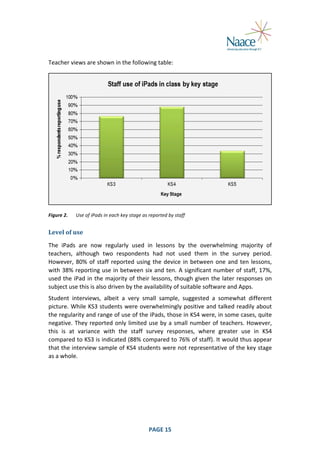
Teacher	
  views	
  are	
  shown	
  in	
  the	
  following	
  table:	


Figure	
  2.	
  

Use	
  of	
  iPads	
  in	
  each	
  key	
  stage	
  as	
  reported	
  by	
  staff	
  

Level	
  of	
  use	
  
The	
   iPads	
   are	
   now	
   regularly	
   used	
   in	
   lessons	
   by	
   the	
   overwhelming	
   majority	
   of	
  
teachers,	
   although	
   two	
   respondents	
   had	
   not	
   used	
   them	
   in	
   the	
   survey	
   period.	
  
However,	
   80%	
   of	
   staff	
   reported	
   using	
   the	
   device	
   in	
   between	
   one	
   and	
   ten	
   lessons,	
  
with	
  38%	
  reporting	
  use	
  in	
  between	
  six	
  and	
  ten.	
  A	
  significant	
  number	
  of	
  staff,	
  17%,	
  
used	
   the	
   iPad	
   in	
   the	
   majority	
   of	
   their	
   lessons,	
   though	
   given	
   the	
   later	
   responses	
   on	
  
subject	
  use	
  this	
  is	
  also	
  driven	
  by	
  the	
  availability	
  of	
  suitable	
  software	
  and	
  Apps.	
  
Student	
   interviews,	
   albeit	
   a	
   very	
   small	
   sample,	
   suggested	
   a	
   somewhat	
   different	
  
picture.	
  While	
  KS3	
  students	
  were	
  overwhelmingly	
  positive	
  and	
  talked	
  readily	
  about	
  
the	
  regularity	
   and	
  range	
   of	
   use	
  of	
   the	
  iPads,	
  those	
  in	
  KS4	
  were,	
  in	
  some	
  cases,	
  quite	
  
negative.	
   They	
   reported	
   only	
   limited	
   use	
   by	
   a	
   small	
   number	
   of	
   teachers.	
   However,	
  
this	
   is	
   at	
   variance	
   with	
   the	
   staff	
   survey	
   responses,	
   where	
   greater	
   use	
   in	
   KS4	
  
compared	
  to	
  KS3	
  is	
  indicated	
  (88%	
  compared	
  to	
  76%	
  of	
  staff).	
  It	
  would	
  thus	
  appear	
  
that	
  the	
  interview	
  sample	
  of	
  KS4	
  students	
  were	
  not	
  representative	
  of	
  the	
  key	
  stage	
  
as	
  a	
  whole.	


PAGE	
  15	


Figure	
  3.	
  

Level	
  of	
  use	
  in	
  lessons	
  (Staff)	
  

Data	
   from	
   pupils	
   provides	
   a	
   similar	
   picture,	
   with	
   84%	
   reporting	
   use	
   in	
   between	
   one	
  
and	
  ten	
  lessons	
  per	
  week,	
  of	
  which	
  27%	
  indicating	
  use	
  in	
  six	
  to	
  ten.	
  Again	
  a	
  significant	
  
number,	
   12%,	
   indicated	
   use	
   in	
   the	
   majority	
   of	
   their	
   lessons.	
   Thus	
   after	
   just	
   two	
   terms	
  
of	
  the	
  implementation	
  programme,	
  the	
  use	
  of	
  the	
  iPads	
  is	
  becoming	
  firmly	
  embedded.	


Figure	
  4.	


Level	
  of	
  use	
  in	
  lessons	
  (Students)	
  

PAGE	
  16	


Use	
  of	
  the	
  iPads	
  in	
  curriculum	
  subjects	
  
It	
   is	
   clear	
   that	
   particular	
   use	
   of	
   the	
   iPads	
   is	
   made	
   in	
   a	
   small	
   number	
   of	
   subjects,	
  
though	
   all	
   are	
   reported	
   to	
   have	
   made	
   some	
   use.	
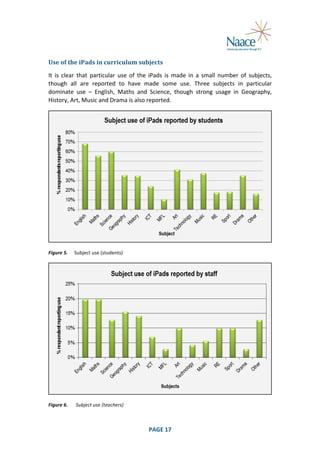
   Three	
   subjects	
   in	
   particular	
  
dominate	
   use	
   –	
   English,	
   Maths	
   and	
   Science,	
   though	
   strong	
   usage	
   in	
   Geography,	
  
History,	
  Art,	
  Music	
  and	
  Drama	
  is	
  also	
  reported.	


Figure	
  5.	
  

Subject	
  use	
  (students)	


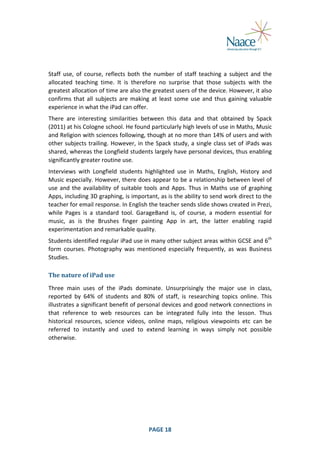
Figure	
  6.	


Subject	
  use	
  (teachers)	
  

PAGE	
  17	


Staff	
   use,	
   of	
   course,	
   reflects	
   both	
   the	
   number	
   of	
   staff	
   teaching	
   a	
   subject	
   and	
   the	
  
allocated	
   teaching	
   time.	
   It	
   is	
   therefore	
   no	
   surprise	
   that	
   those	
   subjects	
   with	
   the	
  
greatest	
  allocation	
   of	
   time	
   are	
   also	
   the	
   greatest	
  users	
   of	
   the	
   device.	
   However,	
   it	
   also	
  
confirms	
   that	
   all	
   subjects	
   are	
   making	
   at	
   least	
   some	
   use	
   and	
   thus	
   gaining	
   valuable	
  
experience	
  in	
  what	
  the	
  iPad	
  can	
  offer.	
  
There	
   are	
   interesting	
   similarities	
   between	
   this	
   data	
   and	
   that	
   obtained	
   by	
   Spack	
  
(2011)	
  at	
  his	
  Cologne	
  school.	
  He	
  found	
  particularly	
  high	
  levels	
  of	
  use	
  in	
  Maths,	
  Music	
  
and	
  Religion	
  with	
  sciences	
   following,	
   though	
  at	
   no	
   more	
   than	
  14%	
  of	
   users	
   and	
  with	
  
other	
   subjects	
   trailing.	
   However,	
   in	
   the	
   Spack	
   study,	
   a	
   single	
   class	
   set	
   of	
   iPads	
   was	
  
shared,	
  whereas	
  the	
  Longfield	
  students	
  largely	
  have	
  personal	
  devices,	
  thus	
  enabling	
  
significantly	
  greater	
  routine	
  use.	
  
Interviews	
   with	
   Longfield	
   students	
   highlighted	
   use	
   in	
   Maths,	
   English,	
   History	
   and	
  
Music	
  especially.	
  However,	
  there	
  does	
  appear	
  to	
  be	
  a	
  relationship	
  between	
  level	
  of	
  
use	
   and	
   the	
   availability	
   of	
   suitable	
   tools	
   and	
   Apps.	
   Thus	
   in	
   Maths	
   use	
   of	
   graphing	
  
Apps,	
   including	
   3D	
   graphing,	
   is	
   important,	
   as	
   is	
   the	
   ability	
   to	
   send	
   work	
   direct	
   to	
   the	
  
teacher	
  for	
  email	
  response.	
  In	
  English	
  the	
  teacher	
  sends	
  slide	
  shows	
  created	
  in	
  Prezi,	
  
while	
   Pages	
   is	
   a	
   standard	
   tool.	
   GarageBand	
   is,	
   of	
   course,	
   a	
   modern	
   essential	
   for	
  
music,	
   as	
   is	
   the	
   Brushes	
   finger	
   painting	
   App	
   in	
   art,	
   the	
   latter	
   enabling	
   rapid	
  
experimentation	
  and	
  remarkable	
  quality.	
  
Students	
   identified	
   regular	
   iPad	
   use	
   in	
   many	
   other	
   subject	
   areas	
   within	
   GCSE	
   and	
   6th	
  
form	
   courses.	
   Photography	
   was	
   mentioned	
   especially	
   frequently,	
   as	
   was	
   Business	
  
Studies.	
  
The	
  nature	
  of	
  iPad	
  use	
  
Three	
   main	
   uses	
   of	
   the	
   iPads	
   dominate.	
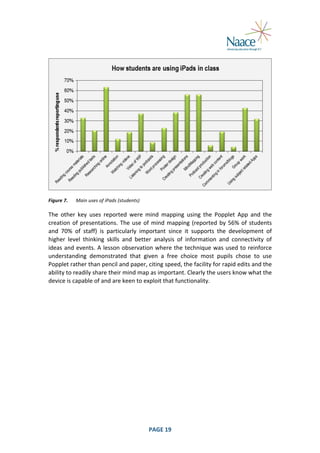
   Unsurprisingly	
   the	
   major	
   use	
   in	
   class,	
  
reported	
   by	
   64%	
   of	
   students	
   and	
   80%	
   of	
   staff,	
   is	
   researching	
   topics	
   online.	
   This	
  
illustrates	
  a	
  significant	
  benefit	
  of	
  personal	
  devices	
  and	
  good	
  network	
  connections	
  in	
  
that	
   reference	
   to	
   web	
   resources	
   can	
   be	
   integrated	
   fully	
   into	
   the	
   lesson.	
   Thus	
  
historical	
   resources,	
   science	
   videos,	
   online	
   maps,	
   religious	
   viewpoints	
   etc	
   can	
   be	
  
referred	
   to	
   instantly	
   and	
   used	
   to	
   extend	
   learning	
   in	
   ways	
   simply	
   not	
   possible	
  
otherwise.	


PAGE	
  18	


Figure	
  7.	
  

Main	
  uses	
  of	
  iPads	
  (students)	
  

The	
   other	
   key	
   uses	
   reported	
   were	
   mind	
   mapping	
   using	
   the	
   Popplet	
   App	
   and	
   the	
  
creation	
   of	
   presentations.	
   The	
   use	
   of	
   mind	
   mapping	
   (reported	
   by	
   56%	
   of	
   students	
  
and	
   70%	
   of	
   staff)	
   is	
   particularly	
   important	
   since	
   it	
   supports	
   the	
   development	
   of	
  
higher	
   level	
   thinking	
   skills	
   and	
   better	
   analysis	
   of	
   information	
   and	
   connectivity	
   of	
  
ideas	
   and	
   events.	
  A	
  lesson	
   observation	
   where	
   the	
  technique	
  was	
   used	
  to	
  reinforce	
  
understanding	
   demonstrated	
   that	
   given	
   a	
   free	
   choice	
   most	
   pupils	
   chose	
   to	
   use	
  
Popplet	
  rather	
  than	
  pencil	
  and	
  paper,	
  citing	
  speed,	
  the	
  facility	
  for	
  rapid	
  edits	
  and	
  the	
  
ability	
  to	
  readily	
  share	
  their	
  mind	
  map	
  as	
  important.	
  Clearly	
  the	
  users	
  know	
  what	
  the	
  
device	
  is	
  capable	
  of	
  and	
  are	
  keen	
  to	
  exploit	
  that	
  functionality.	


PAGE	
  19	


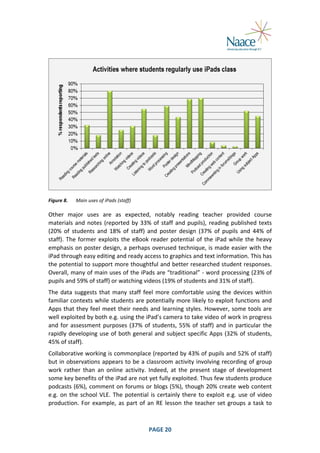
Figure	
  8.	
  

Main	
  uses	
  of	
  iPads	
  (staff)	
  

Other	
   major	
   uses	
   are	
   as	
   expected,	
   notably	
   reading	
   teacher	
   provided	
   course	
  
materials	
   and	
   notes	
   (reported	
   by	
   33%	
   of	
   staff	
   and	
   pupils),	
   reading	
   published	
   texts	
  
(20%	
   of	
   students	
   and	
   18%	
   of	
   staff)	
   and	
   poster	
   design	
   (37%	
   of	
   pupils	
   and	
   44%	
   of	
  
staff).	
   The	
   former	
   exploits	
   the	
   eBook	
   reader	
   potential	
   of	
   the	
   iPad	
   while	
   the	
   heavy	
  
emphasis	
  on	
  poster	
  design,	
  a	
  perhaps	
  overused	
  technique,	
  is	
  made	
  easier	
  with	
  the	
  
iPad	
  through	
  easy	
  editing	
  and	
  ready	
  access	
  to	
  graphics	
  and	
  text	
  information.	
  This	
  has	
  
the	
  potential	
  to	
  support	
  more	
  thoughtful	
  and	
  better	
  researched	
  student	
  responses.	
  
Overall,	
  many	
  of	
  main	
  uses	
  of	
  the	
  iPads	
  are	
  “traditional”	
  -­‐	
  word	
  processing	
  (23%	
  of	
  
pupils	
  and	
  59%	
  of	
  staff)	
  or	
  watching	
  videos	
  (19%	
  of	
  students	
  and	
  31%	
  of	
  staff).	
  
The	
   data	
   suggests	
   that	
   many	
   staff	
   feel	
   more	
   comfortable	
   using	
   the	
   devices	
   within	
  
familiar	
  contexts	
  while	
  students	
  are	
  potentially	
  more	
  likely	
  to	
  exploit	
  functions	
  and	
  
Apps	
  that	
  they	
  feel	
  meet	
  their	
  needs	
  and	
  learning	
   styles.	
  However,	
  some	
  tools	
  are	
  
well	
   exploited	
   by	
   both	
   e.g.	
   using	
   the	
   iPad’s	
   camera	
   to	
   take	
   video	
   of	
   work	
   in	
   progress	
  
and	
   for	
   assessment	
   purposes	
   (37%	
   of	
   students,	
   55%	
   of	
   staff)	
   and	
   in	
   particular	
   the	
  
rapidly	
   developing	
   use	
   of	
   both	
   general	
   and	
   subject	
   specific	
   Apps	
   (32%	
   of	
   students,	
  
45%	
  of	
  staff).	
  
Collaborative	
  working	
  is	
  commonplace	
  (reported	
  by	
  43%	
  of	
  pupils	
  and	
  52%	
  of	
  staff)	
  
but	
  in	
  observations	
  appears	
  to	
  be	
  a	
  classroom	
  activity	
  involving	
  recording	
  of	
  group	
  
work	
   rather	
   than	
   an	
   online	
   activity.	
   Indeed,	
   at	
   the	
   present	
   stage	
   of	
   development	
  
some	
   key	
   benefits	
   of	
   the	
   iPad	
   are	
   not	
   yet	
   fully	
   exploited.	
   Thus	
   few	
   students	
   produce	
  
podcasts	
  (6%),	
  comment	
  on	
  forums	
  or	
  blogs	
  (5%),	
  though	
  20%	
  create	
  web	
  content	
  
e.g.	
   on	
   the	
   school	
   VLE.	
   The	
   potential	
   is	
   certainly	
   there	
   to	
   exploit	
   e.g.	
   use	
   of	
   video	
  
production.	
   For	
   example,	
   as	
   part	
   of	
   an	
   RE	
   lesson	
   the	
   teacher	
   set	
   groups	
   a	
   task	
   to	


PAGE	
  20	


make	
   a	
   two	
   minute	
   news	
   report	
   regarding	
   religious	
   views	
   of	
   certain	
   controversial	
  
individuals.	
  
However,	
  open	
  responses	
  from	
  students	
  offer	
  an	
  insight	
  into	
  the	
  wider	
  uses	
  that	
  are	
  
developing.	
  Examples	
  include:	
  
•
•
•
•
•
•

Maths	
  games	
  and	
  English	
  games	
  
I-­‐Movies	
  for	
  photography	
  
Making	
  music	
  (e.g.	
  using	
  GarageBand	
  App)	
  
Making	
  videos	
  
Writing	
  stories	
  
Art	


This	
  was	
  expanded	
  considerably	
  when	
  students	
  were	
  asked	
  what	
  they	
  would	
  like	
  to	
  
use	
  the	
  iPad	
  for	
  if	
  given	
  the	
  opportunity.	
  
But	
  what	
  would	
  students	
  like	
  to	
  do	
  with	
  their	
  iPads?	
  
A	
   wide	
   range	
   of	
   responses	
   were	
   received	
   but	
   three	
   key	
   issues	
   stand	
   out.	
   In	
   particular,	
  
students	
   wish	
   to	
   make	
   much	
   greater	
   use	
   of	
   video	
   resources	
   to	
   help	
   their	
   learning,	
  
many	
  of	
  which	
  are	
  hosted	
  on	
  YouTube	
  and	
  therefore	
  inaccessible	
  to	
  them	
  in	
  school.	
  
This	
  is	
  not	
  the	
  place	
  for	
  a	
  debate	
  on	
  school	
  web	
  filtering	
  and	
  a	
  good	
  case	
  can	
  be	
  made	
  
for	
   blocking	
   YouTube	
   in	
   schools	
   simply	
   because	
   of	
   the	
   huge	
   amount	
   of	
   undesirable	
  
material	
   hosted	
  there.	
  However,	
  there	
   also	
  exists	
  an	
   equally	
   large	
  repository	
  of	
   free	
  
educational	
  resources	
   that	
   are	
   simply	
   not	
   being	
   exploited.	
  Students	
   are	
   well	
   aware	
   of	
  
this	
   and	
   voiced	
   their	
   frustration	
   both	
   in	
   the	
   questionnaires	
   and	
   in	
   face	
   to	
   face	
  
interviews.	
  This	
  is	
  an	
  issue	
  for	
  all	
  schools	
  and	
  one	
  requiring	
  wider	
  debate.	
  
The	
  other	
  key	
  requests	
  relate	
  to	
  greater	
  use	
  of	
  iMovie	
  and	
  also	
  use	
  of	
  educational	
  
games.	
   Thus	
   students	
   mentioned,	
   “designing	
   games”,	
   “playing	
   interactive	
   games	
  
that	
   help	
   me	
   learn”,	
   “downloading	
   games	
   that	
   help	
   you”,	
   and	
   “use	
   games	
   to	
   help	
  
work	
   better”.	
   While	
   ‘computer	
   games’	
   is	
   a	
   term	
   with	
   negative	
   connotations	
   for	
  
traditionalists	
  (although	
  gaming	
  has	
  been	
  used	
  e.g.	
  in	
  Geography	
  for	
  many	
  years)	
  at	
  
least	
   some	
   students	
   appreciate	
   the	
   learning	
   benefits	
   offered	
   by	
   appropriately	
  
designed	
  gaming	
  activities.	
  
Overwhelmingly	
   students	
   wanted	
   to	
   make	
   more	
   use	
   of	
   their	
   iPads	
   and	
   indicated	
   a	
  
range	
  of	
  activities	
  that	
  they	
  felt	
  should	
  be	
  more	
  common	
  e.g.	
  
•
•
•
•
•
•


Use	
  them	
  more	
  in	
  Art,	
  PE,	
  Maths,	
  English	
  etc.	
  
Use	
  wikispaces	
  
Edit	
  photographs	
  and	
  animations	
  
Write	
  more	
  notes	
  
Create	
  more	
  presentations	
  
Make	
  videos/movies	
  
PAGE	
  21	


•
•
•
•
•
•
•
•
•
•
•
•

More	
  online	
  research	
  
Word	
  games	
  to	
  help	
  spelling	
  
For	
  staff	
  to	
  set	
  more	
  tasks	
  requiring	
  use	
  of	
  the	
  iPads	
  
Using	
  the	
  iPads	
  instead	
  of	
  pen	
  and	
  paper	
  
Write	
  essays	
  and	
  stories	
  using	
  the	
  iPad	
  
Make	
  more	
  music	
  on	
  the	
  iPad	
  
Do	
  tests	
  on	
  the	
  iPad	
  
Use	
  more	
  Apps	
  for	
  Science	
  
Maths	
  homework	
  
Designing	
  games	
  
Use	
  the	
  iPad	
  instead	
  of	
  books	
  
Access	
  the	
  school	
  VLE	


These	
  represent	
   no	
   more	
   than	
   a	
   summary	
  of	
  the	
   main	
   responses	
   but	
   one	
   has	
   to	
   feel	
  
for	
   the	
   student	
   who	
   complained	
   that,	
   “we	
   never	
   use	
   our	
   iPads”.	
   This	
   was	
   the	
   only	
  
negative	
   response,	
   most	
   others	
   demonstrating	
   that	
   not	
   only	
   are	
   their	
   iPads	
   well	
  
used	
   but	
   that	
   students	
   want	
   much	
   more,	
   to	
   the	
   point	
   where	
   their	
   ideas	
   might	
  
usefully	
  form	
  the	
  driver	
  for	
  the	
  next	
  stages	
  of	
  development.	
  
Doing	
  now	
  what	
  could	
  not	
  be	
  done	
  before	
  
This	
  same	
  theme	
  is	
  apparent	
  when	
  students	
  were	
  asked	
  what	
  they	
  could	
  now	
  do	
  to	
  help	
  
their	
  learning	
  compared	
  to	
  the	
  pre-­‐iPad	
  era.	
  A	
  key	
  theme	
  to	
  emerge	
  was,	
  once	
  again,	
  
the	
  ease	
  of	
  access	
  to	
  resources.	
  Thus,	
  in	
  summary,	
  responses	
  included	
  aspects	
  such	
  as:	
  
•
•
•
•
•
•
•
•
•
•
•
•
•
•
•

Easy	
  Internet	
  access	
  
Use	
  of	
  iBooks	
  
Makes	
  reading	
  interactive	
  
Translation	
  tools	
  
Making	
  movies	
  
Use	
  of	
  educational	
  games	
  
Use	
  of	
  Apps	
  to	
  support	
  learning	
  
Mind	
  mapping	
  
Communication	
  with	
  teachers	
  
Creating	
  and	
  delivering	
  presentations	
  
Homework	
  
Access	
  to	
  texts,	
  mark	
  schemes	
  and	
  past	
  exam	
  papers	
  
Listening	
  to	
  podcasts	
  e.g.	
  on	
  GCSE	
  Pod	
  
Annotation	
  of	
  texts	
  
Drawing	
  etc	
  in	
  art.	


PAGE	
  22	


Again,	
  there	
  is	
  a	
  clear	
  message	
  that	
  students	
  regard	
  the	
  iPad	
  as	
  a	
  tool	
  that	
  enables	
  
them	
  to	
  work	
  more	
  efficiently	
  and	
  thus,	
  by	
  extrapolation,	
  more	
  productively.	
  
Staff	
   were	
   as	
   positive	
   as	
   students	
   in	
   this	
   respect.	
   With	
   the	
   exception	
   of	
   one	
  
respondent	
   who	
   stated	
   bluntly,	
   “Take	
   them	
   away”,	
   the	
   majority	
   were	
   able	
   to	
  
identify	
  benefits.	
  Some	
  were	
  glowing	
  in	
  their	
  praise:	
  
Everything!	
   Frees	
   me	
   up	
   from	
   finding	
   a	
   computer	
   room	
   when	
   I	
   want	
   to	
   do	
  
something.	
  This	
  means	
  much	
  less	
  stress.	
  Can	
  plan	
  lessons	
  with	
  more	
  variety	
  and	
  
better	
  pace	
  as	
  the	
  device	
  can	
  be	
  used	
  for	
  a	
  few	
  minutes	
  and	
  then	
  move	
  on,	
  then	
  
again	
  later	
  in	
  the	
  lesson.	
  Makes	
  role	
  play	
  much	
  more	
  productive.	
  Students	
  can	
  
better	
   review	
   what	
   they	
   have	
   done,	
   with	
   other	
   students,	
   and	
   allows	
   effective	
  
peer	
   evaluation	
   of	
   this	
   work.	
   Allows	
   students	
   to	
   research	
   maps	
   and	
   link	
   with	
  
satellite	
  photos	
  in	
  a	
  way	
  it	
  has	
  never	
  possible	
  before.	
  They	
  can	
  easily	
  find	
  places	
  
they	
  know	
  to	
  do	
  work	
  which	
  makes	
  it	
  more	
  relevant.	
  I	
  have	
  taken	
  the	
  devices	
  
outside	
  onto	
  the	
  field	
  to	
  do	
  things;	
  I	
  could	
  not	
  do	
  this	
  with	
  a	
  desktop!	
  These	
  are	
  
just	
  a	
  few.”	
  
Another	
  teacher	
  noted	
  that:	
  
“iPads	
   allow	
   instant	
   access	
   to	
   a	
   huge	
   range	
   of	
   resources.	
   Students	
   are	
   able	
   to	
  
research	
   a	
   word	
   definition	
   in	
   an	
   instant.	
   They	
   can	
   dip	
   in	
   and	
   out	
   of	
   various	
  
literary	
   texts	
   without	
   the	
   need	
   to	
   go	
   to	
   the	
   library	
   or	
   be	
   given	
   photocopied	
  
resources	
   or	
   books.	
   Learning	
   is	
   far	
   more	
   varied	
   and	
   interactive.	
   Electronic	
  
textbooks	
  can	
  be	
  tailored	
  to	
  the	
  group	
  or	
  even	
  to	
  the	
  individual,	
  so	
  that	
  iPads	
  
open	
  the	
  door	
  to	
  a	
  genuinely	
  individualised	
  curriculum.”	
  
One	
  noted	
  cost	
  savings	
  amongst	
  other	
  benefits:	
  
“Personalised	
   PowerPoint	
   slides,	
   saves	
   on	
   my	
   photocopying	
   bill,	
   set	
   tasks	
   at	
  
home	
  -­‐	
  such	
  as	
  researching	
  video	
  clips,	
  receiving	
  typed	
  work	
  in	
  the	
  lesson,	
  pupils	
  
can	
  message	
  my	
  iPad	
  within	
  class	
  if	
  they	
  are	
  needing	
  help.”	
  
Others	
  talked	
  about:	
  
“Animations	
  on	
  locations	
  editing	
  and	
  analysing	
  photographs	
  as	
  they	
  are	
  taken.	
  
Spontaneous	
  visual	
  research	
  in	
  class	
  discussions.”	
  
“Allows	
  more	
  independent	
  learning	
  from	
  students.	
  They	
  can	
  take	
  on	
  board	
  the	
  
task	
   and	
   feed	
   it	
   back	
   however	
   they	
   wish	
   as	
   long	
   as	
   they	
   are	
   answering	
   the	
  
question	
  or	
  completing	
  the	
  task.”	


PAGE	
  23	


“Immediate	
  access	
  to	
  information.	
  Videoing	
  experiments	
  and	
  playing	
  back,	
  use	
  
of	
  photos	
  easily	
  in	
  coursework	
  and	
  assessments.”	


Yet	
  others	
  noted	
  personal	
  benefits	
  such	
  as:	
  
•
•
•
•
•
•

Using	
  their	
  own	
  iPad	
  for	
  registration	
  
Creating	
  podcasts	
  
Not	
  having	
  to	
  worry	
  about	
  finding	
  a	
  computer	
  
Easier	
  lesson	
  planning	
  
Facilitating	
  target	
  setting	
  
Sharing	
  resources	
  easily	


While	
  benefits	
  to	
  learning	
  were	
  equally	
  clear	
  in	
  comments	
  including	
  amongst	
  others:	
  
•
•
•
•
•

Engaging	
  students	
  
Immediate	
  research	
  
Promoting	
  independent	
  learning	
  
Easier	
  to	
  differentiate	
  
Enabling	
  students	
  to	
  immediately	
  see	
  the	
  results	
  of	
  their	
  learning.	


Comments	
  such	
  as	
  those	
  quoted	
  above	
  show	
  not	
  only	
  the	
  impact	
  that	
  the	
  iPad	
  is	
  having	
  
on	
  pedagogical	
  thinking	
  but	
  also	
  that	
  staff	
  increasingly	
  recognise	
  and	
  exploit	
  the	
  benefits	
  
brought	
  about	
  by	
  students’	
  access	
  to	
  personal	
  devices	
  that	
  are	
  always	
  available.	
  
Teachers	
   also	
   offered	
   interesting	
   insights	
   into	
   those	
   things	
   that	
   they	
   would	
   like	
   to	
  
further	
  develop	
  using	
  the	
  iPads	
  and	
  while	
  some	
  wished	
  to	
  develop	
  innovative	
  practice,	
  
this	
   was	
   not	
   always	
   the	
   case	
   despite,	
   the	
   remarkable	
   range	
   of	
   uses	
   so	
   far.	
   In	
   some	
  
cases,	
  frustration	
  with	
  the	
  technology	
  was	
  evident	
  e.g.	
  the	
  inability	
  to	
  use	
  education	
  
websites	
   such	
   as	
   MyMaths	
   that	
   use	
   Flash	
   (which	
   Apple	
   systems	
   cannot	
   handle),	
  
technical	
   issues	
   in	
   connecting	
   iPads	
   to	
   the	
   interactive	
   whiteboards	
   in	
   order	
   to	
   use	
  
AppleTV	
  and	
  the	
  potential	
  cost	
  of	
  some	
  useful	
  Apps,	
  e.g.	
  for	
  Science	
  teaching.	
  Indeed,	
  
lack	
  of	
  budget	
  for	
  paid-­‐for	
  Apps	
  appears	
  as	
  a	
  potential	
  use	
  limiting	
  issue.	
  However,	
  the	
  
Flash	
  issue	
  has	
  now	
  been	
  resolved	
  through	
  use	
  of	
  the	
  Puffin	
  web	
  browser	
  App.	
  
Others	
   were	
   keen	
   to	
   further	
   explore	
   both	
   currently	
   available	
   tools,	
   as	
   well	
   as	
  
developing	
  pedagogical	
  practice.	
  The	
  following	
  were	
  commonly	
  mentioned:	
  
•
•
•
•
•
•


Podcasts	
  and	
  Apps	
  to	
  support	
  literacy	
  
Blogging	
  
eBooks	
  
More	
  subject	
  specific	
  Apps	
  
Final	
  product	
  performance	
  videos	
  for	
  assessment	
  and	
  peer	
  review	
  
Self	
  review	
  and	
  peer	
  assessment	
  in	
  general	
  

PAGE	
  24	


•
•
•
•
•

Creating	
  eBooks	
  
Peer	
  teaching	
  
Creation	
  and	
  use	
  of	
  revision	
  resources	
  
Use	
  of	
  interactive	
  games	
  
Linking	
  to	
  voting	
  systems.	


Some	
   teachers	
   identified	
   several	
   of	
   the	
   above	
   but	
   bemoaned	
   the	
   lack	
   of	
   time	
   to	
  
develop	
  resources,	
  a	
  common	
  issue	
  that	
  also	
  arises	
  in	
  VLE	
  development.	
  It	
  is	
  possible	
  
that	
   commercial	
   providers	
   will	
   identify	
   this	
   as	
   a	
   potential	
   market	
   and	
   create	
  
materials,	
  though	
  cost	
  may	
  be	
  a	
  limiting	
  factor	
  in	
  the	
  current	
  financial	
  climate.	
  
It	
  is	
  clearly	
  evident,	
  however,	
  that	
  both	
  teachers	
  and	
  pupils	
  not	
  only	
  want	
  to	
  expand	
  
the	
  use	
  of	
  the	
  iPads	
  but	
  can	
  articulate	
  many	
  ways	
  in	
  which	
  this	
  can	
  and	
  should	
  be	
  
done.	
  The	
  ideas	
  are	
  there	
  and	
  while	
  some	
  are	
  still	
  at	
  the	
  stage	
  of	
  doing	
  traditional	
  
things	
  more	
  easily,	
  many	
  others	
  are	
  potentially	
  agents	
  of	
  change.	
  
Use	
  of	
  the	
  iPads	
  beyond	
  the	
  classroom	
  
There	
  is	
  little	
  point	
  in	
  students	
  having	
  personal	
  devices	
  if	
  they	
  are	
  not	
  fully	
  utilised	
  
wherever	
   the	
   student	
   happens	
   to	
   be.	
   Clearly	
   the	
   school	
   seeks	
   to	
   exploit	
   this	
   by	
  
setting	
  homework	
  and	
  other	
  learning	
  activities	
  that	
  require	
  use	
  of	
  the	
  iPads	
  but	
  has	
  
to	
  accept	
  that	
  students	
  will	
  also	
  use	
  them	
  for	
  personal	
  activities.	
  Thus	
  while	
  71%	
  of	
  
students	
   report	
   using	
   their	
   iPad	
   to	
   complete	
   homework	
   tasks	
   87%	
   use	
   them	
   for	
  
playing	
  games	
  and	
  social	
  networking.	
  While	
  the	
  latter	
  use	
  raises	
  the	
  usual	
  e-­‐safety	
  
and	
  cyberbullying	
  issues,	
  the	
  majority	
  of	
  reported	
  uses	
  were	
  broadly	
  in	
  the	
  context	
  
of	
  learning	
  activities.	


PAGE	
  25	


Figure	
  9.	
  

Student	
  use	
  of	
  iPads	
  beyond	
  school	
  

Thus	
  47%	
  of	
  students	
  researched	
  topics	
  online,	
  while	
  39%	
  reported	
  using	
  them	
  for	
  
creative	
   and	
   design	
   activities.	
   Other	
   reported	
   uses	
   included	
   making	
   videos,	
   music	
  
and	
  taking	
  pictures,	
  with	
  one	
  student	
  complaining	
  that	
  they	
  needed	
  more	
  books	
  on	
  
the	
   device.	
   There	
   is	
   therefore	
   strong	
   evidence	
   that	
   most	
   students	
   are	
   using	
   their	
  
iPads	
  to	
  support	
  their	
  learning	
  in	
  ways	
  that	
  meet	
  their	
  particular	
  needs.	
  
Some,	
  but	
  not	
  all	
  staff	
  (60	
  of	
  71	
  respondents),	
  set	
  homework	
  and	
  coursework	
  tasks	
  
requiring	
   use	
   of	
   the	
   iPad,	
   with	
   73%	
   of	
   those	
   responding	
   requiring	
   online	
   research	
  
and	
   63%	
   completion	
   of	
   homework	
   tasks	
   with	
   a	
   further	
   38%	
   requiring	
   students	
   to	
  
access	
  course	
  materials	
  and	
  texts.	


PAGE	
  26	


Figure	
  10.	
   Staff	
  requirement	
  for	
  student	
  use	
  of	
  iPads	
  beyond	
  school	
  

Some	
   innovative	
   use	
   was	
   mentioned	
   e.g.	
   listening	
   to	
   and/or	
   preparing	
   podcasts,	
  
making	
  presentations	
  and	
  work	
  on	
  graphs	
  and	
  data	
  handling.	
  
Overall,	
  a	
  significant	
  group	
  of	
  staff	
  are	
  developing	
  the	
  use	
  of	
  the	
  iPads	
  for	
  learning	
  
beyond	
  school,	
  albeit	
  largely	
  as	
  a	
  replacement	
  for	
  traditional	
  paper-­‐based	
  activities	
  
at	
   this	
   stage	
   with	
   only	
   limited	
   exploitation	
   of	
   the	
   more	
   innovative	
   tools	
   available.	
  
However,	
  this	
  reflects	
  the	
  current	
  early	
  stage	
  of	
  development	
  and	
  provides	
  a	
  good	
  
basis	
  for	
  further	
  development.	
  
Of	
   more	
   concern	
   is	
   the	
   15%	
   of	
   staff	
   who	
   appear	
   not	
   to	
   set	
   homework	
   and	
   similar	
  
tasks	
   that	
   require	
   use	
   of	
   the	
   iPads,	
   especially	
   as	
   this	
   number	
   is	
   much	
   larger	
   than	
   the	
  
5%	
   who	
   indicate	
   overall	
   antipathy	
   to	
   them.	
   Whilst	
   this	
   may	
   be	
   due	
   to	
   a	
   view	
   that	
   as	
  
not	
   all	
   students	
   yet	
   have	
   the	
   devices	
   it	
   would	
   be	
   impractical,	
   there	
   may	
   be	
   other	
  
reasons	
   that	
   this	
   study	
   has	
   not	
   been	
   able	
   to	
   identify.	
   However,	
   the	
   school	
   is	
  
introducing	
  a	
  new	
  homework	
  policy	
  in	
  June	
  2012	
  that	
  emphasises	
  the	
  use	
  of	
  iPads	
  
and	
  should	
  serve	
  to	
  address	
  this	
  issue.	
  
The	
  impact	
  of	
  the	
  iPads	
  on	
  student	
  motivation	
  
A	
   significant	
   69%	
   of	
   students	
   certainly	
   consider	
   themselves	
   to	
   be	
   more	
   motivated	
  
now	
  that	
  they	
  have	
  the	
  iPads,	
  with	
  46%	
  agreeing	
  and	
  23%	
  strongly	
  agreeing	
  with	
  the	
  
statement,	
  “I	
  feel	
  more	
  motivated	
  and	
  can	
  work	
  better	
  than	
  without	
  it”.	
  Only	
  11%	
  
disagreed	
  with	
  the	
  statement,	
  possibly	
  including	
  those	
  who	
  later	
  indicated	
  technical	
  
problems	
  with	
  their	
  devices.	


PAGE	
  27	


Figure	
  11.	
   iPads	
  and	
  student	
  motivation	
  (student	
  responses)	
  

Interestingly,	
   67%	
   of	
   staff	
   had	
   similar	
   views	
   with	
   51%	
   agreeing	
   and	
   16%	
   strongly	
  
agreeing	
  that	
  students	
  are	
  more	
  motivated	
  and	
  worked	
  better	
  when	
  using	
  the	
  iPads.	
  
Some	
  14%	
  of	
  staff	
  disagreed,	
  a	
  figure	
  consistent	
  with	
  other	
  staff	
  responses.	


Figure	
  12.	
   iPads	
  and	
  student	
  motivation	
  (staff	
  responses)	


PAGE	
  28	


Rather	
   more	
   staff	
   than	
   pupils	
   currently	
   maintain	
   a	
   neutral	
   position,	
   though	
   this	
   is	
   to	
  
be	
  expected	
  at	
  this	
  stage	
  of	
  the	
  implementation.	
  What	
  is	
  important	
  is	
  that	
  there	
  is	
  a	
  
clear	
   consensus	
   from	
   all	
   involved	
   that	
   the	
   iPads	
   are	
   having	
   a	
   positive	
   impact	
   on	
  
both	
  motivation	
  and	
  how	
  students	
  work.	
  
The	
  impact	
  of	
  the	
  iPads	
  on	
  the	
  quality	
  of	
  students	
  work	
  
Some	
  73%	
  of	
  students	
  report	
  a	
  highly	
  positive	
  impact,	
  with	
  49%	
  indicating	
  that	
  they	
  
agreed	
   and	
   24%	
   that	
   they	
   strongly	
   agreed	
   that	
   working	
   with	
   the	
   iPad	
   has	
   helped	
  
improve	
  the	
  quality	
  of	
  their	
  work.	
  Only	
  some	
  6%	
  disagree.	


Figure	
  13.	
   iPads	
  and	
  student	
  work	
  quality	
  (student	
  responses)	
  

Staff	
   were	
   rather	
   more	
   reticent	
   on	
   this	
   issue,	
   with	
   31%	
   remaining	
   neutral.	
   Of	
   the	
  
remainder	
   51%	
   agreed	
   and	
   16%	
   strongly	
   agreed	
   that	
   work	
   quality	
   was	
   improving.	
  
However,	
   after	
   a	
   mere	
   two	
   terms	
   there	
   is	
   not	
   currently	
   sufficient	
   assessment	
   data	
  
available	
  to	
  confirm	
  the	
  current	
  subjective	
  view.	
  
The	
   fact	
   that	
   virtually	
   half	
   the	
   staff	
   believe	
   that	
   the	
   quality	
   of	
   work	
   is	
   improving	
   due	
  
to	
  the	
  iPads	
  is	
  a	
  very	
  positive	
  indication	
  of	
  the	
  impact	
  of	
  the	
  devices.	


PAGE	
  29	


Figure	
  14.	
   iPads	
  and	
  student	
  work	
  quality	
  (staff	
  responses)	
  

Again	
  some	
  14%	
  of	
  staff	
  disagree,	
  reinforcing	
  the	
  view	
  that,	
  as	
  in	
  any	
  school,	
  there	
  
are	
  a	
  small	
  group	
  of	
  staff	
  who	
  simply	
  cannot	
  see	
  the	
  benefits	
  of	
  technology.	
  
The	
  impact	
  of	
  iPads	
  on	
  student	
  progress	
  
Again,	
   there	
   is	
   a	
   division	
   of	
   opinion	
   between	
   students	
   and	
   staff,	
   with	
   the	
   former	
  
again	
  more	
  positive.	
  Thus	
  a	
  consistent	
  67%	
  of	
  students	
  agree	
  (44%)	
  or	
  strongly	
  agree	
  
(23%)	
   that	
   they	
   are	
   making	
   better	
   progress	
   now	
   that	
   they	
   have	
   iPads,	
   though	
   a	
  
quarter	
  remain	
  neutral.	
  Again,	
  under	
  10%	
  disagree.	


PAGE	
  30	


Figure	
  15.	
   iPads	
  and	
  student	
  progress	
  (student	
  responses)	
  

The	
   views	
   of	
   staff	
   are	
   rather	
   less	
   positive,	
   though	
   28%	
   agree	
  and	
   11%	
   strongly	
   agree	
  
that	
   the	
   iPads	
   have	
   resulted	
   in	
   improved	
   student	
   progress	
   and	
   a	
   larger	
   18%	
  
disagreeing.	
  Some	
  42%	
  remain	
  neutral.	


Figure	
  16.	
   iPads	
  and	
  student	
  progress	
  (staff	
  responses)	


PAGE	
  31	


The	
  impact	
  of	
  iPads	
  on	
  student	
  achievement	
  
As	
   with	
   progress,	
   so	
   with	
   achievement,	
   where	
   the	
   disparity	
   of	
   opinions	
   between	
  
staff	
  and	
  students	
  is	
  similarly	
  marked	
  -­‐	
  indeed	
  more	
  so	
  as	
  the	
  positive	
  response	
  from	
  
staff	
   in	
   particular	
   is	
   much	
   lower.	
   Thus	
   some	
   61%	
   of	
   students	
   agree	
   (42%)	
   or	
   strongly	
  
agree	
   (19%)	
   that	
   their	
   achievement	
   has	
   risen,	
   while	
   28%	
   remain	
   neutral.	
  
Unfortunately,	
  the	
  reasons	
  for	
  this	
  perception	
  were	
  not	
  investigated	
  so	
  it	
  is	
  unclear	
  
as	
   to	
   whether	
   it	
   is	
   due	
   to	
   assessment	
   data	
   and	
   commentary	
   returned	
   to	
   students	
   or	
  
simply	
  a	
  ‘feel	
  good’	
  factor	
  engendered	
  by	
  the	
  facility	
  to	
  produce	
  work	
  digitally.	


Figure	
  17.	
   iPads	
  and	
  student	
  achievement	
  (student	
  responses)	
  

The	
  majority	
  of	
  staff,	
  almost	
  58%,	
  remained	
  neutral	
  on	
  this	
  question,	
  indicating	
  again	
  
that	
   there	
   is	
   currently	
  insufficient	
   assessment	
  data	
   available	
   to	
   confirm	
   or	
   otherwise	
  
any	
   impact	
   from	
   the	
   use	
   of	
   the	
   iPads.	
   Indeed,	
   in	
   a	
   new	
   school	
   building	
   with	
   new	
  
working	
  methods,	
  it	
  may	
  be	
  difficult	
  to	
  define	
  any	
  one	
  individual	
  factor	
  influencing	
  
achievement	
  in	
  the	
  short	
  term.	


PAGE	
  32	


Figure	
  18.	
   iPads	
  and	
  student	
  achievement	
  (staff	
  responses)	
  

Despite	
  this,	
  some	
  28%	
  of	
  staff	
  took	
  the	
  view	
  that	
  achievement	
  has	
  risen,	
  with	
  over	
  
8%	
  agreeing	
  strongly.	
  Thus	
  in	
  some	
  classes	
  at	
  least,	
  it	
  can	
  be	
  considered	
  that	
  the	
  use	
  
of	
  the	
  iPads	
  is	
  certainly	
  having	
  a	
  positive	
  impact	
  on	
  achievement.	
  The	
  challenge	
  for	
  
the	
   school	
   will	
   lie	
   in	
   identifying	
   the	
   pedagogical	
   practices	
   in	
   those	
   lessons	
   that	
   are	
  
enabling	
  this	
  improvement.	
  
The	
  impact	
  of	
  iPads	
  on	
  working	
  effectiveness	
  
Unsurprisingly,	
   a	
   significant	
   73%	
   of	
   students	
   consider	
   that	
   they	
   work	
   more	
  
effectively	
   now	
   that	
   they	
   can	
   (usually)	
   make	
   routine	
   use	
   of	
   the	
   iPads.	
   Thus	
   48%	
  
agreed	
  and	
  25%	
  strongly	
  agreed	
  that	
  this	
  is	
  the	
  case.	
  Only	
  19%	
  remain	
  neutral	
  and	
  
the	
   same	
   small	
   cohort	
   of	
   8%	
   disagree.	
   Given	
   responses	
   elsewhere	
   regarding	
   e.g.	
   the	
  
benefits	
  of	
  immediate	
  online	
  research	
  and	
  the	
  benefits	
  of	
  many	
  Apps,	
  such	
  a	
  positive	
  
response	
  is	
  to	
  be	
  expected.	


PAGE	
  33	


Figure	
  19.	
   iPads	
  and	
  effective	
  working	
  (student	
  responses)	


Figure	
  20.	
   iPads	
  and	
  effective	
  working	
  (student	
  responses)	
  

Staff	
   again	
   take	
   a	
   more	
   reserved	
   attitude,	
   though	
   42%	
   agree	
   and	
   9%	
   strongly	
   agree	
  
that	
   students	
   are	
   indeed	
   working	
   more	
   effectively,	
   with	
   31%	
   remaining	
   neutral.	
   A	
  
rather	
   higher	
   proportion	
   than	
   with	
   other	
   questions,	
   18%,	
   disagree,	
   though	
   whether	
  
this	
  is	
  due	
  to	
  e.g.	
  technical	
  issues	
  or	
  the	
  nature	
  of	
  a	
  particular	
  subject	
   is	
  not	
  recorded.	
  
Again,	
  this	
  is	
  an	
  area	
  requiring	
  further	
  research	
  and	
  analysis	
  at	
  school	
  level.	


PAGE	
  34	


The	
  iPad	
  and	
  collaboration	
  
Both	
  students	
  and	
  staff	
  were	
  asked	
  whether	
  the	
  availability	
  of	
  the	
  iPads	
  enabled	
  a	
  
greater	
   level	
   of	
   collaborative	
   work	
   than	
   had	
   previously	
   been	
   the	
   case	
   e.g.	
   through	
  
sharing	
   resources	
   and	
   ideas	
   online	
   and	
   through	
   group	
   working	
   in	
   class	
   where	
   the	
  
devices	
  enabled	
  such	
  activities	
  as	
  the	
  rapid	
  creation	
  of	
  group	
  videos.	
  
Students	
   clearly	
   believed	
   that	
   the	
   iPads	
   supported	
   collaboration,	
   with	
   which	
   47%	
  
agreeing	
  and	
  18%	
  strongly	
  agreeing	
  with	
  the	
  question.	
  Again	
  a	
  consistent	
  group,	
  10%	
  
disagreed.	
   As	
   has	
   already	
   been	
   noted,	
   a	
   proportion	
   of	
   the	
   respondents	
   reported	
  
technical	
  and	
  other	
  issues	
  with	
  their	
  iPads	
  and	
  others	
  will	
  not	
  have	
  been	
  placed	
  in	
  
learning	
  situations	
  where	
  the	
  teacher	
  uses	
  collaborative	
  techniques	
  or	
  where	
  these	
  
are	
  not	
  an	
  appropriate	
  methodology.	


Figure	
  21.	
   iPads	
  and	
  collaborative	
  working	
  (students)	
  

Staff	
  were	
  slightly	
  less	
  confident	
  in	
  their	
  responses	
  but	
  even	
  so	
  56%	
  overall	
  agreed	
  
(39%)	
   or	
   strongly	
   agreed	
   (17%)	
   that	
   students	
   did	
   work	
   more	
   collaboratively	
   with	
  
iPads	
   that	
   they	
   did	
   without.	
   Again,	
   a	
   consistent	
   14%	
   disagreed	
   while	
   about	
   one	
  
quarter	
  remain	
  neutral.	


PAGE	
  35	


Figure	
  22.	
   iPads	
  and	
  collaborative	
  working	
  (staff)	
  

Again	
  though,	
  a	
  majority	
  of	
  staff	
  do	
  recognise	
  and	
  exploit	
  the	
  potential	
  of	
  the	
  iPad	
  
and	
   are	
   evolving	
   their	
   pedagogical	
   approaches	
   accordingly.	
   It	
   will	
   therefore	
   be	
  
important	
  for	
  future	
  development	
  that	
  the	
  school	
  is	
  able	
  to	
  identify	
  the	
  best	
  practice	
  
in	
   the	
   school	
   and	
   to	
   disseminate	
   this	
   as	
   part	
   of	
   their	
   already	
   well	
   structured	
  
programme	
  of	
  continuing	
  professional	
  development.	
  
Does	
  the	
  use	
  of	
  Apps	
  aid	
  learning?	
  
A	
  range	
  of	
  iPad	
  Apps	
  were	
  installed	
  when	
  the	
  devices	
  were	
  introduced	
  with	
  others	
  
added	
  since.	
  It	
  is	
  therefore	
  not	
  surprising	
  that	
  these	
  are	
  well	
  used,	
  with	
  student	
  use	
  
higher	
   than	
   for	
   staff.	
   This	
   is	
   while	
   74%	
   of	
   students	
   reported	
   use	
   of	
   Apps	
   in	
   their	
  
classes	
  and	
  only	
  66%	
  of	
  staff	
  did	
  so,	
  suggesting	
  that	
  students	
  make	
  use	
  of	
  some	
  Apps	
  
regardless.	
   The	
   relatively	
   brief	
   classroom	
   observations	
   and	
   interviews	
   suggest	
   that	
  
students	
  understand	
  the	
  benefits	
  of	
  e.g.	
  keeping	
  notes	
  using	
  Pages	
  or	
  mind	
  mapping	
  
with	
  Popplet	
  and	
  prefer	
  to	
  work	
  on	
  the	
  iPad	
  rather	
  than	
  in	
  an	
  exercise	
  book.	
  
Interestingly,	
  slightly	
  more	
  than	
  one	
  third	
  of	
  staff	
  (34%)	
  had	
  not	
  used	
  Apps	
  in	
  their	
  
lessons,	
   with	
   some	
   claiming	
   that	
   there	
   were	
   no	
   subject	
   appropriate	
   Apps	
   or	
   that	
  
they	
   could	
   not	
   afford	
   to	
   purchase	
   those	
   that	
   were.	
   All	
   iPads	
   have	
   Pages	
   and	
  
Keynotes	
   installed.	
   These	
   are	
   Apps	
   that	
   have	
   uses	
   across	
   the	
   curriculum,	
   so	
   a	
   lack	
   of	
  
use	
   by	
   some	
   teachers	
   perhaps	
   indicates	
   either	
   an	
   unwillingness	
   to	
   explore	
   their	
  
potential	
   or	
   a	
   limited	
   awareness	
   of	
   how	
   to	
   exploit	
   them	
   in	
   the	
   classroom.	
   It	
   also	
   sits	
  
uneasily	
   with	
   the	
   indications	
   in	
   earlier	
   responses	
   of	
   the	
   benefits	
   offered	
   by	
   the	
  
devices.	
   However,	
   the	
   reason	
   may	
   be	
   more	
   prosaic	
   in	
   that	
   Pages	
   etc	
   are	
   not	
  
regarded	
  as	
  Apps	
  but	
  as	
  what,	
  on	
  a	
  traditional	
  computer,	
  would	
  be	
  seen	
  as	
  ‘office’	


PAGE	
  36	


tools	
  and	
  that	
  these	
  are	
  used	
  anyway.	
  It	
  is	
  possible	
  that	
  non-­‐App	
  users	
  are	
  actually	
  
referring	
  to	
  non-­‐use	
  of	
  subject	
  specific	
  Apps	
  only.	


Figure	
  23.	
   Student	
  use	
  of	
  Apps	
  in	
  class	
  (students)	


Figure	
  24.	
   Use	
  of	
  Apps	
  in	
  class	
  (staff)	


PAGE	
  37	


A	
   wide	
   range	
   of	
   Apps	
   were	
   indicated	
   to	
   be	
   in	
   use	
   covering	
   several	
   subjects,	
   but	
  
particularly	
   those	
   noted	
   earlier,	
   Maths,	
   Science	
   and	
   English.	
   Those	
   mentioned	
   by	
  
both	
  staff	
  and	
  students	
  include:	
  
•
•
•
•
•
•
•
•
•
•
•
•
•
•
•
•
•
•
•
•
•
•
•
•
•
•

Pages	
  
Keynote	
  
iMovie	
  
Popplet	
  
GarageBand	
  
Wordz	
  
Froggy	
  Jump	
  
Calculator	
  
Dice	
  
Fractions	
  
Quick	
  Graph	
  
Number	
  Cruncher	
  
Wordventure	
  
Accelerated	
  Reader	
  
Jumbline2	
  
Numbers	
  
iBooks	
  
Show	
  Me	
  
Freddy	
  Fractions	
  
Maths	
  Party	
  
Quakes	
  
Traffic	
  Lights	
  
Creative	
  Book	
  Builder	
  
Easy	
  Recorder	
  
Brushes	
  
.	
  .	
  .	
  and	
  many	
  more.	


The	
   potential	
   is	
   certainly	
   recognised,	
   though	
   it	
   might	
   be	
   prudent	
   for	
   the	
   school	
   to	
  
review	
  and	
  evaluate	
  these	
  resources	
  in	
  order	
  to	
  identify	
  those	
  that	
  offer	
  the	
  greatest	
  
value	
  with	
  regard	
  to	
  learning.	
  
The	
   students	
   certainly	
   consider	
   that	
   Apps	
   are	
   a	
   valuable	
   part	
   of	
   their	
   lessons	
   with	
  
51%	
   indicating	
   agreement	
   and	
   25%	
   strong	
   agreement	
   with	
   the	
   idea	
   that	
   Apps	
   had	
  
helped	
  their	
  learning.	
  Only	
  6%	
  disagreed,	
  though	
  this	
  rises	
  slightly	
  to	
  8%	
  if	
  those	
  who	
  
skipped	
  the	
  question	
  are	
  considered	
  as	
  negative	
  responses.	
  The	
  positive	
  response	
  is,	
  
however,	
  overwhelming.	


PAGE	
  38	


Figure	
  25.	
   The	
  value	
  of	
  Apps	
  in	
  helping	
  learning	
  (students)	


Figure	
  26.	
   The	
  value	
  of	
  Apps	
  in	
  helping	
  teaching	
  (staff)	
  

Staff,	
   similarly,	
   appear	
   to	
   recognise	
   the	
   value	
   of	
   Apps	
   in	
   their	
   teaching	
   with	
   54%	
  
agreeing	
   and	
   10%	
   strongly	
   agreeing	
   with	
   the	
   contention	
   that	
   use	
   of	
   Apps	
   appears	
  
useful	
  to	
  their	
  teaching.	
  A	
  further	
  31%	
  remain	
  neutral	
  on	
  the	
  matter	
  again	
  indicating	
  
that	
  around	
  one	
  third	
  of	
  staff	
  respondents	
  to	
  all	
  questions	
  are	
  still	
  taking	
  the	
  line	
  the	
  
‘the	
   jury	
   is	
   still	
   out’.	
   However,	
   while	
   not	
   as	
   strongly	
   positive	
   as	
   the	
   students	
   the	
  
value	
  of	
  Apps	
  is	
  recognised	
  though	
  the	
  open	
  responses	
  indicate	
  that	
  whilst	
  there	
  is	


PAGE	
  39	


considerable	
   innovation	
   in	
   some	
   classes	
   this	
   is	
   not	
   universal.	
   Thus	
   there	
   remains	
   a	
  
need	
   for	
   ongoing	
   professional	
   development	
   and	
   sharing	
   of	
   best	
   practice.	
   This	
   is	
   well	
  
understood	
  by	
  the	
  senior	
  management	
  team.	
  
How	
  happy	
  are	
  staff	
  and	
  students	
  using	
  the	
  iPads	
  in	
  learning	
  and	
  teaching?	
  
This	
  is	
  perhaps	
  an	
  awkward	
  question	
  but	
  one	
  that	
  provides	
  a	
  valuable	
  summary	
  of	
  
feelings	
   and	
   attitudes	
   towards	
   the	
   introduction	
   of	
   these	
   devices.	
   This	
   is,	
   after	
   all,	
  
something	
  of	
  a	
  radical	
  experiment,	
  as	
  Longfield	
  is	
  one	
  of	
  a	
  very	
  small	
  number	
  of	
  UK	
  
schools	
  to	
  implement	
  a	
  school-­‐wide	
  programme	
  of	
  this	
  nature.	
  
A	
   highly	
   significant	
   90%	
   of	
   students	
   indicated	
   that	
   they	
   happy	
   using	
   iPads	
   in	
   their	
  
learning,	
   with	
   48%	
   agreeing	
   and	
   42%	
   strongly	
   agreeing	
   with	
   the	
   statement.	
   This	
  
represents	
   an	
   overwhelming	
   endorsement	
   of	
   the	
   device	
   and	
   its	
   use	
   by	
   the	
   students.	
  
It	
   may	
   be	
   surmised	
   that	
   this	
   majority	
   included	
   all	
   iPad	
   owners	
   and	
   that	
   the	
   small	
  
number	
  who	
  disagreed	
  were	
  those	
  without	
  their	
  own	
  devices	
  or	
  who	
  had	
  technical	
  
issues.	


Figure	
  27.	
   Willingness	
  to	
  use	
  iPads	
  regularly	
  for	
  learning	
  (students).	
  

The	
  student	
  view	
  was	
  confirmed	
  by	
  staff,	
  with	
  77%	
  happy	
  to	
  regularly	
  use	
  the	
  iPad	
  in	
  
their	
  teaching.	
  A	
  significant	
  55%	
  agreed	
  and	
  a	
  further	
  23%	
  strongly	
  agreed	
  with	
  the	
  
statement.	
   Only	
   6%	
   disagreed	
   while	
   17%	
   remained	
   neutral	
   on	
   the	
   matter.	
   The	
  
proportion	
   of	
   staff	
   happy	
   to	
   develop	
   the	
   use	
   of	
   the	
   iPad	
   is	
   unusually	
   high,	
   though	
   as	
  
studies	
   cited	
   earlier	
   confirm,	
   it	
   does	
   seem	
   to	
   be	
   a	
   common	
   finding.	
   A	
   number	
   of	
  
reasons	
   may	
   be	
   postulated,	
   most	
   importantly	
   the	
   fact	
   that	
   the	
   device	
   is	
   (almost)	
  
always	
   available,	
   thus	
   it	
   becomes	
   ubiquitous	
   and	
   can	
   be	
   used	
   at	
   will,	
   unlike	
   older	


PAGE	
  40	


laptop	
   and	
   desktop	
   technologies	
   that	
   require	
   considerable	
   planning	
   and	
   preparation	
  
if	
  they	
  are	
  to	
  be	
  used	
  in	
  a	
  lesson.	
  Other	
  reasons	
  concern	
  the	
  type	
  and	
  use	
  of	
  Apps,	
  
immediacy	
  of	
  research	
  and	
  ease	
  of	
  collaboration.	


Figure	
  28.	
   Willingness	
  to	
  use	
  iPads	
  regularly	
  for	
  teaching	
  (staff).	
  

This	
  leads	
  to	
  a	
  consideration	
  of	
  whether	
  the	
  iPad	
  has	
  impacted	
  on	
  the	
  way	
  in	
  which	
  
teachers	
  now	
  teach.	
  Again	
  a	
  majority	
  of	
  the	
  staff,	
  some	
  63%	
  consider	
  that	
   it	
  has	
  and	
  
many	
  offer	
  valuable	
  insights	
  into	
  why	
  this	
  is	
  so.	
  Typical	
  responses	
  include:	
  
•

More	
   student	
   centred	
   approach,	
   more	
   group	
   work	
   activities,	
   more	
   student	
   led	
  
plenaries	
  and	
  activities	
  
• I	
  just	
  use	
  it	
  as	
  another	
  tool.	
  My	
  teaching	
  approach	
  has	
  not	
  changed	
  but	
  clearly	
  
using	
  the	
  iPads	
  is	
  new.	
  
• The	
   iPad	
   is	
   intuitive	
   and	
   a	
   pleasure	
   to	
   use.	
   This	
   means	
   that	
   I	
   am	
   more	
  
enthusiastic	
   about	
   researching	
   and	
   planning	
   lessons.	
   I	
   have	
   greater	
   scope	
   to	
  
introduce	
   English	
   students	
   to	
   a	
   broad	
   range	
   of	
   literature	
   without	
   spending	
   hours	
  
creating	
   and	
   photocopying	
   resources	
   (This	
   is	
   particularly	
   true	
   of	
   A	
   Level	
  
teaching).	
   I	
   have	
   started	
   to	
   create	
   electronic	
   textbooks	
   which	
   aim	
   to	
   focus	
  
individual	
  students	
  on	
  the	
  GCSE	
  tasks	
  they	
  need	
  to	
  complete.	
  This	
  sort	
  of	
  tailored	
  
curriculum	
  was	
  simply	
  impossible	
  before	
  the	
  introduction	
  of	
  the	
  iPad.	
  
• The	
  instant	
  access	
  to	
  new	
  information	
  means	
  that	
  students	
  can	
  gain	
  info	
  from	
  a	
  
variety	
  of	
  resources	
  not	
  just	
  a	
  textbook	
  or	
  worksheet.	
  
• My	
   teaching	
   is	
   now	
   very	
   focused	
   during	
   practical	
   sessions	
   on	
   students	
   who	
  
struggle	
   to	
   concentrate	
   while	
   others	
   are	
   able	
   to	
   continue	
   with	
   the	
   work	
   because	
  
they	
  have	
  the	
  task	
  and	
  video	
  tutorials	
  in	
  front	
  of	
  them.	


PAGE	
  41	


•

Allows	
  me	
  to	
  set	
  tasks	
  and	
  the	
  students	
  to	
  just	
  get	
  on	
  with	
  it,	
  they	
  have	
  all	
  the	
  
visual	
   tools	
   and	
   resources	
   in	
   front	
   of	
   them.	
   Plus	
   they	
   can	
   email	
   me	
   work	
   so	
   I	
  
don't	
  have	
  to	
  lug	
  bits	
  of	
  work	
  home.	
  
• I	
   think	
   it	
   makes	
   for	
   more	
   relevant	
   lessons.	
   Students	
   engage	
   in	
   the	
   material	
   more	
  
and	
  can	
  work	
  independently	
  more	
  effectively.	
  
• Easier	
   to	
   work	
   with	
   students	
   who	
   experienced	
   difficulty	
   when	
   grasping	
   certain	
  
concepts.	


Other	
  teachers	
  expressed	
  some	
  reservations	
  but	
  were	
  clearly	
  aware	
  of	
  the	
  value	
  of	
  
the	
   iPads.	
   Interestingly,	
   there	
   were	
   no	
   overtly	
   negative	
   comments	
   although	
   the	
  
anonymous	
   nature	
   of	
   the	
   survey	
   enabled	
   such	
   responses.	
   The	
   example	
   comments	
  
below	
   indicate	
   that	
   teachers	
   are	
   reflecting	
   both	
   on	
   the	
   role	
   of	
   the	
   iPad	
   and	
   its	
  
impact	
   on	
   their	
   teaching	
   and	
   they	
   are	
   thus	
   identifying	
   practical	
   and	
   policy,	
   rather	
  
than	
  pedagogical,	
  issues.	
  
•

It	
   has	
   made	
   me	
   think	
   differently	
   about	
   how	
   I	
   deliver	
   my	
   lessons,	
   ultimately	
  
though	
  students	
  still	
  need	
  key	
  drawing	
  skills	
  which	
  they	
  do	
  not	
  need	
  the	
  iPad	
  for.	
  
• I	
   still	
   find	
   myself	
   doing	
   activities	
   that	
   the	
   iPad	
   can	
   be	
   incorporated	
   into	
   rather	
  
than	
  centralising	
  all	
  work	
  to	
  be	
  done	
  on	
  the	
  iPad.	
  I	
  am	
  not	
  sure	
  what	
  the	
  policy	
  is	
  
on	
   the	
   use	
   of	
   iPads	
   over	
   exercise	
   books	
   are	
   and	
   whether	
   it	
   is	
   acceptable	
   to	
   have	
  
all	
   work	
   on	
   the	
   iPad	
   and	
   none	
   in	
   the	
   books.	
   How	
   is	
   all	
   the	
   work	
   on	
   the	
   iPad	
  
meant	
  to	
  be	
  marked.	
  
• Because	
  I	
  still	
  need	
  basic	
  resources	
  available	
  for	
  those	
  without	
  iPads.	
  
• It	
   has	
   made	
   resourcing	
   slightly	
   easier	
   (i.e.	
   not	
   having	
   to	
   have	
   whiteboards	
   and	
  
pens	
  and	
  A3	
  paper)	
  but	
  not	
  changed	
  much	
  in	
  my	
  style	
  of	
  teaching.	


A	
  majority	
  of	
  staff	
  further	
  confirmed	
  that	
  they	
  found	
  the	
  iPad	
  easy	
  to	
  integrate	
  into	
  
their	
   work	
   in	
   a	
   classroom	
   context,	
   with	
   62%	
   overall	
   in	
   agreement	
   (Agree	
   52%,	
  
strongly	
   agree	
   10%)	
   with	
   a	
   further	
   23%	
   remaining	
   neutral	
   at	
   this	
   time.	
   However,	
  
some	
   16%	
   were	
   in	
   disagreement	
   and	
   although	
   reasons	
   were	
   not	
   sought,	
   it	
   can	
   be	
  
surmised	
  from	
  other	
  comments	
  to	
  include	
  a	
  supposed	
  lack	
  of	
  appropriate	
  Apps	
  and	
  
perhaps	
  antipathy	
  towards	
  technology	
  in	
  general.	


PAGE	
  42	


Figure	
  29.	
   Ease	
  of	
  integration	
  of	
  iPads	
  in	
  classroom	
  contexts	
  (staff)	
  

There	
   are	
   messages	
   here,	
   both	
   for	
   Longfield	
   and	
   for	
   other	
   schools	
   following	
   a	
  
personal	
   device	
   strategy.	
   In	
   particular,	
   regular,ongoing	
   CPD	
   and	
   dissemination	
   of	
  
experiences	
   and	
   practice	
   are	
   crucial	
   aspects	
   of	
   the	
   change	
   management	
   process.	
  
This	
  is	
  well	
  understood	
  by	
  Longfield,	
  where	
  the	
  implementation	
  strategy	
  has	
  been	
  
exemplary.	
  
But	
  is	
  the	
  iPad	
  easy	
  to	
  use?	
  
There	
  is	
  no	
  doubt	
  that	
  it	
  is,	
  for	
  both	
  students	
  and	
  staff.	
  Some	
  87%	
  of	
  students	
  and	
  
over	
  86%	
  of	
  staff	
  agreed	
  or	
  strongly	
  agreed	
  that	
  both	
  the	
  interface	
  and	
  applications	
  
were	
  easy	
  to	
  use.	


PAGE	
  43	


Figure	
  30.	
   iPad	
  ease	
  of	
  use	
  (students)	


Figure	
  31.	
   iPad	
  ease	
  of	
  use	
  (staff)	
  

A	
   very	
   small	
   proportion	
   of	
   the	
   respondents	
   found	
   difficulty	
   with	
   the	
   device,	
   that	
  
figure	
  being	
  in	
  line	
  with	
  the	
  proportion	
  of	
  negative	
  responses	
  found	
  throughout	
  the	
  
study.	
  Problems	
  in	
  using	
  the	
  device	
  itself	
  are	
  therefore	
  no	
  barrier	
  to	
  its	
  use	
  in	
  class	
  
by	
   most	
   people.	
   It	
   should	
   be	
   noted	
  that	
   this	
  study	
  has	
  a	
   focus	
   entirely	
   on	
   the	
   use	
   of	
  
the	
   Apple	
   iPad	
   and	
   that	
   this	
   response	
   may	
   not	
   necessarily	
   apply	
   to	
   other	
   table	
  
devices	
  and	
  operating	
  systems.	


PAGE	
  44	


Technical	
  issues	
  
With	
   all	
   computer	
   and	
   network	
   technologies	
   there	
   are	
   technical	
   issues	
   that	
   arise	
  
from	
   time	
   to	
   time.	
   While	
   good	
   infrastructure	
   planning	
   and	
   use	
   of	
   good	
   quality	
  
equipment	
  can	
  minimise	
  these,	
  a	
  school	
  is	
  a	
  tough	
  environment	
  for	
  any	
  piece	
  of	
  kit	
  –	
  
some	
   users	
   could	
   easily	
   push	
   military	
   grade	
   devices	
   to	
   their	
   limit!	
   Thus	
   some	
  
technical	
   issues	
   are	
   to	
   be	
   expected,	
   particularly	
   as	
   a	
   completely	
   new	
   installation	
  
beds	
  in,	
  and	
  it	
  is	
  therefore	
  no	
  surprise	
  that	
  some	
  were	
  reported.	
  
About	
  one	
  third	
  of	
  students	
  agreed	
  that	
  they	
  had	
  technical	
  issues	
  in	
  school,	
  with	
  a	
  
similar	
   proportion	
   disagreeing	
   and	
   the	
   same	
   remaining	
   neutral.	
   Staff	
   responses	
  
offered	
   a	
   very	
   similar	
   picture	
   evenly	
   spread	
   between	
   those	
   having	
   problems	
   and	
  
those	
  not,	
  though	
  in	
  this	
  case	
  only	
  20%	
  remained	
  neutral	
  on	
  the	
  issue.	


Figure	
  32.	
   Technical	
  issues	
  (Students)	


PAGE	
  45	


Figure	
  33.	
   Technical	
  issues	
  (Staff)	
  

However,	
   it	
   is	
   when	
   the	
   reasons	
   are	
   analysed	
   that	
   the	
   picture	
   becomes	
   clear.	
   Of	
  
particular	
   note	
   are	
   the	
   lack	
   of	
   problems	
   with	
   the	
   iPads	
   themselves,	
   though	
   some	
  
students	
  had	
  received	
  faulty	
  devices	
  e.g.	
  buttons	
  and	
  sound	
  not	
  working	
  but	
  within	
  
the	
  expected	
  failure	
  rate	
  for	
  what	
  is	
  essentially	
  a	
  consumer	
  device.	
  Other	
  complaints	
  
include	
   Apps	
   crashing,	
   not	
   doing	
   what	
   the	
   user	
   wanted,	
   or	
   freezing	
   in	
   use	
   and	
   for	
  
some	
  the	
  inability	
  to	
  update	
  or	
  download	
  Apps.	
  However,	
  many	
  of	
  these	
  may	
  be	
  due	
  
to	
  user	
  error,	
  either	
  through	
  naivety	
  or	
  malicious	
  intent.	
  
One	
   student	
   user	
   interviewed	
   was	
   quite	
   scathing	
   of	
   those	
   having	
   problems,	
   claiming	
  
to	
   be	
   aware	
   of	
   many	
   who	
   had	
   tried,	
   for	
   example,	
   to	
   ‘jailbreak’	
   the	
   machine	
   with	
   not	
  
unexpected	
  consequences.	
  The	
  same	
  student	
  noted	
  also	
  that	
  some	
  of	
  his	
  peers	
  just	
  
could	
  not	
  be	
  bothered	
  to	
  maintain	
  the	
  systems	
  or	
  to	
  use	
  the	
  support	
  that	
  the	
  school	
  
had	
   put	
   in	
   place.	
   Others	
   praised	
   the	
   iLeaders	
   (tech	
   savvy	
   students)	
   system	
   for	
   the	
  
quality	
   of	
   support	
   it	
   provided	
   to	
   others	
   -­‐	
   it	
   is	
   clearly	
   a	
   strength	
   and	
   the	
   school	
   is	
  
doing	
   well	
   in	
   ensuring	
   that	
   students	
   can	
   update	
   and	
   maintain	
   their	
  iPads	
   effectively.	
  
This	
  is,	
  however,	
  a	
  normal	
  school	
  with	
  normal	
  students	
  and	
  all	
  that	
  that	
  entails.	
  
The	
  main	
  student	
  complaints	
  related	
  to	
  occasional	
  poor	
  network	
  access	
  and	
  to	
  the	
  
blocking	
  of	
  Internet	
  sites.	
  Further	
  investigation	
  of	
  the	
  network	
  issues	
  with	
  technical	
  
staff	
  indicated	
  that	
  these	
  were	
  well	
  understood	
  and	
  that	
  appropriate	
  upgrading	
  and	
  
provision	
   of	
   further	
   access	
   points	
   was	
   in	
   progress.	
   Once	
   again,	
   the	
   high	
   quality	
   of	
  
project	
  monitoring	
  by	
  the	
  school	
  is	
  highlighted	
  as	
  well	
  as	
  the	
  speed	
  with	
  which	
  issues	
  
can	
  be	
  dealt	
  with,	
  offering	
  a	
  useful	
  lesson	
  to	
  others	
  planning	
  similar	
  developments.	
  
Restrictions	
   on	
   web	
   access	
   due	
   to	
   school	
   filtering	
   policies	
   result	
   in	
   student	
  
complaints	
   in	
   all	
   schools.	
   However,	
   schools	
   have	
   a	
   duty	
   of	
   care	
   and	
   this	
   requires	


PAGE	
  46	


them	
   to	
   filter	
   Internet	
   access	
   to	
   an	
   acceptable	
   standard,	
   typically	
   that	
   set	
   by	
   the	
  
erstwhile	
  BECTA	
  some	
  years	
  ago.	
  The	
  critical	
  thing	
  is	
  not	
  the	
  filtering	
  but	
  whether	
  it	
  
is	
   flexible	
   enough	
   to	
   take	
   account	
   of	
   the	
   needs	
   of	
   learning,	
   especially	
   for	
   older	
  
students	
   and	
   for	
   advanced	
   courses.	
   However,	
   despite	
   the	
   frequency	
   of	
   this	
  
complaint	
   in	
   the	
   questionnaire	
   returns,	
   when	
   interviewed,	
   students	
   at	
   all	
   levels	
  
consider	
   the	
   filtering	
   a	
   mere	
   nuisance	
   rather	
   than	
   a	
   serious	
   restriction	
   on	
   their	
  
activities.	
   Others	
   noted	
   that	
   there	
   were	
   many	
   Apps	
   available	
   to	
   access	
   proxy	
   servers	
  
and	
   thus	
   avoid	
   the	
   school	
   filtering	
   altogether	
   –	
   an	
   ongoing	
   battle	
   for	
   network	
  
technicians	
  in	
  many	
  schools.	
  
Staff	
   reported	
   a	
   different	
   set	
   of	
   problems.	
   The	
   inability	
   of	
   Apple	
   devices	
   to	
   access	
  
Flash	
   based	
   websites	
   is	
   a	
   particular	
   issue,	
   given	
   that	
   many	
   education	
   sites	
   are	
  
created	
  using	
  Flash.	
  With	
  the	
  implementation	
  of	
  HTML5	
  this	
  problem	
  will	
  fade	
  over	
  
time	
   and	
   is	
   something	
   that	
  Apple	
  users	
   must	
  currently	
   live	
  with,	
   though	
   the	
   Puffin	
  
web	
   browser	
   App	
   appears	
   to	
   resolve	
   the	
   issue	
   and	
   has	
   recently	
   been	
   installed	
   at	
  
Longfield.	
  Adobe	
  Flash	
  Media	
  Server	
  4,	
  a	
  recently	
  announced	
  method	
  of	
  streaming	
  
content	
  to	
  an	
  iPad,	
  provides	
  another	
  solution.	
  
However,	
  the	
  key	
  issue	
  for	
  many	
  staff	
  has	
  been	
  problems	
  in	
  connecting	
  the	
  iPad	
  to	
  
class	
   projectors.	
   Technically,	
   this	
   should	
   not	
   be	
   an	
   issue	
   provided	
   that	
   the	
  
appropriate	
  adaptors	
  have	
  been	
  made	
  available	
  and	
  the	
  iPads	
  configured.	
  Since	
  the	
  
ability	
  to	
  project	
  the	
  iPad	
  screen	
  for	
  demonstration	
  purposes	
  is	
  an	
  essential	
  for	
  many	
  
staff,	
   ensuring	
   a	
   simple	
   solution	
   is	
   important	
   and	
   an	
   area	
   that	
   requires	
   further	
  
development	
  and	
  possible	
  staff	
  training.	
  
Other	
   complaints	
   are	
   those	
   common	
   to	
   any	
   technology,	
   including	
   the	
   humble	
  
exercise	
   book	
   –	
   students	
   leaving	
   the	
   device	
   at	
   home,	
   losing	
   work	
   and	
   sometimes	
  
Apps	
   or	
   not	
   actually	
   having	
   the	
   expected	
   Apps	
   installed.	
   Also,	
   despite	
   the	
   long	
  
battery	
   life	
   of	
   an	
   iPad	
   some	
   students	
   still	
   forget	
   to	
   charge	
   them	
   or	
   run	
   down	
   the	
  
battery	
  playing	
  games	
  in	
  the	
  lunch	
  break.	
  
There	
  are	
  few,	
  if	
  any,	
  surprises	
  regarding	
  technical	
  issues.	
  Most	
  are	
  to	
  be	
  expected	
  
and	
  the	
  school	
  is	
  evolving	
  ways	
  to	
  deal	
  with	
  it	
  as	
  they	
  develop	
  experience.	
  Valuable	
  
lessons	
  are	
  being	
  learned	
  but	
  leading	
  edge	
  innovative	
  development	
  has	
  never	
  been	
  
the	
  most	
  comfortable	
  place!	
  
The	
  Parent	
  Perspective	
  
The	
   number	
   of	
   parent	
   questionnaires	
   returned	
   (23)	
   means	
   that	
   the	
   data	
   thus	
  
acquired	
   is	
   not	
   statistically	
   significant.	
   Indeed,	
   the	
   nature	
   of	
   many	
   of	
   these	
  
responses	
  suggests	
  that	
  the	
  population	
  is	
  likely	
  to	
  be	
  unrepresentative	
  and	
  thus	
  the	
  
data	
   presented	
   below	
   should	
   be	
   considered	
   with	
   caution.	
   The	
   fact	
   that	
   the	
  
overwhelming	
  majority	
  of	
  parents	
  have	
  not	
  responded	
  could	
  be	
  taken	
  as	
  acceptance	
  
of	
  the	
  value	
  of	
  the	
  iPad	
  project.	


PAGE	
  47	


As	
  stated,	
  only	
  23	
  parents	
  responded,	
  of	
  which	
  19	
  (82%)	
  had	
  one	
  or	
  more	
  children	
  in	
  
Years	
  7	
  to	
  10.These	
  respondents	
  were	
  the	
  least	
  positive	
  of	
  all	
  the	
  study	
  groups	
  and	
  
suggest	
  a	
  possible	
  gulf	
  in	
  viewpoint	
  between	
  parents	
  and	
  students.	
  Thus	
  only	
  35%	
  of	
  
parents	
  considered	
  their	
  child	
  more	
  motivated	
  and	
  able	
  to	
  work	
  better	
  with	
  the	
  iPad	
  
than	
  without,	
  with	
  30%	
  disagreeing	
  and	
  35%	
  remaining	
  neutral.	
  However,	
  the	
  age	
  of	
  
the	
   students	
   must	
   be	
   a	
   consideration	
   -­‐	
   teenagers	
   are	
   no	
   more	
   likely	
   to	
   appear	
  
motivated	
  about	
  school	
  just	
  because	
  they	
  have	
  an	
  iPad	
  than	
  they	
  would	
  without.	
  
The	
  survey	
  group	
  were	
  more	
  positive	
  when	
  asked	
  whether	
  the	
  iPad	
  could	
  improve	
  
the	
   overall	
   quality	
   of	
   their	
   child’s	
   work	
   with	
   a	
   positive	
   response	
   of	
   43%,	
   though	
   35%	
  
were	
   still	
   negative.	
   Similarly,	
   when	
   asked	
   about	
   impact	
   on	
   their	
   child’s	
   progress	
   only	
  
34%	
  were	
  positive	
  with	
  26%	
  disagreeing.	
  However,	
  with	
  regard	
  to	
  improvements	
  in	
  
achievement	
  since	
  the	
  introduction	
  of	
  the	
  iPads	
  the	
  response	
  is	
  very	
  negative	
  with	
  
43%	
   indicating	
   disagreement	
   and	
   only	
   17%	
   supporting	
   the	
   contention	
   that	
  
achievement	
   has	
   risen.	
   But	
   such	
   an	
   answer	
   is	
   very	
   subjective,	
   since	
   the	
   project	
   is	
  
only	
  two	
  terms	
  old	
  and	
  only	
  limited	
  assessment	
  data	
  would	
  have	
  been	
  reported.	
  
With	
   regard	
  to	
  whether	
   students	
   work	
   more	
   effectively	
   with	
   the	
   iPads	
   than	
   without,	
  
one	
  third	
  agree	
  and	
  one	
  third	
   disagree	
  though	
  a	
  more	
  positive	
   response	
  was	
  elicited	
  
with	
  regard	
  to	
  collaborative	
  working,	
  where	
  43%	
  agreed	
  that	
  their	
  child	
  now	
  worked	
  
more	
   collaboratively,	
   though	
   30%	
   still	
   disagreed.	
   Comments	
   from	
   parents	
   suggested	
  
that	
   they	
   were	
   largely	
   unaware	
   of	
   the	
   widespread	
   use	
   of	
   the	
   iPads	
   in	
   class,	
   while	
  
several	
  complained	
  that	
  their	
  children	
  used	
  the	
  device	
  for	
  too	
  much	
  games	
  playing.	
  
There	
  were,	
  however,	
  positive	
  comments	
  as	
  well,	
  e.g.:	
  
•
•

He	
  uses	
  it	
  a	
  lot	
  in	
  English	
  and	
  History	
  but	
  is	
  increasing	
  his	
  use	
  of	
  it	
  in	
  science.	
  It	
  
has	
  been	
  very	
  useful	
  for	
  revision	
  during	
  exams.	
  
Easy	
  access	
  to	
  internet	
  and	
  emailing	
  homework.	


There	
  were	
  also,	
  perhaps	
  legitimate	
  concerns:	
  
•

My	
   child’s	
   hand	
   writing	
   has	
   deteriorated	
   since	
   using	
   the	
   iPad,	
   but	
   he	
   keeps	
  
better	
  notes	
  on	
  the	
  iPad	
  than	
  in	
  his	
  book,	
  however	
  he	
  can't	
  use	
  it	
  in	
  his	
  exam	
  and	
  
his	
  teachers	
  are	
  concerned	
  as	
  am	
  I.	


In	
   the	
   last	
   quote	
   above	
   there	
   is	
   potentially	
   greater	
   learning	
   being	
   achieved	
   by	
   the	
  
pupil	
   but	
   this	
   is	
   at	
   odds	
   with	
   a	
   highly	
   traditional	
   examination	
   system.There	
   is	
   one	
  
area	
  in	
  which	
  parents	
  do	
  agree	
  fully	
  with	
  staff	
  and	
  students	
  and	
  that	
  is	
  in	
  regard	
  to	
  
the	
   ease	
   of	
   use	
   of	
   the	
   device.	
   Over	
   91%	
   agree	
   that	
   the	
   iPad	
   is	
   easy	
   to	
   use,	
   with	
   only	
  
one	
   respondent	
   in	
   disagreement.	
   A	
   further	
   very	
   positive	
   aspect	
   is	
   the	
   ease	
   of	
  
connection	
  of	
  the	
  iPad	
  to	
  home	
  broadband	
  services,	
  where	
  78%	
  agreed	
  that	
  this	
  was	
  
easy.	
  The	
  negative	
  responses	
  were,	
  it	
  seems,	
  from	
  homes	
  that	
  had	
  wired	
  broadband	
  
connections	
   rather	
   than	
   Wi-­‐Fi.	
   Few	
   other	
   technical	
   issues	
   were	
   reported	
   –	
   faulty	
  
systems	
  being	
  the	
  main	
  issue.	
  There	
  did	
  however	
  seem	
  to	
  be	
  some	
  concern	
  at	
  how	
  
the	
   school	
   dealt	
   with	
   technical	
   problems,	
   though	
   whether	
   these	
   were	
   justified	
   or	
  
simply	
   a	
   perception	
   cannot	
   be	
   discerned.	
   Given	
   the	
   technical	
   support	
   systems	
   put	
   in	


PAGE	
  48	


place	
   by	
   the	
   school,	
   any	
   such	
   issues	
   are	
   as	
   likely	
   to	
   be	
   the	
   result	
   of	
   students	
   not	
  
reporting	
  problems	
  in	
  accordance	
  with	
  procedures.	
  
A	
   final	
   question	
   to	
   parents	
   concerned	
   value	
   for	
   money	
   and	
   how	
   the	
   iPad	
   scheme	
  
might	
  be	
  improved.	
  In	
  the	
  event,	
  only	
  21%	
  (5	
  respondents)	
  considered	
  the	
  scheme	
  
to	
   be	
   value	
   for	
   money,	
   with	
   48%	
   (11	
   respondents)	
   disagreeing	
   of	
   which	
   6	
   were	
   in	
  
strong	
  disagreement.	
  This	
  is	
  disappointing	
  but	
  needs	
  to	
  be	
  considered	
  in	
  the	
  context	
  
of	
   the	
   current	
   financial	
   climate.	
   The	
   scheme	
   requires	
   parents	
   to	
   lease	
   a	
   costly	
  
machine	
  for	
  a	
  prolonged	
  period	
  of	
  time	
  and	
  indeed	
  may	
  have	
  to	
  do	
  so	
  for	
  more	
  than	
  
one	
   child.	
   That	
   so	
   many	
   have	
   done	
   so	
   is	
   remarkable	
   even	
   if,	
   as	
   one	
   respondent	
  
noted,	
   they	
   felt	
   bullied	
   into	
   it.	
   Others	
   noted	
   that	
   the	
   price	
   could	
   be	
   lower,	
   though	
  
may	
  not	
  have	
  fully	
  understood	
  the	
  insurance	
  and	
  maintenance	
  value	
  provided	
  within	
  
the	
  leasing	
  scheme,	
  though	
  concerns	
  over	
  an	
  upgrade	
  path	
  may	
  be	
  legitimate	
  given	
  
the	
   rapid	
   model	
   changes.	
   One	
   respondent	
   demanded	
   that	
   the	
   school	
   should,	
   “Make	
  
them	
  free”.	
  
There	
   is	
   further	
   work	
   to	
   be	
   done	
   then,	
   at	
   least	
   with	
   some	
   parents,	
   to	
   ensure	
   that	
  
they	
   understand	
   the	
   obvious	
   educational	
   value	
   of	
   iPads	
   and	
   their	
   ilk.	
   Indeed	
   this	
  
view	
  was	
  expressed	
  by	
  some	
  e.g.:	
  
•

More	
  feedback	
  to	
  parents	
  what	
  and	
  when	
  they	
  are	
  using	
  them	
  in	
  school	
  so	
  we	
  
can	
  see	
  how	
  much	
  they	
  are	
  helping	
  in	
  lessons	
  etc.	
  
• would	
  like	
  to	
  see	
  a	
  demonstration	
  of	
  it	
  being	
  used	
  in	
  a	
  lesson	


This,	
  then,	
   will	
  be	
   a	
   key	
  issue	
   now	
   that	
   experience	
   had	
   been	
  gained	
   and	
   the	
   benefits	
  
identified.	
   The	
   educational	
   value,	
   and	
   thus	
   the	
   value	
   for	
   money,	
   must	
   be	
   clearly	
  
demonstrated	
   and	
   there	
   is	
   now	
   more	
   than	
   sufficient	
   evidence,	
   not	
   only	
   from	
   this	
  
study	
  but	
  from	
  the	
  wider	
  literature	
  to	
  provide	
  such	
  a	
  demonstration.	
  It	
  is	
  therefore	
  
incumbent	
  on	
  schools	
  to	
  go	
  forth	
  and	
  make	
  the	
  case.	
  At	
  Longfield	
  this	
  dialogue	
  will	
  
take	
  the	
  form	
  of	
  a	
  discussion	
  with	
  their	
  parents	
  Council	
  as	
  part	
  of	
  the	
  school’s	
  review	
  
of	
  the	
  iPads	
  project	
  after	
  the	
  first	
  year.	


PAGE	
  49	


DISCUSSION	
  
The	
   evidence	
   from	
   this	
   study	
   clearly	
   confirms	
   the	
   views	
   of	
   Melhuish,	
   Gliksman,	
  
Spang	
   and	
   others	
   that	
   the	
   use	
   of	
   iPad	
   and	
   similar	
   tablet	
   devices	
   in	
   schools	
   is	
  
beneficial	
  to	
  both	
  learning	
  and	
  teaching.	
  
Such	
  devices	
  cannot	
  be	
  dismissed	
  as	
  mere	
  toys	
  or	
  distractions	
  and	
  while	
  they	
  bring	
  
with	
   them	
   technical	
   and	
   management	
   issues,	
   these	
   are	
   far	
   outweighed	
   by	
   increased	
  
student	
   motivation,	
   progress	
   and	
   collaboration.	
   Students	
   using	
   them	
   regularly	
  
indicate	
   that	
   their	
   iPads	
   have	
   become	
   an	
   indispensible	
   tool,	
   facilitating	
   research,	
  
communication	
   with	
   teachers	
   and,	
   as	
   in	
   art,	
   saving	
   considerable	
   time	
   so	
   enabling	
  
greater	
  achievement.	
  
Teachers	
  too,	
  though	
  perhaps	
  with	
  the	
  same	
  inbuilt	
  cynicism	
  that	
  many	
  have	
  for	
  any	
  
new	
  technology,	
  are	
  very	
  positive	
  about	
  the	
  value	
  of	
  the	
  iPads	
  and	
  articulate	
  many	
  
of	
   the	
   benefits,	
   not	
   only	
   for	
   learning	
   but	
   for	
   themselves.	
   In	
   the	
   context	
   of	
   a	
  
restructured	
  school	
  in	
  brand	
  new	
  buildings,	
  to	
  enable	
  almost	
  all	
  students	
  and	
  all	
  staff	
  
to	
  have	
  a	
  new	
  tablet	
  device,	
  one	
  not	
  designed	
  for	
  such	
  a	
  situation,	
  and	
  to	
  integrate	
  it	
  
into	
  learning	
  and	
  teaching,	
  as	
  has	
  happened	
  at	
  Longfield,	
  would	
  be	
  considered	
  brave	
  
by	
   many.	
   Yet	
   the	
   project	
   proved	
   to	
   be	
   extremely	
   successful.	
   While	
   the	
   technology	
  
has	
   been	
   an	
   integral	
   part	
   of	
   that	
   success,	
   a	
   key	
   factor	
   has	
   been	
   the	
   quality	
   of	
   the	
  
initial	
  and	
  ongoing	
  project	
  management,	
  without	
  which	
  the	
  outcome	
  may	
  have	
  been	
  
very	
   different.	
   Sound	
   change	
   management	
   principles	
   have	
   been	
   applied	
   and	
   other	
  
schools	
  intending	
  to	
  implement	
  similar	
  projects	
  should	
  learn	
  from	
  the	
  experience	
  of	
  
Longfield	
  Academy.	
  
In	
  a	
  presentation	
  to	
  schools	
  and	
  industry	
  in	
  March	
  2012,	
  the	
  Principal,	
  Anne	
  Davis,	
  
set	
   out	
   nine	
   lessons	
   that	
   the	
   school	
   had	
   learned	
   from	
   the	
   project	
   up	
   to	
   that	
   point	
  
and	
  it	
  is	
  useful	
  to	
  repeat	
  these	
  here:	
  
•
•
•
•
•
•
•
•
•

Develop	
  a	
  clear	
  vision	
  and	
  strategy	
  for	
  your	
  1:1	
  scheme	
  
Define	
  your	
  learning	
  culture	
  
Define	
  and	
  create	
  your	
  user	
  experience	
  and	
  support	
  model	
  
Work	
  with	
  a	
  traffic	
  light	
  and	
  reporting	
  system	
  
Evaluate	
  your	
  existing	
  position	
  
Know	
  how	
  many	
  staff	
  and	
  students	
  already	
  own,	
  in	
  this	
  case,	
  an	
  iOS	
  device	
  
Get	
  everyone	
  involved	
  –don’t	
  let	
  a	
  perception	
  grow	
  that	
  it	
  is	
  a	
  ‘done	
  deal’,	
  even	
  
if	
  it	
  is!	
  
Get	
  devices	
  in	
  teachers	
  and	
  learners	
  hand	
  as	
  soon	
  as	
  possible	
  
Record	
  and	
  share	
  your	
  experiences	


She	
  went	
  on	
  to	
  advise	
  that	
  the	
  above	
  should	
  be	
  developed	
  into	
  a	
  robust	
  structural	
  
framework	
   appropriate	
   to	
   the	
   individual	
   school.	
   However,	
   there	
   is	
   nothing	
   new	
   in	


PAGE	
  50	


these	
   principles;	
   they	
   simply	
   represent	
   the	
   good	
   management	
   of	
   school	
  
improvement	
  and	
  development.	
  
Given	
   that	
   the	
   case	
   is	
   made	
   for	
   one	
   to	
   one	
   devices,	
   it	
   is	
   useful	
   to	
   briefly	
   consider	
  
whether	
  a	
  straightforward	
  ‘Bring	
  Your	
  Own	
  Device’	
  (BYOD)	
  approach	
  might	
  work	
  as	
  
well.	
   Such	
   an	
   approach	
   involves	
   students	
   bringing	
   in	
   all	
   manner	
   of	
   devices	
   from	
  
Android	
   Smartphone’s	
   to	
   iPads,	
   along	
   with	
   a	
   raft	
   of	
   technical	
   and	
   management	
  
issues	
  and	
  their	
  associated	
  resource	
  costs.	
  A	
  scheme	
  such	
  as	
  that	
  at	
  Longfield,	
  fully	
  
managed	
   by	
   the	
   school	
   and	
   using	
   tried	
   and	
   tested	
   technical	
   standards	
   based	
   on	
   one	
  
operating	
   system	
   clearly	
   works.	
   Technical	
   problems	
   are	
   minimised,	
   students	
   and	
  
staff	
  use	
  the	
  same	
  tools	
  and	
  Apps	
  while	
  work	
  can	
  be	
  planned	
  and	
  taught,	
  knowing	
  
that	
  most	
  pupils	
  will	
  be	
  able	
  to	
  undertake	
  the	
  activities.	
  To	
  be	
  accepted,	
  the	
  kit	
  must	
  
just	
   work	
   as	
   expected	
   when	
   needed.	
   The	
   approach	
   at	
   Longfield	
   based	
   on	
   the	
   iPad	
  
and	
  other	
  Apple	
  kit	
  does	
  just	
  that	
  –	
  it	
  works.	


PAGE	
  51	


CONCLUSION	
  
The	
  implementation	
  of	
  a	
  one	
  to	
  one	
  scheme	
  using	
  the	
  iPad	
  has	
  been	
  very	
  successful.	
  
The	
   devices	
   have	
   been	
   well	
   received	
   by	
   students	
   and	
   by	
   staff	
   and	
   are	
   increasingly	
  
well-­‐used	
   in	
   the	
   curriculum	
   as	
   their	
   attributes	
   and	
   limitations	
   are	
   learned.	
   There	
   has	
  
been	
  a	
  significant	
  and	
  very	
  positive	
  impact	
  on	
  learning	
  and	
  teaching	
  which,	
  in	
  time,	
  
should	
   be	
   reflected	
   in	
   achievement	
   and	
   attainment,	
   thanks	
   to	
   both	
   pedagogical	
  
changes	
   and	
   new	
   ways	
   of	
   learning	
   engendered	
   by	
   “any	
   time	
   anywhere”	
   access	
   to	
  
information	
  and	
  learning	
  tools.	
  
Progress	
  in	
  the	
  implementation	
  of	
  the	
  scheme	
  has	
  been	
  outstanding.	
  By	
  sharing	
  such	
  
strategies	
  widely,	
  other	
  schools	
  can	
  adopt	
  similar	
  processes.	


PAGE	
  52	


BIBLIOGRAPHY	
  
Garcia,	
  E.	
  R.	
  &	
  Freidman,	
  A.	
  (2011)	
  “There’s	
  an	
  App	
  for	
  That”:	
  A	
  Study	
  Using	
  iPads	
  in	
  a	
  
United	
  States	
  History	
  Classroom.	
  Paper	
  for	
  Wake	
  Forest	
  University	
  Department	
  of	
  
Education.	
  
Gliksman,	
  S.	
  (2011)	
  What	
  do	
  Students	
  Think	
  of	
  Using	
  iPads	
  in	
  Class?	
  Pilot	
  Survey	
  Results.	
  
Online	
  at	
  http://ipadeducators.ning.com/profiles/blog/list?q=Pilot+survey	
  
Hepple,	
  S.	
  (1998)	
  Teachers,	
  teaching	
  and	
  technology	
  in	
  the	
  new	
  millennium.	
  {Online:	
  

http://workshop.heppell.mobi/1998/02/teachers-­‐teaching-­‐and-­‐technology-­‐
in-­‐new.html}	
  
Learning	
  Exchange,	
  (2011).	
  iPads	
  in	
  Schools:	
  Use	
  Testing.	
  Catholic	
  Education	
  –	
  Diocese	
  of	
  
Parramata,	
  Australia.	
  
Melhuish,	
  K.	
  &	
  Falloon,	
  G.	
  (2010).	
  Looking	
  to	
  the	
  future:	
  M-­‐learning	
  with	
  the	
  iPad.	
  
Computers	
  in	
  New	
  Zealand	
  Schools:	
  Learning,	
  Leading,	
  Technology,	
  22(3).	
  
Project	
  Tomorrow	
  (2012).	
  Personalizing	
  Learning	
  in	
  2012:	
  The	
  Student	
  and	
  Parent	
  Point	
  of	
  
View.	
  {Online:	
  http://www.tomorrow.org/index.html.	
  Accessed	
  16/5/12.}	
  
Smith,	
  C.	
  (Ed.)	
  (2011).	
  Tablets	
  are	
  coming	
  to	
  a	
  school	
  near	
  you	
  
Proceedings	
  of	
  the	
  British	
  Society	
  for	
  Research	
  into	
  Learning	
  Mathematics	
  31(1)	
  March	
  
2011	
  
Spang,	
  A.J.	
  (2011).	
  Das	
  iPad	
  im	
  Unterricht	
  an	
  der	
  KAS:	
  Mobiles	
  Lernen	
  an	
  der	
  Kaiser	
  Augusta	
  
Schule.	
  Online	
  at	
  http://ipadkas.wordpress.com/2011/07/21/6-­‐monate-­‐ipad-­‐
eine-­‐bilanz/.	
  Accessed	
  16/5/12.	
  
Speak	
  Up	
  2011	
  National	
  Research	
  Project.	
  (2012)	
  Personalizing	
  Learning	
  in	
  2012	
  –	
  The	
  
Students	
  and	
  Parents	
  Point	
  of	
  View.	
  Project	
  Tomorrow.	
  {Online:	
  
http://www.tomorrow.org/speakup/2012_PersonalizedLearning.html.	
  
Accessed	
  16/5/12.}	
  
Speirs,	
  F.	
  (2012)	
  We	
  Need	
  to	
  Talk	
  About	
  Android.	
  {Online:	
  

http://speirs.org/blog/2012/3/6/we-­‐need-­‐to-­‐talk-­‐about-­‐android.html.	
  
Accessed	
  16/5/12.}	
  
Traxler,	
  J.	
  (2010).	
  Will	
  Student	
  Devices	
  Deliver	
  Innovation,	
  Inclusion	
  and	
  Transformation?	
  
Journal	
  of	
  the	
  Research	
  Centre	
  for	
  Educational	
  Technology,	
  Kent	
  State	
  University	
  
Vrtis,	
  J.	
  (2010).	
  The	
  Effects	
  of	
  Tablets	
  on	
  Pedagogy.	
  Paper	
  for	
  TIE	
  593,	
  National	
  Louis	
  
University.	
  {Online:	
  http://nlutie.com/jvrtis/Artifacts/Vrtis%20TIE%20593.pdf.	
  
Accessed	
  16/5/12.}	


PAGE	
  53	


Copyright	
  Information	
  
©	
  Naace	


Paul	
  Heinrich	
  asserts	
  his	
  moral	
  right	
  to	
  be	
  identified	
  as	
  
the	
  author	
  of	
  this	
  work.	
  
This	
  work	
  is	
  licensed	
  under	
  a	
  Creative	
  
Commons	
  Attribution	
  NonCommercial	
  
NoDerivs	
  3.0	
  Unported	
  License.	


PAGE	
  54	


THE IPAD AS A TOOL FOR EDUCATION

  • 1.
    THE  IPAD  AS  A  TOOL  FOR   EDUCATION   A  study  of  the  introduction  of  iPads   at  Longfield  Academy,  Kent   This  study  was  undertaken  on  behalf  of  Naace  (The  ICT   Association)  and  supported  by  9ine  Consulting  Ltd                           “The  iPads  have  revolutionised  teaching”   —LONGFIELD  ACADEMY  TEACHER                   Paul  Heinrich  BEd  (Oxon)  MPhil  DipRSA   Paul  Heinrich  &  Co  Ltd  (Education  Consultants)   12  Braeside  Close   Winchester   SO22  4JL   paul@paulheinrich.co.uk   www.paulheinrich.co.uk    
  • 2.
      About   This  research  was  jointly  commissioned  by  NAACE  and  9ine  Consulting  to  assess  the   impact   of   iPads   at   Longfield   Academy.     Longfield  Academy   Longfield  Academy  is  an  oversubscribed  mixed  non  selective  secondary  school  for  students   aged   11-­‐18.     It   is   situated   near   Darford   in   Kent   and   forms   part   of   the   Leigh   Academies   Trust.   The  current  role  is  around  970  students  with  around  160  of  these  in  the  sixth  form.     The   Academy   comprises   of   3   Colleges   and   each   College   has   its   own   Principal.   Results   over   the  past  3  years  have  improved  significantly  and  the  Academy  was  described  by  OFSTED  in   May  2011  as  Good  with  outstanding  features.   Naace  (The  ICT  Association)   Naace  is  the  ICT  association.  We  are  a  community  of  educators,  consultants,  school  leaders,   technologists  and  policy  makers  from  all  phases  of  UK  education,  who  share  a  vision  for  the   role   of   technology   in   advancing   education.   We   represent   the   education   technology   community  and  support  it  through  conferences,  courses  and  the  dissemination  of  resources,   research  and  reflection.  We  play  a  key  role  in  members’  professional  development  through   the  challenge  and  support  of  a  community  of  practice,  the  development  of  the  profession  as   a  whole  and  through  sharing  innovation  and  expertise.   Naace   -­‐   PO   Box   6511,   Nottingham   NG11   8TN   -­‐   Phone:   0115   945   7235   Email:   office@naace.co.uk   9ine  Consulting  –  www.9ine.uk.com   9ine   is   an   integrated   consultancy   providing   services   and   solutions   to   education   organisations.  Our  business  is  fundamentally  different  from  any  other  consultancy  operating   within   the   Education   market.   We   manage   the   full   ICT   operations   life   cycle   from   cradle   to   grave.     This   encompasses   technology   consultancy,   curriculum   integration,   solutions   architecture,   management   of   project   delivery,  embedding   the   solution   and   delivering   through   efficient   operations   management.   This   unique   different   means   we   can   talk   about   current   and   future   technology   and   advise   on   the   implementation   of   those   technologies   within  a  live  environment.   We  have  supported  Longfield  Academy  since  2009  in  the  development  of  the  iPad  scheme.  We   provide   technical   consultancy,   change   management   and   project   management   to   Schools,   Academies,   Universities   and   commercial   organisations   in   the   UK   and   internationally   on   the   integration   of   iPads   and   other   emerging   or   new   technologies.   www.9ine.uk.com            
  • 3.
      LIST  OF  CONTENTS   Executive  Summary   4   Abstract   5   Introduction  and  Background   6   Insights  from  the  Literature   7   Background  to  the  Longfield  Academy  iPad  project   12   Methodology   13   Findings   14   Discussion   50   Conclusion   52   Bibliography   53     PAGE  1    
  • 4.
      LIST  OF  FIGURES   Figure  1.   Responses  by  year  group   14   Figure  2.   Use  of  iPads  in  each  key  stage  as  reported  by  staff   15   Figure  3.   Level  of  use  in  lessons  (Staff)   16   Figure  4.   Level  of  use  in  lessons  (Students)   16   Figure  5.   Subject  use  (students)   17   Figure  6.   Subject  use  (teachers)   17   Figure  7.   Main  uses  of  iPads  (students)   19   Figure  8.   Main  uses  of  iPads  (staff)   20   Figure  9.   Student  use  of  iPads  beyond  school   26   Figure  10.   Staff  requirement  for  student  use  of  iPads  beyond  school   27   Figure  11.   iPads  and  student  motivation  (student  responses)   28   Figure  12.   iPads  and  student  motivation  (staff  responses)   28   Figure  13.   iPads  and  student  work  quality  (student  responses)   29   Figure  14.   iPads  and  student  work  quality  (staff  responses)   30   Figure  15.   iPads  and  student  progress  (student  responses)   31   Figure  16.   iPads  and  student  progress  (staff  responses)   31   Figure  17.   iPads  and  student  achievement  (student  responses)   32   Figure  18.   iPads  and  student  achievement  (staff  responses)   33   Figure  19.   iPads  and  effective  working  (student  responses)   34   Figure  20.   iPads  and  effective  working  (student  responses)   34   Figure  21.   iPads  and  collaborative  working  (students)   35   Figure  22.   iPads  and  collaborative  working  (staff)   36   Figure  23.   Student  use  of  Apps  in  class  (students)   37   Figure  24.   Use  of  Apps  in  class  (staff)   37   Figure  25.   The  value  of  Apps  in  helping  learning  (students)   39     PAGE  2    
  • 5.
      Figure  26.   The  value  of  Apps  in  helping  teaching  (staff)   39   Figure  27.   Willingness  to  use  iPads  regularly  for  learning  (students).   40   Figure  28.   Willingness  to  use  iPads  regularly  for  teaching  (staff).   41   Figure  29.   Ease  of  integration  of  iPads  in  classroom  contexts  (staff)   43   Figure  30.   iPad  ease  of  use  (students)   44   Figure  31.   iPad  ease  of  use  (staff)   44   Figure  32.   Technical  issues  (Students)   45   Figure  33.   Technical  issues  (Staff)   46       PAGE  3    
  • 6.
      EXECUTIVE  SUMMARY   This   study,   one   of   the   most   extensive   yet   regarding   the   use   of   tablet   devices   finds   that   with   the   majority   of   pupils   at   the   school   now   having   iPads   there   has   been   a   significant  and   very   positive   impact   on   learning   together   with   further   significant  and   still  developing  changes  in  pedagogy.  In  particular  it  was  found  that:     • • • • The  overwhelming  majority  of  teachers  regularly  use  iPads  in  their  teaching   iPad  use  is  particularly  strong  in  English,  Maths  and  Science   There  is  high  demand  from  students  for  iPad  use  to  be  extended  further   Teachers   have   identified   significant   benefits   for   their   workload   and   have   also   identified  cost  savings   • Use   of   the   iPads   is   increasingly   being   developed   for   homework   and   beyond   school  activities   • Students  are  more  motivated  when  using  iPads   • The  quality  and  standard  of  pupil  work  and  progress  is  rising   • Both  staff  and  student  feel  they  can  work  more  effectively  with  iPads   • Levels  of  collaborative  working  have  improved   • Appropriate  use  of  Apps  aids  learning   • All  find  the  iPad  easy  to  use   • Minor  technical  issues  have  arisen,  often  due  to  user  error,  but  are  readily  dealt   with   • Effective   project   management   has   been   critical   to   the   success   of   this   development.     The   outcomes   at   Longfield   clearly   demonstrate   the   value   of   the   iPad   as   an   educational  tool  and  the  role  that  it  can  play  in  learning  and  teaching.     PAGE  4    
  • 7.
      ABSTRACT   The  iPad  as  a  Tool  for  Education:   A  study  of  the  introduction  of  iPads  at  Longfield  Academy     This   study   reviews   the   impact   on   learning   and   teaching   of   the   introduction   of   iPad   devices   at   Longfield   Academy,   Kent   since   September   2011.   It   finds   that   with   the   majority   of   pupils   now   having   the   devices,   there   has   been   a   significant   and   very   positive   impact   on   learning,   as   well   assignificant   and   still   developing   changes   in   pedagogy.  Students  are  very  positive  about  the  devices  and  the  impact  they  have  on   their   motivation,   ability   to   research,   communicate   and   collaborate,   while   staff   increasingly   exploit   the   range   of   educational   Apps   made   available.   While   some   technical  issues  have  been  identified,  these  are  dealt  with  through  excellent  project   management.  The  outcomes  at  Longfield  clearly  demonstrate  the  value  of  the  iPad  as   an  educational  tool.     PAGE  5    
  • 8.
      INTRODUCTION  AND  BACKGROUND   Although   use   of   conventional   computers   including   laptops   and   netbooks   is   well   established   in   schools   and   a   considerable   body   of   literature   confirms   their   value   and   impact,   the   integration   of   tablet   devices   such  as  the  iPad  is  still,  in  early  2012,  at  the  innovation   stage   of   development.   There   is   currently   only   limited   published   research   on   the   impact   of   such   devices   on   learning  and  teaching,  although  the  work  of  Melhuish   &   Falloon   (2010)   and   Smith   (2011)   demonstrate   the   benefits   and   innovative   practice   engendered.   This   is   further   supported   by   reports   in   non-­‐academic   blogs   such   as   those   at   http://www.ipadinschools.com   and   http://www.ipadineducation.co.uk  .   However,  considerable  debate  remains  regarding  the  educational  benefits  of  tablet   and   other   personal   devices   for   learners.   Most   studies   to   date   have   involved   trials   with   class   sets   of   tablets   rather   than   the   pupils   using   their   own   personal   devices.   While   clearly   demonstrating   benefits   of   the   technology,   the   shared   nature   of   the   trials  raised  its  own  problems.   Thus   the   recent   introduction   of   iPads   throughout   Longfield   Academy   provides   an   excellent  opportunity  for  a  small  scale  research  study  of  the  initial  impact  of  the  iPad   on  learning  and  teaching  throughout  the  school  and  the  social  and  technical  issues   arising.  There  is  also  scope  for  a  more  significant  longitudinal  study  of  these  aspects.   We   are   at   a   point   in   the   evolution   of   technology   where   the   personal   tablet   device   postulated   by   Hepple   (1998)   is   becoming   a   reality.   However,   we   do   not   yet   understand   how   access   to   and   use   of   these   devices   will   change   learning   and   teaching.  Without  such  understanding  we  are  left  with  an  inadequate  analysis  that   creates   the   conditions   for   ill-­‐informed   policy   decisions   at   both   school   and   national   level  and  a  self-­‐sustaining  cycle  of  misunderstanding  and  doubt.   This   study   will   address   a   gap   in   the   literature   by   examining   the   impact   on   learning   and  teaching  in  an  innovative  school  that  already  has  a  strong  commitment  to  ICT.  In   particular,   it   will   focus   on   changes   in   teaching   and   learning   styles,   impact   on   standards   and   on   pupil’s   attitudes   to   learning   with   the   devices,   together   with   any   whole-­‐school  technical  and  management  issues  arising.       PAGE  6    
  • 9.
      INSIGHTS  FROM  THE  LITERATURE   Several  studies  of  the  use  of  the  iPad  as  an  educational  tool  have  been  undertaken   since   the   introduction   of   this   product,   together   with   others   relating   to   tablet   computers  in  general.  However,  the  focus  of  most  has  been  on  the  iPad  due  to  the   functionality  of  the  tool  compared  to  some  others,  the  range  of  apps  available  and   the  attractiveness  and  street  credibility  of  the  iPad  to  young  people.   Researchers  have  explored  the  impact  of  iPads  in  a  number  of  situations  to  date,  though   mostly   where   small   scale   trials   of   the   device   have   taken   place   as   in   that   reported   by   Glicksman  (2011)  on  the  website  iPads  for  Education  and  also  by  Garcia  and  Friedman   (2011)  in  a  study  in  a  United  States  history  classroom.  Other  similar  studies  have  taken   place   in   Germany   at   Kaiserin   Augusta   Schule,   where   a   six   month   evaluation   with   600   students  was  reported  by  Spang  (2011)  at  http://ipdkas.wordpress.com  and  by  Learning   Exchange  (2011)  in  Australia.   In   the   above   examples,   the   devices   were   owned   by   and   managed   by   the   school,   yet   it   must   be   remembered  that  iPads  and  similar  tablet  devices  are   designed   as   personal   devices   and   thus   ‘will   cause   significant   shifts   in   the   idea   of   ownership,   the   ownership   of   technology   and   knowledge.’   (Traxler   2010).   It   is   only   recently   that   schools   such   as   Longfield  have  begun  to  equip  the  majority  of  pupils   with   a   personal   iPad,   thus   enabling   the   full   impact   of   the   device   to   be   evaluated   both   in   a   snapshot   view   and  potentially  as  part  of  a  longitudinal  study.   However,   there   is   considerable   convergence   in   the   findings   of   these   various   studies   which,   while   highlighting   considerable   benefits   of   iPads,   also   highlight   a   number   of   technical,   pedagogical   and   management   issues   that   schools   will   need   to   address.   The   results  from  the  Longfield  study,  using  similar  research  methodologies,  serve  to  further   confirm  the  significant  potential  of  tablet  devices  as  ubiquitous  tools  for  learning.   It  is  useful  here  to  consider  the  nature  and  potential  of  mobile  devices  in  education   identified   by   researchers   thus   far,   while   noting   that   the   situation   regarding   ownership   of   a   range   of   personal,   net   connected   devices   is   expanding   rapidly.   For   example,  a  study  by  the  Speak  Up  National  Research  Project  (2011),  with  a  sample  of   416   000   US   3rd   to   12th   grade   students,   found   that   by   of   secondary   age   pupils   50%   owned   Smartphones   and   21%   personal   tablets.   The   level   of   ownership   is   likely   to   have   increased   since   then   as   prices   generally   become   more   competitive   as   the   technology  matures.   As  ownership  of  devices  increases,  so  does  student  demand  to  use  them  in  school  and   in  parental  acceptance  of  such  devices  in  school.  However,  the  Speak  Up  research  also     PAGE  7    
  • 10.
      notes   that,   as   is   evident   in   the   UK,   school   management   is   reluctant   to   allow   such   use!   Curiously   only   40%   of   parents   see   value   in   ubiquitous   Internet   access   in   a   modern   school,   a   view   totally   at   odds   with   exploiting   the   benefits   of   personal   devices.   Students,  conversely,  find  the  filtering  restrictions  on  school  networks  frustrating.   Current   research   findings   from   Melhuish   and   Falloon   (2010),   Gliksman   (2011),   Learning   Exchange   (2011)   and   Spang   (2011)   all   demonstrate   educational   value   and   positive   learning   outcomes   from   the   use   of   iPads,   as   does   this   writer’s   study   at   Longfield  Academy.  There  are  however  some,  such  as  Traxler  (2010),  who  continue   to   urge   caution   and   express   reservations   about   the   convergence   of   multiple   technologies  in  modern  smart  devices.  He  expresses  concern  that  we  have  yet  to  see   the   emergence   of   a   generic   converged   device   and   that,   “an   architecture   based   on   dedicated   closed   boxes   means   that   this   situation   will   not   change”.   While   true   of   Apple   technology,   this   ignores   the   wide   range   of   devices   based   on   variants   of   the   Android  operating  system  now  available.  Traxler  (2010)  further  notes  that,  “devices   owned  by  students  will  be,  at  best,  poorly  suited  for  learning,  different  and  changing,   often   for   reasons   that   are   not   technical,   not   educational,   and   probably   not   even   rationale  and  foreseeable.”  This  view  does,  indeed,  have  some  validity  at  the  time  of   writing  since  early  adopter  schools  are  adapting  what  is  essentially  a  device  created   for   individual   personal   use   into   a   ubiquitous   classroom   tool.   The   technology   is   still   developing  rapidly  and  this  poses  its  own  problems  for  schools,  such  as  ensuring  that   there  is  a  commonality  of  platform  and  Apps.  However,  where  the  school  recognises   the   personal   nature   of   the   device   and   adapts   its   approach   and   pedagogy   to   suit,   it   is   possible,  as  at  Longfield  Academy,  to  integrate  iPads  as  just  another  tool  for  learning.   Indeed,   Traxler   (2010)   note   that   mobile   technologies   are   difficult   to   ignore   as   they   are,   “woven   into   all   times   and   places   of   students’   lives”,   something   that   can   only   increase  as  devices  become  more  affordable  and  powerful.   Melhuish  and  Falloon  (2010)  lead  us  to  a  consideration  of  how  mobile  technologies   are  redefining  what  constitutes  a  learning  space,  one  that  is  no  longer  fixed  in  time   but   based   on   connecting   people   with   each   other   and   information   through   virtual   collaborative  spaces  and  communities.  Such  use  is  evident  at  only  a  low  level  in  the   Longfield   study,   where   much   use   is   classroom   based.   However,   there   is   evidence   from   both   pupil   interviews   and   questionnaires   indicating   that   some,   but   not   all   students,   are   using   their   iPads   in   just   this   way.   In   this   respect   the   findings   reflect   those  of  the  Speak  Up  2011  study.   Exploring  the  issues   While   these   recent   studies   are   demonstrating   the   benefits   of   personal   devices,   their   introduction   does   give   rise   to   many   issues:   technical,   pedagogical   and   in   management.   However,  lessons   are   being   learned   from   the   early   adopters,   though   not  always  by  the  manufacturers.     PAGE  8    
  • 11.
      Traxler   (2010)   considers   current   mobile   technologies   are   not   designed   for   educational  use  and  are  poorly  suited  to  learning.  However,  this  is  a  generalisation   and  takes  little  account  of  the  speed  of  development  over  the  last  two  years  during   which   the   iPad   has   become   the   dominant   tool   and   the   technology   of   choice   in   schools.  There  are  clear  reasons  for  this,  the  most  important  being  the  consistency   of  the  operating  system  and  interface  and  the  availability  of  educational  apps.  This  is   simply   not   (yet)   the   case   with   other   systems.   Speirs   (2012)   notes   in   his   blog   that   while   iOS   5   is   deployed   in   the   vast   majority   of   iOS   devices   in   the   field,   the   main   competition,   Android   platforms,   are   largely   using   the   outdated   Android   2.x,   with   little   likelihood   of   upgrade.   Further,   there   are   no   Android   Apps   equivalent   to   e.g.   GarageBand,  Keynote,  ArtRage  etc.  As  ever,  it  is  the  availability  of   educational  tools,   as   well   as   issues   of   security,   backup   and   restore   and   lifecycle   support   that   are   important  to  school  users.  Currently  only  the  iPad  provides  all  of  these.   As   noted   above,   the   iPad   and   similar   products   are   produced  and  marketed  as  personal  devices  and  as  such   are  not  designed  for  educational  use.  Thus  Traxler  (2010)   considers   typical   student   owned   devices   to   be,   “poorly   suited  to  learning”.  However,  this  is  too  simplistic  a  view   since  it  applies  to  the  range  of  devices  that  a  learner  may   own,   including   Smartphones,   while   successful   use   of   tablet  devices  has  taken  place  where  there  has  been  use   of  a  consistent  technology,  typically  iPads.   Yet  a  device  is  only  as  useful  as  the  tools  or  apps  that  it  uses  and  in  the  case  of  the   iPad  there  appears  to  be  a  developing  use  of  a  small  but  growing  number  of  apps  –   GarageBand,  Brushes,  KeyNote,  Pages  etc  that  are  proving  their  worth.  These  meet   the   concerns   expressed   by   Melhuish   and   Falloon   (2010)   that,   “For   applications   to   be   effective   as   part   of   an   individual’s   learning   pathway   they   must   be   pedagogically   sound  in  their  design,  foster  interactions  that  is  grounded  .  .  .  in  m-­‐Learning  theory,   rather  than  focusing  solely  on  content,  engagement  or  ‘edutainment’.”   This   brings   us   to   matters   of   pedagogy   and   school   practice,   an   area   that   has   been   widely   debated   since   mobile   and   hand-­‐held   technologies   became   readily   available.   There  is  broad  agreement  on  the  potential  of  such  tools,  notably  around  the  idea  of   anytime,   anywhere   learning   and   the   facility   for   learners   to   access   courses   and   resources  at  will  and  to  both  ask  questions  of  and  to  publish  to  an  audience  far  beyond   school.   This   has   not   however   translated   into   radical   pedagogical   approaches   in   schools.   Personal   classroom   observations   and   those   of   e.g.   OFSTED   (2012)   reinforce   the   notion   that   schools   wish   to   remain   in   full   control   of   a   pupil’s   learning   through   restrictions   on   web   access,   virtual   learning   environments   (VLEs)   that   are   largely   document  repositories  with  little  or  no  direct  student  participation  and  where  learning   is   directed   along   narrow   and   sometimes   shallow   paths.   This   at   a   time   when   universities   are   complaining   (Cambridge   Assessment   2012)   that   students   are   poorly     PAGE  9    
  • 12.
      prepared  in  critical/higher  order  thinking  skills  and  independent  inquiry/research  skills,   the  development  of  which  can  be  supported  by  effective  use  of  mobile  technologies.   There   are,   however,   dangers   if   appropriate   pedagogies   are   not   evolved.   Traxler   (2010)  notes  a  changed  sense  of  both  ownership  and  knowledge  brought  about  by   personal   devices,   while   expressing   concern   that   such   devices   deliver   knowledge,   “chunked,  i.e.  structured  and  connected  in  very  different  ways  from  earlier  learning   technologies   such   as   the   lecture,   the   web   and   the   book.”.   Yet   is   this   markedly   different  from  the  way  in  which  a  school  curriculum  is  often  delivered  –  small  chunks   of   knowledge   sufficient   to   pass   an   exam,   something   that   may   well   become   worse   under   a   Hirsch   style   knowledge-­‐based   curriculum   as   currently   proposed   for   England.   Melhuish   and   Falloon   (2010)   are   similarly   concerned   that   there   is   now   a   blurred   distinction   between   formal   and   ‘just   in   time’   learning   and   no   association   with   the   sustained,  deep  and  formalised  learning  that  society  has  demanded.   Traxler  (2010)  further  notes  that  as  individuals  can  now  exercise  choice  and  control   they  begin  to  inhabit  their  own  worlds  of  knowledge.  Whether  you  agree  or  disagree   with   Traxler’s   view   that,   “This   erodes   the   idea   of   a   commonly   accepted   canon,   a   common   curriculum,   of   things   we   all   need   to   know   and   are   assumed   to   know,   and   replaces   it   with   what   some   people   referred   to   as   a   neo-­‐liberal   nightmare”   may   depend   on   your   personal   political   outlook.   The   very   fact   that   learning   is   able   to   become   much   more   personalised,   and   without   the   cost   and   effort   of   joining   and   travelling   to   libraries,   lectures   and   seminars   can   only   be   positive.   Learning   is   liberated   from   both   the   classroom   and   direct   control   of   the   school,   indeed   of   the   State.   Dangerous   times,   or   an   exciting   new   freedom?   Certainly   it   brings   a   conflict   between  a  highly  formalised  traditional  curriculum  and  testing  regime  and  one  based   on   a   small   core   of   fundamental   knowledge   and   the   open   exploration   of   wider   concepts  and  ideas.  Thus  Melhuish  and  Falloon  (2010)  suggest  teacher  and  student   must  work  together  to  develop  individual  pathways  based  on  actual  student  need.   As   ever,   the   reality   of   the   classroom   might   lead   to   varied   ways   of   utilising   the   opportunities  presented  by  tablet  devices,  yet  the  studies  published  thus  far  and  the   evidence   of   Longfield   Academy   suggest   that   there   is   a   remarkable   similarity   in   modes  of  use  and  of  teacher  and  pupil  perceptions  of  the  devices.  Thus  the  Learning   Exchange   (2011)   study   in   Australia   identified   that   the   iPad   is   a   significant   tool   to   support  and  enhance  learning  and  in  particular:   • • • • •   Was   used   for   tasks   that   best   suited   its   use   rather   than   simply   because   it   was   available,   Offered  quick  access  to  Apps  required  for  particular  learning  tasks,   Was  engaging  learning,  depending  on  choice  of  Apps,   Enabled   reinforcement   and   rote   learning   of   basic   concepts   for   learners   at   all   levels,   Supported  creativity,   PAGE  10    
  • 13.
      • Strongly   supported   research   and   information   fluency   and   critical   thinking,   problem  solving  and  decision  making.     Vrtis  (2010)  further  noted  that  students  using  tablets  in  the  classroom  felt  better  prepared   with  their  homework  and  that  the  technology  assisted  them  with  their  note  taking  skills.   The   latter   use   was   clearly   evident   during   classroom   observations   at   Longfield,   where   a   majority  of  students  used  their  iPad  for  this  purpose  rather  than  pen  and  paper.   Glicksman   (2011)   reporting   on   a   US   high   school   study,   while   again   noting   use   of   a   common  set  of  Apps,  also  refers  to  annotation  of  notes  while  identifying  particular   use   in   subjects   such   as   History,   Religious   Studies   and   Science.   Perhaps   of   greater   significance   are   the   results   of   Glickman’s   student   survey   which   identified   that   the   majority  of  students:   • • • • Found  the  iPad  easy  to  use,   Helped  learning  in  class,   Was  easy  to  use,  including  the  onscreen  keyboard,   Was  preferred  to  a  laptop.     This   again   mirrors   the   more   detailed   Longfield   study   and   is   further   confirmed   by   the   Spang  (2011)  study  in  a  German  grammar  school.  Whilst  small  scale  the  results  are   markedly   similar   to   those   obtained   from   Longfield   Academy.   In   summary   Spang   found  that:   • • • Use  in  Maths,  Music  and  Religion  was  particularly  strong,   Internet  research  was  the  main  use  followed  by  use  of  Pages,  Keynote,  Popplet   and  GarageBand  Apps  plus  annotation  of  documents,   A  significant  majority  of  pupils  felt  they  worked  better  with  an  iPad,  found  Apps   beneficial  to  learning  and  wanted  to  make  greater  use  of  the  devices.     Elsewhere,   Garcia   and   Freedman   (2011),   using   iPads   with   US   high   school   History   students,   found   that   use   of   a   particular   App   (Explore   9/11)   identified   small   but   significant   learning   gains   compared   to   classes   not   using   the   App.   In   particular   they   note  that  use  of  the  iPads  facilitated  and  encouraged  group  collaboration  that  itself   had  a  positive  impact  on  achievement.  This,  of  course,  requires  access  to  discussion   boards,  wikis,  etc  on  a  school  VLE  or  via  cloud  tools,  while  also  raising  e-­‐safety  and   security   issues.   The   potential   is   there   but   perhaps   as   yet   not   fully   exploited,   regardless   of   the   device   or   platform   available   within   the   school   environment.   Beyond  school  is  another  matter  entirely.   There  is  now  strong  evidence  that  devices  such  as  the  iPad2  (and  indeed  the  iPad  in   particular  rather  than  Android  tablets)  are  valuable  educational  tools.  As  will  be  seen   in  the  detailed  analysis  of  the  Longfield  study,  there  are  issues  to  be  resolved  in  using   personal   devices   in   an   enterprise   environment   but   the   increasingly   positive   impact   on   learning   and   attitudes   to   learning   are   clearly   identified,   even   after   a   mere   two   school  terms.     PAGE  11    
  • 14.
      BACKGROUND  TO  THE  LONGFIELD  ACADEMY  IPAD  PROJECT   Longfield  Academy  in  Kent  is  a  new  build  school  of  960  students  covering  Years  7  to   13  (11-­‐18  chronological  ages).  The  school  has  a  strong  vision  for  ICT  and  intends  to   provide:   • • • • A  cutting  edge  learning  experience  including  access  to  technology  in  every  lesson   and  at  home.   Every  student  with  their  own  learning  device.   Exciting  and  engaging  lessons.   Every  student  using  technology  to  improve  their  learning  wherever  they  are.     Working   with   9ine   Consulting,   the   school   has   been   able   to   provide   high   quality   cabled   and   wireless   networking   to   support   400   iMac   workstations   located   in   three   ICT   suites,   three   plaza   spaces   and   the   post-­‐16   learning   area   together   with   teacher   MacBooks  and  staff  and  pupil  iPads.   The  iPads  are  provided  through  a  leasing  scheme  with  uptake  as  at  March  2012  of   726  units  representing  76%  of  the  pupils  on  roll:   Y7   Y8   Y9   Y10   Y11   Y12   Y13   -­‐   -­‐   -­‐   -­‐   -­‐   -­‐   -­‐   159   145   123   125        81        60        33     Additionally,  a  further  100  students  have  iPads  not  supplied  by  the  school.   The  implementation  has  been  led  at  senior  management  level  through  an  iLearning   Group  led  by  the  Principal.  This  oversees  the  vision  and  takes  a  strategic  overview  of   the   iPad   for   learning.   The   group   comprises   staff   with   a   range   of   responsibilities,   experience   and   confidence,   meets   regularly   and   meetings   are   minuted   with   appropriate  actions  and  deadlines.   Considerable   initial   and   ongoing   training   and   professional   development   has   been   provided.   The   school   has   noted   several   challenges   arising   from   this   novel   scheme,   mainly   technical   such   as   ensuring   that   the   VLE   supports   the   Safari   browser   and   also   from   licensing   issues   for   Apps,   since   Apple   do   not   currently   offer   enterprise   licensing.   Education   challenges   include   the   provision   of   ongoing   CPD   and   to   continually   challenge  teachers  in  their  use  of  the  devices.     PAGE  12    
  • 15.
      METHODOLOGY   Within  the  constraints  of  time  and  budget,   it   was   agreed   with   the   school   to   gather   data   via   questionnaire   surveys   of   staff,   students   and   parents.   This   was   further   supported   by   a   structured   site   visit   involving   interviews   and   lesson   observations  in  order  to  clarify  and  further   develop   issues   identified   in   the   questionnaire  responses.   The   questions   and   structure   used   in   the   questionnaires   were   reviewed   by   senior   staff  at  Longfield  and  modified  following  comments  and  some  limited  testing,  after   which  they  were  created  on  SurveyMonkey  with  appropriate  web  links  provided  for   the   school   to   distribute.   The   use   of   SurveyMonkey   enabled   rapid   and   automatic   summarising  and  graphing  of  the  data,  thus  saving  considerable  time  and  speeding   analysis.   Copies   of   the   questionnaires   can   be   found   at   Annex   1   (Staff),   Annex   2   (Students)  and  Annex  3  (Parents).   Given  the  size  of  the  school  (960  on  roll)  and  the  number  of  students  now  with  iPads,   it   was   agreed   that   the   sample   should   include   all   staff   plus   students   with   iPads   and   their   parents.   The   questionnaires   proved   quick   and   easy   to   complete,   resulting   in   71   staff  responses,  310  pupil  responses  but  only  23  responses  from  parents.  While  the   poor   response   rate   from   parents   means   that   this   data   is   of   low   statistical   significance,   parent   comments   have   been   included   in   the   findings   where   appropriate.   Data  collection  and  analysis   Student   and   staff   questionnaires   were   completed   in   late   March/early   April   2012,   largely   during   school   hours   thus   ensuring   ready   access   to   the   tools   and   support   in   the   event   of   problems.   Parents   were   informed   in   the   last   week   of   the   spring   term   2012   but   in   the   event   the   response   rate   by   the   end   of   April   was   poor,   with   numbers   (n=23)  insufficient  to  provide  valid  data.   The   use   of   SurveyMonkey   resulted   in   a   general   analysis   of   responses   to   each   question  being  available  almost  instantly.       PAGE  13    
  • 16.
      FINDINGS   Overview   The  iPads  “Have  revolutionised  teaching.”  In  the  opinion  of  one  Longfield  teacher,  a   statement   that,   while   not   necessarily   shared   by   all,   sums   up   the   views   of   most   students  and  many  staff.   Use  by  year  group   While   the   majority   of   students   have   iPads,   only   one   third   of   these   completed   the   questionnaire   and   of   these   68%   were   in   key   stage   3   (KS3)   and   23%   in   key   stage   4   (KS4)  and  the  remainder  in  the  6th  form.       Figure  1.   Responses  by  year  group   Interestingly,   staff   reported   slightly   greater   use   with   KS4   than   with   younger   pupils,   though   interviews   with   pupils   suggested   that   greater   use   was   occurring   in   KS3.   Certainly  there  were  suggestions  from  KS4  students  that  they  felt  the  tool  was  not   being  exploited  in  sufficient  lessons,  indicating  that  there  is  an  issue  here  that  could   be  followed  up  further.     PAGE  14    
  • 17.
      Teacher  views  are  shown  in  the  following  table:     Figure  2.   Use  of  iPads  in  each  key  stage  as  reported  by  staff   Level  of  use   The   iPads   are   now   regularly   used   in   lessons   by   the   overwhelming   majority   of   teachers,   although   two   respondents   had   not   used   them   in   the   survey   period.   However,   80%   of   staff   reported   using   the   device   in   between   one   and   ten   lessons,   with  38%  reporting  use  in  between  six  and  ten.  A  significant  number  of  staff,  17%,   used   the   iPad   in   the   majority   of   their   lessons,   though   given   the   later   responses   on   subject  use  this  is  also  driven  by  the  availability  of  suitable  software  and  Apps.   Student   interviews,   albeit   a   very   small   sample,   suggested   a   somewhat   different   picture.  While  KS3  students  were  overwhelmingly  positive  and  talked  readily  about   the  regularity   and  range   of   use  of   the  iPads,  those  in  KS4  were,  in  some  cases,  quite   negative.   They   reported   only   limited   use   by   a   small   number   of   teachers.   However,   this   is   at   variance   with   the   staff   survey   responses,   where   greater   use   in   KS4   compared  to  KS3  is  indicated  (88%  compared  to  76%  of  staff).  It  would  thus  appear   that  the  interview  sample  of  KS4  students  were  not  representative  of  the  key  stage   as  a  whole.     PAGE  15    
  • 18.
        Figure  3.   Level  of  use  in  lessons  (Staff)   Data   from   pupils   provides   a   similar   picture,   with   84%   reporting   use   in   between   one   and  ten  lessons  per  week,  of  which  27%  indicating  use  in  six  to  ten.  Again  a  significant   number,   12%,   indicated   use   in   the   majority   of   their   lessons.   Thus   after   just   two   terms   of  the  implementation  programme,  the  use  of  the  iPads  is  becoming  firmly  embedded.     Figure  4.     Level  of  use  in  lessons  (Students)   PAGE  16    
  • 19.
      Use  of  the  iPads  in  curriculum  subjects   It   is   clear   that   particular   use   of   the   iPads   is   made   in   a   small   number   of   subjects,   though   all   are   reported   to   have   made   some   use.   Three   subjects   in   particular   dominate   use   –   English,   Maths   and   Science,   though   strong   usage   in   Geography,   History,  Art,  Music  and  Drama  is  also  reported.     Figure  5.   Subject  use  (students)     Figure  6.     Subject  use  (teachers)   PAGE  17    
  • 20.
        Staff  use,   of   course,   reflects   both   the   number   of   staff   teaching   a   subject   and   the   allocated   teaching   time.   It   is   therefore   no   surprise   that   those   subjects   with   the   greatest  allocation   of   time   are   also   the   greatest  users   of   the   device.   However,   it   also   confirms   that   all   subjects   are   making   at   least   some   use   and   thus   gaining   valuable   experience  in  what  the  iPad  can  offer.   There   are   interesting   similarities   between   this   data   and   that   obtained   by   Spack   (2011)  at  his  Cologne  school.  He  found  particularly  high  levels  of  use  in  Maths,  Music   and  Religion  with  sciences   following,   though  at   no   more   than  14%  of   users   and  with   other   subjects   trailing.   However,   in   the   Spack   study,   a   single   class   set   of   iPads   was   shared,  whereas  the  Longfield  students  largely  have  personal  devices,  thus  enabling   significantly  greater  routine  use.   Interviews   with   Longfield   students   highlighted   use   in   Maths,   English,   History   and   Music  especially.  However,  there  does  appear  to  be  a  relationship  between  level  of   use   and   the   availability   of   suitable   tools   and   Apps.   Thus   in   Maths   use   of   graphing   Apps,   including   3D   graphing,   is   important,   as   is   the   ability   to   send   work   direct   to   the   teacher  for  email  response.  In  English  the  teacher  sends  slide  shows  created  in  Prezi,   while   Pages   is   a   standard   tool.   GarageBand   is,   of   course,   a   modern   essential   for   music,   as   is   the   Brushes   finger   painting   App   in   art,   the   latter   enabling   rapid   experimentation  and  remarkable  quality.   Students   identified   regular   iPad   use   in   many   other   subject   areas   within   GCSE   and   6th   form   courses.   Photography   was   mentioned   especially   frequently,   as   was   Business   Studies.   The  nature  of  iPad  use   Three   main   uses   of   the   iPads   dominate.   Unsurprisingly   the   major   use   in   class,   reported   by   64%   of   students   and   80%   of   staff,   is   researching   topics   online.   This   illustrates  a  significant  benefit  of  personal  devices  and  good  network  connections  in   that   reference   to   web   resources   can   be   integrated   fully   into   the   lesson.   Thus   historical   resources,   science   videos,   online   maps,   religious   viewpoints   etc   can   be   referred   to   instantly   and   used   to   extend   learning   in   ways   simply   not   possible   otherwise.     PAGE  18    
  • 21.
        Figure  7.   Main  uses  of  iPads  (students)   The   other   key   uses   reported   were   mind   mapping   using   the   Popplet   App   and   the   creation   of   presentations.   The   use   of   mind   mapping   (reported   by   56%   of   students   and   70%   of   staff)   is   particularly   important   since   it   supports   the   development   of   higher   level   thinking   skills   and   better   analysis   of   information   and   connectivity   of   ideas   and   events.  A  lesson   observation   where   the  technique  was   used  to  reinforce   understanding   demonstrated   that   given   a   free   choice   most   pupils   chose   to   use   Popplet  rather  than  pencil  and  paper,  citing  speed,  the  facility  for  rapid  edits  and  the   ability  to  readily  share  their  mind  map  as  important.  Clearly  the  users  know  what  the   device  is  capable  of  and  are  keen  to  exploit  that  functionality.     PAGE  19    
  • 22.
        Figure  8.   Main  uses  of  iPads  (staff)   Other   major   uses   are   as   expected,   notably   reading   teacher   provided   course   materials   and   notes   (reported   by   33%   of   staff   and   pupils),   reading   published   texts   (20%   of   students   and   18%   of   staff)   and   poster   design   (37%   of   pupils   and   44%   of   staff).   The   former   exploits   the   eBook   reader   potential   of   the   iPad   while   the   heavy   emphasis  on  poster  design,  a  perhaps  overused  technique,  is  made  easier  with  the   iPad  through  easy  editing  and  ready  access  to  graphics  and  text  information.  This  has   the  potential  to  support  more  thoughtful  and  better  researched  student  responses.   Overall,  many  of  main  uses  of  the  iPads  are  “traditional”  -­‐  word  processing  (23%  of   pupils  and  59%  of  staff)  or  watching  videos  (19%  of  students  and  31%  of  staff).   The   data   suggests   that   many   staff   feel   more   comfortable   using   the   devices   within   familiar  contexts  while  students  are  potentially  more  likely  to  exploit  functions  and   Apps  that  they  feel  meet  their  needs  and  learning   styles.  However,  some  tools  are   well   exploited   by   both   e.g.   using   the   iPad’s   camera   to   take   video   of   work   in   progress   and   for   assessment   purposes   (37%   of   students,   55%   of   staff)   and   in   particular   the   rapidly   developing   use   of   both   general   and   subject   specific   Apps   (32%   of   students,   45%  of  staff).   Collaborative  working  is  commonplace  (reported  by  43%  of  pupils  and  52%  of  staff)   but  in  observations  appears  to  be  a  classroom  activity  involving  recording  of  group   work   rather   than   an   online   activity.   Indeed,   at   the   present   stage   of   development   some   key   benefits   of   the   iPad   are   not   yet   fully   exploited.   Thus   few   students   produce   podcasts  (6%),  comment  on  forums  or  blogs  (5%),  though  20%  create  web  content   e.g.   on   the   school   VLE.   The   potential   is   certainly   there   to   exploit   e.g.   use   of   video   production.   For   example,   as   part   of   an   RE   lesson   the   teacher   set   groups   a   task   to     PAGE  20    
  • 23.
      make   a   two   minute   news   report   regarding   religious   views   of   certain   controversial   individuals.   However,  open  responses  from  students  offer  an  insight  into  the  wider  uses  that  are   developing.  Examples  include:   • • • • • • Maths  games  and  English  games   I-­‐Movies  for  photography   Making  music  (e.g.  using  GarageBand  App)   Making  videos   Writing  stories   Art     This  was  expanded  considerably  when  students  were  asked  what  they  would  like  to   use  the  iPad  for  if  given  the  opportunity.   But  what  would  students  like  to  do  with  their  iPads?   A   wide   range   of   responses   were   received   but   three   key   issues   stand   out.   In   particular,   students   wish   to   make   much   greater   use   of   video   resources   to   help   their   learning,   many  of  which  are  hosted  on  YouTube  and  therefore  inaccessible  to  them  in  school.   This  is  not  the  place  for  a  debate  on  school  web  filtering  and  a  good  case  can  be  made   for   blocking   YouTube   in   schools   simply   because   of   the   huge   amount   of   undesirable   material   hosted  there.  However,  there   also  exists  an   equally   large  repository  of   free   educational  resources   that   are   simply   not   being   exploited.  Students   are   well   aware   of   this   and   voiced   their   frustration   both   in   the   questionnaires   and   in   face   to   face   interviews.  This  is  an  issue  for  all  schools  and  one  requiring  wider  debate.   The  other  key  requests  relate  to  greater  use  of  iMovie  and  also  use  of  educational   games.   Thus   students   mentioned,   “designing   games”,   “playing   interactive   games   that   help   me   learn”,   “downloading   games   that   help   you”,   and   “use   games   to   help   work   better”.   While   ‘computer   games’   is   a   term   with   negative   connotations   for   traditionalists  (although  gaming  has  been  used  e.g.  in  Geography  for  many  years)  at   least   some   students   appreciate   the   learning   benefits   offered   by   appropriately   designed  gaming  activities.   Overwhelmingly   students   wanted   to   make   more   use   of   their   iPads   and   indicated   a   range  of  activities  that  they  felt  should  be  more  common  e.g.   • • • • • •   Use  them  more  in  Art,  PE,  Maths,  English  etc.   Use  wikispaces   Edit  photographs  and  animations   Write  more  notes   Create  more  presentations   Make  videos/movies   PAGE  21    
  • 24.
      • • • • • • • • • • • • More  online  research   Word  games  to  help  spelling   For  staff  to  set  more  tasks  requiring  use  of  the  iPads   Using  the  iPads  instead  of  pen  and  paper   Write  essays  and  stories  using  the  iPad   Make  more  music  on  the  iPad   Do  tests  on  the  iPad   Use  more  Apps  for  Science   Maths  homework   Designing  games   Use  the  iPad  instead  of  books   Access  the  school  VLE     These  represent   no   more   than   a   summary  of  the   main   responses   but   one   has   to   feel   for   the   student   who   complained   that,   “we   never   use   our   iPads”.   This   was   the   only   negative   response,   most   others   demonstrating   that   not   only   are   their   iPads   well   used   but   that   students   want   much   more,   to   the   point   where   their   ideas   might   usefully  form  the  driver  for  the  next  stages  of  development.   Doing  now  what  could  not  be  done  before   This  same  theme  is  apparent  when  students  were  asked  what  they  could  now  do  to  help   their  learning  compared  to  the  pre-­‐iPad  era.  A  key  theme  to  emerge  was,  once  again,   the  ease  of  access  to  resources.  Thus,  in  summary,  responses  included  aspects  such  as:   • • • • • • • • • • • • • • • Easy  Internet  access   Use  of  iBooks   Makes  reading  interactive   Translation  tools   Making  movies   Use  of  educational  games   Use  of  Apps  to  support  learning   Mind  mapping   Communication  with  teachers   Creating  and  delivering  presentations   Homework   Access  to  texts,  mark  schemes  and  past  exam  papers   Listening  to  podcasts  e.g.  on  GCSE  Pod   Annotation  of  texts   Drawing  etc  in  art.       PAGE  22    
  • 25.
      Again,  there  is  a  clear  message  that  students  regard  the  iPad  as  a  tool  that  enables   them  to  work  more  efficiently  and  thus,  by  extrapolation,  more  productively.   Staff   were   as   positive   as   students   in   this   respect.   With   the   exception   of   one   respondent   who   stated   bluntly,   “Take   them   away”,   the   majority   were   able   to   identify  benefits.  Some  were  glowing  in  their  praise:   Everything!   Frees   me   up   from   finding   a   computer   room   when   I   want   to   do   something.  This  means  much  less  stress.  Can  plan  lessons  with  more  variety  and   better  pace  as  the  device  can  be  used  for  a  few  minutes  and  then  move  on,  then   again  later  in  the  lesson.  Makes  role  play  much  more  productive.  Students  can   better   review   what   they   have   done,   with   other   students,   and   allows   effective   peer   evaluation   of   this   work.   Allows   students   to   research   maps   and   link   with   satellite  photos  in  a  way  it  has  never  possible  before.  They  can  easily  find  places   they  know  to  do  work  which  makes  it  more  relevant.  I  have  taken  the  devices   outside  onto  the  field  to  do  things;  I  could  not  do  this  with  a  desktop!  These  are   just  a  few.”   Another  teacher  noted  that:   “iPads   allow   instant   access   to   a   huge   range   of   resources.   Students   are   able   to   research   a   word   definition   in   an   instant.   They   can   dip   in   and   out   of   various   literary   texts   without   the   need   to   go   to   the   library   or   be   given   photocopied   resources   or   books.   Learning   is   far   more   varied   and   interactive.   Electronic   textbooks  can  be  tailored  to  the  group  or  even  to  the  individual,  so  that  iPads   open  the  door  to  a  genuinely  individualised  curriculum.”   One  noted  cost  savings  amongst  other  benefits:   “Personalised   PowerPoint   slides,   saves   on   my   photocopying   bill,   set   tasks   at   home  -­‐  such  as  researching  video  clips,  receiving  typed  work  in  the  lesson,  pupils   can  message  my  iPad  within  class  if  they  are  needing  help.”   Others  talked  about:   “Animations  on  locations  editing  and  analysing  photographs  as  they  are  taken.   Spontaneous  visual  research  in  class  discussions.”   “Allows  more  independent  learning  from  students.  They  can  take  on  board  the   task   and   feed   it   back   however   they   wish   as   long   as   they   are   answering   the   question  or  completing  the  task.”     PAGE  23    
  • 26.
      “Immediate  access  to  information.  Videoing  experiments  and  playing  back,  use   of  photos  easily  in  coursework  and  assessments.”     Yet  others  noted  personal  benefits  such  as:   • • • • • • Using  their  own  iPad  for  registration   Creating  podcasts   Not  having  to  worry  about  finding  a  computer   Easier  lesson  planning   Facilitating  target  setting   Sharing  resources  easily     While  benefits  to  learning  were  equally  clear  in  comments  including  amongst  others:   • • • • • Engaging  students   Immediate  research   Promoting  independent  learning   Easier  to  differentiate   Enabling  students  to  immediately  see  the  results  of  their  learning.     Comments  such  as  those  quoted  above  show  not  only  the  impact  that  the  iPad  is  having   on  pedagogical  thinking  but  also  that  staff  increasingly  recognise  and  exploit  the  benefits   brought  about  by  students’  access  to  personal  devices  that  are  always  available.   Teachers   also   offered   interesting   insights   into   those   things   that   they   would   like   to   further  develop  using  the  iPads  and  while  some  wished  to  develop  innovative  practice,   this   was   not   always   the   case   despite,   the   remarkable   range   of   uses   so   far.   In   some   cases,  frustration  with  the  technology  was  evident  e.g.  the  inability  to  use  education   websites   such   as   MyMaths   that   use   Flash   (which   Apple   systems   cannot   handle),   technical   issues   in   connecting   iPads   to   the   interactive   whiteboards   in   order   to   use   AppleTV  and  the  potential  cost  of  some  useful  Apps,  e.g.  for  Science  teaching.  Indeed,   lack  of  budget  for  paid-­‐for  Apps  appears  as  a  potential  use  limiting  issue.  However,  the   Flash  issue  has  now  been  resolved  through  use  of  the  Puffin  web  browser  App.   Others   were   keen   to   further   explore   both   currently   available   tools,   as   well   as   developing  pedagogical  practice.  The  following  were  commonly  mentioned:   • • • • • •   Podcasts  and  Apps  to  support  literacy   Blogging   eBooks   More  subject  specific  Apps   Final  product  performance  videos  for  assessment  and  peer  review   Self  review  and  peer  assessment  in  general   PAGE  24    
  • 27.
      • • • • • Creating  eBooks   Peer  teaching   Creation  and  use  of  revision  resources   Use  of  interactive  games   Linking  to  voting  systems.     Some   teachers   identified   several   of   the   above   but   bemoaned   the   lack   of   time   to   develop  resources,  a  common  issue  that  also  arises  in  VLE  development.  It  is  possible   that   commercial   providers   will   identify   this   as   a   potential   market   and   create   materials,  though  cost  may  be  a  limiting  factor  in  the  current  financial  climate.   It  is  clearly  evident,  however,  that  both  teachers  and  pupils  not  only  want  to  expand   the  use  of  the  iPads  but  can  articulate  many  ways  in  which  this  can  and  should  be   done.  The  ideas  are  there  and  while  some  are  still  at  the  stage  of  doing  traditional   things  more  easily,  many  others  are  potentially  agents  of  change.   Use  of  the  iPads  beyond  the  classroom   There  is  little  point  in  students  having  personal  devices  if  they  are  not  fully  utilised   wherever   the   student   happens   to   be.   Clearly   the   school   seeks   to   exploit   this   by   setting  homework  and  other  learning  activities  that  require  use  of  the  iPads  but  has   to  accept  that  students  will  also  use  them  for  personal  activities.  Thus  while  71%  of   students   report   using   their   iPad   to   complete   homework   tasks   87%   use   them   for   playing  games  and  social  networking.  While  the  latter  use  raises  the  usual  e-­‐safety   and  cyberbullying  issues,  the  majority  of  reported  uses  were  broadly  in  the  context   of  learning  activities.     PAGE  25    
  • 28.
        Figure  9.   Student  use  of  iPads  beyond  school   Thus  47%  of  students  researched  topics  online,  while  39%  reported  using  them  for   creative   and   design   activities.   Other   reported   uses   included   making   videos,   music   and  taking  pictures,  with  one  student  complaining  that  they  needed  more  books  on   the   device.   There   is   therefore   strong   evidence   that   most   students   are   using   their   iPads  to  support  their  learning  in  ways  that  meet  their  particular  needs.   Some,  but  not  all  staff  (60  of  71  respondents),  set  homework  and  coursework  tasks   requiring   use   of   the   iPad,   with   73%   of   those   responding   requiring   online   research   and   63%   completion   of   homework   tasks   with   a   further   38%   requiring   students   to   access  course  materials  and  texts.     PAGE  26    
  • 29.
        Figure  10.   Staff  requirement  for  student  use  of  iPads  beyond  school   Some   innovative   use   was   mentioned   e.g.   listening   to   and/or   preparing   podcasts,   making  presentations  and  work  on  graphs  and  data  handling.   Overall,  a  significant  group  of  staff  are  developing  the  use  of  the  iPads  for  learning   beyond  school,  albeit  largely  as  a  replacement  for  traditional  paper-­‐based  activities   at   this   stage   with   only   limited   exploitation   of   the   more   innovative   tools   available.   However,  this  reflects  the  current  early  stage  of  development  and  provides  a  good   basis  for  further  development.   Of   more   concern   is   the   15%   of   staff   who   appear   not   to   set   homework   and   similar   tasks   that   require   use   of   the   iPads,   especially   as   this   number   is   much   larger   than   the   5%   who   indicate   overall   antipathy   to   them.   Whilst   this   may   be   due   to   a   view   that   as   not   all   students   yet   have   the   devices   it   would   be   impractical,   there   may   be   other   reasons   that   this   study   has   not   been   able   to   identify.   However,   the   school   is   introducing  a  new  homework  policy  in  June  2012  that  emphasises  the  use  of  iPads   and  should  serve  to  address  this  issue.   The  impact  of  the  iPads  on  student  motivation   A   significant   69%   of   students   certainly   consider   themselves   to   be   more   motivated   now  that  they  have  the  iPads,  with  46%  agreeing  and  23%  strongly  agreeing  with  the   statement,  “I  feel  more  motivated  and  can  work  better  than  without  it”.  Only  11%   disagreed  with  the  statement,  possibly  including  those  who  later  indicated  technical   problems  with  their  devices.     PAGE  27    
  • 30.
        Figure  11.   iPads  and  student  motivation  (student  responses)   Interestingly,   67%   of   staff   had   similar   views   with   51%   agreeing   and   16%   strongly   agreeing  that  students  are  more  motivated  and  worked  better  when  using  the  iPads.   Some  14%  of  staff  disagreed,  a  figure  consistent  with  other  staff  responses.     Figure  12.   iPads  and  student  motivation  (staff  responses)     PAGE  28    
  • 31.
      Rather   more   staff   than   pupils   currently   maintain   a   neutral   position,   though   this   is   to   be  expected  at  this  stage  of  the  implementation.  What  is  important  is  that  there  is  a   clear   consensus   from   all   involved   that   the   iPads   are   having   a   positive   impact   on   both  motivation  and  how  students  work.   The  impact  of  the  iPads  on  the  quality  of  students  work   Some  73%  of  students  report  a  highly  positive  impact,  with  49%  indicating  that  they   agreed   and   24%   that   they   strongly   agreed   that   working   with   the   iPad   has   helped   improve  the  quality  of  their  work.  Only  some  6%  disagree.     Figure  13.   iPads  and  student  work  quality  (student  responses)   Staff   were   rather   more   reticent   on   this   issue,   with   31%   remaining   neutral.   Of   the   remainder   51%   agreed   and   16%   strongly   agreed   that   work   quality   was   improving.   However,   after   a   mere   two   terms   there   is   not   currently   sufficient   assessment   data   available  to  confirm  the  current  subjective  view.   The   fact   that   virtually   half   the   staff   believe   that   the   quality   of   work   is   improving   due   to  the  iPads  is  a  very  positive  indication  of  the  impact  of  the  devices.     PAGE  29    
  • 32.
        Figure  14.   iPads  and  student  work  quality  (staff  responses)   Again  some  14%  of  staff  disagree,  reinforcing  the  view  that,  as  in  any  school,  there   are  a  small  group  of  staff  who  simply  cannot  see  the  benefits  of  technology.   The  impact  of  iPads  on  student  progress   Again,   there   is   a   division   of   opinion   between   students   and   staff,   with   the   former   again  more  positive.  Thus  a  consistent  67%  of  students  agree  (44%)  or  strongly  agree   (23%)   that   they   are   making   better   progress   now   that   they   have   iPads,   though   a   quarter  remain  neutral.  Again,  under  10%  disagree.     PAGE  30    
  • 33.
        Figure  15.   iPads  and  student  progress  (student  responses)   The   views   of   staff   are   rather   less   positive,   though   28%   agree  and   11%   strongly   agree   that   the   iPads   have   resulted   in   improved   student   progress   and   a   larger   18%   disagreeing.  Some  42%  remain  neutral.     Figure  16.   iPads  and  student  progress  (staff  responses)     PAGE  31    
  • 34.
      The  impact  of  iPads  on  student  achievement   As   with   progress,   so   with   achievement,   where   the   disparity   of   opinions   between   staff  and  students  is  similarly  marked  -­‐  indeed  more  so  as  the  positive  response  from   staff   in   particular   is   much   lower.   Thus   some   61%   of   students   agree   (42%)   or   strongly   agree   (19%)   that   their   achievement   has   risen,   while   28%   remain   neutral.   Unfortunately,  the  reasons  for  this  perception  were  not  investigated  so  it  is  unclear   as   to   whether   it   is   due   to   assessment   data   and   commentary   returned   to   students   or   simply  a  ‘feel  good’  factor  engendered  by  the  facility  to  produce  work  digitally.     Figure  17.   iPads  and  student  achievement  (student  responses)   The  majority  of  staff,  almost  58%,  remained  neutral  on  this  question,  indicating  again   that   there   is   currently  insufficient   assessment  data   available   to   confirm   or   otherwise   any   impact   from   the   use   of   the   iPads.   Indeed,   in   a   new   school   building   with   new   working  methods,  it  may  be  difficult  to  define  any  one  individual  factor  influencing   achievement  in  the  short  term.     PAGE  32    
  • 35.
        Figure  18.   iPads  and  student  achievement  (staff  responses)   Despite  this,  some  28%  of  staff  took  the  view  that  achievement  has  risen,  with  over   8%  agreeing  strongly.  Thus  in  some  classes  at  least,  it  can  be  considered  that  the  use   of  the  iPads  is  certainly  having  a  positive  impact  on  achievement.  The  challenge  for   the   school   will   lie   in   identifying   the   pedagogical   practices   in   those   lessons   that   are   enabling  this  improvement.   The  impact  of  iPads  on  working  effectiveness   Unsurprisingly,   a   significant   73%   of   students   consider   that   they   work   more   effectively   now   that   they   can   (usually)   make   routine   use   of   the   iPads.   Thus   48%   agreed  and  25%  strongly  agreed  that  this  is  the  case.  Only  19%  remain  neutral  and   the   same   small   cohort   of   8%   disagree.   Given   responses   elsewhere   regarding   e.g.   the   benefits  of  immediate  online  research  and  the  benefits  of  many  Apps,  such  a  positive   response  is  to  be  expected.     PAGE  33    
  • 36.
        Figure  19.   iPads  and  effective  working  (student  responses)     Figure  20.   iPads  and  effective  working  (student  responses)   Staff   again   take   a   more   reserved   attitude,   though   42%   agree   and   9%   strongly   agree   that   students   are   indeed   working   more   effectively,   with   31%   remaining   neutral.   A   rather   higher   proportion   than   with   other   questions,   18%,   disagree,   though   whether   this  is  due  to  e.g.  technical  issues  or  the  nature  of  a  particular  subject   is  not  recorded.   Again,  this  is  an  area  requiring  further  research  and  analysis  at  school  level.     PAGE  34    
  • 37.
      The  iPad  and  collaboration   Both  students  and  staff  were  asked  whether  the  availability  of  the  iPads  enabled  a   greater   level   of   collaborative   work   than   had   previously   been   the   case   e.g.   through   sharing   resources   and   ideas   online   and   through   group   working   in   class   where   the   devices  enabled  such  activities  as  the  rapid  creation  of  group  videos.   Students   clearly   believed   that   the   iPads   supported   collaboration,   with   which   47%   agreeing  and  18%  strongly  agreeing  with  the  question.  Again  a  consistent  group,  10%   disagreed.   As   has   already   been   noted,   a   proportion   of   the   respondents   reported   technical  and  other  issues  with  their  iPads  and  others  will  not  have  been  placed  in   learning  situations  where  the  teacher  uses  collaborative  techniques  or  where  these   are  not  an  appropriate  methodology.     Figure  21.   iPads  and  collaborative  working  (students)   Staff  were  slightly  less  confident  in  their  responses  but  even  so  56%  overall  agreed   (39%)   or   strongly   agreed   (17%)   that   students   did   work   more   collaboratively   with   iPads   that   they   did   without.   Again,   a   consistent   14%   disagreed   while   about   one   quarter  remain  neutral.     PAGE  35    
  • 38.
        Figure  22.   iPads  and  collaborative  working  (staff)   Again  though,  a  majority  of  staff  do  recognise  and  exploit  the  potential  of  the  iPad   and   are   evolving   their   pedagogical   approaches   accordingly.   It   will   therefore   be   important  for  future  development  that  the  school  is  able  to  identify  the  best  practice   in   the   school   and   to   disseminate   this   as   part   of   their   already   well   structured   programme  of  continuing  professional  development.   Does  the  use  of  Apps  aid  learning?   A  range  of  iPad  Apps  were  installed  when  the  devices  were  introduced  with  others   added  since.  It  is  therefore  not  surprising  that  these  are  well  used,  with  student  use   higher   than   for   staff.   This   is   while   74%   of   students   reported   use   of   Apps   in   their   classes  and  only  66%  of  staff  did  so,  suggesting  that  students  make  use  of  some  Apps   regardless.   The   relatively   brief   classroom   observations   and   interviews   suggest   that   students  understand  the  benefits  of  e.g.  keeping  notes  using  Pages  or  mind  mapping   with  Popplet  and  prefer  to  work  on  the  iPad  rather  than  in  an  exercise  book.   Interestingly,  slightly  more  than  one  third  of  staff  (34%)  had  not  used  Apps  in  their   lessons,   with   some   claiming   that   there   were   no   subject   appropriate   Apps   or   that   they   could   not   afford   to   purchase   those   that   were.   All   iPads   have   Pages   and   Keynotes   installed.   These   are   Apps   that   have   uses   across   the   curriculum,   so   a   lack   of   use   by   some   teachers   perhaps   indicates   either   an   unwillingness   to   explore   their   potential   or   a   limited   awareness   of   how   to   exploit   them   in   the   classroom.   It   also   sits   uneasily   with   the   indications   in   earlier   responses   of   the   benefits   offered   by   the   devices.   However,   the   reason   may   be   more   prosaic   in   that   Pages   etc   are   not   regarded  as  Apps  but  as  what,  on  a  traditional  computer,  would  be  seen  as  ‘office’     PAGE  36    
  • 39.
      tools  and  that  these  are  used  anyway.  It  is  possible  that  non-­‐App  users  are  actually   referring  to  non-­‐use  of  subject  specific  Apps  only.     Figure  23.   Student  use  of  Apps  in  class  (students)     Figure  24.   Use  of  Apps  in  class  (staff)     PAGE  37    
  • 40.
      A   wide   range   of   Apps   were   indicated   to   be   in   use   covering   several   subjects,   but   particularly   those   noted   earlier,   Maths,   Science   and   English.   Those   mentioned   by   both  staff  and  students  include:   • • • • • • • • • • • • • • • • • • • • • • • • • • Pages   Keynote   iMovie   Popplet   GarageBand   Wordz   Froggy  Jump   Calculator   Dice   Fractions   Quick  Graph   Number  Cruncher   Wordventure   Accelerated  Reader   Jumbline2   Numbers   iBooks   Show  Me   Freddy  Fractions   Maths  Party   Quakes   Traffic  Lights   Creative  Book  Builder   Easy  Recorder   Brushes   .  .  .  and  many  more.     The   potential   is   certainly   recognised,   though   it   might   be   prudent   for   the   school   to   review  and  evaluate  these  resources  in  order  to  identify  those  that  offer  the  greatest   value  with  regard  to  learning.   The   students   certainly   consider   that   Apps   are   a   valuable   part   of   their   lessons   with   51%   indicating   agreement   and   25%   strong   agreement   with   the   idea   that   Apps   had   helped  their  learning.  Only  6%  disagreed,  though  this  rises  slightly  to  8%  if  those  who   skipped  the  question  are  considered  as  negative  responses.  The  positive  response  is,   however,  overwhelming.     PAGE  38    
  • 41.
        Figure  25.   The  value  of  Apps  in  helping  learning  (students)     Figure  26.   The  value  of  Apps  in  helping  teaching  (staff)   Staff,   similarly,   appear   to   recognise   the   value   of   Apps   in   their   teaching   with   54%   agreeing   and   10%   strongly   agreeing   with   the   contention   that   use   of   Apps   appears   useful  to  their  teaching.  A  further  31%  remain  neutral  on  the  matter  again  indicating   that  around  one  third  of  staff  respondents  to  all  questions  are  still  taking  the  line  the   ‘the   jury   is   still   out’.   However,   while   not   as   strongly   positive   as   the   students   the   value  of  Apps  is  recognised  though  the  open  responses  indicate  that  whilst  there  is     PAGE  39    
  • 42.
      considerable   innovation   in   some   classes   this   is   not   universal.   Thus   there   remains   a   need   for   ongoing   professional   development   and   sharing   of   best   practice.   This   is   well   understood  by  the  senior  management  team.   How  happy  are  staff  and  students  using  the  iPads  in  learning  and  teaching?   This  is  perhaps  an  awkward  question  but  one  that  provides  a  valuable  summary  of   feelings   and   attitudes   towards   the   introduction   of   these   devices.   This   is,   after   all,   something  of  a  radical  experiment,  as  Longfield  is  one  of  a  very  small  number  of  UK   schools  to  implement  a  school-­‐wide  programme  of  this  nature.   A   highly   significant   90%   of   students   indicated   that   they   happy   using   iPads   in   their   learning,   with   48%   agreeing   and   42%   strongly   agreeing   with   the   statement.   This   represents   an   overwhelming   endorsement   of   the   device   and   its   use   by   the   students.   It   may   be   surmised   that   this   majority   included   all   iPad   owners   and   that   the   small   number  who  disagreed  were  those  without  their  own  devices  or  who  had  technical   issues.     Figure  27.   Willingness  to  use  iPads  regularly  for  learning  (students).   The  student  view  was  confirmed  by  staff,  with  77%  happy  to  regularly  use  the  iPad  in   their  teaching.  A  significant  55%  agreed  and  a  further  23%  strongly  agreed  with  the   statement.   Only   6%   disagreed   while   17%   remained   neutral   on   the   matter.   The   proportion   of   staff   happy   to   develop   the   use   of   the   iPad   is   unusually   high,   though   as   studies   cited   earlier   confirm,   it   does   seem   to   be   a   common   finding.   A   number   of   reasons   may   be   postulated,   most   importantly   the   fact   that   the   device   is   (almost)   always   available,   thus   it   becomes   ubiquitous   and   can   be   used   at   will,   unlike   older     PAGE  40    
  • 43.
      laptop   and   desktop   technologies   that   require   considerable   planning   and   preparation   if  they  are  to  be  used  in  a  lesson.  Other  reasons  concern  the  type  and  use  of  Apps,   immediacy  of  research  and  ease  of  collaboration.     Figure  28.   Willingness  to  use  iPads  regularly  for  teaching  (staff).   This  leads  to  a  consideration  of  whether  the  iPad  has  impacted  on  the  way  in  which   teachers  now  teach.  Again  a  majority  of  the  staff,  some  63%  consider  that   it  has  and   many  offer  valuable  insights  into  why  this  is  so.  Typical  responses  include:   • More   student   centred   approach,   more   group   work   activities,   more   student   led   plenaries  and  activities   • I  just  use  it  as  another  tool.  My  teaching  approach  has  not  changed  but  clearly   using  the  iPads  is  new.   • The   iPad   is   intuitive   and   a   pleasure   to   use.   This   means   that   I   am   more   enthusiastic   about   researching   and   planning   lessons.   I   have   greater   scope   to   introduce   English   students   to   a   broad   range   of   literature   without   spending   hours   creating   and   photocopying   resources   (This   is   particularly   true   of   A   Level   teaching).   I   have   started   to   create   electronic   textbooks   which   aim   to   focus   individual  students  on  the  GCSE  tasks  they  need  to  complete.  This  sort  of  tailored   curriculum  was  simply  impossible  before  the  introduction  of  the  iPad.   • The  instant  access  to  new  information  means  that  students  can  gain  info  from  a   variety  of  resources  not  just  a  textbook  or  worksheet.   • My   teaching   is   now   very   focused   during   practical   sessions   on   students   who   struggle   to   concentrate   while   others   are   able   to   continue   with   the   work   because   they  have  the  task  and  video  tutorials  in  front  of  them.     PAGE  41    
  • 44.
      • Allows  me  to  set  tasks  and  the  students  to  just  get  on  with  it,  they  have  all  the   visual   tools   and   resources   in   front   of   them.   Plus   they   can   email   me   work   so   I   don't  have  to  lug  bits  of  work  home.   • I   think   it   makes   for   more   relevant   lessons.   Students   engage   in   the   material   more   and  can  work  independently  more  effectively.   • Easier   to   work   with   students   who   experienced   difficulty   when   grasping   certain   concepts.     Other  teachers  expressed  some  reservations  but  were  clearly  aware  of  the  value  of   the   iPads.   Interestingly,   there   were   no   overtly   negative   comments   although   the   anonymous   nature   of   the   survey   enabled   such   responses.   The   example   comments   below   indicate   that   teachers   are   reflecting   both   on   the   role   of   the   iPad   and   its   impact   on   their   teaching   and   they   are   thus   identifying   practical   and   policy,   rather   than  pedagogical,  issues.   • It   has   made   me   think   differently   about   how   I   deliver   my   lessons,   ultimately   though  students  still  need  key  drawing  skills  which  they  do  not  need  the  iPad  for.   • I   still   find   myself   doing   activities   that   the   iPad   can   be   incorporated   into   rather   than  centralising  all  work  to  be  done  on  the  iPad.  I  am  not  sure  what  the  policy  is   on   the   use   of   iPads   over   exercise   books   are   and   whether   it   is   acceptable   to   have   all   work   on   the   iPad   and   none   in   the   books.   How   is   all   the   work   on   the   iPad   meant  to  be  marked.   • Because  I  still  need  basic  resources  available  for  those  without  iPads.   • It   has   made   resourcing   slightly   easier   (i.e.   not   having   to   have   whiteboards   and   pens  and  A3  paper)  but  not  changed  much  in  my  style  of  teaching.     A  majority  of  staff  further  confirmed  that  they  found  the  iPad  easy  to  integrate  into   their   work   in   a   classroom   context,   with   62%   overall   in   agreement   (Agree   52%,   strongly   agree   10%)   with   a   further   23%   remaining   neutral   at   this   time.   However,   some   16%   were   in   disagreement   and   although   reasons   were   not   sought,   it   can   be   surmised  from  other  comments  to  include  a  supposed  lack  of  appropriate  Apps  and   perhaps  antipathy  towards  technology  in  general.     PAGE  42    
  • 45.
        Figure  29.   Ease  of  integration  of  iPads  in  classroom  contexts  (staff)   There   are   messages   here,   both   for   Longfield   and   for   other   schools   following   a   personal   device   strategy.   In   particular,   regular,ongoing   CPD   and   dissemination   of   experiences   and   practice   are   crucial   aspects   of   the   change   management   process.   This  is  well  understood  by  Longfield,  where  the  implementation  strategy  has  been   exemplary.   But  is  the  iPad  easy  to  use?   There  is  no  doubt  that  it  is,  for  both  students  and  staff.  Some  87%  of  students  and   over  86%  of  staff  agreed  or  strongly  agreed  that  both  the  interface  and  applications   were  easy  to  use.     PAGE  43    
  • 46.
        Figure  30.   iPad  ease  of  use  (students)     Figure  31.   iPad  ease  of  use  (staff)   A   very   small   proportion   of   the   respondents   found   difficulty   with   the   device,   that   figure  being  in  line  with  the  proportion  of  negative  responses  found  throughout  the   study.  Problems  in  using  the  device  itself  are  therefore  no  barrier  to  its  use  in  class   by   most   people.   It   should   be   noted  that   this  study  has  a   focus   entirely   on   the   use   of   the   Apple   iPad   and   that   this   response   may   not   necessarily   apply   to   other   table   devices  and  operating  systems.     PAGE  44    
  • 47.
      Technical  issues   With   all   computer   and   network   technologies   there   are   technical   issues   that   arise   from   time   to   time.   While   good   infrastructure   planning   and   use   of   good   quality   equipment  can  minimise  these,  a  school  is  a  tough  environment  for  any  piece  of  kit  –   some   users   could   easily   push   military   grade   devices   to   their   limit!   Thus   some   technical   issues   are   to   be   expected,   particularly   as   a   completely   new   installation   beds  in,  and  it  is  therefore  no  surprise  that  some  were  reported.   About  one  third  of  students  agreed  that  they  had  technical  issues  in  school,  with  a   similar   proportion   disagreeing   and   the   same   remaining   neutral.   Staff   responses   offered   a   very   similar   picture   evenly   spread   between   those   having   problems   and   those  not,  though  in  this  case  only  20%  remained  neutral  on  the  issue.     Figure  32.   Technical  issues  (Students)     PAGE  45    
  • 48.
        Figure  33.   Technical  issues  (Staff)   However,   it   is   when   the   reasons   are   analysed   that   the   picture   becomes   clear.   Of   particular   note   are   the   lack   of   problems   with   the   iPads   themselves,   though   some   students  had  received  faulty  devices  e.g.  buttons  and  sound  not  working  but  within   the  expected  failure  rate  for  what  is  essentially  a  consumer  device.  Other  complaints   include   Apps   crashing,   not   doing   what   the   user   wanted,   or   freezing   in   use   and   for   some  the  inability  to  update  or  download  Apps.  However,  many  of  these  may  be  due   to  user  error,  either  through  naivety  or  malicious  intent.   One   student   user   interviewed   was   quite   scathing   of   those   having   problems,   claiming   to   be   aware   of   many   who   had   tried,   for   example,   to   ‘jailbreak’   the   machine   with   not   unexpected  consequences.  The  same  student  noted  also  that  some  of  his  peers  just   could  not  be  bothered  to  maintain  the  systems  or  to  use  the  support  that  the  school   had   put   in   place.   Others   praised   the   iLeaders   (tech   savvy   students)   system   for   the   quality   of   support   it   provided   to   others   -­‐   it   is   clearly   a   strength   and   the   school   is   doing   well   in   ensuring   that   students   can   update   and   maintain   their  iPads   effectively.   This  is,  however,  a  normal  school  with  normal  students  and  all  that  that  entails.   The  main  student  complaints  related  to  occasional  poor  network  access  and  to  the   blocking  of  Internet  sites.  Further  investigation  of  the  network  issues  with  technical   staff  indicated  that  these  were  well  understood  and  that  appropriate  upgrading  and   provision   of   further   access   points   was   in   progress.   Once   again,   the   high   quality   of   project  monitoring  by  the  school  is  highlighted  as  well  as  the  speed  with  which  issues   can  be  dealt  with,  offering  a  useful  lesson  to  others  planning  similar  developments.   Restrictions   on   web   access   due   to   school   filtering   policies   result   in   student   complaints   in   all   schools.   However,   schools   have   a   duty   of   care   and   this   requires     PAGE  46    
  • 49.
      them   to   filter   Internet   access   to   an   acceptable   standard,   typically   that   set   by   the   erstwhile  BECTA  some  years  ago.  The  critical  thing  is  not  the  filtering  but  whether  it   is   flexible   enough   to   take   account   of   the   needs   of   learning,   especially   for   older   students   and   for   advanced   courses.   However,   despite   the   frequency   of   this   complaint   in   the   questionnaire   returns,   when   interviewed,   students   at   all   levels   consider   the   filtering   a   mere   nuisance   rather   than   a   serious   restriction   on   their   activities.   Others   noted   that   there   were   many   Apps   available   to   access   proxy   servers   and   thus   avoid   the   school   filtering   altogether   –   an   ongoing   battle   for   network   technicians  in  many  schools.   Staff   reported   a   different   set   of   problems.   The   inability   of   Apple   devices   to   access   Flash   based   websites   is   a   particular   issue,   given   that   many   education   sites   are   created  using  Flash.  With  the  implementation  of  HTML5  this  problem  will  fade  over   time   and   is   something   that  Apple  users   must  currently   live  with,   though   the   Puffin   web   browser   App   appears   to   resolve   the   issue   and   has   recently   been   installed   at   Longfield.  Adobe  Flash  Media  Server  4,  a  recently  announced  method  of  streaming   content  to  an  iPad,  provides  another  solution.   However,  the  key  issue  for  many  staff  has  been  problems  in  connecting  the  iPad  to   class   projectors.   Technically,   this   should   not   be   an   issue   provided   that   the   appropriate  adaptors  have  been  made  available  and  the  iPads  configured.  Since  the   ability  to  project  the  iPad  screen  for  demonstration  purposes  is  an  essential  for  many   staff,   ensuring   a   simple   solution   is   important   and   an   area   that   requires   further   development  and  possible  staff  training.   Other   complaints   are   those   common   to   any   technology,   including   the   humble   exercise   book   –   students   leaving   the   device   at   home,   losing   work   and   sometimes   Apps   or   not   actually   having   the   expected   Apps   installed.   Also,   despite   the   long   battery   life   of   an   iPad   some   students   still   forget   to   charge   them   or   run   down   the   battery  playing  games  in  the  lunch  break.   There  are  few,  if  any,  surprises  regarding  technical  issues.  Most  are  to  be  expected   and  the  school  is  evolving  ways  to  deal  with  it  as  they  develop  experience.  Valuable   lessons  are  being  learned  but  leading  edge  innovative  development  has  never  been   the  most  comfortable  place!   The  Parent  Perspective   The   number   of   parent   questionnaires   returned   (23)   means   that   the   data   thus   acquired   is   not   statistically   significant.   Indeed,   the   nature   of   many   of   these   responses  suggests  that  the  population  is  likely  to  be  unrepresentative  and  thus  the   data   presented   below   should   be   considered   with   caution.   The   fact   that   the   overwhelming  majority  of  parents  have  not  responded  could  be  taken  as  acceptance   of  the  value  of  the  iPad  project.     PAGE  47    
  • 50.
      As  stated,  only  23  parents  responded,  of  which  19  (82%)  had  one  or  more  children  in   Years  7  to  10.These  respondents  were  the  least  positive  of  all  the  study  groups  and   suggest  a  possible  gulf  in  viewpoint  between  parents  and  students.  Thus  only  35%  of   parents  considered  their  child  more  motivated  and  able  to  work  better  with  the  iPad   than  without,  with  30%  disagreeing  and  35%  remaining  neutral.  However,  the  age  of   the   students   must   be   a   consideration   -­‐   teenagers   are   no   more   likely   to   appear   motivated  about  school  just  because  they  have  an  iPad  than  they  would  without.   The  survey  group  were  more  positive  when  asked  whether  the  iPad  could  improve   the   overall   quality   of   their   child’s   work   with   a   positive   response   of   43%,   though   35%   were   still   negative.   Similarly,   when   asked   about   impact   on   their   child’s   progress   only   34%  were  positive  with  26%  disagreeing.  However,  with  regard  to  improvements  in   achievement  since  the  introduction  of  the  iPads  the  response  is  very  negative  with   43%   indicating   disagreement   and   only   17%   supporting   the   contention   that   achievement   has   risen.   But   such   an   answer   is   very   subjective,   since   the   project   is   only  two  terms  old  and  only  limited  assessment  data  would  have  been  reported.   With   regard  to  whether   students   work   more   effectively   with   the   iPads   than   without,   one  third  agree  and  one  third   disagree  though  a  more  positive   response  was  elicited   with  regard  to  collaborative  working,  where  43%  agreed  that  their  child  now  worked   more   collaboratively,   though   30%   still   disagreed.   Comments   from   parents   suggested   that   they   were   largely   unaware   of   the   widespread   use   of   the   iPads   in   class,   while   several  complained  that  their  children  used  the  device  for  too  much  games  playing.   There  were,  however,  positive  comments  as  well,  e.g.:   • • He  uses  it  a  lot  in  English  and  History  but  is  increasing  his  use  of  it  in  science.  It   has  been  very  useful  for  revision  during  exams.   Easy  access  to  internet  and  emailing  homework.     There  were  also,  perhaps  legitimate  concerns:   • My   child’s   hand   writing   has   deteriorated   since   using   the   iPad,   but   he   keeps   better  notes  on  the  iPad  than  in  his  book,  however  he  can't  use  it  in  his  exam  and   his  teachers  are  concerned  as  am  I.     In   the   last   quote   above   there   is   potentially   greater   learning   being   achieved   by   the   pupil   but   this   is   at   odds   with   a   highly   traditional   examination   system.There   is   one   area  in  which  parents  do  agree  fully  with  staff  and  students  and  that  is  in  regard  to   the   ease   of   use   of   the   device.   Over   91%   agree   that   the   iPad   is   easy   to   use,   with   only   one   respondent   in   disagreement.   A   further   very   positive   aspect   is   the   ease   of   connection  of  the  iPad  to  home  broadband  services,  where  78%  agreed  that  this  was   easy.  The  negative  responses  were,  it  seems,  from  homes  that  had  wired  broadband   connections   rather   than   Wi-­‐Fi.   Few   other   technical   issues   were   reported   –   faulty   systems  being  the  main  issue.  There  did  however  seem  to  be  some  concern  at  how   the   school   dealt   with   technical   problems,   though   whether   these   were   justified   or   simply   a   perception   cannot   be   discerned.   Given   the   technical   support   systems   put   in     PAGE  48    
  • 51.
      place   by   the   school,   any   such   issues   are   as   likely   to   be   the   result   of   students   not   reporting  problems  in  accordance  with  procedures.   A   final   question   to   parents   concerned   value   for   money   and   how   the   iPad   scheme   might  be  improved.  In  the  event,  only  21%  (5  respondents)  considered  the  scheme   to   be   value   for   money,   with   48%   (11   respondents)   disagreeing   of   which   6   were   in   strong  disagreement.  This  is  disappointing  but  needs  to  be  considered  in  the  context   of   the   current   financial   climate.   The   scheme   requires   parents   to   lease   a   costly   machine  for  a  prolonged  period  of  time  and  indeed  may  have  to  do  so  for  more  than   one   child.   That   so   many   have   done   so   is   remarkable   even   if,   as   one   respondent   noted,   they   felt   bullied   into   it.   Others   noted   that   the   price   could   be   lower,   though   may  not  have  fully  understood  the  insurance  and  maintenance  value  provided  within   the  leasing  scheme,  though  concerns  over  an  upgrade  path  may  be  legitimate  given   the   rapid   model   changes.   One   respondent   demanded   that   the   school   should,   “Make   them  free”.   There   is   further   work   to   be   done   then,   at   least   with   some   parents,   to   ensure   that   they   understand   the   obvious   educational   value   of   iPads   and   their   ilk.   Indeed   this   view  was  expressed  by  some  e.g.:   • More  feedback  to  parents  what  and  when  they  are  using  them  in  school  so  we   can  see  how  much  they  are  helping  in  lessons  etc.   • would  like  to  see  a  demonstration  of  it  being  used  in  a  lesson     This,  then,   will  be   a   key  issue   now   that   experience   had   been  gained   and   the   benefits   identified.   The   educational   value,   and   thus   the   value   for   money,   must   be   clearly   demonstrated   and   there   is   now   more   than   sufficient   evidence,   not   only   from   this   study  but  from  the  wider  literature  to  provide  such  a  demonstration.  It  is  therefore   incumbent  on  schools  to  go  forth  and  make  the  case.  At  Longfield  this  dialogue  will   take  the  form  of  a  discussion  with  their  parents  Council  as  part  of  the  school’s  review   of  the  iPads  project  after  the  first  year.     PAGE  49    
  • 52.
      DISCUSSION   The  evidence   from   this   study   clearly   confirms   the   views   of   Melhuish,   Gliksman,   Spang   and   others   that   the   use   of   iPad   and   similar   tablet   devices   in   schools   is   beneficial  to  both  learning  and  teaching.   Such  devices  cannot  be  dismissed  as  mere  toys  or  distractions  and  while  they  bring   with   them   technical   and   management   issues,   these   are   far   outweighed   by   increased   student   motivation,   progress   and   collaboration.   Students   using   them   regularly   indicate   that   their   iPads   have   become   an   indispensible   tool,   facilitating   research,   communication   with   teachers   and,   as   in   art,   saving   considerable   time   so   enabling   greater  achievement.   Teachers  too,  though  perhaps  with  the  same  inbuilt  cynicism  that  many  have  for  any   new  technology,  are  very  positive  about  the  value  of  the  iPads  and  articulate  many   of   the   benefits,   not   only   for   learning   but   for   themselves.   In   the   context   of   a   restructured  school  in  brand  new  buildings,  to  enable  almost  all  students  and  all  staff   to  have  a  new  tablet  device,  one  not  designed  for  such  a  situation,  and  to  integrate  it   into  learning  and  teaching,  as  has  happened  at  Longfield,  would  be  considered  brave   by   many.   Yet   the   project   proved   to   be   extremely   successful.   While   the   technology   has   been   an   integral   part   of   that   success,   a   key   factor   has   been   the   quality   of   the   initial  and  ongoing  project  management,  without  which  the  outcome  may  have  been   very   different.   Sound   change   management   principles   have   been   applied   and   other   schools  intending  to  implement  similar  projects  should  learn  from  the  experience  of   Longfield  Academy.   In  a  presentation  to  schools  and  industry  in  March  2012,  the  Principal,  Anne  Davis,   set   out   nine   lessons   that   the   school   had   learned   from   the   project   up   to   that   point   and  it  is  useful  to  repeat  these  here:   • • • • • • • • • Develop  a  clear  vision  and  strategy  for  your  1:1  scheme   Define  your  learning  culture   Define  and  create  your  user  experience  and  support  model   Work  with  a  traffic  light  and  reporting  system   Evaluate  your  existing  position   Know  how  many  staff  and  students  already  own,  in  this  case,  an  iOS  device   Get  everyone  involved  –don’t  let  a  perception  grow  that  it  is  a  ‘done  deal’,  even   if  it  is!   Get  devices  in  teachers  and  learners  hand  as  soon  as  possible   Record  and  share  your  experiences     She  went  on  to  advise  that  the  above  should  be  developed  into  a  robust  structural   framework   appropriate   to   the   individual   school.   However,   there   is   nothing   new   in     PAGE  50    
  • 53.
      these   principles;   they   simply   represent   the   good   management   of   school   improvement  and  development.   Given   that   the   case   is   made   for   one   to   one   devices,   it   is   useful   to   briefly   consider   whether  a  straightforward  ‘Bring  Your  Own  Device’  (BYOD)  approach  might  work  as   well.   Such   an   approach   involves   students   bringing   in   all   manner   of   devices   from   Android   Smartphone’s   to   iPads,   along   with   a   raft   of   technical   and   management   issues  and  their  associated  resource  costs.  A  scheme  such  as  that  at  Longfield,  fully   managed   by   the   school   and   using   tried   and   tested   technical   standards   based   on   one   operating   system   clearly   works.   Technical   problems   are   minimised,   students   and   staff  use  the  same  tools  and  Apps  while  work  can  be  planned  and  taught,  knowing   that  most  pupils  will  be  able  to  undertake  the  activities.  To  be  accepted,  the  kit  must   just   work   as   expected   when   needed.   The   approach   at   Longfield   based   on   the   iPad   and  other  Apple  kit  does  just  that  –  it  works.     PAGE  51    
  • 54.
      CONCLUSION   The  implementation  of  a  one  to  one  scheme  using  the  iPad  has  been  very  successful.   The   devices   have   been   well   received   by   students   and   by   staff   and   are   increasingly   well-­‐used   in   the   curriculum   as   their   attributes   and   limitations   are   learned.   There   has   been  a  significant  and  very  positive  impact  on  learning  and  teaching  which,  in  time,   should   be   reflected   in   achievement   and   attainment,   thanks   to   both   pedagogical   changes   and   new   ways   of   learning   engendered   by   “any   time   anywhere”   access   to   information  and  learning  tools.   Progress  in  the  implementation  of  the  scheme  has  been  outstanding.  By  sharing  such   strategies  widely,  other  schools  can  adopt  similar  processes.     PAGE  52    
  • 55.
      BIBLIOGRAPHY   Garcia,  E.  R.  &  Freidman,  A.  (2011)  “There’s  an  App  for  That”:  A  Study  Using  iPads  in  a   United  States  History  Classroom.  Paper  for  Wake  Forest  University  Department  of   Education.   Gliksman,  S.  (2011)  What  do  Students  Think  of  Using  iPads  in  Class?  Pilot  Survey  Results.   Online  at  http://ipadeducators.ning.com/profiles/blog/list?q=Pilot+survey   Hepple,  S.  (1998)  Teachers,  teaching  and  technology  in  the  new  millennium.  {Online:   http://workshop.heppell.mobi/1998/02/teachers-­‐teaching-­‐and-­‐technology-­‐ in-­‐new.html}   Learning  Exchange,  (2011).  iPads  in  Schools:  Use  Testing.  Catholic  Education  –  Diocese  of   Parramata,  Australia.   Melhuish,  K.  &  Falloon,  G.  (2010).  Looking  to  the  future:  M-­‐learning  with  the  iPad.   Computers  in  New  Zealand  Schools:  Learning,  Leading,  Technology,  22(3).   Project  Tomorrow  (2012).  Personalizing  Learning  in  2012:  The  Student  and  Parent  Point  of   View.  {Online:  http://www.tomorrow.org/index.html.  Accessed  16/5/12.}   Smith,  C.  (Ed.)  (2011).  Tablets  are  coming  to  a  school  near  you   Proceedings  of  the  British  Society  for  Research  into  Learning  Mathematics  31(1)  March   2011   Spang,  A.J.  (2011).  Das  iPad  im  Unterricht  an  der  KAS:  Mobiles  Lernen  an  der  Kaiser  Augusta   Schule.  Online  at  http://ipadkas.wordpress.com/2011/07/21/6-­‐monate-­‐ipad-­‐ eine-­‐bilanz/.  Accessed  16/5/12.   Speak  Up  2011  National  Research  Project.  (2012)  Personalizing  Learning  in  2012  –  The   Students  and  Parents  Point  of  View.  Project  Tomorrow.  {Online:   http://www.tomorrow.org/speakup/2012_PersonalizedLearning.html.   Accessed  16/5/12.}   Speirs,  F.  (2012)  We  Need  to  Talk  About  Android.  {Online:   http://speirs.org/blog/2012/3/6/we-­‐need-­‐to-­‐talk-­‐about-­‐android.html.   Accessed  16/5/12.}   Traxler,  J.  (2010).  Will  Student  Devices  Deliver  Innovation,  Inclusion  and  Transformation?   Journal  of  the  Research  Centre  for  Educational  Technology,  Kent  State  University   Vrtis,  J.  (2010).  The  Effects  of  Tablets  on  Pedagogy.  Paper  for  TIE  593,  National  Louis   University.  {Online:  http://nlutie.com/jvrtis/Artifacts/Vrtis%20TIE%20593.pdf.   Accessed  16/5/12.}         PAGE  53    
  • 56.
                      Copyright  Information   ©  Naace     Paul  Heinrich  asserts  his  moral  right  to  be  identified  as   the  author  of  this  work.   This  work  is  licensed  under  a  Creative   Commons  Attribution  NonCommercial   NoDerivs  3.0  Unported  License.     PAGE  54