Frank Cowell: Microeconomics


                                Consumption Basics

                                  MICROECONOMICS
                                   Principles and Analysis
                                        Frank Cowell


October 2006
Overview...       Consumption:
                                                 Basics
Frank Cowell: Microeconomics


                                                    The setting

                               The environment
                               for the basic        Budget sets
                               consumer
                               optimisation
                               problem.             Revealed
                                                    Preference

                                                    Axiomatic
                                                    Approach
Notation
Frank Cowell: Microeconomics


                                   Quantities
                                                           a ―basket
                                     xi                    of goods    •amount of commodity i
                                     x = (x1, x2 , ..., xn)            •commodity vector


                                     X                                 •consumption set
                                             x X denotes
                                             feasibility
                                   Prices
                                     pi                                •price of commodity i
                                     p = (p1 , p2 ,..., pn)            •price vector

                                     y                                 •income
Things that shape the consumer's
                               problem
Frank Cowell: Microeconomics


                                  The set X and the number y are both important.
                                  But they are associated with two distinct types of
                                   constraint.
                                  We'll save y for later and handle X now.
                                  (And we haven't said anything yet about
                                   objectives...)
The consumption set
Frank Cowell: Microeconomics


                                  The set X describes the basic entities of the
                                   consumption problem.
                                  Not a description of the consumer’s opportunities.
                                      That comes later.
                                  Use it to make clear the type of choice problem we
                                   are dealing with; for example:
                                      Discrete versus continuous choice (refrigerators vs.
                                       contents of refrigerators)
                                      Is negative consumption ruled out?
                                  ―x X ‖ means ―x belongs the set of logically
                                   feasible baskets.‖
The set X: standard assumptions
Frank Cowell: Microeconomics


                                                                Axes indicate quantities of
                                           x2                   the two goods x1 and x2.
                                                                Usually assume that X
                                                                consists of the whole non-
                                                                negative orthant.
                                                                Zero consumptions make
                                                                good economic sense
                                                                But negative consumptions
                                                                ruled out by definition


                               no points                         Consumption goods are
                               here…
                                                                (theoretically) divisible…
                                                                 …and indefinitely
                                                           x1   extendable…
                                                …or here
                                                                 But only in the ++
                                                                direction
Rules out this case...
Frank Cowell: Microeconomics


                                                         Consumption set X
                                 x2                      consists of a countable
                                                         number of points


                                                          Conventional assumption
                                                         does not allow for
                                                         indivisible objects.
                                                    x1    But suitably modified
                                                         assumptions may be
                                                         appropriate
... and this
Frank Cowell: Microeconomics


                                                   Consumption set X has
                                 x2                holes in it


                                              x1
... and this
Frank Cowell: Microeconomics


                                                       Consumption set X has
                                 x2                                         ˉ
                                                       the restriction x1 < x


                                                        Conventional assumption
                                                       does not allow for physical
                                                       upper bounds
                                                  x1    But there are several
                                              ˉ
                                              x        economic applications
                                                       where this is relevant
Overview...       Consumption:
                                                 Basics
Frank Cowell: Microeconomics


                                                    The setting

                               Budget
                               constraints:         Budget sets
                               prices, incomes
                               and resources
                                                    Revealed
                                                    Preference

                                                    Axiomatic
                                                    Approach
The budget constraint
Frank Cowell: Microeconomics


                                                       The budget constraint
                                x2                     typically looks like this
                                                       Slope is determined by
                                                       price ratio.
                                                       “Distance out” of budget
                                                       line fixed by income or
                                                       resources


                                                       Two important subcases
                                                         determined by
                                                       1. … amount of money
                                                          income y.
                                                  p1
                                                – __
                                                  p2   2. …vector of resources R

                                                  x1                   Let’s see
Case 1: fixed nominal income
Frank Cowell: Microeconomics


                                      y                     Budget constraint
                                     __
                                         .


                                x2   .


                                     p2                    determined by the two end-
                                                           points
                                                            Examine the effect of
                                                          changing p1 by “swinging”
                                                           the boundary thus…


                                                            Budget constraint is
                                                           n
                                                                 pixi ≤ y
                                                           i=1
                                                   y
                                                  __
                                                      .


                                                  .


                                                  p1


                                                     x1
Case 2: fixed resource endowment
Frank Cowell: Microeconomics


                                                                   Budget constraint
                                 x2                               determined by location of
                                                                  “resources” endowment R.
                                                                   Examine the effect of
                                                                  changing p1 by “swinging”
                                                                  the boundary thus…


                                                n                  Budget constraint is
                                           y=         piRi        n              n
                                                i=1                     pixi ≤         piRi
                                                                  i=1            i=1
                                      R

                                                             x1
Budget constraint: Key points
Frank Cowell: Microeconomics


                                  Slope of the budget constraint given by price ratio.
                                  There is more than one way of specifying
                                   ―income‖:
                                      Determined exogenously as an amount y.
                                      Determined endogenously from resources.
                                  The exact specification can affect behaviour when
                                   prices change.
                                      Take care when income is endogenous.
                                      Value of income is determined by prices.
Overview...       Consumption:
                                                 Basics
Frank Cowell: Microeconomics


                                                    The setting

                               Deducing
                               preference from      Budget sets
                               market
                               behaviour?
                                                    Revealed
                                                    Preference

                                                    Axiomatic
                                                    Approach
A basic problem
Frank Cowell: Microeconomics


                                  In the case of the firm we have an observable
                                   constraint set (input requirement set)…
                                  …and we can reasonably assume an obvious
                                   objective function (profits)
                                  But, for the consumer it is more difficult.
                                  We have an observable constraint set (budget
                                   set)…
                                  But what objective function?
The Axiomatic Approach
Frank Cowell: Microeconomics


                                  We could ―invent‖ an objective function.
                                  This is more reasonable than it may sound:
                                      It is the standard approach.
                                      See later in this presentation.
                                  But some argue that we should only use what we
                                   can observe:
                                      Test from market data?
                                      The ―revealed preference‖ approach.
                                      Deal with this now.
                                  Could we develop a coherent theory on this basis
                                   alone?
Using observables only
Frank Cowell: Microeconomics


                                  Model the opportunities faced by a consumer
                                  Observe the choices made
                                  Introduce some minimal ―consistency‖ axioms
                                  Use them to derive testable predictions about
                                   consumer behaviour
―Revealed Preference‖
Frank Cowell: Microeconomics


                                                                    Let market prices
                                x2                                 determine a person's budget
                                                                   constraint..
                                                                   Suppose the person
                                                                   chooses bundle x...
                                     x is example x is
                                     For revealed
                                     preferred to all
                                     revealed                       Use this to introduce
                                     these points.x′
                                     preferred to                  Revealed Preference


                                                    x′
                                                          x

                                                              x1
Axioms of Revealed Preference
Frank Cowell: Microeconomics


                                  Axiom of Rational Choice      Essential if observations are to
                                                                 have meaning
                               the consumer always makes a
                               choice, and selects the most
                               preferred bundle that is available.
                               Weak Axiom of Revealed               If x was chosen when x' was
                               Preference (WARP)                     available then x' can never be
                                                                     chosen whenever x is available
                               If x RP x' then x' not-RP x.


                               WARP is more powerful than might be thought
WARP in the market
Frank Cowell: Microeconomics


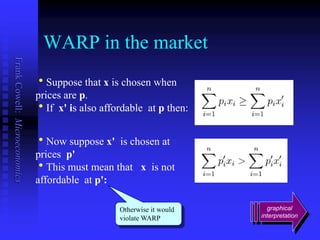
                               Suppose that x is chosen when
                               prices are p.
                               If x' is also affordable at p then:


                               Now suppose x' is chosen at
                               prices p'
                               This must mean that x is not
                               affordable at p':

                                                  Otherwise it would     graphical
                                                  violate WARP         interpretation
WARP in action
Frank Cowell: Microeconomics


                                                                                         Take the original equilibrium
                                x2
                                                                                         Now let the prices change...
                                      Could we have chosen x
                                      on Monday? x violates
                                                                                        WARP rules out some points
                                      WARP; x does not.
                                                                                        as possible solutions


                                                      Tuesday's choice:
                                                      On Monday we could have
                                     x               afforded Tuesday’s bundle

                                                                                          Clearly WARP
                                                x′                                       induces a kind of
                                                                        Monday's          negative substitution
                                                                        choice:
                                                                                          effect
                                                                  x
                                                                                           But could we extend
                                                                                   x1     this idea...?
Trying to Extend WARP
Frank Cowell: Microeconomics


                                                                                                   Take the basic idea of
                                x2                                                                 revealed preference
                                         x″ is revealed
                                         preferred to all                                           Invoke revealed preference
                                         these points.                                             again
                                                                                                    Invoke revealed preference
                                                                                                   yet again
                                         x''        x' is revealed                                 Draw the “envelope”
                                                     preferred to all
                                                     these points.


                                                        x'
                                                                                x is revealed       Is this an “indifference
                                                                                preferred to all
                                                                                these points.      curve”...?
                                                                           x                      No. Why?
                                                                                             x1
Limitations of WARP
Frank Cowell: Microeconomics


                                                     WARP rules out this
                                                     pattern
                                                     ...but not this


                                x            x′

                                                      WARP does not rule out
                                                     cycles of preference
                                                      You need an extra axiom
                                                     to progress further on this:
                                    x″′      x″      the strong axiom of
                                                     revealed preference.
Revealed Preference: is it useful?
Frank Cowell: Microeconomics


                                  You can get a lot from just a little:
                                      You can even work out substitution effects.
                                  WARP provides a simple consistency test:
                                      Useful when considering consumers en masse.
                                      WARP will be used in this way later on.
                                  You do not need any special assumptions
                                   about consumer's motives:
                                      But that's what we're going to try right now.
                                      It’s time to look at the mainstream modelling of
                                       preferences.
Overview...   Consumption:
                                             Basics
Frank Cowell: Microeconomics


                                                The setting

                               Standard
                               approach to      Budget sets
                               modelling
                               preferences
                                                Revealed
                                                Preference

                                                Axiomatic
                                                Approach
The Axiomatic Approach
Frank Cowell: Microeconomics


                                Useful for setting out a priori what we mean
                                 by consumer preferences
                                But, be careful...
                                ...axioms can't be ―right‖ or ―wrong,‖...
                                ... although they could be inappropriate or
                                 over-restrictive
                                That depends on what you want to model
                                Let's start with the basic relation...
The (weak) preference relation
Frank Cowell: Microeconomics


                                The basic weak-preference       "Basket x is regarded as at
                               relation:                         least as good as basket x' ..."

                                    x < x'
                                  From this we can derive the   “ x < x' ” and “ x' < x. ”
                               indifference relation.

                                    x v x'
                                …and the strict preference      “ x < x' ” and not “ x' < x. ”
                               relation…

                                    x  x'
Fundamental preference axioms
Frank Cowell: Microeconomics


                                  Completeness    For every x, x' X either x<x' is true, or
                                                   x'<x is true, or both statements are true
                                  Transitivity
                                  Continuity
                                  Greed
                                  (Strict) Quasi-concavity
                                  Smoothness
Fundamental preference axioms
Frank Cowell: Microeconomics


                                  Completeness
                                  Transitivity    For all x, x' , x″ X if x<x' and x'<x″
                                                   then x<x'″.
                                  Continuity
                                  Greed
                                  (Strict) Quasi-concavity
                                  Smoothness
Fundamental preference axioms
Frank Cowell: Microeconomics


                                  Completeness
                                  Transitivity
                                  Continuity     For all x' X the not-better-than-x' set and
                                                  the not-worse-than-x' set are closed in X
                                  Greed
                                  (Strict) Quasi-concavity
                                  Smoothness
Continuity: an example
Frank Cowell: Microeconomics


                                                                                        Take consumption bundle x .
                                x2                                                       Construct two other
                                                                                        bundles, xL with Less than
                                                                                        x , xM with More
                                                                      Better             There is a set of points like
                                                                      than x ?          xL, and a set like xM
                                                    do we jump straight from
                                                                                         Draw a path joining xL , xM.
                                                    a point marked ―better‖ to
                                                                       M
                                                                    x
                                                    one marked ―worse"?                  If there’s no “jump”…
                                               x         but what about the
                                                          boundary points
                                                          between the two?
                                                                     The indifference
                                        xL                          curve


                                         Worse
                                         than x ?
                                                                                 x1
Axioms 1 to 3 are crucial ...
Frank Cowell: Microeconomics


                               completeness

                               transitivity
                                                     The utility
                               continuity            function
A continuous utility function then
                               represents preferences...
Frank Cowell: Microeconomics


                                x < x'               U(x)   U(x')
Tricks with utility functions
Frank Cowell: Microeconomics


                                U-functions represent preference
                                 orderings.
                                So the utility scales don’t matter.
                                And you can transform the U-function in
                                 any (monotonic) way you want...
Irrelevance of cardinalisation
Frank Cowell: Microeconomics


                                        U(x1, x2,..., xn)      So take any utility function...
                                                                This transformation
                                                               represents the same
                                                               preferences...
                                   log( U(x1, x2,..., xn) )    …and so do both of these
                                                                And, for any monotone
                                                               increasing φ, this represents
                                   exp( U(x1, x2,..., xn) )   the same preferences.


                                      ( U(x1, x2,..., xn) )    U is defined up to a
                                                               monotonic transformation
                                     φ( U(x1, x2,..., xn) )   Each of these forms will
                                                               generate the same
                                                               contours.
                                                               Let’s view this graphically.
A utility function
Frank Cowell: Microeconomics


                                                     Take a slice at given utility level
                                                     Project down to get contours

                                   U(x1,x2)


                                                    The indifference
                                                    curve
                                                                       x2
                               0
Another utility function
Frank Cowell: Microeconomics


                                                      By construction U* = φ(U)
                                                      Again take a slice…
                                      U*(x1,x2)       Project down …


                                                     The same
                                                     indifference curve
                                                                 x2
                               0
Assumptions to give the U-function
                               shape
Frank Cowell: Microeconomics


                                  Completeness
                                  Transitivity
                                  Continuity
                                  Greed
                                  (Strict) Quasi-concavity
                                  Smoothness
The greed axiom
Frank Cowell: Microeconomics


                                                                    Pick any consumption
                                x2                                  bundle in X.
                                                                     Greed implies that these
                                                                     bundles are preferred to x'.
                                                                    Gives a clear “North-East”
                                                                    direction of preference.

                                                     Bliss!
                                                      B             What can happen if
                                                                    consumers are not greedy


                                                                     Greed: utility function is
                                                                    monotonic
                                         x'   


                                                               x1
A key mathematical concept
Frank Cowell: Microeconomics


                                  We’ve previously used the concept of concavity:
                                      Shape of the production function.
                                  But here simple concavity is inappropriate:
                                      The U-function is defined only up to a monotonic transformation.
                                      U may be concave and U2 non-concave even though they represent
                 Review
                 Example
                                       the same preferences.
                                  So we use the concept of ―quasi-concavity‖:
                                      ―Quasi-concave‖ is equivalently known as ―concave contoured‖.
                                      A concave-contoured function has the same contours as a concave
                                       function (the above example).
                                      Somewhat confusingly, when you draw the IC in (x1,x2)-space,
                                       common parlance describes these as ―convex to the origin.‖
                                  It’s important to get your head round this:
                                      Some examples of ICs coming up…
Conventionally shaped indifference
                               curves
Frank Cowell: Microeconomics


                                                                Slope well-defined
                                 x2                             everywhere
                                                                Pick two points on the
                                                                same indifference curve.
                                                               Draw the line joining them.
                                      A                        Any interior point must line
                                                               on a higher indifference
                                                               curve


                                              C                ICs are smooth
                                                               …and strictly concaved-
                                                               contoured
                                                   B
                                                             (-)I.e. strictly quasiconcave
                                                                 Slope is the Marginal
                                                             Rate of Substitution
                                                                             sometimes these
                                                        x1                    U1(x)
                                                                              ——       ..
                                                                             assumptions can
                                                                              U2be relaxed
                                                                                 (x) .
Other types of IC: Kinks
Frank Cowell: Microeconomics


                                                                        Strictly quasiconcave
                                 x2
                                                                        But not everywhere smooth


                                      A


                                                         C
                                       MRS not
                                       defined here


                                                              B


                                                                   x1
Other types of IC: not strictly
                               quasiconcave
Frank Cowell: Microeconomics


                                                                                         Slope well-defined
                                 x2                                                      everywhere
                                                                                         Not quasiconcave
                                                                                         Quasiconcave but not
                                                                                         strictly quasiconcave
                                                   utility here lower
                                                   than at A or B
                                      A

                                              C
                                                   B


                                                                                         Indifference curves
                                                               Indifference curve
                                                               follows axis here         with flat sections make
                                                                                         sense
                                                                                    x1   But may be a little
                                                                                         harder to work with...
Summary: why preferences can be a
                               problem
Frank Cowell: Microeconomics


                                Unlike firms there is no ―obvious‖ objective
                                 function.
                                Unlike firms there is no observable
                                 objective function.
                                And who is to say what constitutes a ―good‖
                                 assumption about preferences...?
Review: basic concepts
Frank Cowell: Microeconomics


                          Review
                                    Consumer’s environment
                          Review
                                    How budget sets work
                        Review
                                    WARP and its meaning
                        Review      Axioms that give you a utility function
                        Review
                                    Axioms that determine its shape
What next?
Frank Cowell: Microeconomics


                                Setting up consumer’s optimisation problem
                                Comparison with that of the firm
                                Solution concepts.
Prerequisites


Almost essential
Firm: Optimisation
Consumption: Basics
  Frank Cowell: Microeconomics


                                 Consumer Optimisation

                                    MICROECONOMICS
                                     Principles and Analysis
                                          Frank Cowell


October 2006
The problem
Frank Cowell: Microeconomics


                                  Maximise consumer’s utility         U assumed to satisfy the
                                          U(x)                         standard “shape” axioms


                                  Subject to feasibility constraint   Assume consumption set X is
                                          x X                          the non-negative orthant.

                                  and to the budget constraint        The version with fixed money
                                           n                           income
                                                pixi ≤ y
                                          i=1
Overview...       Consumer:
                                                 Optimisation
Frank Cowell: Microeconomics


                                                    Primal and
                               Two fundamental      Dual problems
                               views of
                               consumer             Lessons from
                               optimisation         the Firm

                                                    Primal and
                                                    Dual again
An obvious approach?
Frank Cowell: Microeconomics


                                  We now have the elements of a standard
                                   constrained optimisation problem:
                                      the constraints on the consumer.
                                      the objective function.
                                  The next steps might seem obvious:
                                      set up a standard Lagrangean.
                                      solve it.
                                      interpret the solution.
                                  But the obvious approach is not always the most
                                   insightful.
                                  We’re going to try something a little sneakier…
Think laterally...
Frank Cowell: Microeconomics


                                  In microeconomics an optimisation problem can
                                   often be represented in more than one form.
                                  Which form you use depends on the information
                                   you want to get from the solution.
                                  This applies here.
                                  The same consumer optimisation problem can be
                                   seen in two different ways.
                                  I’ve used the labels ―primal‖ and ―dual‖ that have
                                   become standard in the literature.
A five-point plan
                                                                                The primal
Frank Cowell: Microeconomics


                                                                                problem
                                  Set out the basic consumer optimisation
                                   problem.                                The dual
                                                                           problem
                                  Show that the solution is equivalent to
                                   another problem.
                                  Show that this equivalent problem is
                                   identical to that of the firm.              The primal
                                                                               problem again
                                  Write down the solution.
                                  Go back to the problem we first thought of...
The primal problem
Frank Cowell: Microeconomics


                                            Contours of                The consumer aims to
                                      x2                              maximise utility...
                                            objective function
                                                                       Subject to budget constraint
                                                                       Defines the primal problem.
                                                                       Solution to primal problem


                               Constraint
                               set
                                                                      max U(x) subject to
                                                                       n
                                                        x*                 pixi y
                                                                      i=1

                                                                      But there's another way
                                                                 x1   at looking at this
The dual problem
Frank Cowell: Microeconomics


                                                                     Alternatively the consumer
                                 x2
                                 z
                                      q                             could aim to minimise cost...
                                                 Constraint          Subject to utility constraint
                                                 set                 Defines the dual problem.
                                                                     Solution to the problem
                                                                     Cost minimisation by the
                                                                    firm

                                                                    minimise
                                                                     n
                                                                          pixi
                                                       
                                                                   i=1
                                                    x*
                                                    z*              subject to U(x)

                                          Contours of          x1
                                                               z
                                                                     But where have we seen
                                          objective function
                                                                     the dual problem before?
Two types of cost minimisation
Frank Cowell: Microeconomics


                                  The similarity between the two problems is not
                                   just a curiosity.
                                  We can use it to save ourselves work.
                                  All the results that we had for the firm's ―stage 1‖
                                   problem can be used.
                                  We just need to ―translate‖ them intelligently
                                     Swap over the symbols
                                     Swap over the terminology
                                     Relabel the theorems
Overview...       Consumer:
                                                 Optimisation
Frank Cowell: Microeconomics


                                                    Primal and
                               Reusing results      Dual problems
                               on optimisation
                                                    Lessons from
                                                    the Firm

                                                    Primal and
                                                    Dual again
A lesson from the firm
Frank Cowell: Microeconomics


                                                        Compare cost-minimisation
                                                       for the firm...
                                                       ...and for the consumer


                               z2   q        x2                    The difference
                                                                  is only in notation

                                                                   So their
                                                                  solution functions
                                                                  and response
                                                                  functions must be
                                                                the same
                                        z*        x*
                                                                     Run through
                                             z1              x1      formal stuff
Cost-minimisation: strictly
                               quasiconcave U
Frank Cowell: Microeconomics


                                                                            Use the objective function
                                  Minimise           Lagrange             ...and output constraint
                                      n               multiplier           ...to build the Lagrangean
                                            pi xi +   [ – U(x)]
                                                          U(x)              Differentiate w.r.t. x1, ..., xn and
                                      i=1                                  set equal to 0.
                                                                            ... and w.r.t
                                Because of strict quasiconcavity we        Denote cost minimising
                               have an interior solution.                  values with a * .

                                A set of n+1 First-Order Conditions


                                       U1 (x     ) = p1        one for
                                       U2 (x     ) = p2        each good

                                      … …         …
                                       Un (x     ) = pn
                                          = U(x )     utility
                                                      constraint
If ICs can touch the axes...
Frank Cowell: Microeconomics


                                  Minimise
                                      n
                                           pixi +   [ – U(x)]
                                     i=1
                                Now there is the possibility of corner
                               solutions.
                                A set of n+1 First-Order Conditions


                                      U1 (x ) p1
                                      U2 (x ) p2
                                     … … …
                                      Un(x ) pn
                                                                                Interpretation
                                          = U(x )     Can get ―<‖ if optimal
                                                      value of this good is 0
From the FOC
Frank Cowell: Microeconomics


                               If both goods i and j are purchased
                               and MRS is defined then...
                                    Ui(x ) pi
                                    ——— = —
                                    Uj(x ) pj
                                  MRS = price ratio                  “implicit” price = market price

                                  If good i could be zero then...
                                    Ui(x )        pi
                                    ———           —
                                    Uj(x )        pj
                                  MRSji    price ratio               “implicit” price   market price
                                                                                           Solution
The solution...
                                    Solving the FOC, you get a cost-minimising value for
Frank Cowell: Microeconomics


                                  

                                  each good...

                                              xi* = Hi(p, )

                                     ...for the Lagrange multiplier
                                           * = *(p, )
                                   ...and for the minimised value of cost itself.

                                   The consumer’s cost function or expenditure function is

                                  defined as
                                          C(p, ) := min pi xi
                                                         {U(x)      }

                               vector of
                               goods prices         Specified
                                                    utility level
The cost function has the same
                               properties as for the firm
Frank Cowell: Microeconomics


                                Non-decreasing in every price. Increasing in
                                 at least one price
                                Increasing in utility .
                                Concave in p
  Jump to
   “Firm”
                                Homogeneous of degree 1 in all prices p.
                                Shephard's lemma.
Other results follow
Frank Cowell: Microeconomics


                                Shephard's Lemma gives demand       H is the “compensated” or
                               as a function of prices and utility   conditional demand function.
                                    Hi(p, ) = Ci(p, )

                                Properties of the solution          Downward-sloping with respect
                               function determine behaviour of       to its own price, etc…
                               response functions.


                                ―Short-run‖ results can be used     For example rationing.
                               to model side constraints
Comparing firm and consumer
Frank Cowell: Microeconomics


                                  Cost-minimisation by the firm...
                                  ...and expenditure-minimisation by the consumer
                                  ...are effectively identical problems.
                                  So the solution and response functions are the same:

                                            Firm                           Consumer
                                                m                                n
                                Problem: min         wizi + [q –   (z)]   min         pixi + [ – U(x)]
                                            z   i=1                        x     i=1
                                Solution
                                function:
                                            C(w, q)                        C(p, )
                                Response z * = Hi(w, q)                   xi* = Hi(p, )
                                 function: i
Overview...      Consumer:
                                                Optimisation
Frank Cowell: Microeconomics


                                                   Primal and
                               Exploiting the      Dual problems
                               two approaches
                                                   Lessons from
                                                   the Firm

                                                   Primal and
                                                   Dual again
The Primal and the Dual…
Frank Cowell: Microeconomics


                               There’s an attractive symmetry
                               about the two approaches to the   n
                               problem                                 pixi+ [ – U(x)]
                                                                 i=1
                               In both cases the ps are given
                               and you choose the xs. But…                         n
                                                                 U(x) +     [y–         pi xi   ]
                               …constraint in the primal                         i=1
                               becomes objective in the dual…

                                  …and vice versa.
A neat connection
Frank Cowell: Microeconomics


                                                         Compare the primal problem
                                                        of the consumer...
                                                        ...with the dual problem


                               x2            x2                      The two are
                                                                    equivalent

                                                                     So we can link up
                                                                    their solution
                                                                    functions and
                                                                    response functions
                                       x*          
                                                  x*
                                                                       Run through
                                             x1                x1       the primal
Utility maximisation
Frank Cowell: Microeconomics


                                                         Lagrange                   Use the objective function
                                        Maximise        multiplier                ...and budget constraint
                                                                n                  ...to build the Lagrangean
                                         U(x) +   [ y – i=1 p x ]     ii ii
                                                                                    Differentiate w.r.t. x1, ..., xn and
                                                                                   set equal to 0.
                                                                i=1
                                                                                    ... and w.r.t
                                     If U is strictly quasiconcave we have         Denote utility maximising
                                    an interior solution.                          values with a * .

                                     A set of n+1 First-Order Conditions

                                          U1(x ) = p1         If U not strictly
                                                                one for
                                                              quasiconcave then
                                          U2(x ) = p2           each good
                                                              replace ―=‖ by ― ‖
                                          … … …
                                          Un(x ) = pn
                               budget             n
                               constraint                                                          Interpretation
                                            y =         pi xi
                                                  i=1
From the FOC
Frank Cowell: Microeconomics


                               If both goods i and j are purchased
                               and MRS is defined then...
                                    Ui(x ) pi                        (same as before)
                                    ——— = —
                                    Uj(x ) pj
                                  MRS = price ratio                  “implicit” price = market price

                                  If good i could be zero then...
                                    Ui(x )        pi
                                    ———           —
                                    Uj(x )        pj
                                  MRSji    price ratio               “implicit” price   market price
                                                                                           Solution
The solution...
Frank Cowell: Microeconomics


                                     Solving the FOC, you get a utility-maximising value for
                                    each good...
                                        xi* = Di(p, y)
                                        ...for the Lagrange multiplier
                                              * = *(p, y)
                                      ...and for the maximised value of utility itself.
                                      The indirect utility function is defined as


                                           V(p, y) := max U(x)
                                                             { pixi y}
                               vector of            money
                               goods prices         income
A useful connection
Frank Cowell: Microeconomics


                                The indirect utility function maps     The indirect utility function works
                               prices and budget into maximal utility   like an "inverse" to the cost
                                        = V(p, y)                       function

                                The cost function maps prices and      The two solution functions have
                               utility into minimal budget              to be consistent with each other.
                                      y = C(p, )                        Two sides of the same coin


                                  Therefore we have:
                                                                        Odd-looking identities like these
                                       = V(p, C(p, ))                   can be useful
                                     y = C(p, V(p, y))
The Indirect Utility Function has
                               some familiar properties...
Frank Cowell: Microeconomics


                               (All of these can be established using the known
                               properties of the cost function)

                                  Non-increasing in every price. Decreasing in at
                                   least one price
                                  Increasing in income y.
                                  quasi-convex in prices p
                                  Homogeneous of degree zero in (p, y)
                                                    But what’s
                                                    this…?
                                  Roy's Identity
Roy's Identity
Frank Cowell: Microeconomics


                                 = V(p, y)= V(p, C(p, ))     ―function-of-a-            Use the definition of the
                                                             function‖ rule            optimum
                                                                                        Differentiate w.r.t. pi .
                               0 = Vi(p,C(p, )) + Vy(p,C(p, )) Ci(p, )                  Use Shephard’s Lemma
                                                                                        Rearrange to get…
                                                                                        So we also have…
                               0 = Vi(p, y)     + Vy(p, y)         xi*
                                                             Marginal disutility
                                                             of price i
                                              Vi(p, y)           Marginal utility of
                                      xi* = – ————               money income
                                               Vy(p, y)
                                                                       Ordinary demand
                                                                       function
                               xi* = –Vi(p, y)/Vy(p, y) = Di(p, y)
Utility and expenditure
Frank Cowell: Microeconomics


                                  Utility maximisation
                                  ...and expenditure-minimisation by the consumer
                                  ...are effectively two aspects of the same problem.
                                  So their solution and response functions are closely connected:

                                            Primal                                 Dual
                                                                  n                      n
                                Problem: max U(x) +       [y –         pixi   ]   min
                                                                                   x     i=1
                                                                                               pixi + [ – U(x)]
                                             x                    i=1
                                Solution
                                function:
                                            V(p, y)                                C(p, )
                                Response x * = Di(p, y)                           xi* = Hi(p, )
                                 function: i
Summary
Frank Cowell: Microeconomics


                                   A lot of the basic results of the consumer theory
                                    can be found without too much hard work.
                                   We need two ―tricks‖:

                               1.   A simple relabelling exercise:
                                       cost minimisation is reinterpreted from output targets
                                        to utility targets.
                               2.   The primal-dual insight:
                                       utility maximisation subject to budget is equivalent to
                                        cost minimisation subject to utility.
1. Cost minimisation: two applications
Frank Cowell: Microeconomics


                                  THE FIRM                THE CONSUMER

                                  min cost of inputs      min budget

                                  subject to output       subject to utility
                                   target                   target

                                  Solution is of the      Solution is of the
                                   form C(w,q)              form C(p, )
2. Consumer: equivalent approaches
Frank Cowell: Microeconomics


                                  PRIMAL                 DUAL

                                  max utility            min budget

                                  subject to budget      subject to utility
                                   constraint              constraint

                                  Solution is a          Solution is a
                                   function of (p,y)       function of (p, )
Basic functional relations
Frank Cowell: Microeconomics


                                             Utility


    Review
                                  C(p, )        cost (expenditure)    H is also known as
                                                                       "Hicksian" demand.

                                                 Compensated demand
     Review                       Hi(p,   )     for good i

      Review                      V(p, y)       indirect utility

                                                 ordinary demand for
    Review
                                  Di(p,   y)    input i
                                                money
                                                income
What next?
Frank Cowell: Microeconomics


                                Examine the response of consumer demand
                                 to changes in prices and incomes.
                                Household supply of goods to the market.
                                Develop the concept of consumer welfare

Consumption basics

  • 1.
    Frank Cowell: Microeconomics Consumption Basics MICROECONOMICS Principles and Analysis Frank Cowell October 2006
  • 2.
    Overview... Consumption: Basics Frank Cowell: Microeconomics The setting The environment for the basic Budget sets consumer optimisation problem. Revealed Preference Axiomatic Approach
  • 3.
    Notation Frank Cowell: Microeconomics  Quantities a ―basket xi of goods •amount of commodity i x = (x1, x2 , ..., xn) •commodity vector X •consumption set x X denotes feasibility  Prices pi •price of commodity i p = (p1 , p2 ,..., pn) •price vector y •income
  • 4.
    Things that shapethe consumer's problem Frank Cowell: Microeconomics  The set X and the number y are both important.  But they are associated with two distinct types of constraint.  We'll save y for later and handle X now.  (And we haven't said anything yet about objectives...)
  • 5.
    The consumption set FrankCowell: Microeconomics  The set X describes the basic entities of the consumption problem.  Not a description of the consumer’s opportunities.  That comes later.  Use it to make clear the type of choice problem we are dealing with; for example:  Discrete versus continuous choice (refrigerators vs. contents of refrigerators)  Is negative consumption ruled out?  ―x X ‖ means ―x belongs the set of logically feasible baskets.‖
  • 6.
    The set X:standard assumptions Frank Cowell: Microeconomics Axes indicate quantities of x2 the two goods x1 and x2. Usually assume that X consists of the whole non- negative orthant. Zero consumptions make good economic sense But negative consumptions ruled out by definition no points  Consumption goods are here… (theoretically) divisible…  …and indefinitely x1 extendable… …or here  But only in the ++ direction
  • 7.
    Rules out thiscase... Frank Cowell: Microeconomics Consumption set X x2 consists of a countable number of points  Conventional assumption does not allow for indivisible objects. x1  But suitably modified assumptions may be appropriate
  • 8.
    ... and this FrankCowell: Microeconomics Consumption set X has x2 holes in it x1
  • 9.
    ... and this FrankCowell: Microeconomics Consumption set X has x2 ˉ the restriction x1 < x  Conventional assumption does not allow for physical upper bounds x1  But there are several ˉ x economic applications where this is relevant
  • 10.
    Overview... Consumption: Basics Frank Cowell: Microeconomics The setting Budget constraints: Budget sets prices, incomes and resources Revealed Preference Axiomatic Approach
  • 11.
    The budget constraint FrankCowell: Microeconomics The budget constraint x2 typically looks like this Slope is determined by price ratio. “Distance out” of budget line fixed by income or resources Two important subcases determined by 1. … amount of money income y. p1 – __ p2 2. …vector of resources R x1 Let’s see
  • 12.
    Case 1: fixednominal income Frank Cowell: Microeconomics y  Budget constraint __ . x2 . p2 determined by the two end- points  Examine the effect of  changing p1 by “swinging” the boundary thus…  Budget constraint is n pixi ≤ y i=1 y __ . . p1  x1
  • 13.
    Case 2: fixedresource endowment Frank Cowell: Microeconomics  Budget constraint x2 determined by location of “resources” endowment R.  Examine the effect of changing p1 by “swinging” the boundary thus… n  Budget constraint is y= piRi n n i=1 pixi ≤ piRi i=1 i=1 R x1
  • 14.
    Budget constraint: Keypoints Frank Cowell: Microeconomics  Slope of the budget constraint given by price ratio.  There is more than one way of specifying ―income‖:  Determined exogenously as an amount y.  Determined endogenously from resources.  The exact specification can affect behaviour when prices change.  Take care when income is endogenous.  Value of income is determined by prices.
  • 15.
    Overview... Consumption: Basics Frank Cowell: Microeconomics The setting Deducing preference from Budget sets market behaviour? Revealed Preference Axiomatic Approach
  • 16.
    A basic problem FrankCowell: Microeconomics  In the case of the firm we have an observable constraint set (input requirement set)…  …and we can reasonably assume an obvious objective function (profits)  But, for the consumer it is more difficult.  We have an observable constraint set (budget set)…  But what objective function?
  • 17.
    The Axiomatic Approach FrankCowell: Microeconomics  We could ―invent‖ an objective function.  This is more reasonable than it may sound:  It is the standard approach.  See later in this presentation.  But some argue that we should only use what we can observe:  Test from market data?  The ―revealed preference‖ approach.  Deal with this now.  Could we develop a coherent theory on this basis alone?
  • 18.
    Using observables only FrankCowell: Microeconomics  Model the opportunities faced by a consumer  Observe the choices made  Introduce some minimal ―consistency‖ axioms  Use them to derive testable predictions about consumer behaviour
  • 19.
    ―Revealed Preference‖ Frank Cowell:Microeconomics  Let market prices x2 determine a person's budget constraint.. Suppose the person chooses bundle x... x is example x is For revealed preferred to all revealed  Use this to introduce these points.x′ preferred to Revealed Preference  x′ x x1
  • 20.
    Axioms of RevealedPreference Frank Cowell: Microeconomics  Axiom of Rational Choice Essential if observations are to have meaning the consumer always makes a choice, and selects the most preferred bundle that is available. Weak Axiom of Revealed If x was chosen when x' was Preference (WARP) available then x' can never be chosen whenever x is available If x RP x' then x' not-RP x. WARP is more powerful than might be thought
  • 21.
    WARP in themarket Frank Cowell: Microeconomics Suppose that x is chosen when prices are p. If x' is also affordable at p then: Now suppose x' is chosen at prices p' This must mean that x is not affordable at p': Otherwise it would graphical violate WARP interpretation
  • 22.
    WARP in action FrankCowell: Microeconomics  Take the original equilibrium x2  Now let the prices change... Could we have chosen x on Monday? x violates WARP rules out some points WARP; x does not. as possible solutions Tuesday's choice: On Monday we could have x afforded Tuesday’s bundle Clearly WARP  x′ induces a kind of Monday's negative substitution choice: effect  x  But could we extend x1 this idea...?
  • 23.
    Trying to ExtendWARP Frank Cowell: Microeconomics Take the basic idea of x2 revealed preference x″ is revealed preferred to all  Invoke revealed preference these points. again  Invoke revealed preference yet again  x'' x' is revealed  Draw the “envelope” preferred to all these points.  x' x is revealed  Is this an “indifference preferred to all these points. curve”...?  x No. Why? x1
  • 24.
    Limitations of WARP FrankCowell: Microeconomics WARP rules out this pattern ...but not this x x′  WARP does not rule out cycles of preference  You need an extra axiom to progress further on this: x″′ x″ the strong axiom of revealed preference.
  • 25.
    Revealed Preference: isit useful? Frank Cowell: Microeconomics  You can get a lot from just a little:  You can even work out substitution effects.  WARP provides a simple consistency test:  Useful when considering consumers en masse.  WARP will be used in this way later on.  You do not need any special assumptions about consumer's motives:  But that's what we're going to try right now.  It’s time to look at the mainstream modelling of preferences.
  • 26.
    Overview... Consumption: Basics Frank Cowell: Microeconomics The setting Standard approach to Budget sets modelling preferences Revealed Preference Axiomatic Approach
  • 27.
    The Axiomatic Approach FrankCowell: Microeconomics  Useful for setting out a priori what we mean by consumer preferences  But, be careful...  ...axioms can't be ―right‖ or ―wrong,‖...  ... although they could be inappropriate or over-restrictive  That depends on what you want to model  Let's start with the basic relation...
  • 28.
    The (weak) preferencerelation Frank Cowell: Microeconomics  The basic weak-preference "Basket x is regarded as at relation: least as good as basket x' ..." x < x'  From this we can derive the “ x < x' ” and “ x' < x. ” indifference relation. x v x'  …and the strict preference “ x < x' ” and not “ x' < x. ” relation… x  x'
  • 29.
    Fundamental preference axioms FrankCowell: Microeconomics  Completeness For every x, x' X either x<x' is true, or x'<x is true, or both statements are true  Transitivity  Continuity  Greed  (Strict) Quasi-concavity  Smoothness
  • 30.
    Fundamental preference axioms FrankCowell: Microeconomics  Completeness  Transitivity For all x, x' , x″ X if x<x' and x'<x″ then x<x'″.  Continuity  Greed  (Strict) Quasi-concavity  Smoothness
  • 31.
    Fundamental preference axioms FrankCowell: Microeconomics  Completeness  Transitivity  Continuity For all x' X the not-better-than-x' set and the not-worse-than-x' set are closed in X  Greed  (Strict) Quasi-concavity  Smoothness
  • 32.
    Continuity: an example FrankCowell: Microeconomics Take consumption bundle x . x2  Construct two other bundles, xL with Less than x , xM with More Better  There is a set of points like than x ? xL, and a set like xM do we jump straight from  Draw a path joining xL , xM. a point marked ―better‖ to M  x one marked ―worse"?  If there’s no “jump”…  x but what about the boundary points between the two? The indifference  xL curve Worse than x ? x1
  • 33.
    Axioms 1 to3 are crucial ... Frank Cowell: Microeconomics completeness transitivity The utility continuity function
  • 34.
    A continuous utilityfunction then represents preferences... Frank Cowell: Microeconomics x < x' U(x) U(x')
  • 35.
    Tricks with utilityfunctions Frank Cowell: Microeconomics  U-functions represent preference orderings.  So the utility scales don’t matter.  And you can transform the U-function in any (monotonic) way you want...
  • 36.
    Irrelevance of cardinalisation FrankCowell: Microeconomics  U(x1, x2,..., xn)  So take any utility function...  This transformation represents the same preferences...  log( U(x1, x2,..., xn) )  …and so do both of these  And, for any monotone increasing φ, this represents  exp( U(x1, x2,..., xn) ) the same preferences.  ( U(x1, x2,..., xn) )  U is defined up to a monotonic transformation  φ( U(x1, x2,..., xn) ) Each of these forms will generate the same contours. Let’s view this graphically.
  • 37.
    A utility function FrankCowell: Microeconomics  Take a slice at given utility level  Project down to get contours U(x1,x2) The indifference curve x2 0
  • 38.
    Another utility function FrankCowell: Microeconomics  By construction U* = φ(U)  Again take a slice… U*(x1,x2)  Project down … The same indifference curve x2 0
  • 39.
    Assumptions to givethe U-function shape Frank Cowell: Microeconomics  Completeness  Transitivity  Continuity  Greed  (Strict) Quasi-concavity  Smoothness
  • 40.
    The greed axiom FrankCowell: Microeconomics Pick any consumption x2 bundle in X. Greed implies that these bundles are preferred to x'. Gives a clear “North-East” direction of preference.  Bliss! B What can happen if consumers are not greedy  Greed: utility function is monotonic x'  x1
  • 41.
    A key mathematicalconcept Frank Cowell: Microeconomics  We’ve previously used the concept of concavity:  Shape of the production function.  But here simple concavity is inappropriate:  The U-function is defined only up to a monotonic transformation.  U may be concave and U2 non-concave even though they represent Review Example the same preferences.  So we use the concept of ―quasi-concavity‖:  ―Quasi-concave‖ is equivalently known as ―concave contoured‖.  A concave-contoured function has the same contours as a concave function (the above example).  Somewhat confusingly, when you draw the IC in (x1,x2)-space, common parlance describes these as ―convex to the origin.‖  It’s important to get your head round this:  Some examples of ICs coming up…
  • 42.
    Conventionally shaped indifference curves Frank Cowell: Microeconomics Slope well-defined x2 everywhere Pick two points on the same indifference curve. Draw the line joining them. A  Any interior point must line on a higher indifference curve  C  ICs are smooth …and strictly concaved- contoured B (-)I.e. strictly quasiconcave Slope is the Marginal Rate of Substitution sometimes these x1 U1(x) —— .. assumptions can U2be relaxed (x) .
  • 43.
    Other types ofIC: Kinks Frank Cowell: Microeconomics Strictly quasiconcave x2 But not everywhere smooth A  C MRS not defined here B x1
  • 44.
    Other types ofIC: not strictly quasiconcave Frank Cowell: Microeconomics Slope well-defined x2 everywhere Not quasiconcave Quasiconcave but not strictly quasiconcave utility here lower than at A or B A  C B Indifference curves Indifference curve follows axis here with flat sections make sense x1 But may be a little harder to work with...
  • 45.
    Summary: why preferencescan be a problem Frank Cowell: Microeconomics  Unlike firms there is no ―obvious‖ objective function.  Unlike firms there is no observable objective function.  And who is to say what constitutes a ―good‖ assumption about preferences...?
  • 46.
    Review: basic concepts FrankCowell: Microeconomics Review  Consumer’s environment Review  How budget sets work Review  WARP and its meaning Review  Axioms that give you a utility function Review  Axioms that determine its shape
  • 47.
    What next? Frank Cowell:Microeconomics  Setting up consumer’s optimisation problem  Comparison with that of the firm  Solution concepts.
  • 48.
    Prerequisites Almost essential Firm: Optimisation Consumption:Basics Frank Cowell: Microeconomics Consumer Optimisation MICROECONOMICS Principles and Analysis Frank Cowell October 2006
  • 49.
    The problem Frank Cowell:Microeconomics  Maximise consumer’s utility U assumed to satisfy the U(x) standard “shape” axioms  Subject to feasibility constraint Assume consumption set X is x X the non-negative orthant.  and to the budget constraint The version with fixed money n income pixi ≤ y i=1
  • 50.
    Overview... Consumer: Optimisation Frank Cowell: Microeconomics Primal and Two fundamental Dual problems views of consumer Lessons from optimisation the Firm Primal and Dual again
  • 51.
    An obvious approach? FrankCowell: Microeconomics  We now have the elements of a standard constrained optimisation problem:  the constraints on the consumer.  the objective function.  The next steps might seem obvious:  set up a standard Lagrangean.  solve it.  interpret the solution.  But the obvious approach is not always the most insightful.  We’re going to try something a little sneakier…
  • 52.
    Think laterally... Frank Cowell:Microeconomics  In microeconomics an optimisation problem can often be represented in more than one form.  Which form you use depends on the information you want to get from the solution.  This applies here.  The same consumer optimisation problem can be seen in two different ways.  I’ve used the labels ―primal‖ and ―dual‖ that have become standard in the literature.
  • 53.
    A five-point plan The primal Frank Cowell: Microeconomics problem  Set out the basic consumer optimisation problem. The dual problem  Show that the solution is equivalent to another problem.  Show that this equivalent problem is identical to that of the firm. The primal problem again  Write down the solution.  Go back to the problem we first thought of...
  • 54.
    The primal problem FrankCowell: Microeconomics Contours of  The consumer aims to x2 maximise utility... objective function  Subject to budget constraint  Defines the primal problem.  Solution to primal problem Constraint set max U(x) subject to n  x* pixi y i=1 But there's another way x1 at looking at this
  • 55.
    The dual problem FrankCowell: Microeconomics  Alternatively the consumer x2 z q could aim to minimise cost... Constraint  Subject to utility constraint set  Defines the dual problem.  Solution to the problem  Cost minimisation by the firm minimise n pixi   i=1 x* z* subject to U(x) Contours of x1 z But where have we seen objective function the dual problem before?
  • 56.
    Two types ofcost minimisation Frank Cowell: Microeconomics  The similarity between the two problems is not just a curiosity.  We can use it to save ourselves work.  All the results that we had for the firm's ―stage 1‖ problem can be used.  We just need to ―translate‖ them intelligently  Swap over the symbols  Swap over the terminology  Relabel the theorems
  • 57.
    Overview... Consumer: Optimisation Frank Cowell: Microeconomics Primal and Reusing results Dual problems on optimisation Lessons from the Firm Primal and Dual again
  • 58.
    A lesson fromthe firm Frank Cowell: Microeconomics  Compare cost-minimisation for the firm... ...and for the consumer z2 q x2  The difference is only in notation  So their solution functions and response functions must be   the same z* x* Run through z1 x1 formal stuff
  • 59.
    Cost-minimisation: strictly quasiconcave U Frank Cowell: Microeconomics  Use the objective function  Minimise Lagrange ...and output constraint n multiplier ...to build the Lagrangean pi xi + [ – U(x)] U(x)  Differentiate w.r.t. x1, ..., xn and i=1 set equal to 0.  ... and w.r.t  Because of strict quasiconcavity we  Denote cost minimising have an interior solution. values with a * .  A set of n+1 First-Order Conditions U1 (x ) = p1 one for U2 (x ) = p2 each good … … … Un (x ) = pn = U(x ) utility constraint
  • 60.
    If ICs cantouch the axes... Frank Cowell: Microeconomics  Minimise n pixi + [ – U(x)] i=1  Now there is the possibility of corner solutions.  A set of n+1 First-Order Conditions U1 (x ) p1 U2 (x ) p2 … … … Un(x ) pn Interpretation = U(x ) Can get ―<‖ if optimal value of this good is 0
  • 61.
    From the FOC FrankCowell: Microeconomics If both goods i and j are purchased and MRS is defined then... Ui(x ) pi ——— = — Uj(x ) pj  MRS = price ratio  “implicit” price = market price  If good i could be zero then... Ui(x ) pi ——— — Uj(x ) pj  MRSji price ratio  “implicit” price market price Solution
  • 62.
    The solution... Solving the FOC, you get a cost-minimising value for Frank Cowell: Microeconomics  each good... xi* = Hi(p, )  ...for the Lagrange multiplier * = *(p, )  ...and for the minimised value of cost itself.  The consumer’s cost function or expenditure function is defined as C(p, ) := min pi xi {U(x) } vector of goods prices Specified utility level
  • 63.
    The cost functionhas the same properties as for the firm Frank Cowell: Microeconomics  Non-decreasing in every price. Increasing in at least one price  Increasing in utility .  Concave in p Jump to “Firm”  Homogeneous of degree 1 in all prices p.  Shephard's lemma.
  • 64.
    Other results follow FrankCowell: Microeconomics  Shephard's Lemma gives demand H is the “compensated” or as a function of prices and utility conditional demand function. Hi(p, ) = Ci(p, )  Properties of the solution Downward-sloping with respect function determine behaviour of to its own price, etc… response functions.  ―Short-run‖ results can be used For example rationing. to model side constraints
  • 65.
    Comparing firm andconsumer Frank Cowell: Microeconomics  Cost-minimisation by the firm...  ...and expenditure-minimisation by the consumer  ...are effectively identical problems.  So the solution and response functions are the same: Firm Consumer m n  Problem: min wizi + [q – (z)] min pixi + [ – U(x)] z i=1 x i=1  Solution function: C(w, q) C(p, )  Response z * = Hi(w, q) xi* = Hi(p, ) function: i
  • 66.
    Overview... Consumer: Optimisation Frank Cowell: Microeconomics Primal and Exploiting the Dual problems two approaches Lessons from the Firm Primal and Dual again
  • 67.
    The Primal andthe Dual… Frank Cowell: Microeconomics There’s an attractive symmetry about the two approaches to the n problem pixi+ [ – U(x)] i=1 In both cases the ps are given and you choose the xs. But… n U(x) + [y– pi xi ] …constraint in the primal i=1 becomes objective in the dual…  …and vice versa.
  • 68.
    A neat connection FrankCowell: Microeconomics  Compare the primal problem of the consumer... ...with the dual problem x2 x2  The two are equivalent  So we can link up their solution functions and response functions  x*  x* Run through x1 x1 the primal
  • 69.
    Utility maximisation Frank Cowell:Microeconomics Lagrange  Use the objective function  Maximise multiplier ...and budget constraint n ...to build the Lagrangean U(x) + [ y – i=1 p x ] ii ii  Differentiate w.r.t. x1, ..., xn and set equal to 0. i=1  ... and w.r.t  If U is strictly quasiconcave we have  Denote utility maximising an interior solution. values with a * .  A set of n+1 First-Order Conditions U1(x ) = p1 If U not strictly one for quasiconcave then U2(x ) = p2 each good replace ―=‖ by ― ‖ … … … Un(x ) = pn budget n constraint Interpretation y = pi xi i=1
  • 70.
    From the FOC FrankCowell: Microeconomics If both goods i and j are purchased and MRS is defined then... Ui(x ) pi (same as before) ——— = — Uj(x ) pj  MRS = price ratio  “implicit” price = market price  If good i could be zero then... Ui(x ) pi ——— — Uj(x ) pj  MRSji price ratio  “implicit” price market price Solution
  • 71.
    The solution... Frank Cowell:Microeconomics  Solving the FOC, you get a utility-maximising value for each good... xi* = Di(p, y)  ...for the Lagrange multiplier * = *(p, y)  ...and for the maximised value of utility itself.  The indirect utility function is defined as V(p, y) := max U(x) { pixi y} vector of money goods prices income
  • 72.
    A useful connection FrankCowell: Microeconomics  The indirect utility function maps The indirect utility function works prices and budget into maximal utility like an "inverse" to the cost = V(p, y) function  The cost function maps prices and The two solution functions have utility into minimal budget to be consistent with each other. y = C(p, ) Two sides of the same coin  Therefore we have: Odd-looking identities like these = V(p, C(p, )) can be useful y = C(p, V(p, y))
  • 73.
    The Indirect UtilityFunction has some familiar properties... Frank Cowell: Microeconomics (All of these can be established using the known properties of the cost function)  Non-increasing in every price. Decreasing in at least one price  Increasing in income y.  quasi-convex in prices p  Homogeneous of degree zero in (p, y) But what’s this…?  Roy's Identity
  • 74.
    Roy's Identity Frank Cowell:Microeconomics = V(p, y)= V(p, C(p, )) ―function-of-a-  Use the definition of the function‖ rule optimum  Differentiate w.r.t. pi . 0 = Vi(p,C(p, )) + Vy(p,C(p, )) Ci(p, )  Use Shephard’s Lemma  Rearrange to get…  So we also have… 0 = Vi(p, y) + Vy(p, y) xi* Marginal disutility of price i Vi(p, y) Marginal utility of xi* = – ———— money income Vy(p, y) Ordinary demand function xi* = –Vi(p, y)/Vy(p, y) = Di(p, y)
  • 75.
    Utility and expenditure FrankCowell: Microeconomics  Utility maximisation  ...and expenditure-minimisation by the consumer  ...are effectively two aspects of the same problem.  So their solution and response functions are closely connected: Primal Dual n n  Problem: max U(x) + [y – pixi ] min x i=1 pixi + [ – U(x)] x i=1  Solution function: V(p, y) C(p, )  Response x * = Di(p, y) xi* = Hi(p, ) function: i
  • 76.
    Summary Frank Cowell: Microeconomics  A lot of the basic results of the consumer theory can be found without too much hard work.  We need two ―tricks‖: 1. A simple relabelling exercise:  cost minimisation is reinterpreted from output targets to utility targets. 2. The primal-dual insight:  utility maximisation subject to budget is equivalent to cost minimisation subject to utility.
  • 77.
    1. Cost minimisation:two applications Frank Cowell: Microeconomics  THE FIRM  THE CONSUMER  min cost of inputs  min budget  subject to output  subject to utility target target  Solution is of the  Solution is of the form C(w,q) form C(p, )
  • 78.
    2. Consumer: equivalentapproaches Frank Cowell: Microeconomics  PRIMAL  DUAL  max utility  min budget  subject to budget  subject to utility constraint constraint  Solution is a  Solution is a function of (p,y) function of (p, )
  • 79.
    Basic functional relations FrankCowell: Microeconomics Utility Review  C(p, ) cost (expenditure) H is also known as "Hicksian" demand. Compensated demand Review  Hi(p, ) for good i Review  V(p, y) indirect utility ordinary demand for Review  Di(p, y) input i money income
  • 80.
    What next? Frank Cowell:Microeconomics  Examine the response of consumer demand to changes in prices and incomes.  Household supply of goods to the market.  Develop the concept of consumer welfare