Your next competitive advantage?


       Senior Executive Programme
            Jeroen De Flander
          London, 28 June 2011
What are the key points about Strategy
  Execution that have been made in
      this executive programme?


                           “However beautiful the strategy,
                you should occasionally look at the results”
                                         - Sir Winston Churchill
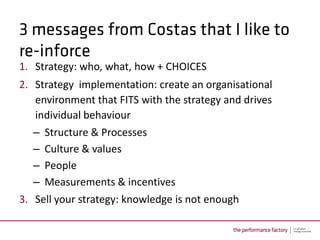
1. Strategy: who, what, how + CHOICES
2. Strategy implementation: create an organisational
   environment that FITS with the strategy and drives
   individual behaviour
  –   Structure & Processes
  –   Culture & values
  –   People
  –   Measurements & incentives
3. Sell your strategy: knowledge is not enough
What are the Strategy Execution
challenges that you were faced with
            in the past?


                        “However beautiful the strategy,
             you should occasionally look at the results”
                                      - Sir Winston Churchill
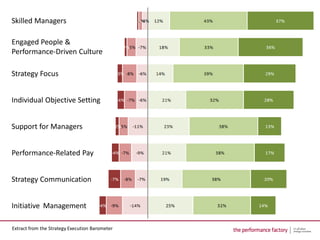
Skilled Managers

Engaged People &
Performance-Driven Culture

Strategy Focus


Individual Objective Setting


Support for Managers


Performance-Related Pay


Strategy Communication


Initiative Management

Extract from the Strategy Execution Barometer
Back-up slides


      “Don’t measure performance by what you
     have accomplished, but by what you should
     have accomplished within your capabilities.”
What are the capabilities you need to
     excel at strategy execution?


                 “Don’t measure performance by what you
                have accomplished, but by what you should
                have accomplished within your capabilities.”
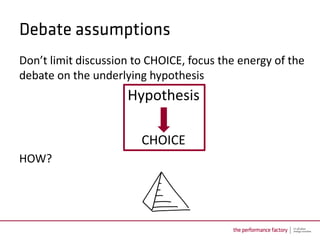
Don’t limit discussion to CHOICE, focus the energy of the
debate on the underlying hypothesis
                     Hypothesis

                        CHOICE
HOW?
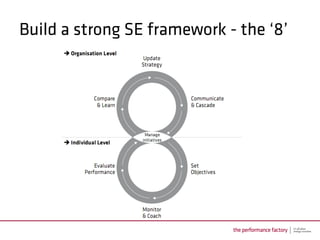
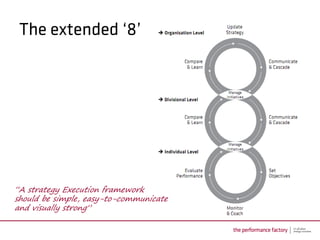
“A strategy Execution framework
should be simple, easy-to-communicate
and visually strong”
1 hour every quarter in a company with 1000 employees
                            =
               2.6 full time equivalents !


     “Any intelligent fool can make things bigger and more complex.
               It takes a touch of genius – and a lot of courage – to
                                      move in the opposite direction”
                                                        - Albert Einstein
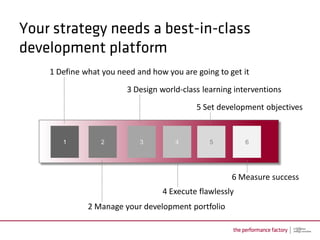
1 Define what you need and how you are going to get it
                    3 Design world-class learning interventions
                                       5 Set development objectives


   1         2          3         4        5         6


                                                 6 Measure success
                              4 Execute flawlessly
          2 Manage your development portfolio

                                                                  13
How to increase the sell-ability of your
               strategy?


                   “Don’t measure performance by what you
                  have accomplished, but by what you should
                  have accomplished within your capabilities.”
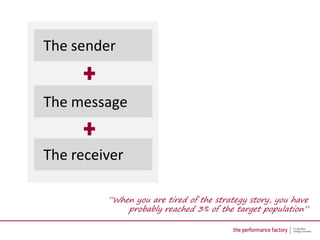
The sender


The message


The receiver

         “When you are tired of the strategy story, you have
             probably reached 3% of the target population”
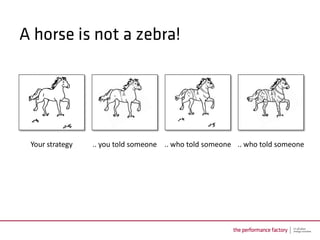
Your strategy   .. you told someone .. who told someone .. who told someone
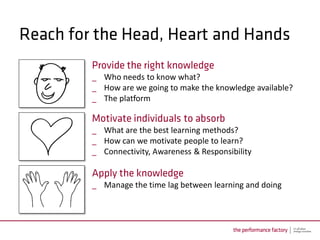
_ Who needs to know what?
_ How are we going to make the knowledge available?
_ The platform


_ What are the best learning methods?
_ How can we motivate people to learn?
_ Connectivity, Awareness & Responsibility


_ Manage the time lag between learning and doing
... a visual
… a compelling business case that creates enthusiasm and inspires
    people
… a simple storyline so it’s easy for employees to pick it up and
    repeat the story vividly at the kitchen table
… consistency. Stick to the message and make sure others do too
… to be easy to relate to. People need to see how they fit in
… great communication skills to get the strategy into the heads,
    hands and harts of the employees
… a heavy investment in awareness creation
… role models
AWARENESS
              +
RESPONSIBILITY
“Coaching is unlocking a person’s potential to maximise
     their own performance. It’s helping them to learn
                            rather than teaching them.
                                             - Tim Gallwey
When your employee says ‘yes’ to the strategy....
                      ....what does (s)he really say?

                 I will make the strategy happen, no matter what
                                          or
               I will work hard (effort ) to implement the strategy
                                          or
  I see the benefits of the strategy and will contribute to the implementation
                                          or
             I don’t see the benefits but don’t want to loose my job
                                          or
I’m against the strategy, don’t want to implement but I don’t tell it in your face
Individual objective setting is not about the
     SMART technique, it’s about creating
   emotional commitment to the strategy
   and answering the “What’s in it for me”
                   question?
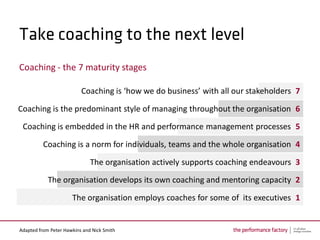
Coaching - the 7 maturity stages

                          Coaching is ‘how we do business’ with all our stakeholders 7

Coaching is the predominant style of managing throughout the organisation 6

 Coaching is embedded in the HR and performance management processes 5

          Coaching is a norm for individuals, teams and the whole organisation 4

                              The organisation actively supports coaching endeavours 3
            The organisation develops its own coaching and mentoring capacity 2

                      The organisation employs coaches for some of its executives 1


Adapted from Peter Hawkins and Nick Smith
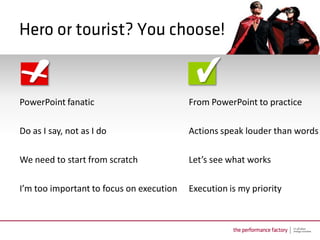
PowerPoint fanatic                        From PowerPoint to practice

Do as I say, not as I do                  Actions speak louder than words

We need to start from scratch             Let’s see what works

I’m too important to focus on execution   Execution is my priority
Your next competitive advantage?

London Business School - senior executive programme

  • 1.
    Your next competitiveadvantage? Senior Executive Programme Jeroen De Flander London, 28 June 2011
  • 2.
    What are thekey points about Strategy Execution that have been made in this executive programme? “However beautiful the strategy, you should occasionally look at the results” - Sir Winston Churchill
  • 3.
    1. Strategy: who,what, how + CHOICES 2. Strategy implementation: create an organisational environment that FITS with the strategy and drives individual behaviour – Structure & Processes – Culture & values – People – Measurements & incentives 3. Sell your strategy: knowledge is not enough
  • 4.
    What are theStrategy Execution challenges that you were faced with in the past? “However beautiful the strategy, you should occasionally look at the results” - Sir Winston Churchill
  • 5.
    Skilled Managers Engaged People& Performance-Driven Culture Strategy Focus Individual Objective Setting Support for Managers Performance-Related Pay Strategy Communication Initiative Management Extract from the Strategy Execution Barometer
  • 6.
    Back-up slides “Don’t measure performance by what you have accomplished, but by what you should have accomplished within your capabilities.”
  • 8.
    What are thecapabilities you need to excel at strategy execution? “Don’t measure performance by what you have accomplished, but by what you should have accomplished within your capabilities.”
  • 9.
    Don’t limit discussionto CHOICE, focus the energy of the debate on the underlying hypothesis Hypothesis CHOICE HOW?
  • 11.
    “A strategy Executionframework should be simple, easy-to-communicate and visually strong”
  • 12.
    1 hour everyquarter in a company with 1000 employees = 2.6 full time equivalents ! “Any intelligent fool can make things bigger and more complex. It takes a touch of genius – and a lot of courage – to move in the opposite direction” - Albert Einstein
  • 13.
    1 Define whatyou need and how you are going to get it 3 Design world-class learning interventions 5 Set development objectives 1 2 3 4 5 6 6 Measure success 4 Execute flawlessly 2 Manage your development portfolio 13
  • 15.
    How to increasethe sell-ability of your strategy? “Don’t measure performance by what you have accomplished, but by what you should have accomplished within your capabilities.”
  • 16.
    The sender The message Thereceiver “When you are tired of the strategy story, you have probably reached 3% of the target population”
  • 17.
    Your strategy .. you told someone .. who told someone .. who told someone
  • 18.
    _ Who needsto know what? _ How are we going to make the knowledge available? _ The platform _ What are the best learning methods? _ How can we motivate people to learn? _ Connectivity, Awareness & Responsibility _ Manage the time lag between learning and doing
  • 19.
    ... a visual …a compelling business case that creates enthusiasm and inspires people … a simple storyline so it’s easy for employees to pick it up and repeat the story vividly at the kitchen table … consistency. Stick to the message and make sure others do too … to be easy to relate to. People need to see how they fit in … great communication skills to get the strategy into the heads, hands and harts of the employees … a heavy investment in awareness creation … role models
  • 20.
    AWARENESS + RESPONSIBILITY “Coaching is unlocking a person’s potential to maximise their own performance. It’s helping them to learn rather than teaching them. - Tim Gallwey
  • 21.
    When your employeesays ‘yes’ to the strategy.... ....what does (s)he really say? I will make the strategy happen, no matter what or I will work hard (effort ) to implement the strategy or I see the benefits of the strategy and will contribute to the implementation or I don’t see the benefits but don’t want to loose my job or I’m against the strategy, don’t want to implement but I don’t tell it in your face
  • 22.
    Individual objective settingis not about the SMART technique, it’s about creating emotional commitment to the strategy and answering the “What’s in it for me” question?
  • 23.
    Coaching - the7 maturity stages Coaching is ‘how we do business’ with all our stakeholders 7 Coaching is the predominant style of managing throughout the organisation 6 Coaching is embedded in the HR and performance management processes 5 Coaching is a norm for individuals, teams and the whole organisation 4 The organisation actively supports coaching endeavours 3 The organisation develops its own coaching and mentoring capacity 2 The organisation employs coaches for some of its executives 1 Adapted from Peter Hawkins and Nick Smith
  • 24.
    PowerPoint fanatic From PowerPoint to practice Do as I say, not as I do Actions speak louder than words We need to start from scratch Let’s see what works I’m too important to focus on execution Execution is my priority
  • 25.