WORKING SMARTER
Maximizing Performance through
Effective Recruiting Leadership

Jon Bartos
PART I
  MANAGEMENT
FOR PERFORMANCE
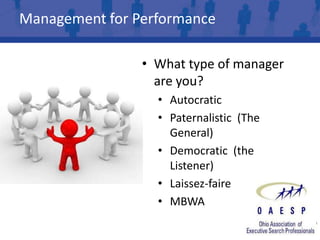
Management for Performance

                • What type of manager
                  are you?
                  • Autocratic
                  • Paternalistic (The
                    General)
                  • Democratic (the
                    Listener)
                  • Laissez-faire
                  • MBWA
Management for Performance

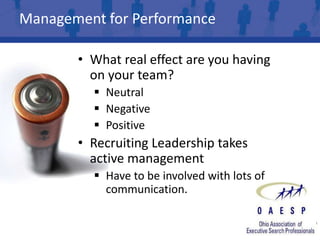
       • What real effect are you having
         on your team?
          Neutral
          Negative
          Positive
       • Recruiting Leadership takes
         active management
          Have to be involved with lots of
           communication.
Management for Performance

• Process of Managing
   •   Set Direction
   •   Set Expectations
   •   Educate and Inform
   •   Refocus and Redirect
   •   “What gets measured, gets managed.” – Peter Drucker
• Successful Management Strategies
   •   Daily: set goals, get commitment and ask for results
   •   Parachute Time
   •   Complement, Suggest, Complement
   •   Manage by their goals and tie to company goals
   •   Your Success Strategy will depend on Hiring Strategy
PART II
ENVIRONMENT
FOR WINNING
Environment for Winning

        • Components of Environment
          • Developing a Habit of Planning and Effective Planning
            Sun Tzu – Art of War. “Every battle is won, before it is
            ever fought”
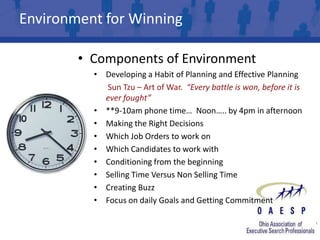
          • **9-10am phone time… Noon….. by 4pm in afternoon
          • Making the Right Decisions
          • Which Job Orders to work on
          • Which Candidates to work with
          • Conditioning from the beginning
          • Selling Time Versus Non Selling Time
          • Creating Buzz
          • Focus on daily Goals and Getting Commitment
Environment for Winning


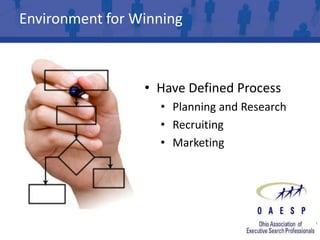
                 • Have Defined Process
                   • Planning and Research
                   • Recruiting
                   • Marketing
Environment for Winning

         • Other Important Topics
           • Getting Good at the Objections
           • Thou shall never accept an offer
             without……
           • Role Play, Role Play, Role Play
           • Depositing Money in their Bank
             Account
           • Competition Encouraged
           • Winning Recognized and
             Rewarded
PART III
 CREATING A
 CULTURE OF
PERFORMANCE
A Culture of Performance

            Definition:
            A culture in which each and every
            individual in an organization is focused
            on achieving performance goals. These
            are quantifiable targets that are set for
            each individual, team and broken down
            by time – from year to quarter to month
            to week to day. Where every employee
            knows the importance and significance of
            their particular contribution in order to
            attain the team goals. Performance goals
            are also translated into activities and
            results that need to be accomplished in
            order to achieve the target.
Gartner’s Definition of Business Intelligence


                          An interactive process for
                          exploring and analyzing structured
                          and domain-specific information
                          to discern trends or patterns,
                          Thereby deriving insights and
                          drawing conclusions. The business
                           intelligence process includes
                          communicating findings and
                          effecting change.
Benefits of a Culture of Performance

        • Individuals accountable for their performance
        • Specific focus on activities needed to be
          performed to attain targets
        • More individuals hitting goals
        • Reward systems are in place for
          achievement of targets – individual
          and team
        • There is a specific measurement tool that
          shows progress to achieving the targets
        • New Hires up to speed 50% faster
        • Decrease turnover
        • Pareto Rule is reversed
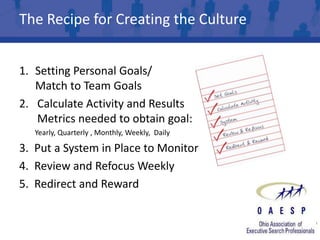
The Recipe for Creating the Culture


1. Setting Personal Goals/
   Match to Team Goals
2. Calculate Activity and Results
   Metrics needed to obtain goal:
   Yearly, Quarterly , Monthly, Weekly, Daily

3. Put a System in Place to Monitor
4. Review and Refocus Weekly
5. Redirect and Reward
Recruiting: What the Metrics Tell Us

• Activity Metrics - Volume
  # of Calls, Connects, Marketing and Recruiting Presentations
                                                “When a team outgrows
• Results Metrics – Getting it Done?             individual performance
                                                     and learns team
  Sendouts, QCs, Placements, Cash in              confidence, excellence
                                                   becomes a reality.”
                                               - Joe Paterno, Penn State
• Ratios - How good is our quality?
  Cap/QC, NMP/JO, JO/PL, QC/SO, $/CT

• New Versus Tenured
PART IV
 HIRING AND
ON-BOARDING
 STRATEGIES
Hiring and On-Boarding Strategies

       • Successful Recruiter Traits
          •   Fast paced and activity oriented
          •   Smart – Pass the Wonderlic and Selecsys tests
          •   Sales-oriented – outgoing; like to talk to customers
          •    Have above level of ambition to achieve
          •    Have a high sense of urgency
          •    Have a track record of success
          •    Continually sets high goals and achieves them
          •    Competitive
          •    Have the ability to create rapport instantly
          •    Ability to multi-task and not be bogged down in the details
          •   Background in business-to-business sales
          •    Superior communication skills both verbal and written
Hiring and On-Boarding Strategies

        • Successful Recruiter Traits, continued…
           •   Good listener
           •   Experienced in full life-cycle selling – from
               prospecting to close
           •    An outwardly energetic attitude with a superior
               work ethic
           •   Goal driven with a history of working towards
               defined metrics
           •   Inquisitive and asks good questions
           •   Must be a student of business with an
               entrepreneurial spirit (understands they can build a
               business within a business, without financial risk)
           •   Computer literate
           •   Can type ____________ words per minute
           •   Stable work history
           •   Understands that this is a high level phone-centric
               position – making 80-100 calls a day resulting in 20-
               25 business
Hiring and On-Boarding Strategies

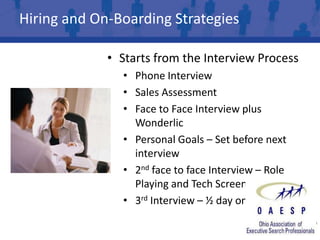
             • Starts from the Interview Process
               • Phone Interview
               • Sales Assessment
               • Face to Face Interview plus
                 Wonderlic
               • Personal Goals – Set before next
                 interview
               • 2nd face to face Interview – Role
                 Playing and Tech Screen
               • 3rd Interview – ½ day on the phone
Hiring and On-Boarding Strategies

• Communication of Real Expectations
  • My goal – Condition YOU to Be Successful
  • First Week, Second Week, 30 days, 60 days and 90 days
  • Daily Setting Goals, expecting Plans, getting
    Commitment and Results Wrap-ups
  • Explain the Transition between – Telemarketer, Tactical
    Recuiter, to Trusted Advsior to Power Broker
  • The 30- 45 day Chasm
  • Missing Critical Steps in the Process
  • 9 out of 10 don’t make it… why?
PART V
MANAGEMENT
   TOOLS
In
Conclusion…
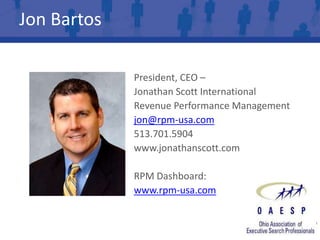
Jon Bartos

             President, CEO –
             Jonathan Scott International
             Revenue Performance Management
             jon@rpm-usa.com
             513.701.5904
             www.jonathanscott.com

             RPM Dashboard:
             www.rpm-usa.com

Working smarter effective leadership-oaesp

  • 1.
    WORKING SMARTER Maximizing Performancethrough Effective Recruiting Leadership Jon Bartos
  • 2.
    PART I MANAGEMENT FOR PERFORMANCE
  • 3.
    Management for Performance • What type of manager are you? • Autocratic • Paternalistic (The General) • Democratic (the Listener) • Laissez-faire • MBWA
  • 4.
    Management for Performance • What real effect are you having on your team?  Neutral  Negative  Positive • Recruiting Leadership takes active management  Have to be involved with lots of communication.
  • 5.
    Management for Performance •Process of Managing • Set Direction • Set Expectations • Educate and Inform • Refocus and Redirect • “What gets measured, gets managed.” – Peter Drucker • Successful Management Strategies • Daily: set goals, get commitment and ask for results • Parachute Time • Complement, Suggest, Complement • Manage by their goals and tie to company goals • Your Success Strategy will depend on Hiring Strategy
  • 6.
  • 7.
    Environment for Winning • Components of Environment • Developing a Habit of Planning and Effective Planning Sun Tzu – Art of War. “Every battle is won, before it is ever fought” • **9-10am phone time… Noon….. by 4pm in afternoon • Making the Right Decisions • Which Job Orders to work on • Which Candidates to work with • Conditioning from the beginning • Selling Time Versus Non Selling Time • Creating Buzz • Focus on daily Goals and Getting Commitment
  • 8.
    Environment for Winning • Have Defined Process • Planning and Research • Recruiting • Marketing
  • 9.
    Environment for Winning • Other Important Topics • Getting Good at the Objections • Thou shall never accept an offer without…… • Role Play, Role Play, Role Play • Depositing Money in their Bank Account • Competition Encouraged • Winning Recognized and Rewarded
  • 10.
    PART III CREATINGA CULTURE OF PERFORMANCE
  • 11.
    A Culture ofPerformance Definition: A culture in which each and every individual in an organization is focused on achieving performance goals. These are quantifiable targets that are set for each individual, team and broken down by time – from year to quarter to month to week to day. Where every employee knows the importance and significance of their particular contribution in order to attain the team goals. Performance goals are also translated into activities and results that need to be accomplished in order to achieve the target.
  • 12.
    Gartner’s Definition ofBusiness Intelligence An interactive process for exploring and analyzing structured and domain-specific information to discern trends or patterns, Thereby deriving insights and drawing conclusions. The business intelligence process includes communicating findings and effecting change.
  • 13.
    Benefits of aCulture of Performance • Individuals accountable for their performance • Specific focus on activities needed to be performed to attain targets • More individuals hitting goals • Reward systems are in place for achievement of targets – individual and team • There is a specific measurement tool that shows progress to achieving the targets • New Hires up to speed 50% faster • Decrease turnover • Pareto Rule is reversed
  • 14.
    The Recipe forCreating the Culture 1. Setting Personal Goals/ Match to Team Goals 2. Calculate Activity and Results Metrics needed to obtain goal: Yearly, Quarterly , Monthly, Weekly, Daily 3. Put a System in Place to Monitor 4. Review and Refocus Weekly 5. Redirect and Reward
  • 15.
    Recruiting: What theMetrics Tell Us • Activity Metrics - Volume # of Calls, Connects, Marketing and Recruiting Presentations “When a team outgrows • Results Metrics – Getting it Done? individual performance and learns team Sendouts, QCs, Placements, Cash in confidence, excellence becomes a reality.” - Joe Paterno, Penn State • Ratios - How good is our quality? Cap/QC, NMP/JO, JO/PL, QC/SO, $/CT • New Versus Tenured
  • 16.
    PART IV HIRINGAND ON-BOARDING STRATEGIES
  • 17.
    Hiring and On-BoardingStrategies • Successful Recruiter Traits • Fast paced and activity oriented • Smart – Pass the Wonderlic and Selecsys tests • Sales-oriented – outgoing; like to talk to customers • Have above level of ambition to achieve • Have a high sense of urgency • Have a track record of success • Continually sets high goals and achieves them • Competitive • Have the ability to create rapport instantly • Ability to multi-task and not be bogged down in the details • Background in business-to-business sales • Superior communication skills both verbal and written
  • 18.
    Hiring and On-BoardingStrategies • Successful Recruiter Traits, continued… • Good listener • Experienced in full life-cycle selling – from prospecting to close • An outwardly energetic attitude with a superior work ethic • Goal driven with a history of working towards defined metrics • Inquisitive and asks good questions • Must be a student of business with an entrepreneurial spirit (understands they can build a business within a business, without financial risk) • Computer literate • Can type ____________ words per minute • Stable work history • Understands that this is a high level phone-centric position – making 80-100 calls a day resulting in 20- 25 business
  • 19.
    Hiring and On-BoardingStrategies • Starts from the Interview Process • Phone Interview • Sales Assessment • Face to Face Interview plus Wonderlic • Personal Goals – Set before next interview • 2nd face to face Interview – Role Playing and Tech Screen • 3rd Interview – ½ day on the phone
  • 20.
    Hiring and On-BoardingStrategies • Communication of Real Expectations • My goal – Condition YOU to Be Successful • First Week, Second Week, 30 days, 60 days and 90 days • Daily Setting Goals, expecting Plans, getting Commitment and Results Wrap-ups • Explain the Transition between – Telemarketer, Tactical Recuiter, to Trusted Advsior to Power Broker • The 30- 45 day Chasm • Missing Critical Steps in the Process • 9 out of 10 don’t make it… why?
  • 21.
  • 22.
  • 23.
    Jon Bartos President, CEO – Jonathan Scott International Revenue Performance Management jon@rpm-usa.com 513.701.5904 www.jonathanscott.com RPM Dashboard: www.rpm-usa.com