Distribution
What is a Marketing Channel?
• This is a set of interdependent organizations
  involved in the process of making a product
  or service available for use or consumption
Intermediaries involved in this
          process
• Agents – acting on behalf of buyer or seller
  but do not take title of the goods
• Facilitators – transporters, C&Fs, banks, ad
  agencies
Advantages of a distribution
           system
• Key external resource
• Takes years to build
• Significant corporate commitment to a large
  no. of firms
• Commitment to a set of policies that
  nourishes long term relationships
Why would a manufacturer not
like to do his own distribution?
• Lacks the financial resources to do direct
  marketing
• Cannot have the infrastructure to make the
  product widely available and near the
  customer
• Trading profits could be less than
  manufacturing profits
Manufactures typically
produce a large quantity of a
  limited variety of goods
   Consumers usually desire a small
  quantity of a wide variety of goods
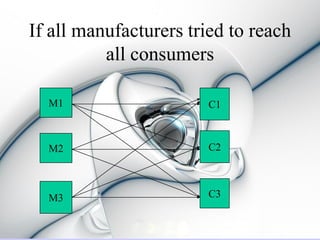
If all manufacturers tried to reach
          all consumers

  M1                   C1


  M2                   C2


  M3                   C3
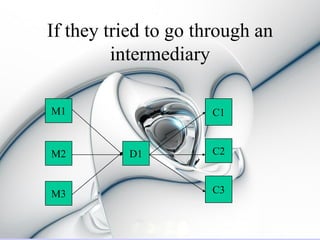
If they tried to go through an
         intermediary

M1                   C1


M2        D1         C2


M3                   C3
Channel functions
• Gathers information on customers,
  competitors and other external market data
• Develop and disseminate persuasive
  communication to stimulate purchases
• Agreement on price and other terms so that
  transfer of ownership can be effected
• Placing orders with manufacturers
Channel functions (cont’d)
• Acquire funds to finance inventories and credit in
  the market
• Assume responsibility of all risks of the trade
• Successive storage and movement of products
• Helps buyers in getting their payments through
  with the banks
• Oversee actual transfer of ownership
Channels can be
• Forward
• Backward
Channel Alternatives
• Types of available business intermediaries
• No. of intermediaries needed
• Terms and responsibilities of each channel
  member
Types of intermediaries
•   Distributors
•   Wholesalers
•   Retailers
•   Department stores
What kind of distribution?
• Exclusive
• Selective
• Intensive
Terms and Responsibilities
• Rights and responsibilities are drawn up
• Territorial rights are fixed
• Pricing policies and conditions of sales are
  fixed
Evaluating alternatives
• Economic
• Control
• Adaptive
Channel management
• Selecting channel members
• Training channel members
• Motivating channel members
Managing channel members
•   Coercive
•   Reward
•   Legitimate
•   Expert
•   Referent
Channel modification
• With time channels need to change along
  with product as it get older in the PLC
• Introduction – boutiques,company
  showrooms
• Growth – chain stores, departmental stores
• Maturity – Mass merchandisers
• Decline – ‘sales stores’, discount stores
Adding channels
Advantages
• Increased market coverage
• Lower channel costs
• More customised selling
  Disadvantages
• Increases selling costs
• Increases channel control
• Breeds channel conflict
Roles of individual channel
            member firms
•   Insiders
•   Strivers
•   Complementers
•   Transients
•   Outside innovators
Channel conflict
• Interest of different business interests do not
  necessarily coincide
• Conflicts can occur at various levels
  vertical
  horizontal
  multichannel
Conflict causes
• Goal incompatibility
• Differences in perception
• Great dependence
Legal and ethical issues
•   Exclusive dealings
•   Exclusive territories
•   Tying agreements
•   Dealer rights
Retailing


 Includes all activities involved in
selling goods or services directly to
          final consumers.
Types of Retailers
• Self – service – discount stores (no assistance)
• Self – selection – dept. store (assistance is
  available if required)
• Limited service – counter sales men are there
• Full service – Co. showrooms. Salesmen are
  available to explain, demonstrate, give technical
  help and promote the products
The target market will define
•   Assortment of goods to be stocked
•   Store atmospherics and services
•   Pricing decision
•   Promotion decision
•   Place decision
Retail sales effectiveness
•   No. of people passing by on an average day
•   % who enter the store (footfalls)
•   %entering who buy
•   Amount spent per buyer
Store Brands
• With the increase in size and buying
  strength of retailers, companies are forced
  to now customize products for them. These
  are known as store brands. They may
  compete at the store with the company’s
  own brands.
What is wholesaling?


• It includes all activities involved in selling
  goods and services for resale or business
  use. They are the intermediaries between
  manufacturers and retailers.
Characteristics of wholesalers
• Less attention to promotion, atmosphere
  and location
• Transactions are usually large and cover a
  wider geographical area
• Could have different tax implications,
  regulations,etc. because of its status as a
  wholesaler
Functions of a wholesaler
•   Financing             • Selling and promoting
•   Risk bearing          • Buying and assortment
•   Market information      building
•   Management services   • Bulk breaking
    and counselling       • Warehousing
                          • Transportation
Market Logistics
• Involves the planning, implementing and
  controlling the physical flows of materials
  and final goods from point of origin to
  points of use to meet customer requirements
  at a profit.
• It involves materials management,
  distribution systems and IT systems
  interlinked with one another
Logistics objective
• Getting the right goods at the right place at
  the right time for the least cost
• ‘the last frontier for cost economies’.
Market Logistics decisions
•   Order processing
•   Warehousing
•   Inventory
•   Transportation
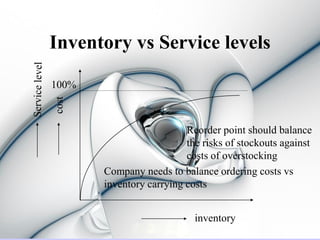
Inventory vs Service levels

100%


                          Reorder point should balance
                          the risks of stockouts against
                          costs of overstocking
       Company needs to balance ordering costs vs
       inventory carrying costs


                            inventory
Logistics vs. Sales
• Objectives can be conflicting
• Conflict resolution can be done by trading
  off costs vis -a- vis customer satisfaction

Logistics and Distribution

  • 1.
  • 2.
    What is aMarketing Channel? • This is a set of interdependent organizations involved in the process of making a product or service available for use or consumption
  • 3.
    Intermediaries involved inthis process • Agents – acting on behalf of buyer or seller but do not take title of the goods • Facilitators – transporters, C&Fs, banks, ad agencies
  • 4.
    Advantages of adistribution system • Key external resource • Takes years to build • Significant corporate commitment to a large no. of firms • Commitment to a set of policies that nourishes long term relationships
  • 5.
    Why would amanufacturer not like to do his own distribution? • Lacks the financial resources to do direct marketing • Cannot have the infrastructure to make the product widely available and near the customer • Trading profits could be less than manufacturing profits
  • 6.
    Manufactures typically produce alarge quantity of a limited variety of goods Consumers usually desire a small quantity of a wide variety of goods
  • 7.
    If all manufacturerstried to reach all consumers M1 C1 M2 C2 M3 C3
  • 8.
    If they triedto go through an intermediary M1 C1 M2 D1 C2 M3 C3
  • 9.
    Channel functions • Gathersinformation on customers, competitors and other external market data • Develop and disseminate persuasive communication to stimulate purchases • Agreement on price and other terms so that transfer of ownership can be effected • Placing orders with manufacturers
  • 10.
    Channel functions (cont’d) •Acquire funds to finance inventories and credit in the market • Assume responsibility of all risks of the trade • Successive storage and movement of products • Helps buyers in getting their payments through with the banks • Oversee actual transfer of ownership
  • 11.
    Channels can be •Forward • Backward
  • 12.
    Channel Alternatives • Typesof available business intermediaries • No. of intermediaries needed • Terms and responsibilities of each channel member
  • 13.
    Types of intermediaries • Distributors • Wholesalers • Retailers • Department stores
  • 14.
    What kind ofdistribution? • Exclusive • Selective • Intensive
  • 15.
    Terms and Responsibilities •Rights and responsibilities are drawn up • Territorial rights are fixed • Pricing policies and conditions of sales are fixed
  • 16.
  • 17.
    Channel management • Selectingchannel members • Training channel members • Motivating channel members
  • 18.
    Managing channel members • Coercive • Reward • Legitimate • Expert • Referent
  • 19.
    Channel modification • Withtime channels need to change along with product as it get older in the PLC • Introduction – boutiques,company showrooms • Growth – chain stores, departmental stores • Maturity – Mass merchandisers • Decline – ‘sales stores’, discount stores
  • 20.
    Adding channels Advantages • Increasedmarket coverage • Lower channel costs • More customised selling Disadvantages • Increases selling costs • Increases channel control • Breeds channel conflict
  • 21.
    Roles of individualchannel member firms • Insiders • Strivers • Complementers • Transients • Outside innovators
  • 22.
    Channel conflict • Interestof different business interests do not necessarily coincide • Conflicts can occur at various levels vertical horizontal multichannel
  • 23.
    Conflict causes • Goalincompatibility • Differences in perception • Great dependence
  • 24.
    Legal and ethicalissues • Exclusive dealings • Exclusive territories • Tying agreements • Dealer rights
  • 25.
    Retailing Includes allactivities involved in selling goods or services directly to final consumers.
  • 26.
    Types of Retailers •Self – service – discount stores (no assistance) • Self – selection – dept. store (assistance is available if required) • Limited service – counter sales men are there • Full service – Co. showrooms. Salesmen are available to explain, demonstrate, give technical help and promote the products
  • 27.
    The target marketwill define • Assortment of goods to be stocked • Store atmospherics and services • Pricing decision • Promotion decision • Place decision
  • 28.
    Retail sales effectiveness • No. of people passing by on an average day • % who enter the store (footfalls) • %entering who buy • Amount spent per buyer
  • 29.
    Store Brands • Withthe increase in size and buying strength of retailers, companies are forced to now customize products for them. These are known as store brands. They may compete at the store with the company’s own brands.
  • 30.
    What is wholesaling? •It includes all activities involved in selling goods and services for resale or business use. They are the intermediaries between manufacturers and retailers.
  • 31.
    Characteristics of wholesalers •Less attention to promotion, atmosphere and location • Transactions are usually large and cover a wider geographical area • Could have different tax implications, regulations,etc. because of its status as a wholesaler
  • 32.
    Functions of awholesaler • Financing • Selling and promoting • Risk bearing • Buying and assortment • Market information building • Management services • Bulk breaking and counselling • Warehousing • Transportation
  • 33.
    Market Logistics • Involvesthe planning, implementing and controlling the physical flows of materials and final goods from point of origin to points of use to meet customer requirements at a profit. • It involves materials management, distribution systems and IT systems interlinked with one another
  • 34.
    Logistics objective • Gettingthe right goods at the right place at the right time for the least cost • ‘the last frontier for cost economies’.
  • 35.
    Market Logistics decisions • Order processing • Warehousing • Inventory • Transportation
  • 36.
    Inventory vs Servicelevels 100% Reorder point should balance the risks of stockouts against costs of overstocking Company needs to balance ordering costs vs inventory carrying costs inventory
  • 37.
    Logistics vs. Sales •Objectives can be conflicting • Conflict resolution can be done by trading off costs vis -a- vis customer satisfaction