Distribution & Retailing Unit  4 Subhajit Sanyal
P = Location Convenience Distribution Availability Accessibility Usability Where and when necessary Size and portability
Product Classes - Place Convenience Products - have to be in convenient places - small stores, vending machines Shopping Products - have to be where shoppers go, malls, superstores etc. Specialty Products - have to available where people want to buy them  - ie. Movie theatres have to be located where many people go, and where you can park easily
Place and PLC PLACE must be considered in terms of the Product Life Cycle In the beginning Growth Stage - it might be good to have your product sold in a certain location, but in the maturity or decline stage, you may have to change locations to make it better for customers who are no longer so strongly interested in buying
What is it? Distribution - the where when how and why products and services are made available to potential customers Physical distribution - the activities concerned with the physical flows  through producer to intermediaries to consumers and customers
Objectives of Distribution Appropriate and adequate distribution Access to markets and target customers Relative cost effectiveness in access, transaction value and distribution Reseller motivation Revenue returns from channel members Competitive representation Customer service
Marketing / Distribution Channels create -  Time - Place - Possession/ownership  utility Delivered at the right time - time utility Delivered to the right place - place utility With appropriate legal requirements - possession / ownership utility
Product Classes - Place The different Product Classes have different PLACE situations Place decisions can be aided by knowing about the product classes
Product Classes - Place Convenience Products - have to be in convenient places - small stores, vending machines Shopping Products - have to be where shoppers go, malls, superstores etc. Specialty Products - have to available where people want to buy them  - ie. Movie theatres have to be located where many people go, and where you can park easily
Place and PLC PLACE must be considered in terms of the Product Life Cycle In the beginning Growth Stage - it might be good to have your product sold in a certain location, but in the maturity or decline stage, you may have to change locations to make it better for customers who are no longer so strongly interested in buying
Discrepancies Discrepancy of Quantity Discrepancy of Assortment
Discrepancies Discrepancy of Quantity the mfg. Makes much more than individual consumers want to buy each time middlemen, wholesalers and retailers break this amount down into smaller amounts for individual consumers to buy
Discrepancies Discrepancy of Quantity …  the difference between   the quantity of products it is economical for an individual producer to make and the quantity normally wanted by individual consumers or users...
Discrepancies Discrepancy of Assortment the difference between ALL the product lines a mfg. Makes, and what the wholesaler wants to sell, and what the consumer will buy middlemen, break this amount down into different selections which the wholesalers want
Discrepancies middlemen, break this amount down into different selections which the wholesalers want EG. KRAFT makes many many different types of salad dressing A no-frills store just wants to sell 7 types cause its customers don’t buy the fancy kinds
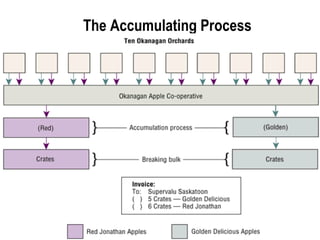
Accumulation - combining products from several different producers. “… make it more convenient for companies to buy and handle…” When farmers collect food, and sell them to buyers who gather large amounts for shipping to processors
The Accumulating Process
Breaking Bulk - take all the product and physically move it into small containers so it can be shipped to wholesalers. “… divide larger quantities into smaller quantities…”
Separating products into grades and qualities desired by different target markets. Eg. Food products, small onions, large onions, or white eggs, brown eggs or … Sorting
Taking heterogeneus commodities and sorting them into homogenous categories Eg. All apples into red apples and green apples Sorting
The process that helps producers,  who produce different amounts, and different types,  organize their products into categories/assortments  to make it easier for the consumer to buy.  Sorting
“…  putting together a variety of products to give a target market what it wants…” ie. In this video store, mostly Asian films ie. In this record store, mostly hip hop ie. In this jewelry store, mostly chains Assorting
Some stores cannot take the full range of a company’s product line - they do not have the shelf space or floor space - so they carefully select the brands of several mfgs to sell.  Assorting
Marketing / Distribution Channels create -  Time - Place - Possession/ownership  utility Delivered at the right time - time utility Delivered to the right place - place utility With appropriate legal requirements - possession / ownership utility
Channels and key players Channel of distribution Intermediary Merchant Functional middleman
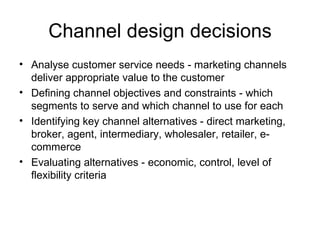
Channel design decisions Analyse customer service needs - marketing channels deliver appropriate value to the customer Defining channel objectives and constraints - which segments to serve and which channel to use for each Identifying key channel alternatives - direct marketing, broker, agent, intermediary, wholesaler, retailer, e-commerce Evaluating alternatives - economic, control, level of flexibility criteria
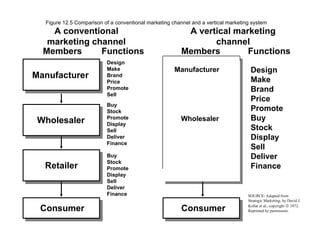
A vertical marketing channel Members Consumer Functions Design Make Brand Price Promote Buy Stock Display Sell Deliver Finance Manufacturer Wholesaler Retailer Consumer A conventional marketing channel Members Functions Design Make Brand Price Promote Sell Buy Stock Promote Display Sell Deliver Finance Buy Stock Promote Display Sell Deliver Finance Figure 12.5 Comparison of a conventional marketing channel and a vertical marketing system SOURCE: Adapted from Strategic Marketing, by David J. Kollat et al., copyright    1972. Reprinted by permission. Manufacturer Wholesaler Retailer
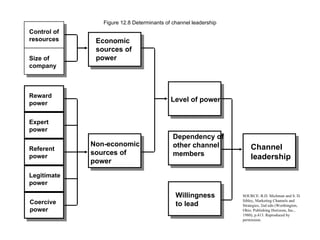
Control of resources Size of company Reward power Expert power Referent power Legitimate power Coercive power Economic sources of power Non-economic sources of power Level of power Dependency of other channel members Willingness to lead Channel leadership Figure 12.8 Determinants of channel leadership SOURCE: R.D. Michman and S. D. Sibley, Marketing Channels and Strategies, 2nd edn (Worthington, Ohio: Publishing Horizons, Inc., 1980), p.413. Reproduced by permission.
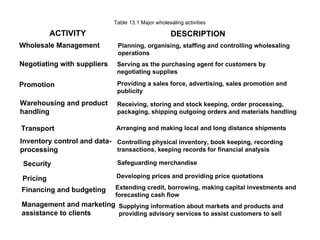
ACTIVITY DESCRIPTION Table 13.1 Major wholesaling activities Wholesale Management Negotiating with suppliers Promotion Transport Inventory control and data- processing Planning, organising, staffing and controlling wholesaling operations Serving as the purchasing agent for customers by negotiating supplies Providing a sales force, advertising, sales promotion and publicity Arranging and making local and long distance shipments Controlling physical inventory, book keeping, recording transactions, keeping records for financial analysis Warehousing and product handling Receiving, storing and stock keeping, order processing, packaging, shipping outgoing orders and materials handling Security Safeguarding merchandise Pricing Developing prices and providing price quotations Financing and budgeting Extending credit, borrowing, making capital investments and forecasting cash flow Management and marketing assistance to clients Supplying information about markets and products and providing advisory services to assist customers to sell
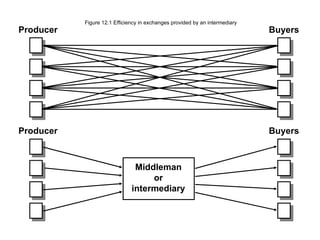
Figure 12.1 Efficiency in exchanges provided by an intermediary Producer Buyers Producer Buyers Middleman or intermediary
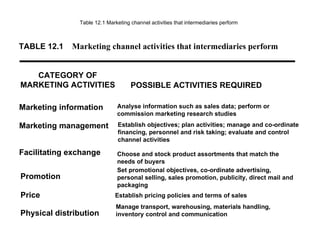
Marketing channel activities that intermediaries perform TABLE 12.1 CATEGORY OF MARKETING ACTIVITIES POSSIBLE ACTIVITIES REQUIRED Table 12.1 Marketing channel activities that intermediaries perform Marketing information Marketing management Facilitating exchange Price Physical distribution Analyse information such as sales data; perform or commission marketing research studies Establish objectives; plan activities; manage and co-ordinate financing, personnel and risk taking; evaluate and control channel activities Choose and stock product assortments that match the needs of buyers Establish pricing policies and terms of sales Manage transport, warehousing, materials handling, inventory control and communication Promotion Set promotional objectives, co-ordinate advertising, personal selling, sales promotion, publicity, direct mail and packaging
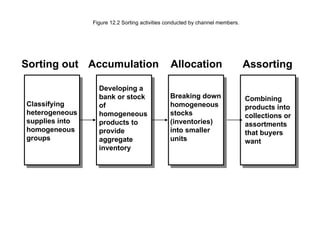
Classifying heterogeneous supplies into homogeneous groups Developing a bank or stock of homogeneous products to provide aggregate inventory Breaking down homogeneous stocks (inventories) into smaller units  Combining products into collections or assortments that buyers want Sorting out Accumulation Allocation Assorting Figure 12.2 Sorting activities conducted by channel members.
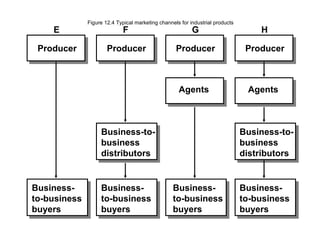
Figure 12.4 Typical marketing channels for industrial products E F G H Producer Producer Producer Producer Agents Agents Business-to-business distributors Business-to-business distributors Business-to-business buyers Business-to-business buyers Business-to-business buyers Business-to-business buyers
CHANNEL CAPTAIN “ A person, or company, that helps direct the activities of a whole channel, and tries to avoid, or solve conflicts…” However, some older products don’t have such a position.
CHANNEL CAPTAIN Can be,,, A strong wholesaler a market oriented producer a large retailer
CHANNEL CAPTAIN Sometimes  Middlemen have a clear picture of what the customer wants, and who the producers are, so they arrange for producers to be in contact with the retailers, so more product can flow in the channel. The Middlemen makes more money by making nore commission on stuff sold.
The whole channel focusses on the same target market at the end of the channel sometimes a large firm will buy up the smaller companies in the channel to have more control over the distribution Vertical Marketing Systems
The paths goods follow from consumer to manufacturer or to marketing intermediaries. Common in the recycling industries. Eg.  - Empty glass bottles - used batteries - used tires - used printer cartridges - Canon Reverse Channels
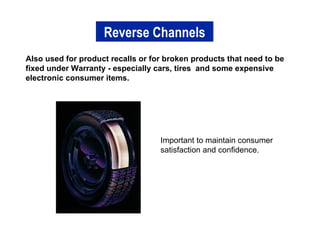
Also used for product recalls or for broken products that need to be fixed under Warranty - especially cars, tires  and some expensive electronic consumer items. Reverse Channels Important to maintain consumer satisfaction and confidence.
STRATEGIC ISSUES IN RETAILING Location Property Ownership Product Assortment Retail Positioning Atmospherics Store Image Scrambled Merchandising The Wheel of Retailing
Recent Trends in Retailing Customisation Larger outlets Own label brands Customer expectations Category stores Relocation of businesses e.shopping Home delivery
e-commerce Basics of doing business Market opportunities & the future Media Branding Business to business Regulations Internet and Society

Unit4 distribution & retailing

  • 1.
    Distribution & RetailingUnit 4 Subhajit Sanyal
  • 2.
    P = LocationConvenience Distribution Availability Accessibility Usability Where and when necessary Size and portability
  • 3.
    Product Classes -Place Convenience Products - have to be in convenient places - small stores, vending machines Shopping Products - have to be where shoppers go, malls, superstores etc. Specialty Products - have to available where people want to buy them - ie. Movie theatres have to be located where many people go, and where you can park easily
  • 4.
    Place and PLCPLACE must be considered in terms of the Product Life Cycle In the beginning Growth Stage - it might be good to have your product sold in a certain location, but in the maturity or decline stage, you may have to change locations to make it better for customers who are no longer so strongly interested in buying
  • 5.
    What is it?Distribution - the where when how and why products and services are made available to potential customers Physical distribution - the activities concerned with the physical flows through producer to intermediaries to consumers and customers
  • 6.
    Objectives of DistributionAppropriate and adequate distribution Access to markets and target customers Relative cost effectiveness in access, transaction value and distribution Reseller motivation Revenue returns from channel members Competitive representation Customer service
  • 7.
    Marketing / DistributionChannels create - Time - Place - Possession/ownership utility Delivered at the right time - time utility Delivered to the right place - place utility With appropriate legal requirements - possession / ownership utility
  • 8.
    Product Classes -Place The different Product Classes have different PLACE situations Place decisions can be aided by knowing about the product classes
  • 9.
    Product Classes -Place Convenience Products - have to be in convenient places - small stores, vending machines Shopping Products - have to be where shoppers go, malls, superstores etc. Specialty Products - have to available where people want to buy them - ie. Movie theatres have to be located where many people go, and where you can park easily
  • 10.
    Place and PLCPLACE must be considered in terms of the Product Life Cycle In the beginning Growth Stage - it might be good to have your product sold in a certain location, but in the maturity or decline stage, you may have to change locations to make it better for customers who are no longer so strongly interested in buying
  • 11.
    Discrepancies Discrepancy ofQuantity Discrepancy of Assortment
  • 12.
    Discrepancies Discrepancy ofQuantity the mfg. Makes much more than individual consumers want to buy each time middlemen, wholesalers and retailers break this amount down into smaller amounts for individual consumers to buy
  • 13.
    Discrepancies Discrepancy ofQuantity … the difference between the quantity of products it is economical for an individual producer to make and the quantity normally wanted by individual consumers or users...
  • 14.
    Discrepancies Discrepancy ofAssortment the difference between ALL the product lines a mfg. Makes, and what the wholesaler wants to sell, and what the consumer will buy middlemen, break this amount down into different selections which the wholesalers want
  • 15.
    Discrepancies middlemen, breakthis amount down into different selections which the wholesalers want EG. KRAFT makes many many different types of salad dressing A no-frills store just wants to sell 7 types cause its customers don’t buy the fancy kinds
  • 16.
    Accumulation - combiningproducts from several different producers. “… make it more convenient for companies to buy and handle…” When farmers collect food, and sell them to buyers who gather large amounts for shipping to processors
  • 17.
  • 18.
    Breaking Bulk -take all the product and physically move it into small containers so it can be shipped to wholesalers. “… divide larger quantities into smaller quantities…”
  • 19.
    Separating products intogrades and qualities desired by different target markets. Eg. Food products, small onions, large onions, or white eggs, brown eggs or … Sorting
  • 20.
    Taking heterogeneus commoditiesand sorting them into homogenous categories Eg. All apples into red apples and green apples Sorting
  • 21.
    The process thathelps producers, who produce different amounts, and different types, organize their products into categories/assortments to make it easier for the consumer to buy. Sorting
  • 22.
    “… puttingtogether a variety of products to give a target market what it wants…” ie. In this video store, mostly Asian films ie. In this record store, mostly hip hop ie. In this jewelry store, mostly chains Assorting
  • 23.
    Some stores cannottake the full range of a company’s product line - they do not have the shelf space or floor space - so they carefully select the brands of several mfgs to sell. Assorting
  • 24.
    Marketing / DistributionChannels create - Time - Place - Possession/ownership utility Delivered at the right time - time utility Delivered to the right place - place utility With appropriate legal requirements - possession / ownership utility
  • 25.
    Channels and keyplayers Channel of distribution Intermediary Merchant Functional middleman
  • 26.
    Channel design decisionsAnalyse customer service needs - marketing channels deliver appropriate value to the customer Defining channel objectives and constraints - which segments to serve and which channel to use for each Identifying key channel alternatives - direct marketing, broker, agent, intermediary, wholesaler, retailer, e-commerce Evaluating alternatives - economic, control, level of flexibility criteria
  • 27.
    A vertical marketingchannel Members Consumer Functions Design Make Brand Price Promote Buy Stock Display Sell Deliver Finance Manufacturer Wholesaler Retailer Consumer A conventional marketing channel Members Functions Design Make Brand Price Promote Sell Buy Stock Promote Display Sell Deliver Finance Buy Stock Promote Display Sell Deliver Finance Figure 12.5 Comparison of a conventional marketing channel and a vertical marketing system SOURCE: Adapted from Strategic Marketing, by David J. Kollat et al., copyright  1972. Reprinted by permission. Manufacturer Wholesaler Retailer
  • 28.
    Control of resourcesSize of company Reward power Expert power Referent power Legitimate power Coercive power Economic sources of power Non-economic sources of power Level of power Dependency of other channel members Willingness to lead Channel leadership Figure 12.8 Determinants of channel leadership SOURCE: R.D. Michman and S. D. Sibley, Marketing Channels and Strategies, 2nd edn (Worthington, Ohio: Publishing Horizons, Inc., 1980), p.413. Reproduced by permission.
  • 29.
    ACTIVITY DESCRIPTION Table13.1 Major wholesaling activities Wholesale Management Negotiating with suppliers Promotion Transport Inventory control and data- processing Planning, organising, staffing and controlling wholesaling operations Serving as the purchasing agent for customers by negotiating supplies Providing a sales force, advertising, sales promotion and publicity Arranging and making local and long distance shipments Controlling physical inventory, book keeping, recording transactions, keeping records for financial analysis Warehousing and product handling Receiving, storing and stock keeping, order processing, packaging, shipping outgoing orders and materials handling Security Safeguarding merchandise Pricing Developing prices and providing price quotations Financing and budgeting Extending credit, borrowing, making capital investments and forecasting cash flow Management and marketing assistance to clients Supplying information about markets and products and providing advisory services to assist customers to sell
  • 30.
    Figure 12.1 Efficiencyin exchanges provided by an intermediary Producer Buyers Producer Buyers Middleman or intermediary
  • 31.
    Marketing channel activitiesthat intermediaries perform TABLE 12.1 CATEGORY OF MARKETING ACTIVITIES POSSIBLE ACTIVITIES REQUIRED Table 12.1 Marketing channel activities that intermediaries perform Marketing information Marketing management Facilitating exchange Price Physical distribution Analyse information such as sales data; perform or commission marketing research studies Establish objectives; plan activities; manage and co-ordinate financing, personnel and risk taking; evaluate and control channel activities Choose and stock product assortments that match the needs of buyers Establish pricing policies and terms of sales Manage transport, warehousing, materials handling, inventory control and communication Promotion Set promotional objectives, co-ordinate advertising, personal selling, sales promotion, publicity, direct mail and packaging
  • 32.
    Classifying heterogeneous suppliesinto homogeneous groups Developing a bank or stock of homogeneous products to provide aggregate inventory Breaking down homogeneous stocks (inventories) into smaller units Combining products into collections or assortments that buyers want Sorting out Accumulation Allocation Assorting Figure 12.2 Sorting activities conducted by channel members.
  • 33.
    Figure 12.4 Typicalmarketing channels for industrial products E F G H Producer Producer Producer Producer Agents Agents Business-to-business distributors Business-to-business distributors Business-to-business buyers Business-to-business buyers Business-to-business buyers Business-to-business buyers
  • 34.
    CHANNEL CAPTAIN “A person, or company, that helps direct the activities of a whole channel, and tries to avoid, or solve conflicts…” However, some older products don’t have such a position.
  • 35.
    CHANNEL CAPTAIN Canbe,,, A strong wholesaler a market oriented producer a large retailer
  • 36.
    CHANNEL CAPTAIN Sometimes Middlemen have a clear picture of what the customer wants, and who the producers are, so they arrange for producers to be in contact with the retailers, so more product can flow in the channel. The Middlemen makes more money by making nore commission on stuff sold.
  • 37.
    The whole channelfocusses on the same target market at the end of the channel sometimes a large firm will buy up the smaller companies in the channel to have more control over the distribution Vertical Marketing Systems
  • 38.
    The paths goodsfollow from consumer to manufacturer or to marketing intermediaries. Common in the recycling industries. Eg. - Empty glass bottles - used batteries - used tires - used printer cartridges - Canon Reverse Channels
  • 39.
    Also used forproduct recalls or for broken products that need to be fixed under Warranty - especially cars, tires and some expensive electronic consumer items. Reverse Channels Important to maintain consumer satisfaction and confidence.
  • 40.
    STRATEGIC ISSUES INRETAILING Location Property Ownership Product Assortment Retail Positioning Atmospherics Store Image Scrambled Merchandising The Wheel of Retailing
  • 41.
    Recent Trends inRetailing Customisation Larger outlets Own label brands Customer expectations Category stores Relocation of businesses e.shopping Home delivery
  • 42.
    e-commerce Basics ofdoing business Market opportunities & the future Media Branding Business to business Regulations Internet and Society

Editor's Notes