PLACE
UNIT – 3
• Well maintained interiors
• Attractive Display
• Superb Assortment
• Spacious Movement
• Well trained salespersons
PLACE
• Management of Distribution is called third ‘P’ (Place) in
marketing.
• This involves processes to place the finished goods from
manufacturer to a customer for final consumption and usage.
PLACE
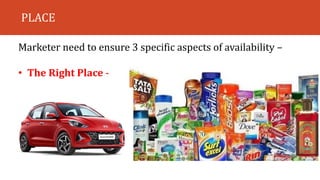
Marketer need to ensure 3 specific aspects of availability –
• The Right Place -
PLACE
• The Right Time -
PLACE
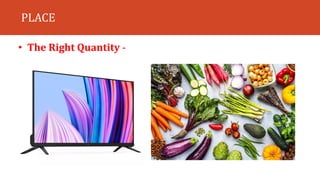
• The Right Quantity -
MARKETING CHANNELS
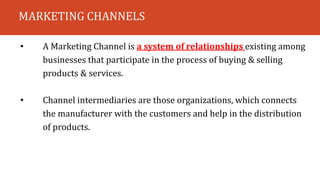
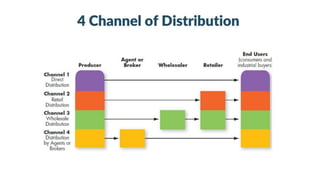
• A Marketing Channel is a system of relationships existing among
businesses that participate in the process of buying & selling
products & services.
• Channel intermediaries are those organizations, which connects
the manufacturer with the customers and help in the distribution
of products.
MARKETING CHANNELS
• Intermediaries play a great role in distribution and creating value
for the consumers.
• A Value chain consists of two sets of components
• Primary Activities – Inbound Logistics, Operations, Outbound
Logistics, Marketing, Sales & Services.
• Secondary Activities – Procurement, Technology Development,
H R M, Development of Organizational Infrastructure.
S
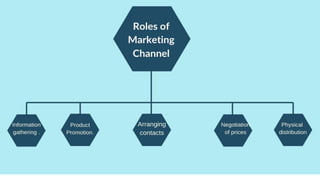
Functions of Marketing Channels
• A distribution channel moves goods from producers to consumers.
• Marketing channel members perform many functions:
• Buying,
• Carrying Inventory,
• Selling,
• Transporting,
• Financing,
• Promoting,
• Negotiating,
• Conducting Market Research,
• Servicing.
Functions of Marketing Channels
• Buying – Purchasing a broad assortment of goods from the
producer or other channel members.
• Carrying Inventory - Assuming the risks associated with
purchasing and holding an inventory.
• Selling – Performing activities required for selling goods to
consumers or other channel members.
Functions of Marketing Channels
• Transporting – Arranging for the shipment of goods to the
desired destination.
• Financing – Providing funds required to cover the cost of
channel activities.
• Promoting – Contributing to national & local advertising and
engaging in personal selling efforts.
Functions of Marketing Channels
• Negotiating – Attempting to determine the final price of
goods and the terms of payment & delivery.
• Conducting Market Research – Providing information
regarding the needs of customers.
• Servicing – Providing a variety of services, such as credit,
delivery and returns.
Channel Design Decision
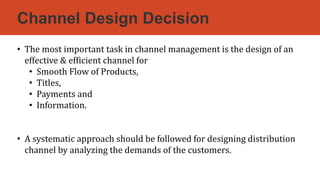
• The most important task in channel management is the design of an
effective & efficient channel for
• Smooth Flow of Products,
• Titles,
• Payments and
• Information.
• A systematic approach should be followed for designing distribution
channel by analyzing the demands of the customers.
Channel Design Decision
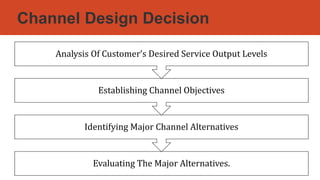
Evaluating The Major Alternatives.
Identifying Major Channel Alternatives
Establishing Channel Objectives
Analysis Of Customer’s Desired Service Output Levels
Channel Design Decision
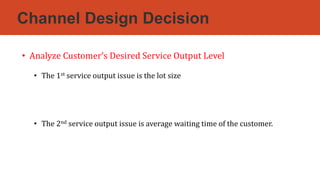
• Analyze Customer’s Desired Service Output Level
• The 1st service output issue is the lot size
• The 2nd service output issue is average waiting time of the customer.
Channel Design Decision
• Establishing Objectives
• Broad objectives includes
• Availability of product in the target market.
• Smooth movement of the product from the producer to the customer.
• Cost effective & economic distribution.
• Information communication from the producer to the consumer.
Channel Design Decision
• Establishing Objectives
• Channel objectives will vary depending on the nature & characteristics of the
product.
• For perishable products, the channel has to be short. - Direct Marketing
• For bulky & heavy products need longer distribution channel.
• For non-standardized & customized products, the company prefers to have
direct marketing network.
Channel Design Decision
• Identification of Major Channel Alternatives
• While evaluating channel alternatives, there are 3 issues to be addressed.
• The overall business environment
• Type & number of intermediaries needed
• Responsibilities of each channel member
Channel Design Decision
• Identification of Major Channel Alternatives
• Types of intermediaries
• Company Sales Force
• Agent or Broker
• Wholesaler
• Retailer
• Distributor
• Dealer
• Value Added Reseller
• Merchants
• Carrying & Forwarding Agents
Channel Design Decision
• Number of intermediaries –
• The Marketing manager should decide how many intermediaries he should use
for distributing his products.
• The decision on no. of intermediaries should largely depend on the
distribution strategy followed by the firm.
• Three kinds of Distribution Strategy viz.
• Intensive Distribution
• Selective Distribution
• Exclusive Distribution
Channel Design Decision
• Intensive Distribution - A channel strategy that seeks to make products
available in as many appropriate places as possible.
• This strategy is used for FMCG.
• Selective Distribution - A channel strategy that limits availability of products
to a few carefully selected outlets in given market area.
• This strategy is used for Clothing, Watches.
• Exclusive Distribution - An extreme case of selective distribution in which
only one outlet in a market territory is allowed to carry a product or product line.
• Example – Mercedes, BMW, Apple
Channel Design Decision
• Evaluating Major Channel Alternatives
• The channels should be evaluated on the basis of following criteria
• Economic Criteria
• Control Criteria
• Adaptive Criteria
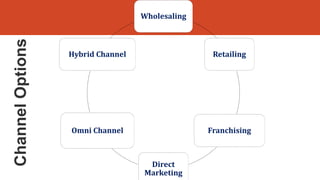
Wholesaling
Retailing
Franchising
Direct
Marketing
Omni Channel
Hybrid Channel
Channel
Options
Wholesaling
• Wholesaling includes all the activities in selling goods & services to
those who buy for resale or business use.
• It excludes manufacturers & farmers because they are engaged primarily in
production.
Wholesaling - Functions
• In general, wholesalers are more efficient in performing one or more
of the following functions :
1) Selling & Promoting: Wholesalers’ sales forces help manufacturers reach
many small business customers at a relatively low cost. They have more
contacts & buyers often trust them more than they trust a distant
manufacturer.
2) Buying & Assortment Building: Wholesalers are able to select items and
build the assortments their customers need, saving them considerable work.
Wholesaling - Functions
3) Bulk Breaking: Wholesalers achieve savings for their customers by buying
large carload lots and breaking the bulk into smaller units.
4) Warehousing: Wholesalers hold inventories, thereby reducing inventory
costs and risks to suppliers & customers.
5) Transportation: Wholesalers can often provide quicker delivery to buyer
because they are close to the buyers.
Retailing
• Retailing includes all the activities in selling goods or services directly
to final consumers for personal, nonbusiness use.
• Any organization selling to final consumers – whether it is a
manufacturer, wholesaler or retailer – is doing retailing.
• It doesn’t matter how the goods or services are sold
• In person OR By mail OR Vending machine OR On the internet
• Or where
• In a store OR On the street OR In the consumer’s home.
Types of Retailers
• Convenience store
• Chain of stores
• Franchisee
• Specialty Store
• Departmental Stores
• Super Market
• Hypermarket
• Shopping Malls
• Discount Store
• Factory Outlet
Types of Retailers
• Convenience store - This is located close to residential areas so as to
make easy access to the customers.
• It offers a limited range of product like grocery, daily needed FMCG
products, etc.
Types of Retailers
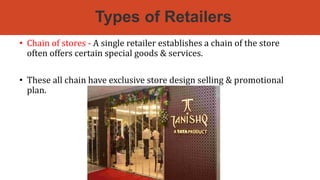
• Chain of stores - A single retailer establishes a chain of the store
often offers certain special goods & services.
• These all chain have exclusive store design selling & promotional
plan.
Types of Retailers
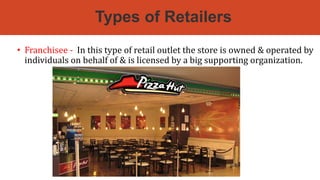
• Franchisee - In this type of retail outlet the store is owned & operated by
individuals on behalf of & is licensed by a big supporting organization.
Types of Retailers
• Specialty Store - A shop that specializes in one breed of products.
• Examples of specialist stores include camera stores, pharmacies, stationary,
and bookstores.
Types of Retailers
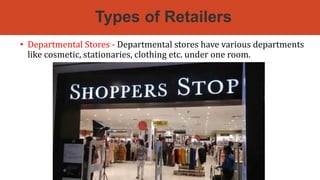
• Departmental Stores - Departmental stores have various departments
like cosmetic, stationaries, clothing etc. under one room.
Types of Retailers
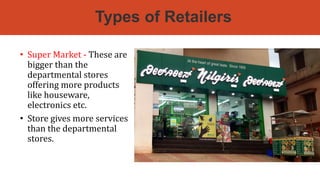
• Super Market - These are
bigger than the
departmental stores
offering more products
like houseware,
electronics etc.
• Store gives more services
than the departmental
stores.
Types of Retailers
• Hypermarket - These are very large in size. They provide large parking
than supermarket & departmental stores. E.g. Big Bazaar.
• Shopping Malls - Here retail space is shared by other retailers who
operate these retail outlet individually. Such group of a retail outlet in
the same building or premises is called a shopping mall. E.g. S.G mall in
Pune, Pyramid Vishal in Mumbai
Types of Retailers
• Discount Store - Discount stores differentiated themselves on the
basis of low price & various offers. E.g. Subhiksha.
• Factory Outlet - Factory stores are owned & operated by a
manufacturer who sells the product directly to the customer at a low
price because there is no middleman involved. E.g. Bata, Raymond.

Unit - 3 - PLACE.pdf

  • 1.
  • 2.
    • Well maintainedinteriors • Attractive Display • Superb Assortment • Spacious Movement • Well trained salespersons
  • 3.
    PLACE • Management ofDistribution is called third ‘P’ (Place) in marketing. • This involves processes to place the finished goods from manufacturer to a customer for final consumption and usage.
  • 4.
    PLACE Marketer need toensure 3 specific aspects of availability – • The Right Place -
  • 5.
  • 6.
  • 7.
    MARKETING CHANNELS • AMarketing Channel is a system of relationships existing among businesses that participate in the process of buying & selling products & services. • Channel intermediaries are those organizations, which connects the manufacturer with the customers and help in the distribution of products.
  • 8.
    MARKETING CHANNELS • Intermediariesplay a great role in distribution and creating value for the consumers. • A Value chain consists of two sets of components • Primary Activities – Inbound Logistics, Operations, Outbound Logistics, Marketing, Sales & Services. • Secondary Activities – Procurement, Technology Development, H R M, Development of Organizational Infrastructure.
  • 9.
  • 10.
    Functions of MarketingChannels • A distribution channel moves goods from producers to consumers. • Marketing channel members perform many functions: • Buying, • Carrying Inventory, • Selling, • Transporting, • Financing, • Promoting, • Negotiating, • Conducting Market Research, • Servicing.
  • 11.
    Functions of MarketingChannels • Buying – Purchasing a broad assortment of goods from the producer or other channel members. • Carrying Inventory - Assuming the risks associated with purchasing and holding an inventory. • Selling – Performing activities required for selling goods to consumers or other channel members.
  • 12.
    Functions of MarketingChannels • Transporting – Arranging for the shipment of goods to the desired destination. • Financing – Providing funds required to cover the cost of channel activities. • Promoting – Contributing to national & local advertising and engaging in personal selling efforts.
  • 13.
    Functions of MarketingChannels • Negotiating – Attempting to determine the final price of goods and the terms of payment & delivery. • Conducting Market Research – Providing information regarding the needs of customers. • Servicing – Providing a variety of services, such as credit, delivery and returns.
  • 15.
    Channel Design Decision •The most important task in channel management is the design of an effective & efficient channel for • Smooth Flow of Products, • Titles, • Payments and • Information. • A systematic approach should be followed for designing distribution channel by analyzing the demands of the customers.
  • 16.
    Channel Design Decision EvaluatingThe Major Alternatives. Identifying Major Channel Alternatives Establishing Channel Objectives Analysis Of Customer’s Desired Service Output Levels
  • 17.
    Channel Design Decision •Analyze Customer’s Desired Service Output Level • The 1st service output issue is the lot size • The 2nd service output issue is average waiting time of the customer.
  • 18.
    Channel Design Decision •Establishing Objectives • Broad objectives includes • Availability of product in the target market. • Smooth movement of the product from the producer to the customer. • Cost effective & economic distribution. • Information communication from the producer to the consumer.
  • 19.
    Channel Design Decision •Establishing Objectives • Channel objectives will vary depending on the nature & characteristics of the product. • For perishable products, the channel has to be short. - Direct Marketing • For bulky & heavy products need longer distribution channel. • For non-standardized & customized products, the company prefers to have direct marketing network.
  • 20.
    Channel Design Decision •Identification of Major Channel Alternatives • While evaluating channel alternatives, there are 3 issues to be addressed. • The overall business environment • Type & number of intermediaries needed • Responsibilities of each channel member
  • 21.
    Channel Design Decision •Identification of Major Channel Alternatives • Types of intermediaries • Company Sales Force • Agent or Broker • Wholesaler • Retailer • Distributor • Dealer • Value Added Reseller • Merchants • Carrying & Forwarding Agents
  • 22.
    Channel Design Decision •Number of intermediaries – • The Marketing manager should decide how many intermediaries he should use for distributing his products. • The decision on no. of intermediaries should largely depend on the distribution strategy followed by the firm. • Three kinds of Distribution Strategy viz. • Intensive Distribution • Selective Distribution • Exclusive Distribution
  • 23.
    Channel Design Decision •Intensive Distribution - A channel strategy that seeks to make products available in as many appropriate places as possible. • This strategy is used for FMCG. • Selective Distribution - A channel strategy that limits availability of products to a few carefully selected outlets in given market area. • This strategy is used for Clothing, Watches. • Exclusive Distribution - An extreme case of selective distribution in which only one outlet in a market territory is allowed to carry a product or product line. • Example – Mercedes, BMW, Apple
  • 24.
    Channel Design Decision •Evaluating Major Channel Alternatives • The channels should be evaluated on the basis of following criteria • Economic Criteria • Control Criteria • Adaptive Criteria
  • 25.
  • 26.
    Wholesaling • Wholesaling includesall the activities in selling goods & services to those who buy for resale or business use. • It excludes manufacturers & farmers because they are engaged primarily in production.
  • 27.
    Wholesaling - Functions •In general, wholesalers are more efficient in performing one or more of the following functions : 1) Selling & Promoting: Wholesalers’ sales forces help manufacturers reach many small business customers at a relatively low cost. They have more contacts & buyers often trust them more than they trust a distant manufacturer. 2) Buying & Assortment Building: Wholesalers are able to select items and build the assortments their customers need, saving them considerable work.
  • 28.
    Wholesaling - Functions 3)Bulk Breaking: Wholesalers achieve savings for their customers by buying large carload lots and breaking the bulk into smaller units. 4) Warehousing: Wholesalers hold inventories, thereby reducing inventory costs and risks to suppliers & customers. 5) Transportation: Wholesalers can often provide quicker delivery to buyer because they are close to the buyers.
  • 29.
    Retailing • Retailing includesall the activities in selling goods or services directly to final consumers for personal, nonbusiness use. • Any organization selling to final consumers – whether it is a manufacturer, wholesaler or retailer – is doing retailing. • It doesn’t matter how the goods or services are sold • In person OR By mail OR Vending machine OR On the internet • Or where • In a store OR On the street OR In the consumer’s home.
  • 30.
    Types of Retailers •Convenience store • Chain of stores • Franchisee • Specialty Store • Departmental Stores • Super Market • Hypermarket • Shopping Malls • Discount Store • Factory Outlet
  • 31.
    Types of Retailers •Convenience store - This is located close to residential areas so as to make easy access to the customers. • It offers a limited range of product like grocery, daily needed FMCG products, etc.
  • 32.
    Types of Retailers •Chain of stores - A single retailer establishes a chain of the store often offers certain special goods & services. • These all chain have exclusive store design selling & promotional plan.
  • 33.
    Types of Retailers •Franchisee - In this type of retail outlet the store is owned & operated by individuals on behalf of & is licensed by a big supporting organization.
  • 34.
    Types of Retailers •Specialty Store - A shop that specializes in one breed of products. • Examples of specialist stores include camera stores, pharmacies, stationary, and bookstores.
  • 35.
    Types of Retailers •Departmental Stores - Departmental stores have various departments like cosmetic, stationaries, clothing etc. under one room.
  • 36.
    Types of Retailers •Super Market - These are bigger than the departmental stores offering more products like houseware, electronics etc. • Store gives more services than the departmental stores.
  • 37.
    Types of Retailers •Hypermarket - These are very large in size. They provide large parking than supermarket & departmental stores. E.g. Big Bazaar. • Shopping Malls - Here retail space is shared by other retailers who operate these retail outlet individually. Such group of a retail outlet in the same building or premises is called a shopping mall. E.g. S.G mall in Pune, Pyramid Vishal in Mumbai
  • 38.
    Types of Retailers •Discount Store - Discount stores differentiated themselves on the basis of low price & various offers. E.g. Subhiksha. • Factory Outlet - Factory stores are owned & operated by a manufacturer who sells the product directly to the customer at a low price because there is no middleman involved. E.g. Bata, Raymond.