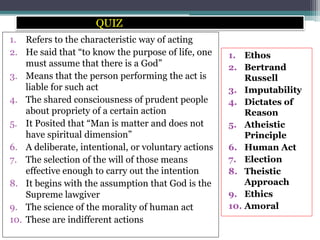
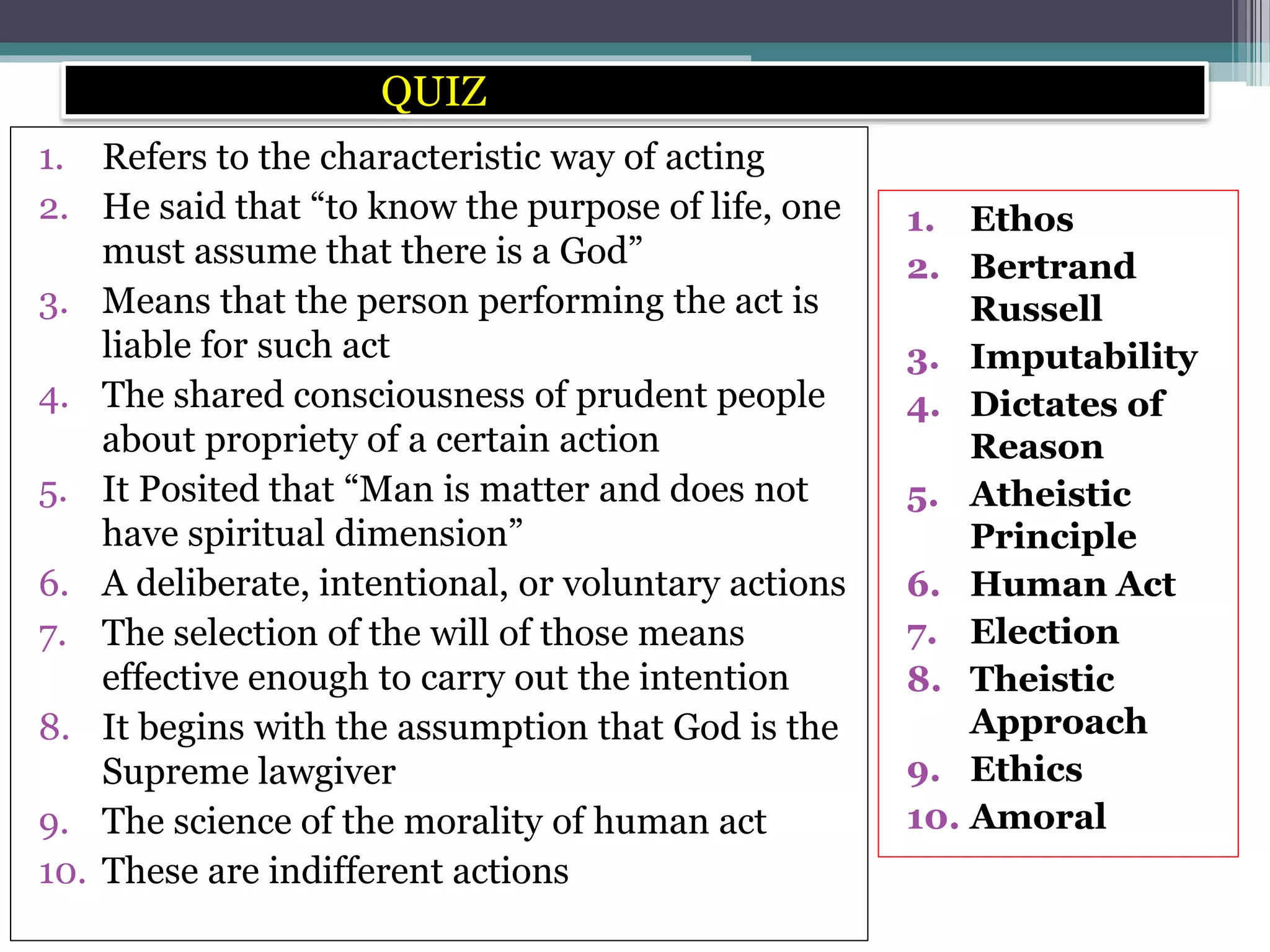
QUIZ
1. Refers to the characteristic way of acting
2. He said that “to know the purpose of life, one
must assume that there is a God”
3. Means that the person performing the act is
liable for such act
4. The shared consciousness of prudent people
about propriety of a certain action
5. It Posited that “Man is matter and does not
have spiritual dimension”
6. A deliberate, intentional, or voluntary actions
7. The selection of the will of those means
effective enough to carry out the intention
8. It begins with the assumption that God is the
Supreme lawgiver
9. The science of the morality of human act
10. These are indifferent actions
1. Ethos
2. Bertrand
Russell
3. Imputability
4. Dictates of
Reason
5. Atheistic
Principle
6. Human Act
7. Election
8. Theistic
Approach
9. Ethics
10. Amoral
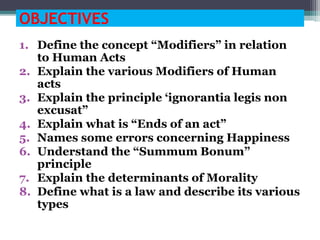
OBJECTIVES
1. Define the concept “Modifiers” in relation
to Human Acts
2. Explain the various Modifiers of Human
acts
3. Explain the principle ‘ignorantia legis non
excusat”
4. Explain what is “Ends of an act”
5. Names some errors concerning Happiness
6. Understand the “Summum Bonum”
principle
7. Explain the determinants of Morality
8. Define what is a law and describe its various
types
THE
MODIFIERS
OF
HUMAN ACTS
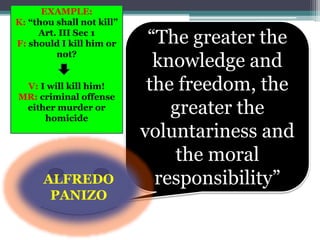
“The greater the
knowledge and
the freedom, the
greater the
voluntariness and
the moral
responsibility”ALFREDO
PANIZO
EXAMPLE:
K: “thou shall not kill”
Art. III Sec 1
F: should I kill him or
not?
V: I will kill him!
MR: criminal offense
either murder or
homicide
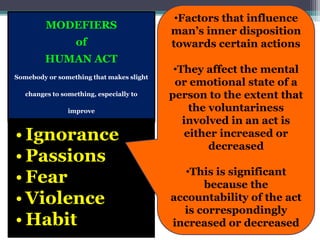
MODEFIERS
of
HUMAN ACT
Somebody or something that makes slight
changes to something, especially to
improve
• Ignorance
• Passions
• Fear
• Violence
• Habit
•Factors that influence
man’s inner disposition
towards certain actions
•They affect the mental
or emotional state of a
person to the extent that
the voluntariness
involved in an act is
either increased or
decreased
•This is significant
because the
accountability of the act
is correspondingly
increased or decreased
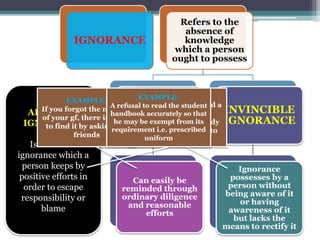
IGNORANCE
Refers to the
absence of
knowledge
which a person
ought to possess
VINCIBLE
IGNORANCE
Can easily be
reminded through
ordinary diligence
and reasonable
efforts
INVINCIBLE
IGNORANCE
Ignorance
possesses by a
person without
being aware of it
or having
awareness of it
but lacks the
means to rectify it
AFFECTED
IGNORANCE
Is a vincible
ignorance which a
person keeps by
positive efforts in
order to escape
responsibility or
blame
EXAMPLE:
If you forgot the number
of your gf, there is a way
to find it by asking her
friends
EXAMPLE:
If you gave your friend a
leftover food not
knowing it was already
spoiled causing her to
vomit intensely
EXAMPLE:
A refusal to read the student
handbook accurately so that
he may be exempt from its
requirement i.e. prescribed
uniform
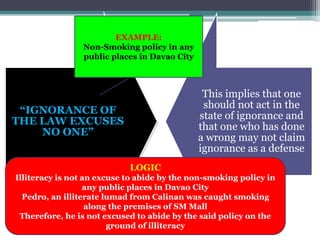
“IGNORANCE OF
THE LAW EXCUSES
NO ONE”
This implies that one
should not act in the
state of ignorance and
that one who has done
a wrong may not claim
ignorance as a defense
EXAMPLE:
Non-Smoking policy in any
public places in Davao City
LOGIC
Illiteracy is not an excuse to abide by the non-smoking policy in
any public places in Davao City
Pedro, an illiterate lumad from Calinan was caught smoking
along the premises of SM Mall
Therefore, he is not excused to abide by the said policy on the
ground of illiteracy
UNDESIRABLE
or NEGATIVE
Hatred, horror,
sadness, despair,
fear and anger
DESIRABLE or
POSITIVE
EMOTION
Love, desire, delight,
hope, and bravery
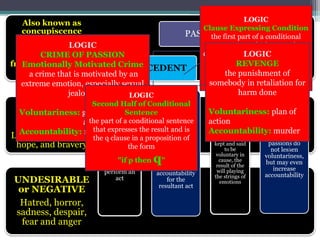
Also known as
concupiscence
which refers to
either tendencies
towards or away
from undesirable or
harmful objects
PASSION
ANTECEDENT
Those that
precede an
act and may
happen that
a person is
emotionally
aroused to
perform an
act
PRINCIPLE
Antecedent
passions do
not always
destroy
voluntariness,
but they
diminish
accountability
for the
resultant act
CONSEQUENT
Those that
are
intentionally
aroused and
kept and said
to be
voluntary in
cause, the
result of the
will playing
the strings of
emotions
PRINCIPLE
Consequent
passions do
not lessen
voluntariness,
but may even
increase
accountability
LOGIC
CRIME OF PASSION
Emotionally Motivated Crime
a crime that is motivated by an
extreme emotion, especially sexual
jealousy
Voluntariness: getting a knife or
a gun
Accountability: not murder
LOGIC
Clause Expressing Condition
the first part of a conditional
proposition, which states the
condition and is the p component
in a proposition phrased
"if pthen q”
LOGIC
Second Half of Conditional
Sentence
the part of a conditional sentence
that expresses the result and is
the q clause in a proposition of
the form
"if p then q"
LOGIC
REVENGE
the punishment of
somebody in retaliation for
harm done
Voluntariness: plan of
action
Accountability: murder
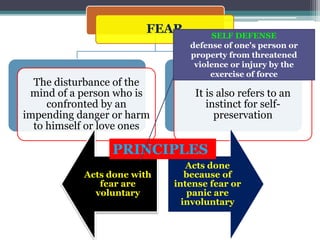
FEAR
The disturbance of the
mind of a person who is
confronted by an
impending danger or harm
to himself or love ones
It is also refers to an
instinct for self-
preservation
Acts done with
fear are
voluntary
Acts done
because of
intense fear or
panic are
involuntary
PRINCIPLES
SELF DEFENSE
defense of one's person or
property from threatened
violence or injury by the
exercise of force
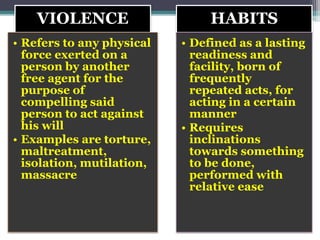
VIOLENCE
• Refers to any physical
force exerted on a
person by another
free agent for the
purpose of
compelling said
person to act against
his will
• Examples are torture,
maltreatment,
isolation, mutilation,
massacre
HABITS
• Defined as a lasting
readiness and
facility, born of
frequently
repeated acts, for
acting in a certain
manner
• Requires
inclinations
towards something
to be done,
performed with
relative ease
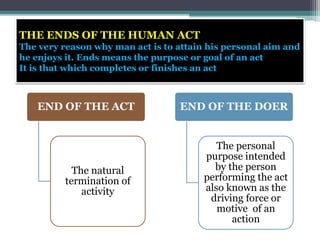
THE ENDS OF THE HUMAN ACT
The very reason why man act is to attain his personal aim and
he enjoys it. Ends means the purpose or goal of an act
It is that which completes or finishes an act
END OF THE ACT
The natural
termination of
activity
END OF THE DOER
The personal
purpose intended
by the person
performing the act
also known as the
driving force or
motive of an
action
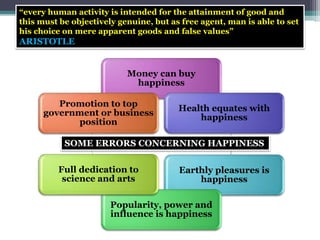
“every human activity is intended for the attainment of good and
this must be objectively genuine, but as free agent, man is able to set
his choice on mere apparent goods and false values”
ARISTOTLE
Money can buy
happiness
Health equates with
happiness
Earthly pleasures is
happiness
Popularity, power and
influence is happiness
Full dedication to
science and arts
Promotion to top
government or business
position
SOME ERRORS CONCERNING HAPPINESS
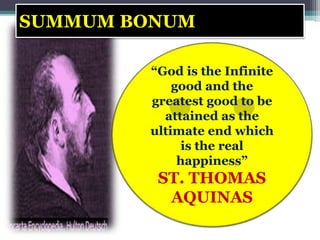
SUMMUM BONUM
“God is the Infinite
good and the
greatest good to be
attained as the
ultimate end which
is the real
happiness”
ST. THOMAS
AQUINAS
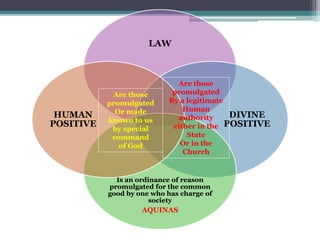
LAW
DIVINE
POSITIVE
Is an ordinance of reason
promulgated for the common
good by one who has charge of
society
AQUINAS
HUMAN
POSITIVE
Are those
promulgated
Or made
known to us
by special
command
of God
Are those
promulgated
By a legitimate
Human
authority
either in the
State
Or in the
Church
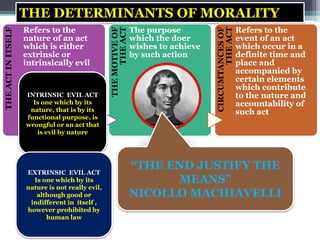
THE DETERMINANTS OF MORALITYTHEACTINITSELF
Refers to the
nature of an act
which is either
extrinsic or
intrinsically evil
THEMOTIVEOF
THEACT
The purpose
which the doer
wishes to achieve
by such action
CIRCUMTANCESOF
THEACT
Refers to the
event of an act
which occur in a
definite time and
place and
accompanied by
certain elements
which contribute
to the nature and
accountability of
such act
INTRINSIC EVIL ACT
Is one which by its
nature, that is by its
functional purpose, is
wrongful or an act that
is evil by nature
EXTRINSIC EVIL ACT
Is one which by its
nature is not really evil,
although good or
indifferent in itself ,
however prohibited by
human law
“THE END JUSTIFY THE
MEANS”
NICOLLO MACHIAVELLI
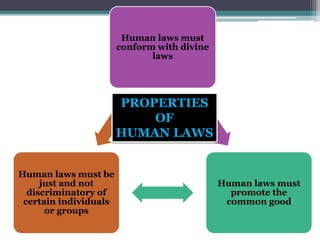
Human laws must
conform with divine
laws
Human laws must
promote the
common good
Human laws must be
just and not
discriminatory of
certain individuals
or groups
PROPERTIES
OF
HUMAN LAWS

Logic & Ethics 3

  • 1.
    QUIZ 1. Refers tothe characteristic way of acting 2. He said that “to know the purpose of life, one must assume that there is a God” 3. Means that the person performing the act is liable for such act 4. The shared consciousness of prudent people about propriety of a certain action 5. It Posited that “Man is matter and does not have spiritual dimension” 6. A deliberate, intentional, or voluntary actions 7. The selection of the will of those means effective enough to carry out the intention 8. It begins with the assumption that God is the Supreme lawgiver 9. The science of the morality of human act 10. These are indifferent actions 1. Ethos 2. Bertrand Russell 3. Imputability 4. Dictates of Reason 5. Atheistic Principle 6. Human Act 7. Election 8. Theistic Approach 9. Ethics 10. Amoral
  • 2.
    OBJECTIVES 1. Define theconcept “Modifiers” in relation to Human Acts 2. Explain the various Modifiers of Human acts 3. Explain the principle ‘ignorantia legis non excusat” 4. Explain what is “Ends of an act” 5. Names some errors concerning Happiness 6. Understand the “Summum Bonum” principle 7. Explain the determinants of Morality 8. Define what is a law and describe its various types
  • 3.
  • 4.
    “The greater the knowledgeand the freedom, the greater the voluntariness and the moral responsibility”ALFREDO PANIZO EXAMPLE: K: “thou shall not kill” Art. III Sec 1 F: should I kill him or not? V: I will kill him! MR: criminal offense either murder or homicide
  • 5.
    MODEFIERS of HUMAN ACT Somebody orsomething that makes slight changes to something, especially to improve • Ignorance • Passions • Fear • Violence • Habit •Factors that influence man’s inner disposition towards certain actions •They affect the mental or emotional state of a person to the extent that the voluntariness involved in an act is either increased or decreased •This is significant because the accountability of the act is correspondingly increased or decreased
  • 6.
    IGNORANCE Refers to the absenceof knowledge which a person ought to possess VINCIBLE IGNORANCE Can easily be reminded through ordinary diligence and reasonable efforts INVINCIBLE IGNORANCE Ignorance possesses by a person without being aware of it or having awareness of it but lacks the means to rectify it AFFECTED IGNORANCE Is a vincible ignorance which a person keeps by positive efforts in order to escape responsibility or blame EXAMPLE: If you forgot the number of your gf, there is a way to find it by asking her friends EXAMPLE: If you gave your friend a leftover food not knowing it was already spoiled causing her to vomit intensely EXAMPLE: A refusal to read the student handbook accurately so that he may be exempt from its requirement i.e. prescribed uniform
  • 7.
    “IGNORANCE OF THE LAWEXCUSES NO ONE” This implies that one should not act in the state of ignorance and that one who has done a wrong may not claim ignorance as a defense EXAMPLE: Non-Smoking policy in any public places in Davao City LOGIC Illiteracy is not an excuse to abide by the non-smoking policy in any public places in Davao City Pedro, an illiterate lumad from Calinan was caught smoking along the premises of SM Mall Therefore, he is not excused to abide by the said policy on the ground of illiteracy
  • 8.
    UNDESIRABLE or NEGATIVE Hatred, horror, sadness,despair, fear and anger DESIRABLE or POSITIVE EMOTION Love, desire, delight, hope, and bravery Also known as concupiscence which refers to either tendencies towards or away from undesirable or harmful objects PASSION ANTECEDENT Those that precede an act and may happen that a person is emotionally aroused to perform an act PRINCIPLE Antecedent passions do not always destroy voluntariness, but they diminish accountability for the resultant act CONSEQUENT Those that are intentionally aroused and kept and said to be voluntary in cause, the result of the will playing the strings of emotions PRINCIPLE Consequent passions do not lessen voluntariness, but may even increase accountability LOGIC CRIME OF PASSION Emotionally Motivated Crime a crime that is motivated by an extreme emotion, especially sexual jealousy Voluntariness: getting a knife or a gun Accountability: not murder LOGIC Clause Expressing Condition the first part of a conditional proposition, which states the condition and is the p component in a proposition phrased "if pthen q” LOGIC Second Half of Conditional Sentence the part of a conditional sentence that expresses the result and is the q clause in a proposition of the form "if p then q" LOGIC REVENGE the punishment of somebody in retaliation for harm done Voluntariness: plan of action Accountability: murder
  • 9.
    FEAR The disturbance ofthe mind of a person who is confronted by an impending danger or harm to himself or love ones It is also refers to an instinct for self- preservation Acts done with fear are voluntary Acts done because of intense fear or panic are involuntary PRINCIPLES SELF DEFENSE defense of one's person or property from threatened violence or injury by the exercise of force
  • 10.
    VIOLENCE • Refers toany physical force exerted on a person by another free agent for the purpose of compelling said person to act against his will • Examples are torture, maltreatment, isolation, mutilation, massacre HABITS • Defined as a lasting readiness and facility, born of frequently repeated acts, for acting in a certain manner • Requires inclinations towards something to be done, performed with relative ease
  • 11.
    THE ENDS OFTHE HUMAN ACT The very reason why man act is to attain his personal aim and he enjoys it. Ends means the purpose or goal of an act It is that which completes or finishes an act END OF THE ACT The natural termination of activity END OF THE DOER The personal purpose intended by the person performing the act also known as the driving force or motive of an action
  • 12.
    “every human activityis intended for the attainment of good and this must be objectively genuine, but as free agent, man is able to set his choice on mere apparent goods and false values” ARISTOTLE Money can buy happiness Health equates with happiness Earthly pleasures is happiness Popularity, power and influence is happiness Full dedication to science and arts Promotion to top government or business position SOME ERRORS CONCERNING HAPPINESS
  • 13.
    SUMMUM BONUM “God isthe Infinite good and the greatest good to be attained as the ultimate end which is the real happiness” ST. THOMAS AQUINAS
  • 14.
    LAW DIVINE POSITIVE Is an ordinanceof reason promulgated for the common good by one who has charge of society AQUINAS HUMAN POSITIVE Are those promulgated Or made known to us by special command of God Are those promulgated By a legitimate Human authority either in the State Or in the Church
  • 15.
    THE DETERMINANTS OFMORALITYTHEACTINITSELF Refers to the nature of an act which is either extrinsic or intrinsically evil THEMOTIVEOF THEACT The purpose which the doer wishes to achieve by such action CIRCUMTANCESOF THEACT Refers to the event of an act which occur in a definite time and place and accompanied by certain elements which contribute to the nature and accountability of such act INTRINSIC EVIL ACT Is one which by its nature, that is by its functional purpose, is wrongful or an act that is evil by nature EXTRINSIC EVIL ACT Is one which by its nature is not really evil, although good or indifferent in itself , however prohibited by human law “THE END JUSTIFY THE MEANS” NICOLLO MACHIAVELLI
  • 16.
    Human laws must conformwith divine laws Human laws must promote the common good Human laws must be just and not discriminatory of certain individuals or groups PROPERTIES OF HUMAN LAWS