


BACKGROUND
OF
PSYCHOLOGY
Origins and Beginnings
of
Psychology
I. GREEK PHILOSOPHERS
 Their ideas about psychology were based from the writing of the
ancient Greek philosophers like Socrates, Plato, and Aristotle
 They used two approaches to wit;
1. SPECULATION
The motivational aspect of human
behavior
2. EMPIRICAL METHOD
Through observation. Further
sharpened by the empiricists of the
17th century
II. RENAISSANCE SCIENTISTS
 Introduced the idea that observation could
be further objectified through
measurements
 Objectified means, to present or regard
as an object or to make
objective, external, or concrete
III. 19TH CENTURY GERMAN PSYCHOLOGISTS-PHYSICISTS
 Used measurement techniques to study
sensation, the foundation of scientific
psychology
 Sensation is the faculty to feel or
perceive; physical sensibility
IV. WILHELM WUNDT
 Opened his laboratory at Leipzig, Germany in 1879. The beginning of
psychological research
 Often considered as the “Father of Experimental Psychology”
 His students opened psychological laboratories at the major universities in
Europe and in the United States
 STRUCTURALISM
- His approach to the study of human behavior
- It is concerned with identifying and studying the elements that
form the structure of consciousness
 CONSCIOUSNESS
- Special awareness or sensitivity or alertness to or concern for
a particular issue or situation
V. WILLIAM JAMES
 Developed a different approach in the
study of behavior called Functionalism
 FUNCTIONALISM
–Emphasized the study of behavior
as an integrated process
VI. GERMAN PSYCHOLOGISTS
 Popularly known as the “ Gestalts”
 Objected to the idea of studying behavior
by analyzing the elements
 Proposed that behavior shall be studied in
terms of organization or form
VII. JOHN B. WATSON
 The man who did more than any other to set
the direction of modern experimental psychology
 Expressed skepticism about studying any aspect
of behavior that cannot be objectively observe
 Proposed that psychologist should study the
behavior of organism
 This approach led to the movement called
“Behaviorism”
VIII. SIGMUND FREUD
 Initiated the “ Psychoanalytic “ movement
 It is another conceptual source of modern
psychology
 The concept entered the American psychology
late but brings great impact on personality
theory and methods of treating mental illness
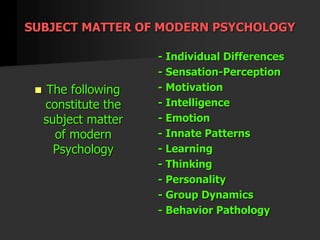
SUBJECT MATTER OF MODERN PSYCHOLOGY
 The following
constitute the
subject matter
of modern
Psychology
- Individual Differences
- Sensation-Perception
- Motivation
- Intelligence
- Emotion
- Innate Patterns
- Learning
- Thinking
- Personality
- Group Dynamics
- Behavior Pathology
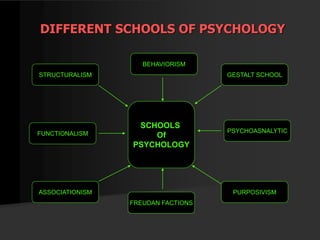
DIFFERENT SCHOOLS OF PSYCHOLOGY
STRUCTURALISM GESTALT SCHOOL
PURPOSIVISMASSOCIATIONISM
FREUDAN FACTIONS
BEHAVIORISM
SCHOOLS
Of
PSYCHOLOGY
FUNCTIONALISM PSYCHOASNALYTIC
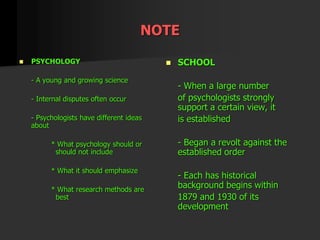
NOTE
 PSYCHOLOGY
- A young and growing science
- Internal disputes often occur
- Psychologists have different ideas
about
* What psychology should or
should not include
* What it should emphasize
* What research methods are
best
 SCHOOL
- When a large number
of psychologists strongly
support a certain view, it
is established
- Began a revolt against the
established order
- Each has historical
background begins within
1879 and 1930 of its
development
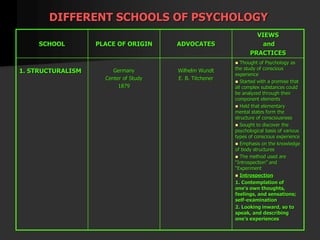
DIFFERENT SCHOOLS OF PSYCHOLOGY
SCHOOL PLACE OF ORIGIN ADVOCATES
VIEWS
and
PRACTICES
1. STRUCTURALISM Germany
Center of Study
1879
Wilhelm Wundt
E. B. Titchener
 Thought of Psychology as
the study of conscious
experience
 Started with a premise that
all complex substances could
be analyzed through their
component elements
 Held that elementary
mental states form the
structure of consciousness
 Sought to discover the
psychological basis of various
types of conscious experience
 Emphasis on the knowledge
of body structures
 The method used are
“Introspection” and
“Experiment
 Introspection
1. Contemplation of
one's own thoughts,
feelings, and sensations;
self-examination
2. Looking inward, so to
speak, and describing
one’s experiences
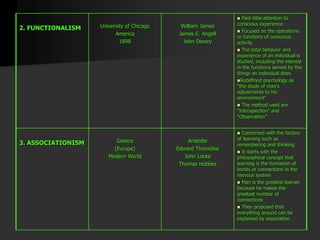
2. FUNCTIONALISM University of Chicago
America
1898
William James
James E. Angell
John Dewey
 Paid little attention to
conscious experience
 Focused on the operations
or functions of conscious
activity
 The total behavior and
experience of an individual is
studied, including the interest
in the functions served by the
things an individual does
Redefined psychology as
“the study of man’s
adjustments to his
environment”
 The method used are
“Introspection” and
“Observation”
3. ASSOCIATIONISM Greece
(Europe)
Modern World
Aristotle
Edward Thorndike
John Locke
Thomas Hobbes
 Concerned with the factors
of learning such as
remembering and thinking
 It starts with the
philosophical concept that
learning is the formation of
bonds or connections in the
nervous system
 Man is the greatest learner
because he makes the
greatest number of
connections
 They proposed that
everything around can be
explained by association
4. BEHAVIORISM America
1912
John Watson
E. L. Thorndike
 A revolt against both
Structuralism and Functionalism
 Turned to the study of overt
behavior
- Observable by others, a social
and explicit act
 Rejected the study of
conscious experience as a
subject for scientific research
 defines psychology as “the
science of behavior and not of
consciousness”
 Emphasizes conditional
reflexes of the elements of
behavior
 Denies the existence of instinct
or inborn tendencies, and insist
on learned behavior
“Instinct”
-An inborn pattern of behavior
that is characteristic of a species
and is often a response to
specific environmental stimuli
 Studies animal behavior and
emphasizes the objective
method in observing responses
 it is psychology based upon
“Stimulus-Response” connections
 Believes that there can be no
response with out a stimuli
“Stimulus”
- Any factor inside or outside, or
anything which causes the
organism to react or response
5. GESTALT SCHOOL Germany
1912
Max Wertheimer
Wolfgang Kohler
Kurt Koffka
 Maintains that
psychology should study
the whole patterns of
behavior or experience or
the perception of organized
configuration
 “ The whole is more than
the sum of all its parts” is
their fundamental principle
 They believed that the
overall pattern of any
experience which was
stored is important to study
than the specific elements
which made it up
 With emphasis on the
study of human behavior
and perception
“Perception”
-Recognition and
interpretation of sensory
stimuli based chiefly on
memory
 Contributed much to the
understanding of learning,
memory, and problem
solving
 Uses Introspection and
observation
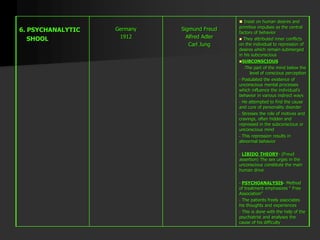
6. PSYCHANALYTIC
SHOOL
Germany
1912
Sigmund Freud
Alfred Adler
Carl Jung
 Insist on human desires and
primitive impulses as the central
factors of behavior
 They attributed inner conflicts
on the individual to repression of
desires which remain submerged
in his subconscious
SUBCONSCIOUS
-The part of the mind below the
level of conscious perception
- Postulated the existence of
unconscious mental processes
which influence the individual’s
behavior in various indirect ways
- He attempted to find the cause
and cure of personality disorder
- Stresses the role of motives and
cravings, often hidden and
repressed in the subconscious or
unconscious mind
- This repression results in
abnormal behavior
- LIBIDO THEORY- (Freud
assertion) The sex urges in the
unconscious constitute the main
human drive
- PSYCHOANALYSIS- Method
of treatment emphasizes “ Free
Association”
- The patients freely associates
his thoughts and experiences
- This is done with the help of the
psychiatrist and analyses the
cause of his difficulty
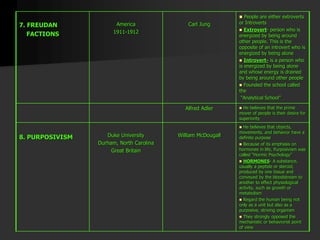
7. FREUDAN
FACTIONS
America
1911-1912
Carl Jung
 People are either extroverts
or Introverts
 Extrovert- person who is
energized by being around
other people. This is the
opposite of an introvert who is
energized by being alone
 Introvert- is a person who
is energized by being alone
and whose energy is drained
by being around other people
 Founded the school called
the
“Analytical School”
Alfred Adler  He believes that the prime
mover of people is their desire for
superiority
8. PURPOSIVISM Duke University
Durham, North Carolina
Great Britain
William McDougall
 He believes that objects,
movements, and behavior have a
definite purpose
 Because of its emphasis on
hormones in life, Purposivism was
called “Hormic Psychology”
 HORMONES- A substance,
usually a peptide or steroid,
produced by one tissue and
conveyed by the bloodstream to
another to effect physiological
activity, such as growth or
metabolism
 Regard the human being not
only as a unit but also as a
purposive, striving organism
 They strongly opposed the
mechanistic or behaviorist point
of view
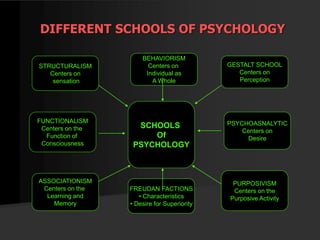
DIFFERENT SCHOOLS OF PSYCHOLOGY
STRUCTURALISM
Centers on
sensation
GESTALT SCHOOL
Centers on
Perception
PURPOSIVISM
Centers on the
Purposive Activity
ASSOCIATIONISM
Centers on the
Learning and
Memory
FREUDAN FACTIONS
• Characteristics
• Desire for Superiority
BEHAVIORISM
Centers on
Individual as
A Whole
SCHOOLS
Of
PSYCHOLOGY
FUNCTIONALISM
Centers on the
Function of
Consciousness
PSYCHOASNALYTIC
Centers on
Desire
BRANCHES OF PSYCHOLOGY
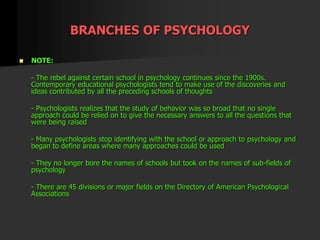
 NOTE:
- The rebel against certain school in psychology continues since the 1900s.
Contemporary educational psychologists tend to make use of the discoveries and
ideas contributed by all the preceding schools of thoughts
- Psychologists realizes that the study of behavior was so broad that no single
approach could be relied on to give the necessary answers to all the questions that
were being raised
- Many psychologists stop identifying with the school or approach to psychology and
began to define areas where many approaches could be used
- They no longer bore the names of schools but took on the names of sub-fields of
psychology
- There are 45 divisions or major fields on the Directory of American Psychological
Associations
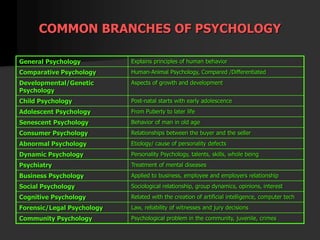
COMMON BRANCHES OF PSYCHOLOGY
General Psychology Explains principles of human behavior
Comparative Psychology Human-Animal Psychology, Compared /Differentiated
Developmental/Genetic
Psychology
Aspects of growth and development
Child Psychology Post-natal starts with early adolescence
Adolescent Psychology From Puberty to later life
Senescent Psychology Behavior of man in old age
Consumer Psychology Relationships between the buyer and the seller
Abnormal Psychology Etiology/ cause of personality defects
Dynamic Psychology Personality Psychology, talents, skills, whole being
Psychiatry Treatment of mental diseases
Business Psychology Applied to business, employee and employers relationship
Social Psychology Sociological relationship, group dynamics, opinions, interest
Cognitive Psychology Related with the creation of artificial intelligence, computer tech
Forensic/Legal Psychology Law, reliability of witnesses and jury decisions
Community Psychology Psychological problem in the community, juvenile, crimes
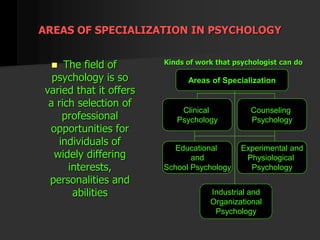
AREAS OF SPECIALIZATION IN PSYCHOLOGY
 The field of
psychology is so
varied that it offers
a rich selection of
professional
opportunities for
individuals of
widely differing
interests,
personalities and
abilities
Kinds of work that psychologist can do
Clinical
Psychology
Areas of Specialization
Counseling
Psychology
Experimental and
Physiological
Psychology
Educational
and
School Psychology
Industrial and
Organizational
Psychology
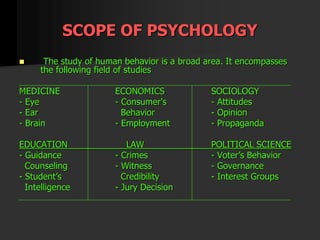
SCOPE OF PSYCHOLOGY
 The study of human behavior is a broad area. It encompasses
the following field of studies
MEDICINE ECONOMICS SOCIOLOGY
- Eye - Consumer’s - Attitudes
- Ear Behavior - Opinion
- Brain - Employment - Propaganda
EDUCATION LAW POLITICAL SCIENCE
- Guidance - Crimes - Voter’s Behavior
Counseling - Witness - Governance
- Student’s Credibility - Interest Groups
Intelligence - Jury Decision
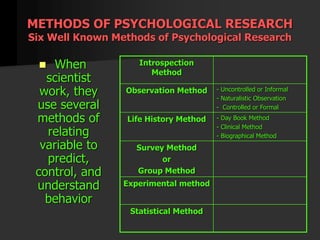
METHODS OF PSYCHOLOGICAL RESEARCH
Six Well Known Methods of Psychological Research
 When
scientist
work, they
use several
methods of
relating
variable to
predict,
control, and
understand
behavior
Introspection
Method
Observation Method - Uncontrolled or Informal
- Naturalistic Observation
- Controlled or Formal
Life History Method - Day Book Method
- Clinical Method
- Biographical Method
Survey Method
or
Group Method
Experimental method
Statistical Method
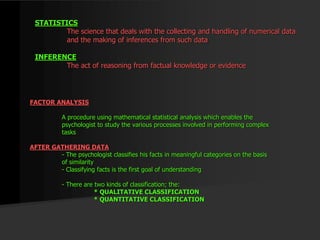
STATISTICS
The science that deals with the collecting and handling of numerical data
and the making of inferences from such data
INFERENCE
The act of reasoning from factual knowledge or evidence
FACTOR ANALYSIS
A procedure using mathematical statistical analysis which enables the
psychologist to study the various processes involved in performing complex
tasks
AFTER GATHERING DATA
- The psychologist classifies his facts in meaningful categories on the basis
of similarity
- Classifying facts is the first goal of understanding
- There are two kinds of classification; the:
* QUALITATIVE CLASSIFICATION
* QUANTITATIVE CLASSIFICATION
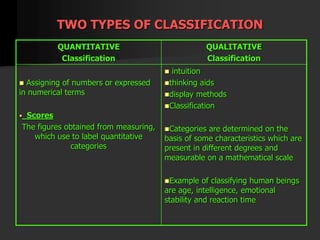
TWO TYPES OF CLASSIFICATION
QUANTITATIVE
Classification
QUALITATIVE
Classification
 Assigning of numbers or expressed
in numerical terms
 Scores
The figures obtained from measuring,
which use to label quantitative
categories
 intuition
thinking aids
display methods
Classification
Categories are determined on the
basis of some characteristics which are
present in different degrees and
measurable on a mathematical scale
Example of classifying human beings
are age, intelligence, emotional
stability and reaction time
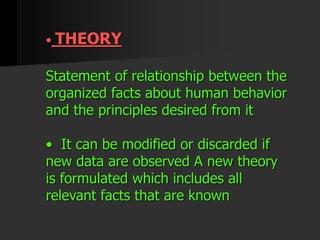
• THEORY
Statement of relationship between the
organized facts about human behavior
and the principles desired from it
• It can be modified or discarded if
new data are observed A new theory
is formulated which includes all
relevant facts that are known
OBJECTIVES OF PSYCHOLOGY
 Psychology has made great strides in the development of principles
and methods and the discovery of facts which find useful application
in various aspects of everyday life
The Objectives
1. To understand human behavior
2. To predict human behavior by means of observation and experiment
3. To influence or alter the behavior of the individual or group in
desirable ways so that the designed goal can be achieved
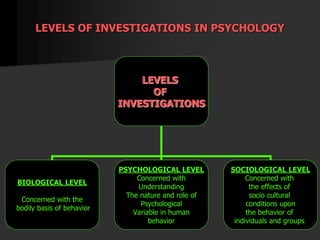
LEVELS OF INVESTIGATIONS IN PSYCHOLOGY
LEVELS
OF
INVESTIGATIONS
BIOLOGICAL LEVEL
Concerned with the
bodily basis of behavior
PSYCHOLOGICAL LEVEL
Concerned with
Understanding
The nature and role of
Psychological
Variable in human
behavior
SOCIOLOGICAL LEVEL
Concerned with
the effects of
socio cultural
conditions upon
the behavior of
individuals and groups
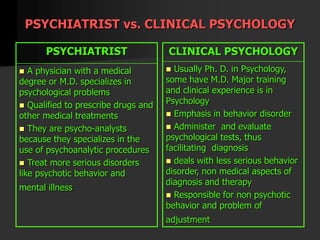
PSYCHIATRIST vs. CLINICAL PSYCHOLOGY
PSYCHIATRIST
 A physician with a medical
degree or M.D. specializes in
psychological problems
 Qualified to prescribe drugs and
other medical treatments
 They are psycho-analysts
because they specializes in the
use of psychoanalytic procedures
 Treat more serious disorders
like psychotic behavior and
mental illness
CLINICAL PSYCHOLOGY
 Usually Ph. D. in Psychology,
some have M.D. Major training
and clinical experience is in
Psychology
 Emphasis in behavior disorder
 Administer and evaluate
psychological tests, thus
facilitating diagnosis
 deals with less serious behavior
disorder, non medical aspects of
diagnosis and therapy
 Responsible for non psychotic
behavior and problem of
adjustment
VALUES OF PSYCHOLOGY
1. As a science, it enables the individual to learn more quickly
and to choose a vocation more intelligently
2. It enables a person to understand that no two individuals
are exactly alike
3. It enables one to resolve his own problems and to develop
greater personal efficiency. Thus the person develops
himself into a well integrated and happy individual
4. Psychology is applied to such fields as business, education,
courtroom testimonies, politics and others
sirc0212

Psyche Background 3

  • 1.
  • 2.
    I. GREEK PHILOSOPHERS Their ideas about psychology were based from the writing of the ancient Greek philosophers like Socrates, Plato, and Aristotle  They used two approaches to wit; 1. SPECULATION The motivational aspect of human behavior 2. EMPIRICAL METHOD Through observation. Further sharpened by the empiricists of the 17th century
  • 3.
    II. RENAISSANCE SCIENTISTS Introduced the idea that observation could be further objectified through measurements  Objectified means, to present or regard as an object or to make objective, external, or concrete
  • 4.
    III. 19TH CENTURYGERMAN PSYCHOLOGISTS-PHYSICISTS  Used measurement techniques to study sensation, the foundation of scientific psychology  Sensation is the faculty to feel or perceive; physical sensibility
  • 5.
    IV. WILHELM WUNDT Opened his laboratory at Leipzig, Germany in 1879. The beginning of psychological research  Often considered as the “Father of Experimental Psychology”  His students opened psychological laboratories at the major universities in Europe and in the United States  STRUCTURALISM - His approach to the study of human behavior - It is concerned with identifying and studying the elements that form the structure of consciousness  CONSCIOUSNESS - Special awareness or sensitivity or alertness to or concern for a particular issue or situation
  • 6.
    V. WILLIAM JAMES Developed a different approach in the study of behavior called Functionalism  FUNCTIONALISM –Emphasized the study of behavior as an integrated process
  • 7.
    VI. GERMAN PSYCHOLOGISTS Popularly known as the “ Gestalts”  Objected to the idea of studying behavior by analyzing the elements  Proposed that behavior shall be studied in terms of organization or form
  • 8.
    VII. JOHN B.WATSON  The man who did more than any other to set the direction of modern experimental psychology  Expressed skepticism about studying any aspect of behavior that cannot be objectively observe  Proposed that psychologist should study the behavior of organism  This approach led to the movement called “Behaviorism”
  • 9.
    VIII. SIGMUND FREUD Initiated the “ Psychoanalytic “ movement  It is another conceptual source of modern psychology  The concept entered the American psychology late but brings great impact on personality theory and methods of treating mental illness
  • 10.
    SUBJECT MATTER OFMODERN PSYCHOLOGY  The following constitute the subject matter of modern Psychology - Individual Differences - Sensation-Perception - Motivation - Intelligence - Emotion - Innate Patterns - Learning - Thinking - Personality - Group Dynamics - Behavior Pathology
  • 11.
    DIFFERENT SCHOOLS OFPSYCHOLOGY STRUCTURALISM GESTALT SCHOOL PURPOSIVISMASSOCIATIONISM FREUDAN FACTIONS BEHAVIORISM SCHOOLS Of PSYCHOLOGY FUNCTIONALISM PSYCHOASNALYTIC
  • 12.
    NOTE  PSYCHOLOGY - Ayoung and growing science - Internal disputes often occur - Psychologists have different ideas about * What psychology should or should not include * What it should emphasize * What research methods are best  SCHOOL - When a large number of psychologists strongly support a certain view, it is established - Began a revolt against the established order - Each has historical background begins within 1879 and 1930 of its development
  • 13.
    DIFFERENT SCHOOLS OFPSYCHOLOGY SCHOOL PLACE OF ORIGIN ADVOCATES VIEWS and PRACTICES 1. STRUCTURALISM Germany Center of Study 1879 Wilhelm Wundt E. B. Titchener  Thought of Psychology as the study of conscious experience  Started with a premise that all complex substances could be analyzed through their component elements  Held that elementary mental states form the structure of consciousness  Sought to discover the psychological basis of various types of conscious experience  Emphasis on the knowledge of body structures  The method used are “Introspection” and “Experiment  Introspection 1. Contemplation of one's own thoughts, feelings, and sensations; self-examination 2. Looking inward, so to speak, and describing one’s experiences
  • 14.
    2. FUNCTIONALISM Universityof Chicago America 1898 William James James E. Angell John Dewey  Paid little attention to conscious experience  Focused on the operations or functions of conscious activity  The total behavior and experience of an individual is studied, including the interest in the functions served by the things an individual does Redefined psychology as “the study of man’s adjustments to his environment”  The method used are “Introspection” and “Observation” 3. ASSOCIATIONISM Greece (Europe) Modern World Aristotle Edward Thorndike John Locke Thomas Hobbes  Concerned with the factors of learning such as remembering and thinking  It starts with the philosophical concept that learning is the formation of bonds or connections in the nervous system  Man is the greatest learner because he makes the greatest number of connections  They proposed that everything around can be explained by association
  • 15.
    4. BEHAVIORISM America 1912 JohnWatson E. L. Thorndike  A revolt against both Structuralism and Functionalism  Turned to the study of overt behavior - Observable by others, a social and explicit act  Rejected the study of conscious experience as a subject for scientific research  defines psychology as “the science of behavior and not of consciousness”  Emphasizes conditional reflexes of the elements of behavior  Denies the existence of instinct or inborn tendencies, and insist on learned behavior “Instinct” -An inborn pattern of behavior that is characteristic of a species and is often a response to specific environmental stimuli  Studies animal behavior and emphasizes the objective method in observing responses  it is psychology based upon “Stimulus-Response” connections  Believes that there can be no response with out a stimuli “Stimulus” - Any factor inside or outside, or anything which causes the organism to react or response
  • 16.
    5. GESTALT SCHOOLGermany 1912 Max Wertheimer Wolfgang Kohler Kurt Koffka  Maintains that psychology should study the whole patterns of behavior or experience or the perception of organized configuration  “ The whole is more than the sum of all its parts” is their fundamental principle  They believed that the overall pattern of any experience which was stored is important to study than the specific elements which made it up  With emphasis on the study of human behavior and perception “Perception” -Recognition and interpretation of sensory stimuli based chiefly on memory  Contributed much to the understanding of learning, memory, and problem solving  Uses Introspection and observation
  • 17.
    6. PSYCHANALYTIC SHOOL Germany 1912 Sigmund Freud AlfredAdler Carl Jung  Insist on human desires and primitive impulses as the central factors of behavior  They attributed inner conflicts on the individual to repression of desires which remain submerged in his subconscious SUBCONSCIOUS -The part of the mind below the level of conscious perception - Postulated the existence of unconscious mental processes which influence the individual’s behavior in various indirect ways - He attempted to find the cause and cure of personality disorder - Stresses the role of motives and cravings, often hidden and repressed in the subconscious or unconscious mind - This repression results in abnormal behavior - LIBIDO THEORY- (Freud assertion) The sex urges in the unconscious constitute the main human drive - PSYCHOANALYSIS- Method of treatment emphasizes “ Free Association” - The patients freely associates his thoughts and experiences - This is done with the help of the psychiatrist and analyses the cause of his difficulty
  • 18.
    7. FREUDAN FACTIONS America 1911-1912 Carl Jung People are either extroverts or Introverts  Extrovert- person who is energized by being around other people. This is the opposite of an introvert who is energized by being alone  Introvert- is a person who is energized by being alone and whose energy is drained by being around other people  Founded the school called the “Analytical School” Alfred Adler  He believes that the prime mover of people is their desire for superiority 8. PURPOSIVISM Duke University Durham, North Carolina Great Britain William McDougall  He believes that objects, movements, and behavior have a definite purpose  Because of its emphasis on hormones in life, Purposivism was called “Hormic Psychology”  HORMONES- A substance, usually a peptide or steroid, produced by one tissue and conveyed by the bloodstream to another to effect physiological activity, such as growth or metabolism  Regard the human being not only as a unit but also as a purposive, striving organism  They strongly opposed the mechanistic or behaviorist point of view
  • 19.
    DIFFERENT SCHOOLS OFPSYCHOLOGY STRUCTURALISM Centers on sensation GESTALT SCHOOL Centers on Perception PURPOSIVISM Centers on the Purposive Activity ASSOCIATIONISM Centers on the Learning and Memory FREUDAN FACTIONS • Characteristics • Desire for Superiority BEHAVIORISM Centers on Individual as A Whole SCHOOLS Of PSYCHOLOGY FUNCTIONALISM Centers on the Function of Consciousness PSYCHOASNALYTIC Centers on Desire
  • 20.
    BRANCHES OF PSYCHOLOGY NOTE: - The rebel against certain school in psychology continues since the 1900s. Contemporary educational psychologists tend to make use of the discoveries and ideas contributed by all the preceding schools of thoughts - Psychologists realizes that the study of behavior was so broad that no single approach could be relied on to give the necessary answers to all the questions that were being raised - Many psychologists stop identifying with the school or approach to psychology and began to define areas where many approaches could be used - They no longer bore the names of schools but took on the names of sub-fields of psychology - There are 45 divisions or major fields on the Directory of American Psychological Associations
  • 21.
    COMMON BRANCHES OFPSYCHOLOGY General Psychology Explains principles of human behavior Comparative Psychology Human-Animal Psychology, Compared /Differentiated Developmental/Genetic Psychology Aspects of growth and development Child Psychology Post-natal starts with early adolescence Adolescent Psychology From Puberty to later life Senescent Psychology Behavior of man in old age Consumer Psychology Relationships between the buyer and the seller Abnormal Psychology Etiology/ cause of personality defects Dynamic Psychology Personality Psychology, talents, skills, whole being Psychiatry Treatment of mental diseases Business Psychology Applied to business, employee and employers relationship Social Psychology Sociological relationship, group dynamics, opinions, interest Cognitive Psychology Related with the creation of artificial intelligence, computer tech Forensic/Legal Psychology Law, reliability of witnesses and jury decisions Community Psychology Psychological problem in the community, juvenile, crimes
  • 22.
    AREAS OF SPECIALIZATIONIN PSYCHOLOGY  The field of psychology is so varied that it offers a rich selection of professional opportunities for individuals of widely differing interests, personalities and abilities Kinds of work that psychologist can do Clinical Psychology Areas of Specialization Counseling Psychology Experimental and Physiological Psychology Educational and School Psychology Industrial and Organizational Psychology
  • 23.
    SCOPE OF PSYCHOLOGY The study of human behavior is a broad area. It encompasses the following field of studies MEDICINE ECONOMICS SOCIOLOGY - Eye - Consumer’s - Attitudes - Ear Behavior - Opinion - Brain - Employment - Propaganda EDUCATION LAW POLITICAL SCIENCE - Guidance - Crimes - Voter’s Behavior Counseling - Witness - Governance - Student’s Credibility - Interest Groups Intelligence - Jury Decision
  • 24.
    METHODS OF PSYCHOLOGICALRESEARCH Six Well Known Methods of Psychological Research  When scientist work, they use several methods of relating variable to predict, control, and understand behavior Introspection Method Observation Method - Uncontrolled or Informal - Naturalistic Observation - Controlled or Formal Life History Method - Day Book Method - Clinical Method - Biographical Method Survey Method or Group Method Experimental method Statistical Method
  • 25.
    STATISTICS The science thatdeals with the collecting and handling of numerical data and the making of inferences from such data INFERENCE The act of reasoning from factual knowledge or evidence FACTOR ANALYSIS A procedure using mathematical statistical analysis which enables the psychologist to study the various processes involved in performing complex tasks AFTER GATHERING DATA - The psychologist classifies his facts in meaningful categories on the basis of similarity - Classifying facts is the first goal of understanding - There are two kinds of classification; the: * QUALITATIVE CLASSIFICATION * QUANTITATIVE CLASSIFICATION
  • 26.
    TWO TYPES OFCLASSIFICATION QUANTITATIVE Classification QUALITATIVE Classification  Assigning of numbers or expressed in numerical terms  Scores The figures obtained from measuring, which use to label quantitative categories  intuition thinking aids display methods Classification Categories are determined on the basis of some characteristics which are present in different degrees and measurable on a mathematical scale Example of classifying human beings are age, intelligence, emotional stability and reaction time
  • 27.
    • THEORY Statement ofrelationship between the organized facts about human behavior and the principles desired from it • It can be modified or discarded if new data are observed A new theory is formulated which includes all relevant facts that are known
  • 28.
    OBJECTIVES OF PSYCHOLOGY Psychology has made great strides in the development of principles and methods and the discovery of facts which find useful application in various aspects of everyday life The Objectives 1. To understand human behavior 2. To predict human behavior by means of observation and experiment 3. To influence or alter the behavior of the individual or group in desirable ways so that the designed goal can be achieved
  • 29.
    LEVELS OF INVESTIGATIONSIN PSYCHOLOGY LEVELS OF INVESTIGATIONS BIOLOGICAL LEVEL Concerned with the bodily basis of behavior PSYCHOLOGICAL LEVEL Concerned with Understanding The nature and role of Psychological Variable in human behavior SOCIOLOGICAL LEVEL Concerned with the effects of socio cultural conditions upon the behavior of individuals and groups
  • 30.
    PSYCHIATRIST vs. CLINICALPSYCHOLOGY PSYCHIATRIST  A physician with a medical degree or M.D. specializes in psychological problems  Qualified to prescribe drugs and other medical treatments  They are psycho-analysts because they specializes in the use of psychoanalytic procedures  Treat more serious disorders like psychotic behavior and mental illness CLINICAL PSYCHOLOGY  Usually Ph. D. in Psychology, some have M.D. Major training and clinical experience is in Psychology  Emphasis in behavior disorder  Administer and evaluate psychological tests, thus facilitating diagnosis  deals with less serious behavior disorder, non medical aspects of diagnosis and therapy  Responsible for non psychotic behavior and problem of adjustment
  • 31.
    VALUES OF PSYCHOLOGY 1.As a science, it enables the individual to learn more quickly and to choose a vocation more intelligently 2. It enables a person to understand that no two individuals are exactly alike 3. It enables one to resolve his own problems and to develop greater personal efficiency. Thus the person develops himself into a well integrated and happy individual 4. Psychology is applied to such fields as business, education, courtroom testimonies, politics and others sirc0212