LAW ON ARREST & Seizure
Objective
Law-is rule of conduct establish by competent
authority for the general welfare.
Course Overview
Vocabulary
Law-is rule of conduct establish by competent
authority for the general welfare.
One article is the BILL OF RIGHTS
-enumerates the right of an individual
1. Right against unreasonable search and
seizures – encompass the right to be secured in
their persons, houses, papers, and effects.
• GENERAL RULE: a person can be arrested only when
there is a warrant of arrest.
• EXCEPTIONS:
warrantless arrest or citizen’s arrest- a person can
be arrested even without warrant of arrest.
ARREST – is the taking of a person into custody in
order that he/she may be bound to answer for the
commission of an offense.
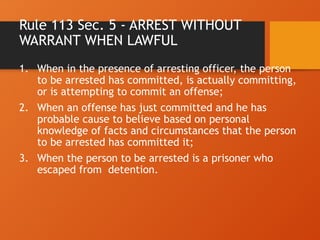
Rule 113 Sec. 5 - ARREST WITHOUT
WARRANT WHEN LAWFUL
1. When in the presence of arresting officer, the person
to be arrested has committed, is actually committing,
or is attempting to commit an offense;
2. When an offense has just committed and he has
probable cause to believe based on personal
knowledge of facts and circumstances that the person
to be arrested has committed it;
3. When the person to be arrested is a prisoner who
escaped from detention.
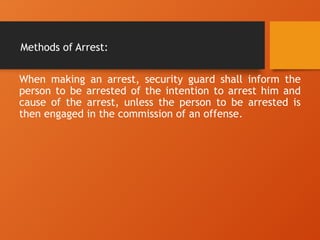
Methods of Arrest:
When making an arrest, security guard shall inform the
person to be arrested of the intention to arrest him and
cause of the arrest, unless the person to be arrested is
then engaged in the commission of an offense.
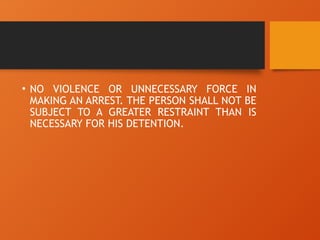
• NO VIOLENCE OR UNNECESSARY FORCE IN
MAKING AN ARREST. THE PERSON SHALL NOT BE
SUBJECT TO A GREATER RESTRAINT THAN IS
NECESSARY FOR HIS DETENTION.
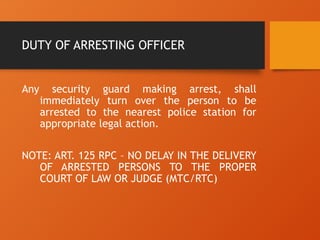
DUTY OF ARRESTING OFFICER
Any security guard making arrest, shall
immediately turn over the person to be
arrested to the nearest police station for
appropriate legal action.
NOTE: ART. 125 RPC – NO DELAY IN THE DELIVERY
OF ARRESTED PERSONS TO THE PROPER
COURT OF LAW OR JUDGE (MTC/RTC)
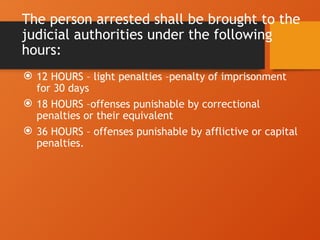
The person arrested shall be brought to the
judicial authorities under the following
hours:
 12 HOURS – light penalties –penalty of imprisonment
for 30 days
 18 HOURS –offenses punishable by correctional
penalties or their equivalent
 36 HOURS – offenses punishable by afflictive or capital
penalties.
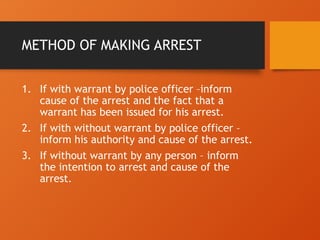
METHOD OF MAKING ARREST
1. If with warrant by police officer –inform
cause of the arrest and the fact that a
warrant has been issued for his arrest.
2. If with without warrant by police officer –
inform his authority and cause of the arrest.
3. If without warrant by any person – inform
the intention to arrest and cause of the
arrest.
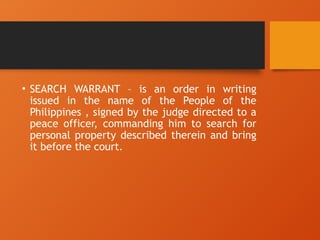
• SEARCH WARRANT – is an order in writing
issued in the name of the People of the
Philippines , signed by the judge directed to a
peace officer, commanding him to search for
personal property described therein and bring
it before the court.
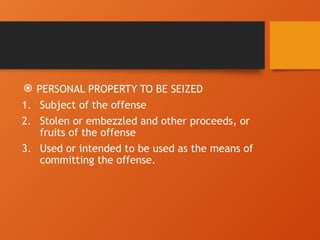
 PERSONAL PROPERTY TO BE SEIZED
1. Subject of the offense
2. Stolen or embezzled and other proceeds, or
fruits of the offense
3. Used or intended to be used as the means of
committing the offense.
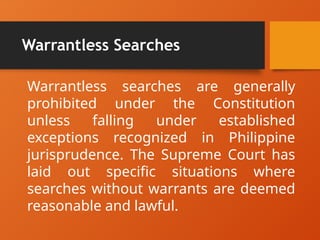
Warrantless Searches
Warrantless searches are generally
prohibited under the Constitution
unless falling under established
exceptions recognized in Philippine
jurisprudence. The Supreme Court has
laid out specific situations where
searches without warrants are deemed
reasonable and lawful.
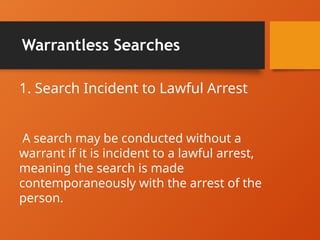
Warrantless Searches
1. Search Incident to Lawful Arrest
A search may be conducted without a
warrant if it is incident to a lawful arrest,
meaning the search is made
contemporaneously with the arrest of the
person.
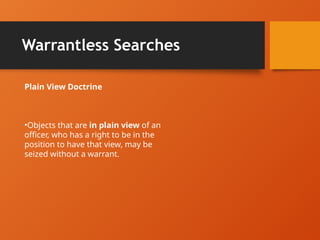
Warrantless Searches
Plain View Doctrine
•Objects that are in plain view of an
officer, who has a right to be in the
position to have that view, may be
seized without a warrant.
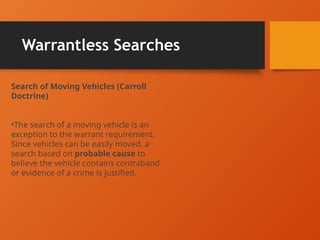
Search of Moving Vehicles (Carroll
Doctrine)
•The search of a moving vehicle is an
exception to the warrant requirement.
Since vehicles can be easily moved, a
search based on probable cause to
believe the vehicle contains contraband
or evidence of a crime is justified.
Warrantless Searches
• Consent Searches
• A search may be conducted without a warrant
if the person voluntarily consents to the
search. The consent must be unequivocal,
specific, and freely given without coercion or
duress.
Warrantless Searches
• Customs and Border Searches
• Searches conducted at immigration
checkpoints, ports, or customs areas are
exceptions to the warrant requirement, given
the government's interest in regulating the
entry and exit of goods and people.
Warrantless Searches
• Stop and Frisk (Terry Search)
• This is a limited warrantless search where law
enforcement officers may stop and pat down a
person on the street if there is reasonable
suspicion that the individual is involved in
criminal activity.
Warrantless Searches
• Checkpoints
• Checkpoints are constitutionally permissible
when justified by public safety and national
security concerns. While not all searches at
checkpoints require a warrant, they must still
be reasonable and not overly intrusive.
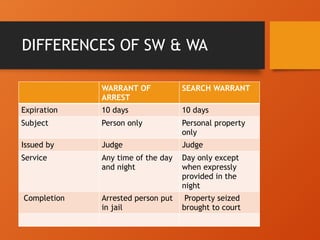
DIFFERENCES OF SW & WA
WARRANT OF
ARREST
SEARCH WARRANT
Expiration 10 days 10 days
Subject Person only Personal property
only
Issued by Judge Judge
Service Any time of the day
and night
Day only except
when expressly
provided in the
night
Completion Arrested person put
in jail
Property seized
brought to court
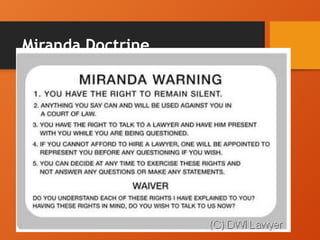
Miranda Doctrine

LAW ON ARREST & SEARCH Procedure for security.pptx

  • 1.
    LAW ON ARREST& Seizure
  • 2.
    Objective Law-is rule ofconduct establish by competent authority for the general welfare.
  • 3.
  • 4.
  • 5.
    Law-is rule ofconduct establish by competent authority for the general welfare.
  • 6.
    One article isthe BILL OF RIGHTS -enumerates the right of an individual 1. Right against unreasonable search and seizures – encompass the right to be secured in their persons, houses, papers, and effects.
  • 7.
    • GENERAL RULE:a person can be arrested only when there is a warrant of arrest. • EXCEPTIONS: warrantless arrest or citizen’s arrest- a person can be arrested even without warrant of arrest. ARREST – is the taking of a person into custody in order that he/she may be bound to answer for the commission of an offense.
  • 8.
    Rule 113 Sec.5 - ARREST WITHOUT WARRANT WHEN LAWFUL 1. When in the presence of arresting officer, the person to be arrested has committed, is actually committing, or is attempting to commit an offense; 2. When an offense has just committed and he has probable cause to believe based on personal knowledge of facts and circumstances that the person to be arrested has committed it; 3. When the person to be arrested is a prisoner who escaped from detention.
  • 9.
    Methods of Arrest: Whenmaking an arrest, security guard shall inform the person to be arrested of the intention to arrest him and cause of the arrest, unless the person to be arrested is then engaged in the commission of an offense.
  • 10.
    • NO VIOLENCEOR UNNECESSARY FORCE IN MAKING AN ARREST. THE PERSON SHALL NOT BE SUBJECT TO A GREATER RESTRAINT THAN IS NECESSARY FOR HIS DETENTION.
  • 11.
    DUTY OF ARRESTINGOFFICER Any security guard making arrest, shall immediately turn over the person to be arrested to the nearest police station for appropriate legal action. NOTE: ART. 125 RPC – NO DELAY IN THE DELIVERY OF ARRESTED PERSONS TO THE PROPER COURT OF LAW OR JUDGE (MTC/RTC)
  • 12.
    The person arrestedshall be brought to the judicial authorities under the following hours:  12 HOURS – light penalties –penalty of imprisonment for 30 days  18 HOURS –offenses punishable by correctional penalties or their equivalent  36 HOURS – offenses punishable by afflictive or capital penalties.
  • 13.
    METHOD OF MAKINGARREST 1. If with warrant by police officer –inform cause of the arrest and the fact that a warrant has been issued for his arrest. 2. If with without warrant by police officer – inform his authority and cause of the arrest. 3. If without warrant by any person – inform the intention to arrest and cause of the arrest.
  • 14.
    • SEARCH WARRANT– is an order in writing issued in the name of the People of the Philippines , signed by the judge directed to a peace officer, commanding him to search for personal property described therein and bring it before the court.
  • 15.
     PERSONAL PROPERTYTO BE SEIZED 1. Subject of the offense 2. Stolen or embezzled and other proceeds, or fruits of the offense 3. Used or intended to be used as the means of committing the offense.
  • 16.
    Warrantless Searches Warrantless searchesare generally prohibited under the Constitution unless falling under established exceptions recognized in Philippine jurisprudence. The Supreme Court has laid out specific situations where searches without warrants are deemed reasonable and lawful.
  • 17.
    Warrantless Searches 1. SearchIncident to Lawful Arrest A search may be conducted without a warrant if it is incident to a lawful arrest, meaning the search is made contemporaneously with the arrest of the person.
  • 18.
    Warrantless Searches Plain ViewDoctrine •Objects that are in plain view of an officer, who has a right to be in the position to have that view, may be seized without a warrant.
  • 19.
    Search of MovingVehicles (Carroll Doctrine) •The search of a moving vehicle is an exception to the warrant requirement. Since vehicles can be easily moved, a search based on probable cause to believe the vehicle contains contraband or evidence of a crime is justified. Warrantless Searches
  • 20.
    Warrantless Searches • ConsentSearches • A search may be conducted without a warrant if the person voluntarily consents to the search. The consent must be unequivocal, specific, and freely given without coercion or duress.
  • 21.
    Warrantless Searches • Customsand Border Searches • Searches conducted at immigration checkpoints, ports, or customs areas are exceptions to the warrant requirement, given the government's interest in regulating the entry and exit of goods and people.
  • 22.
    Warrantless Searches • Stopand Frisk (Terry Search) • This is a limited warrantless search where law enforcement officers may stop and pat down a person on the street if there is reasonable suspicion that the individual is involved in criminal activity.
  • 23.
    Warrantless Searches • Checkpoints •Checkpoints are constitutionally permissible when justified by public safety and national security concerns. While not all searches at checkpoints require a warrant, they must still be reasonable and not overly intrusive.
  • 24.
    DIFFERENCES OF SW& WA WARRANT OF ARREST SEARCH WARRANT Expiration 10 days 10 days Subject Person only Personal property only Issued by Judge Judge Service Any time of the day and night Day only except when expressly provided in the night Completion Arrested person put in jail Property seized brought to court

  • 25.