Personnel Security
Personnel Security
Dir Arturo B. Bringas CSP, CSMS
SCOPE OF THE LECTURE
 Introduction
Introduction
 Purpose
Purpose
 Scope
Scope
 Key Functions
Key Functions
 Elements of a Comprehensive Personnel
Elements of a Comprehensive Personnel
Security Program
Security Program
SCOPE OF THE LECTURE
 Basic Considerations
Basic Considerations
 Applicant Screening
Applicant Screening
 Red Flags in a Screening Process
Red Flags in a Screening Process
 Personnel Security Investigation
Personnel Security Investigation
 Background Investigation
Background Investigation
 Positive Vetting
Positive Vetting
 Profiling
Profiling
SCOPE OF THE LECTURE
 Deception Detection Techniques
Deception Detection Techniques
 Financial and Lifestyle Inquiry
Financial and Lifestyle Inquiry
 Undercover Investigations
Undercover Investigations
 Exit Interview as a Loss Prevention
Exit Interview as a Loss Prevention
Technique
Technique
 Anti-Competitive Clause
Anti-Competitive Clause
 Security Education
Security Education
Introduction
Introduction
 Of the three key security processes,
Of the three key security processes,
personnel security is considered the
most important simply because security
involves people, both as assets to be
protected, and as sources of security
threats.
threats.
Purpose
Purpose
 To insure that a firm hires those
To insure that a firm hires those
employees best suited to assist the firm
in achieving its goals; and,
 Once hired, assist in providing the
Once hired, assist in providing the
necessary security to them.
Scope of Personnel Security
 Personnel security investigation
Personnel security investigation
 Security Education
Security Education
Key Functions of
Key Functions of
Personnel Security
Personnel Security
 It serves as a screening device to assist
It serves as a screening device to assist
the organization in hiring suitable
employees.
employees.
 It conducts background investigation on
It conducts background investigation on
employees.
employees.
 It handles investigation of employees
It handles investigation of employees
suspected of wrongdoing.
Key Functions of
Key Functions of
Personnel Security
Personnel Security
 It develops security awareness among
It develops security awareness among
employees.
employees.
 It attempts to ensure the protection of
It attempts to ensure the protection of
employees from discriminatory hiring or
terminating procedures as well as
unfounded allegations of illegal or
unethical activities and conduct.
Elements of a Comprehensive
Personnel Security Program
 Adequate job specifications and
Adequate job specifications and
performance standards.
 Appropriate recruitment and selection
Appropriate recruitment and selection
criteria.
criteria.
 Background applicant screening
Background applicant screening
procedures and standards.
 Background investigative standards.
Background investigative standards.
Elements of a Comprehensive
Personnel Security Program
 Truth verification standards.
Truth verification standards.
 Criteria for employee conduct.
Criteria for employee conduct.
 Investigation of questionable employees
Investigation of questionable employees
conduct.
conduct.
 Disciplinary procedures.
Disciplinary procedures.
 Termination procedures.
Termination procedures.
Basic Considerations
 It is the responsibility of the appointing authority to determine
It is the responsibility of the appointing authority to determine
the suitability and loyalty of the person he is appointing.
 No person is entitled solely by virtue of his grade or position to
No person is entitled solely by virtue of his grade or position to
knowledge or possession of classified matter.
Basic Considerations
 All personnel whose duties require access to
All personnel whose duties require access to
classified matter shall be subjected to a security
investigation to determine eligibility for the
required security clearance.
 All personnel shall undergo security education.
All personnel shall undergo security education.
Basic Considerations
 Security Managers and other key officers
Security Managers and other key officers
responsible for personnel clearance
investigations should keep abreast of
changes in the law.
changes in the law.
 An employee has the right to review his
An employee has the right to review his
pre-employment investigation file and
reasonably challenge any findings.
Basic Considerations
There are virtually no restrictions on what
There are virtually no restrictions on what
can be asked of an applicant once an
offer of employment has been made.
Applicant Screening
Applicant Screening
The most effective tools in employee selection
are:
are:
the application form; and,
the application form; and,
the interview
the interview.
.
“
“Whole Man Rule”
Whole Man Rule”
 Act of weighing all elements of a person’s
Act of weighing all elements of a person’s
background in determining his suitability.
 A system for evaluating the suitability of
A system for evaluating the suitability of
an applicant.
an applicant.
 Governing standards;
Governing standards;
 Needs of the company
Needs of the company
 Fairness to the applicant.
Fairness to the applicant.
Pointers in Screening
Process
Process
 In screening an applicant for a position,
In screening an applicant for a position,
the most expensive techniques should be
used last. That is why, a background
investigation shall only be conducted
after the applicant has already
undergone interview.
“
“Red Flags” in a Screening
Red Flags” in a Screening
Process
Process
 Application form not signed.
Application form not signed.
 Application date not filled up.
Application date not filled up.
 Applicant’s name and possible aliases.
Applicant’s name and possible aliases.
 Gaps in employment history or use of
Gaps in employment history or use of
term “self-employed”.
 Inability to remember names of former
Inability to remember names of former
colleagues or bosses.
“
“Red Flags” in a Screening
Red Flags” in a Screening
Process
Process
 Gaps in residence
Gaps in residence
 Inadequate references
Inadequate references
 Lack of job stability
Lack of job stability
 Signs of instability of personal relations
Signs of instability of personal relations
 Indications of over-qualifications
Indications of over-qualifications
 Declining salary history
Declining salary history
 Signature is stamped
Signature is stamped
“
“Red Flags” in a Screening
Red Flags” in a Screening
Process
Process
 Criminal record left blank.
Criminal record left blank.
 Military service left blank.
Military service left blank.
 Never accept a resume from an applicant
Never accept a resume from an applicant
in lieu of the company’s application form,
as it does not contain the various legal
clauses nor is there a space for a signed
declaration.
declaration.
“
“Red Flags” in a Screening
Red Flags” in a Screening
Process
Process
Never accept a resume from an applicant
in lieu of the company’s application form,
as it does not contain the various legal
clauses nor is there a space for a signed
declaration.
declaration.
Personnel Security
Personnel Security
Investigation (PSI)
Investigation (PSI)
Definition - An inquiry into the character,
reputation, discretion, integrity, morals
and loyalty of an individual in order to
determine a person’s suitability for
appointment or access to classified
matter.
matter.
Personnel Security
Personnel Security
Investigation (PSI)
Investigation (PSI)
PSI has 3 General Techniques
 Background Investigation (BI)
Background Investigation (BI)
 Positive Vetting
Positive Vetting
 Profiling
Profiling
Background Investigation
(BI)
(BI)
The BI serves to:
The BI serves to:
 verify information on the application form;
verify information on the application form;
 ascertain past employment experiences;
ascertain past employment experiences;
and,
and,
 obtain other information pertinent to the
obtain other information pertinent to the
decision to employ.
decision to employ.
Background Investigation
(BI)
(BI)
Factors to consider in a BI:
 Loyalty
Loyalty
 Integrity
Integrity
 Discretion
Discretion
 Morals
Morals
 Character
Character
 Reputation
Reputation
Motives That Cause People
to be Disloyal
to be Disloyal
 Revenge
Revenge
 Material Gain
Material Gain
 Personal Prestige
Personal Prestige
 Friendship
Friendship
 Ideological Beliefs
Ideological Beliefs
Weaknesses that Make
People Susceptible to
Pressure
Pressure
 Close relatives in foreign lands
Close relatives in foreign lands
 Heavy investments in foreign lands
Heavy investments in foreign lands
 Jealousy
Jealousy
 Gullibility
Gullibility
 Weakness of Character
Weakness of Character
Weaknesses that Make
People Susceptible to
Pressure
Pressure
 Heavy indebtedness
Heavy indebtedness
 Addiction to narcotics and drugs
Addiction to narcotics and drugs
 Guilty Past
Guilty Past
 Moral depravity
Moral depravity
Types of Local Agency
Check
Check
 Police Clearance
Police Clearance
 City / Municipal clearance
City / Municipal clearance
 Mayor’s clearance
Mayor’s clearance
 Regional Trial Courts
Regional Trial Courts
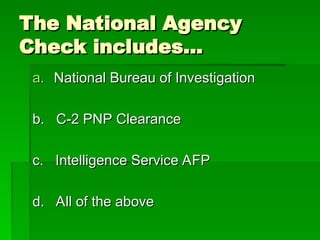
National Agency Check
 National Bureau of Investigation
 Intelligence Service, AFP, ISAFP
Intelligence Service, AFP, ISAFP
 DI Clearance (PNP)
DI Clearance (PNP)
Components of a Complete
Background Investigation
 Applicant’s Name
Applicant’s Name
 Date of Birth
Date of Birth
 Present Residence Address
Present Residence Address
 LAC
LAC
 NAC
NAC
 Personal History
Personal History
 Marital History
Marital History
Components of a Complete
Background Investigation
 Residence History
Residence History
 Citizenship history
Citizenship history
 Physical data
Physical data
 Educational History
Educational History
 Organization membership
Organization membership
 Neighborhood investigation
Neighborhood investigation
 Character references
Character references
Components of a Complete
Background Investigation
 Employment history
Employment history
 Military history
Military history
 Foreign travel & connection history
Foreign travel & connection history
 Criminal record
Criminal record
 Credit records
Credit records
 Applicant’s Signature
Applicant’s Signature
 Date of Application
Date of Application
Investigative Coverage
 Prior employment for at least 7 years
Prior employment for at least 7 years
should be verified.
should be verified.
 Claimed education should be checked.
Claimed education should be checked.
 Claimed residence should be verified.
Claimed residence should be verified.
 If the candidate indicates a criminal
If the candidate indicates a criminal
record, then details should be checked.
Investigative Standards
 Information sought should be relevant to
Information sought should be relevant to
the hiring decision.
 Information should be reliable.
Information should be reliable.
 Unfavorable information should be
Unfavorable information should be
confirmed by at least two sources.
Investigative Review
All completed investigations should be
reviewed by a responsible supervisor so
that all applicants are measured
according to the same standards.
Positive Vetting
Positive Vetting
It is a personal interview conducted under
stress. Vetting is defined by Webster
Dictionary as the process of inspecting or
examining with careful thoroughness.
ESSENCE OF VETTING
ESSENCE OF VETTING
1.
1. A personal interview
A personal interview
2.
2. Conducted under stress
Conducted under stress
3.
3. The interview is based upon answers
The interview is based upon answers
previously give by the applicant
4.
4. Other information is used during the
Other information is used during the
interview, which confirms or denies
that given by the applicant.
BASIC REASONS FOR AN
INTERVIEW DURING VETTING
1.
1. Challenge the applicant on the basis
Challenge the applicant on the basis
of any false statements.
2.
2. To observe the applicants behavior
To observe the applicants behavior
under stress.
under stress.
3.
3. To open areas for exploration which
To open areas for exploration which
have until now remain hidden.
4.
4. To provide new investigative leads.
To provide new investigative leads.
Profiling
Profiling
The process whereby a subject’s reaction
in a future critical situation is predicted
by observing his behavior, by
interviewing him, or by analyzing his
response to a questionnaire.
REID REPORT
REID REPORT
Is an example of an honesty test
Deception Detection
Deception Detection
Techniques
Techniques
 The Polygraph
The Polygraph
 The Psychological Stress Evaluator
The Psychological Stress Evaluator
 The Voice Analyzer
The Voice Analyzer
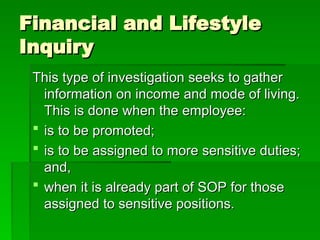
Financial and Lifestyle
Inquiry
Inquiry
This type of investigation seeks to gather
information on income and mode of living.
This is done when the employee:
 is to be promoted;
is to be promoted;
 is to be assigned to more sensitive duties;
is to be assigned to more sensitive duties;
and,
and,
 when it is already part of SOP for those
when it is already part of SOP for those
assigned to sensitive positions.
Undercover Investigations
The placement of an agent in a role where
his true identity is unknown, in order to
obtain information for criminal
prosecution or for recovery or limitation of
asset losses.
asset losses.
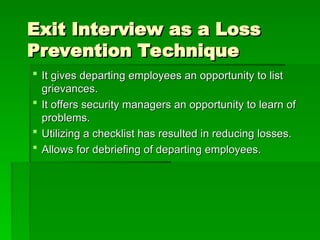
Exit Interview as a Loss
Prevention Technique
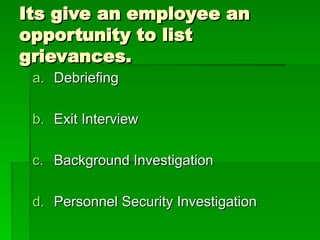
 It gives departing employees an opportunity to list
It gives departing employees an opportunity to list
grievances.
grievances.
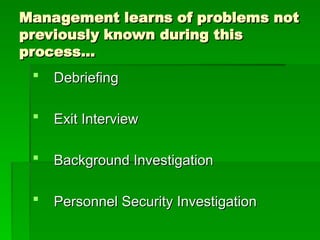
 It offers security managers an opportunity to learn of
It offers security managers an opportunity to learn of
problems.
problems.
 Utilizing a checklist has resulted in reducing losses.
Utilizing a checklist has resulted in reducing losses.
 Allows for debriefing of departing employees.
Allows for debriefing of departing employees.
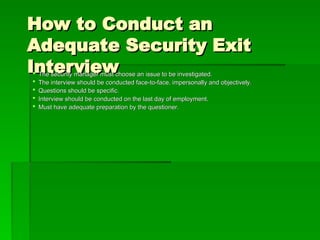
How to Conduct an
How to Conduct an
Adequate Security Exit
Interview
Interview
 The security manager must choose an issue to be investigated.
The security manager must choose an issue to be investigated.
 The interview should be conducted face-to-face, impersonally and objectively.
The interview should be conducted face-to-face, impersonally and objectively.
 Questions should be specific.
Questions should be specific.
 Interview should be conducted on the last day of employment.
Interview should be conducted on the last day of employment.
 Must have adequate preparation by the questioner.
Must have adequate preparation by the questioner.
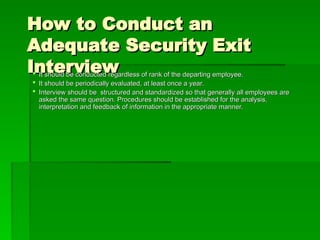
How to Conduct an
How to Conduct an
Adequate Security Exit
Interview
Interview
 It should be conducted regardless of rank of the departing employee.
It should be conducted regardless of rank of the departing employee.
 It should be periodically evaluated, at least once a year.
It should be periodically evaluated, at least once a year.
 Interview should be structured and standardized so that generally all employees are
Interview should be structured and standardized so that generally all employees are
asked the same question. Procedures should be established for the analysis,
interpretation and feedback of information in the appropriate manner.
Anti-Competitive Clause
 An effective method to prevent former
An effective method to prevent former
employees from competing against the
company.
company.
SECURITY EDUCATION is
conducted…………
conducted…………
To develop security awareness
To develop security awareness
among employees of the
company.
company.
To emphasize the importance
To emphasize the importance
and role of security in achieving
the company’s goals among the
top brass.
top brass.
Security Awareness results
in:
in:
 Better understanding of the relationship
Better understanding of the relationship
between security and successful
operations;
operations;
 Knowledge of one’s personal obligations
Knowledge of one’s personal obligations
under the security program;
 Understanding between security
Understanding between security
objectives and measures;
Security Awareness results
in:
in:
 Familiarity with sources of help in
Familiarity with sources of help in
carrying out personal and departmental
responsibilities under the security
program; and,
program; and,
 Compliance with statutory and regulatory
Compliance with statutory and regulatory
requirements and contractual obligations.
Security Education may be
Conducted During:
Conducted During:
The Initial Interview:
 Overview of company security
Overview of company security
policies
policies
 employee accountability and
employee accountability and
corresponding penalties
Security Education may be
Conducted During:
Conducted During:
Training and Orientation:
 Detailed presentation of personnel
Detailed presentation of personnel
security policies
security policies
 If possible, give handouts.
If possible, give handouts.
Security Education may be
Conducted During:
Conducted During:
Refresher Conference:
 Review Guidelines and policies.
Review Guidelines and policies.
 Explain/ Introduce new policies.
Explain/ Introduce new policies.
 Determine if employee has problems.
Determine if employee has problems.
 Try to gather information of probable
Try to gather information of probable
violations of company policies.
 Ask for recommendations or comments
Ask for recommendations or comments
about existing policies.
Security Education may be
Conducted During:
Conducted During:
Security Reminders:
Security Reminders:
 Indirect Approach
Indirect Approach
 Use of posters and fliers.
Use of posters and fliers.
 Must be replaced periodically.
Must be replaced periodically.
Security Education may be
Conducted During:
Conducted During:
Security Promotion:
Security Promotion:
 Market security within company.
Market security within company.
 Get support among employees.
Get support among employees.
 Promote importance of security,
Promote importance of security,
especially among top brass.
Security Education may be
Conducted During:
Conducted During:
Special Interviews:
Special Interviews:
 Used to augment regular refresher
Used to augment regular refresher
conferences.
conferences.
 Used as an investigative tool.
Used as an investigative tool.
Security Education may be
Conducted During:
Conducted During:
Debriefing
Debriefing
- is required whenever a person who has
access to classified information leaves
the company or is assigned to other
duties.
duties.
How To Conduct
How To Conduct
Debriefing
Debriefing
 Debriefing should be established as a
Debriefing should be established as a
formally conducted procedure.
 Procedures must be established for the
Procedures must be established for the
analysis, interpretation and feedback of
information.
information.
 Obtain a signed statement indicating that
Obtain a signed statement indicating that
he is aware of his continuing security
responsibility.
responsibility.
End of Presentation
End of Presentation
THANK YOU……………
THANK YOU……………
REVIEW QUESTIONS
REVIEW QUESTIONS
The National Agency
The National Agency
Check includes…
Check includes…
a.
a. National Bureau of Investigation
National Bureau of Investigation
b. C-2 PNP Clearance
c. Intelligence Service AFP
d. All of the above
d. All of the above
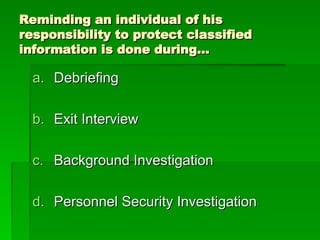
Reminding an individual of his
responsibility to protect classified
information is done during…
a.
a. Debriefing
Debriefing
b.
b. Exit Interview
Exit Interview
c.
c. Background Investigation
Background Investigation
d.
d. Personnel Security Investigation
Personnel Security Investigation
Its give an employee an
opportunity to list
opportunity to list
grievances.
grievances.
a.
a. Debriefing
Debriefing
b.
b. Exit Interview
Exit Interview
c.
c. Background Investigation
Background Investigation
d.
d. Personnel Security Investigation
Personnel Security Investigation
Management learns of problems not
previously known during this
process…
process…
 Debriefing
Debriefing
 Exit Interview
Exit Interview
 Background Investigation
Background Investigation
 Personnel Security Investigation
Personnel Security Investigation
Security exit interview
should be conducted…
a.
a. In private
In private
b.
b. On the last day of employment
On the last day of employment
c.
c. With adequate interview preparation by the
With adequate interview preparation by the
questioner
questioner
d.
d. All of the above
All of the above
Which of the following could not be
considered a weakness that makes
people susceptible to pressure
a.
a. Heavy indebtedness
Heavy indebtedness
b.
b. Stress
Stress
c.
c. Moral depravity
Moral depravity
d.
d. Ideology beliefs
Ideology beliefs

PERSONNEL SECURITY .PSIS. powerpoint presentation

PERSONNEL SECURITY .PSIS. powerpoint presentation

  • 1.
    Personnel Security Personnel Security DirArturo B. Bringas CSP, CSMS Dir Arturo B. Bringas CSP, CSMS
  • 2.
    SCOPE OF THELECTURE SCOPE OF THE LECTURE  Introduction Introduction  Purpose Purpose  Scope Scope  Key Functions Key Functions  Elements of a Comprehensive Personnel Elements of a Comprehensive Personnel Security Program Security Program
  • 3.
    SCOPE OF THELECTURE SCOPE OF THE LECTURE  Basic Considerations Basic Considerations  Applicant Screening Applicant Screening  Red Flags in a Screening Process Red Flags in a Screening Process  Personnel Security Investigation Personnel Security Investigation  Background Investigation Background Investigation  Positive Vetting Positive Vetting  Profiling Profiling
  • 4.
    SCOPE OF THELECTURE SCOPE OF THE LECTURE  Deception Detection Techniques Deception Detection Techniques  Financial and Lifestyle Inquiry Financial and Lifestyle Inquiry  Undercover Investigations Undercover Investigations  Exit Interview as a Loss Prevention Exit Interview as a Loss Prevention Technique Technique  Anti-Competitive Clause Anti-Competitive Clause  Security Education Security Education
  • 5.
    Introduction Introduction  Of thethree key security processes, Of the three key security processes, personnel security is considered the personnel security is considered the most important simply because security most important simply because security involves people, both as assets to be involves people, both as assets to be protected, and as sources of security protected, and as sources of security threats. threats.
  • 6.
    Purpose Purpose  To insurethat a firm hires those To insure that a firm hires those employees best suited to assist the firm employees best suited to assist the firm in achieving its goals; and, in achieving its goals; and,  Once hired, assist in providing the Once hired, assist in providing the necessary security to them. necessary security to them. Scope of Personnel Security Scope of Personnel Security  Personnel security investigation Personnel security investigation  Security Education Security Education
  • 7.
    Key Functions of KeyFunctions of Personnel Security Personnel Security  It serves as a screening device to assist It serves as a screening device to assist the organization in hiring suitable the organization in hiring suitable employees. employees.  It conducts background investigation on It conducts background investigation on employees. employees.  It handles investigation of employees It handles investigation of employees suspected of wrongdoing. suspected of wrongdoing.
  • 8.
    Key Functions of KeyFunctions of Personnel Security Personnel Security  It develops security awareness among It develops security awareness among employees. employees.  It attempts to ensure the protection of It attempts to ensure the protection of employees from discriminatory hiring or employees from discriminatory hiring or terminating procedures as well as terminating procedures as well as unfounded allegations of illegal or unfounded allegations of illegal or unethical activities and conduct. unethical activities and conduct.
  • 9.
    Elements of aComprehensive Elements of a Comprehensive Personnel Security Program Personnel Security Program  Adequate job specifications and Adequate job specifications and performance standards. performance standards.  Appropriate recruitment and selection Appropriate recruitment and selection criteria. criteria.  Background applicant screening Background applicant screening procedures and standards. procedures and standards.  Background investigative standards. Background investigative standards.
  • 10.
    Elements of aComprehensive Elements of a Comprehensive Personnel Security Program Personnel Security Program  Truth verification standards. Truth verification standards.  Criteria for employee conduct. Criteria for employee conduct.  Investigation of questionable employees Investigation of questionable employees conduct. conduct.  Disciplinary procedures. Disciplinary procedures.  Termination procedures. Termination procedures.
  • 11.
    Basic Considerations Basic Considerations It is the responsibility of the appointing authority to determine It is the responsibility of the appointing authority to determine the suitability and loyalty of the person he is appointing. the suitability and loyalty of the person he is appointing.  No person is entitled solely by virtue of his grade or position to No person is entitled solely by virtue of his grade or position to knowledge or possession of classified matter. knowledge or possession of classified matter.
  • 12.
    Basic Considerations Basic Considerations All personnel whose duties require access to All personnel whose duties require access to classified matter shall be subjected to a security classified matter shall be subjected to a security investigation to determine eligibility for the investigation to determine eligibility for the required security clearance. required security clearance.  All personnel shall undergo security education. All personnel shall undergo security education.
  • 13.
    Basic Considerations Basic Considerations Security Managers and other key officers Security Managers and other key officers responsible for personnel clearance responsible for personnel clearance investigations should keep abreast of investigations should keep abreast of changes in the law. changes in the law.  An employee has the right to review his An employee has the right to review his pre-employment investigation file and pre-employment investigation file and reasonably challenge any findings. reasonably challenge any findings.
  • 14.
    Basic Considerations Basic Considerations Thereare virtually no restrictions on what There are virtually no restrictions on what can be asked of an applicant once an can be asked of an applicant once an offer of employment has been made. offer of employment has been made. Applicant Screening Applicant Screening The most effective tools in employee selection The most effective tools in employee selection are: are: the application form; and, the application form; and, the interview the interview. .
  • 15.
    “ “Whole Man Rule” WholeMan Rule”  Act of weighing all elements of a person’s Act of weighing all elements of a person’s background in determining his suitability. background in determining his suitability.  A system for evaluating the suitability of A system for evaluating the suitability of an applicant. an applicant.  Governing standards; Governing standards;  Needs of the company Needs of the company  Fairness to the applicant. Fairness to the applicant.
  • 16.
    Pointers in Screening Pointersin Screening Process Process  In screening an applicant for a position, In screening an applicant for a position, the most expensive techniques should be the most expensive techniques should be used last. That is why, a background used last. That is why, a background investigation shall only be conducted investigation shall only be conducted after the applicant has already after the applicant has already undergone interview. undergone interview.
  • 17.
    “ “Red Flags” ina Screening Red Flags” in a Screening Process Process  Application form not signed. Application form not signed.  Application date not filled up. Application date not filled up.  Applicant’s name and possible aliases. Applicant’s name and possible aliases.  Gaps in employment history or use of Gaps in employment history or use of term “self-employed”. term “self-employed”.  Inability to remember names of former Inability to remember names of former colleagues or bosses. colleagues or bosses.
  • 18.
    “ “Red Flags” ina Screening Red Flags” in a Screening Process Process  Gaps in residence Gaps in residence  Inadequate references Inadequate references  Lack of job stability Lack of job stability  Signs of instability of personal relations Signs of instability of personal relations  Indications of over-qualifications Indications of over-qualifications  Declining salary history Declining salary history  Signature is stamped Signature is stamped
  • 19.
    “ “Red Flags” ina Screening Red Flags” in a Screening Process Process  Criminal record left blank. Criminal record left blank.  Military service left blank. Military service left blank.  Never accept a resume from an applicant Never accept a resume from an applicant in lieu of the company’s application form, in lieu of the company’s application form, as it does not contain the various legal as it does not contain the various legal clauses nor is there a space for a signed clauses nor is there a space for a signed declaration. declaration.
  • 20.
    “ “Red Flags” ina Screening Red Flags” in a Screening Process Process Never accept a resume from an applicant Never accept a resume from an applicant in lieu of the company’s application form, in lieu of the company’s application form, as it does not contain the various legal as it does not contain the various legal clauses nor is there a space for a signed clauses nor is there a space for a signed declaration. declaration.
  • 21.
    Personnel Security Personnel Security Investigation(PSI) Investigation (PSI) Definition - An inquiry into the character, Definition - An inquiry into the character, reputation, discretion, integrity, morals reputation, discretion, integrity, morals and loyalty of an individual in order to and loyalty of an individual in order to determine a person’s suitability for determine a person’s suitability for appointment or access to classified appointment or access to classified matter. matter.
  • 22.
    Personnel Security Personnel Security Investigation(PSI) Investigation (PSI) PSI has 3 General Techniques PSI has 3 General Techniques  Background Investigation (BI) Background Investigation (BI)  Positive Vetting Positive Vetting  Profiling Profiling
  • 23.
    Background Investigation Background Investigation (BI) (BI) TheBI serves to: The BI serves to:  verify information on the application form; verify information on the application form;  ascertain past employment experiences; ascertain past employment experiences; and, and,  obtain other information pertinent to the obtain other information pertinent to the decision to employ. decision to employ.
  • 24.
    Background Investigation Background Investigation (BI) (BI) Factorsto consider in a BI: Factors to consider in a BI:  Loyalty Loyalty  Integrity Integrity  Discretion Discretion  Morals Morals  Character Character  Reputation Reputation
  • 25.
    Motives That CausePeople Motives That Cause People to be Disloyal to be Disloyal  Revenge Revenge  Material Gain Material Gain  Personal Prestige Personal Prestige  Friendship Friendship  Ideological Beliefs Ideological Beliefs
  • 26.
    Weaknesses that Make Weaknessesthat Make People Susceptible to People Susceptible to Pressure Pressure  Close relatives in foreign lands Close relatives in foreign lands  Heavy investments in foreign lands Heavy investments in foreign lands  Jealousy Jealousy  Gullibility Gullibility  Weakness of Character Weakness of Character
  • 27.
    Weaknesses that Make Weaknessesthat Make People Susceptible to People Susceptible to Pressure Pressure  Heavy indebtedness Heavy indebtedness  Addiction to narcotics and drugs Addiction to narcotics and drugs  Guilty Past Guilty Past  Moral depravity Moral depravity
  • 28.
    Types of LocalAgency Types of Local Agency Check Check  Police Clearance Police Clearance  City / Municipal clearance City / Municipal clearance  Mayor’s clearance Mayor’s clearance  Regional Trial Courts Regional Trial Courts
  • 29.
    National Agency Check NationalAgency Check  National Bureau of Investigation  Intelligence Service, AFP, ISAFP Intelligence Service, AFP, ISAFP  DI Clearance (PNP) DI Clearance (PNP)
  • 30.
    Components of aComplete Components of a Complete Background Investigation Background Investigation  Applicant’s Name Applicant’s Name  Date of Birth Date of Birth  Present Residence Address Present Residence Address  LAC LAC  NAC NAC  Personal History Personal History  Marital History Marital History
  • 31.
    Components of aComplete Components of a Complete Background Investigation Background Investigation  Residence History Residence History  Citizenship history Citizenship history  Physical data Physical data  Educational History Educational History  Organization membership Organization membership  Neighborhood investigation Neighborhood investigation  Character references Character references
  • 32.
    Components of aComplete Components of a Complete Background Investigation Background Investigation  Employment history Employment history  Military history Military history  Foreign travel & connection history Foreign travel & connection history  Criminal record Criminal record  Credit records Credit records  Applicant’s Signature Applicant’s Signature  Date of Application Date of Application
  • 33.
    Investigative Coverage Investigative Coverage Prior employment for at least 7 years Prior employment for at least 7 years should be verified. should be verified.  Claimed education should be checked. Claimed education should be checked.  Claimed residence should be verified. Claimed residence should be verified.  If the candidate indicates a criminal If the candidate indicates a criminal record, then details should be checked. record, then details should be checked.
  • 34.
    Investigative Standards Investigative Standards Information sought should be relevant to Information sought should be relevant to the hiring decision. the hiring decision.  Information should be reliable. Information should be reliable.  Unfavorable information should be Unfavorable information should be confirmed by at least two sources. confirmed by at least two sources.
  • 35.
    Investigative Review Investigative Review Allcompleted investigations should be All completed investigations should be reviewed by a responsible supervisor so reviewed by a responsible supervisor so that all applicants are measured that all applicants are measured according to the same standards. according to the same standards. Positive Vetting Positive Vetting It is a personal interview conducted under It is a personal interview conducted under stress. Vetting is defined by Webster stress. Vetting is defined by Webster Dictionary as the process of inspecting or Dictionary as the process of inspecting or examining with careful thoroughness. examining with careful thoroughness.
  • 36.
    ESSENCE OF VETTING ESSENCEOF VETTING 1. 1. A personal interview A personal interview 2. 2. Conducted under stress Conducted under stress 3. 3. The interview is based upon answers The interview is based upon answers previously give by the applicant previously give by the applicant 4. 4. Other information is used during the Other information is used during the interview, which confirms or denies interview, which confirms or denies that given by the applicant. that given by the applicant.
  • 37.
    BASIC REASONS FORAN BASIC REASONS FOR AN INTERVIEW DURING VETTING INTERVIEW DURING VETTING 1. 1. Challenge the applicant on the basis Challenge the applicant on the basis of any false statements. of any false statements. 2. 2. To observe the applicants behavior To observe the applicants behavior under stress. under stress. 3. 3. To open areas for exploration which To open areas for exploration which have until now remain hidden. have until now remain hidden. 4. 4. To provide new investigative leads. To provide new investigative leads.
  • 38.
    Profiling Profiling The process wherebya subject’s reaction The process whereby a subject’s reaction in a future critical situation is predicted in a future critical situation is predicted by observing his behavior, by by observing his behavior, by interviewing him, or by analyzing his interviewing him, or by analyzing his response to a questionnaire. response to a questionnaire.
  • 39.
    REID REPORT REID REPORT Isan example of an honesty test Is an example of an honesty test
  • 40.
    Deception Detection Deception Detection Techniques Techniques The Polygraph The Polygraph  The Psychological Stress Evaluator The Psychological Stress Evaluator  The Voice Analyzer The Voice Analyzer
  • 41.
    Financial and Lifestyle Financialand Lifestyle Inquiry Inquiry This type of investigation seeks to gather This type of investigation seeks to gather information on income and mode of living. information on income and mode of living. This is done when the employee: This is done when the employee:  is to be promoted; is to be promoted;  is to be assigned to more sensitive duties; is to be assigned to more sensitive duties; and, and,  when it is already part of SOP for those when it is already part of SOP for those assigned to sensitive positions. assigned to sensitive positions.
  • 42.
    Undercover Investigations Undercover Investigations Theplacement of an agent in a role where The placement of an agent in a role where his true identity is unknown, in order to his true identity is unknown, in order to obtain information for criminal obtain information for criminal prosecution or for recovery or limitation of prosecution or for recovery or limitation of asset losses. asset losses.
  • 43.
    Exit Interview asa Loss Exit Interview as a Loss Prevention Technique Prevention Technique  It gives departing employees an opportunity to list It gives departing employees an opportunity to list grievances. grievances.  It offers security managers an opportunity to learn of It offers security managers an opportunity to learn of problems. problems.  Utilizing a checklist has resulted in reducing losses. Utilizing a checklist has resulted in reducing losses.  Allows for debriefing of departing employees. Allows for debriefing of departing employees.
  • 44.
    How to Conductan How to Conduct an Adequate Security Exit Adequate Security Exit Interview Interview  The security manager must choose an issue to be investigated. The security manager must choose an issue to be investigated.  The interview should be conducted face-to-face, impersonally and objectively. The interview should be conducted face-to-face, impersonally and objectively.  Questions should be specific. Questions should be specific.  Interview should be conducted on the last day of employment. Interview should be conducted on the last day of employment.  Must have adequate preparation by the questioner. Must have adequate preparation by the questioner.
  • 45.
    How to Conductan How to Conduct an Adequate Security Exit Adequate Security Exit Interview Interview  It should be conducted regardless of rank of the departing employee. It should be conducted regardless of rank of the departing employee.  It should be periodically evaluated, at least once a year. It should be periodically evaluated, at least once a year.  Interview should be structured and standardized so that generally all employees are Interview should be structured and standardized so that generally all employees are asked the same question. Procedures should be established for the analysis, asked the same question. Procedures should be established for the analysis, interpretation and feedback of information in the appropriate manner. interpretation and feedback of information in the appropriate manner.
  • 46.
    Anti-Competitive Clause Anti-Competitive Clause An effective method to prevent former An effective method to prevent former employees from competing against the employees from competing against the company. company.
  • 47.
    SECURITY EDUCATION is SECURITYEDUCATION is conducted………… conducted………… To develop security awareness To develop security awareness among employees of the among employees of the company. company. To emphasize the importance To emphasize the importance and role of security in achieving and role of security in achieving the company’s goals among the the company’s goals among the top brass. top brass.
  • 48.
    Security Awareness results SecurityAwareness results in: in:  Better understanding of the relationship Better understanding of the relationship between security and successful between security and successful operations; operations;  Knowledge of one’s personal obligations Knowledge of one’s personal obligations under the security program; under the security program;  Understanding between security Understanding between security objectives and measures; objectives and measures;
  • 49.
    Security Awareness results SecurityAwareness results in: in:  Familiarity with sources of help in Familiarity with sources of help in carrying out personal and departmental carrying out personal and departmental responsibilities under the security responsibilities under the security program; and, program; and,  Compliance with statutory and regulatory Compliance with statutory and regulatory requirements and contractual obligations. requirements and contractual obligations.
  • 50.
    Security Education maybe Security Education may be Conducted During: Conducted During: The Initial Interview: The Initial Interview:  Overview of company security Overview of company security policies policies  employee accountability and employee accountability and corresponding penalties corresponding penalties
  • 51.
    Security Education maybe Security Education may be Conducted During: Conducted During: Training and Orientation: Training and Orientation:  Detailed presentation of personnel Detailed presentation of personnel security policies security policies  If possible, give handouts. If possible, give handouts.
  • 52.
    Security Education maybe Security Education may be Conducted During: Conducted During: Refresher Conference: Refresher Conference:  Review Guidelines and policies. Review Guidelines and policies.  Explain/ Introduce new policies. Explain/ Introduce new policies.  Determine if employee has problems. Determine if employee has problems.  Try to gather information of probable Try to gather information of probable violations of company policies. violations of company policies.  Ask for recommendations or comments Ask for recommendations or comments about existing policies. about existing policies.
  • 53.
    Security Education maybe Security Education may be Conducted During: Conducted During: Security Reminders: Security Reminders:  Indirect Approach Indirect Approach  Use of posters and fliers. Use of posters and fliers.  Must be replaced periodically. Must be replaced periodically.
  • 54.
    Security Education maybe Security Education may be Conducted During: Conducted During: Security Promotion: Security Promotion:  Market security within company. Market security within company.  Get support among employees. Get support among employees.  Promote importance of security, Promote importance of security, especially among top brass. especially among top brass.
  • 55.
    Security Education maybe Security Education may be Conducted During: Conducted During: Special Interviews: Special Interviews:  Used to augment regular refresher Used to augment regular refresher conferences. conferences.  Used as an investigative tool. Used as an investigative tool.
  • 56.
    Security Education maybe Security Education may be Conducted During: Conducted During: Debriefing Debriefing - is required whenever a person who has - is required whenever a person who has access to classified information leaves access to classified information leaves the company or is assigned to other the company or is assigned to other duties. duties.
  • 57.
    How To Conduct HowTo Conduct Debriefing Debriefing  Debriefing should be established as a Debriefing should be established as a formally conducted procedure. formally conducted procedure.  Procedures must be established for the Procedures must be established for the analysis, interpretation and feedback of analysis, interpretation and feedback of information. information.  Obtain a signed statement indicating that Obtain a signed statement indicating that he is aware of his continuing security he is aware of his continuing security responsibility. responsibility.
  • 58.
    End of Presentation Endof Presentation THANK YOU…………… THANK YOU……………
  • 59.
  • 60.
    The National Agency TheNational Agency Check includes… Check includes… a. a. National Bureau of Investigation National Bureau of Investigation b. C-2 PNP Clearance b. C-2 PNP Clearance c. Intelligence Service AFP c. Intelligence Service AFP d. All of the above d. All of the above
  • 61.
    Reminding an individualof his Reminding an individual of his responsibility to protect classified responsibility to protect classified information is done during… information is done during… a. a. Debriefing Debriefing b. b. Exit Interview Exit Interview c. c. Background Investigation Background Investigation d. d. Personnel Security Investigation Personnel Security Investigation
  • 62.
    Its give anemployee an Its give an employee an opportunity to list opportunity to list grievances. grievances. a. a. Debriefing Debriefing b. b. Exit Interview Exit Interview c. c. Background Investigation Background Investigation d. d. Personnel Security Investigation Personnel Security Investigation
  • 63.
    Management learns ofproblems not Management learns of problems not previously known during this previously known during this process… process…  Debriefing Debriefing  Exit Interview Exit Interview  Background Investigation Background Investigation  Personnel Security Investigation Personnel Security Investigation
  • 64.
    Security exit interview Securityexit interview should be conducted… should be conducted… a. a. In private In private b. b. On the last day of employment On the last day of employment c. c. With adequate interview preparation by the With adequate interview preparation by the questioner questioner d. d. All of the above All of the above
  • 65.
    Which of thefollowing could not be Which of the following could not be considered a weakness that makes considered a weakness that makes people susceptible to pressure people susceptible to pressure a. a. Heavy indebtedness Heavy indebtedness b. b. Stress Stress c. c. Moral depravity Moral depravity d. d. Ideology beliefs Ideology beliefs