© 2017 ComplianceSigns, Inc. All Rights Reserved
Compliance – Resource Bulletins are reference summaries of rules which govern the design of signs and related products. These bulletins are not legal advice,
and are not intended for use in legal proceedings or inspections. Please do your own research, and seek professional advice from your inspector, lawyer, or other
professional who is familiar with your specific situation on signage requirements, compliance or installation.
www.ComplianceSigns.com | PHONE: 1.800.578.1245 | FAX: 1.800.578.1246 | EMAIL:
Lock Out Tag Out
SEE O TH ER SI D E
DO NOT
REMOVE
THIS TAG
Reorder:www.ComplianceSigns.com
D at e:
S i gn:
DO NOT
CLOSE
This
Lock/Tag
may only be
removed by:
Compliance – Resource Bulletin
Page1of2
Lockout Tagout
Overview:
Lockout Tagout is a set of procedures and rules that must be used to shut down equipment and prevent the
release of energy so that maintenance can be performed on the equipment (Lockout Tagout Tutorial). Lockout
refers to using a lockout device to ensure that the machine it is placed on cannot be used during maintenance.
Tagout refers to placing a tag on the machine to show that employees cannot use the machine until the servicing
is complete and the tag has been removed. This tag is used in conjunction with a lockout device because the
lockout device does not have the warning labeled on it. The tag assures that employees are aware of what is
happening with the machine. (29 CFR 1910.147(b))
This process is essential for employees working with machinery that has the risk of harming employees due to
electric shock. Dangerous energy release is the cause of about 10 percent of accidents for employees working
with this type of equipment, so properly understanding and using this system is very beneficial. Lockout Tagout is
regulated by OSHA through the standard for The Control of Hazardous Energy (Lockout/Tagout). It is the
employer’s responsibility to protect workers by implementing this program and assuring that employees are
properly trained (29 CFR 1910.147). This standard only applies to the control of energy during servicing and
maintenance of machines and equipment. Employers should have other rules and regulations for using machines
in other situations. (29 CFR 1910.147 (a)(2)(i))
Outlined in this standard are ways of controlling various hazardous forms of energy, including: electrical,
mechanical, hydraulic, pneumatic, chemical, and thermal. While this standard offers various safety precautions
and practices, it is important for employees to be diligent in following these rules, and the additional rules of their
employer, to maintain and assure a safe working environment.
Resources:
OSHA Standard 1910.147: (Free) https://www.osha.gov/pls/oshaweb/owadisp.show_
document?p_table=STANDARDS&p_id=9804
Lockout Tagout Tutorial: (Free) https://www.osha.gov/dts/osta/lototraining/tutorial/tu-
overvw.html
OSHA Fact Sheet: (Free) https://www.osha.gov/OshDoc/data_General_Facts/factsheet-
lockout-tagout.pdf
Lockout/Tagout Procedure: (Free)
https://www.osha.gov/pls/oshaweb/owadisp.show_document?
p_table=STANDARDS&p_id=9805
© 2017 ComplianceSigns, Inc. All Rights Reserved
Compliance – Resource Bulletins are reference summaries of rules which govern the design of signs and related products. These bulletins are not legal advice,
and are not intended for use in legal proceedings or inspections. Please do your own research, and seek professional advice from your inspector, lawyer, or other
professional who is familiar with your specific situation on signage requirements, compliance or installation.
www.ComplianceSigns.com | PHONE: 1.800.578.1245 | FAX: 1.800.578.1246 | EMAIL:
Lock Out Tag Out
SEE O TH ER SI D E
DO NOT
REMOVE
THIS TAG
Reorder:www.ComplianceSigns.com
D at e:
S i gn:
DO NOT
CLOSE
This
Lock/Tag
may only be
removed by:
Compliance – Resource Bulletin
Page2of2
(Lockout Tagout Continued)
Design of Lockout Tagout Tags:
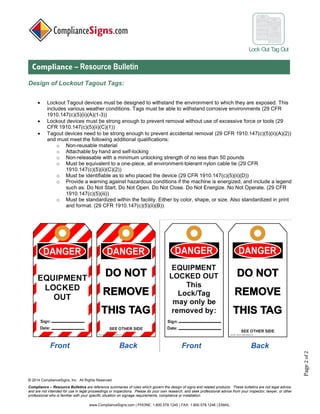
• Lockout Tagout devices must be designed to withstand the environment to which they are exposed. This
includes various weather conditions. Tags must be able to withstand corrosive environments (29 CFR
1910.147(c)(5)(ii)(A)(1-3))
• Lockout devices must be strong enough to prevent removal without use of excessive force or tools (29
CFR 1910.147(c)(5)(ii)(C)(1))
• Tagout devices need to be strong enough to prevent accidental removal (29 CFR 1910.147(c)(5)(ii)(A)(2))
and must meet the following additional qualifications:
o Non-reusable material
o Attachable by hand and self-locking
o Non-releasable with a minimum unlocking strength of no less than 50 pounds
o Must be equivalent to a one-piece, all environment-tolerant nylon cable tie (29 CFR
1910.147(c)(5)(ii)(C)(2))
o Must be identifiable as to who placed the device (29 CFR 1910.147(c)(5)(ii)(D))
o Provide a warning against hazardous conditions if the machine is energized, and include a legend
such as: Do Not Start. Do Not Open. Do Not Close. Do Not Energize. No Not Operate. (29 CFR
1910.147(c)(5)(iii))
o Must be standardized within the facility. Either by color, shape, or size. Also standardized in print
and format. (29 CFR 1910.147(c)(5)(ii)(B))

Lockout Tagout Safety Resources

  • 1.
    © 2017 ComplianceSigns,Inc. All Rights Reserved Compliance – Resource Bulletins are reference summaries of rules which govern the design of signs and related products. These bulletins are not legal advice, and are not intended for use in legal proceedings or inspections. Please do your own research, and seek professional advice from your inspector, lawyer, or other professional who is familiar with your specific situation on signage requirements, compliance or installation. www.ComplianceSigns.com | PHONE: 1.800.578.1245 | FAX: 1.800.578.1246 | EMAIL: Lock Out Tag Out SEE O TH ER SI D E DO NOT REMOVE THIS TAG Reorder:www.ComplianceSigns.com D at e: S i gn: DO NOT CLOSE This Lock/Tag may only be removed by: Compliance – Resource Bulletin Page1of2 Lockout Tagout Overview: Lockout Tagout is a set of procedures and rules that must be used to shut down equipment and prevent the release of energy so that maintenance can be performed on the equipment (Lockout Tagout Tutorial). Lockout refers to using a lockout device to ensure that the machine it is placed on cannot be used during maintenance. Tagout refers to placing a tag on the machine to show that employees cannot use the machine until the servicing is complete and the tag has been removed. This tag is used in conjunction with a lockout device because the lockout device does not have the warning labeled on it. The tag assures that employees are aware of what is happening with the machine. (29 CFR 1910.147(b)) This process is essential for employees working with machinery that has the risk of harming employees due to electric shock. Dangerous energy release is the cause of about 10 percent of accidents for employees working with this type of equipment, so properly understanding and using this system is very beneficial. Lockout Tagout is regulated by OSHA through the standard for The Control of Hazardous Energy (Lockout/Tagout). It is the employer’s responsibility to protect workers by implementing this program and assuring that employees are properly trained (29 CFR 1910.147). This standard only applies to the control of energy during servicing and maintenance of machines and equipment. Employers should have other rules and regulations for using machines in other situations. (29 CFR 1910.147 (a)(2)(i)) Outlined in this standard are ways of controlling various hazardous forms of energy, including: electrical, mechanical, hydraulic, pneumatic, chemical, and thermal. While this standard offers various safety precautions and practices, it is important for employees to be diligent in following these rules, and the additional rules of their employer, to maintain and assure a safe working environment. Resources: OSHA Standard 1910.147: (Free) https://www.osha.gov/pls/oshaweb/owadisp.show_ document?p_table=STANDARDS&p_id=9804 Lockout Tagout Tutorial: (Free) https://www.osha.gov/dts/osta/lototraining/tutorial/tu- overvw.html OSHA Fact Sheet: (Free) https://www.osha.gov/OshDoc/data_General_Facts/factsheet- lockout-tagout.pdf Lockout/Tagout Procedure: (Free) https://www.osha.gov/pls/oshaweb/owadisp.show_document? p_table=STANDARDS&p_id=9805
  • 2.
    © 2017 ComplianceSigns,Inc. All Rights Reserved Compliance – Resource Bulletins are reference summaries of rules which govern the design of signs and related products. These bulletins are not legal advice, and are not intended for use in legal proceedings or inspections. Please do your own research, and seek professional advice from your inspector, lawyer, or other professional who is familiar with your specific situation on signage requirements, compliance or installation. www.ComplianceSigns.com | PHONE: 1.800.578.1245 | FAX: 1.800.578.1246 | EMAIL: Lock Out Tag Out SEE O TH ER SI D E DO NOT REMOVE THIS TAG Reorder:www.ComplianceSigns.com D at e: S i gn: DO NOT CLOSE This Lock/Tag may only be removed by: Compliance – Resource Bulletin Page2of2 (Lockout Tagout Continued) Design of Lockout Tagout Tags: • Lockout Tagout devices must be designed to withstand the environment to which they are exposed. This includes various weather conditions. Tags must be able to withstand corrosive environments (29 CFR 1910.147(c)(5)(ii)(A)(1-3)) • Lockout devices must be strong enough to prevent removal without use of excessive force or tools (29 CFR 1910.147(c)(5)(ii)(C)(1)) • Tagout devices need to be strong enough to prevent accidental removal (29 CFR 1910.147(c)(5)(ii)(A)(2)) and must meet the following additional qualifications: o Non-reusable material o Attachable by hand and self-locking o Non-releasable with a minimum unlocking strength of no less than 50 pounds o Must be equivalent to a one-piece, all environment-tolerant nylon cable tie (29 CFR 1910.147(c)(5)(ii)(C)(2)) o Must be identifiable as to who placed the device (29 CFR 1910.147(c)(5)(ii)(D)) o Provide a warning against hazardous conditions if the machine is energized, and include a legend such as: Do Not Start. Do Not Open. Do Not Close. Do Not Energize. No Not Operate. (29 CFR 1910.147(c)(5)(iii)) o Must be standardized within the facility. Either by color, shape, or size. Also standardized in print and format. (29 CFR 1910.147(c)(5)(ii)(B))