Local Initiatives for E-Government   (L.I.F.E) IT Pilot Project   Dadang Solihin INDONESIA Advanced International Training Programme of Information Technology Management Karlstad-Sweden, 26 September 2005 Download file: http://www.docstoc.com/profile/DadangSolihin
www.dadangsolihin.com
Background What is E-Government? Why E-Government is Important? Why Public Access is Important to the Success of E-Government? What is the LIFE Model? www.dadangsolihin.com
What is E-Government? The use of information and communication technologies to improve the efficiency, effectiveness, transparency and accountability of the government. The ability to transform relations with citizens, businesses, and other parts of the government. Better delivery of government services to citizens, improve interactions with business and industry, citizens empowerment trough access to information, or more efficient government management. Less corruption, increased transparency, greater convenience, revenue growth, cost reductions. www.dadangsolihin.com
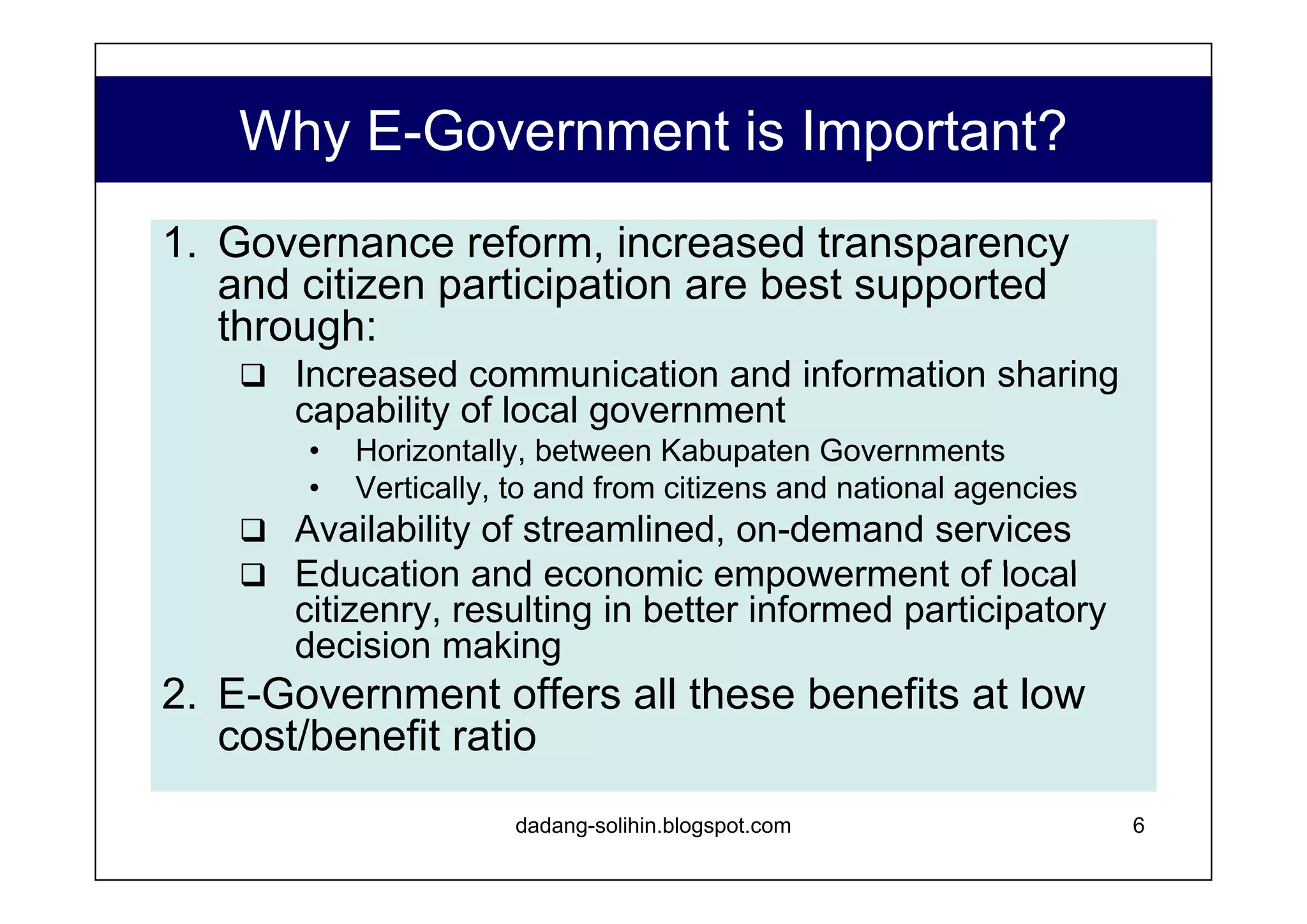
Why E-Government is Important?   Governance reform, increased transparency and citizen participation are best supported through: Increased communication and information sharing capability of local government Horizontally, between Kabupaten Governments Vertically, to and from citizens and national agencies Availability of streamlined, on-demand services  Education and economic empowerment of local citizenry, resulting in better informed participatory decision making E-Government offers all these benefits at low cost/benefit ratio www.dadangsolihin.com
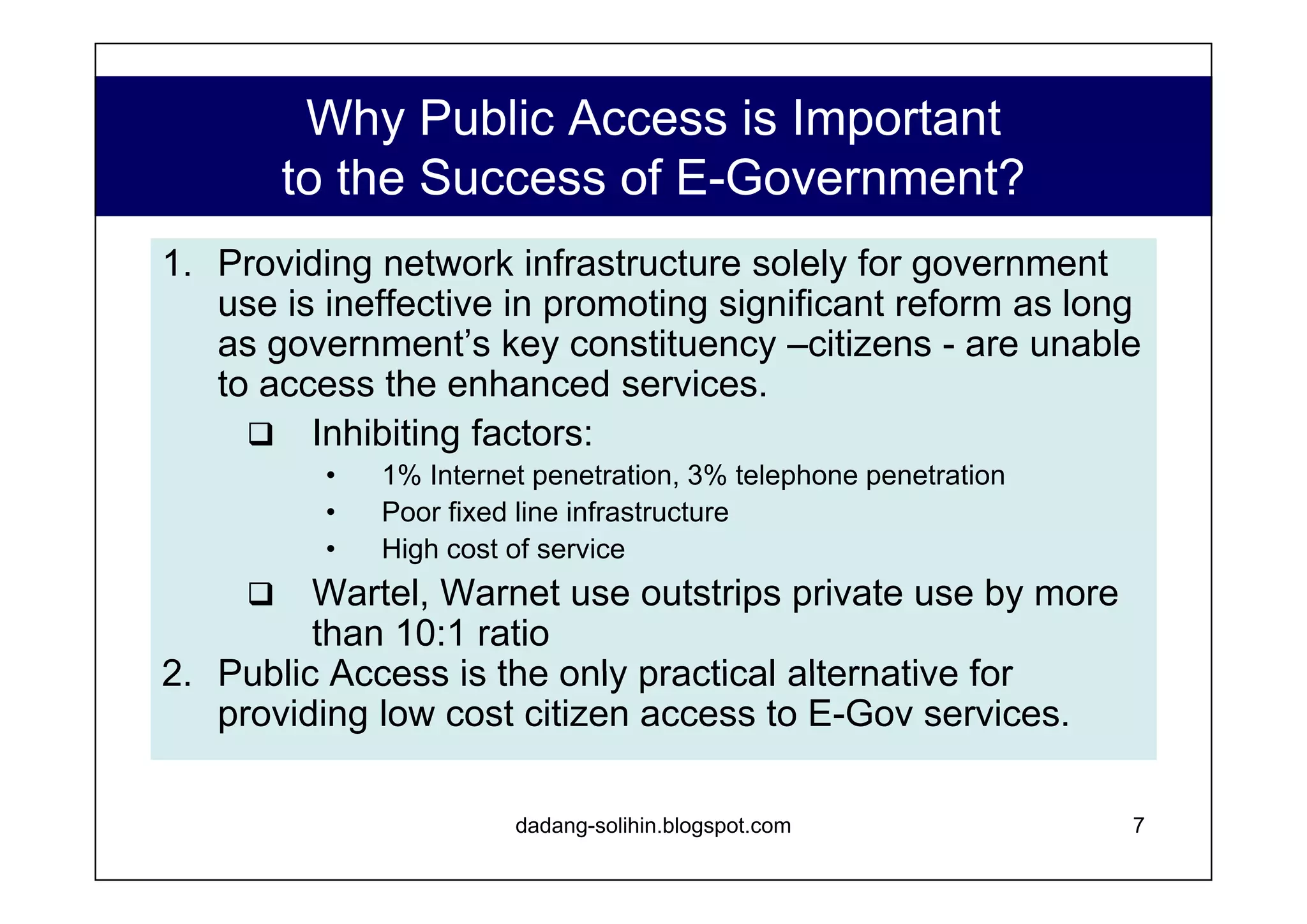
Why Public Access is Important  to the Success of E-Government?   Providing network infrastructure solely for government use is ineffective in promoting significant reform as long as government’s key constituency –citizens - are unable to access the enhanced services. Inhibiting factors: 1% Internet penetration, 3% telephone penetration Poor fixed line infrastructure High cost of service Wartel, Warnet use outstrips private use by more than 10:1 ratio Public Access is the only practical alternative for providing low cost citizen access to E-Gov services. www.dadangsolihin.com
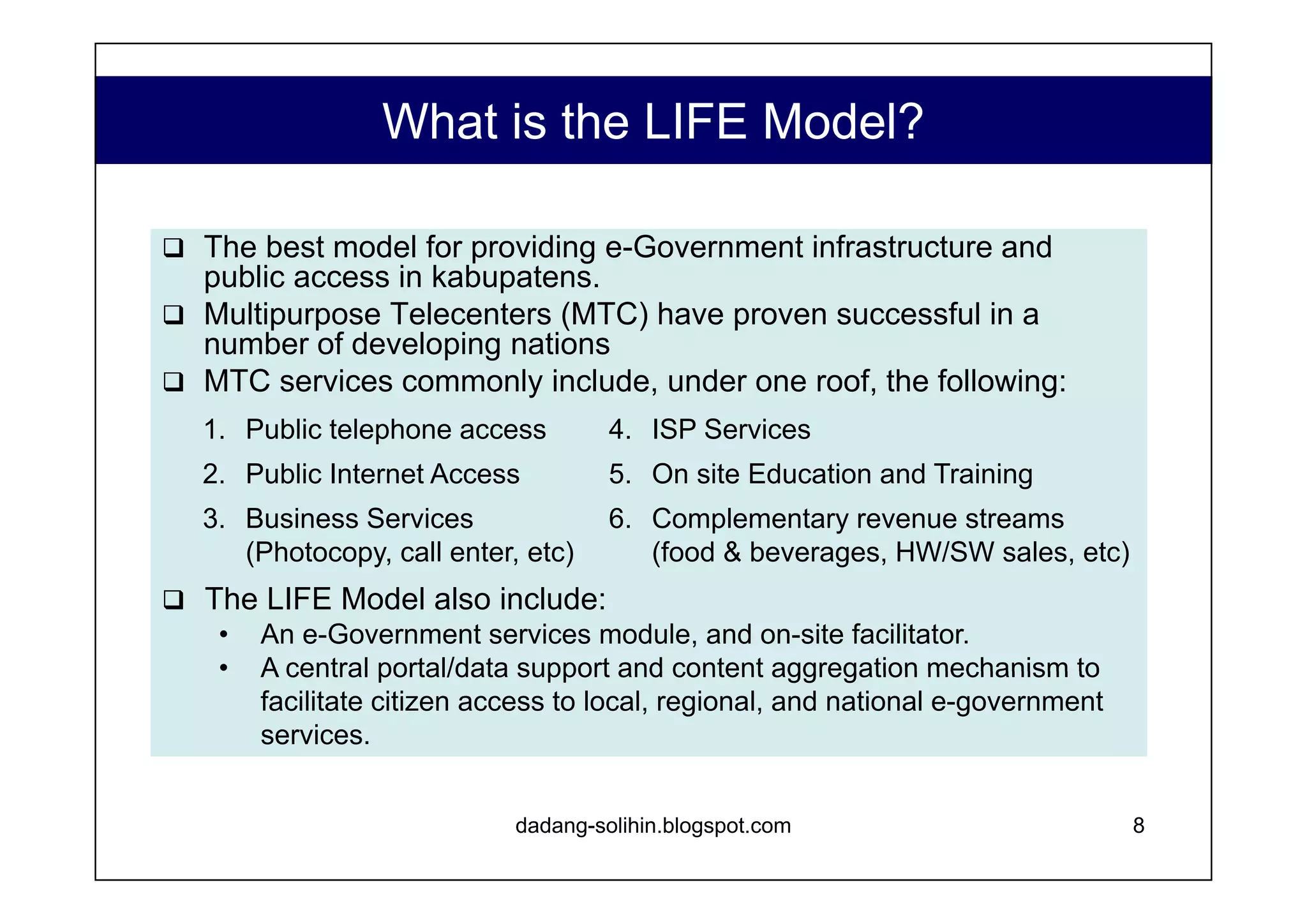
What is the LIFE Model? The best model for providing e-Government infrastructure and public access in kabupatens.  Multipurpose Telecenters (MTC) have proven successful in a number of developing nations MTC services commonly include, under one roof, the following: www.dadangsolihin.com Complementary revenue streams (food & beverages, HW/SW sales, etc) Business Services (Photocopy, call enter, etc) On site Education and Training Public Internet Access ISP Services Public telephone access The LIFE Model also include:  An e-Government services module, and on-site facilitator. A central portal/data support and content aggregation mechanism to facilitate citizen access to local, regional, and national e-government services.
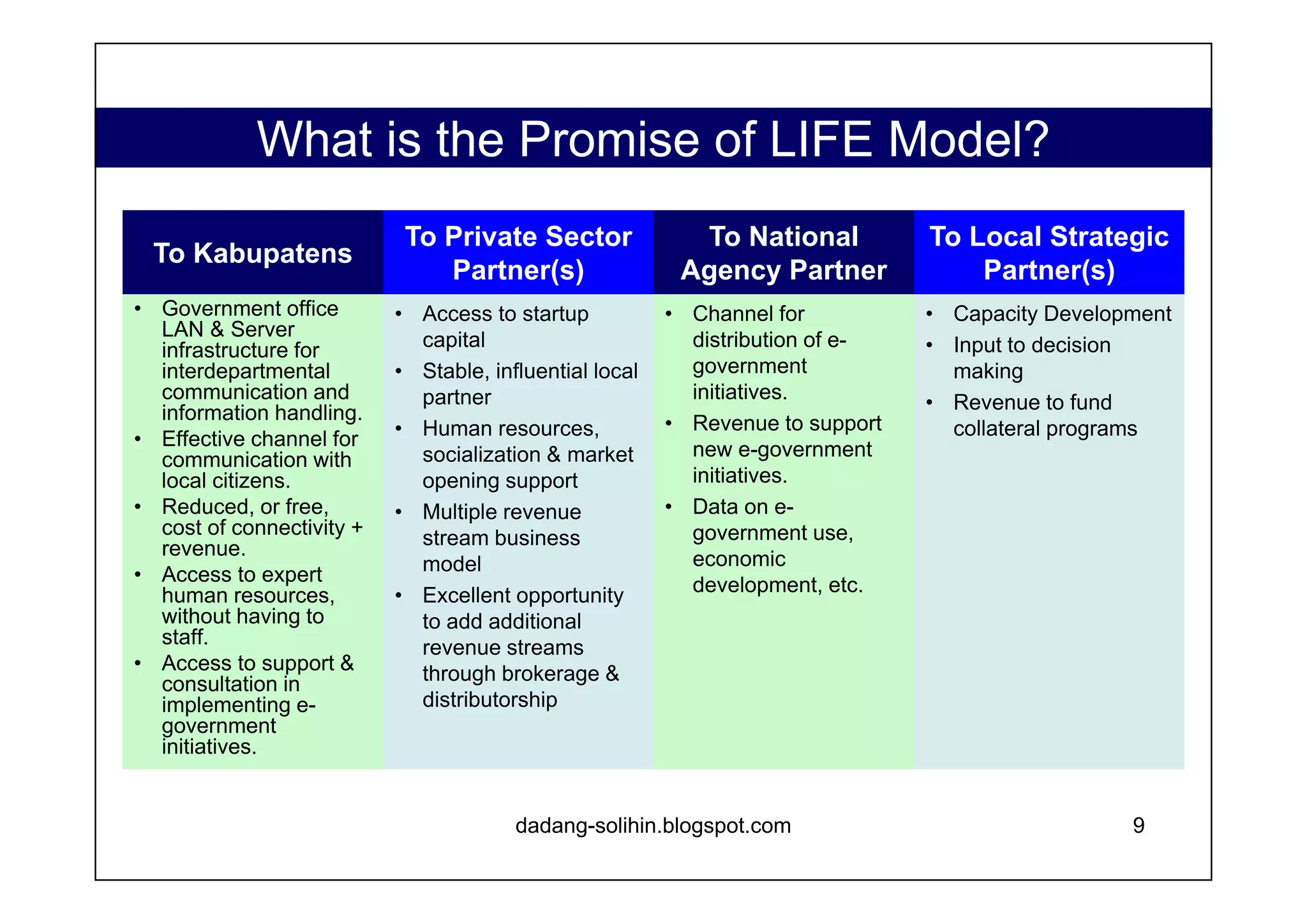
What is the Promise of LIFE Model? Government office LAN & Server infrastructure for interdepartmental communication and information handling. Effective channel for communication with local citizens. Reduced, or free, cost of connectivity + revenue. Access to expert human resources, without having to staff. Access to support & consultation in implementing e-government initiatives. www.dadangsolihin.com Access to startup capital Stable, influential local partner Human resources, socialization & market opening support Multiple revenue stream business model Excellent opportunity to add additional revenue streams through brokerage & distributorship Channel for distribution of e-government initiatives. Revenue to support new e-government initiatives. Data on e-government use, economic development, etc. Capacity Development Input to decision making Revenue to fund collateral programs To Kabupatens To Private Sector Partner(s) To National Agency Partner To Local Strategic Partner(s)
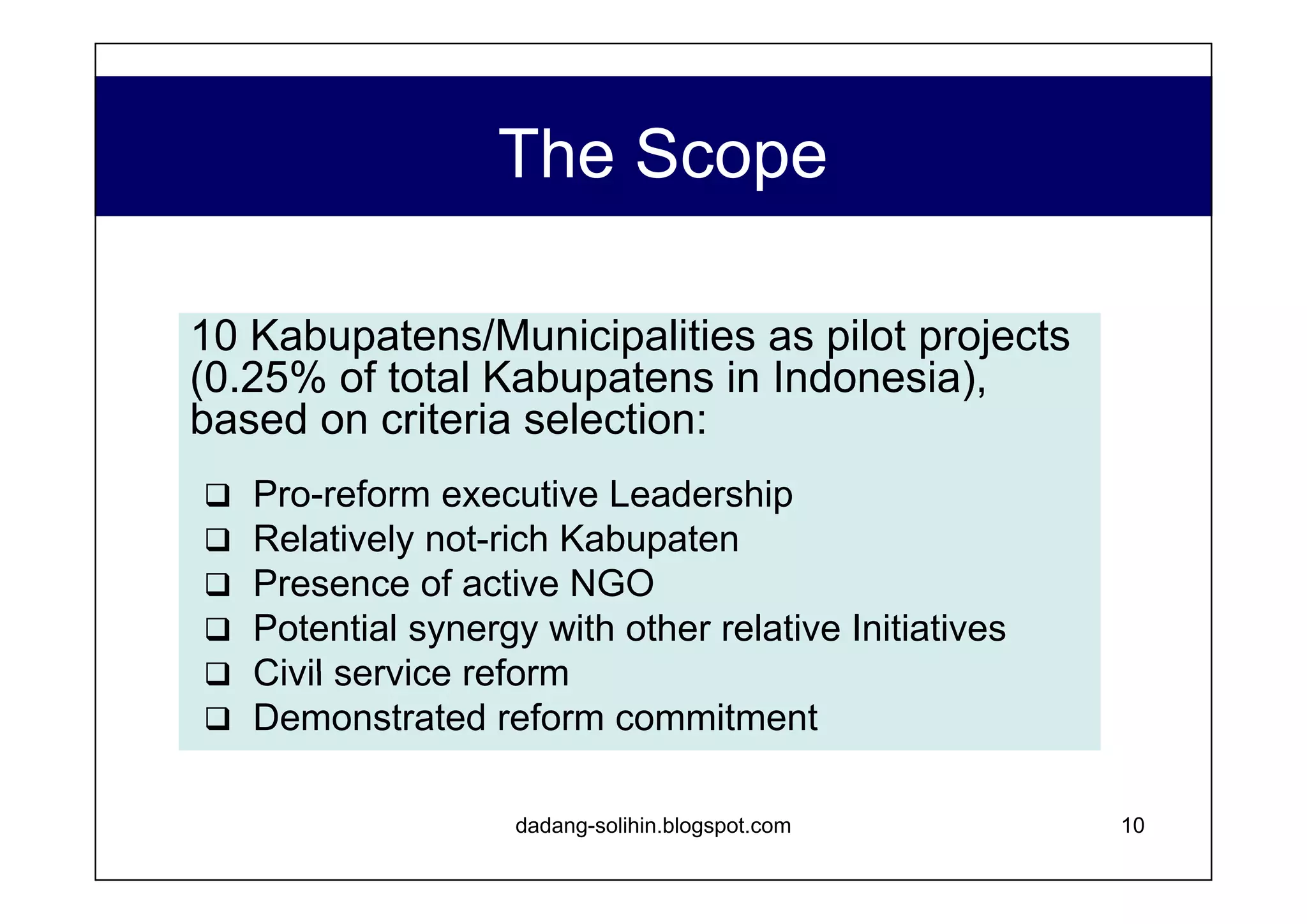
The Scope   10 Kabupatens/Municipalities as pilot projects (0.25% of total Kabupatens in Indonesia), based on criteria selection: Pro-reform executive Leadership Relatively not-rich Kabupaten Presence of active NGO  Potential synergy with other relative Initiatives Civil service reform Demonstrated reform commitment www.dadangsolihin.com
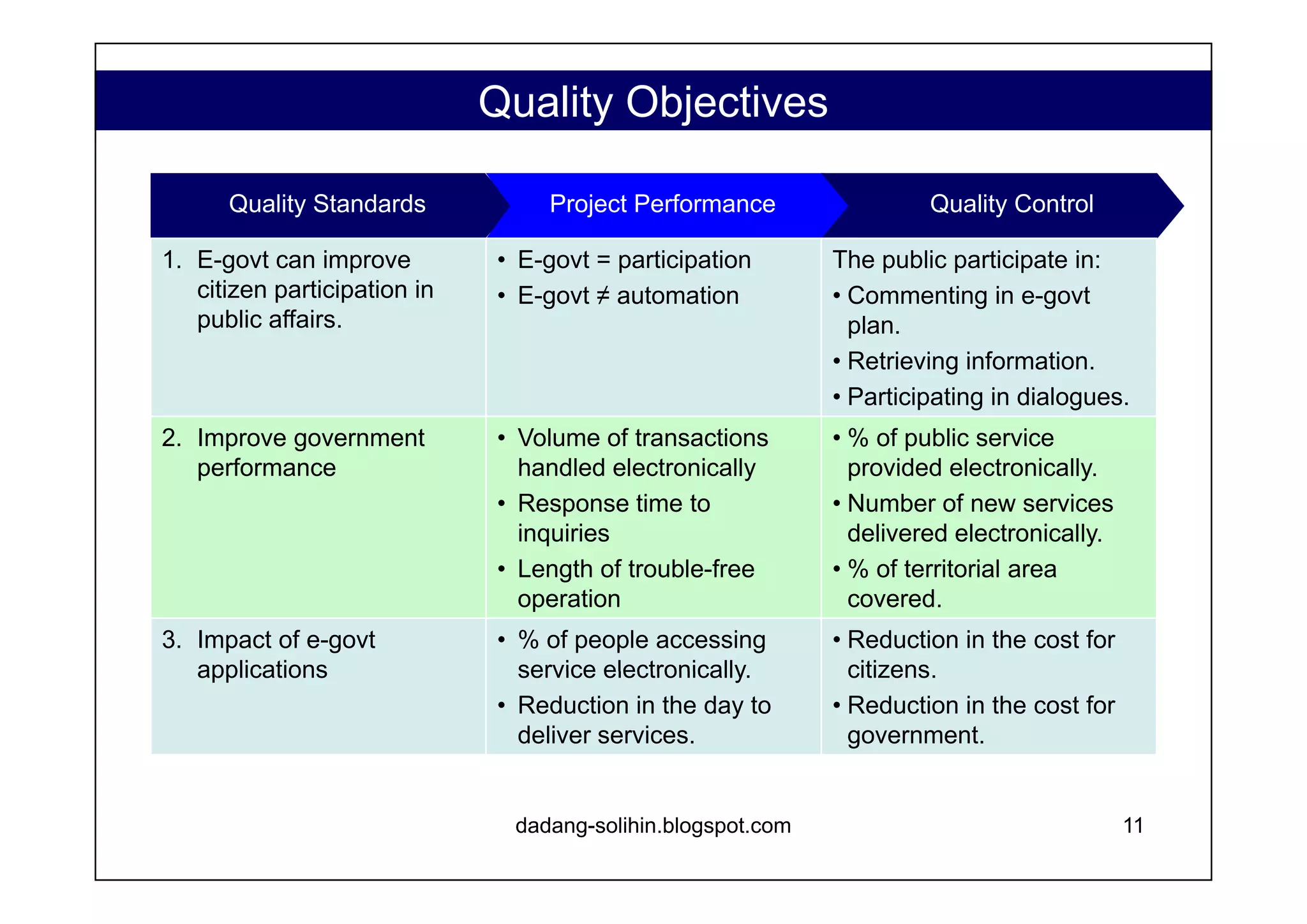
Quality Objectives www.dadangsolihin.com Project Performance Quality Control Quality Standards E-govt can improve citizen participation in public affairs. E-govt = participation E-govt  ≠  automation The public participate in: Commenting in e-govt plan. Retrieving information. Participating in dialogues. Improve government performance Volume of transactions handled electronically Response time to inquiries Length of trouble-free operation % of public service provided electronically. Number of new services delivered electronically. % of territorial area covered. Impact of e-govt applications % of people accessing service electronically. Reduction in the day to deliver services. Reduction in the cost for citizens. Reduction in the cost for government.
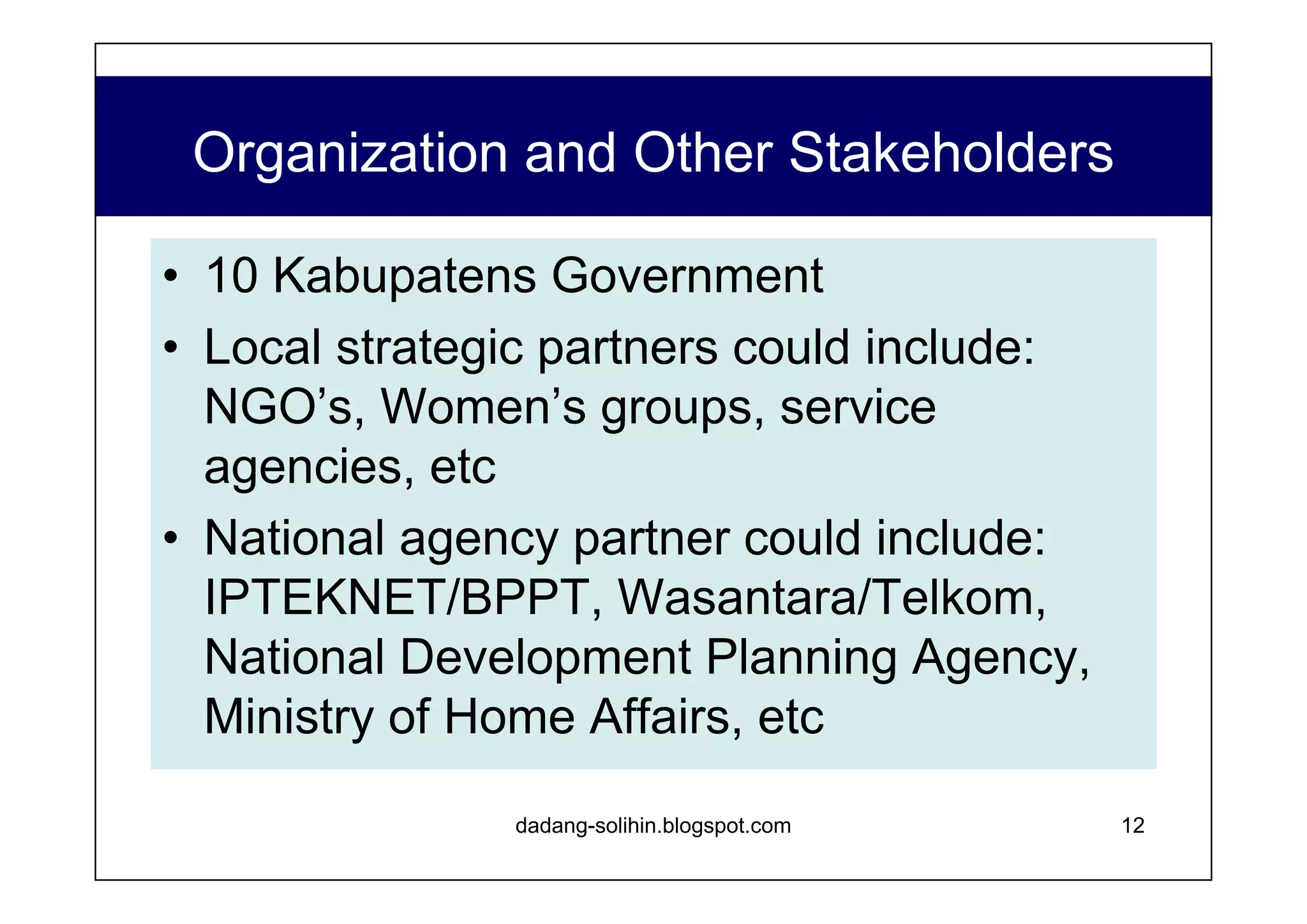
Organization and Other Stakeholders   10 Kabupatens Government Local strategic partners could include: NGO’s, Women’s groups, service agencies, etc National agency partner could include: IPTEKNET/BPPT, Wasantara/Telkom, National Development Planning Agency, Ministry of Home Affairs, etc www.dadangsolihin.com
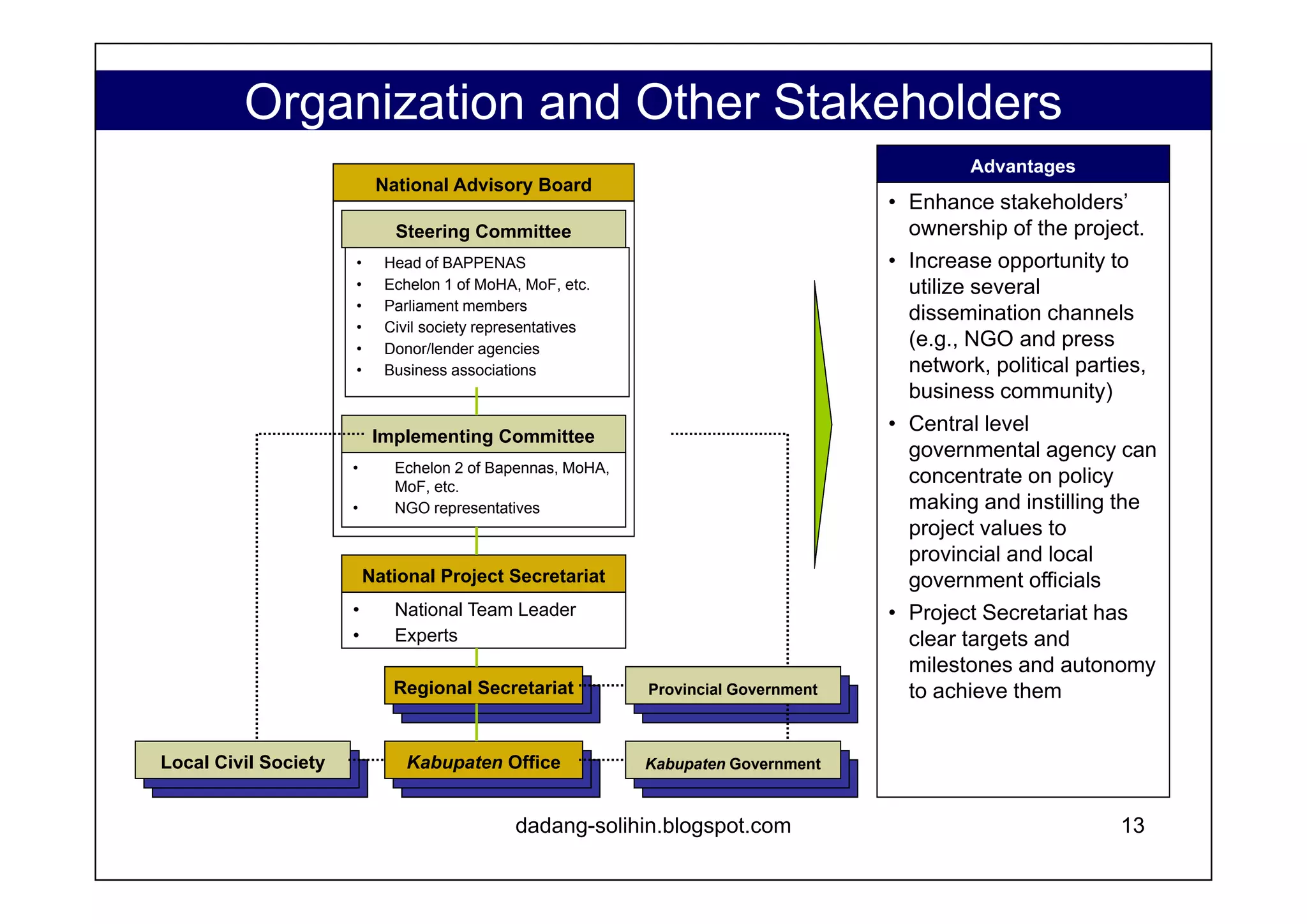
Organization and Other Stakeholders www.dadangsolihin.com National Advisory Board Steering Committee Head of BAPPENAS Echelon 1 of MoHA, MoF, etc. Parliament members Civil society representatives Donor/lender agencies Business associations Implementing Committee Echelon 2 of Bapennas, MoHA, MoF, etc. NGO representatives National Project Secretariat National Team Leader Experts Regional Secretariat Kabupaten  Office Provincial Government Kabupaten  Government Local Civil Society Advantages Enhance stakeholders’ ownership of the project. Increase opportunity to utilize several dissemination channels (e.g., NGO and press network, political parties, business community) Central level governmental agency can concentrate on policy making and instilling the project values to provincial and local government officials Project Secretariat has clear targets and milestones and autonomy to achieve them
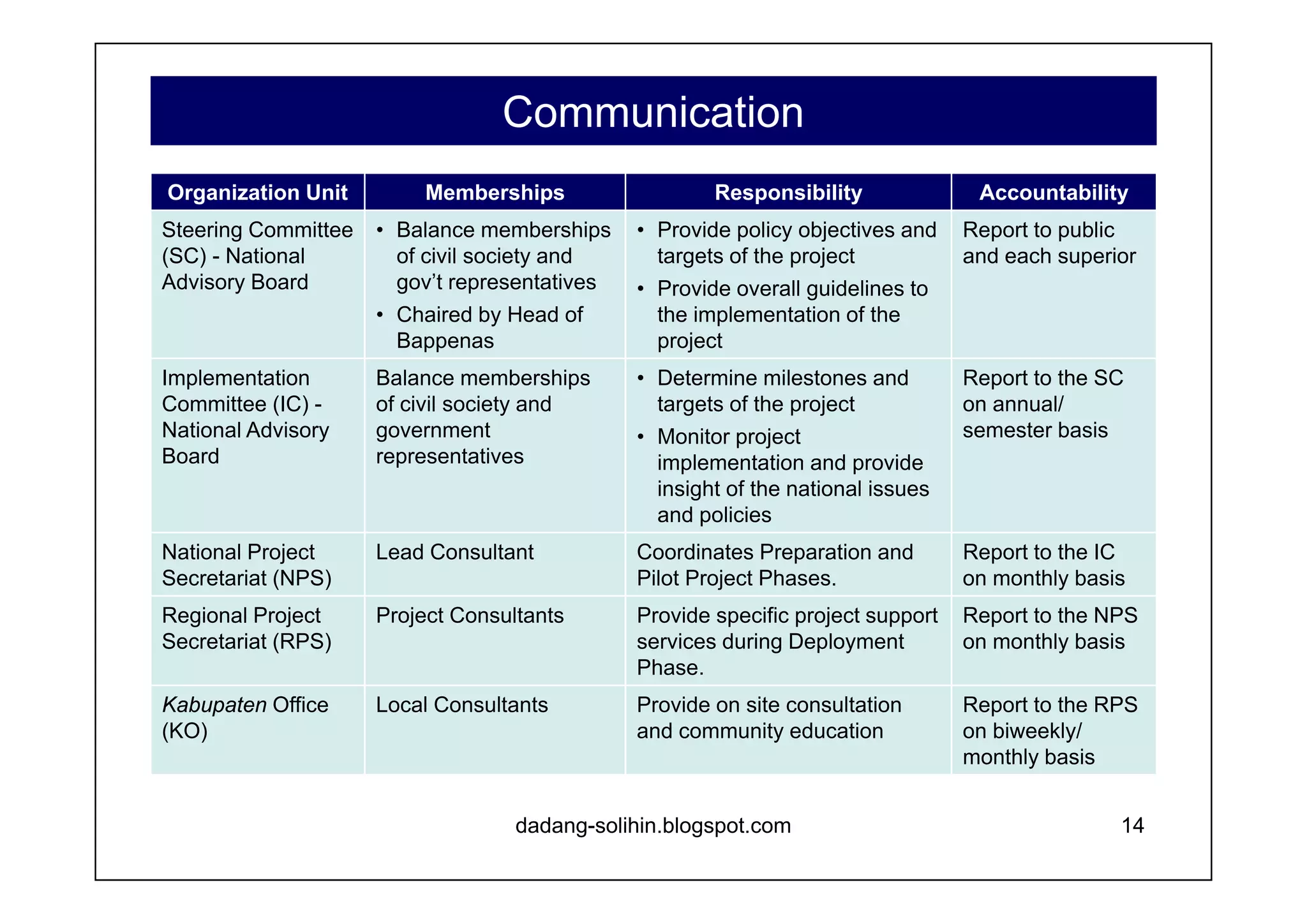
Communication www.dadangsolihin.com Organization Unit Memberships Responsibility Accountability Steering Committee (SC) - National Advisory Board Balance memberships of civil society and gov’t representatives Chaired by Head of Bappenas Provide policy objectives and targets of the project Provide overall guidelines to the implementation of the project Report to public and each superior Implementation Committee (IC) - National Advisory Board Balance memberships of civil society and government representatives Determine milestones and targets of the project Monitor project implementation and provide insight of the national issues and policies Report to the SC on annual/ semester basis National Project Secretariat (NPS) Lead Consultant Coordinates Preparation and Pilot Project Phases. Report to the IC on monthly basis Regional Project Secretariat (RPS) Project Consultants Provide specific project support services during Deployment Phase. Report to the NPS on monthly basis Kabupaten  Office (KO) Local Consultants Provide on site consultation and community education Report to the RPS on biweekly/ monthly basis
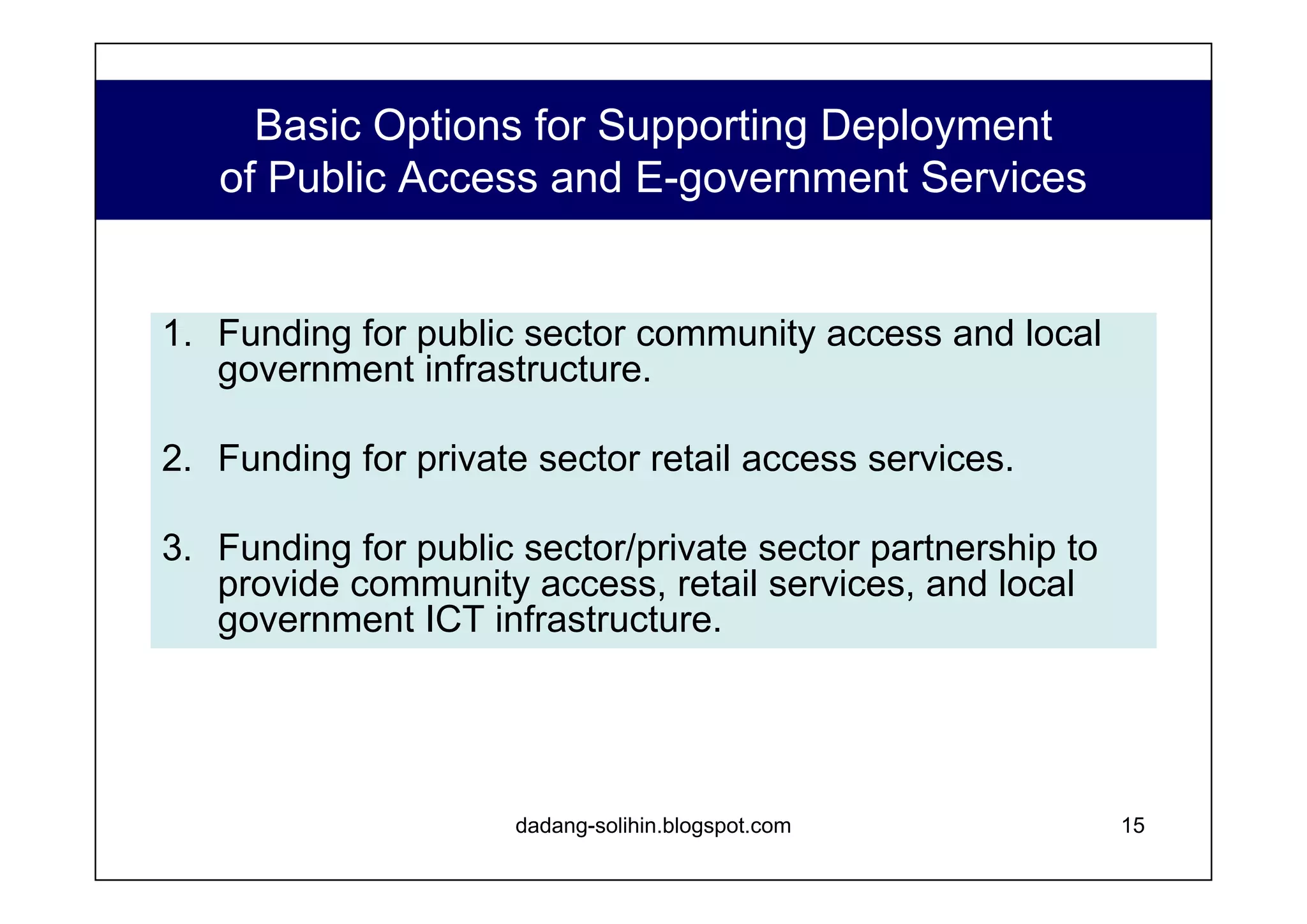
Basic Options for Supporting Deployment  of Public Access and E-government Services Funding for public sector community access and local government infrastructure. Funding for private sector retail access services. Funding for public sector/private sector partnership to provide community access, retail services, and local government ICT infrastructure. www.dadangsolihin.com
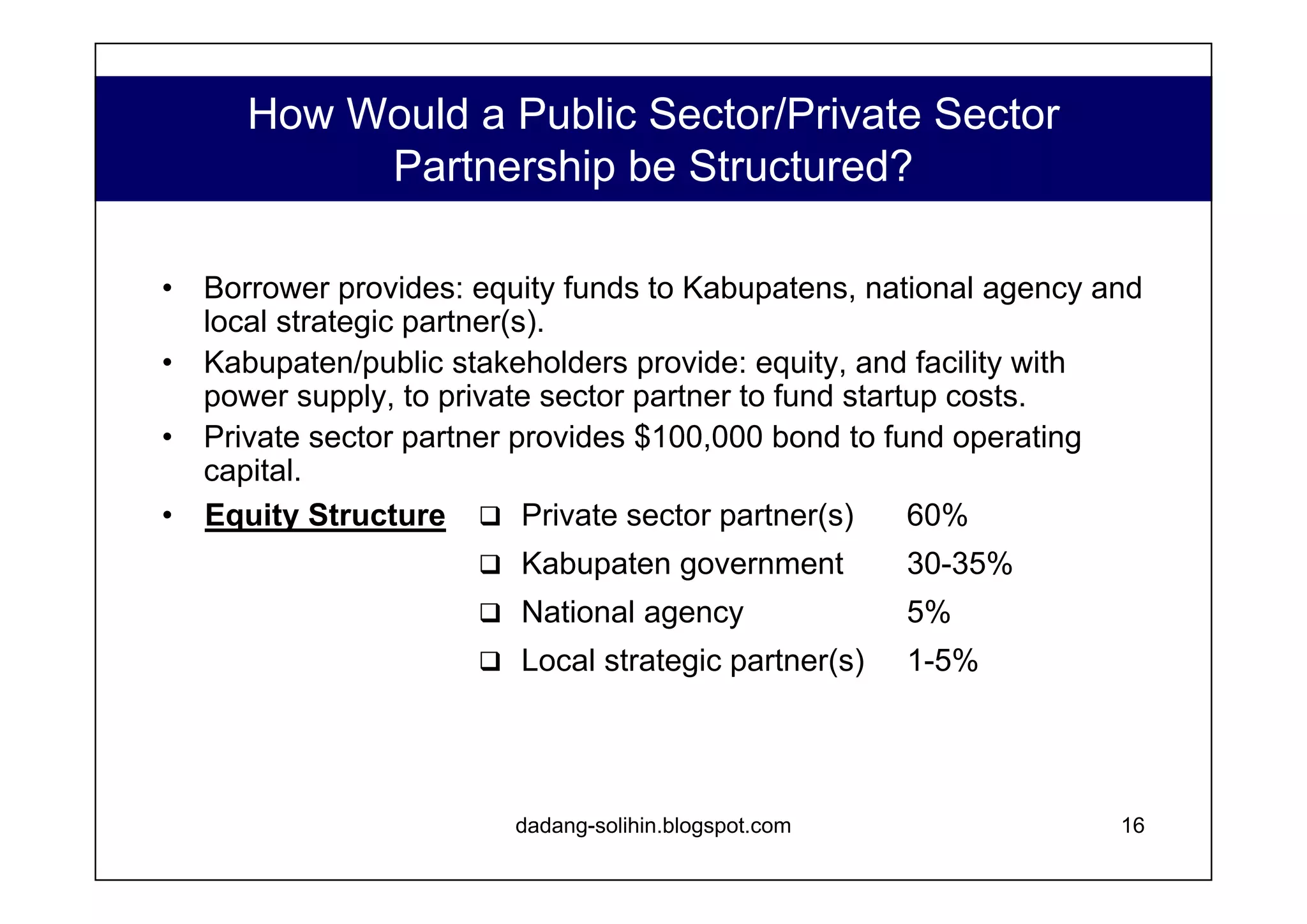
How Would a Public Sector/Private Sector  Partnership be Structured? Borrower provides: equity funds to Kabupatens, national agency and local strategic partner(s). Kabupaten/public stakeholders provide: equity, and facility with power supply, to private sector partner to fund startup costs. Private sector partner provides $100,000 bond to fund operating capital. www.dadangsolihin.com Equity Structure Private sector partner(s) 60% Kabupaten government 30-35% National agency 5% Local strategic partner(s) 1-5%
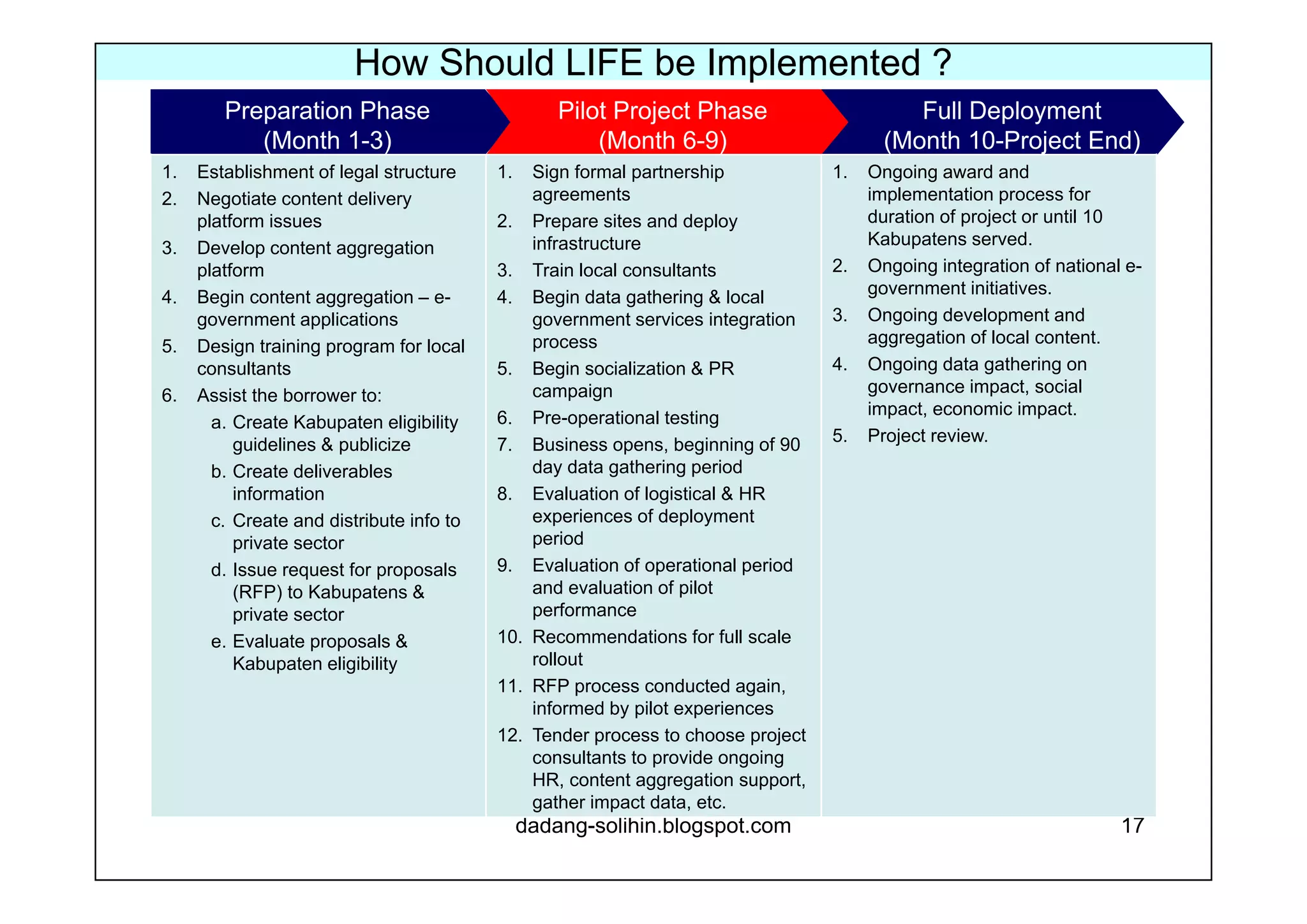
How Should LIFE be Implemented ? www.dadangsolihin.com Ongoing award and implementation process for duration of project or until 10 Kabupatens served. Ongoing integration of national e-government initiatives. Ongoing development and aggregation of local content. Ongoing data gathering on governance impact, social impact, economic impact. Project review. Sign formal partnership agreements Prepare sites and deploy infrastructure Train local consultants Begin data gathering & local government services integration process Begin socialization & PR campaign Pre-operational testing Business opens, beginning of 90 day data gathering period Evaluation of logistical & HR experiences of deployment period Evaluation of operational period and evaluation of pilot performance Recommendations for full scale rollout RFP process conducted again, informed by pilot experiences Tender process to choose project consultants to provide ongoing HR, content aggregation support, gather impact data, etc. Establishment of legal structure  Negotiate content delivery platform issues Develop content aggregation platform Begin content aggregation – e-government applications Design training program for local consultants Assist the borrower to: Create Kabupaten eligibility guidelines & publicize Create deliverables information Create and distribute info to private sector Issue request for proposals (RFP) to Kabupatens & private sector Evaluate proposals & Kabupaten eligibility Pilot Project Phase  (Month 6-9) Full Deployment  (Month 10-Project End) Preparation Phase  (Month 1-3)
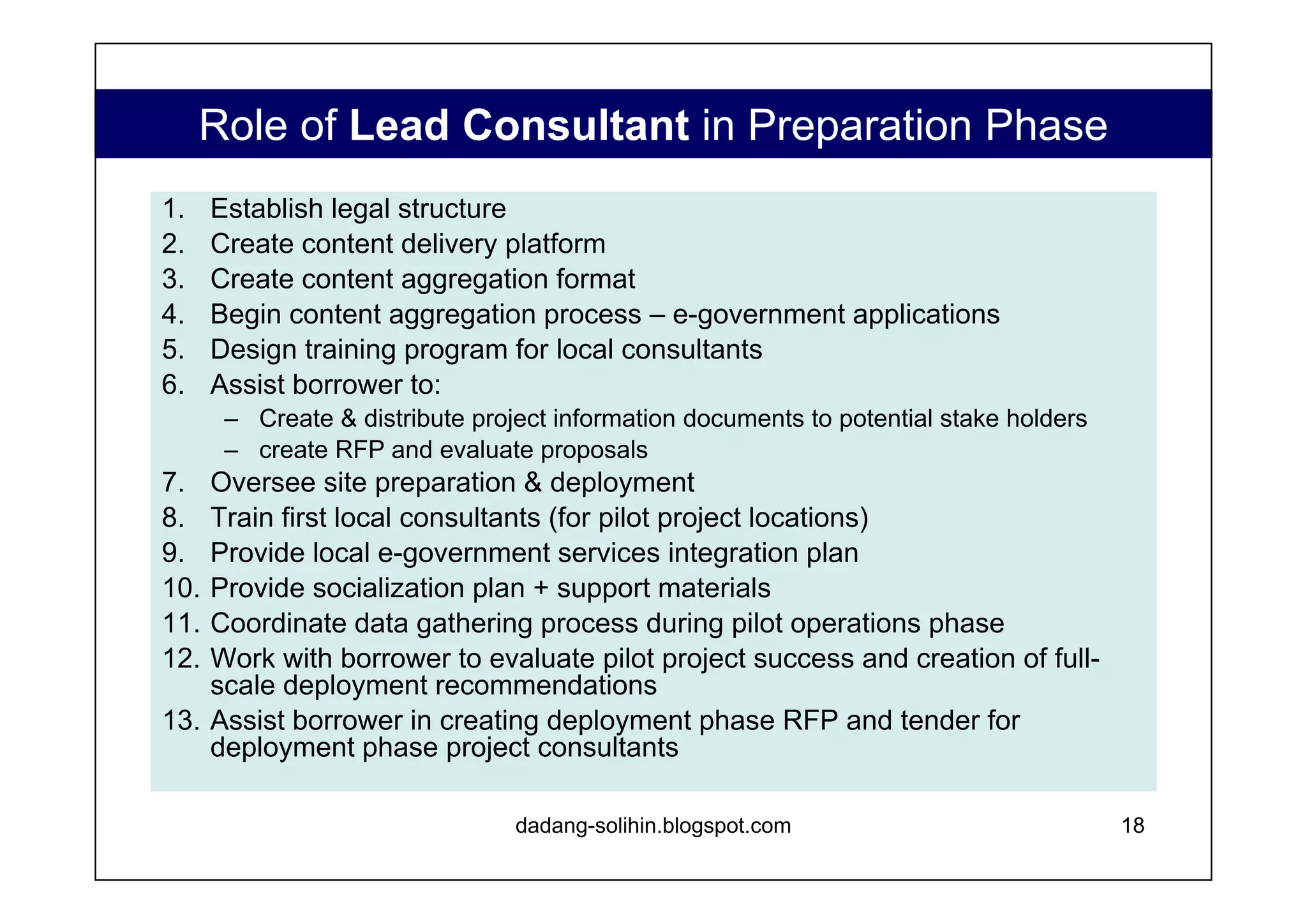
Role of  Lead Consultant  in Preparation Phase Establish legal structure Create content delivery platform Create content aggregation format Begin content aggregation process – e-government applications Design training program for local consultants Assist borrower to: Create & distribute project information documents to potential stake holders create RFP and evaluate proposals Oversee site preparation & deployment Train first local consultants (for pilot project locations) Provide local e-government services integration plan Provide socialization plan + support materials Coordinate data gathering process during pilot operations phase Work with borrower to evaluate pilot project success and creation of full-scale deployment recommendations Assist borrower in creating deployment phase RFP and tender for deployment phase project consultants www.dadangsolihin.com
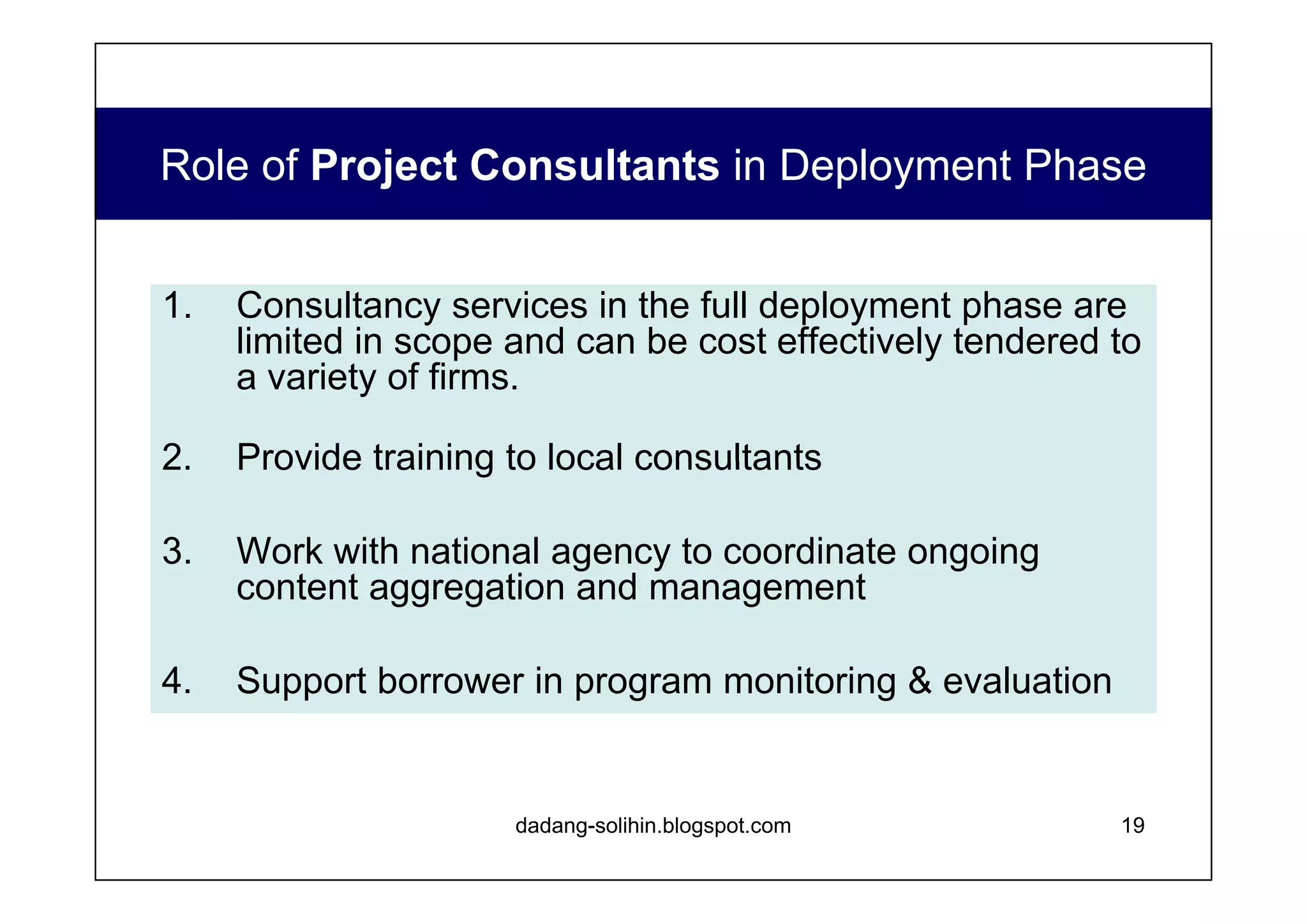
Role of  Project Consultants  in Deployment Phase Consultancy services in the full deployment phase are limited in scope and can be cost effectively tendered to a variety of firms. Provide training to local consultants Work with national agency to coordinate ongoing content aggregation and management Support borrower in program monitoring & evaluation www.dadangsolihin.com
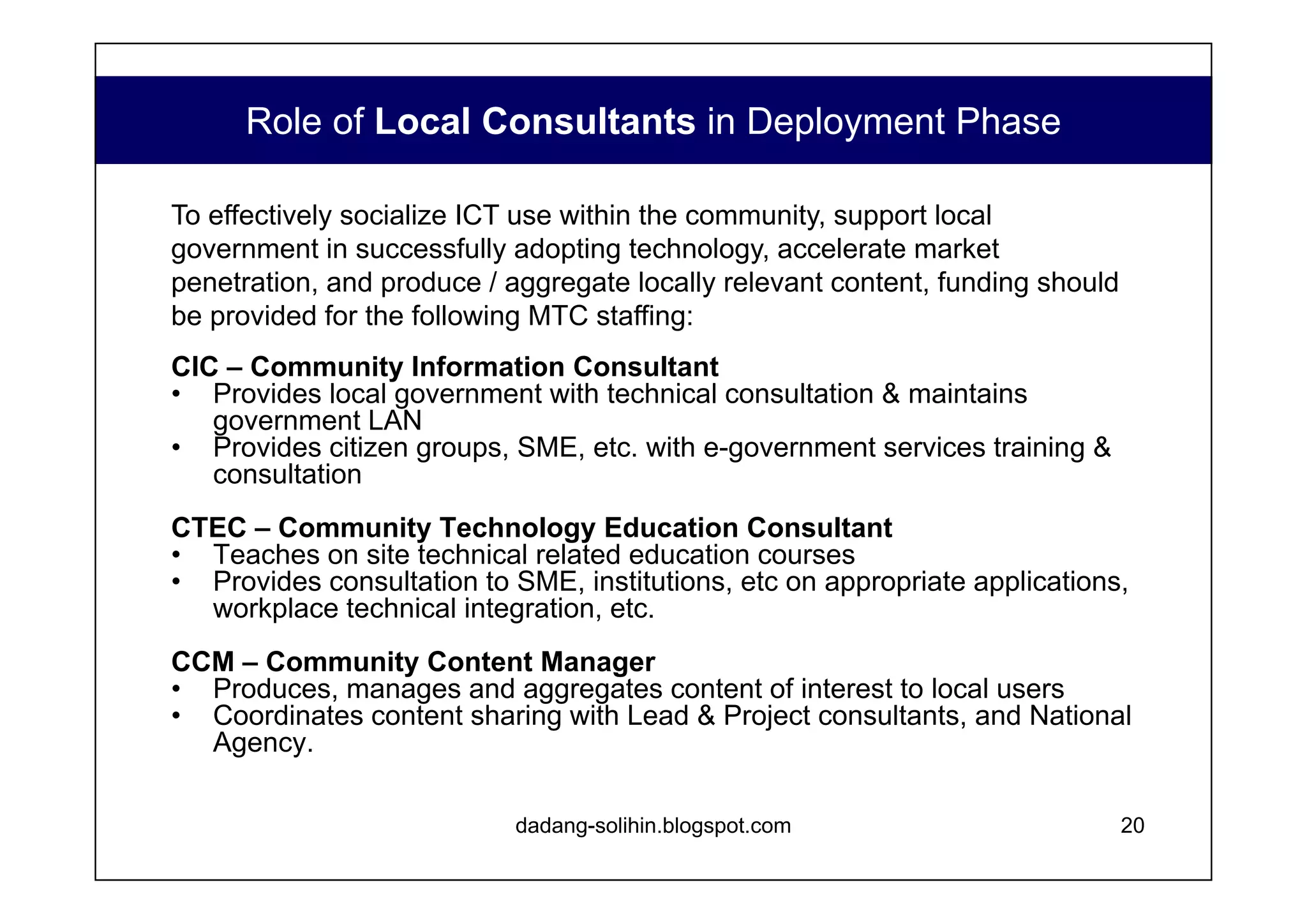
Role of  Local Consultants  in Deployment Phase CIC – Community Information Consultant Provides local government with technical consultation & maintains government LAN Provides citizen groups, SME, etc. with e-government services training & consultation CTEC – Community Technology Education Consultant Teaches on site technical related education courses Provides consultation to SME, institutions, etc on appropriate applications, workplace technical integration, etc. CCM – Community Content Manager Produces, manages and aggregates content of interest to local users Coordinates content sharing with Lead & Project consultants, and National Agency. www.dadangsolihin.com To effectively socialize ICT use within the community, support local government in successfully adopting technology, accelerate market penetration, and produce / aggregate locally relevant content, funding should be provided for the following MTC staffing:
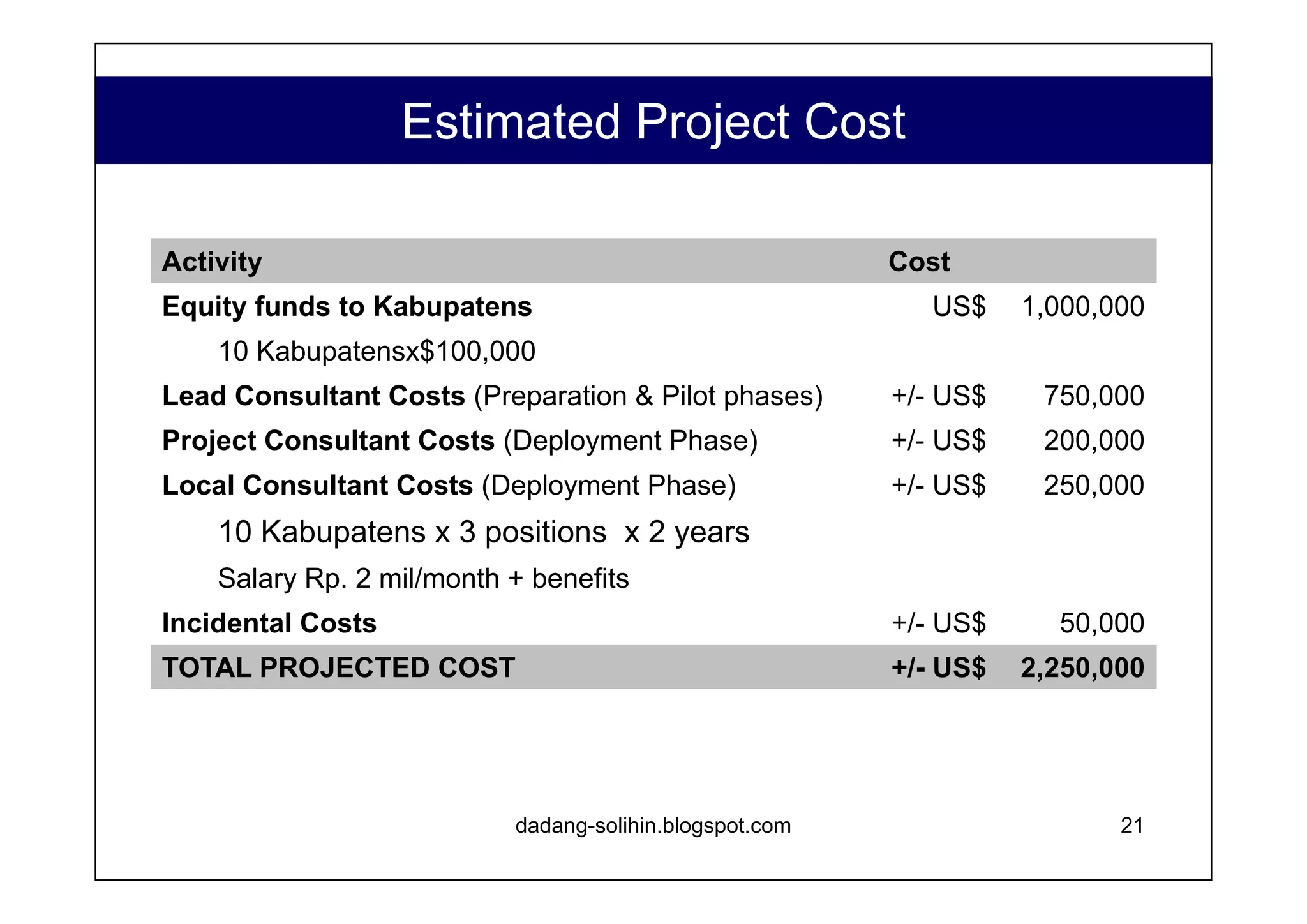
Estimated Project Cost www.dadangsolihin.com Activity Cost Equity funds to Kabupatens US$ 1,000,000 10 Kabupatensx$100,000 Lead Consultant Costs  (Preparation & Pilot phases) +/- US$ 750,000 Project Consultant Costs  (Deployment Phase) +/- US$ 200,000 Local Consultant Costs  (Deployment Phase) +/- US$ 250,000 10 Kabupatens x 3 positions  x 2 years Salary Rp. 2 mil/month + benefits Incidental Costs +/- US$ 50,000 TOTAL PROJECTED COST +/- US$ 2,250,000
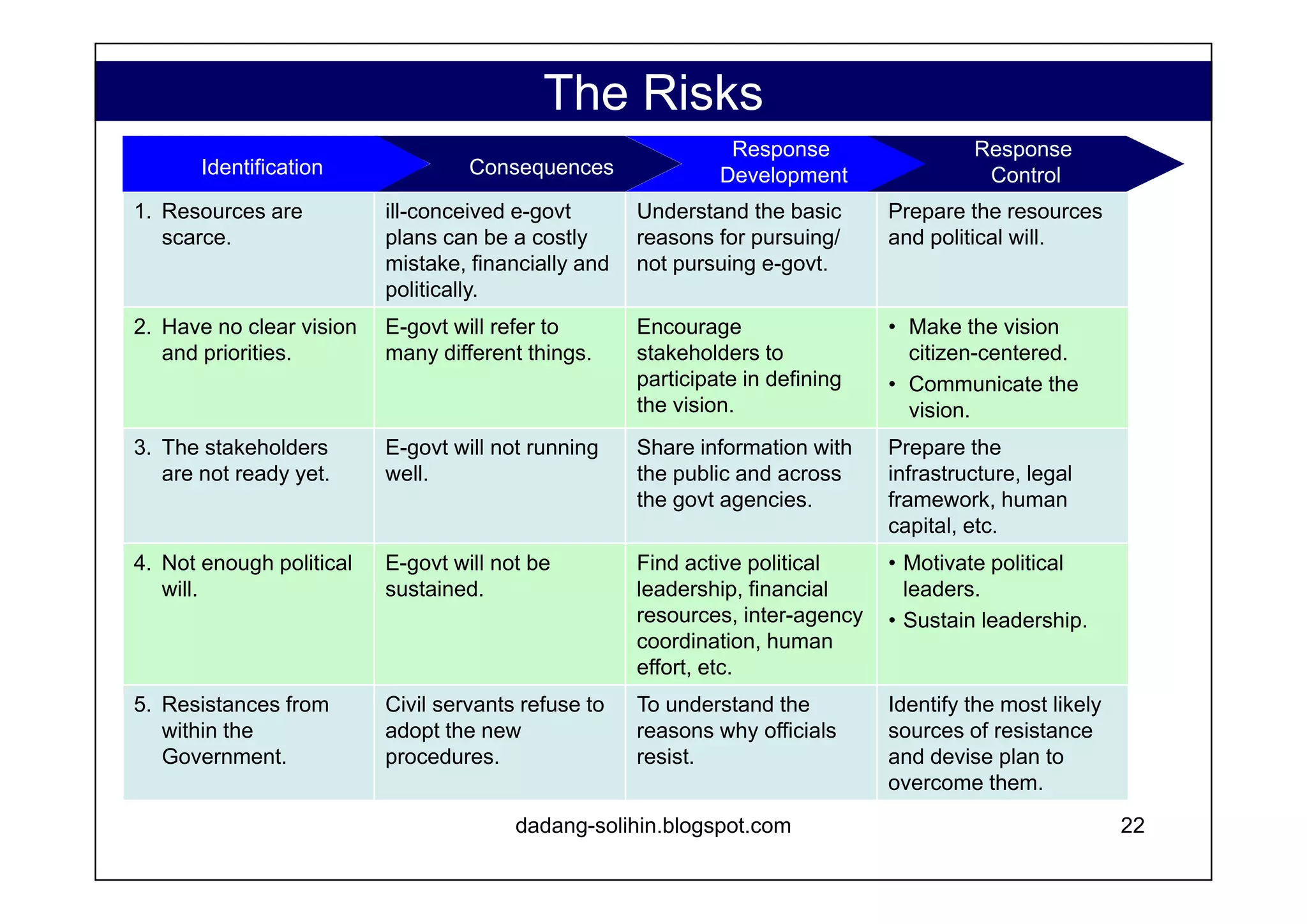
The Risks www.dadangsolihin.com Resources are scarce. ill-conceived e-govt plans can be a costly mistake, financially and politically. Understand the basic reasons for pursuing/ not pursuing e-govt. Prepare the resources and political will. Have no clear vision and priorities. E-govt will refer to many different things. Encourage stakeholders to participate in defining the vision. Make the vision citizen-centered. Communicate the vision. The stakeholders are not ready yet. E-govt will not running well. Share information with the public and across the govt agencies. Prepare the infrastructure, legal framework, human capital, etc. Not enough political will. E-govt will not be sustained. Find active political leadership, financial resources, inter-agency coordination, human effort, etc. Motivate political leaders. Sustain leadership. Resistances from within the Government. Civil servants refuse to adopt the new procedures. To understand the reasons why officials resist. Identify the most likely sources of resistance and devise plan to overcome them. Identification Consequences Response  Development Response  Control
www.dadangsolihin.com Thank You
www.dadangsolihin.com Dadang holds a MA degree (Economics), University of Colorado, USA. His previous post is Head, Center for Research Data and Information at DPD Secretariat General as well as Deputy Director for Information of Spatial Planning and Land Use Management at Indonesian National Development Planning Agency (Bappenas).  Beside working as Assistant Professor at Graduate School of Asia-Pacific Studies, Waseda University, Tokyo, Japan, he also active as Associate Professor at University of Darma Persada, Jakarta, Indonesia. He got various training around the globe, included the Training Seminar on Land Use and Management, Taiwan (2004);  Developing Multimedia Applications for Managers, Kuala Lumpur, Malaysia (2003); Applied Policy Development Training, Vancouver, Canada (2002); Local Government Administration Training Course, Hiroshima, Japan (2001); and Regional Development and Planning Training Course, Sapporo, Japan (1999). He published more than five books regarding local autonomous.  You can reach Dadang Solihin by email at  [email_address]   or by his mobile at +62812 932 2202 Dadang Solihin’s Profile

Local Initiatives for E-Government (L.I.F.E)

  • 1.
    Local Initiatives forE-Government (L.I.F.E) IT Pilot Project Dadang Solihin INDONESIA Advanced International Training Programme of Information Technology Management Karlstad-Sweden, 26 September 2005 Download file: http://www.docstoc.com/profile/DadangSolihin
  • 2.
  • 3.
    Background What isE-Government? Why E-Government is Important? Why Public Access is Important to the Success of E-Government? What is the LIFE Model? www.dadangsolihin.com
  • 4.
    What is E-Government?The use of information and communication technologies to improve the efficiency, effectiveness, transparency and accountability of the government. The ability to transform relations with citizens, businesses, and other parts of the government. Better delivery of government services to citizens, improve interactions with business and industry, citizens empowerment trough access to information, or more efficient government management. Less corruption, increased transparency, greater convenience, revenue growth, cost reductions. www.dadangsolihin.com
  • 5.
    Why E-Government isImportant? Governance reform, increased transparency and citizen participation are best supported through: Increased communication and information sharing capability of local government Horizontally, between Kabupaten Governments Vertically, to and from citizens and national agencies Availability of streamlined, on-demand services Education and economic empowerment of local citizenry, resulting in better informed participatory decision making E-Government offers all these benefits at low cost/benefit ratio www.dadangsolihin.com
  • 6.
    Why Public Accessis Important to the Success of E-Government? Providing network infrastructure solely for government use is ineffective in promoting significant reform as long as government’s key constituency –citizens - are unable to access the enhanced services. Inhibiting factors: 1% Internet penetration, 3% telephone penetration Poor fixed line infrastructure High cost of service Wartel, Warnet use outstrips private use by more than 10:1 ratio Public Access is the only practical alternative for providing low cost citizen access to E-Gov services. www.dadangsolihin.com
  • 7.
    What is theLIFE Model? The best model for providing e-Government infrastructure and public access in kabupatens. Multipurpose Telecenters (MTC) have proven successful in a number of developing nations MTC services commonly include, under one roof, the following: www.dadangsolihin.com Complementary revenue streams (food & beverages, HW/SW sales, etc) Business Services (Photocopy, call enter, etc) On site Education and Training Public Internet Access ISP Services Public telephone access The LIFE Model also include: An e-Government services module, and on-site facilitator. A central portal/data support and content aggregation mechanism to facilitate citizen access to local, regional, and national e-government services.
  • 8.
    What is thePromise of LIFE Model? Government office LAN & Server infrastructure for interdepartmental communication and information handling. Effective channel for communication with local citizens. Reduced, or free, cost of connectivity + revenue. Access to expert human resources, without having to staff. Access to support & consultation in implementing e-government initiatives. www.dadangsolihin.com Access to startup capital Stable, influential local partner Human resources, socialization & market opening support Multiple revenue stream business model Excellent opportunity to add additional revenue streams through brokerage & distributorship Channel for distribution of e-government initiatives. Revenue to support new e-government initiatives. Data on e-government use, economic development, etc. Capacity Development Input to decision making Revenue to fund collateral programs To Kabupatens To Private Sector Partner(s) To National Agency Partner To Local Strategic Partner(s)
  • 9.
    The Scope 10 Kabupatens/Municipalities as pilot projects (0.25% of total Kabupatens in Indonesia), based on criteria selection: Pro-reform executive Leadership Relatively not-rich Kabupaten Presence of active NGO Potential synergy with other relative Initiatives Civil service reform Demonstrated reform commitment www.dadangsolihin.com
  • 10.
    Quality Objectives www.dadangsolihin.comProject Performance Quality Control Quality Standards E-govt can improve citizen participation in public affairs. E-govt = participation E-govt ≠ automation The public participate in: Commenting in e-govt plan. Retrieving information. Participating in dialogues. Improve government performance Volume of transactions handled electronically Response time to inquiries Length of trouble-free operation % of public service provided electronically. Number of new services delivered electronically. % of territorial area covered. Impact of e-govt applications % of people accessing service electronically. Reduction in the day to deliver services. Reduction in the cost for citizens. Reduction in the cost for government.
  • 11.
    Organization and OtherStakeholders 10 Kabupatens Government Local strategic partners could include: NGO’s, Women’s groups, service agencies, etc National agency partner could include: IPTEKNET/BPPT, Wasantara/Telkom, National Development Planning Agency, Ministry of Home Affairs, etc www.dadangsolihin.com
  • 12.
    Organization and OtherStakeholders www.dadangsolihin.com National Advisory Board Steering Committee Head of BAPPENAS Echelon 1 of MoHA, MoF, etc. Parliament members Civil society representatives Donor/lender agencies Business associations Implementing Committee Echelon 2 of Bapennas, MoHA, MoF, etc. NGO representatives National Project Secretariat National Team Leader Experts Regional Secretariat Kabupaten Office Provincial Government Kabupaten Government Local Civil Society Advantages Enhance stakeholders’ ownership of the project. Increase opportunity to utilize several dissemination channels (e.g., NGO and press network, political parties, business community) Central level governmental agency can concentrate on policy making and instilling the project values to provincial and local government officials Project Secretariat has clear targets and milestones and autonomy to achieve them
  • 13.
    Communication www.dadangsolihin.com OrganizationUnit Memberships Responsibility Accountability Steering Committee (SC) - National Advisory Board Balance memberships of civil society and gov’t representatives Chaired by Head of Bappenas Provide policy objectives and targets of the project Provide overall guidelines to the implementation of the project Report to public and each superior Implementation Committee (IC) - National Advisory Board Balance memberships of civil society and government representatives Determine milestones and targets of the project Monitor project implementation and provide insight of the national issues and policies Report to the SC on annual/ semester basis National Project Secretariat (NPS) Lead Consultant Coordinates Preparation and Pilot Project Phases. Report to the IC on monthly basis Regional Project Secretariat (RPS) Project Consultants Provide specific project support services during Deployment Phase. Report to the NPS on monthly basis Kabupaten Office (KO) Local Consultants Provide on site consultation and community education Report to the RPS on biweekly/ monthly basis
  • 14.
    Basic Options forSupporting Deployment of Public Access and E-government Services Funding for public sector community access and local government infrastructure. Funding for private sector retail access services. Funding for public sector/private sector partnership to provide community access, retail services, and local government ICT infrastructure. www.dadangsolihin.com
  • 15.
    How Would aPublic Sector/Private Sector Partnership be Structured? Borrower provides: equity funds to Kabupatens, national agency and local strategic partner(s). Kabupaten/public stakeholders provide: equity, and facility with power supply, to private sector partner to fund startup costs. Private sector partner provides $100,000 bond to fund operating capital. www.dadangsolihin.com Equity Structure Private sector partner(s) 60% Kabupaten government 30-35% National agency 5% Local strategic partner(s) 1-5%
  • 16.
    How Should LIFEbe Implemented ? www.dadangsolihin.com Ongoing award and implementation process for duration of project or until 10 Kabupatens served. Ongoing integration of national e-government initiatives. Ongoing development and aggregation of local content. Ongoing data gathering on governance impact, social impact, economic impact. Project review. Sign formal partnership agreements Prepare sites and deploy infrastructure Train local consultants Begin data gathering & local government services integration process Begin socialization & PR campaign Pre-operational testing Business opens, beginning of 90 day data gathering period Evaluation of logistical & HR experiences of deployment period Evaluation of operational period and evaluation of pilot performance Recommendations for full scale rollout RFP process conducted again, informed by pilot experiences Tender process to choose project consultants to provide ongoing HR, content aggregation support, gather impact data, etc. Establishment of legal structure Negotiate content delivery platform issues Develop content aggregation platform Begin content aggregation – e-government applications Design training program for local consultants Assist the borrower to: Create Kabupaten eligibility guidelines & publicize Create deliverables information Create and distribute info to private sector Issue request for proposals (RFP) to Kabupatens & private sector Evaluate proposals & Kabupaten eligibility Pilot Project Phase (Month 6-9) Full Deployment (Month 10-Project End) Preparation Phase (Month 1-3)
  • 17.
    Role of Lead Consultant in Preparation Phase Establish legal structure Create content delivery platform Create content aggregation format Begin content aggregation process – e-government applications Design training program for local consultants Assist borrower to: Create & distribute project information documents to potential stake holders create RFP and evaluate proposals Oversee site preparation & deployment Train first local consultants (for pilot project locations) Provide local e-government services integration plan Provide socialization plan + support materials Coordinate data gathering process during pilot operations phase Work with borrower to evaluate pilot project success and creation of full-scale deployment recommendations Assist borrower in creating deployment phase RFP and tender for deployment phase project consultants www.dadangsolihin.com
  • 18.
    Role of Project Consultants in Deployment Phase Consultancy services in the full deployment phase are limited in scope and can be cost effectively tendered to a variety of firms. Provide training to local consultants Work with national agency to coordinate ongoing content aggregation and management Support borrower in program monitoring & evaluation www.dadangsolihin.com
  • 19.
    Role of Local Consultants in Deployment Phase CIC – Community Information Consultant Provides local government with technical consultation & maintains government LAN Provides citizen groups, SME, etc. with e-government services training & consultation CTEC – Community Technology Education Consultant Teaches on site technical related education courses Provides consultation to SME, institutions, etc on appropriate applications, workplace technical integration, etc. CCM – Community Content Manager Produces, manages and aggregates content of interest to local users Coordinates content sharing with Lead & Project consultants, and National Agency. www.dadangsolihin.com To effectively socialize ICT use within the community, support local government in successfully adopting technology, accelerate market penetration, and produce / aggregate locally relevant content, funding should be provided for the following MTC staffing:
  • 20.
    Estimated Project Costwww.dadangsolihin.com Activity Cost Equity funds to Kabupatens US$ 1,000,000 10 Kabupatensx$100,000 Lead Consultant Costs (Preparation & Pilot phases) +/- US$ 750,000 Project Consultant Costs (Deployment Phase) +/- US$ 200,000 Local Consultant Costs (Deployment Phase) +/- US$ 250,000 10 Kabupatens x 3 positions x 2 years Salary Rp. 2 mil/month + benefits Incidental Costs +/- US$ 50,000 TOTAL PROJECTED COST +/- US$ 2,250,000
  • 21.
    The Risks www.dadangsolihin.comResources are scarce. ill-conceived e-govt plans can be a costly mistake, financially and politically. Understand the basic reasons for pursuing/ not pursuing e-govt. Prepare the resources and political will. Have no clear vision and priorities. E-govt will refer to many different things. Encourage stakeholders to participate in defining the vision. Make the vision citizen-centered. Communicate the vision. The stakeholders are not ready yet. E-govt will not running well. Share information with the public and across the govt agencies. Prepare the infrastructure, legal framework, human capital, etc. Not enough political will. E-govt will not be sustained. Find active political leadership, financial resources, inter-agency coordination, human effort, etc. Motivate political leaders. Sustain leadership. Resistances from within the Government. Civil servants refuse to adopt the new procedures. To understand the reasons why officials resist. Identify the most likely sources of resistance and devise plan to overcome them. Identification Consequences Response Development Response Control
  • 22.
  • 23.
    www.dadangsolihin.com Dadang holdsa MA degree (Economics), University of Colorado, USA. His previous post is Head, Center for Research Data and Information at DPD Secretariat General as well as Deputy Director for Information of Spatial Planning and Land Use Management at Indonesian National Development Planning Agency (Bappenas). Beside working as Assistant Professor at Graduate School of Asia-Pacific Studies, Waseda University, Tokyo, Japan, he also active as Associate Professor at University of Darma Persada, Jakarta, Indonesia. He got various training around the globe, included the Training Seminar on Land Use and Management, Taiwan (2004); Developing Multimedia Applications for Managers, Kuala Lumpur, Malaysia (2003); Applied Policy Development Training, Vancouver, Canada (2002); Local Government Administration Training Course, Hiroshima, Japan (2001); and Regional Development and Planning Training Course, Sapporo, Japan (1999). He published more than five books regarding local autonomous. You can reach Dadang Solihin by email at [email_address] or by his mobile at +62812 932 2202 Dadang Solihin’s Profile