e-Readiness Assessment


Belize National ICT Policy

September 2007


     Belize National ICT Policy – e-Readiness Assessment
TABLE OF CONTENTS


1.     Overview                                                                        2

2.     Approach                                                                        3

3.     A Summary of e-Readiness in Belize – September 2007                             4


Appendices:

Appendix A.   e-Readiness Questionnaire                                                7

Appendix B.   Completed e-Readiness Questionnaires                                     31


                                 Belize National ICT Policy – e-Readiness Assessment   1
1.      OVERVIEW
The Government of Belize, supported by the Commonwealth Secretariat, has embarked on a
process to develop a National Information and Communications Technology (ICT) Policy and
Strategic Plan. The National ICT programme will play a pivotal role in the achieving many of
the country’s national development goals; seeking to deliver broad social, economic and
public administration improvements through increased levels of connectivity, effective
application of ICT and development of appropriate skills and expertise within the local
workforce.

Before any detailed strategic planning can take place, it is important to understand the
current state of ICT diffusion within Belize – and Belize’s level of ICT maturity on a global
scale. ICT Benchmarking and e-Readiness assessments are both useful tools for
determining a country’s “starting point” in terms of ICT, and are the initial phase of the
national ICT strategic planning process. A separate ICT Benchmarking Assessment has
been produced as a companion document to this report. The ICT Benchmarking
Assessment uses secondary data to compare the level of ICT development in Belize to
seven other comparator countries, while the e-Readiness analysis looks at the current state
of ICT preparedness within Belize, using primary data collected through a survey
questionnaire sent to a number of public and private sector organisations.

During August and September 2007, the Office of Governance, assisted by the
Commonwealth Secretariat, carried out the ICT Benchmarking and e-Readiness reviews to
determine the current level of ICT preparedness and competitiveness in Belize. A series of
multi-stakeholder follow-up discussions took place over the period 24-28 September to
review the Benchmarking and e-Readiness findings and identify possible areas for further
analysis during the policy development and strategic planning process.

The development of the National ICT Policy and Strategic Plan is scheduled to continue
throughout the remainder of 2007 and into the first few months of 2008. A framework and
methodology for the ICT strategic planning process is currently under discussion.


                                     Belize National ICT Policy – e-Readiness Assessment   2
2.       APPROACH

The e-Readiness Assessment analyzed the preparedness of Belize to participate in the
global information society and digital economy. The level of e-Readiness was gauged by
assessing maturity across a series of Information and Communications Technology (ICT)
indicators that are considered key in facilitating national development and delivering broad
ICT-related benefits.

The Assessment focused on the five areas of development that will likely feature in the
National ICT Policy and Strategic Plan:

     •   ICT Infrastructure
     •   Legal and Regulatory Framework
     •   Human Resource Development
     •   Industry
     •   Government

These components were further broken down into a series of sub-sections, each containing
questions that probe various aspects of ICT readiness. Some are statistical or quantitative in
nature; others call for information that is more descriptive or qualitative.

An e-Readiness Questionnaire was formulated (see Appendix A) and forwarded to various
Ministries and agencies within the Government of Belize. These included the Ministry of the
Attorney General, Ministry of Education, Ministry of Foreign Trade, Ministry of Public Service
and the Ministry of the Solicitor General. The document was also sent to the Public Utilities
Commission, Statistical Institute of Belize, University of Belize, Galen University, the Belize
Chamber of Commerce and Industry and a selection of local companies. Response to the
Questionnaire was limited however it did provide sufficient information to develop a
reasonable understanding of the current state of ICT readiness within Belize. Feedback from
the various participants can be found at Appendix B.

The results from the e-Readiness Assessment will be combined with the output from the ICT
Benchmarking Analysis in order to provide a complete picture of Belize ICT competitiveness
within a global context. This will allow the country to precisely determine where it is
positioned in terms of advancing its connectivity agenda, and facilitate the development of a
pragmatic action plan for helping the nation achieve a series of critical ICT goals.


                                     Belize National ICT Policy – e-Readiness Assessment     3
3.      A SUMMARY OF E-READINESS IN BELIZE – SEPTEMBER 2007
A summary of the findings of the e-Readiness Assessment is provided below:

ICT Infrastructure

The telecommunications infrastructure is developing. Although Internet subscription
remains modest, the number of telephone users (especially mobile users) is high:
        Belize benefits from >90% national electrification – with fibre being built into all new
        transmission cables
        Telecommunications infrastructure continues to improve:
            o Liberalized telecommunications sector
            o 2 carrier service licenses awarded, however one license has subsequently
                been withdrawn
            o 36 ISP licenses have been issued
            o International and mobile rates have decreased as a result of increased
                competition
            o Growing network capacity with speeds up to 2Mbps
            o Access to international fibre connectivity via ARCOS1 link through Mexico
        No formal information was made available regarding ICT’s at a community or
        household level – the following figures were gathered from interviews and from the
        ICT Benchmarking Assessment (i.e. secondary data from 2005/2006)
        More than 90% of households have radios
        Approximately 20% of households own a television
        Approximately 40% of homes have a telephone
        Approximately 50% of the population are cellular subscribers (150,000 subscribers)
        Approximately 14% of the population have access to Personal Computers
        Approximately 7% of the population are Internet subscribers (40,000 subscribers)
        Affordability of PC’s and Internet subscription is a key constraint – most use Internet
        from work

Legal and Regulatory Framework

A solid legislative base is being established. Effort is now required to further
accelerate implementation:
       ICT related legislation and policy frameworks exist in the areas shown below:
            o Telecommunications Act 2002 – allows for the development of the
               telecommunications sector through competition.
            o Electronic Transactions Act 2003:
               − eliminates legal barriers to electronic communications
               − acknowledges electronic/digital signatures
               − promotes harmonization of legal rules on electronic transactions across
                    international boundaries


                                      Belize National ICT Policy – e-Readiness Assessment     4
−    promotes confidence in electronic transactions and enables electronic
                      communications with government
                 − provides for “Universal Service” – “to provide all Belizeans, regardless
                      of where they reside, with reasonable access to basic
                      telecommunications services, payphones and community telephones
                      with due regard for cost, benefits and national priorities”
            o Electronic Evidence Act 2003 – makes provision for the legal recognition of
                 electronic records and facilitates the admission of electronic records into
                 evidence in legal proceedings
            o Copyright Act 2003 – provides Intellectual Property legislation for digital data
        The Public Utilities Commission was introduced in 2003. It is an autonomous
        agency with a mandate to promote fair competition and efficient market conduct
        within the telecommunications industry
        Strengthened/additional legislation is required in the following areas:
            o Data Protection and Privacy
            o Computer Misuse
            o Cybercrime
            o Inappropriate/undesirable content on the Internet
            o Competition legislation

Human Resource Development

Insufficient data was provided to develop a clear understanding of the level Human
Resource Development with relation to ICT:
        Virtually all schools are on the national grid and have a reliable source of electricity
        The majority of primary schools, and all secondary and tertiary institutions, have
        telephones
        The University of Belize estimates that it has one computer for every 10 students
        High speed Internet access is provided to both the University of Belize and Galen
        University
        A significant number of students are undertaking tertiary level education in important
        ICT related fields:
             o 143 in computer related studies
             o 560 in business related studies
             o 213 in science related studies
             o 0 in Telecommunications and Network Engineering

Industry

Limited data was received with regards to ICT in Industry
       Most companies in Belize realize the importance of ICT and the Internet, however it
       is not currently being utilized as a business tool
       It was suggested that 40-50% of companies have computers and Internet access
       It was suggested that 40-50% of companies have static websites – but <5% of
       companies offer e-commerce transactions


                                      Belize National ICT Policy – e-Readiness Assessment     5
Some of the larger companies offer e-payment (e.g. BEL has approximately 5,000
        on-line customers, Bank of Nova Scotia has approximately 2,000 on-line customers)
        BEL has implemented a customer call centre and IVR system
        Other than the Office of Governance, there appears to be no specific branch within
        Government that is stimulating ICT uptake and e-Commerce within the marketplace
        At this time there appears to be no/little incentives (tax/fiscal) encouraging the
        private sector to use ICT and e-Commerce
        There are no sector specific ICT policies at this time, e.g. Tourism, Agriculture,
        Financial Services, etc
        There appears to be no active ICT Association or National Computer Society at this
        time
        No online Government-to-Business (G2B) services are available at present
        The University of Belize is planning to establish a co-location of its ICT related
        campus with a high-tech park

Government

Steady progress is being made in advancing the national e-Government programme
       A formal e-Government Policy is in place – however the Policy focuses primarily on
       the Internet and does not incorporate the telephone channel into e-Government
       service delivery
       Several e-Government projects are in progress including a Government Wide Area
       Network and a Central Portal
       All of the eleven government ministries have a website
       Most government websites are primarily information based sites, with some
       downloadable application forms
       Most ministries and departments have introduced initiatives aimed at greater
       efficiency, effectiveness and improvement of service delivery – with the Ministry of
       Finance and the Ministry of Natural Resources, Local Government and the
       Environment at the forefront of these changes
       Most of the payroll processes have been automated with salary and deduction
       transfers made online directly into Public Officers bank accounts
       Some ICT and customer service training is available to civil servants
       Specific e-Government policies are limited


                                    Belize National ICT Policy – e-Readiness Assessment   6
Appendix A


e-Readiness Questionnaire


      Belize National ICT Policy – e-Readiness Assessment   7
Introduction
What is e-Readiness?

e-Readiness is a term used to assess the preparedness of a community to participate in the
global information society and digital economy. The level of e-Readiness is gauged by
assessing a community’s maturity across a series of Information and Communications
Technology (ICT) indicators that are considered key in facilitating national development and
delivering broad ICT-related benefits.

Understanding a nation’s level of e-Readiness provides an excellent platform for launching
any national ICT endeavour, and also provides the all important baseline for measuring
progress as the national ICT agenda advances. e-Readiness assessments should be
routinely carried out as a part of ICT monitoring and reporting.


e-Readiness Methodology

Many e-Readiness assessments are academic exercises that calculate various indices of
penetration, coverage, etc. e-Readiness assessments featuring these types of measures are
available from a number of sources such as McConnell, Harvard or others institutions. These
studies typically give a good view of physical infrastructure statistics, along with subjective
ordinal rankings of other criteria. While they are useful as a starting point, these forms of
assessment often overlook the more obscure, subtle readiness determinants that drive
momentum and accelerate development. It is important therefore, to go beyond these
numbers, and collect more meaningful data that provides a deeper, cross-societal view of
ICT absorption and usage.

The Government of Belize is currently prepapring to undertake the development of a
National ICT Policy. An important first step in developing the Policy will be to establish the
current level of national e-Readiness. This document contains a detailed e-Readiness
Questionnaire with a series of criteria that will provide a clear understanding of Belize’s
preparedness to participate in the networked world.

The e-Readiness Questionnaire has been specifically structured to complement and build
upon the five focus areas that feature in the National ICT Policy, namely:

    1.   Infrastructure and Security
    2.   Legal and Regulatory Framework
    3.   Human Resource Development
    4.   Industry and Economic Development
    5.   Government


                                     Belize National ICT Policy – e-Readiness Assessment     8
These components are broken down into a series of sub-sections, each containing questions
that probe various aspects of ICT readiness. Some are statistical or quantitative in nature;
others call for information that is more descriptive or qualitative. In order for this study to be
successful, it is important that the data collection teams thoroughly investigate each area in
order to accurately portray the Belize current state of readiness.

The results from the e-Readiness Assessment will be combined with the output from a
Benchmarking Analysis, which examines ICT indicators from selected jurisdictions, in order
to provide a complete picture of Belize’s ICT competitiveness within a global context. This
will allow the country to precisely determine where it is positioned in terms of advancing its
connectivity agenda, and facilitate the development of a pragmatic action plan for helping the
nation achieve a series of critical ICT goals.


How to Use This Guide

Completing the e-Readiness Assessment is a hands-on exercise. While it may prove helpful
to consult previous studies for baseline statistics, it is expected that new information be
collected as part of the assessment. Such information may include primary research of raw
data, as well as research from secondary sources (e.g. World Economic Forum (WEF),
International Telecommunications Union (ITU) etc.). It may be useful to examine historical
trends as well as “point in time” snapshots of information. National level data should be
considered, as well as breakdowns by geography (e.g. regional comparisons, urban vs. rural,
etc.). Additionally, it is important that the data collection teams strive to include descriptive
qualitative information in addition to quantitative data, and show all the thinking around a
question, not just the final answer.

Some questions may make reference to a potential answer format, such as “number per 100
inhabitants” or “annual cost”. However, in general, the answer format for the research
questions is unstructured; the data collection teams are being challenged to generate as
much data as required, at the appropriate level of detail, in order to best answer the
question. The format of the response to this survey is left to the teams themselves, with input
from the specialist consulting team. The information collected will be used as a starting point
for the ICT Policy development, so it is critically important that the teams strive to answer
each aspect of the study as completely as possible.

The consulting team will be available, either in person, or via telephone or e-mail, to provide
assistance and answer any questions the data collection teams may have.


                                       Belize National ICT Policy – e-Readiness Assessment        9
1.      Infrastructure & Security Questionnaire
The minimum necessary condition for e-Readiness is access to adequate network
infrastructure. Without access to global communications networks, no community can
participate in the networked world. Access is determined by a combination of the availability
and affordability of use of the network itself, as well as of the hardware and software needed
for network interface. The quality and speed of the network are also important in determining
how the network is used. The customer service orientation of access providers is another
major factor in network application adoption and usability which must be considered.
Because of the growing importance and unique character of the Internet, which provides a
global platform for both data and (increasingly) voice services, the assessment of network
access should be carried out in the context of Internet access, rather than access to either
voice or data. The significance of the Internet will only continue to grow in terms of global
trade and communication.

The fundamental building block to allow any country to become connected is to have a
network infrastructure in place that reaches everywhere, is affordable to all, and has
sufficient scalability to carry greater levels of data in the future.

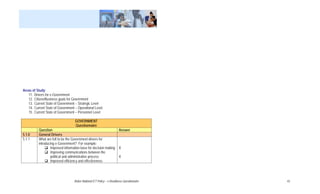
For the purposes of this assessment, Infrastructure e-Readiness will be examined across
eight areas:

Areas of Study:
   1. Access to Telecommunications
   2. Service and support
   3. Internet availability
   4. Hardware and software
   5. Information infrastructure
   6. Internet affordability
   7. Policy
   8. Community Access

                            INFRASTRUCTURE & SECURITY
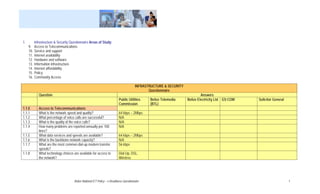
                                   Questionnaire
           Question                                                      Answer
1.1.0      Access to Telecommunications
1.1.1      What is the network speed and quality?
1.1.2      What percentage of voice calls are successful?
1.1.3      What is the quality of the voice calls?
1.1.4      How many problems are reported annually per 100
           lines?
1.1.5      What data services and speeds are available?
1.1.6      What is the backbone network capacity?


                                     Belize National ICT Policy – e-Readiness Assessment   10
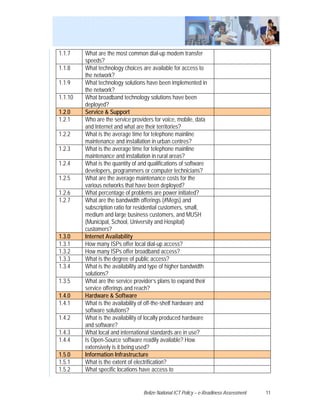
1.1.7    What are the most common dial-up modem transfer
         speeds?
1.1.8    What technology choices are available for access to
         the network?
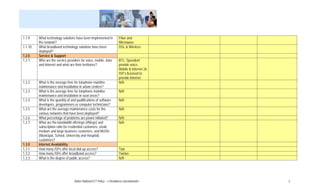
1.1.9    What technology solutions have been implemented in
         the network?
1.1.10   What broadband technology solutions have been
         deployed?
1.2.0    Service & Support
1.2.1    Who are the service providers for voice, mobile, data
         and Internet and what are their territories?
1.2.2    What is the average time for telephone mainline
         maintenance and installation in urban centres?
1.2.3    What is the average time for telephone mainline
         maintenance and installation in rural areas?
1.2.4    What is the quantity of and qualifications of software
         developers, programmers or computer technicians?
1.2.5    What are the average maintenance costs for the
         various networks that have been deployed?
1.2.6    What percentage of problems are power initiated?
1.2.7    What are the bandwidth offerings (#Megs) and
         subscription ratio for residential customers, small,
         medium and large business customers, and MUSH
         (Municipal, School, University and Hospital)
         customers?
1.3.0    Internet Availability
1.3.1    How many ISPs offer local dial-up access?
1.3.2    How many ISPs offer broadband access?
1.3.3    What is the degree of public access?
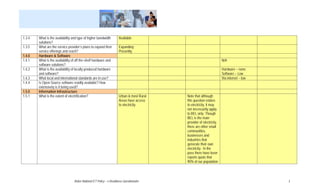
1.3.4    What is the availability and type of higher bandwidth
         solutions?
1.3.5    What are the service provider’s plans to expand their
         service offerings and reach?
1.4.0    Hardware & Software
1.4.1    What is the availability of off-the-shelf hardware and
         software solutions?
1.4.2    What is the availability of locally produced hardware
         and software?
1.4.3    What local and international standards are in use?
1.4.4    Is Open-Source software readily available? How
         extensively is it being used?
1.5.0    Information Infrastructure
1.5.1    What is the extent of electrification?
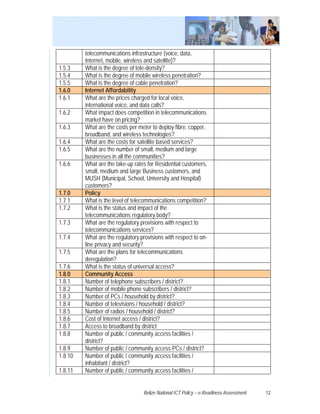
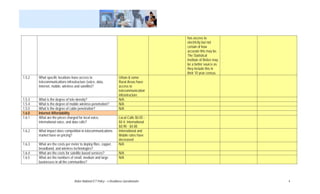
1.5.2    What specific locations have access to


                                  Belize National ICT Policy – e-Readiness Assessment   11
telecommunications infrastructure (voice, data,
         Internet, mobile, wireless and satellite)?
1.5.3    What is the degree of tele-density?
1.5.4    What is the degree of mobile wireless penetration?
1.5.5    What is the degree of cable penetration?
1.6.0    Internet Affordability
1.6.1    What are the prices charged for local voice,
         international voice, and data calls?
1.6.2    What impact does competition in telecommunications
         market have on pricing?
1.6.3    What are the costs per meter to deploy fibre, copper,
         broadband, and wireless technologies?
1.6.4    What are the costs for satellite based services?
1.6.5    What are the number of small, medium and large
         businesses in all the communities?
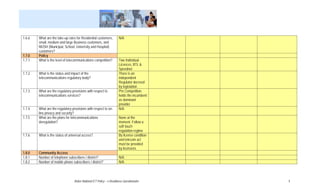
1.6.6    What are the take-up rates for Residential customers,
         small, medium and large Business customers, and
         MUSH (Municipal, School, University and Hospital)
         customers?
1.7.0    Policy
1.7.1    What is the level of telecommunications competition?
1.7.2    What is the status and impact of the
         telecommunications regulatory body?
1.7.3    What are the regulatory provisions with respect to
         telecommunications services?
1.7.4    What are the regulatory provisions with respect to on-
         line privacy and security?
1.7.5    What are the plans for telecommunications
         deregulation?
1.7.6    What is the status of universal access?
1.8.0    Community Access
1.8.1    Number of telephone subscribers / district?
1.8.2    Number of mobile phone subscribers / district?
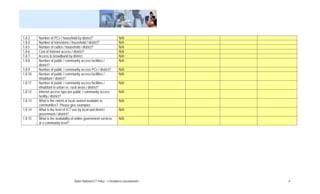
1.8.3    Number of PCs / household by district?
1.8.4    Number of televisions / household / district?
1.8.5    Number of radios / household / district?
1.8.6    Cost of Internet access / district?
1.8.7    Access to broadband by district
1.8.8    Number of public / community access facilities /
         district?
1.8.9    Number of public / community access PCs / district?
1.8.10   Number of public / community access facilities /
         inhabitant / district?
1.8.11   Number of public / community access facilities /


                                  Belize National ICT Policy – e-Readiness Assessment   12
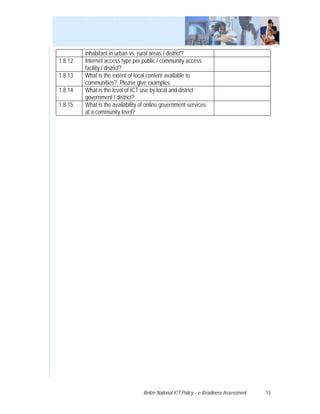
inhabitant in urban vs. rural areas / district?
1.8.12   Internet access type per public / community access
         facility / district?
1.8.13   What is the extent of local content available to
         communities? Please give examples.
1.8.14   What is the level of ICT use by local and district
         government / district?
1.8.15   What is the availability of online government services
         at a community level?


                                   Belize National ICT Policy – e-Readiness Assessment   13
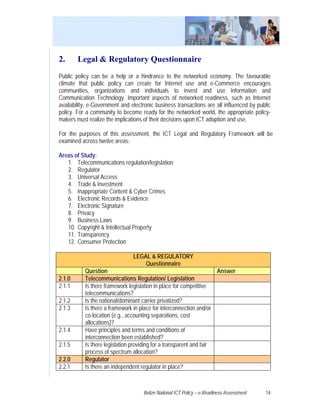
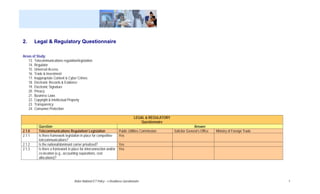
2.      Legal & Regulatory Questionnaire
Public policy can be a help or a hindrance to the networked economy. The favourable
climate that public policy can create for Internet use and e-Commerce encourages
communities, organizations and individuals to invest and use Information and
Communication Technology. Important aspects of networked readiness, such as Internet
availability, e-Government and electronic business transactions are all influenced by public
policy. For a community to become ready for the networked world, the appropriate policy-
makers must realize the implications of their decisions upon ICT adoption and use.

For the purposes of this assessment, the ICT Legal and Regulatory Framework will be
examined across twelve areas:

Areas of Study:
   1. Telecommunications regulation/legislation
   2. Regulator
   3. Universal Access
   4. Trade & Investment
   5. Inappropriate Content & Cyber Crimes
   6. Electronic Records & Evidence
   7. Electronic Signature
   8. Privacy
   9. Business Laws
   10. Copyright & Intellectual Property
   11. Transparency
   12. Consumer Protection

                                LEGAL & REGULATORY
                                    Questionnaire
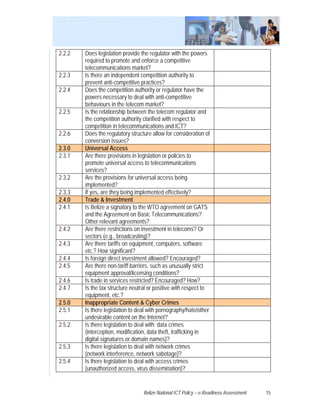
           Question                                                  Answer
2.1.0      Telecommunications Regulation/ Legislation
2.1.1      Is there framework legislation in place for competitive
           telecommunications?
2.1.2      Is the national/dominant carrier privatized?
2.1.3      Is there a framework in place for interconnection and/or
           co-location (e.g., accounting separations, cost
           allocations)?
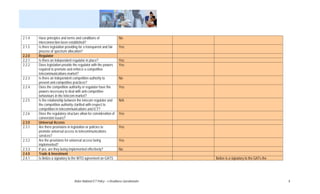
2.1.4      Have principles and terms and conditions of
           interconnection been established?
2.1.5      Is there legislation providing for a transparent and fair
           process of spectrum allocation?
2.2.0      Regulator
2.2.1      Is there an independent regulator in place?


                                    Belize National ICT Policy – e-Readiness Assessment   14
2.2.2   Does legislation provide the regulator with the powers
        required to promote and enforce a competitive
        telecommunications market?
2.2.3   Is there an independent competition authority to
        prevent anti-competitive practices?
2.2.4   Does the competition authority or regulator have the
        powers necessary to deal with anti-competitive
        behaviours in the telecom market?
2.2.5   Is the relationship between the telecom regulator and
        the competition authority clarified with respect to
        competition in telecommunications and ICT?
2.2.6   Does the regulatory structure allow for consideration of
        conversion issues?
2.3.0   Universal Access
2.3.1   Are there provisions in legislation or policies to
        promote universal access to telecommunications
        services?
2.3.2   Are the provisions for universal access being
        implemented?
2.3.3   If yes, are they being implemented effectively?
2.4.0   Trade & Investment
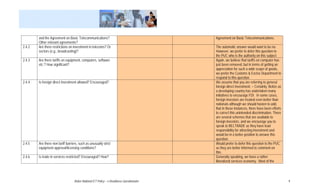
2.4.1   Is Belize a signatory to the WTO agreement on GATS
        and the Agreement on Basic Telecommunications?
        Other relevant agreements?
2.4.2   Are there restrictions on investment in telecoms? Or
        sectors (e.g., broadcasting)?
2.4.3   Are there tariffs on equipment, computers, software
        etc.? How significant?
2.4.4   Is foreign direct investment allowed? Encouraged?
2.4.5   Are there non-tariff barriers, such as unusually strict
        equipment approval/licensing conditions?
2.4.6   Is trade in services restricted? Encouraged? How?
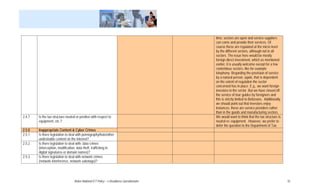
2.4.7   Is the tax structure neutral or positive with respect to
        equipment, etc.?
2.5.0   Inappropriate Content & Cyber Crimes
2.5.1   Is there legislation to deal with pornography/hate/other
        undesirable content on the Internet?
2.5.2   Is there legislation to deal with: data crimes
        (interception, modification, data theft, trafficking in
        digital signatures or domain names)?
2.5.3   Is there legislation to deal with network crimes
        (network interference, network sabotage)?
2.5.4   Is there legislation to deal with access crimes
        (unauthorized access, virus dissemination)?


                                  Belize National ICT Policy – e-Readiness Assessment   15
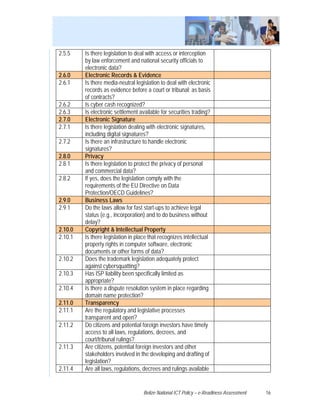
2.5.5    Is there legislation to deal with access or interception
         by law enforcement and national security officials to
         electronic data?
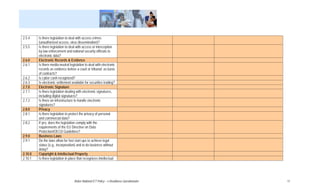
2.6.0    Electronic Records & Evidence
2.6.1    Is there media-neutral legislation to deal with electronic
         records as evidence before a court or tribunal; as basis
         of contracts?
2.6.2    Is cyber cash recognized?
2.6.3    Is electronic settlement available for securities trading?
2.7.0    Electronic Signature
2.7.1    Is there legislation dealing with electronic signatures,
         including digital signatures?
2.7.2    Is there an infrastructure to handle electronic
         signatures?
2.8.0    Privacy
2.8.1    Is there legislation to protect the privacy of personal
         and commercial data?
2.8.2    If yes, does the legislation comply with the
         requirements of the EU Directive on Data
         Protection/OECD Guidelines?
2.9.0    Business Laws
2.9.1    Do the laws allow for fast start-ups to achieve legal
         status (e.g., incorporation) and to do business without
         delay?
2.10.0   Copyright & Intellectual Property
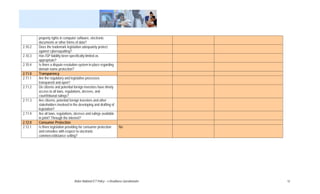
2.10.1   Is there legislation in place that recognizes intellectual
         property rights in computer software, electronic
         documents or other forms of data?
2.10.2   Does the trademark legislation adequately protect
         against cybersquatting?
2.10.3   Has ISP liability been specifically limited as
         appropriate?
2.10.4   Is there a dispute resolution system in place regarding
         domain name protection?
2.11.0   Transparency
2.11.1   Are the regulatory and legislative processes
         transparent and open?
2.11.2   Do citizens and potential foreign investors have timely
         access to all laws, regulations, decrees, and
         court/tribunal rulings?
2.11.3   Are citizens, potential foreign investors and other
         stakeholders involved in the developing and drafting of
         legislation?
2.11.4   Are all laws, regulations, decrees and rulings available


                                    Belize National ICT Policy – e-Readiness Assessment   16
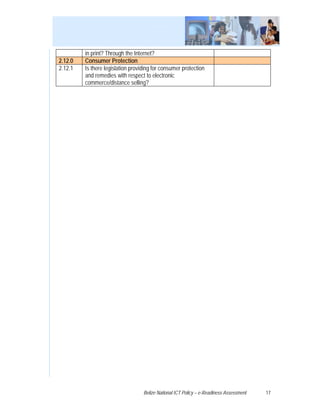
in print? Through the Internet?
2.12.0   Consumer Protection
2.12.1   Is there legislation providing for consumer protection
         and remedies with respect to electronic
         commerce/distance selling?


                                   Belize National ICT Policy – e-Readiness Assessment   17
3.       Human Development Questionnaire
Without an educated, ICT-savvy workforce, no community can fully participate in the digital
economy. To foster this resource, Information and Communications Technology must be
effectively incorporated into a country’s learning “system”. Unfortunately, even though the
effective use of ICTs in schools, educational institutions and adult training centres is one of
the most powerful catalysts for establishing a prominent position in the global information
society, it is an opportunity that is often squandered, misunderstood or underestimated.

The educational objectives of integrating computer, telecommunication and Internet
technologies into the learning environment requires complex decisions about curriculum,
training, financial, technical, and infrastructure requirements, plus active participation of
teachers, principals and government planners to determine the optimum set of programmes
for integrating ICTs into learning institutions, curriculum and professional training.

This section of the e-Readiness Questionnaire will help to identify the state of technologies
and programmes available to the educational sector (primary, secondary, colleges,
vocational schools and universities, non formal work-based) and build a national
understanding of the issues generally included in ICT policies for education and human
development.

For the purposes of this assessment, the Human Development e-Readiness will be examined
across three areas:

Areas of Study:
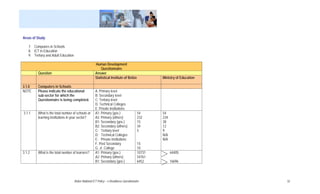
   1. Computers in Schools
   2. ICT in Education
   3. Tertiary and Adult Education

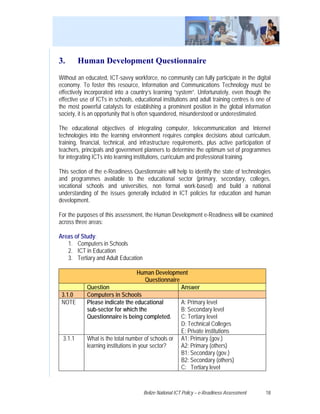
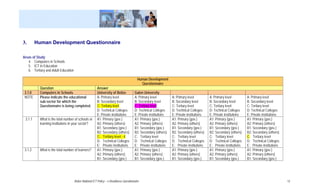
                                    Human Development
                                        Questionnaire
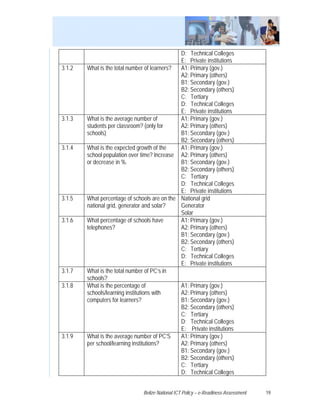
            Question                                  Answer
 3.1.0      Computers in Schools
 NOTE       Please indicate the educational           A: Primary level
            sub-sector for which the                  B: Secondary level
            Questionnaire is being completed.         C: Tertiary level
                                                      D: Technical Colleges
                                                      E: Private institutions
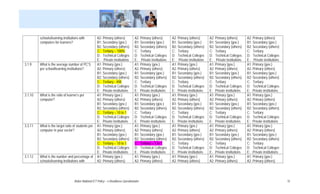
 3.1.1      What is the total number of schools or A1: Primary (gov.)
            learning institutions in your sector?     A2: Primary (others)
                                                      B1: Secondary (gov.)
                                                      B2: Secondary (others)
                                                      C: Tertiary level


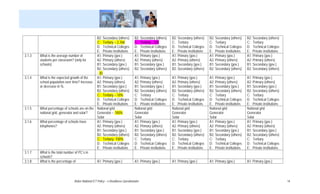
                                     Belize National ICT Policy – e-Readiness Assessment    18
D: Technical Colleges
                                              E: Private institutions
3.1.2   What is the total number of learners? A1: Primary (gov.)
                                              A2: Primary (others)
                                              B1: Secondary (gov.)
                                              B2: Secondary (others)
                                              C: Tertiary
                                              D: Technical Colleges
                                              E: Private institutions
3.1.3   What is the average number of         A1: Primary (gov.)
        students per classroom? (only for     A2: Primary (others)
        schools)                              B1: Secondary (gov.)
                                              B2: Secondary (others)
3.1.4   What is the expected growth of the    A1: Primary (gov.)
        school population over time? Increase A2: Primary (others)
        or decrease in %.                     B1: Secondary (gov.)
                                              B2: Secondary (others)
                                              C: Tertiary
                                              D: Technical Colleges
                                              E: Private institutions
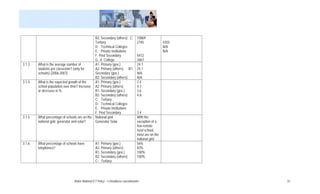
3.1.5   What percentage of schools are on the National grid
        national grid, generator and solar?   Generator
                                              Solar
3.1.6   What percentage of schools have       A1: Primary (gov.)
        telephones?                           A2: Primary (others)
                                              B1: Secondary (gov.)
                                              B2: Secondary (others)
                                              C: Tertiary
                                              D: Technical Colleges
                                              E: Private institutions
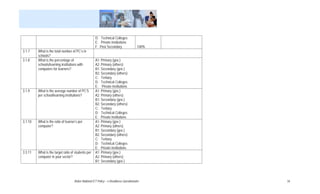
3.1.7   What is the total number of PC’s in
        schools?
3.1.8   What is the percentage of             A1: Primary (gov.)
        schools/learning institutions with    A2: Primary (others)
        computers for learners?               B1: Secondary (gov.)
                                              B2: Secondary (others)
                                              C: Tertiary
                                              D: Technical Colleges
                                              E: Private institutions
3.1.9   What is the average number of PC’S    A1: Primary (gov.)
        per school/learning institutions?     A2: Primary (others)
                                              B1: Secondary (gov.)
                                              B2: Secondary (others)
                                              C: Tertiary
                                              D: Technical Colleges


                               Belize National ICT Policy – e-Readiness Assessment   19
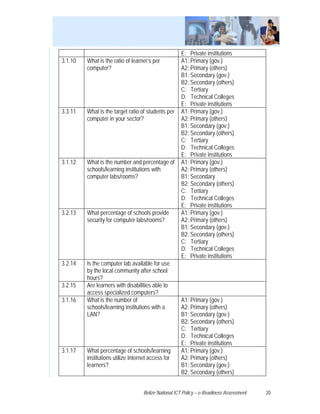
E: Private institutions
3.1.10   What is the ratio of learner’s per           A1: Primary (gov.)
         computer?                                    A2: Primary (others)
                                                      B1: Secondary (gov.)
                                                      B2: Secondary (others)
                                                      C: Tertiary
                                                      D: Technical Colleges
                                                      E: Private institutions
3.3.11   What is the target ratio of students per     A1: Primary (gov.)
         computer in your sector?                     A2: Primary (others)
                                                      B1: Secondary (gov.)
                                                      B2: Secondary (others)
                                                      C: Tertiary
                                                      D: Technical Colleges
                                                      E: Private institutions
3.1.12   What is the number and percentage of         A1: Primary (gov.)
         schools/learning institutions with           A2: Primary (others)
         computer labs/rooms?                         B1: Secondary
                                                      B2: Secondary (others)
                                                      C: Tertiary
                                                      D: Technical Colleges
                                                      E: Private institutions
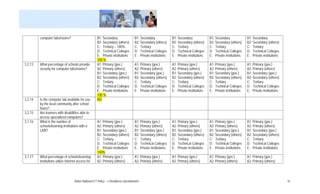
3.2.13   What percentage of schools provide           A1: Primary (gov.)
         security for computer labs/rooms?            A2: Primary (others)
                                                      B1: Secondary (gov.)
                                                      B2: Secondary (others)
                                                      C: Tertiary
                                                      D: Technical Colleges
                                                      E: Private institutions
3.2.14   Is the computer lab available for use
         by the local community after school
         hours?
3.2.15   Are learners with disabilities able to
         access specialized computers?
3.1.16   What is the number of                        A1: Primary (gov.)
         schools/learning institutions with a         A2: Primary (others)
         LAN?                                         B1: Secondary (gov.)
                                                      B2: Secondary (others)
                                                      C: Tertiary
                                                      D: Technical Colleges
                                                      E: Private institutions
3.1.17   What percentage of schools/learning          A1: Primary (gov.)
         institutions utilize Internet access for     A2: Primary (others)
         learners?                                    B1: Secondary (gov.)
                                                      B2: Secondary (others)


                                    Belize National ICT Policy – e-Readiness Assessment   20
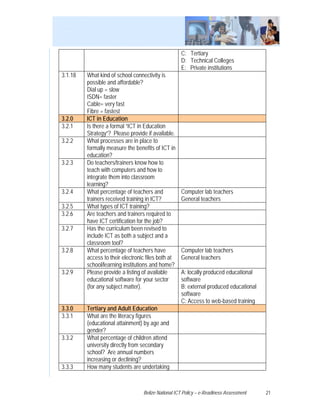
C: Tertiary
                                                    D: Technical Colleges
                                                    E: Private institutions
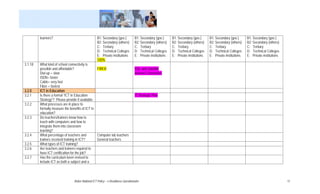
3.1.18   What kind of school connectivity is
         possible and affordable?
         Dial up = slow
         ISDN= faster
         Cable= very fast
         Fibre = fastest
3.2.0    ICT in Education
3.2.1    Is there a formal “ICT in Education
         Strategy”? Please provide if available.
3.2.2    What processes are in place to
         formally measure the benefits of ICT in
         education?
3.2.3    Do teachers/trainers know how to
         teach with computers and how to
         integrate them into classroom
         learning?
3.2.4    What percentage of teachers and            Computer lab teachers
         trainers received training in ICT?         General teachers
3.2.5    What types of ICT training?
3.2.6    Are teachers and trainers required to
         have ICT certification for the job?
3.2.7    Has the curriculum been revised to
         include ICT as both a subject and a
         classroom tool?
3.2.8    What percentage of teachers have           Computer lab teachers
         access to their electronic files both at   General teachers
         school/learning institutions and home?
3.2.9    Please provide a listing of available      A: locally produced educational
         educational software for your sector       software
         (for any subject matter).                  B: external produced educational
                                                    software
                                                    C: Access to web-based training
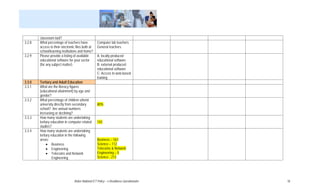
3.3.0    Tertiary and Adult Education
3.3.1    What are the literacy figures
         (educational attainment) by age and
         gender?
3.3.2    What percentage of children attend
         university directly from secondary
         school? Are annual numbers
         increasing or declining?
3.3.3    How many students are undertaking


                                  Belize National ICT Policy – e-Readiness Assessment   21
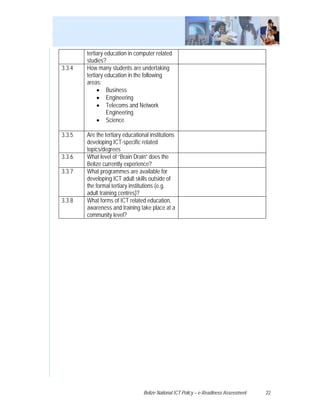
tertiary education in computer related
        studies?
3.3.4   How many students are undertaking
        tertiary education in the following
        areas:
             • Business
             • Engineering
             • Telecoms and Network
                  Engineering
             • Science

3.3.5   Are the tertiary educational institutions
        developing ICT-specific related
        topics/degrees
3.3.6   What level of “Brain Drain” does the
        Belize currently experience?
3.3.7   What programmes are available for
        developing ICT adult skills outside of
        the formal tertiary institutions (e.g.
        adult training centres)?
3.3.8   What forms of ICT related education,
        awareness and training take place at a
        community level?


                                  Belize National ICT Policy – e-Readiness Assessment   22
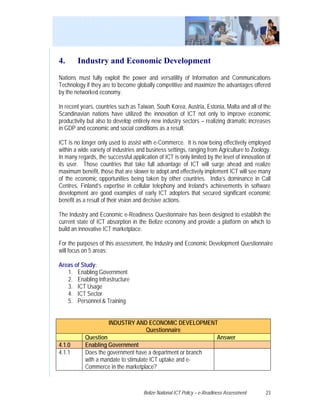
4.      Industry and Economic Development
Nations must fully exploit the power and versatility of Information and Communications
Technology if they are to become globally competitive and maximize the advantages offered
by the networked economy.

In recent years, countries such as Taiwan, South Korea, Austria, Estonia, Malta and all of the
Scandinavian nations have utilized the innovation of ICT not only to improve economic
productivity but also to develop entirely new industry sectors – realizing dramatic increases
in GDP and economic and social conditions as a result.

ICT is no longer only used to assist with e-Commerce. It is now being effectively employed
within a wide variety of industries and business settings, ranging from Agriculture to Zoology.
In many regards, the successful application of ICT is only limited by the level of innovation of
its user. Those countries that take full advantage of ICT will surge ahead and realize
maximum benefit, those that are slower to adopt and effectively implement ICT will see many
of the economic opportunities being taken by other countries. India’s dominance in Call
Centres, Finland’s expertise in cellular telephony and Ireland’s achievements in software
development are good examples of early ICT adopters that secured significant economic
benefit as a result of their vision and decisive actions.

The Industry and Economic e-Readiness Questionnaire has been designed to establish the
current state of ICT absorption in the Belize economy and provide a platform on which to
build an innovative ICT marketplace.

For the purposes of this assessment, the Industry and Economic Development Questionnaire
will focus on 5 areas:

Areas of Study:
   1. Enabling Government
   2. Enabling Infrastructure
   3. ICT Usage
   4. ICT Sector
   5. Personnel & Training


                     INDUSTRY AND ECONOMIC DEVELOPMENT
                                     Questionnaire
           Question                                        Answer
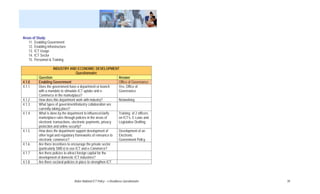
4.1.0      Enabling Government
4.1.1      Does the government have a department or branch
           with a mandate to stimulate ICT uptake and e-
           Commerce in the marketplace?


                                      Belize National ICT Policy – e-Readiness Assessment    23
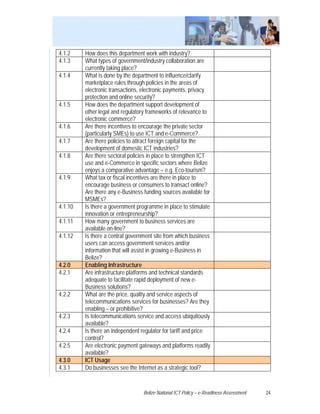
4.1.2    How does this department work with industry?
4.1.3    What types of government/industry collaboration are
         currently taking place?
4.1.4    What is done by the department to influence/clarify
         marketplace rules through policies in the areas of
         electronic transactions, electronic payments, privacy
         protection and online security?
4.1.5    How does the department support development of
         other legal and regulatory frameworks of relevance to
         electronic commerce?
4.1.6    Are there incentives to encourage the private sector
         (particularly SMEs) to use ICT and e-Commerce?
4.1.7    Are there policies to attract foreign capital for the
         development of domestic ICT industries?
4.1.8    Are there sectoral policies in place to strengthen ICT
         use and e-Commerce in specific sectors where Belize
         enjoys a comparative advantage – e.g. Eco-tourism?
4.1.9    What tax or fiscal incentives are there in place to
         encourage business or consumers to transact online?
         Are there any e-Business funding sources available for
         MSMEs?
4.1.10   Is there a government programme in place to stimulate
         innovation or entrepreneurship?
4.1.11   How many government to business services are
         available on-line?
4.1.12   Is there a central government site from which business
         users can access government services and/or
         information that will assist in growing e-Business in
         Belize?
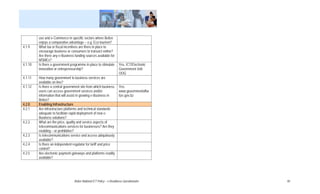
4.2.0    Enabling Infrastructure
4.2.1    Are infrastructure platforms and technical standards
         adequate to facilitate rapid deployment of new e-
         Business solutions?
4.2.2    What are the price, quality and service aspects of
         telecommunications services for businesses? Are they
         enabling – or prohibitive?
4.2.3    Is telecommunications service and access ubiquitously
         available?
4.2.4    Is there an independent regulator for tariff and price
         control?
4.2.5    Are electronic payment gateways and platforms readily
         available?
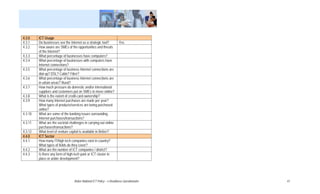
4.3.0    ICT Usage
4.3.1    Do businesses see the Internet as a strategic tool?


                                  Belize National ICT Policy – e-Readiness Assessment   24
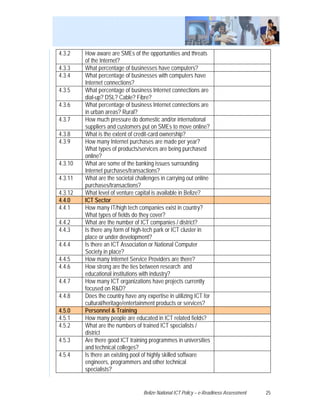
4.3.2    How aware are SMEs of the opportunities and threats
         of the Internet?
4.3.3    What percentage of businesses have computers?
4.3.4    What percentage of businesses with computers have
         Internet connections?
4.3.5    What percentage of business Internet connections are
         dial-up? DSL? Cable? Fibre?
4.3.6    What percentage of business Internet connections are
         in urban areas? Rural?
4.3.7    How much pressure do domestic and/or international
         suppliers and customers put on SMEs to move online?
4.3.8    What is the extent of credit-card ownership?
4.3.9    How many Internet purchases are made per year?
         What types of products/services are being purchased
         online?
4.3.10   What are some of the banking issues surrounding
         Internet purchases/transactions?
4.3.11   What are the societal challenges in carrying out online
         purchases/transactions?
4.3.12   What level of venture capital is available in Belize?
4.4.0    ICT Sector
4.4.1    How many IT/high tech companies exist in country?
         What types of fields do they cover?
4.4.2    What are the number of ICT companies / district?
4.4.3    Is there any form of high-tech park or ICT cluster in
         place or under development?
4.4.4    Is there an ICT Association or National Computer
         Society in place?
4.4.5    How many Internet Service Providers are there?
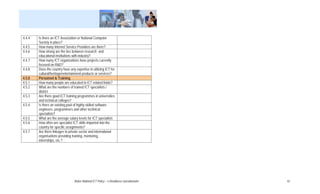
4.4.6    How strong are the ties between research and
         educational institutions with industry?
4.4.7    How many ICT organizations have projects currently
         focused on R&D?
4.4.8    Does the country have any expertise in utilizing ICT for
         cultural/heritage/entertainment products or services?
4.5.0    Personnel & Training
4.5.1    How many people are educated in ICT related fields?
4.5.2    What are the numbers of trained ICT specialists /
         district
4.5.3    Are there good ICT training programmes in universities
         and technical colleges?
4.5.4    Is there an existing pool of highly skilled software
         engineers, programmers and other technical
         specialists?


                                   Belize National ICT Policy – e-Readiness Assessment   25
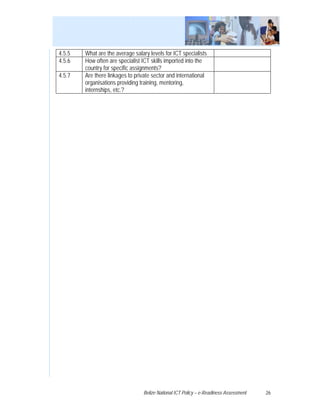
4.5.5   What are the average salary levels for ICT specialists
4.5.6   How often are specialist ICT skills imported into the
        country for specific assignments?
4.5.7   Are there linkages to private sector and international
        organisations providing training, mentoring,
        internships, etc.?


                                 Belize National ICT Policy – e-Readiness Assessment   26
5. e-Government Questionnaire
What is e-Government and Why is it Important?

e-Government is the application of Information and Communications Technology (ICT) within
public administration. e-Government can provide government, the citizen and business with
a set of tools that can potentially transform the way in which interactions take place. An
effective e-Government programme can improve the way in which public services are
delivered, knowledge is utilised, policy is developed and implemented, citizens participate in
governance, and public administration reform and good governance is met.

The strategic and well conceived use of ICTs in government result in a more inclusive,
effective, efficient, transparent, accountable and “people centred” public administration. It
can also serve as a vehicle for meeting the Millennium Development Goals across sectors
such as governance, economic development, health, education and the environment.


Why Measure e-Government Readiness?

It is recommended that any e-Government programme include an e-Readiness Assessment
as part of the initial planning process. An e-Readiness assessment will help determine
where Government is “starting from” and therefore identify what plans and actions are
required to achieve longer-term e-Government, and public sector reform goals.

It is important to understand that any e-Readiness Assessment captures “a moment in time”
and therefore has a relatively short shelf life before becoming out of date. Consequently, the
e-Readiness phase should be comprehensive, but not protracted, and used as a springboard
for the development of an action-oriented plan.

For the purposes of this assessment, the level e-Government in Belize will be examined
across five areas:

Areas of Study:
   1. Drivers for e-Government
   2. Citizen/Business goals for Government
   3. Current State of Government – Strategic Level
   4. Current State of Government – Operational Level
   5. Current State of Government – Personnel Level


                                     Belize National ICT Policy – e-Readiness Assessment   27
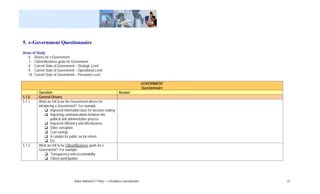
GOVERNMENT
                                  Questionnaire
        Question                                                      Answer
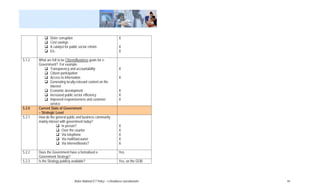
5.1.0   General Drivers
5.1.1   What are felt to be the Government drivers for
        introducing e-Government? For example:
                 Improved information base for decision making
                 Improving communications between the
                 political and administrative process
                 Improved efficiency and effectiveness
                 Deter corruption
                 Cost savings
                 A catalyst for public sector reform
                 Etc.
5.1.2   What are felt to be Citizen/Business goals for e-
        Government? For example:
                 Transparency and accountability
                 Citizen participation
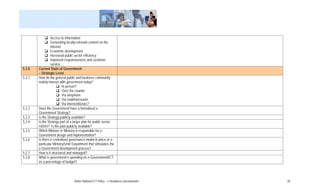
                 Access to Information
                 Generating locally-relevant content on the
                 Internet
                 Economic development
                 Increased public sector efficiency
                 Improved responsiveness and customer
                 service
5.2.0   Current State of Government
        – Strategic Level
5.2.1   How do the general public and business community
        mainly interact with government today?
                           In person?
                           Over the counter
                           Via telephone
                           Via mail/fax/courier
                           Via Internet/kiosks?
5.2.2   Does the Government have a formalised e-
        Government Strategy?
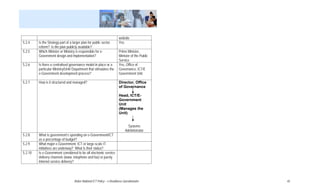
5.2.3   Is the Strategy publicly available?
5.2.4   Is the Strategy part of a larger plan for public sector
        reform? Is the plan publicly available?
5.2.5   Which Minister or Ministry is responsible for e-
        Government design and implementation?
5.2.6   Is there a centralised governance model in place or a
        particular Ministry/Unit/ Department that stimulates the


                                  Belize National ICT Policy – e-Readiness Assessment   28
e-Government development process?
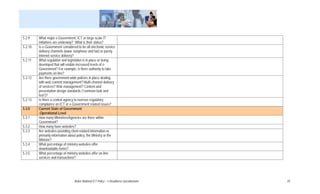
5.2.7    How is it structured and managed?
5.2.8    What is government’s spending on e-Government/ICT
         as a percentage of budget?
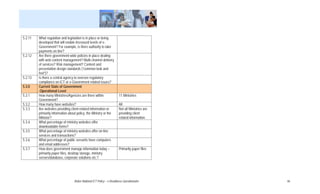
5.2.9    What major e-Government, ICT or large-scale IT
         initiatives are underway? What is their status?
5.2.10   Is e-Government considered to be all electronic service
         delivery channels (www. telephone and fax) or purely
         Internet service delivery?
5.2.11   What regulation and legislation is in place or being
         developed that will enable increased levels of e-
         Government? For example, is there authority to take
         payments on line?
5.2.12   Are there government-wide policies in place dealing
         with web content management? Multi-channel delivery
         of services? Risk management? Content and
         presentation design standards (“common look and
         feel”)?
5.2.13   Is there a central agency to oversee regulatory
         compliance on ICT or e-Government related issues?
5.3.0    Current State of Government
         -Operational Level
5.3.1    How many Ministries/Agencies are there within
         Government?
5.3.2    How many have websites?
5.3.3    Are websites providing client-related information or
         primarily information about policy, the Ministry or the
         Minister?
5.3.4    What percentage of ministry websites offer
         downloadable forms?
5.3.5    What percentage of ministry websites offer on-line
         services and transactions?
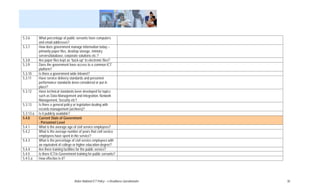
5.3.6    What percentage of public servants have computers
         and email addresses?
5.3.7    How does government manage information today –
         primarily paper files, desktop storage, ministry
         servers/database, corporate solutions etc.?
5.3.8    Are paper files kept as “back-up” to electronic files?
5.3.9    Does the government have access to a common ICT
         platform?
5.3.10   Is there a government wide Intranet?
5.3.11   Have service delivery standards and personnel
         performance standards been considered or put in
         place?


                                  Belize National ICT Policy – e-Readiness Assessment   29
5.3.12     Have technical standards been developed for topics
           such as Data Management and Integration, Network
           Management, Security etc?
5.3.13     Is there a general policy or legislation dealing with
           records management (archives)?
5.3.13.a   Is it publicly available?
5.4.0      Current State of Government
           - Personnel Level
5.4.1      What is the average age of civil service employees?
5.4.2      What is the average number of years that civil service
           employees have spent in the service?
5.4.3      What is the percentage of civil service employees with
           an equivalent of college or higher education degree?
5.4.4      Are there training facilities for the public service?
5.4.5      Is there ICT/e-Government training for public servants?
5.4.5.a    How effective is it?
5.4.6      Is there customer service training for public servants?
5.4.6.a    How effective is it?
5.4.7      Is there change management training for public
           servants?
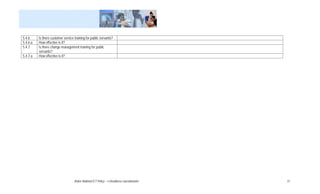
5.4.7.a    How effective is it?


                                    Belize National ICT Policy – e-Readiness Assessment   30
Appendix B


Completed e-Readiness Questionnaires


            Belize National ICT Policy – e-Readiness Assessment   31
MEMORANDUM
To:          Director, Office of Governance

From:        Solicitor General, Attorney General’s Ministry

Date:        22nd August, 2007


SUBJECT: NATIONAL E-READINESS ASSESSMENT FOR BELIZE


I refer to your letter (with questionnaire attached) dated May 18th, 2007,
Ref. GEN/13/10/07 regarding the matter at caption.

Kindly find attached answers to Sections 1.7, 2.3, 2.5 to 2.12 of the
National E-Readiness Assessment for Belize as per your request.

If you have any further enquiries regarding this matter, please do not
hesitate to contact this office.

The delay in submitting the completed sections is deeply regretted.


Yours sincerely,


PRICILLA J. BANNER
CROWN COUNSEL
FOR: SOLICITOR GENERAL


                              Belize National ICT Policy – e-Readiness Assessment   32
NATIONAL E-READINESS ASSESSMENT FOR
                     BELIZE
            e-Readiness Questionnaire


1.7   POLICY

1.7.1 What is the level of telecommunications competition?

      According to the 2001 Policy Framework that maps the
      future direction and developments of telecommunications in
      Belize (available at www.puc.bz), the main objectives
      following the expiration of the BTL monopoly licence on 29
      December, 2002 include allowing the phasing in of
      competition in the provision of all telecommunications
      services, providing for regulation to prevent anti-competitive
      practices, creating an environment that promotes and
      fosters investment and entrepreneurship, providing for the
      fulfillment of universal service obligations with funds raised
      through the use of competitively neutral and non-
      discriminatory methods, encouraging the introduction and
      use of innovative technologies especially in the achievement
      of universal access, assuring that consumers enjoy
      reasonable prices to ensure that the benefits of increased
      efficiency prompted by competition or improved technology
      are passed on to them in the form of lower prices or by the
      regulation of prices in markets where effective competition
      is lacking, facilitating the use of telecommunications to
      enhance education, health, national security and meet the
      needs of disabled persons, protecting consumers by ensuring
      quality of service, service standards and privacy of
      communications,       and    ensuring      that    international
      commitments, treatments or agreements are honoured. The
      Policy     Framework       states     that      ”provision    of
      telecommunication services will no longer be on an exclusive
      basis but will be done within an open and competitive
      framework”.       The Policy Framework indicates that
      competition “would be allowed in networks and services


                             Belize National ICT Policy – e-Readiness Assessment   33
including but not limited to…fixed wireline services
      including local, long distance and international calls;
      wireless services such as mobile cellular and radio paging;
      customer premises equipment importation, manufacture,
      distribution, installation and maintenance; and data
      communication, including internet.” Competition in these
      services would be opened on a gradual basis. Further,
      actions that may constitute anti-competitive behaviour are
      monitored by the Public Utilities Commission (“PUC”).
      Conduct by a service provider with dominant market power
      that takes advantage of that power with the effect or likely
      effect of substantially lessening competition in the market
      constitutes anti-competitive behaviour.       In the Policy
      Framework the PUC recommended the enacting of
      legislation such as a Competition Act since PUC utility
      regulations do not cover all aspects of anti-competitive
      practices. Currently, Belize has no Competition Act.

      The 2001 Policy Framework formed the basis from which the
      Belize Telecommunications Act was developed and enacted
      in 2002. The Belize Telecommunications Act allows for the
      development of the industry through competition. In 2002,
      post-monopoly, two individual licences were granted to
      Belize Telecommunications Limited and The International
      Telecommunications Limited. In 2003, a third individual
      licence was granted to Speednet Communications Limited.
      Over the period December 2002 to present, the PUC has
      granted over 20 Class Licences such as Internet Services,
      Reseller, Data Networks, and Private Domestic Network.
      Notable is that VoIP is also available to Belizeans.

1.7.2 What is the status and impact of the telecommunications regulatory
body?

      The telecommunications regulatory body, the PUC, is
      governed by the Public Utilities Commission Act, Cap.223 of
      the Substantive Laws of Belize R.E. 2003 and is a body
      corporate with perpetual succession and a common seal.
      The PUC is an autonomous institution and the 7
      Commissioners are appointed by the Governor General
      acting on the advice of the Prime Minister given after
      consultation with the Leader of the Opposition.        The
      Commissioners are appointed for a period not exceeding six


                             Belize National ICT Policy – e-Readiness Assessment   34
years. The telecommunications regulatory body is active in
      developing competition in the telecommunications industry.
      However, it is expected that its impact would be felt to a
      greater degree with the introduction of Competition
      legislation.


1.7.3 What   are    the   regulatory         provisions        with       respect   to
      telecommunications services?

      The PUC under section 2 (c) of the Belize
      Telecommunications Act, 2002, is charged with the
      promotion of fair competition and efficient market conduct
      within the telecommunications industry. The PUC is of the
      view that consistent with the regulatory framework as
      established under governing legislation, market forces
      should     determine    the    price   levels for   certain
      telecommunications services. The PUC can intervene as
      provided for in Section 26 of the Telecommunications Act if,
      for example, the PUC detects anti-competitive pricing and
      acts of unfair competition. Furthermore, the PUC can also
      review rates to assess if they are fair and reasonable
      through the complaint process established in the Public
      Utilities Commission Act.


1.7.4 What are the regulatory provisions with respect to online privacy and
      security?

      Currently there exist no regulatory provisions and no data
      protection or privacy legislation as it relates to online
      privacy and security.

1.7.5 What are the plans for telecommunications deregulation?

      In the present telecommunications environment, the PUC
      intends to regulate new and converging technologies “in the
      most optimum manner to maximize the benefits to the
      country” but "as the market becomes effectively competitive
      and the interests of users are met appropriately, the PUC
      may forbear from imposing regulatory obligations when, and
      as they are no longer justified”.


                             Belize National ICT Policy – e-Readiness Assessment    35
1.7.6 What is the status of universal access?

      In its 2001 Framework Policy, the Government of Belize and
      the Public Utilities Commission saw as the objective for
      universal service “to provide all Belizeans, regardless of
      where they reside, with reasonable access to basic
      telecommunications services, payphones and community
      telephones with due regard for cost, benefits and national
      priorities”. It was noted in the Framework Policy that “the
      new universal service obligation (USO) regime will also have
      to address the needs of people with disabilities by requiring
      the supply of prescribed services and equipment that are
      designed or adapted to meet the reasonable demands of
      disabled persons in Belize.” Universal service therefore
      entails assured access to all existing users, provision of
      access to the national telephone to all potential users, and
      provision of service on standard terms and conditions and at
      affordable rates. In order to relieve any single operator from
      having to bear the full cost of providing such service, the
      PUC noted that it would recommend that all licensed service
      providers contribute towards USO costs in direct proportion
      to their share of total “eligible revenue”. While funding
      would be the preferred method, the PUC noted that it
      reserved the right to use other methods of providing
      universal service including making it a condition of the
      licence given to the service provider. Section 34 of the
      Telecommunications Act, “Universal Access Fund,” provides
      that: “(1) The PUC may establish a fund into which providers
      of telecommunications services (public and private) shall
      pay any fees the PUC may prescribe as universal access
      development fees; (2) The PUC may impose, as a condition
      of the grant of a licence, any obligations with regard to the
      provision of universal service to the widest users including
      those with disabilities or in a specified area or region, to the
      extent technically feasible and economically reasonable; (3)
      A licensee who, under this Act, is required to provide
      universal service shall be entitled to compensation in
      relation to the actual costs incurred in meeting that
      obligation.”

      Currently provisions dealing with universal access are being
      included in the licences for service providers in the following
      terms:


                              Belize National ICT Policy – e-Readiness Assessment   36
“2.1 - The Licensee shall provide to every Person who
      requests the provision of such services at any place within
      the Licensees Service Area (normally the entire country),
      including rural areas (a) Two-way voice telephony services;
      and (b) Other Telecommunications services as determined
      by the PUC consistent with Universal Access Obligations;
      except where the PUC has made a determination that the
      services set out in 2.1(a) and 2.1(b) shall be implemented
      and financed under the Universal Access Fund and as such
      this obligation is removed from the Licensee. The Licensee
      shall ensure that its systems are installed, kept installed and
      run for those purposes.”
      “2.2 – The Licensee shall comply with the provisions in the
      Act and any Regulations, Orders or Directives made
      thereunder by the PUC relating to universal service
      obligations and the Licensee shall pay promptly any fees or
      other levies assessed by the PUC and payable to the
      Universal Access Fund.”
      “2.3 – The Licensee shall file with the PUC and update on a
      quarterly basis (i) the number and location of Community
      Telephones and Public Payphones currently installed; (ii) the
      procedures in place for the operation and management of
      these Community Telephones and Public Payphones.”
      “2.4 – The PUC, after review and consultation with the
      Licensee, may cause amendments to the procedures
      described in condition 2.3.”
      “2.5 – The Licensee cannot terminate services provided to a
      Community by a Public and Community Telephone without
      prior approval from the PUC.”

2.3.0 UNIVERSAL ACCESS:
2.3.1 Are there provisions in legislation or policies to promote universal
      access to telecommunications services?

      Yes.     The Telecommunications Act, Cap. 229 of the
      Substantive Laws of Belize, R.E. 2003 makes provision for
      Universal Service (Section 33) and for the establishment of a
      Universal Access Fund (Section 34). Under Section 16 of the
      Telecommunications Act, in granting a license, the Public
      Utilities Commission may among other relevant factors, have
      regard to, “the extent of technical feasibility and economic
      reasonableness, and the promotion of universal access
      throughout Belize”. Section 33 of the Telecommunications


                               Belize National ICT Policy – e-Readiness Assessment   37
Act provides: “(1) The PUC shall develop annual objectives
      for services to be provided with the purpose of ensuring that
      the public telecommunication service, in particular basic
      telephone service, is accessible to the widest number of
      users; (2) The PUC shall determine the public
      telecommunications services in respect of which the
      requirement of universal service shall apply taking into
      account the needs of the public, affordability of the service
      and advances in technology; (3) The PUC shall develop the
      regulations and any conditions for the provision of public
      telecommunications services with respect to universal
      service obligation.” Section 34 of the Telecommunications
      Act “Universal Access Fund” provides that: “(1) The PUC may
      establish a fund into which providers of telecommunications
      services (public and private) shall pay any fees the PUC may
      prescribe as universal access development fees; (2) The PUC
      may impose, as a condition of the grant of a licence, any
      obligations with regard to the provision of universal service
      to the widest users including those with disabilities or in a
      specified area or region, to the extent technically feasible
      and economically reasonable; (3) A licensee who, under this
      Act, is required to provide universal service shall be entitled
      to compensation in relation to the actual costs incurred in
      meeting that obligation.”         Further, under Statutory
      Instrument No. 110, “Telecommunications (Licensing
      Classification, Authorisation and Fee Structure) Regulations,
      section 9 provides that “where a person applying under the
      Act for a licence is required to make a contribution to the
      Universal Access Fund such person shall pay such
      contributions as prescribed in Regulations made by the PUC
      governing Universal Service Obligations.”

2.3.2 Are the provisions for universal access being implemented?

      No. The provisions for universal access are in the process of
      being implemented by the Public Utilities Commission.

2.3.3 If yes to 2.3.2, are they being implemented effectively?

      Not applicable.

2.5.0 INAPPROPRIATE CONTENT AND CYBER CRIMES


                              Belize National ICT Policy – e-Readiness Assessment   38
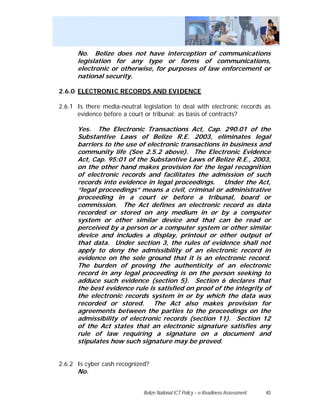
2.5.1 Is there legislation to deal with pornography/hate/other undesirable
      content on the Internet?

      No. Currently Belize does not have any legislation dealing
      with Cyber Crime or crimes committed through the use of
      the internet.

2.5.2 Is there legislation to deal with: data crimes (interception,
      modification, data theft, trafficking in digital signatures or domain
      names)?

      No. Currently Belize has no Data Protection legislation nor
      does it have specific legislation criminalizing corruption or
      tampering of digital signatures or domain names or
      fraudulent activities concerned therewith.         Belize does
      however have the Electronic Transactions Act which
      facilitates electronic transactions in order to eliminate legal
      barriers to the effective use of electronic communications in
      transactions; promotes the harmonization of legal rules on
      electronic transactions across national boundaries;
      facilitates the appropriate use of electronic transactions;
      promotes business and community confidence in electronic
      transactions; and enables business and community to use
      electronic communications in their transactions with
      Government. While the Act makes provision for the use of
      electronic signatures, it does not likewise criminalize
      improper use or theft of a person’s e-signature by others.

2.5.3 Is there legislation to deal with              network       crimes      (network
      interference, network sabotage)?

      No. Belize does not have enacted any legislation dealing
      with computer misuse as it relates to the interference with
      or the sabotage of computer networks.

2.5.4 Is there legislation to deal with access crimes (unauthorized access,
      virus dissemination)?

      No. Belize does not have any cyber crime legislation.

2.5.5 Is there legislation to deal with access or interception by law
      enforcement and national security officials to electronic data?


                             Belize National ICT Policy – e-Readiness Assessment     39
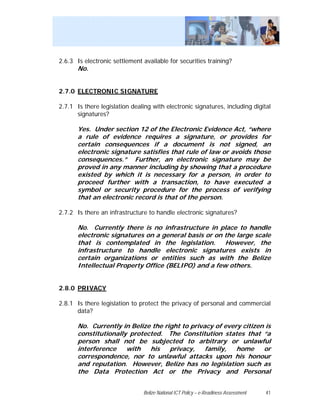
No. Belize does not have interception of communications
      legislation for any type or forms of communications,
      electronic or otherwise, for purposes of law enforcement or
      national security.

2.6.0 ELECTRONIC RECORDS AND EVIDENCE

2.6.1 Is there media-neutral legislation to deal with electronic records as
      evidence before a court or tribunal; as basis of contracts?

      Yes. The Electronic Transactions Act, Cap. 290.01 of the
      Substantive Laws of Belize R.E. 2003, eliminates legal
      barriers to the use of electronic transactions in business and
      community life (See 2.5.2 above). The Electronic Evidence
      Act, Cap. 95:01 of the Substantive Laws of Belize R.E., 2003,
      on the other hand makes provision for the legal recognition
      of electronic records and facilitates the admission of such
      records into evidence in legal proceedings. Under the Act,
      “legal proceedings” means a civil, criminal or administrative
      proceeding in a court or before a tribunal, board or
      commission. The Act defines an electronic record as data
      recorded or stored on any medium in or by a computer
      system or other similar device and that can be read or
      perceived by a person or a computer system or other similar
      device and includes a display, printout or other output of
      that data. Under section 3, the rules of evidence shall not
      apply to deny the admissibility of an electronic record in
      evidence on the sole ground that it is an electronic record.
      The burden of proving the authenticity of an electronic
      record in any legal proceeding is on the person seeking to
      adduce such evidence (section 5). Section 6 declares that
      the best evidence rule is satisfied on proof of the integrity of
      the electronic records system in or by which the data was
      recorded or stored. The Act also makes provision for
      agreements between the parties to the proceedings on the
      admissibility of electronic records (section 11). Section 12
      of the Act states that an electronic signature satisfies any
      rule of law requiring a signature on a document and
      stipulates how such signature may be proved.


2.6.2 Is cyber cash recognized?
      No.


                              Belize National ICT Policy – e-Readiness Assessment   40
2.6.3 Is electronic settlement available for securities training?
       No.


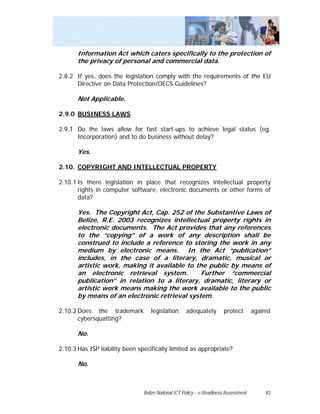
2.7.0 ELECTRONIC SIGNATURE

2.7.1 Is there legislation dealing with electronic signatures, including digital
      signatures?

       Yes. Under section 12 of the Electronic Evidence Act, “where
       a rule of evidence requires a signature, or provides for
       certain consequences if a document is not signed, an
       electronic signature satisfies that rule of law or avoids those
       consequences.” Further, an electronic signature may be
       proved in any manner including by showing that a procedure
       existed by which it is necessary for a person, in order to
       proceed further with a transaction, to have executed a
       symbol or security procedure for the process of verifying
       that an electronic record is that of the person.

2.7.2 Is there an infrastructure to handle electronic signatures?

       No. Currently there is no infrastructure in place to handle
       electronic signatures on a general basis or on the large scale
       that is contemplated in the legislation.       However, the
       infrastructure to handle electronic signatures exists in
       certain organizations or entities such as with the Belize
       Intellectual Property Office (BELIPO) and a few others.


2.8.0 PRIVACY

2.8.1 Is there legislation to protect the privacy of personal and commercial
      data?

       No. Currently in Belize the right to privacy of every citizen is
       constitutionally protected. The Constitution states that “a
       person shall not be subjected to arbitrary or unlawful
       interference    with   his    privacy,    family,   home     or
       correspondence, nor to unlawful attacks upon his honour
       and reputation. However, Belize has no legislation such as
       the Data Protection Act or the Privacy and Personal


                               Belize National ICT Policy – e-Readiness Assessment   41
Information Act which caters specifically to the protection of
       the privacy of personal and commercial data.

2.8.2 If yes, does the legislation comply with the requirements of the EU
      Directive on Data Protection/OECS Guidelines?

       Not Applicable.

2.9.0 BUSINESS LAWS

2.9.1 Do the laws allow for fast start-ups to achieve legal status (eg.
      Incorporation) and to do business without delay?

       Yes.

2.10. COPYRIGHT AND INTELLECTUAL PROPERTY

2.10.1 Is there legislation in place that recognizes intellectual property
       rights in computer software, electronic documents or other forms of
       data?

       Yes. The Copyright Act, Cap. 252 of the Substantive Laws of
       Belize, R.E. 2003 recognizes intellectual property rights in
       electronic documents. The Act provides that any references
       to the “copying” of a work of any description shall be
       construed to include a reference to storing the work in any
       medium by electronic means. In the Act “publication”
       includes, in the case of a literary, dramatic, musical or
       artistic work, making it available to the public by means of
       an electronic retrieval system.         Further “commercial
       publication” in relation to a literary, dramatic, literary or
       artistic work means making the work available to the public
       by means of an electronic retrieval system.

2.10.2 Does the trademark          legislation       adequately        protect        against
       cybersquatting?

       No.

2.10.3 Has ISP liability been specifically limited as appropriate?

       No.


                                Belize National ICT Policy – e-Readiness Assessment        42
2.10.4 Is there a dispute resolution system in place regarding domain name
       protection?

         No.

2.11.0         TRANSPARENCY
2.11.1         Are the regulatory and legislative processes transparent and
open?

               Yes.

2.11.2         Do citizens and potential foreign investors have timely access
               to all laws, regulations, decrees, and court/tribunal rulings?

               Yes. All laws, regulations, decrees and court rulings
               are available at the Supreme Court library for easy
               access by the public as well as on the websites for the
               various organizations or entities which are regulated,
               governed or affected by a specific law, regulation,
               decree or court ruling. Information relating to laws,
               regulations and court rulings may also be found on the
               website of the Attorney General’s Ministry at
               www.belizelaw.org.

2.11.3         Are citizens, potential foreign investors and other stakeholders
               involved in the developing and drafting of legislation?

               Yes. The legislative process is participatory in nature.
               Stakeholders are involved to a great extent in the
               drafting of legislation and such legislation is further
               brought to the attention of citizens as well as foreign
               investors and stakeholders when Bills are tabled
               before the House of Representatives. Following this
               tabling there is normally robust debate and interaction
               with citizens and consequent amendments being made
               as a result of the interaction.

2.11.4         Are all laws, regulations, decrees and rulings available in
               print? Through the internet?

               All laws, regulations, decrees and rulings are available
               in print at the Supreme Court Library. Most of this
               information is also available on the internet at


                                Belize National ICT Policy – e-Readiness Assessment   43
www.belizelaw.org.       The last                 update         of   the
         information took place in 2006.

2.12.0   CONSUMER PROTECTION
2.12.1   Is there legislation providing for consumer protection and
         remedies with respect to electronic commerce/distance
         selling?

         Yes. Section 24 of the Electronic Transactions Act,
         Cap. 290:01 makes provision for consumer protection
         in electronic commerce by ensuring that consumers
         have certain contact information of providers of goods
         or services.     Section 24 protects consumers by
         requiring e-commerce providers to provide certain
         information:      “(1) A person using electronic
         communications to sell goods or services to consumers
         shall provide accurate, clear and accessible
         information about themselves sufficient to allow (a)
         the legal name of the person, its principal geographic
         address, and an electronic means of contact and
         telephone number; (b) prompt, easy and effective
         consumer communication with the seller; (c) service of
         legal process; (2) A person using electronic
         communications to sell goods or services to consumers
         shall provide accurate and accessible information
         describing the goods or services offered, sufficient to
         enable consumers to make an informed decision about
         the proposed transaction and to maintain an accurate
         record of the information; (3) A person using
         electronic communications to sell goods and services
         to consumers shall provide information about the
         terms, conditions and costs associated with a
         transaction, and notably: (a) terms, conditions and
         methods of payment, (b) details of and conditions
         related to withdrawal, termination, return, exchange,
         cancellation and refund policy information.” Notable is
         that it is felt that the issue of consumer protection
         should be dealt with in the context of modernised
         consumer legislation, eg. legislation that deals with
         unfair terms in electronic contracts, unfair business
         practices and modern warranties.


                        Belize National ICT Policy – e-Readiness Assessment     44
1.         Infrastructure & Security Questionnaire Areas of Study:
     9.    Access to Telecommunications
     10.   Service and support
     11.   Internet availability
     12.   Hardware and software
     13.   Information infrastructure
     14.   Internet affordability
     15.   Policy
     16.   Community Access

                                                                                         INFRASTRUCTURE & SECURITY
                                                                                                Questionnaire
              Question                                                                                                        Answers
                                                                            Public Utilities    Belize Telemedia     Belize Electricity Ltd GS-COM   Solicitor General
                                                                            Commission          (BTL)
1.1.0         Access to Telecommunications
1.1.1         What is the network speed and quality?                        64 kbps – 2Mbps
1.1.2         What percentage of voice calls are successful?                N/A
1.1.3         What is the quality of the voice calls?                       N/A
1.1.4         How many problems are reported annually per 100               N/A
              lines?
1.1.5         What data services and speeds are available?                  64 kbps – 2Mbps
1.1.6         What is the backbone network capacity?                        N/A
1.1.7         What are the most common dial-up modem transfer               56 kbps
              speeds?
1.1.8         What technology choices are available for access to           Dial-Up, DSL,
              the network?                                                  Wireless


                                       Belize National ICT Policy – e-Readiness Questionnaire                                                                            1
1.1.9    What technology solutions have been implemented in             Fiber and
         the network?                                                   Microwave
1.1.10   What broadband technology solutions have been                  DSL & Wireless
         deployed?
1.2.0    Service & Support
1.2.1    Who are the service providers for voice, mobile, data          BTL, Speednet
         and Internet and what are their territories?                   provide voice,
                                                                        Mobile & Internet 26
                                                                        ISP’s licensed to
                                                                        provide Internet
1.2.2    What is the average time for telephone mainline                N/A
         maintenance and installation in urban centres?
1.2.3    What is the average time for telephone mainline                N/A
         maintenance and installation in rural areas?
1.2.4    What is the quantity of and qualifications of software         N/A
         developers, programmers or computer technicians?
1.2.5    What are the average maintenance costs for the                 N/A
         various networks that have been deployed?
1.2.6    What percentage of problems are power initiated?               N/A
1.2.7    What are the bandwidth offerings (#Megs) and                   N/A
         subscription ratio for residential customers, small,
         medium and large business customers, and MUSH
         (Municipal, School, University and Hospital)
         customers?
1.3.0    Internet Availability
1.3.1    How many ISPs offer local dial-up access?                      Two
1.3.2    How many ISPs offer broadband access?                          Twelve
1.3.3    What is the degree of public access?                           N/A


                                   Belize National ICT Policy – e-Readiness Questionnaire      2
1.3.4   What is the availability and type of higher bandwidth          Available
        solutions?
1.3.5   What are the service provider’s plans to expand their          Expanding
        service offerings and reach?                                   Presently
1.4.0   Hardware & Software
1.4.1   What is the availability of off-the-shelf hardware and                                                         N/A
        software solutions?
1.4.2   What is the availability of locally produced hardware                                                          Hardware – none
        and software?                                                                                                  Software – Low
1.4.3   What local and international standards are in use?                                                             Via internet – low
1.4.4   Is Open-Source software readily available? How
        extensively is it being used?
1.5.0   Information Infrastructure
1.5.1   What is the extent of electrification?                         Urban & most Rural   Note that although
                                                                       Areas have access    this question relates
                                                                       to electricity       to electricity, it may
                                                                                            not necessarily apply
                                                                                            to BEL only. Though
                                                                                            BEL is the main
                                                                                            provider of electricity,
                                                                                            there are other small
                                                                                            communities,
                                                                                            businesses and
                                                                                            industries that
                                                                                            generate their own
                                                                                            electricity. In the
                                                                                            pass there have been
                                                                                            reports quote that
                                                                                            90% of our population


                                  Belize National ICT Policy – e-Readiness Questionnaire                                                    3
has access to
                                                                                            electricity but not
                                                                                            certain of how
                                                                                            accurate this may be.
                                                                                            The Statistical
                                                                                            Institute of Belize may
                                                                                            be a better source as
                                                                                            they include this in
                                                                                            their 10 year census.
1.5.2   What specific locations have access to                        Urban & some
        telecommunications infrastructure (voice, data,               Rural Areas have
        Internet, mobile, wireless and satellite)?                    access to
                                                                      telecommunication
                                                                      infrastructure
1.5.3   What is the degree of tele-density?                           N/A
1.5.4   What is the degree of mobile wireless penetration?            N/A
1.5.5   What is the degree of cable penetration?                      N/A
1.6.0   Internet Affordability
1.6.1   What are the prices charged for local voice,                  Local Calls $0.05 -
        international voice, and data calls?                          $0.4, International
                                                                      $0.90 - $4.00
1.6.2   What impact does competition in telecommunications            International and
        market have on pricing?                                       Mobile rates have
                                                                      decreased
1.6.3   What are the costs per meter to deploy fibre, copper,         N/A
        broadband, and wireless technologies?
1.6.4   What are the costs for satellite based services?              N/A
1.6.5   What are the numbers of small, medium and large               N/A
        businesses in all the communities?


                                 Belize National ICT Policy – e-Readiness Questionnaire                               4
1.6.6   What are the take-up rates for Residential customers,         N/A
        small, medium and large Business customers, and
        MUSH (Municipal, School, University and Hospital)
        customers?
1.7.0   Policy
1.7.1   What is the level of telecommunications competition?          Two Individual
                                                                      Licences, BTL &
                                                                      Speednet
1.7.2   What is the status and impact of the                          There is an
        telecommunications regulatory body?                           independent
                                                                      Regulator decreed
                                                                      by legislation
1.7.3   What are the regulatory provisions with respect to            Pro Competition,
        telecommunications services?                                  holds the incumbent
                                                                      as dominant
                                                                      provider
1.7.4   What are the regulatory provisions with respect to on-        N/A
        line privacy and security?
1.7.5   What are the plans for telecommunications                     None at the
        deregulation?                                                 moment. Follow a
                                                                      soft touch
                                                                      regulation regime
1.7.6   What is the status of universal access?                       By license condition
                                                                      and telecom act
                                                                      must be provided
                                                                      by licensees
1.8.0   Community Access
1.8.1   Number of telephone subscribers / district?                   N/A
1.8.2   Number of mobile phone subscribers / district?                N/A


                                 Belize National ICT Policy – e-Readiness Questionnaire      5
1.8.3    Number of PCs / household by district?                         N/A
1.8.4    Number of televisions / household / district?                  N/A
1.8.5    Number of radios / household / district?                       N/A
1.8.6    Cost of Internet access / district?                            N/A
1.8.7    Access to broadband by district                                N/A
1.8.8    Number of public / community access facilities /               N/A
         district?
1.8.9    Number of public / community access PCs / district?            N/A
1.8.10   Number of public / community access facilities /               N/A
         inhabitant / district?
1.8.11   Number of public / community access facilities /               N/A
         inhabitant in urban vs. rural areas / district?
1.8.12   Internet access type per public / community access             N/A
         facility / district?
1.8.13   What is the extent of local content available to               N/A
         communities? Please give examples.
1.8.14   What is the level of ICT use by local and district             N/A
         government / district?
1.8.15   What is the availability of online government services         N/A
         at a community level?


                                   Belize National ICT Policy – e-Readiness Questionnaire   6
2.      Legal & Regulatory Questionnaire

Areas of Study:
   13. Telecommunications regulation/legislation
   14. Regulator
   15. Universal Access
   16. Trade & Investment
   17. Inappropriate Content & Cyber Crimes
   18. Electronic Records & Evidence
   19. Electronic Signature
   20. Privacy
   21. Business Laws
   22. Copyright & Intellectual Property
   23. Transparency
   24. Consumer Protection

                                                                                     LEGAL & REGULATORY
                                                                                         Questionnaire
           Question                                                                                                      Answer
2.1.0      Telecommunications Regulation/ Legislation                    Public Utilities Commission      Solicitor General’s Office   Ministry of Foreign Trade
2.1.1      Is there framework legislation in place for competitive       Yes
           telecommunications?
2.1.2      Is the national/dominant carrier privatized?                  Yes
2.1.3      Is there a framework in place for interconnection and/or      Yes
           co-location (e.g., accounting separations, cost
           allocations)?


                                    Belize National ICT Policy – e-Readiness Questionnaire                                                                         7
2.1.4   Have principles and terms and conditions of                    No
        interconnection been established?
2.1.5   Is there legislation providing for a transparent and fair      Yes
        process of spectrum allocation?
2.2.0   Regulator
2.2.1   Is there an independent regulator in place?                    Yes
2.2.2   Does legislation provide the regulator with the powers         Yes
        required to promote and enforce a competitive
        telecommunications market?
2.2.3   Is there an independent competition authority to               No
        prevent anti-competitive practices?
2.2.4   Does the competition authority or regulator have the           Yes
        powers necessary to deal with anti-competitive
        behaviours in the telecom market?
2.2.5   Is the relationship between the telecom regulator and          N/A
        the competition authority clarified with respect to
        competition in telecommunications and ICT?
2.2.6   Does the regulatory structure allow for consideration of       Yes
        conversion issues?
2.3.0   Universal Access
2.3.1   Are there provisions in legislation or policies to             Yes
        promote universal access to telecommunications
        services?
2.3.2   Are the provisions for universal access being                  Yes
        implemented?
2.3.3   If yes, are they being implemented effectively?                No
2.4.0   Trade & Investment
2.4.1   Is Belize a signatory to the WTO agreement on GATS                                 Belize is a signatory to the GATs the


                                  Belize National ICT Policy – e-Readiness Questionnaire                                           8
and the Agreement on Basic Telecommunications?                                      Agreement on Basic Telecommunications.
        Other relevant agreements?
2.4.2   Are there restrictions on investment in telecoms? Or                                The automatic answer would want to be no.
        sectors (e.g., broadcasting)?                                                       However, we prefer to defer this question to
                                                                                            the PUC who is the authority on this subject
2.4.3   Are there tariffs on equipment, computers, software                                 Again, we believe that tariffs on computer has
        etc.? How significant?                                                              just been removed, but in terms of getting an
                                                                                            appreciation for such a wide scope of goods,
                                                                                            we prefer the Customs & Excise Department to
                                                                                            respond to this question
2.4.4   Is foreign direct investment allowed? Encouraged?                                   We assume that you are referring to general
                                                                                            foreign direct investment. – Certainly, Belize as
                                                                                            a developing country has undertaken many
                                                                                            initiatives to encourage FDI. In some cases,
                                                                                            foreign investors are treated even better than
                                                                                            nationals although we should hasten to add,
                                                                                            that in these instances, there have been efforts
                                                                                            to correct this unintended discrimination. There
                                                                                            are several schemes that are available to
                                                                                            foreign investors, and we encourage you to
                                                                                            speak to BELTRADE as they have lead
                                                                                            responsibility for attracting investment and
                                                                                            would be in a better position to answer this
                                                                                            question.
2.4.5   Are there non-tariff barriers, such as unusually strict                             Would prefer to defer this question to the PUC
        equipment approval/licensing conditions?                                            as they are better informed to comment on
                                                                                            this.
2.4.6   Is trade in services restricted? Encouraged? How?                                   Generally speaking, we have a rather
                                                                                            liberalized services economy. Most of the


                                   Belize National ICT Policy – e-Readiness Questionnaire                                                       9
time, sectors are open and service suppliers
                                                                                            can come and provide their services. Of
                                                                                            course these are regulated at the micro level
                                                                                            by the different sectors, although not in all
                                                                                            sectors. The issue here would be mostly
                                                                                            foreign direct investment, which as mentioned
                                                                                            earlier, it is usually welcome except for a few
                                                                                            contentious sectors, like for example
                                                                                            telephony. Regarding the provision of service
                                                                                            by a natural person, again, that is dependent
                                                                                            on the extent of regulation the sector
                                                                                            concerned has in place. E.g., we want foreign
                                                                                            investors in the sector. But we have closed off
                                                                                            the service of tour guides by foreigners and
                                                                                            this is strictly limited to Belizeans. Additionally,
                                                                                            we should point out that investors enjoy
                                                                                            instances, these are service providers rather
                                                                                            than in the goods and manufacturing sectors.
2.4.7   Is the tax structure neutral or positive with respect to                            We would want to think that the tax structure is
        equipment, etc.?                                                                    neutral re:-equipment. However, we prefer to
                                                                                            defer the question to the Department of Tax.
2.5.0   Inappropriate Content & Cyber Crimes
2.5.1   Is there legislation to deal with pornography/hate/other
        undesirable content on the Internet?
2.5.2   Is there legislation to deal with: data crimes
        (interception, modification, data theft, trafficking in
        digital signatures or domain names)?
2.5.3   Is there legislation to deal with network crimes
        (network interference, network sabotage)?


                                   Belize National ICT Policy – e-Readiness Questionnaire                                                          10
2.5.4    Is there legislation to deal with access crimes
         (unauthorized access, virus dissemination)?
2.5.5    Is there legislation to deal with access or interception
         by law enforcement and national security officials to
         electronic data?
2.6.0    Electronic Records & Evidence
2.6.1    Is there media-neutral legislation to deal with electronic
         records as evidence before a court or tribunal; as basis
         of contracts?
2.6.2    Is cyber cash recognized?
2.6.3    Is electronic settlement available for securities trading?
2.7.0    Electronic Signature
2.7.1    Is there legislation dealing with electronic signatures,
         including digital signatures?
2.7.2    Is there an infrastructure to handle electronic
         signatures?
2.8.0    Privacy
2.8.1    Is there legislation to protect the privacy of personal
         and commercial data?
2.8.2    If yes, does the legislation comply with the
         requirements of the EU Directive on Data
         Protection/OECD Guidelines?
2.9.0    Business Laws
2.9.1    Do the laws allow for fast start-ups to achieve legal
         status (e.g., incorporation) and to do business without
         delay?
2.10.0   Copyright & Intellectual Property
2.10.1   Is there legislation in place that recognizes intellectual


                                    Belize National ICT Policy – e-Readiness Questionnaire   11
property rights in computer software, electronic
         documents or other forms of data?
2.10.2   Does the trademark legislation adequately protect
         against cybersquatting?
2.10.3   Has ISP liability been specifically limited as
         appropriate?
2.10.4   Is there a dispute resolution system in place regarding
         domain name protection?
2.11.0   Transparency
2.11.1   Are the regulatory and legislative processes
         transparent and open?
2.11.2   Do citizens and potential foreign investors have timely
         access to all laws, regulations, decrees, and
         court/tribunal rulings?
2.11.3   Are citizens, potential foreign investors and other
         stakeholders involved in the developing and drafting of
         legislation?
2.11.4   Are all laws, regulations, decrees and rulings available
         in print? Through the Internet?
2.12.0   Consumer Protection
2.12.1   Is there legislation providing for consumer protection         No
         and remedies with respect to electronic
         commerce/distance selling?


                                   Belize National ICT Policy – e-Readiness Questionnaire   12
3.       Human Development Questionnaire

Areas of Study:
   4. Computers in Schools
   5. ICT in Education
   6. Tertiary and Adult Education

                                                                                         Human Development
                                                                                           Questionnaire
           Question                                     Answer
 3.1.0     Computers in Schools                         University of Belize           Galen University
 NOTE      Please indicate the educational              A: Primary level               A: Primary level          A: Primary level          A: Primary level          A: Primary level
           sub-sector for which the                     B: Secondary level             B: Secondary level        B: Secondary level        B: Secondary level        B: Secondary level
           Questionnaire is being completed.            C: Tertiary level              C: Tertiary level         C: Tertiary level         C: Tertiary level         C: Tertiary level
                                                        D: Technical Colleges          D: Technical Colleges     D: Technical Colleges     D: Technical Colleges     D: Technical Colleges
                                                        E: Private institutions        E: Private institutions   E: Private institutions   E: Private institutions   E: Private institutions
 3.1.1     What is the total number of schools or       A1: Primary (gov.)             A1: Primary (gov.)        A1: Primary (gov.)        A1: Primary (gov.)        A1: Primary (gov.)
           learning institutions in your sector?        A2: Primary (others)           A2: Primary (others)      A2: Primary (others)      A2: Primary (others)      A2: Primary (others)
                                                        B1: Secondary (gov.)           B1: Secondary (gov.)      B1: Secondary (gov.)      B1: Secondary (gov.)      B1: Secondary (gov.)
                                                        B2: Secondary (others)         B2: Secondary (others)    B2: Secondary (others)    B2: Secondary (others)    B2: Secondary (others)
                                                        C: Tertiary level - 4          C: Tertiary level         C: Tertiary level         C: Tertiary level         C: Tertiary level
                                                        D: Technical Colleges          D: Technical Colleges     D: Technical Colleges     D: Technical Colleges     D: Technical Colleges
                                                        E: Private institutions        E: Private institutions   E: Private institutions   E: Private institutions   E: Private institutions
 3.1.2     What is the total number of learners?        A1: Primary (gov.)             A1: Primary (gov.)        A1: Primary (gov.)        A1: Primary (gov.)        A1: Primary (gov.)
                                                        A2: Primary (others)           A2: Primary (others)      A2: Primary (others)      A2: Primary (others)      A2: Primary (others)
                                                        B1: Secondary (gov.)           B1: Secondary (gov.)      B1: Secondary (gov.)      B1: Secondary (gov.)      B1: Secondary (gov.)


                                     Belize National ICT Policy – e-Readiness Questionnaire                                                                                                    13
B2: Secondary (others)             B2: Secondary (others)    B2: Secondary (others)    B2: Secondary (others)    B2: Secondary (others)
                                              C: Tertiary – 2,768                C: Tertiary - 220         C: Tertiary               C: Tertiary               C: Tertiary
                                              D: Technical Colleges              D: Technical Colleges     D: Technical Colleges     D: Technical Colleges     D: Technical Colleges
                                              E: Private institutions            E: Private institutions   E: Private institutions   E: Private institutions   E: Private institutions
3.1.3   What is the average number of         A1: Primary (gov.)                 A1: Primary (gov.)        A1: Primary (gov.)        A1: Primary (gov.)        A1: Primary (gov.)
        students per classroom? (only for     A2: Primary (others)               A2: Primary (others)      A2: Primary (others)      A2: Primary (others)      A2: Primary (others)
        schools)                              B1: Secondary (gov.)               B1: Secondary (gov.)      B1: Secondary (gov.)      B1: Secondary (gov.)      B1: Secondary (gov.)
                                              B2: Secondary (others)             B2: Secondary (others)    B2: Secondary (others)    B2: Secondary (others)    B2: Secondary (others)
                                              - 30
3.1.4   What is the expected growth of the    A1: Primary (gov.)                 A1: Primary (gov.)        A1: Primary (gov.)        A1: Primary (gov.)        A1: Primary (gov.)
        school population over time? Increase A2: Primary (others)               A2: Primary (others)      A2: Primary (others)      A2: Primary (others)      A2: Primary (others)
        or decrease in %.                     B1: Secondary (gov.)               B1: Secondary (gov.)      B1: Secondary (gov.)      B1: Secondary (gov.)      B1: Secondary (gov.)
                                              B2: Secondary (others)             B2: Secondary (others)    B2: Secondary (others)    B2: Secondary (others)    B2: Secondary (others)
                                              C: Tertiary – 10%                  C: Tertiary               C: Tertiary               C: Tertiary               C: Tertiary
                                              D: Technical Colleges              D: Technical Colleges     D: Technical Colleges     D: Technical Colleges     D: Technical Colleges
                                              E: Private institutions            E: Private institutions   E: Private institutions   E: Private institutions   E: Private institutions
3.1.5   What percentage of schools are on the National grid                      National grid             National grid             National grid             National grid
        national grid, generator and solar?   Generator – 100%                   Generator                 Generator                 Generator                 Generator
                                              Solar                              Solar                     Solar                     Solar                     Solar
3.1.6   What percentage of schools have       A1: Primary (gov.)                 A1: Primary (gov.)        A1: Primary (gov.)        A1: Primary (gov.)        A1: Primary (gov.)
        telephones?                           A2: Primary (others)               A2: Primary (others)      A2: Primary (others)      A2: Primary (others)      A2: Primary (others)
                                              B1: Secondary (gov.)               B1: Secondary (gov.)      B1: Secondary (gov.)      B1: Secondary (gov.)      B1: Secondary (gov.)
                                              B2: Secondary (others)             B2: Secondary (others)    B2: Secondary (others)    B2: Secondary (others)    B2: Secondary (others)
                                              C: Tertiary- 100%                  C: Tertiary               C: Tertiary               C: Tertiary               C: Tertiary
                                              D: Technical Colleges              D: Technical Colleges     D: Technical Colleges     D: Technical Colleges     D: Technical Colleges
                                              E: Private institutions            E: Private institutions   E: Private institutions   E: Private institutions   E: Private institutions
3.1.7   What is the total number of PC’s in
        schools?
3.1.8   What is the percentage of             A1: Primary (gov.)                 A1: Primary (gov.)        A1: Primary (gov.)        A1: Primary (gov.)        A1: Primary (gov.)


                               Belize National ICT Policy – e-Readiness Questionnaire                                                                                                    14
schools/learning institutions with           A2: Primary (others)           A2: Primary (others)      A2: Primary (others)      A2: Primary (others)      A2: Primary (others)
         computers for learners?                      B1: Secondary (gov.)           B1: Secondary (gov.)      B1: Secondary (gov.)      B1: Secondary (gov.)      B1: Secondary (gov.)
                                                      B2: Secondary (others)         B2: Secondary (others)    B2: Secondary (others)    B2: Secondary (others)    B2: Secondary (others)
                                                      C: Tertiary – 100%             C: Tertiary               C: Tertiary               C: Tertiary               C: Tertiary
                                                      D: Technical Colleges          D: Technical Colleges     D: Technical Colleges     D: Technical Colleges     D: Technical Colleges
                                                      E: Private institutions        E: Private institutions   E: Private institutions   E: Private institutions   E: Private institutions
3.1.9    What is the average number of PC’S           A1: Primary (gov.)             A1: Primary (gov.)        A1: Primary (gov.)        A1: Primary (gov.)        A1: Primary (gov.)
         per school/learning institutions?            A2: Primary (others)           A2: Primary (others)      A2: Primary (others)      A2: Primary (others)      A2: Primary (others)
                                                      B1: Secondary (gov.)           B1: Secondary (gov.)      B1: Secondary (gov.)      B1: Secondary (gov.)      B1: Secondary (gov.)
                                                      B2: Secondary (others)         B2: Secondary (others)    B2: Secondary (others)    B2: Secondary (others)    B2: Secondary (others)
                                                      C: Tertiary - 498              C: Tertiary               C: Tertiary               C: Tertiary               C: Tertiary
                                                      D: Technical Colleges          D: Technical Colleges     D: Technical Colleges     D: Technical Colleges     D: Technical Colleges
                                                      E: Private institutions        E: Private institutions   E: Private institutions   E: Private institutions   E: Private institutions
3.1.10   What is the ratio of learner’s per           A1: Primary (gov.)             A1: Primary (gov.)        A1: Primary (gov.)        A1: Primary (gov.)        A1: Primary (gov.)
         computer?                                    A2: Primary (others)           A2: Primary (others)      A2: Primary (others)      A2: Primary (others)      A2: Primary (others)
                                                      B1: Secondary (gov.)           B1: Secondary (gov.)      B1: Secondary (gov.)      B1: Secondary (gov.)      B1: Secondary (gov.)
                                                      B2: Secondary (others)         B2: Secondary (others)    B2: Secondary (others)    B2: Secondary (others)    B2: Secondary (others)
                                                      C: Tertiary – 10 to 1          C: Tertiary               C: Tertiary               C: Tertiary               C: Tertiary
                                                      D: Technical Colleges          D: Technical Colleges     D: Technical Colleges     D: Technical Colleges     D: Technical Colleges
                                                      E: Private institutions        E: Private institutions   E: Private institutions   E: Private institutions   E: Private institutions
3.3.11   What is the target ratio of students per     A1: Primary (gov.)             A1: Primary (gov.)        A1: Primary (gov.)        A1: Primary (gov.)        A1: Primary (gov.)
         computer in your sector?                     A2: Primary (others)           A2: Primary (others)      A2: Primary (others)      A2: Primary (others)      A2: Primary (others)
                                                      B1: Secondary (gov.)           B1: Secondary (gov.)      B1: Secondary (gov.)      B1: Secondary (gov.)      B1: Secondary (gov.)
                                                      B2: Secondary (others)         B2: Secondary (others)    B2: Secondary (others)    B2: Secondary (others)    B2: Secondary (others)
                                                      C: Tertiary – 10 to 1          C: Tertiary – 7 to 1      C: Tertiary               C: Tertiary               C: Tertiary
                                                      D: Technical Colleges          D: Technical Colleges     D: Technical Colleges     D: Technical Colleges     D: Technical Colleges
                                                      E: Private institutions        E: Private institutions   E: Private institutions   E: Private institutions   E: Private institutions
3.1.12   What is the number and percentage of         A1: Primary (gov.)             A1: Primary (gov.)        A1: Primary (gov.)        A1: Primary (gov.)        A1: Primary (gov.)
         schools/learning institutions with           A2: Primary (others)           A2: Primary (others)      A2: Primary (others)      A2: Primary (others)      A2: Primary (others)


                                   Belize National ICT Policy – e-Readiness Questionnaire                                                                                                    15
computer labs/rooms?                          B1: Secondary                  B1: Secondary             B1: Secondary             B1: Secondary             B1: Secondary
                                                       B2: Secondary (others)         B2: Secondary (others)    B2: Secondary (others)    B2: Secondary (others)    B2: Secondary (others)
                                                       C: Tertiary – 100%             C: Tertiary               C: Tertiary               C: Tertiary               C: Tertiary
                                                       D: Technical Colleges          D: Technical Colleges     D: Technical Colleges     D: Technical Colleges     D: Technical Colleges
                                                       E: Private institutions        E: Private institutions   E: Private institutions   E: Private institutions   E: Private institutions
                                                       100 %
3.2.13   What percentage of schools provide            A1: Primary (gov.)             A1: Primary (gov.)        A1: Primary (gov.)        A1: Primary (gov.)        A1: Primary (gov.)
         security for computer labs/rooms?             A2: Primary (others)           A2: Primary (others)      A2: Primary (others)      A2: Primary (others)      A2: Primary (others)
                                                       B1: Secondary (gov.)           B1: Secondary (gov.)      B1: Secondary (gov.)      B1: Secondary (gov.)      B1: Secondary (gov.)
                                                       B2: Secondary (others)         B2: Secondary (others)    B2: Secondary (others)    B2: Secondary (others)    B2: Secondary (others)
                                                       C: Tertiary                    C: Tertiary               C: Tertiary               C: Tertiary               C: Tertiary
                                                       D: Technical Colleges          D: Technical Colleges     D: Technical Colleges     D: Technical Colleges     D: Technical Colleges
                                                       E: Private institutions        E: Private institutions   E: Private institutions   E: Private institutions   E: Private institutions
                                                       100 %
3.2.14   Is the computer lab available for use         NO
         by the local community after school
         hours?
3.2.15   Are learners with disabilities able to
         access specialized computers?
3.1.16   What is the number of                         A1: Primary (gov.)             A1: Primary (gov.)        A1: Primary (gov.)        A1: Primary (gov.)        A1: Primary (gov.)
         schools/learning institutions with a          A2: Primary (others)           A2: Primary (others)      A2: Primary (others)      A2: Primary (others)      A2: Primary (others)
         LAN?                                          B1: Secondary (gov.)           B1: Secondary (gov.)      B1: Secondary (gov.)      B1: Secondary (gov.)      B1: Secondary (gov.)
                                                       B2: Secondary (others)         B2: Secondary (others)    B2: Secondary (others)    B2: Secondary (others)    B2: Secondary (others)
                                                       C: Tertiary                    C: Tertiary               C: Tertiary               C: Tertiary               C: Tertiary
                                                       D: Technical Colleges          D: Technical Colleges     D: Technical Colleges     D: Technical Colleges     D: Technical Colleges
                                                       E: Private institutions        E: Private institutions   E: Private institutions   E: Private institutions   E: Private institutions
                                                       100%
3.1.17   What percentage of schools/learning           A1: Primary (gov.)             A1: Primary (gov.)        A1: Primary (gov.)        A1: Primary (gov.)        A1: Primary (gov.)
         institutions utilize Internet access for      A2: Primary (others)           A2: Primary (others)      A2: Primary (others)      A2: Primary (others)      A2: Primary (others)


                                    Belize National ICT Policy – e-Readiness Questionnaire                                                                                                    16
learners?                                 B1: Secondary (gov.)           B1: Secondary (gov.)      B1: Secondary (gov.)      B1: Secondary (gov.)      B1: Secondary (gov.)
                                                   B2: Secondary (others)         B2: Secondary (others)    B2: Secondary (others)    B2: Secondary (others)    B2: Secondary (others)
                                                   C: Tertiary                    C: Tertiary               C: Tertiary               C: Tertiary               C: Tertiary
                                                   D: Technical Colleges          D: Technical Colleges     D: Technical Colleges     D: Technical Colleges     D: Technical Colleges
                                                   E: Private institutions        E: Private institutions   E: Private institutions   E: Private institutions   E: Private institutions
                                                   100%
3.1.18   What kind of school connectivity is
         possible and affordable?                FIBER                            DSL and Satellite
         Dial up = slow                                                           Internet Connection
         ISDN= faster
         Cable= very fast
         Fibre = fastest
3.2.0    ICT in Education
3.2.1    Is there a formal “ICT in Education                                      IT Strategic Plan
         Strategy”? Please provide if available.
3.2.2    What processes are in place to
         formally measure the benefits of ICT in
         education?
3.2.3    Do teachers/trainers know how to
         teach with computers and how to
         integrate them into classroom
         learning?
3.2.4    What percentage of teachers and         Computer lab teachers
         trainers received training in ICT?      General teachers
3.2.5    What types of ICT training?
3.2.6    Are teachers and trainers required to
         have ICT certification for the job?
3.2.7    Has the curriculum been revised to
         include ICT as both a subject and a


                                Belize National ICT Policy – e-Readiness Questionnaire                                                                                                    17
classroom tool?
3.2.8   What percentage of teachers have            Computer lab teachers
        access to their electronic files both at    General teachers
        school/learning institutions and home?
3.2.9   Please provide a listing of available       A: locally produced
        educational software for your sector        educational software
        (for any subject matter).                   B: external produced
                                                    educational software
                                                    C: Access to web-based
                                                    training
3.3.0   Tertiary and Adult Education
3.3.1   What are the literacy figures
        (educational attainment) by age and
        gender?
3.3.2   What percentage of children attend
        university directly from secondary          80%
        school? Are annual numbers
        increasing or declining?
3.3.3   How many students are undertaking
        tertiary education in computer related      143
        studies?
3.3.4   How many students are undertaking
        tertiary education in the following
        areas:                                      Business – 561
             • Business                             Science – 112
             • Engineering                          Telecoms & Network
             • Telecoms and Network                 Engineering – 0
                  Engineering                       Science - 213


                                 Belize National ICT Policy – e-Readiness Questionnaire   18
•   Science

3.3.5   Are the tertiary educational institutions
        developing ICT-specific related              yes
        topics/degrees
3.3.6   What level of “Brain Drain” does the
        Belize currently experience?
3.3.7   What programmes are available for            Programmes are offered
        developing ICT adult skills outside of       on demand/request
        the formal tertiary institutions (e.g.       through our ACE
        adult training centres)?                     Department
3.3.8   What forms of ICT related education,         NONE
        awareness and training take place at a
        community level?


                                  Belize National ICT Policy – e-Readiness Questionnaire   19
4.      Industry and Economic Development
Areas of Study:
   6. Enabling Government
   7. Enabling Infrastructure
   8. ICT Usage
   9. ICT Sector
   10. Personnel & Training


                                                                        INDUSTRY AND ECONOMIC DEVELOPMENT
                                                                                         Questionnaire
          Question                                                      Answer
4.1.0     Enabling Government                                           Ministry of Foreign    Belize Chamber of
                                                                        Trade                  Commerce &
                                                                                               Industry
4.1.1     Does the government have a department or branch               N/A
          with a mandate to stimulate ICT uptake and e-
          Commerce in the marketplace?
4.1.2     How does this department work with industry?                  N/A
4.1.3     What types of government/industry collaboration are           N/A
          currently taking place?
4.1.4     What is done by the department to influence/clarify           Unfortunately, we are
          marketplace rules through policies in the areas of            not at the level to
          electronic transactions, electronic payments, privacy         which this question is
          protection and online security?                               referring to and it
                                                                        therefore becomes


                                   Belize National ICT Policy – e-Readiness Questionnaire                          20
not applicable.
4.1.5   How does the department support development of                  Defer to BELTRADE
        other legal and regulatory frameworks of relevance to
        electronic commerce?
4.1.6   Are there incentives to encourage the private sector            We know that there
        (particularly SMEs) to use ICT and e-Commerce?                  are general
                                                                        investments
                                                                        schemes. Whether
                                                                        there are specific
                                                                        policies governing
                                                                        the ICT industries, is
                                                                        dubious given that
                                                                        this is a relatively
                                                                        new sector for the
                                                                        country. However,
                                                                        we are aware that
                                                                        the Ministry of
                                                                        National
                                                                        Development has
                                                                        been attempting to
                                                                        put together
                                                                        something in this
                                                                        area. Again, defer to
                                                                        the Ministry of
                                                                        National
                                                                        Development and
                                                                        BELTRADE.
4.1.7   Are there policies to attract foreign capital for the           Again, this is a
        development of domestic ICT industries?                         question best dealt


                                   Belize National ICT Policy – e-Readiness Questionnaire        21
with sectorally as
                                                                      these sectors would
                                                                      have a deeper
                                                                      awareness of what
                                                                      policies have been
                                                                      developed to
                                                                      strengthen ICT use
                                                                      and e-Commerce.
4.1.8   Are there sectoral policies in place to strengthen ICT        This, points to the
        use and e-Commerce in specific sectors where Belize           fundamental issue
        enjoys a comparative advantage – e.g. Eco-tourism?            that we are not as
                                                                      technologically
                                                                      advanced as the
                                                                      question seem to
                                                                      make the assumption
                                                                      that we are to a
                                                                      certain extent. As it
                                                                      is, we have only just
                                                                      received on-line
                                                                      banking and paying
                                                                      utilities on line, but it
                                                                      is a far cry to where
                                                                      we ideally would like
                                                                      to be, and where “tax
                                                                      or fiscal incentives”
                                                                      would have its place.
                                                                      In the interim, we
                                                                      believe the question
                                                                      is not applicable.


                                 Belize National ICT Policy – e-Readiness Questionnaire           22
4.1.9    What tax or fiscal incentives are there in place to           We would want to
         encourage business or consumers to transact online?           think so, again, we
         Are there any e-Business funding sources available for        would prefer to defer
         MSMEs?                                                        this question to
                                                                       BELIPO and/or
                                                                       Ministry of National
                                                                       Development.
4.1.10   Is there a government programme in place to stimulate         As far as we are
         innovation or entrepreneurship?                               aware, and we may
                                                                       be wrong, we do not
                                                                       know of any. We
                                                                       know that the
                                                                       Customs Department
                                                                       along with the
                                                                       Supplies Control
                                                                       Board under the
                                                                       Ministry of Finance is
                                                                       considering
                                                                       implementing an
                                                                       online service for
                                                                       private sector.
4.1.11   How many government to business services are                  We are uncertain as
         available on-line?                                            to the response to
                                                                       this question
4.1.12   Is there a central government site from which business
         users can access government services and/or
         information that will assist in growing e-Business in
         Belize?
4.2.0    Enabling Infrastructure


                                  Belize National ICT Policy – e-Readiness Questionnaire        23
4.2.1   Are infrastructure platforms and technical standards
        adequate to facilitate rapid deployment of new e-
        Business solutions?
4.2.2   What are the price, quality and service aspects of
        telecommunications services for businesses? Are they
        enabling – or prohibitive?
4.2.3   Is telecommunications service and access ubiquitously
        available?
4.2.4   Is there an independent regulator for tariff and price
        control?
4.2.5   Are electronic payment gateways and platforms readily
        available?
4.3.0   ICT Usage                                                     Public Utilities    Belize Chamber of
                                                                      Commission          Commerce and
                                                                                          Industry
4.3.1   Do businesses see the Internet as a strategic tool?           Yes                 Yes
4.3.2   How aware are SMEs of the opportunities and threats           N/A                 Somewhat aware
        of the Internet?
4.3.3   What percentage of businesses have computers?                 N/A                 99%
4.3.4   What percentage of businesses with computers have             N/A                 90% - estimated
        Internet connections?
4.3.5   What percentage of business Internet connections are          N/A                 Don’t Know
        dial-up? DSL? Cable? Fibre?
4.3.6   What percentage of business Internet connections are          N/A
        in urban areas? Rural?
4.3.7   How much pressure do domestic and/or international            N/A                 Significant
        suppliers and customers put on SMEs to move online?
4.3.8   What is the extent of credit-card ownership?                  N/A                 High


                                 Belize National ICT Policy – e-Readiness Questionnaire                       24
4.3.9    How many Internet purchases are made per year?                 N/A                 Goods and services
         What types of products/services are being purchased
         online?
4.3.10   What are some of the banking issues surrounding                N/A                 Foreign Exchange,
         Internet purchases/transactions?                                                   Credit Card
4.3.11   What are the societal challenges in carrying out online        N/A                 None
         purchases/transactions?
4.3.12   What level of venture capital is available in Belize?          N/A                 Limited
4.4.0    ICT Sector
4.4.1    How many IT/high tech companies exist in country?
         What types of fields do they cover?
4.4.2    What are the number of ICT companies / district?
4.4.3    Is there any form of high-tech park or ICT cluster in
         place or under development?
4.4.4    Is there an ICT Association or National Computer
         Society in place?
4.4.5    How many Internet Service Providers are there?
4.4.6    How strong are the ties between research and
         educational institutions with industry?
4.4.7    How many ICT organizations have projects currently
         focused on R&D?
4.4.8    Does the country have any expertise in utilizing ICT for
         cultural/heritage/entertainment products or services?
4.5.0    Personnel & Training
4.5.1    How many people are educated in ICT related fields?
4.5.2    What are the numbers of trained ICT specialists /
         district
4.5.3    Are there good ICT training programmes in universities


                                   Belize National ICT Policy – e-Readiness Questionnaire                        25
and technical colleges?
4.5.4   Is there an existing pool of highly skilled software
        engineers, programmers and other technical
        specialists?
4.5.5   What are the average salary levels for ICT specialists
4.5.6   How often are specialist ICT skills imported into the
        country for specific assignments?
4.5.7   Are there linkages to private sector and international
        organisations providing training, mentoring,
        internships, etc.?


                                 Belize National ICT Policy – e-Readiness Questionnaire   26
5. e-Government Questionnaire
Areas of Study:
   6. Drivers for e-Government
   7. Citizen/Business goals for Government
   8. Current State of Government – Strategic Level
   9. Current State of Government – Operational Level
   10. Current State of Government – Personnel Level

                                                                                           GOVERNMENT
                                                                                           Questionnaire
          Question                                                     Answer
5.1.0     General Drivers
5.1.1     What are felt to be the Government drivers for
          introducing e-Government? For example:
                  Improved information base for decision making
                  Improving communications between the
                  political and administrative process
                  Improved efficiency and effectiveness
                  Deter corruption
                  Cost savings
                  A catalyst for public sector reform
                  Etc.
5.1.2     What are felt to be Citizen/Business goals for e-
          Government? For example:
                  Transparency and accountability
                  Citizen participation


                                  Belize National ICT Policy – e-Readiness Questionnaire                   27
Access to Information
                 Generating locally-relevant content on the
                 Internet
                 Economic development
                 Increased public sector efficiency
                 Improved responsiveness and customer
                 service
5.2.0   Current State of Government
        – Strategic Level
5.2.1   How do the general public and business community
        mainly interact with government today?
                          In person?
                          Over the counter
                          Via telephone
                          Via mail/fax/courier
                          Via Internet/kiosks?
5.2.2   Does the Government have a formalised e-
        Government Strategy?
5.2.3   Is the Strategy publicly available?
5.2.4   Is the Strategy part of a larger plan for public sector
        reform? Is the plan publicly available?
5.2.5   Which Minister or Ministry is responsible for e-
        Government design and implementation?
5.2.6   Is there a centralised governance model in place or a
        particular Ministry/Unit/ Department that stimulates the
        e-Government development process?
5.2.7   How is it structured and managed?
5.2.8   What is government’s spending on e-Government/ICT
        as a percentage of budget?


                                  Belize National ICT Policy – e-Readiness Questionnaire   28
5.2.9    What major e-Government, ICT or large-scale IT
         initiatives are underway? What is their status?
5.2.10   Is e-Government considered to be all electronic service
         delivery channels (www. telephone and fax) or purely
         Internet service delivery?
5.2.11   What regulation and legislation is in place or being
         developed that will enable increased levels of e-
         Government? For example, is there authority to take
         payments on line?
5.2.12   Are there government-wide policies in place dealing
         with web content management? Multi-channel delivery
         of services? Risk management? Content and
         presentation design standards (“common look and
         feel”)?
5.2.13   Is there a central agency to oversee regulatory
         compliance on ICT or e-Government related issues?
5.3.0    Current State of Government
         -Operational Level
5.3.1    How many Ministries/Agencies are there within
         Government?
5.3.2    How many have websites?
5.3.3    Are websites providing client-related information or
         primarily information about policy, the Ministry or the
         Minister?
5.3.4    What percentage of ministry websites offer
         downloadable forms?
5.3.5    What percentage of ministry websites offer on-line
         services and transactions?


                                  Belize National ICT Policy – e-Readiness Questionnaire   29
5.3.6      What percentage of public servants have computers
           and email addresses?
5.3.7      How does government manage information today –
           primarily paper files, desktop storage, ministry
           servers/database, corporate solutions etc.?
5.3.8      Are paper files kept as “back-up” to electronic files?
5.3.9      Does the government have access to a common ICT
           platform?
5.3.10     Is there a government wide Intranet?
5.3.11     Have service delivery standards and personnel
           performance standards been considered or put in
           place?
5.3.12     Have technical standards been developed for topics
           such as Data Management and Integration, Network
           Management, Security etc?
5.3.13     Is there a general policy or legislation dealing with
           records management (archives)?
5.3.13.a   Is it publicly available?
5.4.0      Current State of Government
           - Personnel Level
5.4.1      What is the average age of civil service employees?
5.4.2      What is the average number of years that civil service
           employees have spent in the service?
5.4.3      What is the percentage of civil service employees with
           an equivalent of college or higher education degree?
5.4.4      Are there training facilities for the public service?
5.4.5      Is there ICT/e-Government training for public servants?
5.4.5.a    How effective is it?


                                    Belize National ICT Policy – e-Readiness Questionnaire   30
5.4.6     Is there customer service training for public servants?
5.4.6.a   How effective is it?
5.4.7     Is there change management training for public
          servants?
5.4.7.a   How effective is it?


                                    Belize National ICT Policy – e-Readiness Questionnaire   31
Areas of Study:

    7. Computers in Schools
    8. ICT in Education
    9. Tertiary and Adult Education

                                                       Human Development
                                                           Questionnaire
          Question                                     Answer
                                                       Statistical Institute of Belize            Ministry of Education

3.1.0     Computers in Schools
NOTE      Please indicate the educational              A: Primary level
          sub-sector for which the                     B: Secondary level
          Questionnaire is being completed.            C: Tertiary level
                                                       D: Technical Colleges
                                                       E: Private institutions
3.1.1     What is the total number of schools or       A1: Primary (gov.)                 54      54
          learning institutions in your sector?        A2: Primary (others)               232     234
                                                       B1: Secondary (gov.)               15      38
                                                       B2: Secondary (others)             34      12
                                                       C: Tertiary level                  5       9
                                                       D: Technical Colleges                      N/A
                                                       E: Private institutions                    N/A
                                                       F. Post Secondary                  15
                                                       G. Jr. College                     10
3.1.2     What is the total number of learners?        A1: Primary (gov.)                 10731         64405
                                                       A2: Primary (others)               54761
                                                       B1: Secondary (gov.)               6452          16696


                                      Belize National ICT Policy – e-Readiness Questionnaire                              32
B2: Secondary (others) C:             10869
                                              Tertiary                              2745              4355
                                              D: Technical Colleges                                   N/A
                                              E: Private institutions                                 N/A
                                              F. Post Secondary                     5412
                                              G. Jr. College                        2667
3.1.3   What is the average number of         A1: Primary (gov.)                    24.7
        students per classroom? (only for     A2: Primary (others) B1:              25.1
        schools) (2006-2007)                  Secondary (gov.)                      N/A
                                              B2: Secondary (others)                N/A
3.1.4   What is the expected growth of the    A1: Primary (gov.)                    2.4
        school population over time? Increase A2: Primary (others)                  4.7
        or decrease in %.                     B1: Secondary (gov.)                  3.6
                                              B2: Secondary (others)                4.8
                                              C: Tertiary
                                              D: Technical Colleges
                                              E: Private institutions
                                              F. Post Secondary                     3.4
3.1.5   What percentage of schools are on the National grid                         With the
        national grid, generator and solar?   Generator Solar                       exception of a
                                                                                    few remote
                                                                                    rural school,
                                                                                    most are on the
                                                                                    national grid
3.1.6   What percentage of schools have          A1: Primary (gov.)                 56%
        telephones?                              A2: Primary (others)               83%
                                                 B1: Secondary (gov.)               100%
                                                 B2: Secondary (others)             100%
                                                 C: Tertiary


                                Belize National ICT Policy – e-Readiness Questionnaire                       33
D: Technical Colleges
                                                     E: Private institutions
                                                     F. Post Secondary                  100%
3.1.7    What is the total number of PC’s in
         schools?
3.1.8    What is the percentage of                   A1: Primary (gov.)
         schools/learning institutions with          A2: Primary (others)
         computers for learners?                     B1: Secondary (gov.)
                                                     B2: Secondary (others)
                                                     C: Tertiary
                                                     D: Technical Colleges
                                                     E: Private institutions
3.1.9    What is the average number of PC’S          A1: Primary (gov.)
         per school/learning institutions?           A2: Primary (others)
                                                     B1: Secondary (gov.)
                                                     B2: Secondary (others)
                                                     C: Tertiary
                                                     D: Technical Colleges
                                                     E: Private institutions
3.1.10   What is the ratio of learner’s per          A1: Primary (gov.)
         computer?                                   A2: Primary (others)
                                                     B1: Secondary (gov.)
                                                     B2: Secondary (others)
                                                     C: Tertiary
                                                     D: Technical Colleges
                                                     E: Private institutions
3.3.11   What is the target ratio of students per    A1: Primary (gov.)
         computer in your sector?                    A2: Primary (others)
                                                     B1: Secondary (gov.)


                                    Belize National ICT Policy – e-Readiness Questionnaire     34
B2: Secondary (others)
                                                     C: Tertiary
                                                     D: Technical Colleges
                                                     E: Private institutions
3.1.12   What is the number and percentage of        A1: Primary (gov.)
         schools/learning institutions with          A2: Primary (others)
         computer labs/rooms?                        B1: Secondary
                                                     B2: Secondary (others)
                                                     C: Tertiary
                                                     D: Technical Colleges
                                                     E: Private institutions
3.2.13   What percentage of schools provide          A1: Primary (gov.)
         security for computer labs/rooms?           A2: Primary (others)
                                                     B1: Secondary (gov.)
                                                     B2: Secondary (others)
                                                     C: Tertiary
                                                     D: Technical Colleges
                                                     E: Private institutions
3.2.14   Is the computer lab available for use
         by the local community after school
         hours?
3.2.15   Are learners with disabilities able to
         access specialized computers?
3.1.16   What is the number of                       A1: Primary (gov.)
         schools/learning institutions with a        A2: Primary (others)
         LAN?                                        B1: Secondary (gov.)
                                                     B2: Secondary (others)
                                                     C: Tertiary
                                                     D: Technical Colleges


                                    Belize National ICT Policy – e-Readiness Questionnaire   35
E: Private institutions
3.1.17   What percentage of schools/learning          A1: Primary (gov.)
         institutions utilize Internet access for     A2: Primary (others)
         learners?                                    B1: Secondary (gov.)
                                                      B2: Secondary (others)
                                                      C: Tertiary
                                                      D: Technical Colleges
                                                      E: Private institutions
3.1.18   What kind of school connectivity is
         possible and affordable?
         Dial up = slow
         ISDN= faster
         Cable= very fast
         Fibre = fastest
3.2.0    ICT in Education
3.2.1    Is there a formal “ICT in Education
         Strategy”? Please provide if available.
3.2.2    What processes are in place to
         formally measure the benefits of ICT in
         education?
3.2.3    Do teachers/trainers know how to
         teach with computers and how to
         integrate them into classroom
         learning?
3.2.4    What percentage of teachers and         Computer lab teachers
         trainers received training in ICT?      General teachers
3.2.5    What types of ICT training?
3.2.6    Are teachers and trainers required to
         have ICT certification for the job?


                                     Belize National ICT Policy – e-Readiness Questionnaire   36
3.2.7   Has the curriculum been revised to
        include ICT as both a subject and a
        classroom tool?
3.2.8   What percentage of teachers have            Computer lab teachers
        access to their electronic files both at    General teachers
        school/learning institutions and home?
3.2.9   Please provide a listing of available       A: locally produced educational software
        educational software for your sector        B: external produced educational software
        (for any subject matter).                   C: Access to web-based training
3.3.0   Tertiary and Adult Education
3.3.1   What are the literacy figures
        (educational attainment) by age and
        gender?
3.3.2   What percentage of children attend
        university directly from secondary
        school? Are annual numbers
        increasing or declining?
3.3.3   How many students are undertaking
        tertiary education in computer related
        studies?
3.3.4   How many students are undertaking
        tertiary education in the following
        areas:
             • Business
             • Engineering
             • Telecoms and Network
                  Engineering


                                   Belize National ICT Policy – e-Readiness Questionnaire       37
•   Science

3.3.5   Are the tertiary educational institutions
        developing ICT-specific related
        topics/degrees
3.3.6   What level of “Brain Drain” does the
        Belize currently experience?
3.3.7   What programmes are available for
        developing ICT adult skills outside of
        the formal tertiary institutions (e.g.
        adult training centres)?
3.3.8   What forms of ICT related education,
        awareness and training take place at a
        community level?


                                   Belize National ICT Policy – e-Readiness Questionnaire   38
Areas of Study:
   11. Enabling Government
   12. Enabling Infrastructure
   13. ICT Usage
   14. ICT Sector
   15. Personnel & Training

                       INDUSTRY AND ECONOMIC DEVELOPMENT
                                        Questionnaire
           Question                                               Answer
4.1.0      Enabling Government                                    Office of Governance
4.1.1      Does the government have a department or branch        Yes, Office of
           with a mandate to stimulate ICT uptake and e-          Governance
           Commerce in the marketplace?
4.1.2      How does this department work with industry?           Networking
4.1.3      What types of government/industry collaboration are
           currently taking place?
4.1.4      What is done by the department to influence/clarify    Training of 2 officers
           marketplace rules through policies in the areas of     on ICT’s, E-Laws and
           electronic transactions, electronic payments, privacy  Legislative Drafting
           protection and online security?
4.1.5      How does the department support development of         Development of an
           other legal and regulatory frameworks of relevance to  Electronic
           electronic commerce?                                   Government Policy
4.1.6      Are there incentives to encourage the private sector
           (particularly SMEs) to use ICT and e-Commerce?
4.1.7      Are there policies to attract foreign capital for the
           development of domestic ICT industries?
4.1.8      Are there sectoral policies in place to strengthen ICT


                                   Belize National ICT Policy – e-Readiness Questionnaire   39
use and e-Commerce in specific sectors where Belize
         enjoys a comparative advantage – e.g. Eco-tourism?
4.1.9    What tax or fiscal incentives are there in place to
         encourage business or consumers to transact online?
         Are there any e-Business funding sources available for
         MSMEs?
4.1.10   Is there a government programme in place to stimulate         Yes. ICT/Electronic
         innovation or entrepreneurship?                               Government Unit
                                                                       OOG
4.1.11   How many government to business services are
         available on-line?
4.1.12   Is there a central government site from which business        Yes.
         users can access government services and/or                   www.governmentofbe
         information that will assist in growing e-Business in         lize.gov.bz
         Belize?
4.2.0    Enabling Infrastructure
4.2.1    Are infrastructure platforms and technical standards
         adequate to facilitate rapid deployment of new e-
         Business solutions?
4.2.2    What are the price, quality and service aspects of
         telecommunications services for businesses? Are they
         enabling – or prohibitive?
4.2.3    Is telecommunications service and access ubiquitously
         available?
4.2.4    Is there an independent regulator for tariff and price
         control?
4.2.5    Are electronic payment gateways and platforms readily
         available?


                                  Belize National ICT Policy – e-Readiness Questionnaire     40
4.3.0    ICT Usage
4.3.1    Do businesses see the Internet as a strategic tool?           Yes
4.3.2    How aware are SMEs of the opportunities and threats
         of the Internet?
4.3.3    What percentage of businesses have computers?
4.3.4    What percentage of businesses with computers have
         Internet connections?
4.3.5    What percentage of business Internet connections are
         dial-up? DSL? Cable? Fibre?
4.3.6    What percentage of business Internet connections are
         in urban areas? Rural?
4.3.7    How much pressure do domestic and/or international
         suppliers and customers put on SMEs to move online?
4.3.8    What is the extent of credit-card ownership?
4.3.9    How many Internet purchases are made per year?
         What types of products/services are being purchased
         online?
4.3.10   What are some of the banking issues surrounding
         Internet purchases/transactions?
4.3.11   What are the societal challenges in carrying out online
         purchases/transactions?
4.3.12   What level of venture capital is available in Belize?
4.4.0    ICT Sector
4.4.1    How many IT/high tech companies exist in country?
         What types of fields do they cover?
4.4.2    What are the number of ICT companies / district?
4.4.3    Is there any form of high-tech park or ICT cluster in
         place or under development?


                                  Belize National ICT Policy – e-Readiness Questionnaire   41
4.4.4   Is there an ICT Association or National Computer
        Society in place?
4.4.5   How many Internet Service Providers are there?
4.4.6   How strong are the ties between research and
        educational institutions with industry?
4.4.7   How many ICT organizations have projects currently
        focused on R&D?
4.4.8   Does the country have any expertise in utilizing ICT for
        cultural/heritage/entertainment products or services?
4.5.0   Personnel & Training
4.5.1   How many people are educated in ICT related fields?
4.5.2   What are the numbers of trained ICT specialists /
        district
4.5.3   Are there good ICT training programmes in universities
        and technical colleges?
4.5.4   Is there an existing pool of highly skilled software
        engineers, programmers and other technical
        specialists?
4.5.5   What are the average salary levels for ICT specialists
4.5.6   How often are specialist ICT skills imported into the
        country for specific assignments?
4.5.7   Are there linkages to private sector and international
        organisations providing training, mentoring,
        internships, etc.?


                                  Belize National ICT Policy – e-Readiness Questionnaire   42
Areas of Study:
   11. Drivers for e-Government
   12. Citizen/Business goals for Government
   13. Current State of Government – Strategic Level
   14. Current State of Government – Operational Level
   15. Current State of Government – Personnel Level

                                   GOVERNMENT
                                   Questionnaire
          Question                                                     Answer
5.1.0     General Drivers
5.1.1     What are felt to be the Government drivers for
          introducing e-Government? For example:
                  Improved information base for decision making        X
                  Improving communications between the
                  political and administrative process                 X
                  Improved efficiency and effectiveness


                                  Belize National ICT Policy – e-Readiness Questionnaire   43
Deter corruption                                       X
                Cost savings
                A catalyst for public sector reform                    X
                Etc.                                                   X

5.1.2   What are felt to be Citizen/Business goals for e-
        Government? For example:
                Transparency and accountability                        X
                Citizen participation
                Access to Information                                  X
                Generating locally-relevant content on the
                Internet
                Economic development                                   X
                Increased public sector efficiency                     X
                Improved responsiveness and customer                   X
                service
5.2.0   Current State of Government
        – Strategic Level
5.2.1   How do the general public and business community
        mainly interact with government today?
                         In person?                                    X
                         Over the counter                              X
                         Via telephone                                 X
                         Via mail/fax/courier                          X
                         Via Internet/kiosks?                          X

5.2.2   Does the Government have a formalised e-                       Yes
        Government Strategy?
5.2.3   Is the Strategy publicly available?                            Yes, on the GOB


                                  Belize National ICT Policy – e-Readiness Questionnaire   44
website
5.2.4    Is the Strategy part of a larger plan for public sector         Yes
         reform? Is the plan publicly available?
5.2.5    Which Minister or Ministry is responsible for e-                Prime Minister,
         Government design and implementation?                           Minister of the Public
                                                                         Service
5.2.6    Is there a centralised governance model in place or a           Yes, Office of
         particular Ministry/Unit/ Department that stimulates the        Governance, ICT/E
         e-Government development process?                               Government Unit

5.2.7    How is it structured and managed?                               Director, Office
                                                                         of Governance

                                                                         Head, ICT/E-
                                                                         Government
                                                                         Unit
                                                                         (Manages the
                                                                         Unit)


                                                                                Systems
                                                                              Administrator
5.2.8    What is government’s spending on e-Government/ICT
         as a percentage of budget?
5.2.9    What major e-Government, ICT or large-scale IT
         initiatives are underway? What is their status?
5.2.10   Is e-Government considered to be all electronic service
         delivery channels (www. telephone and fax) or purely
         Internet service delivery?


                                    Belize National ICT Policy – e-Readiness Questionnaire        45
5.2.11   What regulation and legislation is in place or being
         developed that will enable increased levels of e-
         Government? For example, is there authority to take
         payments on line?
5.2.12   Are there government-wide policies in place dealing
         with web content management? Multi-channel delivery
         of services? Risk management? Content and
         presentation design standards (“common look and
         feel”)?
5.2.13   Is there a central agency to oversee regulatory
         compliance on ICT or e-Government related issues?
5.3.0    Current State of Government
         -Operational Level
5.3.1    How many Ministries/Agencies are there within                 11 Ministries
         Government?
5.3.2    How many have websites?                                       All
5.3.3    Are websites providing client-related information or          Not all Ministries are
         primarily information about policy, the Ministry or the       providing client
         Minister?                                                     related information.
5.3.4    What percentage of ministry websites offer
         downloadable forms?
5.3.5    What percentage of ministry websites offer on-line
         services and transactions?
5.3.6    What percentage of public servants have computers
         and email addresses?
5.3.7    How does government manage information today –                Primarily paper files
         primarily paper files, desktop storage, ministry
         servers/database, corporate solutions etc.?


                                  Belize National ICT Policy – e-Readiness Questionnaire        46
5.3.8      Are paper files kept as “back-up” to electronic files?        yes
5.3.9      Does the government have access to a common ICT
           platform?
5.3.10     Is there a government wide Intranet?                          yes
5.3.11     Have service delivery standards and personnel
           performance standards been considered or put in
           place?
5.3.12     Have technical standards been developed for topics
           such as Data Management and Integration, Network
           Management, Security etc?
5.3.13     Is there a general policy or legislation dealing with
           records management (archives)?
5.3.13.a   Is it publicly available?
5.4.0      Current State of Government
           - Personnel Level
5.4.1      What is the average age of civil service employees?
5.4.2      What is the average number of years that civil service        35
           employees have spent in the service?
5.4.3      What is the percentage of civil service employees with
           an equivalent of college or higher education degree?
5.4.4      Are there training facilities for the public service?         no
5.4.5      Is there ICT/e-Government training for public servants?       yes
5.4.5.a    How effective is it?
5.4.6      Is there customer service training for public servants?       yes
5.4.6.a    How effective is it?
5.4.7      Is there change management training for public                yes
           servants?
5.4.7.a    How effective is it?


                                    Belize National ICT Policy – e-Readiness Questionnaire   47
Belize National ICT Policy – e-Readiness Questionnaire   48

Belize e-readiness assessment report

  • 1.
    e-Readiness Assessment Belize NationalICT Policy September 2007 Belize National ICT Policy – e-Readiness Assessment
  • 2.
    TABLE OF CONTENTS 1. Overview 2 2. Approach 3 3. A Summary of e-Readiness in Belize – September 2007 4 Appendices: Appendix A. e-Readiness Questionnaire 7 Appendix B. Completed e-Readiness Questionnaires 31 Belize National ICT Policy – e-Readiness Assessment 1
  • 3.
    1. OVERVIEW The Government of Belize, supported by the Commonwealth Secretariat, has embarked on a process to develop a National Information and Communications Technology (ICT) Policy and Strategic Plan. The National ICT programme will play a pivotal role in the achieving many of the country’s national development goals; seeking to deliver broad social, economic and public administration improvements through increased levels of connectivity, effective application of ICT and development of appropriate skills and expertise within the local workforce. Before any detailed strategic planning can take place, it is important to understand the current state of ICT diffusion within Belize – and Belize’s level of ICT maturity on a global scale. ICT Benchmarking and e-Readiness assessments are both useful tools for determining a country’s “starting point” in terms of ICT, and are the initial phase of the national ICT strategic planning process. A separate ICT Benchmarking Assessment has been produced as a companion document to this report. The ICT Benchmarking Assessment uses secondary data to compare the level of ICT development in Belize to seven other comparator countries, while the e-Readiness analysis looks at the current state of ICT preparedness within Belize, using primary data collected through a survey questionnaire sent to a number of public and private sector organisations. During August and September 2007, the Office of Governance, assisted by the Commonwealth Secretariat, carried out the ICT Benchmarking and e-Readiness reviews to determine the current level of ICT preparedness and competitiveness in Belize. A series of multi-stakeholder follow-up discussions took place over the period 24-28 September to review the Benchmarking and e-Readiness findings and identify possible areas for further analysis during the policy development and strategic planning process. The development of the National ICT Policy and Strategic Plan is scheduled to continue throughout the remainder of 2007 and into the first few months of 2008. A framework and methodology for the ICT strategic planning process is currently under discussion. Belize National ICT Policy – e-Readiness Assessment 2
  • 4.
    2. APPROACH The e-Readiness Assessment analyzed the preparedness of Belize to participate in the global information society and digital economy. The level of e-Readiness was gauged by assessing maturity across a series of Information and Communications Technology (ICT) indicators that are considered key in facilitating national development and delivering broad ICT-related benefits. The Assessment focused on the five areas of development that will likely feature in the National ICT Policy and Strategic Plan: • ICT Infrastructure • Legal and Regulatory Framework • Human Resource Development • Industry • Government These components were further broken down into a series of sub-sections, each containing questions that probe various aspects of ICT readiness. Some are statistical or quantitative in nature; others call for information that is more descriptive or qualitative. An e-Readiness Questionnaire was formulated (see Appendix A) and forwarded to various Ministries and agencies within the Government of Belize. These included the Ministry of the Attorney General, Ministry of Education, Ministry of Foreign Trade, Ministry of Public Service and the Ministry of the Solicitor General. The document was also sent to the Public Utilities Commission, Statistical Institute of Belize, University of Belize, Galen University, the Belize Chamber of Commerce and Industry and a selection of local companies. Response to the Questionnaire was limited however it did provide sufficient information to develop a reasonable understanding of the current state of ICT readiness within Belize. Feedback from the various participants can be found at Appendix B. The results from the e-Readiness Assessment will be combined with the output from the ICT Benchmarking Analysis in order to provide a complete picture of Belize ICT competitiveness within a global context. This will allow the country to precisely determine where it is positioned in terms of advancing its connectivity agenda, and facilitate the development of a pragmatic action plan for helping the nation achieve a series of critical ICT goals. Belize National ICT Policy – e-Readiness Assessment 3
  • 5.
    3. A SUMMARY OF E-READINESS IN BELIZE – SEPTEMBER 2007 A summary of the findings of the e-Readiness Assessment is provided below: ICT Infrastructure The telecommunications infrastructure is developing. Although Internet subscription remains modest, the number of telephone users (especially mobile users) is high: Belize benefits from >90% national electrification – with fibre being built into all new transmission cables Telecommunications infrastructure continues to improve: o Liberalized telecommunications sector o 2 carrier service licenses awarded, however one license has subsequently been withdrawn o 36 ISP licenses have been issued o International and mobile rates have decreased as a result of increased competition o Growing network capacity with speeds up to 2Mbps o Access to international fibre connectivity via ARCOS1 link through Mexico No formal information was made available regarding ICT’s at a community or household level – the following figures were gathered from interviews and from the ICT Benchmarking Assessment (i.e. secondary data from 2005/2006) More than 90% of households have radios Approximately 20% of households own a television Approximately 40% of homes have a telephone Approximately 50% of the population are cellular subscribers (150,000 subscribers) Approximately 14% of the population have access to Personal Computers Approximately 7% of the population are Internet subscribers (40,000 subscribers) Affordability of PC’s and Internet subscription is a key constraint – most use Internet from work Legal and Regulatory Framework A solid legislative base is being established. Effort is now required to further accelerate implementation: ICT related legislation and policy frameworks exist in the areas shown below: o Telecommunications Act 2002 – allows for the development of the telecommunications sector through competition. o Electronic Transactions Act 2003: − eliminates legal barriers to electronic communications − acknowledges electronic/digital signatures − promotes harmonization of legal rules on electronic transactions across international boundaries Belize National ICT Policy – e-Readiness Assessment 4
  • 6.
    promotes confidence in electronic transactions and enables electronic communications with government − provides for “Universal Service” – “to provide all Belizeans, regardless of where they reside, with reasonable access to basic telecommunications services, payphones and community telephones with due regard for cost, benefits and national priorities” o Electronic Evidence Act 2003 – makes provision for the legal recognition of electronic records and facilitates the admission of electronic records into evidence in legal proceedings o Copyright Act 2003 – provides Intellectual Property legislation for digital data The Public Utilities Commission was introduced in 2003. It is an autonomous agency with a mandate to promote fair competition and efficient market conduct within the telecommunications industry Strengthened/additional legislation is required in the following areas: o Data Protection and Privacy o Computer Misuse o Cybercrime o Inappropriate/undesirable content on the Internet o Competition legislation Human Resource Development Insufficient data was provided to develop a clear understanding of the level Human Resource Development with relation to ICT: Virtually all schools are on the national grid and have a reliable source of electricity The majority of primary schools, and all secondary and tertiary institutions, have telephones The University of Belize estimates that it has one computer for every 10 students High speed Internet access is provided to both the University of Belize and Galen University A significant number of students are undertaking tertiary level education in important ICT related fields: o 143 in computer related studies o 560 in business related studies o 213 in science related studies o 0 in Telecommunications and Network Engineering Industry Limited data was received with regards to ICT in Industry Most companies in Belize realize the importance of ICT and the Internet, however it is not currently being utilized as a business tool It was suggested that 40-50% of companies have computers and Internet access It was suggested that 40-50% of companies have static websites – but <5% of companies offer e-commerce transactions Belize National ICT Policy – e-Readiness Assessment 5
  • 7.
    Some of thelarger companies offer e-payment (e.g. BEL has approximately 5,000 on-line customers, Bank of Nova Scotia has approximately 2,000 on-line customers) BEL has implemented a customer call centre and IVR system Other than the Office of Governance, there appears to be no specific branch within Government that is stimulating ICT uptake and e-Commerce within the marketplace At this time there appears to be no/little incentives (tax/fiscal) encouraging the private sector to use ICT and e-Commerce There are no sector specific ICT policies at this time, e.g. Tourism, Agriculture, Financial Services, etc There appears to be no active ICT Association or National Computer Society at this time No online Government-to-Business (G2B) services are available at present The University of Belize is planning to establish a co-location of its ICT related campus with a high-tech park Government Steady progress is being made in advancing the national e-Government programme A formal e-Government Policy is in place – however the Policy focuses primarily on the Internet and does not incorporate the telephone channel into e-Government service delivery Several e-Government projects are in progress including a Government Wide Area Network and a Central Portal All of the eleven government ministries have a website Most government websites are primarily information based sites, with some downloadable application forms Most ministries and departments have introduced initiatives aimed at greater efficiency, effectiveness and improvement of service delivery – with the Ministry of Finance and the Ministry of Natural Resources, Local Government and the Environment at the forefront of these changes Most of the payroll processes have been automated with salary and deduction transfers made online directly into Public Officers bank accounts Some ICT and customer service training is available to civil servants Specific e-Government policies are limited Belize National ICT Policy – e-Readiness Assessment 6
  • 8.
    Appendix A e-Readiness Questionnaire Belize National ICT Policy – e-Readiness Assessment 7
  • 9.
    Introduction What is e-Readiness? e-Readinessis a term used to assess the preparedness of a community to participate in the global information society and digital economy. The level of e-Readiness is gauged by assessing a community’s maturity across a series of Information and Communications Technology (ICT) indicators that are considered key in facilitating national development and delivering broad ICT-related benefits. Understanding a nation’s level of e-Readiness provides an excellent platform for launching any national ICT endeavour, and also provides the all important baseline for measuring progress as the national ICT agenda advances. e-Readiness assessments should be routinely carried out as a part of ICT monitoring and reporting. e-Readiness Methodology Many e-Readiness assessments are academic exercises that calculate various indices of penetration, coverage, etc. e-Readiness assessments featuring these types of measures are available from a number of sources such as McConnell, Harvard or others institutions. These studies typically give a good view of physical infrastructure statistics, along with subjective ordinal rankings of other criteria. While they are useful as a starting point, these forms of assessment often overlook the more obscure, subtle readiness determinants that drive momentum and accelerate development. It is important therefore, to go beyond these numbers, and collect more meaningful data that provides a deeper, cross-societal view of ICT absorption and usage. The Government of Belize is currently prepapring to undertake the development of a National ICT Policy. An important first step in developing the Policy will be to establish the current level of national e-Readiness. This document contains a detailed e-Readiness Questionnaire with a series of criteria that will provide a clear understanding of Belize’s preparedness to participate in the networked world. The e-Readiness Questionnaire has been specifically structured to complement and build upon the five focus areas that feature in the National ICT Policy, namely: 1. Infrastructure and Security 2. Legal and Regulatory Framework 3. Human Resource Development 4. Industry and Economic Development 5. Government Belize National ICT Policy – e-Readiness Assessment 8
  • 10.
    These components arebroken down into a series of sub-sections, each containing questions that probe various aspects of ICT readiness. Some are statistical or quantitative in nature; others call for information that is more descriptive or qualitative. In order for this study to be successful, it is important that the data collection teams thoroughly investigate each area in order to accurately portray the Belize current state of readiness. The results from the e-Readiness Assessment will be combined with the output from a Benchmarking Analysis, which examines ICT indicators from selected jurisdictions, in order to provide a complete picture of Belize’s ICT competitiveness within a global context. This will allow the country to precisely determine where it is positioned in terms of advancing its connectivity agenda, and facilitate the development of a pragmatic action plan for helping the nation achieve a series of critical ICT goals. How to Use This Guide Completing the e-Readiness Assessment is a hands-on exercise. While it may prove helpful to consult previous studies for baseline statistics, it is expected that new information be collected as part of the assessment. Such information may include primary research of raw data, as well as research from secondary sources (e.g. World Economic Forum (WEF), International Telecommunications Union (ITU) etc.). It may be useful to examine historical trends as well as “point in time” snapshots of information. National level data should be considered, as well as breakdowns by geography (e.g. regional comparisons, urban vs. rural, etc.). Additionally, it is important that the data collection teams strive to include descriptive qualitative information in addition to quantitative data, and show all the thinking around a question, not just the final answer. Some questions may make reference to a potential answer format, such as “number per 100 inhabitants” or “annual cost”. However, in general, the answer format for the research questions is unstructured; the data collection teams are being challenged to generate as much data as required, at the appropriate level of detail, in order to best answer the question. The format of the response to this survey is left to the teams themselves, with input from the specialist consulting team. The information collected will be used as a starting point for the ICT Policy development, so it is critically important that the teams strive to answer each aspect of the study as completely as possible. The consulting team will be available, either in person, or via telephone or e-mail, to provide assistance and answer any questions the data collection teams may have. Belize National ICT Policy – e-Readiness Assessment 9
  • 11.
    1. Infrastructure & Security Questionnaire The minimum necessary condition for e-Readiness is access to adequate network infrastructure. Without access to global communications networks, no community can participate in the networked world. Access is determined by a combination of the availability and affordability of use of the network itself, as well as of the hardware and software needed for network interface. The quality and speed of the network are also important in determining how the network is used. The customer service orientation of access providers is another major factor in network application adoption and usability which must be considered. Because of the growing importance and unique character of the Internet, which provides a global platform for both data and (increasingly) voice services, the assessment of network access should be carried out in the context of Internet access, rather than access to either voice or data. The significance of the Internet will only continue to grow in terms of global trade and communication. The fundamental building block to allow any country to become connected is to have a network infrastructure in place that reaches everywhere, is affordable to all, and has sufficient scalability to carry greater levels of data in the future. For the purposes of this assessment, Infrastructure e-Readiness will be examined across eight areas: Areas of Study: 1. Access to Telecommunications 2. Service and support 3. Internet availability 4. Hardware and software 5. Information infrastructure 6. Internet affordability 7. Policy 8. Community Access INFRASTRUCTURE & SECURITY Questionnaire Question Answer 1.1.0 Access to Telecommunications 1.1.1 What is the network speed and quality? 1.1.2 What percentage of voice calls are successful? 1.1.3 What is the quality of the voice calls? 1.1.4 How many problems are reported annually per 100 lines? 1.1.5 What data services and speeds are available? 1.1.6 What is the backbone network capacity? Belize National ICT Policy – e-Readiness Assessment 10
  • 12.
    1.1.7 What are the most common dial-up modem transfer speeds? 1.1.8 What technology choices are available for access to the network? 1.1.9 What technology solutions have been implemented in the network? 1.1.10 What broadband technology solutions have been deployed? 1.2.0 Service & Support 1.2.1 Who are the service providers for voice, mobile, data and Internet and what are their territories? 1.2.2 What is the average time for telephone mainline maintenance and installation in urban centres? 1.2.3 What is the average time for telephone mainline maintenance and installation in rural areas? 1.2.4 What is the quantity of and qualifications of software developers, programmers or computer technicians? 1.2.5 What are the average maintenance costs for the various networks that have been deployed? 1.2.6 What percentage of problems are power initiated? 1.2.7 What are the bandwidth offerings (#Megs) and subscription ratio for residential customers, small, medium and large business customers, and MUSH (Municipal, School, University and Hospital) customers? 1.3.0 Internet Availability 1.3.1 How many ISPs offer local dial-up access? 1.3.2 How many ISPs offer broadband access? 1.3.3 What is the degree of public access? 1.3.4 What is the availability and type of higher bandwidth solutions? 1.3.5 What are the service provider’s plans to expand their service offerings and reach? 1.4.0 Hardware & Software 1.4.1 What is the availability of off-the-shelf hardware and software solutions? 1.4.2 What is the availability of locally produced hardware and software? 1.4.3 What local and international standards are in use? 1.4.4 Is Open-Source software readily available? How extensively is it being used? 1.5.0 Information Infrastructure 1.5.1 What is the extent of electrification? 1.5.2 What specific locations have access to Belize National ICT Policy – e-Readiness Assessment 11
  • 13.
    telecommunications infrastructure (voice,data, Internet, mobile, wireless and satellite)? 1.5.3 What is the degree of tele-density? 1.5.4 What is the degree of mobile wireless penetration? 1.5.5 What is the degree of cable penetration? 1.6.0 Internet Affordability 1.6.1 What are the prices charged for local voice, international voice, and data calls? 1.6.2 What impact does competition in telecommunications market have on pricing? 1.6.3 What are the costs per meter to deploy fibre, copper, broadband, and wireless technologies? 1.6.4 What are the costs for satellite based services? 1.6.5 What are the number of small, medium and large businesses in all the communities? 1.6.6 What are the take-up rates for Residential customers, small, medium and large Business customers, and MUSH (Municipal, School, University and Hospital) customers? 1.7.0 Policy 1.7.1 What is the level of telecommunications competition? 1.7.2 What is the status and impact of the telecommunications regulatory body? 1.7.3 What are the regulatory provisions with respect to telecommunications services? 1.7.4 What are the regulatory provisions with respect to on- line privacy and security? 1.7.5 What are the plans for telecommunications deregulation? 1.7.6 What is the status of universal access? 1.8.0 Community Access 1.8.1 Number of telephone subscribers / district? 1.8.2 Number of mobile phone subscribers / district? 1.8.3 Number of PCs / household by district? 1.8.4 Number of televisions / household / district? 1.8.5 Number of radios / household / district? 1.8.6 Cost of Internet access / district? 1.8.7 Access to broadband by district 1.8.8 Number of public / community access facilities / district? 1.8.9 Number of public / community access PCs / district? 1.8.10 Number of public / community access facilities / inhabitant / district? 1.8.11 Number of public / community access facilities / Belize National ICT Policy – e-Readiness Assessment 12
  • 14.
    inhabitant in urbanvs. rural areas / district? 1.8.12 Internet access type per public / community access facility / district? 1.8.13 What is the extent of local content available to communities? Please give examples. 1.8.14 What is the level of ICT use by local and district government / district? 1.8.15 What is the availability of online government services at a community level? Belize National ICT Policy – e-Readiness Assessment 13
  • 15.
    2. Legal & Regulatory Questionnaire Public policy can be a help or a hindrance to the networked economy. The favourable climate that public policy can create for Internet use and e-Commerce encourages communities, organizations and individuals to invest and use Information and Communication Technology. Important aspects of networked readiness, such as Internet availability, e-Government and electronic business transactions are all influenced by public policy. For a community to become ready for the networked world, the appropriate policy- makers must realize the implications of their decisions upon ICT adoption and use. For the purposes of this assessment, the ICT Legal and Regulatory Framework will be examined across twelve areas: Areas of Study: 1. Telecommunications regulation/legislation 2. Regulator 3. Universal Access 4. Trade & Investment 5. Inappropriate Content & Cyber Crimes 6. Electronic Records & Evidence 7. Electronic Signature 8. Privacy 9. Business Laws 10. Copyright & Intellectual Property 11. Transparency 12. Consumer Protection LEGAL & REGULATORY Questionnaire Question Answer 2.1.0 Telecommunications Regulation/ Legislation 2.1.1 Is there framework legislation in place for competitive telecommunications? 2.1.2 Is the national/dominant carrier privatized? 2.1.3 Is there a framework in place for interconnection and/or co-location (e.g., accounting separations, cost allocations)? 2.1.4 Have principles and terms and conditions of interconnection been established? 2.1.5 Is there legislation providing for a transparent and fair process of spectrum allocation? 2.2.0 Regulator 2.2.1 Is there an independent regulator in place? Belize National ICT Policy – e-Readiness Assessment 14
  • 16.
    2.2.2 Does legislation provide the regulator with the powers required to promote and enforce a competitive telecommunications market? 2.2.3 Is there an independent competition authority to prevent anti-competitive practices? 2.2.4 Does the competition authority or regulator have the powers necessary to deal with anti-competitive behaviours in the telecom market? 2.2.5 Is the relationship between the telecom regulator and the competition authority clarified with respect to competition in telecommunications and ICT? 2.2.6 Does the regulatory structure allow for consideration of conversion issues? 2.3.0 Universal Access 2.3.1 Are there provisions in legislation or policies to promote universal access to telecommunications services? 2.3.2 Are the provisions for universal access being implemented? 2.3.3 If yes, are they being implemented effectively? 2.4.0 Trade & Investment 2.4.1 Is Belize a signatory to the WTO agreement on GATS and the Agreement on Basic Telecommunications? Other relevant agreements? 2.4.2 Are there restrictions on investment in telecoms? Or sectors (e.g., broadcasting)? 2.4.3 Are there tariffs on equipment, computers, software etc.? How significant? 2.4.4 Is foreign direct investment allowed? Encouraged? 2.4.5 Are there non-tariff barriers, such as unusually strict equipment approval/licensing conditions? 2.4.6 Is trade in services restricted? Encouraged? How? 2.4.7 Is the tax structure neutral or positive with respect to equipment, etc.? 2.5.0 Inappropriate Content & Cyber Crimes 2.5.1 Is there legislation to deal with pornography/hate/other undesirable content on the Internet? 2.5.2 Is there legislation to deal with: data crimes (interception, modification, data theft, trafficking in digital signatures or domain names)? 2.5.3 Is there legislation to deal with network crimes (network interference, network sabotage)? 2.5.4 Is there legislation to deal with access crimes (unauthorized access, virus dissemination)? Belize National ICT Policy – e-Readiness Assessment 15
  • 17.
    2.5.5 Is there legislation to deal with access or interception by law enforcement and national security officials to electronic data? 2.6.0 Electronic Records & Evidence 2.6.1 Is there media-neutral legislation to deal with electronic records as evidence before a court or tribunal; as basis of contracts? 2.6.2 Is cyber cash recognized? 2.6.3 Is electronic settlement available for securities trading? 2.7.0 Electronic Signature 2.7.1 Is there legislation dealing with electronic signatures, including digital signatures? 2.7.2 Is there an infrastructure to handle electronic signatures? 2.8.0 Privacy 2.8.1 Is there legislation to protect the privacy of personal and commercial data? 2.8.2 If yes, does the legislation comply with the requirements of the EU Directive on Data Protection/OECD Guidelines? 2.9.0 Business Laws 2.9.1 Do the laws allow for fast start-ups to achieve legal status (e.g., incorporation) and to do business without delay? 2.10.0 Copyright & Intellectual Property 2.10.1 Is there legislation in place that recognizes intellectual property rights in computer software, electronic documents or other forms of data? 2.10.2 Does the trademark legislation adequately protect against cybersquatting? 2.10.3 Has ISP liability been specifically limited as appropriate? 2.10.4 Is there a dispute resolution system in place regarding domain name protection? 2.11.0 Transparency 2.11.1 Are the regulatory and legislative processes transparent and open? 2.11.2 Do citizens and potential foreign investors have timely access to all laws, regulations, decrees, and court/tribunal rulings? 2.11.3 Are citizens, potential foreign investors and other stakeholders involved in the developing and drafting of legislation? 2.11.4 Are all laws, regulations, decrees and rulings available Belize National ICT Policy – e-Readiness Assessment 16
  • 18.
    in print? Throughthe Internet? 2.12.0 Consumer Protection 2.12.1 Is there legislation providing for consumer protection and remedies with respect to electronic commerce/distance selling? Belize National ICT Policy – e-Readiness Assessment 17
  • 19.
    3. Human Development Questionnaire Without an educated, ICT-savvy workforce, no community can fully participate in the digital economy. To foster this resource, Information and Communications Technology must be effectively incorporated into a country’s learning “system”. Unfortunately, even though the effective use of ICTs in schools, educational institutions and adult training centres is one of the most powerful catalysts for establishing a prominent position in the global information society, it is an opportunity that is often squandered, misunderstood or underestimated. The educational objectives of integrating computer, telecommunication and Internet technologies into the learning environment requires complex decisions about curriculum, training, financial, technical, and infrastructure requirements, plus active participation of teachers, principals and government planners to determine the optimum set of programmes for integrating ICTs into learning institutions, curriculum and professional training. This section of the e-Readiness Questionnaire will help to identify the state of technologies and programmes available to the educational sector (primary, secondary, colleges, vocational schools and universities, non formal work-based) and build a national understanding of the issues generally included in ICT policies for education and human development. For the purposes of this assessment, the Human Development e-Readiness will be examined across three areas: Areas of Study: 1. Computers in Schools 2. ICT in Education 3. Tertiary and Adult Education Human Development Questionnaire Question Answer 3.1.0 Computers in Schools NOTE Please indicate the educational A: Primary level sub-sector for which the B: Secondary level Questionnaire is being completed. C: Tertiary level D: Technical Colleges E: Private institutions 3.1.1 What is the total number of schools or A1: Primary (gov.) learning institutions in your sector? A2: Primary (others) B1: Secondary (gov.) B2: Secondary (others) C: Tertiary level Belize National ICT Policy – e-Readiness Assessment 18
  • 20.
    D: Technical Colleges E: Private institutions 3.1.2 What is the total number of learners? A1: Primary (gov.) A2: Primary (others) B1: Secondary (gov.) B2: Secondary (others) C: Tertiary D: Technical Colleges E: Private institutions 3.1.3 What is the average number of A1: Primary (gov.) students per classroom? (only for A2: Primary (others) schools) B1: Secondary (gov.) B2: Secondary (others) 3.1.4 What is the expected growth of the A1: Primary (gov.) school population over time? Increase A2: Primary (others) or decrease in %. B1: Secondary (gov.) B2: Secondary (others) C: Tertiary D: Technical Colleges E: Private institutions 3.1.5 What percentage of schools are on the National grid national grid, generator and solar? Generator Solar 3.1.6 What percentage of schools have A1: Primary (gov.) telephones? A2: Primary (others) B1: Secondary (gov.) B2: Secondary (others) C: Tertiary D: Technical Colleges E: Private institutions 3.1.7 What is the total number of PC’s in schools? 3.1.8 What is the percentage of A1: Primary (gov.) schools/learning institutions with A2: Primary (others) computers for learners? B1: Secondary (gov.) B2: Secondary (others) C: Tertiary D: Technical Colleges E: Private institutions 3.1.9 What is the average number of PC’S A1: Primary (gov.) per school/learning institutions? A2: Primary (others) B1: Secondary (gov.) B2: Secondary (others) C: Tertiary D: Technical Colleges Belize National ICT Policy – e-Readiness Assessment 19
  • 21.
    E: Private institutions 3.1.10 What is the ratio of learner’s per A1: Primary (gov.) computer? A2: Primary (others) B1: Secondary (gov.) B2: Secondary (others) C: Tertiary D: Technical Colleges E: Private institutions 3.3.11 What is the target ratio of students per A1: Primary (gov.) computer in your sector? A2: Primary (others) B1: Secondary (gov.) B2: Secondary (others) C: Tertiary D: Technical Colleges E: Private institutions 3.1.12 What is the number and percentage of A1: Primary (gov.) schools/learning institutions with A2: Primary (others) computer labs/rooms? B1: Secondary B2: Secondary (others) C: Tertiary D: Technical Colleges E: Private institutions 3.2.13 What percentage of schools provide A1: Primary (gov.) security for computer labs/rooms? A2: Primary (others) B1: Secondary (gov.) B2: Secondary (others) C: Tertiary D: Technical Colleges E: Private institutions 3.2.14 Is the computer lab available for use by the local community after school hours? 3.2.15 Are learners with disabilities able to access specialized computers? 3.1.16 What is the number of A1: Primary (gov.) schools/learning institutions with a A2: Primary (others) LAN? B1: Secondary (gov.) B2: Secondary (others) C: Tertiary D: Technical Colleges E: Private institutions 3.1.17 What percentage of schools/learning A1: Primary (gov.) institutions utilize Internet access for A2: Primary (others) learners? B1: Secondary (gov.) B2: Secondary (others) Belize National ICT Policy – e-Readiness Assessment 20
  • 22.
    C: Tertiary D: Technical Colleges E: Private institutions 3.1.18 What kind of school connectivity is possible and affordable? Dial up = slow ISDN= faster Cable= very fast Fibre = fastest 3.2.0 ICT in Education 3.2.1 Is there a formal “ICT in Education Strategy”? Please provide if available. 3.2.2 What processes are in place to formally measure the benefits of ICT in education? 3.2.3 Do teachers/trainers know how to teach with computers and how to integrate them into classroom learning? 3.2.4 What percentage of teachers and Computer lab teachers trainers received training in ICT? General teachers 3.2.5 What types of ICT training? 3.2.6 Are teachers and trainers required to have ICT certification for the job? 3.2.7 Has the curriculum been revised to include ICT as both a subject and a classroom tool? 3.2.8 What percentage of teachers have Computer lab teachers access to their electronic files both at General teachers school/learning institutions and home? 3.2.9 Please provide a listing of available A: locally produced educational educational software for your sector software (for any subject matter). B: external produced educational software C: Access to web-based training 3.3.0 Tertiary and Adult Education 3.3.1 What are the literacy figures (educational attainment) by age and gender? 3.3.2 What percentage of children attend university directly from secondary school? Are annual numbers increasing or declining? 3.3.3 How many students are undertaking Belize National ICT Policy – e-Readiness Assessment 21
  • 23.
    tertiary education incomputer related studies? 3.3.4 How many students are undertaking tertiary education in the following areas: • Business • Engineering • Telecoms and Network Engineering • Science 3.3.5 Are the tertiary educational institutions developing ICT-specific related topics/degrees 3.3.6 What level of “Brain Drain” does the Belize currently experience? 3.3.7 What programmes are available for developing ICT adult skills outside of the formal tertiary institutions (e.g. adult training centres)? 3.3.8 What forms of ICT related education, awareness and training take place at a community level? Belize National ICT Policy – e-Readiness Assessment 22
  • 24.
    4. Industry and Economic Development Nations must fully exploit the power and versatility of Information and Communications Technology if they are to become globally competitive and maximize the advantages offered by the networked economy. In recent years, countries such as Taiwan, South Korea, Austria, Estonia, Malta and all of the Scandinavian nations have utilized the innovation of ICT not only to improve economic productivity but also to develop entirely new industry sectors – realizing dramatic increases in GDP and economic and social conditions as a result. ICT is no longer only used to assist with e-Commerce. It is now being effectively employed within a wide variety of industries and business settings, ranging from Agriculture to Zoology. In many regards, the successful application of ICT is only limited by the level of innovation of its user. Those countries that take full advantage of ICT will surge ahead and realize maximum benefit, those that are slower to adopt and effectively implement ICT will see many of the economic opportunities being taken by other countries. India’s dominance in Call Centres, Finland’s expertise in cellular telephony and Ireland’s achievements in software development are good examples of early ICT adopters that secured significant economic benefit as a result of their vision and decisive actions. The Industry and Economic e-Readiness Questionnaire has been designed to establish the current state of ICT absorption in the Belize economy and provide a platform on which to build an innovative ICT marketplace. For the purposes of this assessment, the Industry and Economic Development Questionnaire will focus on 5 areas: Areas of Study: 1. Enabling Government 2. Enabling Infrastructure 3. ICT Usage 4. ICT Sector 5. Personnel & Training INDUSTRY AND ECONOMIC DEVELOPMENT Questionnaire Question Answer 4.1.0 Enabling Government 4.1.1 Does the government have a department or branch with a mandate to stimulate ICT uptake and e- Commerce in the marketplace? Belize National ICT Policy – e-Readiness Assessment 23
  • 25.
    4.1.2 How does this department work with industry? 4.1.3 What types of government/industry collaboration are currently taking place? 4.1.4 What is done by the department to influence/clarify marketplace rules through policies in the areas of electronic transactions, electronic payments, privacy protection and online security? 4.1.5 How does the department support development of other legal and regulatory frameworks of relevance to electronic commerce? 4.1.6 Are there incentives to encourage the private sector (particularly SMEs) to use ICT and e-Commerce? 4.1.7 Are there policies to attract foreign capital for the development of domestic ICT industries? 4.1.8 Are there sectoral policies in place to strengthen ICT use and e-Commerce in specific sectors where Belize enjoys a comparative advantage – e.g. Eco-tourism? 4.1.9 What tax or fiscal incentives are there in place to encourage business or consumers to transact online? Are there any e-Business funding sources available for MSMEs? 4.1.10 Is there a government programme in place to stimulate innovation or entrepreneurship? 4.1.11 How many government to business services are available on-line? 4.1.12 Is there a central government site from which business users can access government services and/or information that will assist in growing e-Business in Belize? 4.2.0 Enabling Infrastructure 4.2.1 Are infrastructure platforms and technical standards adequate to facilitate rapid deployment of new e- Business solutions? 4.2.2 What are the price, quality and service aspects of telecommunications services for businesses? Are they enabling – or prohibitive? 4.2.3 Is telecommunications service and access ubiquitously available? 4.2.4 Is there an independent regulator for tariff and price control? 4.2.5 Are electronic payment gateways and platforms readily available? 4.3.0 ICT Usage 4.3.1 Do businesses see the Internet as a strategic tool? Belize National ICT Policy – e-Readiness Assessment 24
  • 26.
    4.3.2 How aware are SMEs of the opportunities and threats of the Internet? 4.3.3 What percentage of businesses have computers? 4.3.4 What percentage of businesses with computers have Internet connections? 4.3.5 What percentage of business Internet connections are dial-up? DSL? Cable? Fibre? 4.3.6 What percentage of business Internet connections are in urban areas? Rural? 4.3.7 How much pressure do domestic and/or international suppliers and customers put on SMEs to move online? 4.3.8 What is the extent of credit-card ownership? 4.3.9 How many Internet purchases are made per year? What types of products/services are being purchased online? 4.3.10 What are some of the banking issues surrounding Internet purchases/transactions? 4.3.11 What are the societal challenges in carrying out online purchases/transactions? 4.3.12 What level of venture capital is available in Belize? 4.4.0 ICT Sector 4.4.1 How many IT/high tech companies exist in country? What types of fields do they cover? 4.4.2 What are the number of ICT companies / district? 4.4.3 Is there any form of high-tech park or ICT cluster in place or under development? 4.4.4 Is there an ICT Association or National Computer Society in place? 4.4.5 How many Internet Service Providers are there? 4.4.6 How strong are the ties between research and educational institutions with industry? 4.4.7 How many ICT organizations have projects currently focused on R&D? 4.4.8 Does the country have any expertise in utilizing ICT for cultural/heritage/entertainment products or services? 4.5.0 Personnel & Training 4.5.1 How many people are educated in ICT related fields? 4.5.2 What are the numbers of trained ICT specialists / district 4.5.3 Are there good ICT training programmes in universities and technical colleges? 4.5.4 Is there an existing pool of highly skilled software engineers, programmers and other technical specialists? Belize National ICT Policy – e-Readiness Assessment 25
  • 27.
    4.5.5 What are the average salary levels for ICT specialists 4.5.6 How often are specialist ICT skills imported into the country for specific assignments? 4.5.7 Are there linkages to private sector and international organisations providing training, mentoring, internships, etc.? Belize National ICT Policy – e-Readiness Assessment 26
  • 28.
    5. e-Government Questionnaire Whatis e-Government and Why is it Important? e-Government is the application of Information and Communications Technology (ICT) within public administration. e-Government can provide government, the citizen and business with a set of tools that can potentially transform the way in which interactions take place. An effective e-Government programme can improve the way in which public services are delivered, knowledge is utilised, policy is developed and implemented, citizens participate in governance, and public administration reform and good governance is met. The strategic and well conceived use of ICTs in government result in a more inclusive, effective, efficient, transparent, accountable and “people centred” public administration. It can also serve as a vehicle for meeting the Millennium Development Goals across sectors such as governance, economic development, health, education and the environment. Why Measure e-Government Readiness? It is recommended that any e-Government programme include an e-Readiness Assessment as part of the initial planning process. An e-Readiness assessment will help determine where Government is “starting from” and therefore identify what plans and actions are required to achieve longer-term e-Government, and public sector reform goals. It is important to understand that any e-Readiness Assessment captures “a moment in time” and therefore has a relatively short shelf life before becoming out of date. Consequently, the e-Readiness phase should be comprehensive, but not protracted, and used as a springboard for the development of an action-oriented plan. For the purposes of this assessment, the level e-Government in Belize will be examined across five areas: Areas of Study: 1. Drivers for e-Government 2. Citizen/Business goals for Government 3. Current State of Government – Strategic Level 4. Current State of Government – Operational Level 5. Current State of Government – Personnel Level Belize National ICT Policy – e-Readiness Assessment 27
  • 29.
    GOVERNMENT Questionnaire Question Answer 5.1.0 General Drivers 5.1.1 What are felt to be the Government drivers for introducing e-Government? For example: Improved information base for decision making Improving communications between the political and administrative process Improved efficiency and effectiveness Deter corruption Cost savings A catalyst for public sector reform Etc. 5.1.2 What are felt to be Citizen/Business goals for e- Government? For example: Transparency and accountability Citizen participation Access to Information Generating locally-relevant content on the Internet Economic development Increased public sector efficiency Improved responsiveness and customer service 5.2.0 Current State of Government – Strategic Level 5.2.1 How do the general public and business community mainly interact with government today? In person? Over the counter Via telephone Via mail/fax/courier Via Internet/kiosks? 5.2.2 Does the Government have a formalised e- Government Strategy? 5.2.3 Is the Strategy publicly available? 5.2.4 Is the Strategy part of a larger plan for public sector reform? Is the plan publicly available? 5.2.5 Which Minister or Ministry is responsible for e- Government design and implementation? 5.2.6 Is there a centralised governance model in place or a particular Ministry/Unit/ Department that stimulates the Belize National ICT Policy – e-Readiness Assessment 28
  • 30.
    e-Government development process? 5.2.7 How is it structured and managed? 5.2.8 What is government’s spending on e-Government/ICT as a percentage of budget? 5.2.9 What major e-Government, ICT or large-scale IT initiatives are underway? What is their status? 5.2.10 Is e-Government considered to be all electronic service delivery channels (www. telephone and fax) or purely Internet service delivery? 5.2.11 What regulation and legislation is in place or being developed that will enable increased levels of e- Government? For example, is there authority to take payments on line? 5.2.12 Are there government-wide policies in place dealing with web content management? Multi-channel delivery of services? Risk management? Content and presentation design standards (“common look and feel”)? 5.2.13 Is there a central agency to oversee regulatory compliance on ICT or e-Government related issues? 5.3.0 Current State of Government -Operational Level 5.3.1 How many Ministries/Agencies are there within Government? 5.3.2 How many have websites? 5.3.3 Are websites providing client-related information or primarily information about policy, the Ministry or the Minister? 5.3.4 What percentage of ministry websites offer downloadable forms? 5.3.5 What percentage of ministry websites offer on-line services and transactions? 5.3.6 What percentage of public servants have computers and email addresses? 5.3.7 How does government manage information today – primarily paper files, desktop storage, ministry servers/database, corporate solutions etc.? 5.3.8 Are paper files kept as “back-up” to electronic files? 5.3.9 Does the government have access to a common ICT platform? 5.3.10 Is there a government wide Intranet? 5.3.11 Have service delivery standards and personnel performance standards been considered or put in place? Belize National ICT Policy – e-Readiness Assessment 29
  • 31.
    5.3.12 Have technical standards been developed for topics such as Data Management and Integration, Network Management, Security etc? 5.3.13 Is there a general policy or legislation dealing with records management (archives)? 5.3.13.a Is it publicly available? 5.4.0 Current State of Government - Personnel Level 5.4.1 What is the average age of civil service employees? 5.4.2 What is the average number of years that civil service employees have spent in the service? 5.4.3 What is the percentage of civil service employees with an equivalent of college or higher education degree? 5.4.4 Are there training facilities for the public service? 5.4.5 Is there ICT/e-Government training for public servants? 5.4.5.a How effective is it? 5.4.6 Is there customer service training for public servants? 5.4.6.a How effective is it? 5.4.7 Is there change management training for public servants? 5.4.7.a How effective is it? Belize National ICT Policy – e-Readiness Assessment 30
  • 32.
    Appendix B Completed e-ReadinessQuestionnaires Belize National ICT Policy – e-Readiness Assessment 31
  • 33.
    MEMORANDUM To: Director, Office of Governance From: Solicitor General, Attorney General’s Ministry Date: 22nd August, 2007 SUBJECT: NATIONAL E-READINESS ASSESSMENT FOR BELIZE I refer to your letter (with questionnaire attached) dated May 18th, 2007, Ref. GEN/13/10/07 regarding the matter at caption. Kindly find attached answers to Sections 1.7, 2.3, 2.5 to 2.12 of the National E-Readiness Assessment for Belize as per your request. If you have any further enquiries regarding this matter, please do not hesitate to contact this office. The delay in submitting the completed sections is deeply regretted. Yours sincerely, PRICILLA J. BANNER CROWN COUNSEL FOR: SOLICITOR GENERAL Belize National ICT Policy – e-Readiness Assessment 32
  • 34.
    NATIONAL E-READINESS ASSESSMENTFOR BELIZE e-Readiness Questionnaire 1.7 POLICY 1.7.1 What is the level of telecommunications competition? According to the 2001 Policy Framework that maps the future direction and developments of telecommunications in Belize (available at www.puc.bz), the main objectives following the expiration of the BTL monopoly licence on 29 December, 2002 include allowing the phasing in of competition in the provision of all telecommunications services, providing for regulation to prevent anti-competitive practices, creating an environment that promotes and fosters investment and entrepreneurship, providing for the fulfillment of universal service obligations with funds raised through the use of competitively neutral and non- discriminatory methods, encouraging the introduction and use of innovative technologies especially in the achievement of universal access, assuring that consumers enjoy reasonable prices to ensure that the benefits of increased efficiency prompted by competition or improved technology are passed on to them in the form of lower prices or by the regulation of prices in markets where effective competition is lacking, facilitating the use of telecommunications to enhance education, health, national security and meet the needs of disabled persons, protecting consumers by ensuring quality of service, service standards and privacy of communications, and ensuring that international commitments, treatments or agreements are honoured. The Policy Framework states that ”provision of telecommunication services will no longer be on an exclusive basis but will be done within an open and competitive framework”. The Policy Framework indicates that competition “would be allowed in networks and services Belize National ICT Policy – e-Readiness Assessment 33
  • 35.
    including but notlimited to…fixed wireline services including local, long distance and international calls; wireless services such as mobile cellular and radio paging; customer premises equipment importation, manufacture, distribution, installation and maintenance; and data communication, including internet.” Competition in these services would be opened on a gradual basis. Further, actions that may constitute anti-competitive behaviour are monitored by the Public Utilities Commission (“PUC”). Conduct by a service provider with dominant market power that takes advantage of that power with the effect or likely effect of substantially lessening competition in the market constitutes anti-competitive behaviour. In the Policy Framework the PUC recommended the enacting of legislation such as a Competition Act since PUC utility regulations do not cover all aspects of anti-competitive practices. Currently, Belize has no Competition Act. The 2001 Policy Framework formed the basis from which the Belize Telecommunications Act was developed and enacted in 2002. The Belize Telecommunications Act allows for the development of the industry through competition. In 2002, post-monopoly, two individual licences were granted to Belize Telecommunications Limited and The International Telecommunications Limited. In 2003, a third individual licence was granted to Speednet Communications Limited. Over the period December 2002 to present, the PUC has granted over 20 Class Licences such as Internet Services, Reseller, Data Networks, and Private Domestic Network. Notable is that VoIP is also available to Belizeans. 1.7.2 What is the status and impact of the telecommunications regulatory body? The telecommunications regulatory body, the PUC, is governed by the Public Utilities Commission Act, Cap.223 of the Substantive Laws of Belize R.E. 2003 and is a body corporate with perpetual succession and a common seal. The PUC is an autonomous institution and the 7 Commissioners are appointed by the Governor General acting on the advice of the Prime Minister given after consultation with the Leader of the Opposition. The Commissioners are appointed for a period not exceeding six Belize National ICT Policy – e-Readiness Assessment 34
  • 36.
    years. The telecommunicationsregulatory body is active in developing competition in the telecommunications industry. However, it is expected that its impact would be felt to a greater degree with the introduction of Competition legislation. 1.7.3 What are the regulatory provisions with respect to telecommunications services? The PUC under section 2 (c) of the Belize Telecommunications Act, 2002, is charged with the promotion of fair competition and efficient market conduct within the telecommunications industry. The PUC is of the view that consistent with the regulatory framework as established under governing legislation, market forces should determine the price levels for certain telecommunications services. The PUC can intervene as provided for in Section 26 of the Telecommunications Act if, for example, the PUC detects anti-competitive pricing and acts of unfair competition. Furthermore, the PUC can also review rates to assess if they are fair and reasonable through the complaint process established in the Public Utilities Commission Act. 1.7.4 What are the regulatory provisions with respect to online privacy and security? Currently there exist no regulatory provisions and no data protection or privacy legislation as it relates to online privacy and security. 1.7.5 What are the plans for telecommunications deregulation? In the present telecommunications environment, the PUC intends to regulate new and converging technologies “in the most optimum manner to maximize the benefits to the country” but "as the market becomes effectively competitive and the interests of users are met appropriately, the PUC may forbear from imposing regulatory obligations when, and as they are no longer justified”. Belize National ICT Policy – e-Readiness Assessment 35
  • 37.
    1.7.6 What isthe status of universal access? In its 2001 Framework Policy, the Government of Belize and the Public Utilities Commission saw as the objective for universal service “to provide all Belizeans, regardless of where they reside, with reasonable access to basic telecommunications services, payphones and community telephones with due regard for cost, benefits and national priorities”. It was noted in the Framework Policy that “the new universal service obligation (USO) regime will also have to address the needs of people with disabilities by requiring the supply of prescribed services and equipment that are designed or adapted to meet the reasonable demands of disabled persons in Belize.” Universal service therefore entails assured access to all existing users, provision of access to the national telephone to all potential users, and provision of service on standard terms and conditions and at affordable rates. In order to relieve any single operator from having to bear the full cost of providing such service, the PUC noted that it would recommend that all licensed service providers contribute towards USO costs in direct proportion to their share of total “eligible revenue”. While funding would be the preferred method, the PUC noted that it reserved the right to use other methods of providing universal service including making it a condition of the licence given to the service provider. Section 34 of the Telecommunications Act, “Universal Access Fund,” provides that: “(1) The PUC may establish a fund into which providers of telecommunications services (public and private) shall pay any fees the PUC may prescribe as universal access development fees; (2) The PUC may impose, as a condition of the grant of a licence, any obligations with regard to the provision of universal service to the widest users including those with disabilities or in a specified area or region, to the extent technically feasible and economically reasonable; (3) A licensee who, under this Act, is required to provide universal service shall be entitled to compensation in relation to the actual costs incurred in meeting that obligation.” Currently provisions dealing with universal access are being included in the licences for service providers in the following terms: Belize National ICT Policy – e-Readiness Assessment 36
  • 38.
    “2.1 - TheLicensee shall provide to every Person who requests the provision of such services at any place within the Licensees Service Area (normally the entire country), including rural areas (a) Two-way voice telephony services; and (b) Other Telecommunications services as determined by the PUC consistent with Universal Access Obligations; except where the PUC has made a determination that the services set out in 2.1(a) and 2.1(b) shall be implemented and financed under the Universal Access Fund and as such this obligation is removed from the Licensee. The Licensee shall ensure that its systems are installed, kept installed and run for those purposes.” “2.2 – The Licensee shall comply with the provisions in the Act and any Regulations, Orders or Directives made thereunder by the PUC relating to universal service obligations and the Licensee shall pay promptly any fees or other levies assessed by the PUC and payable to the Universal Access Fund.” “2.3 – The Licensee shall file with the PUC and update on a quarterly basis (i) the number and location of Community Telephones and Public Payphones currently installed; (ii) the procedures in place for the operation and management of these Community Telephones and Public Payphones.” “2.4 – The PUC, after review and consultation with the Licensee, may cause amendments to the procedures described in condition 2.3.” “2.5 – The Licensee cannot terminate services provided to a Community by a Public and Community Telephone without prior approval from the PUC.” 2.3.0 UNIVERSAL ACCESS: 2.3.1 Are there provisions in legislation or policies to promote universal access to telecommunications services? Yes. The Telecommunications Act, Cap. 229 of the Substantive Laws of Belize, R.E. 2003 makes provision for Universal Service (Section 33) and for the establishment of a Universal Access Fund (Section 34). Under Section 16 of the Telecommunications Act, in granting a license, the Public Utilities Commission may among other relevant factors, have regard to, “the extent of technical feasibility and economic reasonableness, and the promotion of universal access throughout Belize”. Section 33 of the Telecommunications Belize National ICT Policy – e-Readiness Assessment 37
  • 39.
    Act provides: “(1)The PUC shall develop annual objectives for services to be provided with the purpose of ensuring that the public telecommunication service, in particular basic telephone service, is accessible to the widest number of users; (2) The PUC shall determine the public telecommunications services in respect of which the requirement of universal service shall apply taking into account the needs of the public, affordability of the service and advances in technology; (3) The PUC shall develop the regulations and any conditions for the provision of public telecommunications services with respect to universal service obligation.” Section 34 of the Telecommunications Act “Universal Access Fund” provides that: “(1) The PUC may establish a fund into which providers of telecommunications services (public and private) shall pay any fees the PUC may prescribe as universal access development fees; (2) The PUC may impose, as a condition of the grant of a licence, any obligations with regard to the provision of universal service to the widest users including those with disabilities or in a specified area or region, to the extent technically feasible and economically reasonable; (3) A licensee who, under this Act, is required to provide universal service shall be entitled to compensation in relation to the actual costs incurred in meeting that obligation.” Further, under Statutory Instrument No. 110, “Telecommunications (Licensing Classification, Authorisation and Fee Structure) Regulations, section 9 provides that “where a person applying under the Act for a licence is required to make a contribution to the Universal Access Fund such person shall pay such contributions as prescribed in Regulations made by the PUC governing Universal Service Obligations.” 2.3.2 Are the provisions for universal access being implemented? No. The provisions for universal access are in the process of being implemented by the Public Utilities Commission. 2.3.3 If yes to 2.3.2, are they being implemented effectively? Not applicable. 2.5.0 INAPPROPRIATE CONTENT AND CYBER CRIMES Belize National ICT Policy – e-Readiness Assessment 38
  • 40.
    2.5.1 Is therelegislation to deal with pornography/hate/other undesirable content on the Internet? No. Currently Belize does not have any legislation dealing with Cyber Crime or crimes committed through the use of the internet. 2.5.2 Is there legislation to deal with: data crimes (interception, modification, data theft, trafficking in digital signatures or domain names)? No. Currently Belize has no Data Protection legislation nor does it have specific legislation criminalizing corruption or tampering of digital signatures or domain names or fraudulent activities concerned therewith. Belize does however have the Electronic Transactions Act which facilitates electronic transactions in order to eliminate legal barriers to the effective use of electronic communications in transactions; promotes the harmonization of legal rules on electronic transactions across national boundaries; facilitates the appropriate use of electronic transactions; promotes business and community confidence in electronic transactions; and enables business and community to use electronic communications in their transactions with Government. While the Act makes provision for the use of electronic signatures, it does not likewise criminalize improper use or theft of a person’s e-signature by others. 2.5.3 Is there legislation to deal with network crimes (network interference, network sabotage)? No. Belize does not have enacted any legislation dealing with computer misuse as it relates to the interference with or the sabotage of computer networks. 2.5.4 Is there legislation to deal with access crimes (unauthorized access, virus dissemination)? No. Belize does not have any cyber crime legislation. 2.5.5 Is there legislation to deal with access or interception by law enforcement and national security officials to electronic data? Belize National ICT Policy – e-Readiness Assessment 39
  • 41.
    No. Belize doesnot have interception of communications legislation for any type or forms of communications, electronic or otherwise, for purposes of law enforcement or national security. 2.6.0 ELECTRONIC RECORDS AND EVIDENCE 2.6.1 Is there media-neutral legislation to deal with electronic records as evidence before a court or tribunal; as basis of contracts? Yes. The Electronic Transactions Act, Cap. 290.01 of the Substantive Laws of Belize R.E. 2003, eliminates legal barriers to the use of electronic transactions in business and community life (See 2.5.2 above). The Electronic Evidence Act, Cap. 95:01 of the Substantive Laws of Belize R.E., 2003, on the other hand makes provision for the legal recognition of electronic records and facilitates the admission of such records into evidence in legal proceedings. Under the Act, “legal proceedings” means a civil, criminal or administrative proceeding in a court or before a tribunal, board or commission. The Act defines an electronic record as data recorded or stored on any medium in or by a computer system or other similar device and that can be read or perceived by a person or a computer system or other similar device and includes a display, printout or other output of that data. Under section 3, the rules of evidence shall not apply to deny the admissibility of an electronic record in evidence on the sole ground that it is an electronic record. The burden of proving the authenticity of an electronic record in any legal proceeding is on the person seeking to adduce such evidence (section 5). Section 6 declares that the best evidence rule is satisfied on proof of the integrity of the electronic records system in or by which the data was recorded or stored. The Act also makes provision for agreements between the parties to the proceedings on the admissibility of electronic records (section 11). Section 12 of the Act states that an electronic signature satisfies any rule of law requiring a signature on a document and stipulates how such signature may be proved. 2.6.2 Is cyber cash recognized? No. Belize National ICT Policy – e-Readiness Assessment 40
  • 42.
    2.6.3 Is electronicsettlement available for securities training? No. 2.7.0 ELECTRONIC SIGNATURE 2.7.1 Is there legislation dealing with electronic signatures, including digital signatures? Yes. Under section 12 of the Electronic Evidence Act, “where a rule of evidence requires a signature, or provides for certain consequences if a document is not signed, an electronic signature satisfies that rule of law or avoids those consequences.” Further, an electronic signature may be proved in any manner including by showing that a procedure existed by which it is necessary for a person, in order to proceed further with a transaction, to have executed a symbol or security procedure for the process of verifying that an electronic record is that of the person. 2.7.2 Is there an infrastructure to handle electronic signatures? No. Currently there is no infrastructure in place to handle electronic signatures on a general basis or on the large scale that is contemplated in the legislation. However, the infrastructure to handle electronic signatures exists in certain organizations or entities such as with the Belize Intellectual Property Office (BELIPO) and a few others. 2.8.0 PRIVACY 2.8.1 Is there legislation to protect the privacy of personal and commercial data? No. Currently in Belize the right to privacy of every citizen is constitutionally protected. The Constitution states that “a person shall not be subjected to arbitrary or unlawful interference with his privacy, family, home or correspondence, nor to unlawful attacks upon his honour and reputation. However, Belize has no legislation such as the Data Protection Act or the Privacy and Personal Belize National ICT Policy – e-Readiness Assessment 41
  • 43.
    Information Act whichcaters specifically to the protection of the privacy of personal and commercial data. 2.8.2 If yes, does the legislation comply with the requirements of the EU Directive on Data Protection/OECS Guidelines? Not Applicable. 2.9.0 BUSINESS LAWS 2.9.1 Do the laws allow for fast start-ups to achieve legal status (eg. Incorporation) and to do business without delay? Yes. 2.10. COPYRIGHT AND INTELLECTUAL PROPERTY 2.10.1 Is there legislation in place that recognizes intellectual property rights in computer software, electronic documents or other forms of data? Yes. The Copyright Act, Cap. 252 of the Substantive Laws of Belize, R.E. 2003 recognizes intellectual property rights in electronic documents. The Act provides that any references to the “copying” of a work of any description shall be construed to include a reference to storing the work in any medium by electronic means. In the Act “publication” includes, in the case of a literary, dramatic, musical or artistic work, making it available to the public by means of an electronic retrieval system. Further “commercial publication” in relation to a literary, dramatic, literary or artistic work means making the work available to the public by means of an electronic retrieval system. 2.10.2 Does the trademark legislation adequately protect against cybersquatting? No. 2.10.3 Has ISP liability been specifically limited as appropriate? No. Belize National ICT Policy – e-Readiness Assessment 42
  • 44.
    2.10.4 Is therea dispute resolution system in place regarding domain name protection? No. 2.11.0 TRANSPARENCY 2.11.1 Are the regulatory and legislative processes transparent and open? Yes. 2.11.2 Do citizens and potential foreign investors have timely access to all laws, regulations, decrees, and court/tribunal rulings? Yes. All laws, regulations, decrees and court rulings are available at the Supreme Court library for easy access by the public as well as on the websites for the various organizations or entities which are regulated, governed or affected by a specific law, regulation, decree or court ruling. Information relating to laws, regulations and court rulings may also be found on the website of the Attorney General’s Ministry at www.belizelaw.org. 2.11.3 Are citizens, potential foreign investors and other stakeholders involved in the developing and drafting of legislation? Yes. The legislative process is participatory in nature. Stakeholders are involved to a great extent in the drafting of legislation and such legislation is further brought to the attention of citizens as well as foreign investors and stakeholders when Bills are tabled before the House of Representatives. Following this tabling there is normally robust debate and interaction with citizens and consequent amendments being made as a result of the interaction. 2.11.4 Are all laws, regulations, decrees and rulings available in print? Through the internet? All laws, regulations, decrees and rulings are available in print at the Supreme Court Library. Most of this information is also available on the internet at Belize National ICT Policy – e-Readiness Assessment 43
  • 45.
    www.belizelaw.org. The last update of the information took place in 2006. 2.12.0 CONSUMER PROTECTION 2.12.1 Is there legislation providing for consumer protection and remedies with respect to electronic commerce/distance selling? Yes. Section 24 of the Electronic Transactions Act, Cap. 290:01 makes provision for consumer protection in electronic commerce by ensuring that consumers have certain contact information of providers of goods or services. Section 24 protects consumers by requiring e-commerce providers to provide certain information: “(1) A person using electronic communications to sell goods or services to consumers shall provide accurate, clear and accessible information about themselves sufficient to allow (a) the legal name of the person, its principal geographic address, and an electronic means of contact and telephone number; (b) prompt, easy and effective consumer communication with the seller; (c) service of legal process; (2) A person using electronic communications to sell goods or services to consumers shall provide accurate and accessible information describing the goods or services offered, sufficient to enable consumers to make an informed decision about the proposed transaction and to maintain an accurate record of the information; (3) A person using electronic communications to sell goods and services to consumers shall provide information about the terms, conditions and costs associated with a transaction, and notably: (a) terms, conditions and methods of payment, (b) details of and conditions related to withdrawal, termination, return, exchange, cancellation and refund policy information.” Notable is that it is felt that the issue of consumer protection should be dealt with in the context of modernised consumer legislation, eg. legislation that deals with unfair terms in electronic contracts, unfair business practices and modern warranties. Belize National ICT Policy – e-Readiness Assessment 44
  • 46.
    1. Infrastructure & Security Questionnaire Areas of Study: 9. Access to Telecommunications 10. Service and support 11. Internet availability 12. Hardware and software 13. Information infrastructure 14. Internet affordability 15. Policy 16. Community Access INFRASTRUCTURE & SECURITY Questionnaire Question Answers Public Utilities Belize Telemedia Belize Electricity Ltd GS-COM Solicitor General Commission (BTL) 1.1.0 Access to Telecommunications 1.1.1 What is the network speed and quality? 64 kbps – 2Mbps 1.1.2 What percentage of voice calls are successful? N/A 1.1.3 What is the quality of the voice calls? N/A 1.1.4 How many problems are reported annually per 100 N/A lines? 1.1.5 What data services and speeds are available? 64 kbps – 2Mbps 1.1.6 What is the backbone network capacity? N/A 1.1.7 What are the most common dial-up modem transfer 56 kbps speeds? 1.1.8 What technology choices are available for access to Dial-Up, DSL, the network? Wireless Belize National ICT Policy – e-Readiness Questionnaire 1
  • 47.
    1.1.9 What technology solutions have been implemented in Fiber and the network? Microwave 1.1.10 What broadband technology solutions have been DSL & Wireless deployed? 1.2.0 Service & Support 1.2.1 Who are the service providers for voice, mobile, data BTL, Speednet and Internet and what are their territories? provide voice, Mobile & Internet 26 ISP’s licensed to provide Internet 1.2.2 What is the average time for telephone mainline N/A maintenance and installation in urban centres? 1.2.3 What is the average time for telephone mainline N/A maintenance and installation in rural areas? 1.2.4 What is the quantity of and qualifications of software N/A developers, programmers or computer technicians? 1.2.5 What are the average maintenance costs for the N/A various networks that have been deployed? 1.2.6 What percentage of problems are power initiated? N/A 1.2.7 What are the bandwidth offerings (#Megs) and N/A subscription ratio for residential customers, small, medium and large business customers, and MUSH (Municipal, School, University and Hospital) customers? 1.3.0 Internet Availability 1.3.1 How many ISPs offer local dial-up access? Two 1.3.2 How many ISPs offer broadband access? Twelve 1.3.3 What is the degree of public access? N/A Belize National ICT Policy – e-Readiness Questionnaire 2
  • 48.
    1.3.4 What is the availability and type of higher bandwidth Available solutions? 1.3.5 What are the service provider’s plans to expand their Expanding service offerings and reach? Presently 1.4.0 Hardware & Software 1.4.1 What is the availability of off-the-shelf hardware and N/A software solutions? 1.4.2 What is the availability of locally produced hardware Hardware – none and software? Software – Low 1.4.3 What local and international standards are in use? Via internet – low 1.4.4 Is Open-Source software readily available? How extensively is it being used? 1.5.0 Information Infrastructure 1.5.1 What is the extent of electrification? Urban & most Rural Note that although Areas have access this question relates to electricity to electricity, it may not necessarily apply to BEL only. Though BEL is the main provider of electricity, there are other small communities, businesses and industries that generate their own electricity. In the pass there have been reports quote that 90% of our population Belize National ICT Policy – e-Readiness Questionnaire 3
  • 49.
    has access to electricity but not certain of how accurate this may be. The Statistical Institute of Belize may be a better source as they include this in their 10 year census. 1.5.2 What specific locations have access to Urban & some telecommunications infrastructure (voice, data, Rural Areas have Internet, mobile, wireless and satellite)? access to telecommunication infrastructure 1.5.3 What is the degree of tele-density? N/A 1.5.4 What is the degree of mobile wireless penetration? N/A 1.5.5 What is the degree of cable penetration? N/A 1.6.0 Internet Affordability 1.6.1 What are the prices charged for local voice, Local Calls $0.05 - international voice, and data calls? $0.4, International $0.90 - $4.00 1.6.2 What impact does competition in telecommunications International and market have on pricing? Mobile rates have decreased 1.6.3 What are the costs per meter to deploy fibre, copper, N/A broadband, and wireless technologies? 1.6.4 What are the costs for satellite based services? N/A 1.6.5 What are the numbers of small, medium and large N/A businesses in all the communities? Belize National ICT Policy – e-Readiness Questionnaire 4
  • 50.
    1.6.6 What are the take-up rates for Residential customers, N/A small, medium and large Business customers, and MUSH (Municipal, School, University and Hospital) customers? 1.7.0 Policy 1.7.1 What is the level of telecommunications competition? Two Individual Licences, BTL & Speednet 1.7.2 What is the status and impact of the There is an telecommunications regulatory body? independent Regulator decreed by legislation 1.7.3 What are the regulatory provisions with respect to Pro Competition, telecommunications services? holds the incumbent as dominant provider 1.7.4 What are the regulatory provisions with respect to on- N/A line privacy and security? 1.7.5 What are the plans for telecommunications None at the deregulation? moment. Follow a soft touch regulation regime 1.7.6 What is the status of universal access? By license condition and telecom act must be provided by licensees 1.8.0 Community Access 1.8.1 Number of telephone subscribers / district? N/A 1.8.2 Number of mobile phone subscribers / district? N/A Belize National ICT Policy – e-Readiness Questionnaire 5
  • 51.
    1.8.3 Number of PCs / household by district? N/A 1.8.4 Number of televisions / household / district? N/A 1.8.5 Number of radios / household / district? N/A 1.8.6 Cost of Internet access / district? N/A 1.8.7 Access to broadband by district N/A 1.8.8 Number of public / community access facilities / N/A district? 1.8.9 Number of public / community access PCs / district? N/A 1.8.10 Number of public / community access facilities / N/A inhabitant / district? 1.8.11 Number of public / community access facilities / N/A inhabitant in urban vs. rural areas / district? 1.8.12 Internet access type per public / community access N/A facility / district? 1.8.13 What is the extent of local content available to N/A communities? Please give examples. 1.8.14 What is the level of ICT use by local and district N/A government / district? 1.8.15 What is the availability of online government services N/A at a community level? Belize National ICT Policy – e-Readiness Questionnaire 6
  • 52.
    2. Legal & Regulatory Questionnaire Areas of Study: 13. Telecommunications regulation/legislation 14. Regulator 15. Universal Access 16. Trade & Investment 17. Inappropriate Content & Cyber Crimes 18. Electronic Records & Evidence 19. Electronic Signature 20. Privacy 21. Business Laws 22. Copyright & Intellectual Property 23. Transparency 24. Consumer Protection LEGAL & REGULATORY Questionnaire Question Answer 2.1.0 Telecommunications Regulation/ Legislation Public Utilities Commission Solicitor General’s Office Ministry of Foreign Trade 2.1.1 Is there framework legislation in place for competitive Yes telecommunications? 2.1.2 Is the national/dominant carrier privatized? Yes 2.1.3 Is there a framework in place for interconnection and/or Yes co-location (e.g., accounting separations, cost allocations)? Belize National ICT Policy – e-Readiness Questionnaire 7
  • 53.
    2.1.4 Have principles and terms and conditions of No interconnection been established? 2.1.5 Is there legislation providing for a transparent and fair Yes process of spectrum allocation? 2.2.0 Regulator 2.2.1 Is there an independent regulator in place? Yes 2.2.2 Does legislation provide the regulator with the powers Yes required to promote and enforce a competitive telecommunications market? 2.2.3 Is there an independent competition authority to No prevent anti-competitive practices? 2.2.4 Does the competition authority or regulator have the Yes powers necessary to deal with anti-competitive behaviours in the telecom market? 2.2.5 Is the relationship between the telecom regulator and N/A the competition authority clarified with respect to competition in telecommunications and ICT? 2.2.6 Does the regulatory structure allow for consideration of Yes conversion issues? 2.3.0 Universal Access 2.3.1 Are there provisions in legislation or policies to Yes promote universal access to telecommunications services? 2.3.2 Are the provisions for universal access being Yes implemented? 2.3.3 If yes, are they being implemented effectively? No 2.4.0 Trade & Investment 2.4.1 Is Belize a signatory to the WTO agreement on GATS Belize is a signatory to the GATs the Belize National ICT Policy – e-Readiness Questionnaire 8
  • 54.
    and the Agreementon Basic Telecommunications? Agreement on Basic Telecommunications. Other relevant agreements? 2.4.2 Are there restrictions on investment in telecoms? Or The automatic answer would want to be no. sectors (e.g., broadcasting)? However, we prefer to defer this question to the PUC who is the authority on this subject 2.4.3 Are there tariffs on equipment, computers, software Again, we believe that tariffs on computer has etc.? How significant? just been removed, but in terms of getting an appreciation for such a wide scope of goods, we prefer the Customs & Excise Department to respond to this question 2.4.4 Is foreign direct investment allowed? Encouraged? We assume that you are referring to general foreign direct investment. – Certainly, Belize as a developing country has undertaken many initiatives to encourage FDI. In some cases, foreign investors are treated even better than nationals although we should hasten to add, that in these instances, there have been efforts to correct this unintended discrimination. There are several schemes that are available to foreign investors, and we encourage you to speak to BELTRADE as they have lead responsibility for attracting investment and would be in a better position to answer this question. 2.4.5 Are there non-tariff barriers, such as unusually strict Would prefer to defer this question to the PUC equipment approval/licensing conditions? as they are better informed to comment on this. 2.4.6 Is trade in services restricted? Encouraged? How? Generally speaking, we have a rather liberalized services economy. Most of the Belize National ICT Policy – e-Readiness Questionnaire 9
  • 55.
    time, sectors areopen and service suppliers can come and provide their services. Of course these are regulated at the micro level by the different sectors, although not in all sectors. The issue here would be mostly foreign direct investment, which as mentioned earlier, it is usually welcome except for a few contentious sectors, like for example telephony. Regarding the provision of service by a natural person, again, that is dependent on the extent of regulation the sector concerned has in place. E.g., we want foreign investors in the sector. But we have closed off the service of tour guides by foreigners and this is strictly limited to Belizeans. Additionally, we should point out that investors enjoy instances, these are service providers rather than in the goods and manufacturing sectors. 2.4.7 Is the tax structure neutral or positive with respect to We would want to think that the tax structure is equipment, etc.? neutral re:-equipment. However, we prefer to defer the question to the Department of Tax. 2.5.0 Inappropriate Content & Cyber Crimes 2.5.1 Is there legislation to deal with pornography/hate/other undesirable content on the Internet? 2.5.2 Is there legislation to deal with: data crimes (interception, modification, data theft, trafficking in digital signatures or domain names)? 2.5.3 Is there legislation to deal with network crimes (network interference, network sabotage)? Belize National ICT Policy – e-Readiness Questionnaire 10
  • 56.
    2.5.4 Is there legislation to deal with access crimes (unauthorized access, virus dissemination)? 2.5.5 Is there legislation to deal with access or interception by law enforcement and national security officials to electronic data? 2.6.0 Electronic Records & Evidence 2.6.1 Is there media-neutral legislation to deal with electronic records as evidence before a court or tribunal; as basis of contracts? 2.6.2 Is cyber cash recognized? 2.6.3 Is electronic settlement available for securities trading? 2.7.0 Electronic Signature 2.7.1 Is there legislation dealing with electronic signatures, including digital signatures? 2.7.2 Is there an infrastructure to handle electronic signatures? 2.8.0 Privacy 2.8.1 Is there legislation to protect the privacy of personal and commercial data? 2.8.2 If yes, does the legislation comply with the requirements of the EU Directive on Data Protection/OECD Guidelines? 2.9.0 Business Laws 2.9.1 Do the laws allow for fast start-ups to achieve legal status (e.g., incorporation) and to do business without delay? 2.10.0 Copyright & Intellectual Property 2.10.1 Is there legislation in place that recognizes intellectual Belize National ICT Policy – e-Readiness Questionnaire 11
  • 57.
    property rights incomputer software, electronic documents or other forms of data? 2.10.2 Does the trademark legislation adequately protect against cybersquatting? 2.10.3 Has ISP liability been specifically limited as appropriate? 2.10.4 Is there a dispute resolution system in place regarding domain name protection? 2.11.0 Transparency 2.11.1 Are the regulatory and legislative processes transparent and open? 2.11.2 Do citizens and potential foreign investors have timely access to all laws, regulations, decrees, and court/tribunal rulings? 2.11.3 Are citizens, potential foreign investors and other stakeholders involved in the developing and drafting of legislation? 2.11.4 Are all laws, regulations, decrees and rulings available in print? Through the Internet? 2.12.0 Consumer Protection 2.12.1 Is there legislation providing for consumer protection No and remedies with respect to electronic commerce/distance selling? Belize National ICT Policy – e-Readiness Questionnaire 12
  • 58.
    3. Human Development Questionnaire Areas of Study: 4. Computers in Schools 5. ICT in Education 6. Tertiary and Adult Education Human Development Questionnaire Question Answer 3.1.0 Computers in Schools University of Belize Galen University NOTE Please indicate the educational A: Primary level A: Primary level A: Primary level A: Primary level A: Primary level sub-sector for which the B: Secondary level B: Secondary level B: Secondary level B: Secondary level B: Secondary level Questionnaire is being completed. C: Tertiary level C: Tertiary level C: Tertiary level C: Tertiary level C: Tertiary level D: Technical Colleges D: Technical Colleges D: Technical Colleges D: Technical Colleges D: Technical Colleges E: Private institutions E: Private institutions E: Private institutions E: Private institutions E: Private institutions 3.1.1 What is the total number of schools or A1: Primary (gov.) A1: Primary (gov.) A1: Primary (gov.) A1: Primary (gov.) A1: Primary (gov.) learning institutions in your sector? A2: Primary (others) A2: Primary (others) A2: Primary (others) A2: Primary (others) A2: Primary (others) B1: Secondary (gov.) B1: Secondary (gov.) B1: Secondary (gov.) B1: Secondary (gov.) B1: Secondary (gov.) B2: Secondary (others) B2: Secondary (others) B2: Secondary (others) B2: Secondary (others) B2: Secondary (others) C: Tertiary level - 4 C: Tertiary level C: Tertiary level C: Tertiary level C: Tertiary level D: Technical Colleges D: Technical Colleges D: Technical Colleges D: Technical Colleges D: Technical Colleges E: Private institutions E: Private institutions E: Private institutions E: Private institutions E: Private institutions 3.1.2 What is the total number of learners? A1: Primary (gov.) A1: Primary (gov.) A1: Primary (gov.) A1: Primary (gov.) A1: Primary (gov.) A2: Primary (others) A2: Primary (others) A2: Primary (others) A2: Primary (others) A2: Primary (others) B1: Secondary (gov.) B1: Secondary (gov.) B1: Secondary (gov.) B1: Secondary (gov.) B1: Secondary (gov.) Belize National ICT Policy – e-Readiness Questionnaire 13
  • 59.
    B2: Secondary (others) B2: Secondary (others) B2: Secondary (others) B2: Secondary (others) B2: Secondary (others) C: Tertiary – 2,768 C: Tertiary - 220 C: Tertiary C: Tertiary C: Tertiary D: Technical Colleges D: Technical Colleges D: Technical Colleges D: Technical Colleges D: Technical Colleges E: Private institutions E: Private institutions E: Private institutions E: Private institutions E: Private institutions 3.1.3 What is the average number of A1: Primary (gov.) A1: Primary (gov.) A1: Primary (gov.) A1: Primary (gov.) A1: Primary (gov.) students per classroom? (only for A2: Primary (others) A2: Primary (others) A2: Primary (others) A2: Primary (others) A2: Primary (others) schools) B1: Secondary (gov.) B1: Secondary (gov.) B1: Secondary (gov.) B1: Secondary (gov.) B1: Secondary (gov.) B2: Secondary (others) B2: Secondary (others) B2: Secondary (others) B2: Secondary (others) B2: Secondary (others) - 30 3.1.4 What is the expected growth of the A1: Primary (gov.) A1: Primary (gov.) A1: Primary (gov.) A1: Primary (gov.) A1: Primary (gov.) school population over time? Increase A2: Primary (others) A2: Primary (others) A2: Primary (others) A2: Primary (others) A2: Primary (others) or decrease in %. B1: Secondary (gov.) B1: Secondary (gov.) B1: Secondary (gov.) B1: Secondary (gov.) B1: Secondary (gov.) B2: Secondary (others) B2: Secondary (others) B2: Secondary (others) B2: Secondary (others) B2: Secondary (others) C: Tertiary – 10% C: Tertiary C: Tertiary C: Tertiary C: Tertiary D: Technical Colleges D: Technical Colleges D: Technical Colleges D: Technical Colleges D: Technical Colleges E: Private institutions E: Private institutions E: Private institutions E: Private institutions E: Private institutions 3.1.5 What percentage of schools are on the National grid National grid National grid National grid National grid national grid, generator and solar? Generator – 100% Generator Generator Generator Generator Solar Solar Solar Solar Solar 3.1.6 What percentage of schools have A1: Primary (gov.) A1: Primary (gov.) A1: Primary (gov.) A1: Primary (gov.) A1: Primary (gov.) telephones? A2: Primary (others) A2: Primary (others) A2: Primary (others) A2: Primary (others) A2: Primary (others) B1: Secondary (gov.) B1: Secondary (gov.) B1: Secondary (gov.) B1: Secondary (gov.) B1: Secondary (gov.) B2: Secondary (others) B2: Secondary (others) B2: Secondary (others) B2: Secondary (others) B2: Secondary (others) C: Tertiary- 100% C: Tertiary C: Tertiary C: Tertiary C: Tertiary D: Technical Colleges D: Technical Colleges D: Technical Colleges D: Technical Colleges D: Technical Colleges E: Private institutions E: Private institutions E: Private institutions E: Private institutions E: Private institutions 3.1.7 What is the total number of PC’s in schools? 3.1.8 What is the percentage of A1: Primary (gov.) A1: Primary (gov.) A1: Primary (gov.) A1: Primary (gov.) A1: Primary (gov.) Belize National ICT Policy – e-Readiness Questionnaire 14
  • 60.
    schools/learning institutions with A2: Primary (others) A2: Primary (others) A2: Primary (others) A2: Primary (others) A2: Primary (others) computers for learners? B1: Secondary (gov.) B1: Secondary (gov.) B1: Secondary (gov.) B1: Secondary (gov.) B1: Secondary (gov.) B2: Secondary (others) B2: Secondary (others) B2: Secondary (others) B2: Secondary (others) B2: Secondary (others) C: Tertiary – 100% C: Tertiary C: Tertiary C: Tertiary C: Tertiary D: Technical Colleges D: Technical Colleges D: Technical Colleges D: Technical Colleges D: Technical Colleges E: Private institutions E: Private institutions E: Private institutions E: Private institutions E: Private institutions 3.1.9 What is the average number of PC’S A1: Primary (gov.) A1: Primary (gov.) A1: Primary (gov.) A1: Primary (gov.) A1: Primary (gov.) per school/learning institutions? A2: Primary (others) A2: Primary (others) A2: Primary (others) A2: Primary (others) A2: Primary (others) B1: Secondary (gov.) B1: Secondary (gov.) B1: Secondary (gov.) B1: Secondary (gov.) B1: Secondary (gov.) B2: Secondary (others) B2: Secondary (others) B2: Secondary (others) B2: Secondary (others) B2: Secondary (others) C: Tertiary - 498 C: Tertiary C: Tertiary C: Tertiary C: Tertiary D: Technical Colleges D: Technical Colleges D: Technical Colleges D: Technical Colleges D: Technical Colleges E: Private institutions E: Private institutions E: Private institutions E: Private institutions E: Private institutions 3.1.10 What is the ratio of learner’s per A1: Primary (gov.) A1: Primary (gov.) A1: Primary (gov.) A1: Primary (gov.) A1: Primary (gov.) computer? A2: Primary (others) A2: Primary (others) A2: Primary (others) A2: Primary (others) A2: Primary (others) B1: Secondary (gov.) B1: Secondary (gov.) B1: Secondary (gov.) B1: Secondary (gov.) B1: Secondary (gov.) B2: Secondary (others) B2: Secondary (others) B2: Secondary (others) B2: Secondary (others) B2: Secondary (others) C: Tertiary – 10 to 1 C: Tertiary C: Tertiary C: Tertiary C: Tertiary D: Technical Colleges D: Technical Colleges D: Technical Colleges D: Technical Colleges D: Technical Colleges E: Private institutions E: Private institutions E: Private institutions E: Private institutions E: Private institutions 3.3.11 What is the target ratio of students per A1: Primary (gov.) A1: Primary (gov.) A1: Primary (gov.) A1: Primary (gov.) A1: Primary (gov.) computer in your sector? A2: Primary (others) A2: Primary (others) A2: Primary (others) A2: Primary (others) A2: Primary (others) B1: Secondary (gov.) B1: Secondary (gov.) B1: Secondary (gov.) B1: Secondary (gov.) B1: Secondary (gov.) B2: Secondary (others) B2: Secondary (others) B2: Secondary (others) B2: Secondary (others) B2: Secondary (others) C: Tertiary – 10 to 1 C: Tertiary – 7 to 1 C: Tertiary C: Tertiary C: Tertiary D: Technical Colleges D: Technical Colleges D: Technical Colleges D: Technical Colleges D: Technical Colleges E: Private institutions E: Private institutions E: Private institutions E: Private institutions E: Private institutions 3.1.12 What is the number and percentage of A1: Primary (gov.) A1: Primary (gov.) A1: Primary (gov.) A1: Primary (gov.) A1: Primary (gov.) schools/learning institutions with A2: Primary (others) A2: Primary (others) A2: Primary (others) A2: Primary (others) A2: Primary (others) Belize National ICT Policy – e-Readiness Questionnaire 15
  • 61.
    computer labs/rooms? B1: Secondary B1: Secondary B1: Secondary B1: Secondary B1: Secondary B2: Secondary (others) B2: Secondary (others) B2: Secondary (others) B2: Secondary (others) B2: Secondary (others) C: Tertiary – 100% C: Tertiary C: Tertiary C: Tertiary C: Tertiary D: Technical Colleges D: Technical Colleges D: Technical Colleges D: Technical Colleges D: Technical Colleges E: Private institutions E: Private institutions E: Private institutions E: Private institutions E: Private institutions 100 % 3.2.13 What percentage of schools provide A1: Primary (gov.) A1: Primary (gov.) A1: Primary (gov.) A1: Primary (gov.) A1: Primary (gov.) security for computer labs/rooms? A2: Primary (others) A2: Primary (others) A2: Primary (others) A2: Primary (others) A2: Primary (others) B1: Secondary (gov.) B1: Secondary (gov.) B1: Secondary (gov.) B1: Secondary (gov.) B1: Secondary (gov.) B2: Secondary (others) B2: Secondary (others) B2: Secondary (others) B2: Secondary (others) B2: Secondary (others) C: Tertiary C: Tertiary C: Tertiary C: Tertiary C: Tertiary D: Technical Colleges D: Technical Colleges D: Technical Colleges D: Technical Colleges D: Technical Colleges E: Private institutions E: Private institutions E: Private institutions E: Private institutions E: Private institutions 100 % 3.2.14 Is the computer lab available for use NO by the local community after school hours? 3.2.15 Are learners with disabilities able to access specialized computers? 3.1.16 What is the number of A1: Primary (gov.) A1: Primary (gov.) A1: Primary (gov.) A1: Primary (gov.) A1: Primary (gov.) schools/learning institutions with a A2: Primary (others) A2: Primary (others) A2: Primary (others) A2: Primary (others) A2: Primary (others) LAN? B1: Secondary (gov.) B1: Secondary (gov.) B1: Secondary (gov.) B1: Secondary (gov.) B1: Secondary (gov.) B2: Secondary (others) B2: Secondary (others) B2: Secondary (others) B2: Secondary (others) B2: Secondary (others) C: Tertiary C: Tertiary C: Tertiary C: Tertiary C: Tertiary D: Technical Colleges D: Technical Colleges D: Technical Colleges D: Technical Colleges D: Technical Colleges E: Private institutions E: Private institutions E: Private institutions E: Private institutions E: Private institutions 100% 3.1.17 What percentage of schools/learning A1: Primary (gov.) A1: Primary (gov.) A1: Primary (gov.) A1: Primary (gov.) A1: Primary (gov.) institutions utilize Internet access for A2: Primary (others) A2: Primary (others) A2: Primary (others) A2: Primary (others) A2: Primary (others) Belize National ICT Policy – e-Readiness Questionnaire 16
  • 62.
    learners? B1: Secondary (gov.) B1: Secondary (gov.) B1: Secondary (gov.) B1: Secondary (gov.) B1: Secondary (gov.) B2: Secondary (others) B2: Secondary (others) B2: Secondary (others) B2: Secondary (others) B2: Secondary (others) C: Tertiary C: Tertiary C: Tertiary C: Tertiary C: Tertiary D: Technical Colleges D: Technical Colleges D: Technical Colleges D: Technical Colleges D: Technical Colleges E: Private institutions E: Private institutions E: Private institutions E: Private institutions E: Private institutions 100% 3.1.18 What kind of school connectivity is possible and affordable? FIBER DSL and Satellite Dial up = slow Internet Connection ISDN= faster Cable= very fast Fibre = fastest 3.2.0 ICT in Education 3.2.1 Is there a formal “ICT in Education IT Strategic Plan Strategy”? Please provide if available. 3.2.2 What processes are in place to formally measure the benefits of ICT in education? 3.2.3 Do teachers/trainers know how to teach with computers and how to integrate them into classroom learning? 3.2.4 What percentage of teachers and Computer lab teachers trainers received training in ICT? General teachers 3.2.5 What types of ICT training? 3.2.6 Are teachers and trainers required to have ICT certification for the job? 3.2.7 Has the curriculum been revised to include ICT as both a subject and a Belize National ICT Policy – e-Readiness Questionnaire 17
  • 63.
    classroom tool? 3.2.8 What percentage of teachers have Computer lab teachers access to their electronic files both at General teachers school/learning institutions and home? 3.2.9 Please provide a listing of available A: locally produced educational software for your sector educational software (for any subject matter). B: external produced educational software C: Access to web-based training 3.3.0 Tertiary and Adult Education 3.3.1 What are the literacy figures (educational attainment) by age and gender? 3.3.2 What percentage of children attend university directly from secondary 80% school? Are annual numbers increasing or declining? 3.3.3 How many students are undertaking tertiary education in computer related 143 studies? 3.3.4 How many students are undertaking tertiary education in the following areas: Business – 561 • Business Science – 112 • Engineering Telecoms & Network • Telecoms and Network Engineering – 0 Engineering Science - 213 Belize National ICT Policy – e-Readiness Questionnaire 18
  • 64.
    Science 3.3.5 Are the tertiary educational institutions developing ICT-specific related yes topics/degrees 3.3.6 What level of “Brain Drain” does the Belize currently experience? 3.3.7 What programmes are available for Programmes are offered developing ICT adult skills outside of on demand/request the formal tertiary institutions (e.g. through our ACE adult training centres)? Department 3.3.8 What forms of ICT related education, NONE awareness and training take place at a community level? Belize National ICT Policy – e-Readiness Questionnaire 19
  • 65.
    4. Industry and Economic Development Areas of Study: 6. Enabling Government 7. Enabling Infrastructure 8. ICT Usage 9. ICT Sector 10. Personnel & Training INDUSTRY AND ECONOMIC DEVELOPMENT Questionnaire Question Answer 4.1.0 Enabling Government Ministry of Foreign Belize Chamber of Trade Commerce & Industry 4.1.1 Does the government have a department or branch N/A with a mandate to stimulate ICT uptake and e- Commerce in the marketplace? 4.1.2 How does this department work with industry? N/A 4.1.3 What types of government/industry collaboration are N/A currently taking place? 4.1.4 What is done by the department to influence/clarify Unfortunately, we are marketplace rules through policies in the areas of not at the level to electronic transactions, electronic payments, privacy which this question is protection and online security? referring to and it therefore becomes Belize National ICT Policy – e-Readiness Questionnaire 20
  • 66.
    not applicable. 4.1.5 How does the department support development of Defer to BELTRADE other legal and regulatory frameworks of relevance to electronic commerce? 4.1.6 Are there incentives to encourage the private sector We know that there (particularly SMEs) to use ICT and e-Commerce? are general investments schemes. Whether there are specific policies governing the ICT industries, is dubious given that this is a relatively new sector for the country. However, we are aware that the Ministry of National Development has been attempting to put together something in this area. Again, defer to the Ministry of National Development and BELTRADE. 4.1.7 Are there policies to attract foreign capital for the Again, this is a development of domestic ICT industries? question best dealt Belize National ICT Policy – e-Readiness Questionnaire 21
  • 67.
    with sectorally as these sectors would have a deeper awareness of what policies have been developed to strengthen ICT use and e-Commerce. 4.1.8 Are there sectoral policies in place to strengthen ICT This, points to the use and e-Commerce in specific sectors where Belize fundamental issue enjoys a comparative advantage – e.g. Eco-tourism? that we are not as technologically advanced as the question seem to make the assumption that we are to a certain extent. As it is, we have only just received on-line banking and paying utilities on line, but it is a far cry to where we ideally would like to be, and where “tax or fiscal incentives” would have its place. In the interim, we believe the question is not applicable. Belize National ICT Policy – e-Readiness Questionnaire 22
  • 68.
    4.1.9 What tax or fiscal incentives are there in place to We would want to encourage business or consumers to transact online? think so, again, we Are there any e-Business funding sources available for would prefer to defer MSMEs? this question to BELIPO and/or Ministry of National Development. 4.1.10 Is there a government programme in place to stimulate As far as we are innovation or entrepreneurship? aware, and we may be wrong, we do not know of any. We know that the Customs Department along with the Supplies Control Board under the Ministry of Finance is considering implementing an online service for private sector. 4.1.11 How many government to business services are We are uncertain as available on-line? to the response to this question 4.1.12 Is there a central government site from which business users can access government services and/or information that will assist in growing e-Business in Belize? 4.2.0 Enabling Infrastructure Belize National ICT Policy – e-Readiness Questionnaire 23
  • 69.
    4.2.1 Are infrastructure platforms and technical standards adequate to facilitate rapid deployment of new e- Business solutions? 4.2.2 What are the price, quality and service aspects of telecommunications services for businesses? Are they enabling – or prohibitive? 4.2.3 Is telecommunications service and access ubiquitously available? 4.2.4 Is there an independent regulator for tariff and price control? 4.2.5 Are electronic payment gateways and platforms readily available? 4.3.0 ICT Usage Public Utilities Belize Chamber of Commission Commerce and Industry 4.3.1 Do businesses see the Internet as a strategic tool? Yes Yes 4.3.2 How aware are SMEs of the opportunities and threats N/A Somewhat aware of the Internet? 4.3.3 What percentage of businesses have computers? N/A 99% 4.3.4 What percentage of businesses with computers have N/A 90% - estimated Internet connections? 4.3.5 What percentage of business Internet connections are N/A Don’t Know dial-up? DSL? Cable? Fibre? 4.3.6 What percentage of business Internet connections are N/A in urban areas? Rural? 4.3.7 How much pressure do domestic and/or international N/A Significant suppliers and customers put on SMEs to move online? 4.3.8 What is the extent of credit-card ownership? N/A High Belize National ICT Policy – e-Readiness Questionnaire 24
  • 70.
    4.3.9 How many Internet purchases are made per year? N/A Goods and services What types of products/services are being purchased online? 4.3.10 What are some of the banking issues surrounding N/A Foreign Exchange, Internet purchases/transactions? Credit Card 4.3.11 What are the societal challenges in carrying out online N/A None purchases/transactions? 4.3.12 What level of venture capital is available in Belize? N/A Limited 4.4.0 ICT Sector 4.4.1 How many IT/high tech companies exist in country? What types of fields do they cover? 4.4.2 What are the number of ICT companies / district? 4.4.3 Is there any form of high-tech park or ICT cluster in place or under development? 4.4.4 Is there an ICT Association or National Computer Society in place? 4.4.5 How many Internet Service Providers are there? 4.4.6 How strong are the ties between research and educational institutions with industry? 4.4.7 How many ICT organizations have projects currently focused on R&D? 4.4.8 Does the country have any expertise in utilizing ICT for cultural/heritage/entertainment products or services? 4.5.0 Personnel & Training 4.5.1 How many people are educated in ICT related fields? 4.5.2 What are the numbers of trained ICT specialists / district 4.5.3 Are there good ICT training programmes in universities Belize National ICT Policy – e-Readiness Questionnaire 25
  • 71.
    and technical colleges? 4.5.4 Is there an existing pool of highly skilled software engineers, programmers and other technical specialists? 4.5.5 What are the average salary levels for ICT specialists 4.5.6 How often are specialist ICT skills imported into the country for specific assignments? 4.5.7 Are there linkages to private sector and international organisations providing training, mentoring, internships, etc.? Belize National ICT Policy – e-Readiness Questionnaire 26
  • 72.
    5. e-Government Questionnaire Areasof Study: 6. Drivers for e-Government 7. Citizen/Business goals for Government 8. Current State of Government – Strategic Level 9. Current State of Government – Operational Level 10. Current State of Government – Personnel Level GOVERNMENT Questionnaire Question Answer 5.1.0 General Drivers 5.1.1 What are felt to be the Government drivers for introducing e-Government? For example: Improved information base for decision making Improving communications between the political and administrative process Improved efficiency and effectiveness Deter corruption Cost savings A catalyst for public sector reform Etc. 5.1.2 What are felt to be Citizen/Business goals for e- Government? For example: Transparency and accountability Citizen participation Belize National ICT Policy – e-Readiness Questionnaire 27
  • 73.
    Access to Information Generating locally-relevant content on the Internet Economic development Increased public sector efficiency Improved responsiveness and customer service 5.2.0 Current State of Government – Strategic Level 5.2.1 How do the general public and business community mainly interact with government today? In person? Over the counter Via telephone Via mail/fax/courier Via Internet/kiosks? 5.2.2 Does the Government have a formalised e- Government Strategy? 5.2.3 Is the Strategy publicly available? 5.2.4 Is the Strategy part of a larger plan for public sector reform? Is the plan publicly available? 5.2.5 Which Minister or Ministry is responsible for e- Government design and implementation? 5.2.6 Is there a centralised governance model in place or a particular Ministry/Unit/ Department that stimulates the e-Government development process? 5.2.7 How is it structured and managed? 5.2.8 What is government’s spending on e-Government/ICT as a percentage of budget? Belize National ICT Policy – e-Readiness Questionnaire 28
  • 74.
    5.2.9 What major e-Government, ICT or large-scale IT initiatives are underway? What is their status? 5.2.10 Is e-Government considered to be all electronic service delivery channels (www. telephone and fax) or purely Internet service delivery? 5.2.11 What regulation and legislation is in place or being developed that will enable increased levels of e- Government? For example, is there authority to take payments on line? 5.2.12 Are there government-wide policies in place dealing with web content management? Multi-channel delivery of services? Risk management? Content and presentation design standards (“common look and feel”)? 5.2.13 Is there a central agency to oversee regulatory compliance on ICT or e-Government related issues? 5.3.0 Current State of Government -Operational Level 5.3.1 How many Ministries/Agencies are there within Government? 5.3.2 How many have websites? 5.3.3 Are websites providing client-related information or primarily information about policy, the Ministry or the Minister? 5.3.4 What percentage of ministry websites offer downloadable forms? 5.3.5 What percentage of ministry websites offer on-line services and transactions? Belize National ICT Policy – e-Readiness Questionnaire 29
  • 75.
    5.3.6 What percentage of public servants have computers and email addresses? 5.3.7 How does government manage information today – primarily paper files, desktop storage, ministry servers/database, corporate solutions etc.? 5.3.8 Are paper files kept as “back-up” to electronic files? 5.3.9 Does the government have access to a common ICT platform? 5.3.10 Is there a government wide Intranet? 5.3.11 Have service delivery standards and personnel performance standards been considered or put in place? 5.3.12 Have technical standards been developed for topics such as Data Management and Integration, Network Management, Security etc? 5.3.13 Is there a general policy or legislation dealing with records management (archives)? 5.3.13.a Is it publicly available? 5.4.0 Current State of Government - Personnel Level 5.4.1 What is the average age of civil service employees? 5.4.2 What is the average number of years that civil service employees have spent in the service? 5.4.3 What is the percentage of civil service employees with an equivalent of college or higher education degree? 5.4.4 Are there training facilities for the public service? 5.4.5 Is there ICT/e-Government training for public servants? 5.4.5.a How effective is it? Belize National ICT Policy – e-Readiness Questionnaire 30
  • 76.
    5.4.6 Is there customer service training for public servants? 5.4.6.a How effective is it? 5.4.7 Is there change management training for public servants? 5.4.7.a How effective is it? Belize National ICT Policy – e-Readiness Questionnaire 31
  • 77.
    Areas of Study: 7. Computers in Schools 8. ICT in Education 9. Tertiary and Adult Education Human Development Questionnaire Question Answer Statistical Institute of Belize Ministry of Education 3.1.0 Computers in Schools NOTE Please indicate the educational A: Primary level sub-sector for which the B: Secondary level Questionnaire is being completed. C: Tertiary level D: Technical Colleges E: Private institutions 3.1.1 What is the total number of schools or A1: Primary (gov.) 54 54 learning institutions in your sector? A2: Primary (others) 232 234 B1: Secondary (gov.) 15 38 B2: Secondary (others) 34 12 C: Tertiary level 5 9 D: Technical Colleges N/A E: Private institutions N/A F. Post Secondary 15 G. Jr. College 10 3.1.2 What is the total number of learners? A1: Primary (gov.) 10731 64405 A2: Primary (others) 54761 B1: Secondary (gov.) 6452 16696 Belize National ICT Policy – e-Readiness Questionnaire 32
  • 78.
    B2: Secondary (others)C: 10869 Tertiary 2745 4355 D: Technical Colleges N/A E: Private institutions N/A F. Post Secondary 5412 G. Jr. College 2667 3.1.3 What is the average number of A1: Primary (gov.) 24.7 students per classroom? (only for A2: Primary (others) B1: 25.1 schools) (2006-2007) Secondary (gov.) N/A B2: Secondary (others) N/A 3.1.4 What is the expected growth of the A1: Primary (gov.) 2.4 school population over time? Increase A2: Primary (others) 4.7 or decrease in %. B1: Secondary (gov.) 3.6 B2: Secondary (others) 4.8 C: Tertiary D: Technical Colleges E: Private institutions F. Post Secondary 3.4 3.1.5 What percentage of schools are on the National grid With the national grid, generator and solar? Generator Solar exception of a few remote rural school, most are on the national grid 3.1.6 What percentage of schools have A1: Primary (gov.) 56% telephones? A2: Primary (others) 83% B1: Secondary (gov.) 100% B2: Secondary (others) 100% C: Tertiary Belize National ICT Policy – e-Readiness Questionnaire 33
  • 79.
    D: Technical Colleges E: Private institutions F. Post Secondary 100% 3.1.7 What is the total number of PC’s in schools? 3.1.8 What is the percentage of A1: Primary (gov.) schools/learning institutions with A2: Primary (others) computers for learners? B1: Secondary (gov.) B2: Secondary (others) C: Tertiary D: Technical Colleges E: Private institutions 3.1.9 What is the average number of PC’S A1: Primary (gov.) per school/learning institutions? A2: Primary (others) B1: Secondary (gov.) B2: Secondary (others) C: Tertiary D: Technical Colleges E: Private institutions 3.1.10 What is the ratio of learner’s per A1: Primary (gov.) computer? A2: Primary (others) B1: Secondary (gov.) B2: Secondary (others) C: Tertiary D: Technical Colleges E: Private institutions 3.3.11 What is the target ratio of students per A1: Primary (gov.) computer in your sector? A2: Primary (others) B1: Secondary (gov.) Belize National ICT Policy – e-Readiness Questionnaire 34
  • 80.
    B2: Secondary (others) C: Tertiary D: Technical Colleges E: Private institutions 3.1.12 What is the number and percentage of A1: Primary (gov.) schools/learning institutions with A2: Primary (others) computer labs/rooms? B1: Secondary B2: Secondary (others) C: Tertiary D: Technical Colleges E: Private institutions 3.2.13 What percentage of schools provide A1: Primary (gov.) security for computer labs/rooms? A2: Primary (others) B1: Secondary (gov.) B2: Secondary (others) C: Tertiary D: Technical Colleges E: Private institutions 3.2.14 Is the computer lab available for use by the local community after school hours? 3.2.15 Are learners with disabilities able to access specialized computers? 3.1.16 What is the number of A1: Primary (gov.) schools/learning institutions with a A2: Primary (others) LAN? B1: Secondary (gov.) B2: Secondary (others) C: Tertiary D: Technical Colleges Belize National ICT Policy – e-Readiness Questionnaire 35
  • 81.
    E: Private institutions 3.1.17 What percentage of schools/learning A1: Primary (gov.) institutions utilize Internet access for A2: Primary (others) learners? B1: Secondary (gov.) B2: Secondary (others) C: Tertiary D: Technical Colleges E: Private institutions 3.1.18 What kind of school connectivity is possible and affordable? Dial up = slow ISDN= faster Cable= very fast Fibre = fastest 3.2.0 ICT in Education 3.2.1 Is there a formal “ICT in Education Strategy”? Please provide if available. 3.2.2 What processes are in place to formally measure the benefits of ICT in education? 3.2.3 Do teachers/trainers know how to teach with computers and how to integrate them into classroom learning? 3.2.4 What percentage of teachers and Computer lab teachers trainers received training in ICT? General teachers 3.2.5 What types of ICT training? 3.2.6 Are teachers and trainers required to have ICT certification for the job? Belize National ICT Policy – e-Readiness Questionnaire 36
  • 82.
    3.2.7 Has the curriculum been revised to include ICT as both a subject and a classroom tool? 3.2.8 What percentage of teachers have Computer lab teachers access to their electronic files both at General teachers school/learning institutions and home? 3.2.9 Please provide a listing of available A: locally produced educational software educational software for your sector B: external produced educational software (for any subject matter). C: Access to web-based training 3.3.0 Tertiary and Adult Education 3.3.1 What are the literacy figures (educational attainment) by age and gender? 3.3.2 What percentage of children attend university directly from secondary school? Are annual numbers increasing or declining? 3.3.3 How many students are undertaking tertiary education in computer related studies? 3.3.4 How many students are undertaking tertiary education in the following areas: • Business • Engineering • Telecoms and Network Engineering Belize National ICT Policy – e-Readiness Questionnaire 37
  • 83.
    Science 3.3.5 Are the tertiary educational institutions developing ICT-specific related topics/degrees 3.3.6 What level of “Brain Drain” does the Belize currently experience? 3.3.7 What programmes are available for developing ICT adult skills outside of the formal tertiary institutions (e.g. adult training centres)? 3.3.8 What forms of ICT related education, awareness and training take place at a community level? Belize National ICT Policy – e-Readiness Questionnaire 38
  • 84.
    Areas of Study: 11. Enabling Government 12. Enabling Infrastructure 13. ICT Usage 14. ICT Sector 15. Personnel & Training INDUSTRY AND ECONOMIC DEVELOPMENT Questionnaire Question Answer 4.1.0 Enabling Government Office of Governance 4.1.1 Does the government have a department or branch Yes, Office of with a mandate to stimulate ICT uptake and e- Governance Commerce in the marketplace? 4.1.2 How does this department work with industry? Networking 4.1.3 What types of government/industry collaboration are currently taking place? 4.1.4 What is done by the department to influence/clarify Training of 2 officers marketplace rules through policies in the areas of on ICT’s, E-Laws and electronic transactions, electronic payments, privacy Legislative Drafting protection and online security? 4.1.5 How does the department support development of Development of an other legal and regulatory frameworks of relevance to Electronic electronic commerce? Government Policy 4.1.6 Are there incentives to encourage the private sector (particularly SMEs) to use ICT and e-Commerce? 4.1.7 Are there policies to attract foreign capital for the development of domestic ICT industries? 4.1.8 Are there sectoral policies in place to strengthen ICT Belize National ICT Policy – e-Readiness Questionnaire 39
  • 85.
    use and e-Commercein specific sectors where Belize enjoys a comparative advantage – e.g. Eco-tourism? 4.1.9 What tax or fiscal incentives are there in place to encourage business or consumers to transact online? Are there any e-Business funding sources available for MSMEs? 4.1.10 Is there a government programme in place to stimulate Yes. ICT/Electronic innovation or entrepreneurship? Government Unit OOG 4.1.11 How many government to business services are available on-line? 4.1.12 Is there a central government site from which business Yes. users can access government services and/or www.governmentofbe information that will assist in growing e-Business in lize.gov.bz Belize? 4.2.0 Enabling Infrastructure 4.2.1 Are infrastructure platforms and technical standards adequate to facilitate rapid deployment of new e- Business solutions? 4.2.2 What are the price, quality and service aspects of telecommunications services for businesses? Are they enabling – or prohibitive? 4.2.3 Is telecommunications service and access ubiquitously available? 4.2.4 Is there an independent regulator for tariff and price control? 4.2.5 Are electronic payment gateways and platforms readily available? Belize National ICT Policy – e-Readiness Questionnaire 40
  • 86.
    4.3.0 ICT Usage 4.3.1 Do businesses see the Internet as a strategic tool? Yes 4.3.2 How aware are SMEs of the opportunities and threats of the Internet? 4.3.3 What percentage of businesses have computers? 4.3.4 What percentage of businesses with computers have Internet connections? 4.3.5 What percentage of business Internet connections are dial-up? DSL? Cable? Fibre? 4.3.6 What percentage of business Internet connections are in urban areas? Rural? 4.3.7 How much pressure do domestic and/or international suppliers and customers put on SMEs to move online? 4.3.8 What is the extent of credit-card ownership? 4.3.9 How many Internet purchases are made per year? What types of products/services are being purchased online? 4.3.10 What are some of the banking issues surrounding Internet purchases/transactions? 4.3.11 What are the societal challenges in carrying out online purchases/transactions? 4.3.12 What level of venture capital is available in Belize? 4.4.0 ICT Sector 4.4.1 How many IT/high tech companies exist in country? What types of fields do they cover? 4.4.2 What are the number of ICT companies / district? 4.4.3 Is there any form of high-tech park or ICT cluster in place or under development? Belize National ICT Policy – e-Readiness Questionnaire 41
  • 87.
    4.4.4 Is there an ICT Association or National Computer Society in place? 4.4.5 How many Internet Service Providers are there? 4.4.6 How strong are the ties between research and educational institutions with industry? 4.4.7 How many ICT organizations have projects currently focused on R&D? 4.4.8 Does the country have any expertise in utilizing ICT for cultural/heritage/entertainment products or services? 4.5.0 Personnel & Training 4.5.1 How many people are educated in ICT related fields? 4.5.2 What are the numbers of trained ICT specialists / district 4.5.3 Are there good ICT training programmes in universities and technical colleges? 4.5.4 Is there an existing pool of highly skilled software engineers, programmers and other technical specialists? 4.5.5 What are the average salary levels for ICT specialists 4.5.6 How often are specialist ICT skills imported into the country for specific assignments? 4.5.7 Are there linkages to private sector and international organisations providing training, mentoring, internships, etc.? Belize National ICT Policy – e-Readiness Questionnaire 42
  • 88.
    Areas of Study: 11. Drivers for e-Government 12. Citizen/Business goals for Government 13. Current State of Government – Strategic Level 14. Current State of Government – Operational Level 15. Current State of Government – Personnel Level GOVERNMENT Questionnaire Question Answer 5.1.0 General Drivers 5.1.1 What are felt to be the Government drivers for introducing e-Government? For example: Improved information base for decision making X Improving communications between the political and administrative process X Improved efficiency and effectiveness Belize National ICT Policy – e-Readiness Questionnaire 43
  • 89.
    Deter corruption X Cost savings A catalyst for public sector reform X Etc. X 5.1.2 What are felt to be Citizen/Business goals for e- Government? For example: Transparency and accountability X Citizen participation Access to Information X Generating locally-relevant content on the Internet Economic development X Increased public sector efficiency X Improved responsiveness and customer X service 5.2.0 Current State of Government – Strategic Level 5.2.1 How do the general public and business community mainly interact with government today? In person? X Over the counter X Via telephone X Via mail/fax/courier X Via Internet/kiosks? X 5.2.2 Does the Government have a formalised e- Yes Government Strategy? 5.2.3 Is the Strategy publicly available? Yes, on the GOB Belize National ICT Policy – e-Readiness Questionnaire 44
  • 90.
    website 5.2.4 Is the Strategy part of a larger plan for public sector Yes reform? Is the plan publicly available? 5.2.5 Which Minister or Ministry is responsible for e- Prime Minister, Government design and implementation? Minister of the Public Service 5.2.6 Is there a centralised governance model in place or a Yes, Office of particular Ministry/Unit/ Department that stimulates the Governance, ICT/E e-Government development process? Government Unit 5.2.7 How is it structured and managed? Director, Office of Governance Head, ICT/E- Government Unit (Manages the Unit) Systems Administrator 5.2.8 What is government’s spending on e-Government/ICT as a percentage of budget? 5.2.9 What major e-Government, ICT or large-scale IT initiatives are underway? What is their status? 5.2.10 Is e-Government considered to be all electronic service delivery channels (www. telephone and fax) or purely Internet service delivery? Belize National ICT Policy – e-Readiness Questionnaire 45
  • 91.
    5.2.11 What regulation and legislation is in place or being developed that will enable increased levels of e- Government? For example, is there authority to take payments on line? 5.2.12 Are there government-wide policies in place dealing with web content management? Multi-channel delivery of services? Risk management? Content and presentation design standards (“common look and feel”)? 5.2.13 Is there a central agency to oversee regulatory compliance on ICT or e-Government related issues? 5.3.0 Current State of Government -Operational Level 5.3.1 How many Ministries/Agencies are there within 11 Ministries Government? 5.3.2 How many have websites? All 5.3.3 Are websites providing client-related information or Not all Ministries are primarily information about policy, the Ministry or the providing client Minister? related information. 5.3.4 What percentage of ministry websites offer downloadable forms? 5.3.5 What percentage of ministry websites offer on-line services and transactions? 5.3.6 What percentage of public servants have computers and email addresses? 5.3.7 How does government manage information today – Primarily paper files primarily paper files, desktop storage, ministry servers/database, corporate solutions etc.? Belize National ICT Policy – e-Readiness Questionnaire 46
  • 92.
    5.3.8 Are paper files kept as “back-up” to electronic files? yes 5.3.9 Does the government have access to a common ICT platform? 5.3.10 Is there a government wide Intranet? yes 5.3.11 Have service delivery standards and personnel performance standards been considered or put in place? 5.3.12 Have technical standards been developed for topics such as Data Management and Integration, Network Management, Security etc? 5.3.13 Is there a general policy or legislation dealing with records management (archives)? 5.3.13.a Is it publicly available? 5.4.0 Current State of Government - Personnel Level 5.4.1 What is the average age of civil service employees? 5.4.2 What is the average number of years that civil service 35 employees have spent in the service? 5.4.3 What is the percentage of civil service employees with an equivalent of college or higher education degree? 5.4.4 Are there training facilities for the public service? no 5.4.5 Is there ICT/e-Government training for public servants? yes 5.4.5.a How effective is it? 5.4.6 Is there customer service training for public servants? yes 5.4.6.a How effective is it? 5.4.7 Is there change management training for public yes servants? 5.4.7.a How effective is it? Belize National ICT Policy – e-Readiness Questionnaire 47
  • 93.
    Belize National ICTPolicy – e-Readiness Questionnaire 48