LOCAL
ANESTHESIA
PRESENTED BY:
PRABLEEN ARORA
MDS 1ST YEAR
Dept. OF
PERIODONTOLOGY AND ORAL
IMPLATOLOGY
LOCAL ANESTHESIA
Defined as a loss of sensation in a
circumscribed area of the body
caused by depression of excitation
in nerve endings or an inhibition of
the conduction process in
peripheral nerves.
PAIN
O Pain is one of the most commonly
experienced symptoms in dentistry and as
such is a major concern to the dentist.
O It is a protective mechanism, since it is
usually manifested when an
environmental change occurs that causes
injury to the responsive tissue.
DEFINITION OF PAIN:
O According to MONHEIM’S :
Pain is an unpleasant emotional
experience usually initiated by a noxious
stimulus and transmitted over a specialized
neural network to the central nervous
system where it is interpreted as such.
Theories of pain:
O SPECIFICITY THEORY:
O This was described by Descrates in 1664 when
he conceived of the pain system as a straight-
through channel from the skin to brain.
O VON FREY in 1894 developed the concept of
specific cutaneous receptors for mediation of
touch , heat , cold and pain . Free nerve endings
were implicated as pain receptors.
Pattern theory:
O Given by Goldscheider in 1894.
O Theory proposes that particular pattern of nerve
impulses that evoke pain are produced by summation
of sensory input within dorsal horn of the spinal
column.
O Pain results when total output of the cells exceeds a
critical level.
Gate control theory:
O Proposed by Melzack and Wall in 1965.
O The theory takes into account the relative input of
neural impulses along large and small fibres , the
small fibres reach the dorsal horn of spinal cord and
relay impulses to further cells which transmit them to
higher levels.
O The large nerve fibres have collateral branches ,
which carry impulse to substantia gelatinosa where
they stimulate secondary neurons.
O The substantia gelatinosa cells terminate on the
smaller nerve fibres just as the latter are about to
synapse , thus reducing ongoing activity , the
result is: ongoing activity is stopped or the gate is
closed.
O The theory also propose that large diameter fibers
has ability to modulate synaptic transmission
within the dorsal horn.
O Large diameter fibres transmit signals that are
initiated by pressure, vibration and temperature ;
small diameter fibres transmit painful sensations.
PATHWAYS OF PAIN IN
MAXILLOFACIAL REGION:
O The fifth cranial nerve or the trigeminal nerve,
is the principal sensory nerve of the head
region.
O Any stimulus in the trigeminal nerve
↓
O Received by both myelinated and non
myelinated fibres and conducted as an
impulse along afferent fibers of ophthalmic ,
maxillary and mandibular branches into
semilunar or gasserian ganglion
↓
O Pain impulse descends from the pons by
spinal tract fibres of trigeminal nerve through
the medulla.
↓
O Termination of the tract is at the level of
second cervical segment
↓
O Axons of secondary neurons from the
spinal nucleus cross the midline & join with
fibres of mesencephalic nucleus to form
Trigeminal lemniscus or spinothalamic tract
↓
O These tracts continue upward & terminate
in posteroventral nucleus of thalamus
↓
O Pain impulse is then mediated by
secondary connecting neurons that
Project from posteroventral nucleus to
posterocentral convolutions of cerebral
cortex.
Receptors of pain:
1) SENSORY RECEPTORS:
Sensory input from external stimuli is received by
specific peripheral receptors that act as tranducers
and transmit pain by nerve action potential along
specific nerve pathways towards the central nervous
system.
2) CUTANEOUS RECEPTORS:
Three types:
O a)mechanoreceptors- pacinian corpuscles
(respond to vibrations)
O b) thermoreceptors
O c) nociceptors:-A nerve ending that responds
to noxious stimuli that produce tissue damage.
Free nerve endings i.e. not enclosed in a capsule
O Receptors of fast pain are sensitive to mechanical
or thermal stimulus
O Receptors of slow pain are sensitive to mechanical
and thermal stimuli and also to wide range of
chemicals associated with inflammation such as
bradykinin , histamine , hydrogen ions , potassium
ions.
O Since pain receptors respond to a wide range
of stimulus so called as polymodal.
OTypes of nociceptors:
O A delta nociceptors
O C polymodal nociceptors
O C fibre mechanical nociceptors
Physiology of peripheral
nerves:
O The function of the nerve is to carry messages from
one part of the body to another. These messages, in
the form of electrical potentials are called impulses
O Action potentials are transient depolarizations of
the membrane that result from a brief increase in
permeability of the membrane to sodium and from a
delayed increase in permeability to potassium.
O A nerve membrane possesses a resting
potential. This is a negative electrical
potential of -70 mV, produced by
differences in the concentrations of ions
on either side of the membrane. The
interior of nerve is negative relative to
exterior.
OStep 1.
O A stimulus excites the nerve, leading to:
A). An initial phase of slow depolarization. The
electrical potential within the nerve becomes
slightly less negative.
O B. When the falling electrical potential
reaches a critical level, an extremely rapid
phase of depolarization results. This is
termed as threshold potential or firing
threshold.
O C. This phase of rapid depolarization results
in a reversal of the electrical potential across
the nerve membrane. The electrical potential
of the interior of nerve is now + 40 mV
OSTEP 2:
The electrical potential gradually becomes more
negative inside the nerve cell relative to outside until
the original resting potential of -70 mV is again
achieved. This is called repolarization.
O The entire process requires I millisecond;
depolarization takes 0.3 msec ; reploarisation takes
0.7 msec.
Electrochemistry of nerve
conduction:
O Resting state: In resting state the nerve
membrane is
O Slightly permeable to sodium ions
O Freely permeable to potassium ions
O Freely permeable to chloride ions
O Potassium remains within the axoplasm, despite
its ability to diffuse freely through the nerve
membrane and its concentration gradient, because
the negative charge of the nerve membrane
restrains the positively charged ions by
electrostatic attraction.
O Chloride remains outside instead of moving along
its concentration gradient into the nerve cell
because the opposing, nearly equal electrostatic
influence forces outward migration. The net result
is no diffusion of chloride through the membrane.
O Sodium moves inwardly because both the
concentration and the electrostatic gradient favour
such migration.
ODepolarization:
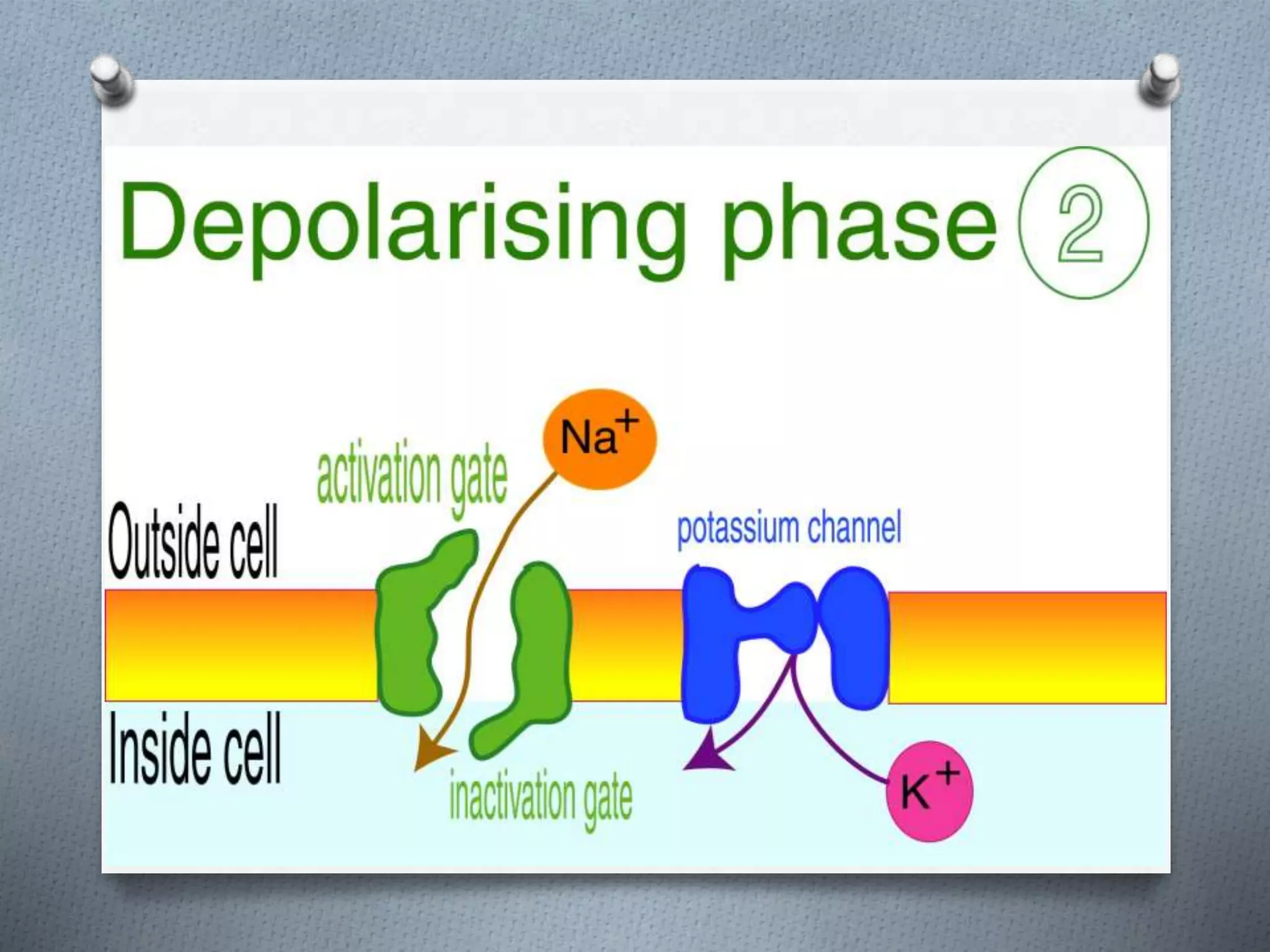
O Excitation of nerve segment leads to an increase in
permeability of the cell membrane to sodium ions.
O This causes depolarization of the nerve membrane
from its resting level to its firing threshold of
approximately -50 to -60 mV.
O When the firing threshold is reached, membrane
permeability to sodium increases dramatically and
sodium ions rapidly enter the axoplasm. At the end
of depolarization, the electrical potential of the nerve
is actually reversed; an electrical potential of + 40
mV exists.
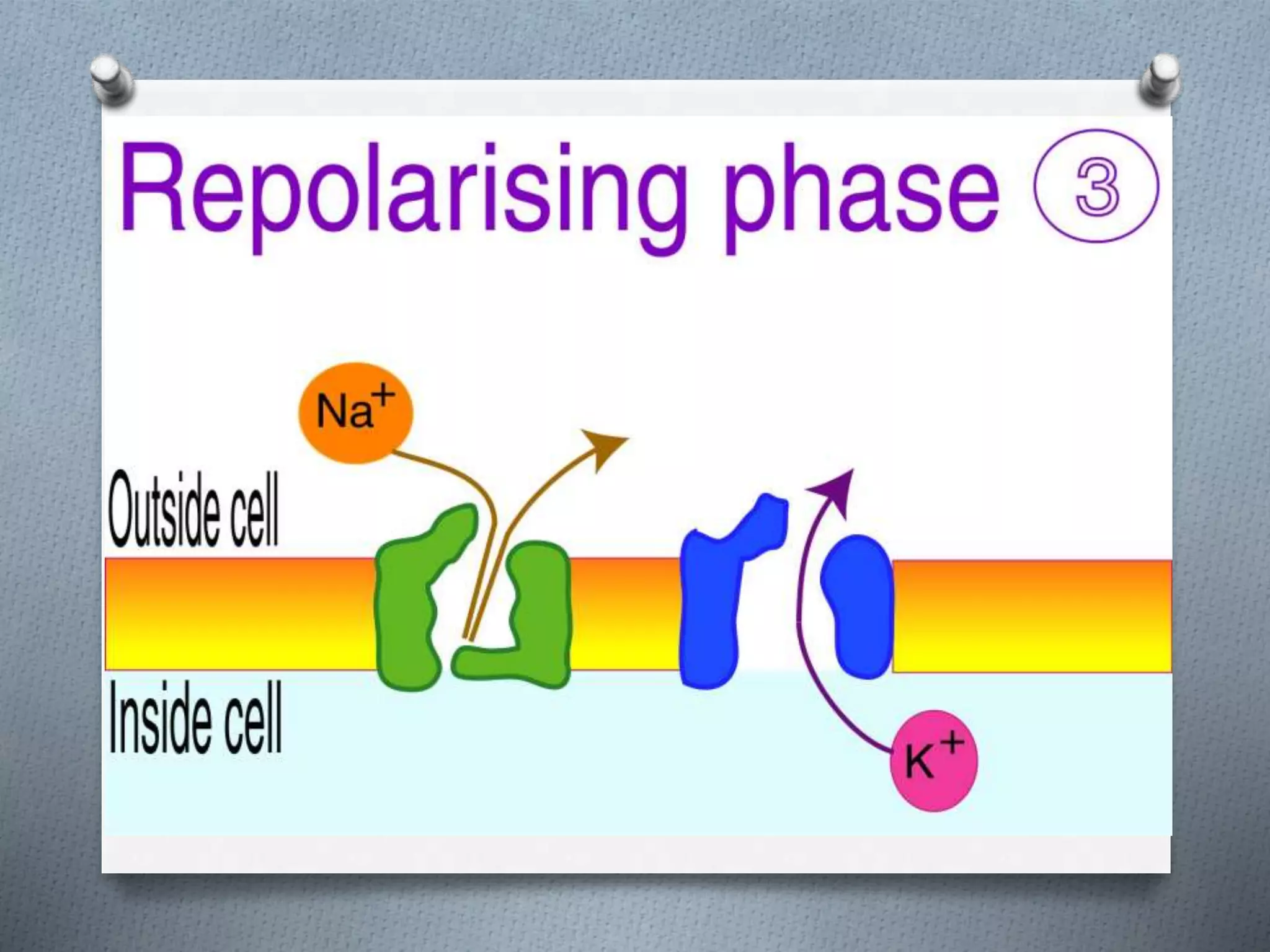
REPOLARIZATION
The action potential is terminated when the
membrane repolarizes. This is caused by the
inactivation of the increased permeability to sodium.
In many cells, there is efflux of potassium ions
leading to more rapid repolarization. & return to its
resting potential. The movement of ions is passive
because each ion moves along its concentration
gradient. After the return of resting potential, a period
of metabolic activity begins in which active transfer of
sodium ions occurs via the sodium pump. The energy
for this pump comes from the oxidative metabolism of
ATP.
Graphical Representation
LOCAL
ANESTHESI
A
HISTORY
O Horace Wells, a dentist at Hartford, in the year 1844
first used nitrous oxide for anesthesia in a tooth
extraction procedure.
O Cocaine was discovered in 1859 by Niemann &
was used and demonstrated by Karl Roller on 15th
Sept, 1884; who first instilled the drug into the eye.
O Hall administered the first inferior alveolar nerve
block with cocaine in the same year. The procaine
was discovered by Alfred Einhorn in 1905.
LOCAL ANESTHESIA
O Local anesthesia produces loss of sensation
without including a loss of consciousness..
O Local Anaesthesia is the local loss of pain,
temperature, touch, pressure and all other
sensation.
O In dentistry, Only loss of pain sensation is
desirable.
INDICATIONS
O Extraction of teeth
O Odetenctomy
O Alveoloplasty or Alveolectomy
O Incision or drainage of abscesses.
O Cavity preparation
O Pulpotomy or Pulpectomy
O Periodontal surgery & gingival surgery
O Cyst enucleation / marsupialization
O Removal of the residual infection, small neoplastic
growths & salivary stones.
O For relief of sore spots of dentures
O Treatment of trismus
O Diagnostic test of various facial pains especially
trigeminal neuralgia
O As a treatment therapy of trigeminal neuralgia
O In radiography when the patient is gagging due to
placement of film in the mouth
O For anesthesia of oral cavity for routine surgical
procedures like treatment of fractures, growths
etc.
CONTRAINDICATIONS
O Allergy to local anaesthetic solution
O Acute infection
O Mentally retarded and non-cooperative children or
very young children when the patient is below the
age of reasoning.
O When the anatomic anomalies make the
anesthesia difficult or impossible.
O Hyperthyroidism - since the local anaesthetics containing
vasoconstrictor & can produce crisis.
O Liver disorders – The drug is metabolized in the liver.
O Renal disorders- As the drug is excreted through the
kidneys.
O Patients with cardiac problems, especially ischemia,
infarction, coronary artery blockade.
O Patients with any internal hemorrhage as the drug may
elevate the blood pressure & induce fresh hemorrhage
because of the vasoconstrictor present.
O Major oral surgical procedures should not be undertaken
local anesthesia as they are time consuming procedures
needing wider area of exposure & one may lose the co-
operation of the patient.
Properties of Ideal
local Anesthetic:
O Possess a specific and reversible action.
O Non-irritant with no permanent damage to
tissues.
O No Systemic toxicity.
O Rapid onset and long duration.
O Active Topically or by injection.
O It should have sufficient penetration to be effective
as a topical anaesthetic.
O It should not produce allergic reactions.
O It should be stable in solution & undergo
biotransformation readily within the body.
O It should be either sterile / capable of being
sterilized by heat without distortion.
Chemistry
OThey are weak bases, insoluble in
water
converted into soluble salts by adding Hcl for
clinical use.
OThey are composed of three parts:
Aromatic (lipophilic) residue with acidic group
R1.
Intermediate aliphatic chain, which is either
ester or amide link R2.
Terminal amino (hydrophilic) group R3 and R4.
Physiochemical Properties
 These are very important for local anaesthetic
activity.
Ionization:
 They are weak base and exist partly in an unionized
and partly in an ionized form.
 The proportion depend on:
> The pKa or dissociation constant
> The pH of the surrounding medium.
 Both ionizing and unionizing are important in
producing local anaesthesia.
Physiochemical Properties
(CONT..)
OpKa is the pH at which the
ionized and unionized form of an
agent are present in equal
amounts.
O The lower the pKa , the more the unionized
form, the greater the lipid solubility.
O The higher the pKa , the more the ionized form
and the slower the lipid solubility
Physiochemical Properties(CONT..)
O Unionized form is able to cross the bi-lipid
nerve membrane.
O The ionized form then blocks conduction.
O Some of the unionized inside the cell wall
become ionized depending upon the pKa and
the intracellular pH (lower than extracellular)
Physiochemical Properties(CONT..)
OIn general the amide type have lower pKa,
and greater proportion of the drug is present
in the lipid-soluble (unionized) form at the
physiological pH
OThis produces faster onset of action.
Lignocaine: 1 – 2 minutes
Procaine: 2 – 5 minutes.
OThe lower the pKa the faster the onset.
Physiochemical Properties(CONT..)
Partition coefficient:
O This measures the relative solubility of an agent in fat
and water.
O High numerical value means:
>High lipid-soluble
>less water-soluble.
O More fat solubility, means rapid crossing of the lipid
barrier of the nerve sheath.
The greater partition coefficient, The faster the
onset
Physiochemical Properties(CONT..)
Protein binding:
O Local anaesthetic agents bind with:
>α1-acid glycoprotein, which possess high affinity
but low capacity.
>Albumin, with low affinity but high capacity
O The binding is simple, reversible and tend to
increase in proportion to the side chain.
O Lignocaine is 64% bound, Bupivacaine is 96%
O The duration of action is related to the degree
of binding.
O Lignocaine 15 – 45 minutes, Bupivacaine 6 hours
Physiochemical Properties(CONT..)
Vasodilatory Ability:
O Most Local anaesthetics possess a
vasodilatory action on blood vessels except
Cocaine.
O It influence the duration of action of the agent.
O Prilocaine is 50% bound to proteins but has a
longer duration than Lignocaine (64%) since it
possess no strong vasodilatory effect.
OAffect the duration of action of the
agent.
Physiochemical Properties(CONT..)
Summary:
O Rapid Onset:
Low pKa value– more unionized – Amides
Higher Partition coefficient – more lipid
soluble
O Long duration of action:
High protein binding.
Low vasodilating property
Pharmacodynamics:
Pharmacological actions
O Reversible block of conduction in nerve.
O Direct relaxation of smooth muscle & inhibition of
neuro-muscular transmission in skeletal muscle
producing vasodilatation.
Intra-arterial procaine reverse
arteriospasm during I.V. Sedation..
Pharmacodynamics:
Mechanism of Action:
O The site of action is the nerve cell membrane.
THEORIES:
OTHE MEMBRANE EXPANSION
THEORY
ONEUTRALIZATION OF
TRANSMEMRANE CHARGE
OCALCIUM DISPLACEMENT
MEMBRANE
OSPECIFIC RECEPTOR HYPOTHESIS
1) Membrane expansion theory:
O A non-specific mechanism similar to the action of
general anaesthetic agents.
O Relies upon the lipophilic moiety of local anaesthetic
agent.
O The molecules of the agent are incorporated into the
lipid cell membrane.
O This theory postulates that local anesthetic molecules
diffuse to hydrophobic regions of excitable membranes
, producing general disturbance of bulk membrane
structure, expanding some regions of membrane and
preventing an increase in permeability to sodium ions.
O Local anesthetics can penetrate lipid portion of sodium
channels , which lead to inhibition of sodium channels
and neural excitation.
2) NEUTRALIZATION OF
TRANSMEMBRANE
CHARGE
This hypothesis suggests that the interaction of the
anaesthetic agent with the receptor areas results in
neutralization of fixed negative charges in the cell
membrane such that the potential across the
membrane would rise although the recorded resting
potential would remain constant.
O Electronic currents from adjacent non
anaesthetized areas would be insufficient to
reduce the transmembrane potential to its
threshold level & blockade would occur.
3)CALCIUM DISPLACEMENT
MEMBRANE
O Local anaesthetics may act by competitive action
with calcium for the same receptor. Thus by
displacing calcium, the anaesthetic drug may bind to
the receptor with a greater affinity thereby preventing
the initiation of depolarization & stabilizing the
membrane.
4) Specific receptor
theory:
O Local anaesthetic drug binds to specific
receptor within the sodium channel producing
physical obstruction to entry of sodium ions.
O The act of binding produces a conformational
changes within the channel.
O It bind to a closed gate and maintain it in the
closed position.
O It is, then, essential that the nerve fires, and
the gate assumes the closed position. (Use-
dependant phenomenon )
How does LA work?
O Local anesthetics interfere with the excitation
processes in nerve membrane in one of the
following way:
O altering the basic resting potential of the nerve
membrane.
O altering the threshold potential.
O decreasing the rate of depolarization.
O prolonging the rate of repolarisation.
O block voltage-dependent sodium channels
• reduce the influx of sodium ions
O prevents depolarization - block conduction of the
action potential.( As the sodium cannot move in nerve
cytoplasm thus potassium cannot move out.)
O The action affecting the process of
depolarization, leading to failure of propagation
of an impulse without affecting the resting
potential, is known as Membrane stabilizing
effect.
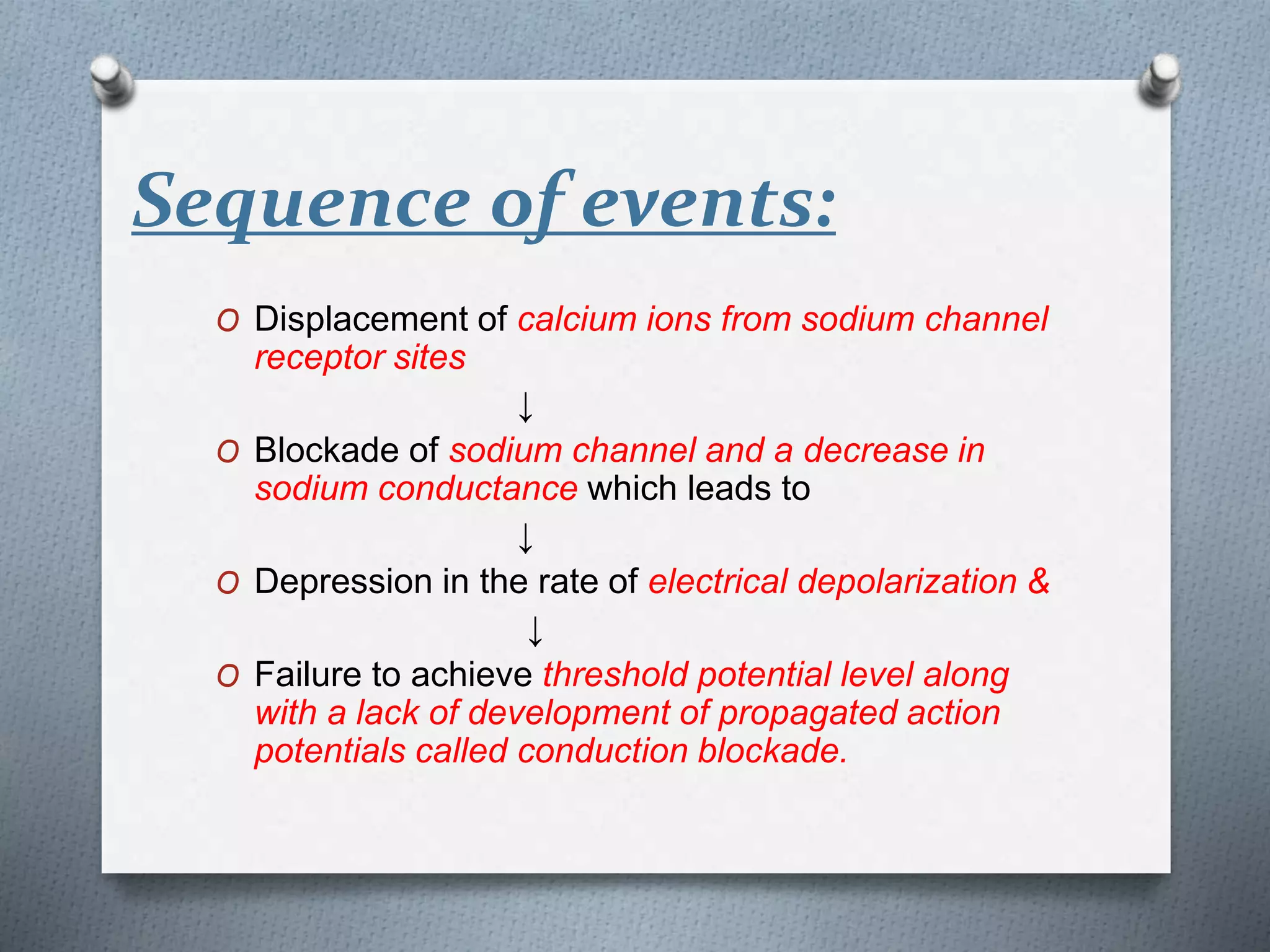
Sequence of events:
O Displacement of calcium ions from sodium channel
receptor sites
↓
O Blockade of sodium channel and a decrease in
sodium conductance which leads to
↓
O Depression in the rate of electrical depolarization &
↓
O Failure to achieve threshold potential level along
with a lack of development of propagated action
potentials called conduction blockade.
O In this solution it exists simultaneously as
uncharged molecule called base RN and positively
charged cation RNH+
O The uncharged lipid soluble free base RN is
responsible for diffusion through nerve sheath
O The cationic form RNH+ is responsible for binding
at receptor site
O The relative proportion of solution varies according
to the ph of surrounding tissue
O In the presence of low ph, solution exists in
cationic form RNH+
O In presence of high pH solution exists as free base
form RN.
O The relative proportion of ionic form depends on
dissociation constant or pKa of solution.
O pKa is the pH at which a compound is half in
ionized form & half in unionized state. The
percentage of a given drug existing in either
molecular form may be determined from the
Henderson – Hasselbalch equation:
base
Log acid = pH – pKa
O The uncharged lipid soluble free base form is
responsible for diffusion of local anaesthetic
through the nerve membrane.
O Following penetration of nerve sheath by base
form, re- equilibration occurs between base &
cation.
O Most of the molecules present intracellular revert
back to cationic form; the remaining molecules
stay in the uncharged free base form.
O Within the sodium channel the cationic charged
form binds to the receptor & ultimately
responsible for the conduction blockade
CLINICAL SIGNIFICANCE:
O In infections , the pH of surrounding tissue falls.
↓
O Increase in hydrogen ions in tissue
↓
O Anesthetic solution will spilt and exist at a
cationic form
↓
O So it will not be able to penetrate the neural
sheath and is rendered ineffective.
Fate & Metabolism:
OAbsorption:
O Many factors influence entry of local
anaesthetic into the circulation:
OVasodilating ability of the drug.
OVolume and concentration.
OVascularity of the tissues.
OThe route of administration.
OThe presence of vasoconstrictor
Composition of local
anesthetic agent:
O Local anesthetic agent
O Vasoconstrictor
O Reducing agent
O Preservative
O Fungicide
O Salt to make it isotonic
O Vehicle
Local Anesthetic agents
O Are drugs that block nerve conduction
when applied locally to nerve tissues in
appropriate concentrations, acts on any
part of the nervous system, peripheral or
central and any type of nerve fibres,
sensory or motor.
CLASSIFICATI
ON OF
LOCAL
ANESTHESIA
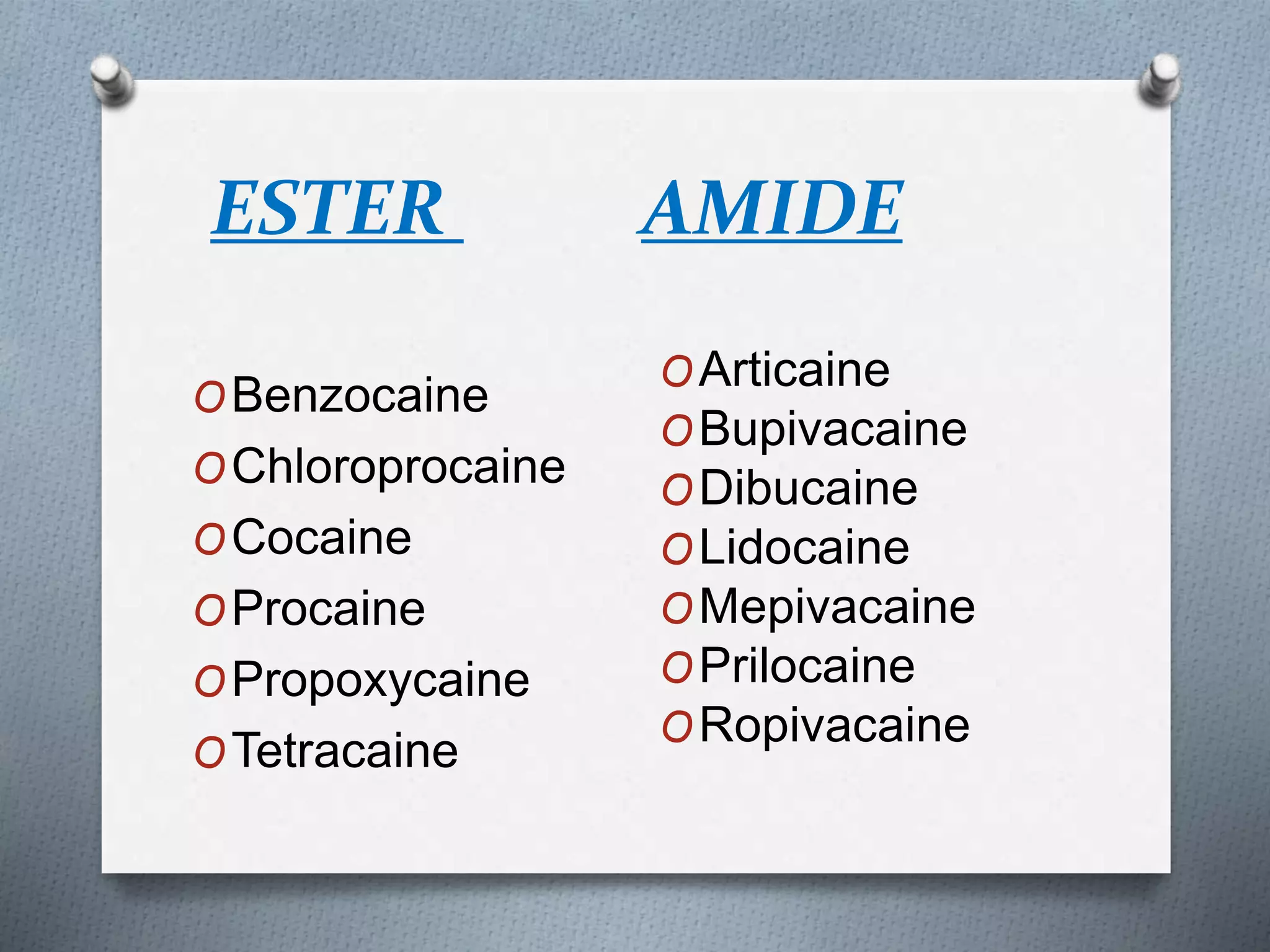
CLASSIFICATION:
O Classified according to their chemical structures
and the determining factor is the intermediate
chain, into two groups:
Ester Amide
They differ in two important respect:
O Their ability to induce hypersensitivity reaction.
O Their pharmacokinetics - fate and metabolism
ESTER AMIDE
OBenzocaine
OChloroprocaine
OCocaine
OProcaine
OPropoxycaine
OTetracaine
OArticaine
OBupivacaine
ODibucaine
OLidocaine
OMepivacaine
OPrilocaine
ORopivacaine
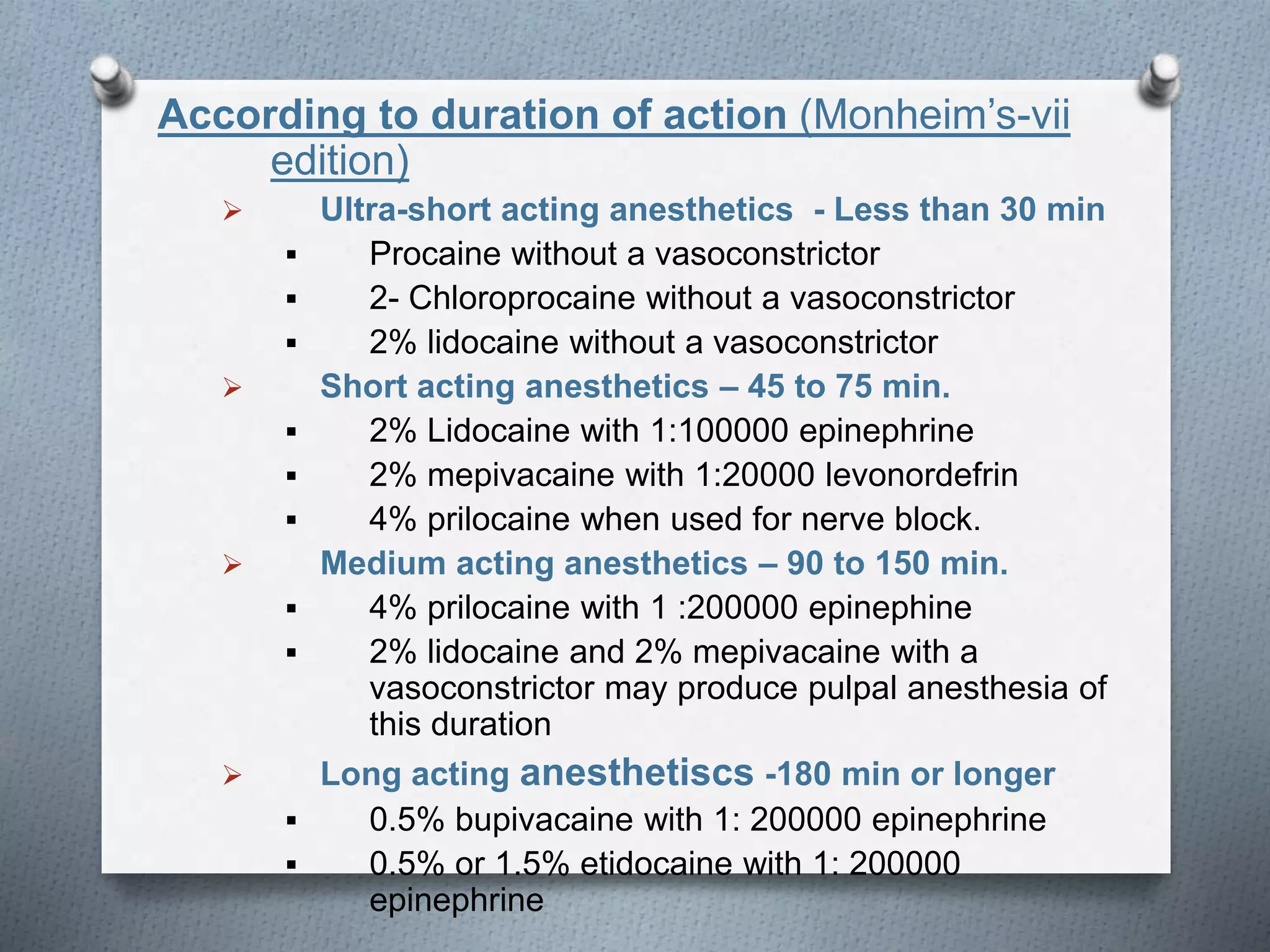
According to duration of action (Monheim’s-vii
edition)
 Ultra-short acting anesthetics - Less than 30 min
 Procaine without a vasoconstrictor
 2- Chloroprocaine without a vasoconstrictor
 2% lidocaine without a vasoconstrictor
 Short acting anesthetics – 45 to 75 min.
 2% Lidocaine with 1:100000 epinephrine
 2% mepivacaine with 1:20000 levonordefrin
 4% prilocaine when used for nerve block.
 Medium acting anesthetics – 90 to 150 min.
 4% prilocaine with 1 :200000 epinephine
 2% lidocaine and 2% mepivacaine with a
vasoconstrictor may produce pulpal anesthesia of
this duration
 Long acting anesthetiscs -180 min or longer
 0.5% bupivacaine with 1: 200000 epinephrine
 0.5% or 1.5% etidocaine with 1: 200000
epinephrine
According to their ability to react with specific
receptor sites in the sodium channel (Stanley
F.Malamed-2005)
 Within the Sodium channel
 Tertiary amine local anesthetics
 At the outer surface of sodium channel
 Tetrodotoxin, saxitoxin
 At either activation or inactivation gates
 Scorpion venom
OLocal anesthetics are classified
according to biological site and
mode of action-
O Agents acting at receptor site on external
surface of nerve membrane...Biotoxins
eg:tetrodotoxin
O Agents acting at receptor site on internal
surface of nerve membrane-quaternary
ammonium analogues of lidocaine
O Agents acting by a receptor-independent
physic-chemical mechanism.-benzocaine
O Agents acting by combination of receptor and
receptor-independent mechanism-
articaine,lidocaine,mepivacaine,prilocaine
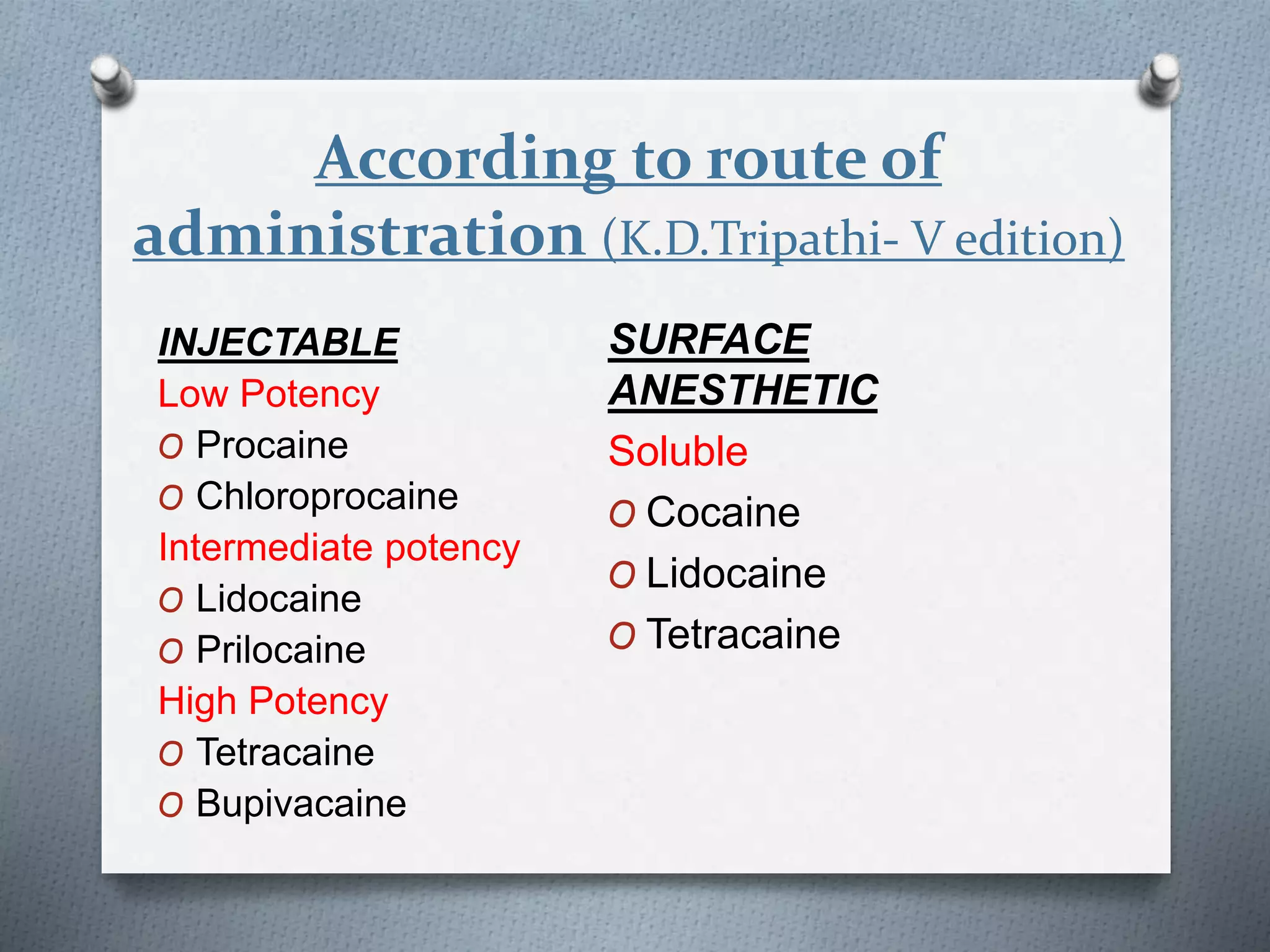
According to route of
administration (K.D.Tripathi- V edition)
INJECTABLE
Low Potency
O Procaine
O Chloroprocaine
Intermediate potency
O Lidocaine
O Prilocaine
High Potency
O Tetracaine
O Bupivacaine
SURFACE
ANESTHETIC
Soluble
O Cocaine
O Lidocaine
O Tetracaine
Action of local anesthetic is affected by
2 factors:
O 1)Diffusion of the drug through the nerve sheath
O 2)Binding at the receptor site
O Local anesthetics are available as salts dissolved
in sterile water or saline .
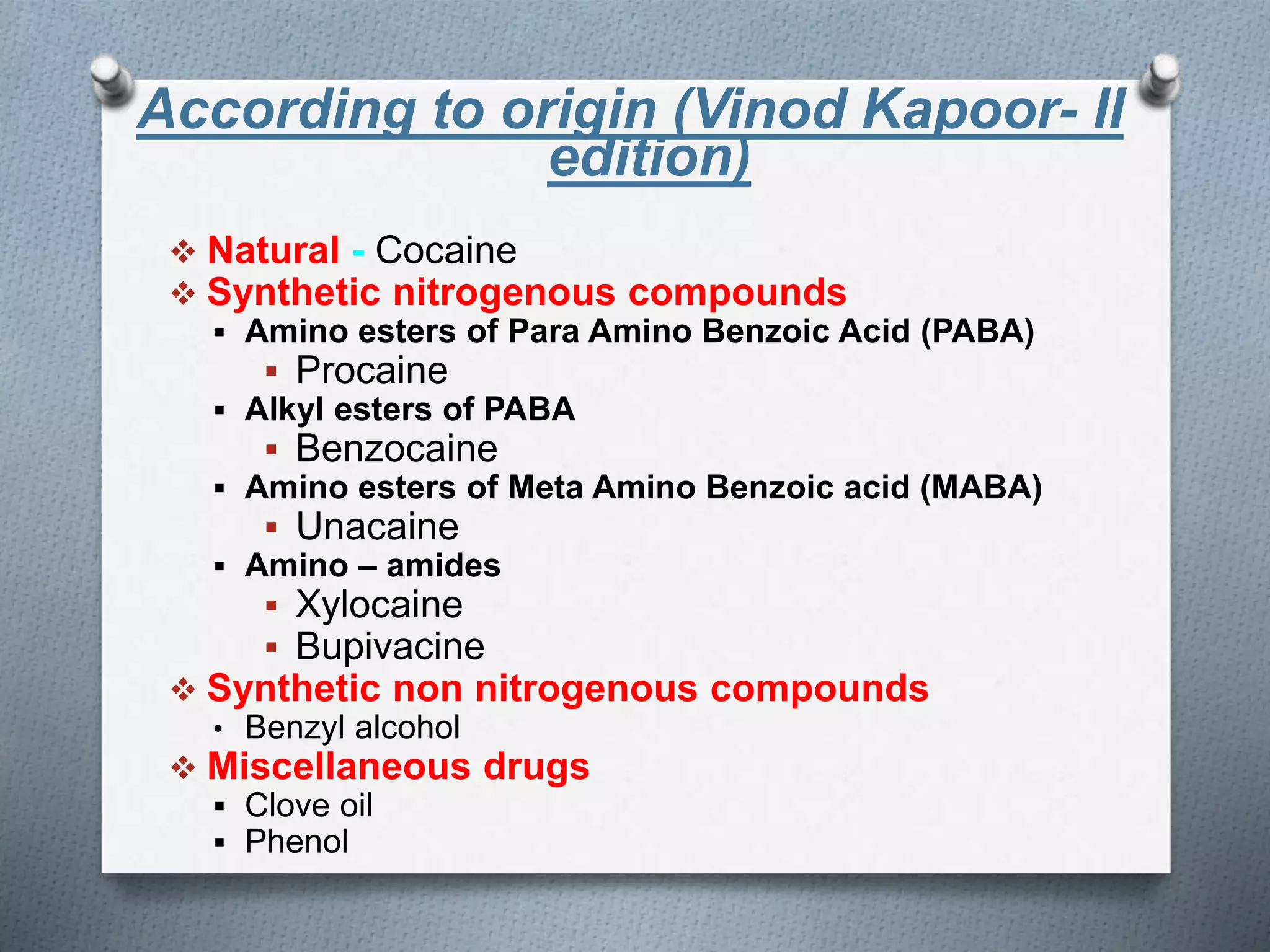
According to origin (Vinod Kapoor- II
edition)
 Natural - Cocaine
 Synthetic nitrogenous compounds
 Amino esters of Para Amino Benzoic Acid (PABA)
 Procaine
 Alkyl esters of PABA
 Benzocaine
 Amino esters of Meta Amino Benzoic acid (MABA)
 Unacaine
 Amino – amides
 Xylocaine
 Bupivacine
 Synthetic non nitrogenous compounds
• Benzyl alcohol
 Miscellaneous drugs
 Clove oil
 Phenol
Ester-type drugs
Cocaine:
O The first and most potent local anaesthetic
agent, rarely used because of the problems of
misuse.
O It is unique in it is ability to produce intense
vasoconstriction. Half life 30 minutes.
O Dosage:
O Used as topical 4 – 10% solution
O Maximum dose is 1.5 mg/kg – 100mg max.
O Used intranasally during apical surgery.
Procaine:
O The only indication for its use in dentistry is
in patients with proven allergy to the amide
group.
O Used intra-arterially, as part of the
recognized regimen, to treat the
arteriospasm which might occur during
intravenous sedation.
O It has an excellent vasodilatory properties.
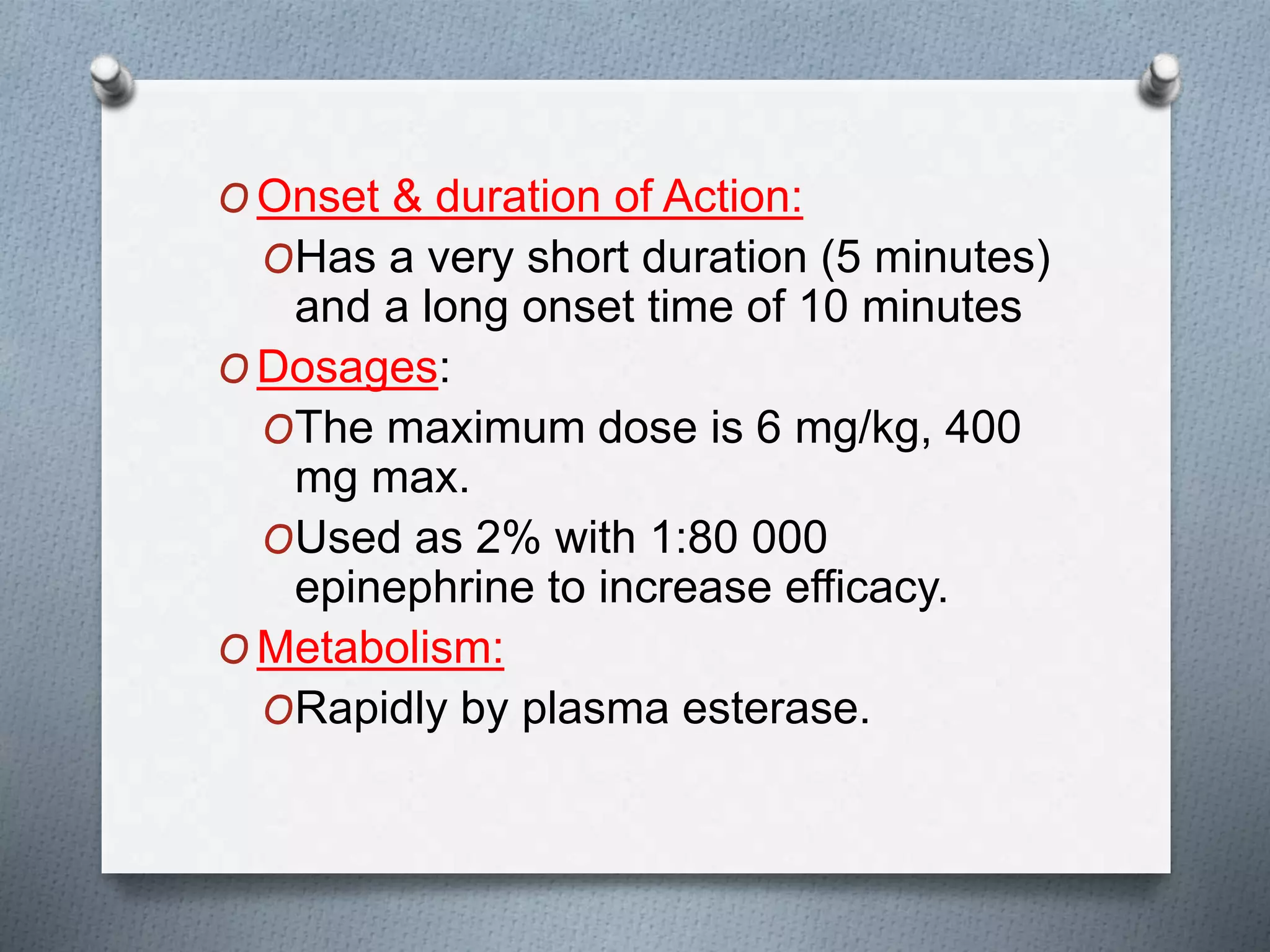
O Onset & duration of Action:
OHas a very short duration (5 minutes)
and a long onset time of 10 minutes
O Dosages:
OThe maximum dose is 6 mg/kg, 400
mg max.
OUsed as 2% with 1:80 000
epinephrine to increase efficacy.
O Metabolism:
ORapidly by plasma esterase.
Benzocaine:
OUsed mainly as topical, due to its poor
water solubility, and because of its low
toxicity, it is used in concentration up
to 20%.
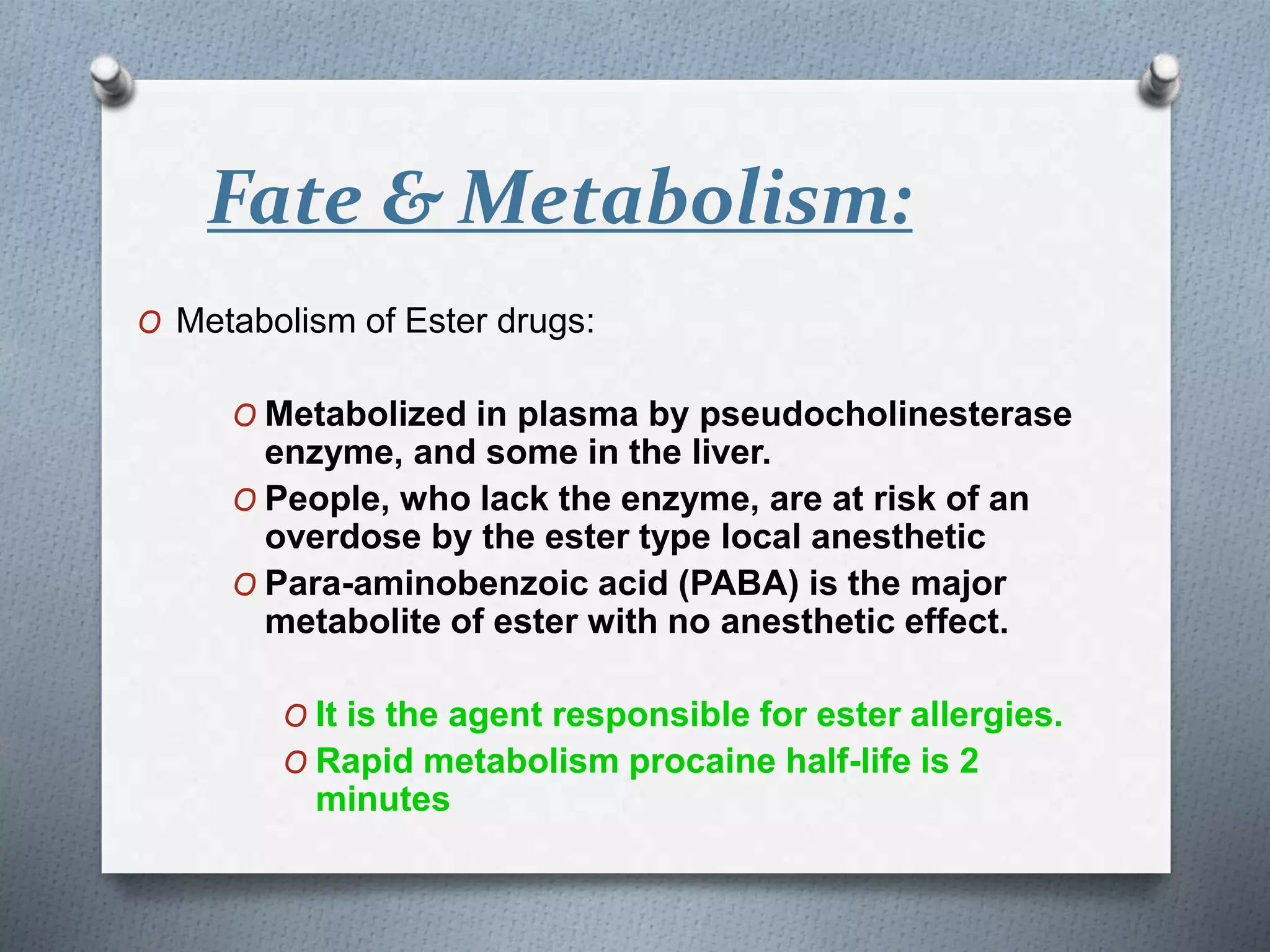
Fate & Metabolism:
O Metabolism of Ester drugs:
O Metabolized in plasma by pseudocholinesterase
enzyme, and some in the liver.
O People, who lack the enzyme, are at risk of an
overdose by the ester type local anesthetic
O Para-aminobenzoic acid (PABA) is the major
metabolite of ester with no anesthetic effect.
O It is the agent responsible for ester allergies.
O Rapid metabolism procaine half-life is 2
minutes
Amide-type drugs:
Lignocaine (Lidocaine):
O Synthesized in 1943 and used in dentistry since
1948 and is also known as Xylocaine
O It highly lipophilic (partition coefficient 3) , rapidly
absorbed.
O Metabolized only in the liver and its metabolites
are less toxic with no action.
O Has half-life (t0.5) of 90 minutes
ODosage:
O 4.4 mg/kg – 300 mg max when without
vasoconstrictor.
O 7mg/kg – 500mg max when used with 1:50,000
or 1:100,000 epinephrine
O 4 and 10% spray, 2% gel and 5% ointments.
OOnset & duration of action:
O Rapid onset 2 – 3 minutes
Prilocaine:
O A very potent local anesthetic and is less toxic than
Lignocaine.
O It produces less vasodilatation than lignocaine.
O Absorbed less rapidly from the site of injection than
lignocaine.
O Rate of clearance is higher than other amide-types,
suggesting extra-hepatic metabolism with relatively
low blood concentration.
O It’s metabolite o-toluidine lead to methaemo-
globinaemia (more than 400 mg in adults)
O Used either plain 4% or 3% combined with 0.03IU/mL
of Felypressin as vasoconstrictor.
O Onset & Duration:
O Slower onset – 4 minutes.
O It’s duration of action is similar to Lignocaine.
O 4% solution without epinephrine will give 60 min of
working anesthesia and when with epinephrine 60-90
min of working anesthesia.
O Dosage;
O 6.0 mg/kg – max. 400 mg.
O Combined with Lignocaine as a topical anesthetic
agent to be used prior to vene-section and during
dental sedation in children.
OMepivacaine:
Possess the least vasodilating effect.
O Metabolized in the liver and has t0.5 of 120 minutes.
O It’s main indication is when local anesthetic without
vasoconstrictor is needed. 3% plain is more
effective than lignocaine.
DOSAGE: 6.6 mg/kg… max: 400mg
Available as 3%conc without vasoconstrictor and 2%
conc with vasoconstrictor
O Onset & duration:
O Rapid onset but slightly shorter duration.
OBupivacaine:
O A long-acting local anaesthetic agent, with a t0.5 of
160 minutes due to greater binding capacity to
plasma protein and tissue proteins
O Metabolized in the liver.
O Used mainly in Oral surgical procedures for its
long-lasting pain control.
O Longer onset and longer duration (Regional 6 – 8
hours)
O Dosage:
O 2mg/kg max 225mg with epinephrine 1:200,000 and
175mg/kg without vasoconstrictor
OEtidocaine:
O A long-acting agent similar to Bupivacaine but with
faster onset.
O Metabolized in the liver.
O Dosage:
O 4mg/kg – Max 300 mg without vasoconstrictor
O 4.4 mg/kg- max 400 mg with 1:200 000 epinephrine.
OLignocaine is the most common used
agent both topically and by injection as
2% with or without adrenaline, with a
maximum dose of 4.4 mg/kg.
Fate & Metabolism:
O Amide Drugs:
O metabolized in the liver, except Prilocaine which
undergo some biotransformation in the kidney and
lungs.
O Normal local anesthetic dose in patient with
impaired liver function will result in relative
overdosage.
O Old age patient shows reduction in liver function
Reduce dose
Vasoconstrictors
O Originally added to reduce systemic uptake in an
attempt to limit toxicity.
O Prolong the duration
O Produces profound anesthesia.
O Reduce operative bleeding.
O Two types:
O Sympathomimetic naturally occurring.
O Synthetic polypeptides, Felypressin
O Vasoconstrictors in general use are adrenaline,
noradrenaline & felypressin.
Functions:
1) Constrict blood vessels  decrease blood flow to the
surgical site
2) Cardiovascular absorption is slowed  lower
anesthetic blood levels
3) Local anesthetic blood levels are lowered  lower
risk of toxicity
4) Local anesthetic remains around the nerve for longer
periods  increased duration of anesthesia
5) Decreases bleeding
CLASSIFICATION
Catecholamines Noncatecholamines
*Epinephrine Amphetamine
*Norepinephrine Methamphetamine
*Levonordefrin Ephedrine
Isoproterenol Mephentermine
Dopamine Hydroxyamphetamine
Metaraminol
Methoxamine
Phenylephrine
Felypressin  synthetic analogue of vasopressin (ADH);
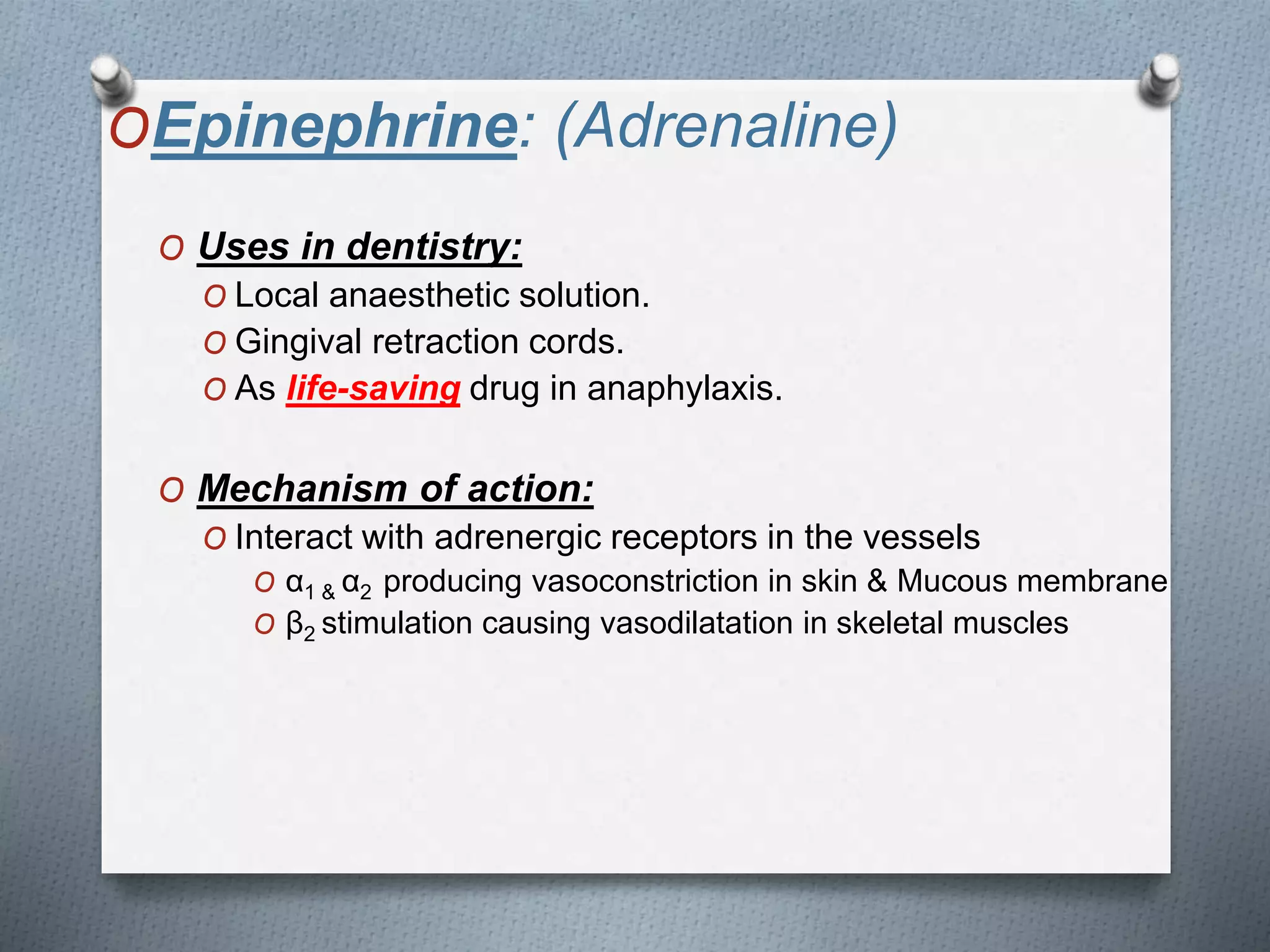
OEpinephrine: (Adrenaline)
O Uses in dentistry:
O Local anaesthetic solution.
O Gingival retraction cords.
O As life-saving drug in anaphylaxis.
O Mechanism of action:
O Interact with adrenergic receptors in the vessels
O α1 & α2 producing vasoconstriction in skin & Mucous membrane
O β2 stimulation causing vasodilatation in skeletal muscles
OMetabolism:
O Appears very rapidly in the systemic circulation
!!!
O Exogenously administered epinephrine is
metabolized extraneuronal and 1% is excreted
in the urine unchanged.
ODosage:
O 1:100,000 epinephrine is equal to 0.01mg/ml.
This conc. Permits the use of 20 ml doses in a
healthy patient to reach the max dose of 0.2mg.
OSystemic effect:
O Being a naturally occurring hormone, it exert a
number of physiological responses on the
different systems.
O The heart:
O Has direct and indirect action.
O Direct action on β1 receptors increases the
rate and force of contraction raising cardiac
output.
O Indirect action, increase pulse and cardiac
output, lead to rise in systolic blood pressure,
(not with dental dose)
OBlood vessels:
OContain α1, α2 and β2 adrenoreceptors
in the vessels of the skin, mucous
membrane and skeletal muscles.
Oα1 receptors causes vasoconstriction
since they are susceptible to endogenous
nor-epinephrine and exogenous
epinephrine. Reduce operative bleeding
Oα2 receptors are only susceptible to
circulating epinephrine.
Oβ2 found in the skeletal muscles, and
very uncommon in the skin and mucous
membrane. β2 stimulation result in
vasodilatation, lowering peripheral
resistance and a fall in the diastolic
blood pressure. (with dental dose)
OHaemostasis:
O The vasoconstricting effect.
O Adrenaline promote platelets aggregation in the early
stages.
O Fibrinolytic activity compromise clot stability.
OLungs:
O Stimulation of β2 receptors in the lung lead to bronchial
muscle relaxation, life-saving in bronchial (spasm)
constriction during anaphylactic reaction.
OWound healing:
O Reduced local tissue oxygen tension.
O Epinephrine-induced fibrinolysis.
O The dilution of vasoconstrictors is commonly referred
to as a ratio i.e.1:50,000; 1:100,000; 1:200,000 etc,…
O A concentration of 1:1,000 means that there is 1 gram
(1000 mg) of solute (drug) contained in 1000 ml (1 L) of
solution, therefore, 1:1,000 dilution contains 1000 mg
in 1000 ml or 1.0 mg/ml of solution (1000 ug/ml)
O The concentration of 1:1,000 is very concentrated
(strong); a much more dilute form is used in dentistry
for example, 1:50,000 > 1:100,000 > 1:200,000
(1:100,000 = 0.01 mg/1 ml of solution)
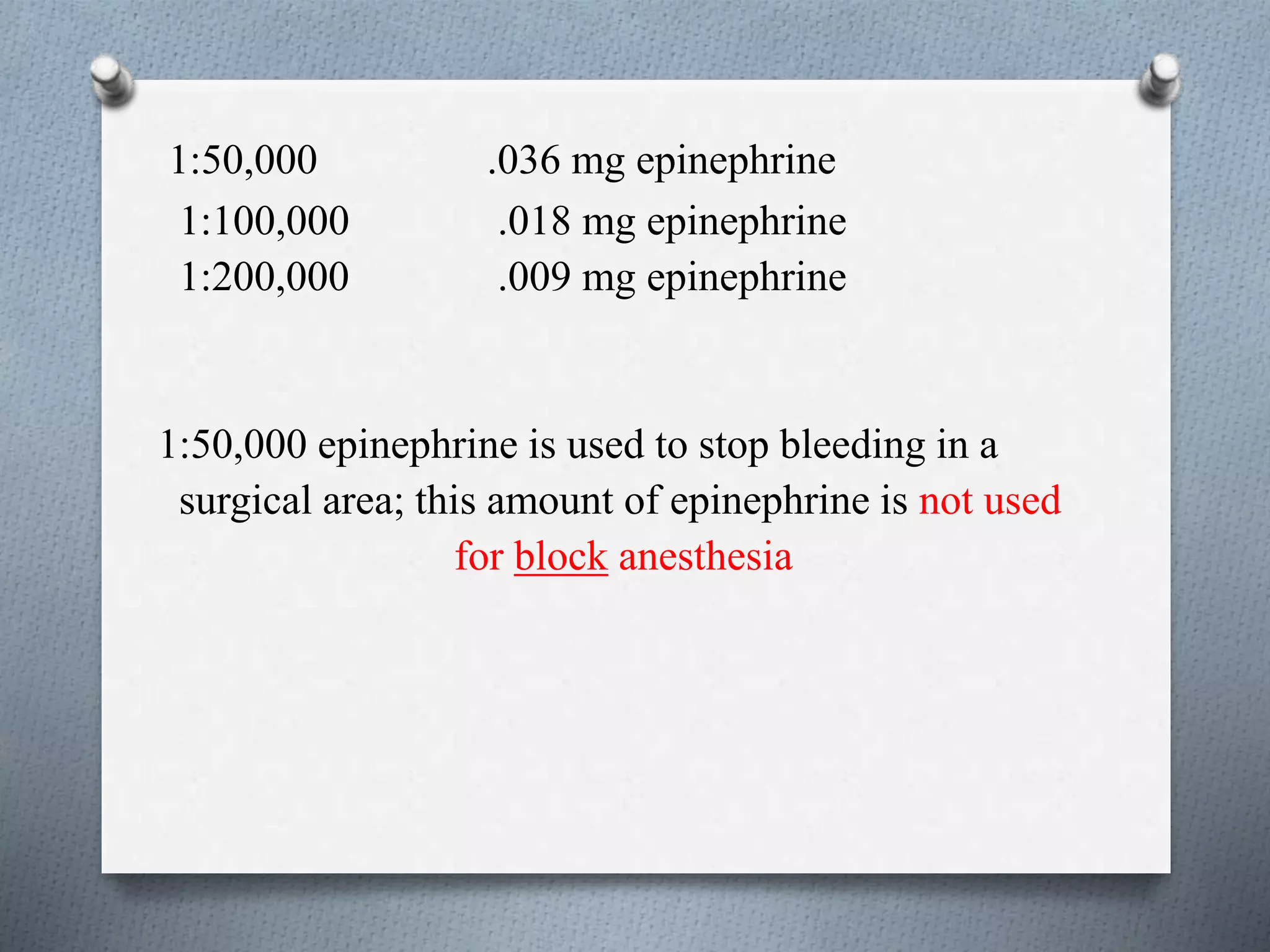
1:50,000 .036 mg epinephrine
1:100,000 .018 mg epinephrine
1:200,000 .009 mg epinephrine
1:50,000 epinephrine is used to stop bleeding in a
surgical area; this amount of epinephrine is not used
for block anesthesia
1.8 ml Cartridge of 2% Lidocaine 1:100,000 epinephrine
Maximum Epinephrine: 11 Cartridges
Maximum Anesthetic: 300 mg
1.8 ml Cartridge of 2% Lidocaine 1:200,000 epinephrine
Maximum Epinephrine: 22 Cartridges
Maximum Anesthetic: 300 mg
The maximum amount of 2% Lidocaine 1:100,000
epinephrine that can be used is 300 mg which is
8.3 cartridges regardless of the patient’s weight; so
the maximum epinephrine will only be achieved
after you have already surpassed the maximum
amount of anesthetic allowable
8.3 cartridges
Maximum L.A.
permitted=7 mg with
vasoconstrictor.
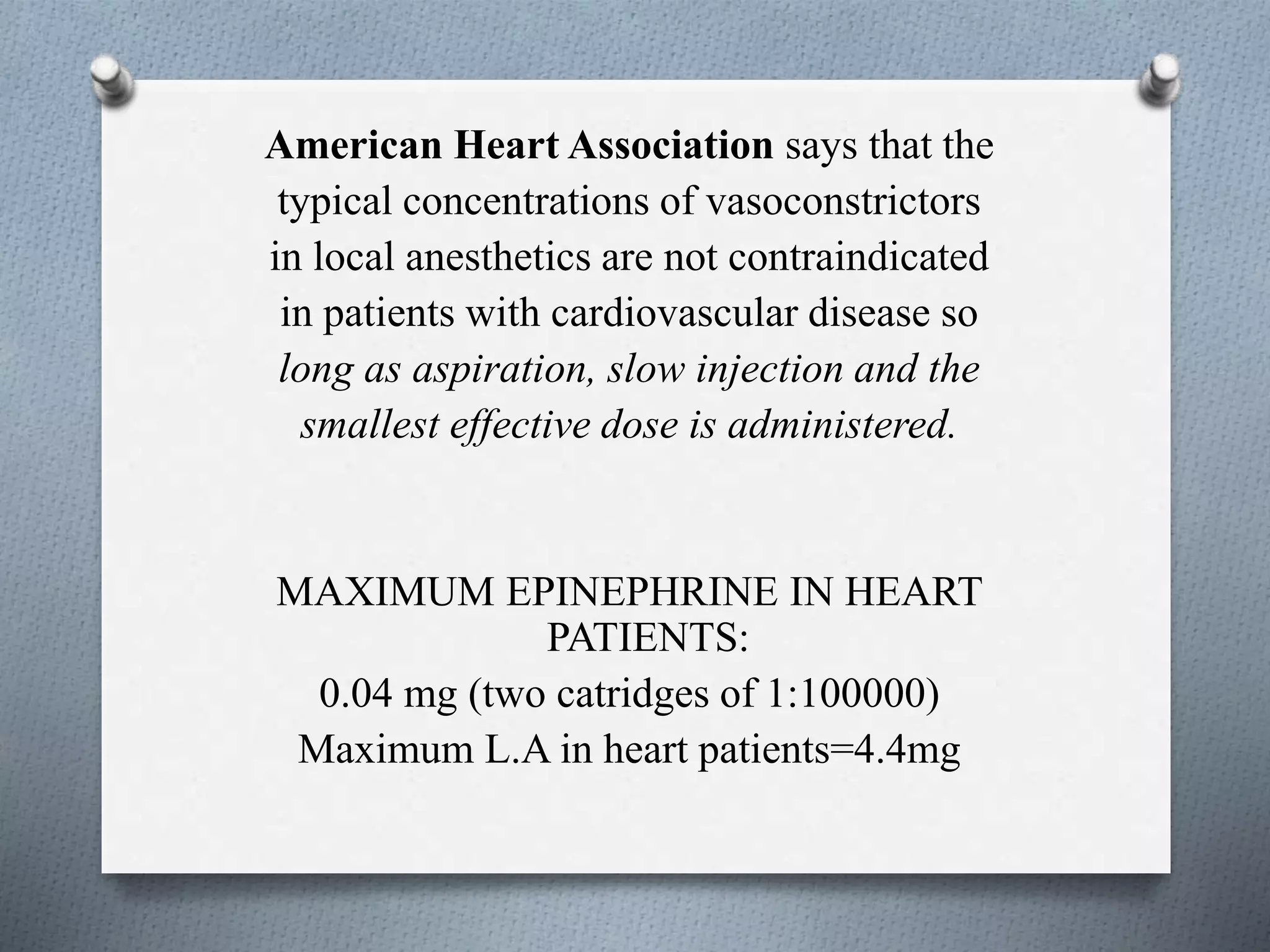
American Heart Association says that the
typical concentrations of vasoconstrictors
in local anesthetics are not contraindicated
in patients with cardiovascular disease so
long as aspiration, slow injection and the
smallest effective dose is administered.
MAXIMUM EPINEPHRINE IN HEART
PATIENTS:
0.04 mg (two catridges of 1:100000)
Maximum L.A in heart patients=4.4mg
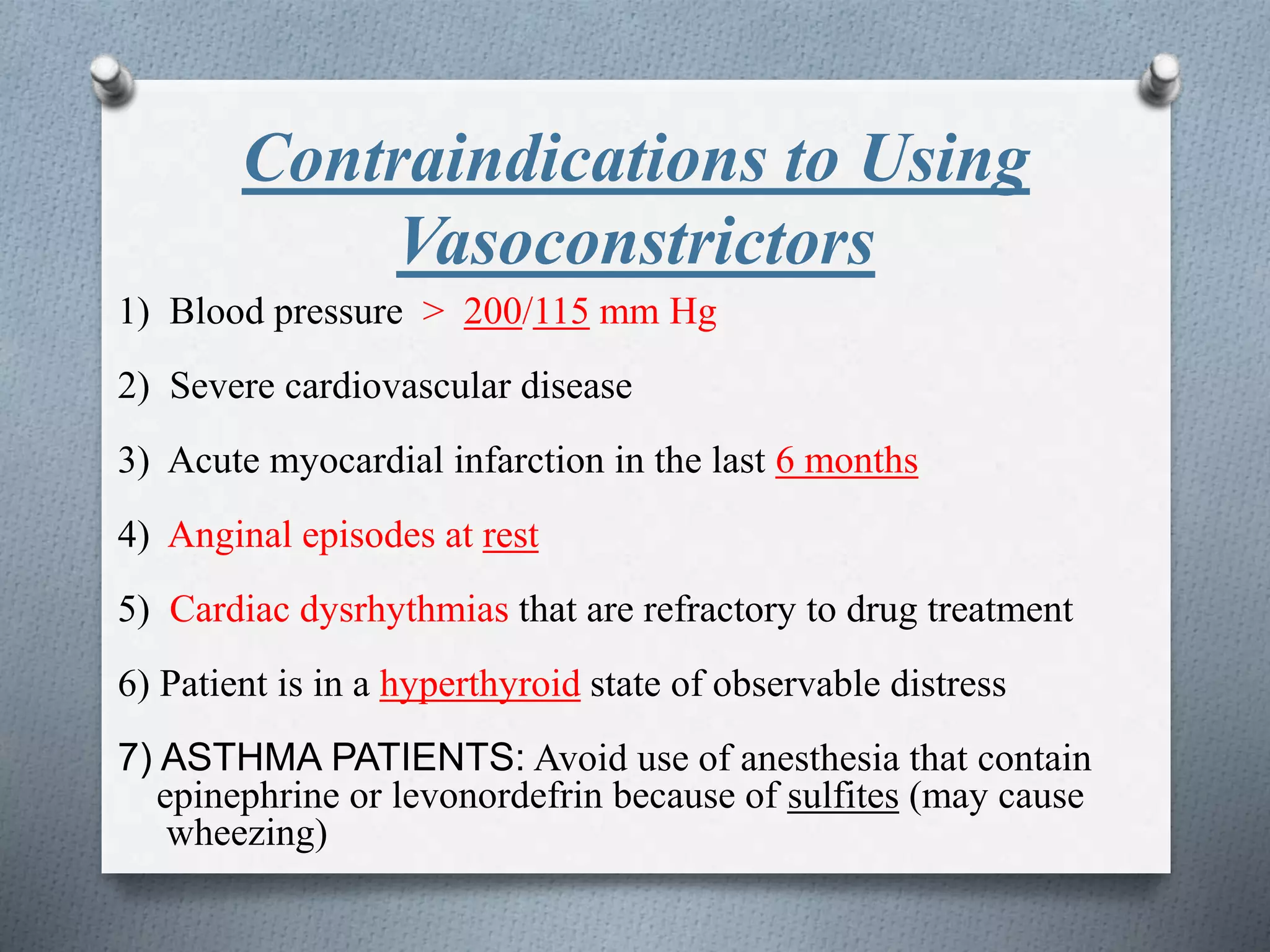
Contraindications to Using
Vasoconstrictors
1) Blood pressure > 200/115 mm Hg
2) Severe cardiovascular disease
3) Acute myocardial infarction in the last 6 months
4) Anginal episodes at rest
5) Cardiac dysrhythmias that are refractory to drug treatment
6) Patient is in a hyperthyroid state of observable distress
7) ASTHMA PATIENTS: Avoid use of anesthesia that contain
epinephrine or levonordefrin because of sulfites (may cause
wheezing)
2) Reducing Agent
O Reducing agent used is 0.5 mg/ml of sodium
metabisulfite. It helps in preventing the
oxidation of vasoconstrictor by competing with
available oxygen in the vial.
3) Preservative
O Methyl paraben 1mg/ml is added as a
preservative to maintain the stability of
solution to increase its shelf life.
4) Fungicide
O A small quantity of thymol is added to local anaesthetic
solution.
5)Salts
O In order to make the local anaesthetic solution isotonic
with the body ph, 5.6 mg of sodium chloride is added to
each ml of the solution.
6)Vehicle
O The anaesthetic agent & other constituents of vial are
dissolved in distilled water which is used as a vehicle for
making the solution.
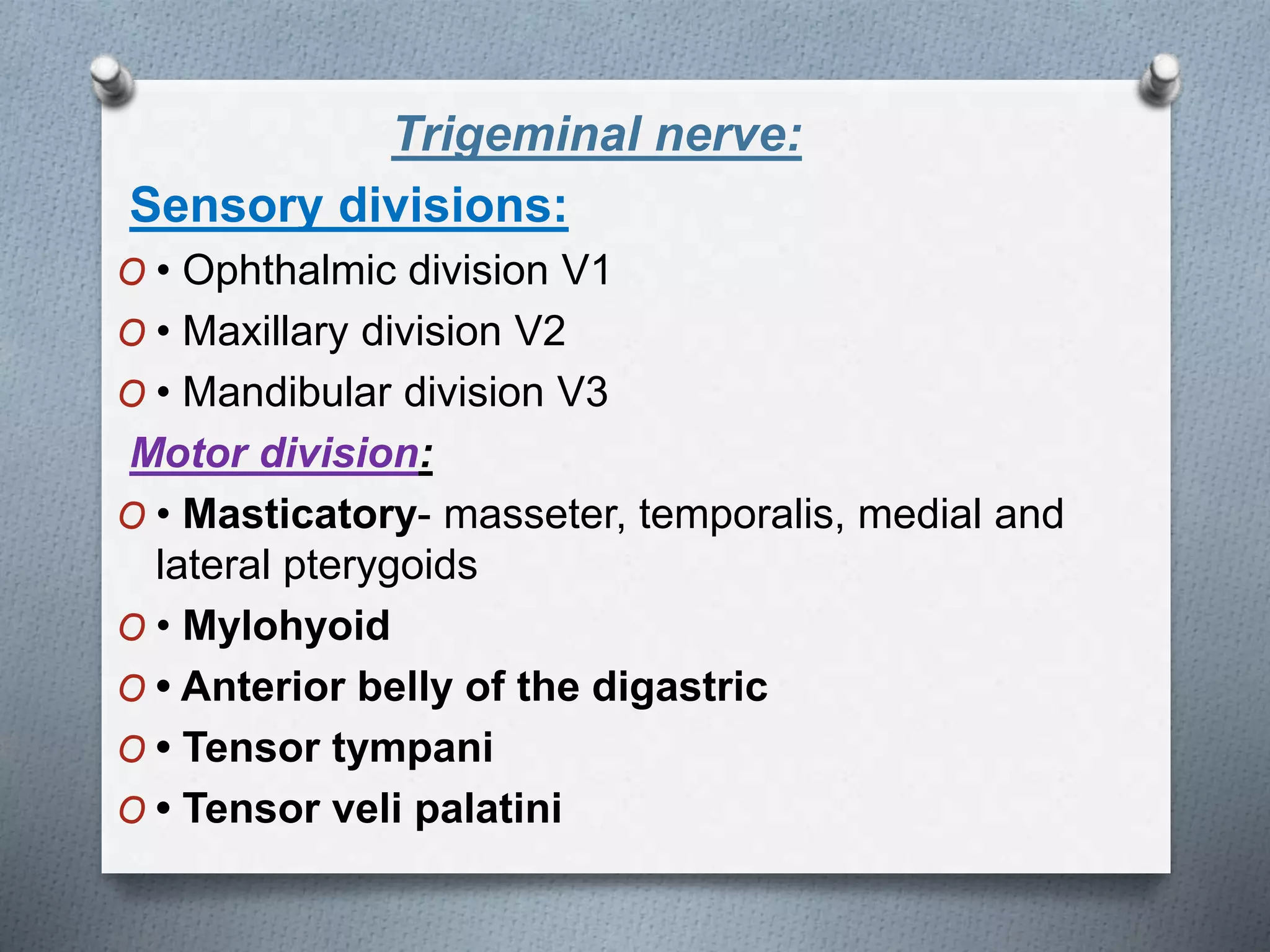
Trigeminal nerve:
Sensory divisions:
O • Ophthalmic division V1
O • Maxillary division V2
O • Mandibular division V3
Motor division:
O • Masticatory- masseter, temporalis, medial and
lateral pterygoids
O • Mylohyoid
O • Anterior belly of the digastric
O • Tensor tympani
O • Tensor veli palatini
Maxilary division:
O • Exits the cranium via foramen rotundum of
the
greater wing of the sphenoid.
O • Travels at the superior most aspect of the
pterygopalatine fossa just posterior to the
maxilla
Branches divided by location:
O – Inter -cranial
O – Pterygopalatine
O – Infraorbital
O – Facial
OBranches:
O – Within the cranium- middle meningeal
nerve
providing sensory innervation to the dura
mater
O – Within the pterygopalatine fossa-
• Zygomatic nerve
• Pterygopalatine nerves
• Posterior superior alveolar nerve
OWithin the pterygopalatine fossa-
Zygomatic nerve:
O • Zygomaticofacial nerve - skin over the
prominence of zygomatic bone.
O • Zygomaticotemporal nerve - skin over the
anterior temporal fossa region
Pterygopalatine nerves:
O • Serves as communication for the
pterygopalatine ganglion and the maxillary
nerve
O • Carries postganglionic secretomotor fibers
through the zygomatic branch to the lacrimal gland
Pterygopalatine nerves:
O Orbital branches - supplies periosteum of the
orbits and mucous membrane of part of the
posterior ethmoidal cells and sphenoid sinus.
O Nasal branches – divides into the
a. Posterior superior lateral nasal branches:
transmits sensory impulse from mucous
membrane of the nasal septum and posterior
ethmoidal cells.
b. Medial or septal branch: transmits sensory
impulse from mucous membrane over the vomer.
O • Palatine branches- greater (anterior) , middle or
posterior palatine nerves
O Greater palatine nerve: travels through the
pterygopalatine canal and enters the palate via the
greater palatine foramen. Lies 1cm medial from
2nd molar region. Supplies major part of hard
palate and palatine gingiva.
O Middle palatine nerve: emerges from lesser
palatine foramen. Supply mucous membrane of
soft palate.
O Posterior palatine nerve: emerges from lesser
palatine foramen. Supply mucous membrane of
the tonsillar area.
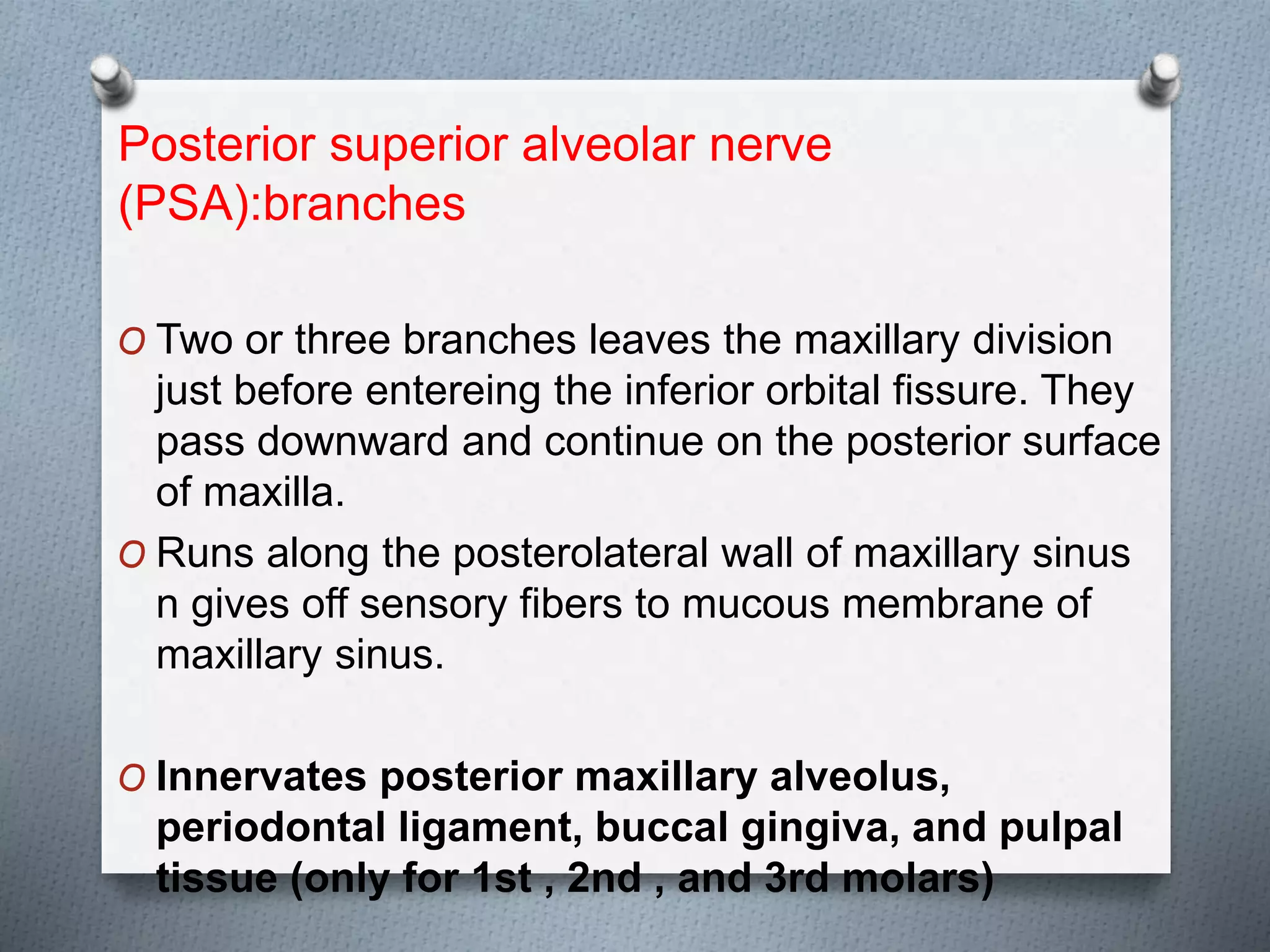
Posterior superior alveolar nerve
(PSA):branches
O Two or three branches leaves the maxillary division
just before entereing the inferior orbital fissure. They
pass downward and continue on the posterior surface
of maxilla.
O Runs along the posterolateral wall of maxillary sinus
n gives off sensory fibers to mucous membrane of
maxillary sinus.
O Innervates posterior maxillary alveolus,
periodontal ligament, buccal gingiva, and pulpal
tissue (only for 1st , 2nd , and 3rd molars)
Infraorbital canal branches:
Middle superior alveolar (MSA):
• Provides innervation to the maxillary alveolus,
buccal gingiva, periodontal ligament, and pulpal
tissue for the premolars only
Anterior superior alveolar (ASA):
• Provides innervation to the maxillary alveolus,
buccal gingiva, periodontal ligament, and pulpal
tissue for the canines, lateral and central incisors
• Branches 6-8mm posterior to the infraorbital nerve
exit from infraorbital foramen
Facial branches:
Emerges from the infraorbital foramen
Branches consist of:
O • Inferior palpebral – supplies skin of lower eyelid
and its conjunctiva.
O • External nasal - lateral skin of nose.
O • Superior labial branch – skin n mucous
membrane of upper lip.
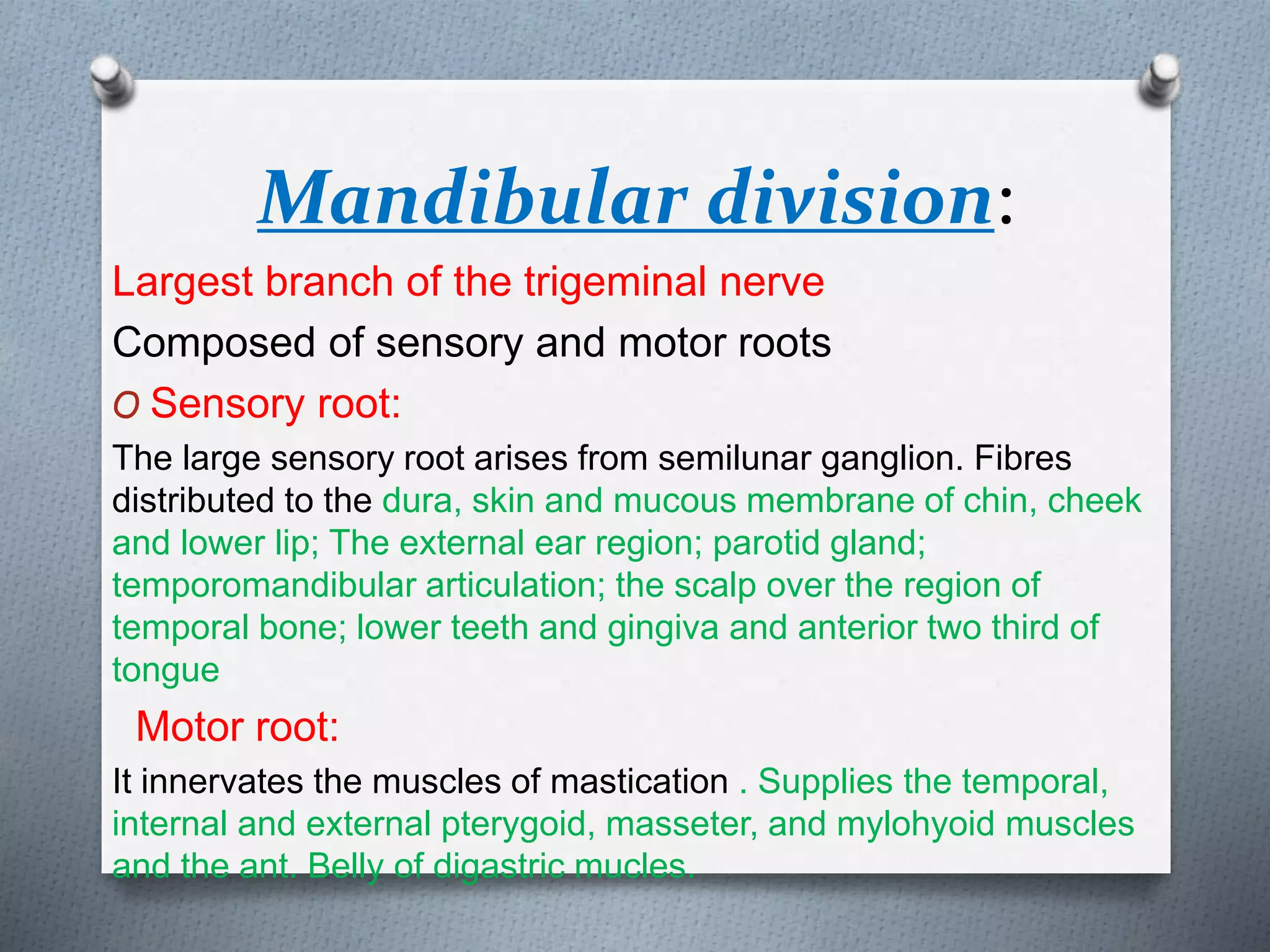
Mandibular division:
Largest branch of the trigeminal nerve
Composed of sensory and motor roots
O Sensory root:
The large sensory root arises from semilunar ganglion. Fibres
distributed to the dura, skin and mucous membrane of chin, cheek
and lower lip; The external ear region; parotid gland;
temporomandibular articulation; the scalp over the region of
temporal bone; lower teeth and gingiva and anterior two third of
tongue
Motor root:
It innervates the muscles of mastication . Supplies the temporal,
internal and external pterygoid, masseter, and mylohyoid muscles
and the ant. Belly of digastric mucles.
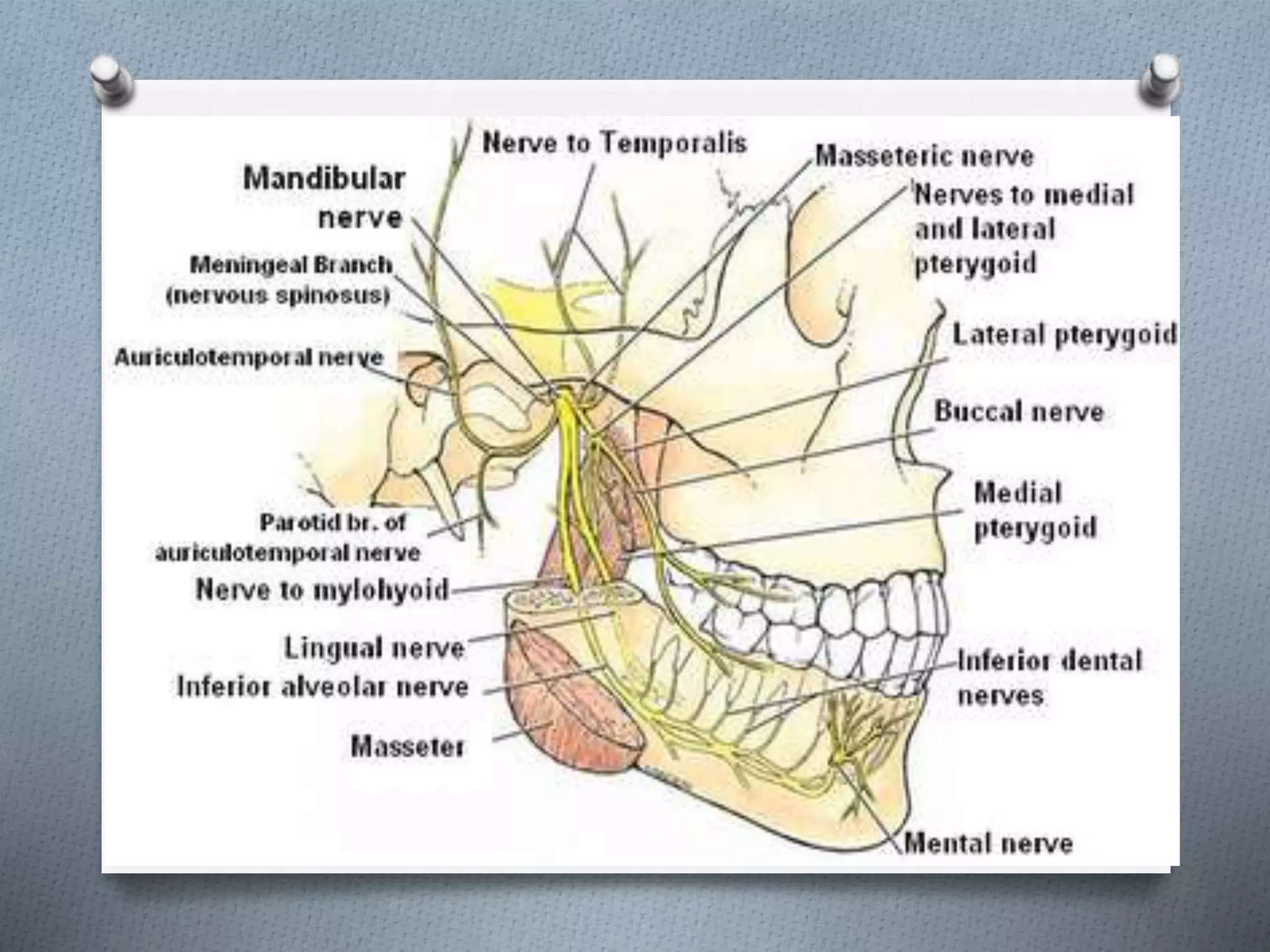
Branches:
O – The sensory and motor roots emerge from
the foramen ovale of the greater wing of the
sphenoid
O Initially merge outside of the skull and divide
about 2-3mm inferiorly.
Branches:
O • Branches from the undivided nerve.
O • Branches from the divided nerve.
Branches of the undivided nerve:
O Nervus spinosus - innervates mastoid cells and
dura.
O Medial pterygoid- innervates medial pterygoid
muscle.
O • Branches innervates into
Tensor veli palatini
Tensor tympani
BRANCHES FROM THE DIVIDED NERVE
Branches of the anterior division:
Supplies muscles of mastication, the skin and the
mucous membrane of the cheek and the buccal
gingiva and lower molars. It passes downward
and forward where it divides into:
Branches to: Pterygoid nerve
Masseter nerve
Nerve to the Temporal muscle
Buccal nerve
Buccal nerve (long buccal and buccinator):
O Travels anteriorly and lateral to the lateral pterygoid
muscle .
O Gives branches to the deep temporal (temporalis
muscle), masseter, and lateral pterygoid muscle
O •Continues to travel in antero-lateral direction.
O At level of the mandibular 3rd molar, branches exit
through the buccinator and provide innervation to the
skin of the cheek
O • Branches also stay within the retromandibular
triangle providing sensory innervation to the buccal
gingiva of the mandibular molars and buccal vestibule
Branches of the posterior division:
O Travels inferior and medial to the lateral
pterygoid.
Divisions:
OAuriculotemporal
O Lingual
O Inferior alveolar
Auriculotemporal Nerve:
All sensory
O Transverses the upper part of the parotid gland
and posterior portion of the zygomatic arch
Branches:
O Parotid branches: gives off sensory, secretory,
vasomotor fibres to the gland.
.
O Articular branches:posterior part of
temporomandibular joint.
O Auricular branches: supply skin of helix and tragus
O Meatal branches: supplies skin lining the meatus and
tympanic membrane.
O Terminal branches: supplies scalp over the temporal
region.
LINGUAL NERVE
O Lies between ramus and medial pterygoid
within the pterygomandibular raphe
O • Lies inferior and medial to the mandibular
3rd molar alveolus
O • Provides sensation to anterior 2/3rds of
tongue , lingual gingiva, floor of mouth
mucosa, and occasionally supplies sensory
fibres to bicuspids and the first molar teeth.
INFERIOR ALVEOLAR
NERVE
O Travels medial to the lateral pterygoid and latero-
posterior to the lingual nerve
O • Enters mandible at the lingula
O • Accompanied by the inferior alveolar artery and
vein (artery anterior to nerve)
O • Travels within the inferior alveolar canal until the
mental foramen
O • Mylohyoid nerve- motor branch prior to entry into
mandibular foramen.
O Inferior alveolar:
O • Provides innervation to the mandibular
alveolus , buccal gingiva from premolar
teeth anteriorly , and the pulpal tissue of
all mandibular teeth on side anestetized.
O • Terminal branches
O – Incisive nerve- remains within inferior
alveolar canal from mental foramen to
midline
O – Mental nerve- exits mental foramen and
divides into 3 branches to innervate the
skin of the chin, lower lip and labial
mucosa.
LOCAL
ANESTHESIA
TECHNIQUE
S
MAXILLARY ANESTHESIA:
3 major types of injections can be performed in the
maxilla for pain control
O Local infiltration
O Field block
O Nerve block
Infiltration:
In local infiltration small terminal nerve endings
in the area of surgery are flooded with local
anaesthetic solution, rendering them insensible
to pain or preventing them from becoming
stimulated & creating an impulse.
O Able to be performed in the maxilla due to the
thin cortical nature of the bone
O Involves injecting to tissue immediately around
surgical site
Field blocks:
O The field block method of securing regional
analgesia consists of depositing a solution
in proximity to the larger terminal nerve
branches so that the area to be
anesthesized is walled off / circumscribed to
prevent the central passage of afferent
impulses.
O It is most commonly confined to the maxilla
because the maxilla's porosity lends itself to this
method. Blocking the larger terminal branches in
the mandible is usually difficult because of its
denseness.
O Techniques:
O paraperiosteal technique - diffusion of
anesthetic solution through the periosteum and
into the underlying bone.
O A 1 inch , 25 gauge needle is inserted through
mucous membrane and underlying connective
tissue.
O 1 – 2 ml of solution is deposited very slowly .
Interosseous:
O injecting directly into the bone.
O Indications:-
O Indicated for maxillary incisors cuspids and
bicuspids when middle superior alveolar nerve
block or paraperiosteal method is ineffective.
Interseptal:
Most effective in children and young adults.
O A 25 gauge needle is pressed into thin porous
interseptal bone on either side of tooth to be
anesthesized .The solution is then forced under
pressure into cancellous bone from where it is taken
up by proximating pericementum and apical nerves.
Intraligamentary technique:
O For anesthetizing single tooth by injecting local
anesthesia into periodontal ligament.
O 30 gauge needle is recommended . It is introduced
through gingival sulcus into periodontal ligament.
Intrapulpal technique:
O For those procedures that involve direct
instrumentation of the pulp
O 25 gauge needle should be wedged firmly into the
pulp chamber or root canal
NERVE BLOCKS
O –The nerve block method of securing regional
anesthesia consists of depositing a suitable local
anaesthetic solution within close proximity to a main
trunk & thus preventing afferent impulses from traveling
centrally beyond that point.
O Local anesthetic deposited near main nerve
trunk and is usually distant from operative
site
O • Posterior superior alveolar - Infraorbital
O • Middle superior alveolar - Greater palatine
O • Anterior superior alveolar - Nasopalatine
POSTERIOR SUPERIOR
ALVEOLAR
O NERVES ANESTHETIZED: Posterior superior
alveolar nerve.
O AREAS ANESTHETIZED. The maxillary molars
with the exception of the mesiobuccal root of the
first molar, the buccal alveolar process of the
maxillary molars including the overlying structures
periosteum connective tissue and mucous
membrane.
Indications:
O Treatment involving two or more maxillary
molars.
O When supraperiosteal injection is
contraindicated
or has proved ineffective.
Contraindication:
O When the risk of hemorrhage is too great
eg. Hemophilic patient.
Advantages:
O Atraumatic
O High success rate (>95%)
O Minimum number of injections required.
O Minimizes the total volume of anesthetic solution
injected.
Disadvantages:
O Risk of hematoma, which is usually diffuse.
O Technique somewhat arbitrary; no bony
landmarks during insertion.
O Second injection required for treatment of the first
molar (mesiobuccal root) in 2% of patients.
ANATOMICAL LANDMARKS
OMucobuccal fold and its concavity
OZygomatic process of the maxilla
OInfratemporal surface of the maxilla
OAnterior border & coronoid process of the
ramus of the mandible
OTuberosity of the maxilla
TECHNIQUE
O Area of insertion- height of mucobuccal fold
between 1st and 2nd molar
O • Angle at 45° superiorly and medially
No resistance should be felt (if bony contact
angle is to medial, reposition laterally).
O • Insert about 15-20mm of needle going
upward, Inward and backward.
• Advance the needle slowly in an
upward , inward and backward
direction in one movement.
Upward: superiorly at 45 degree
angle to the occlusal plane
Inward: medially toward the
midline at a 45 degree angle to
the occlusal plane
Backward: posteriorly at a 45
degree angle to the long axis of
the second molar.
Signs and Symptoms:
Usually no symptoms;
Absence of pain during therapy.
Failures of Anesthesia:
. To correct; redirect the needle tip medially.
. To correct: Redirect the needle tip
superiorly.
To correct: Width draw it to the
proper depth.
Complications
O Hematoma
O There is no easily accessible area to which pressure can be
applied to stop the hemorrhage.
O Bleeding continues until the pressure of the extravascular
blood is equal to or greater than that of intravascular blood.
MIDDLE SUPERIOR
ALVEOLAR
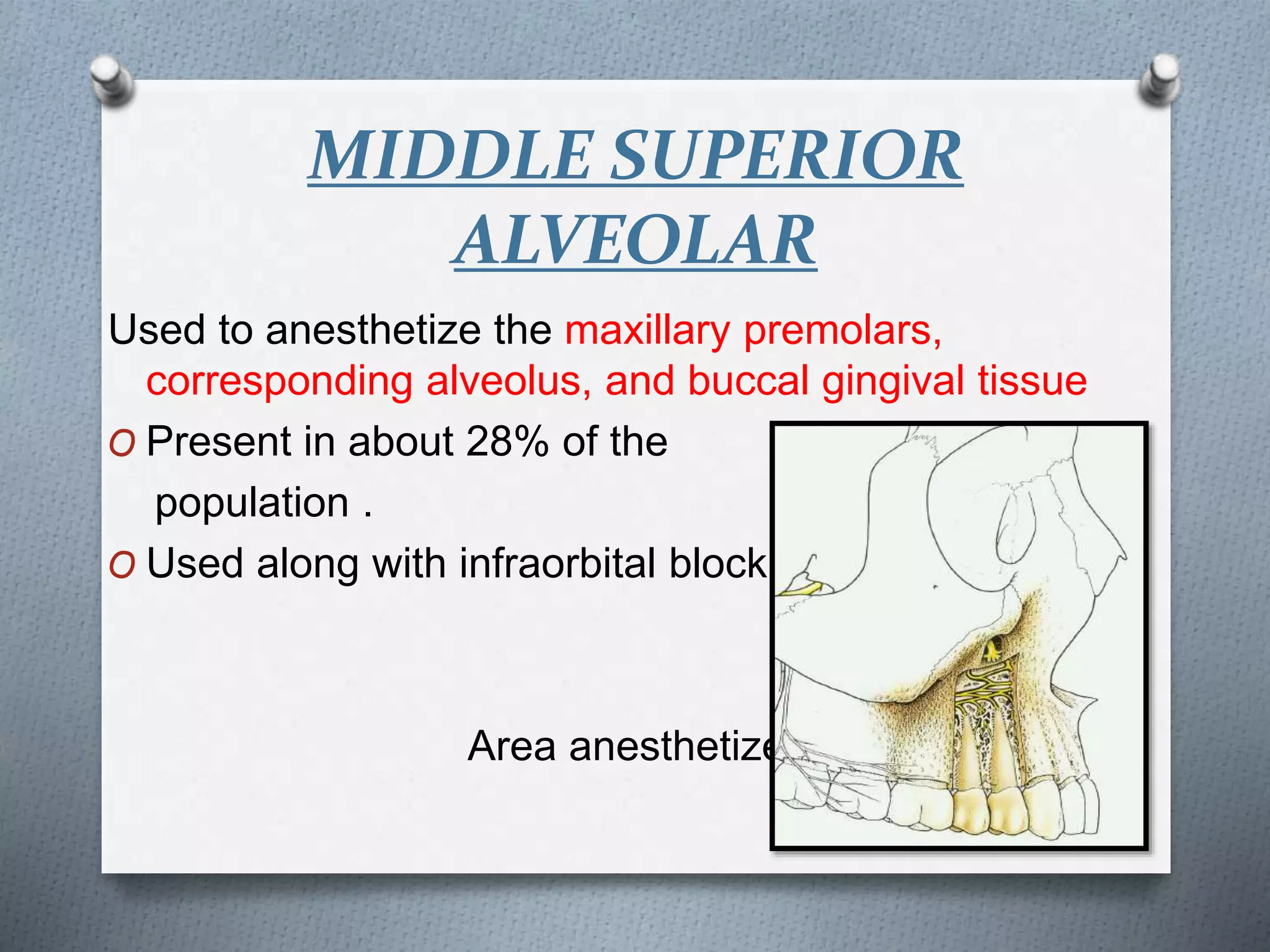
Used to anesthetize the maxillary premolars,
corresponding alveolus, and buccal gingival tissue
O Present in about 28% of the
population .
O Used along with infraorbital block.
Area anesthetized
Indications:
O When infraorbital nerve block fails to provide
pulpal anesthesia distal to the maxillary
canine.
O Dental procedures involving both maxillary
premolars and mesiobuccal root of maxillary
first molar.
Contraindications:
O Infection or inflammation in the area of
injection or needle insertion or drug
deposition.
Advantages:
O Minimizes the number of injections and
volume of solution.
Positive aspiration:
O Negligible (<3%).
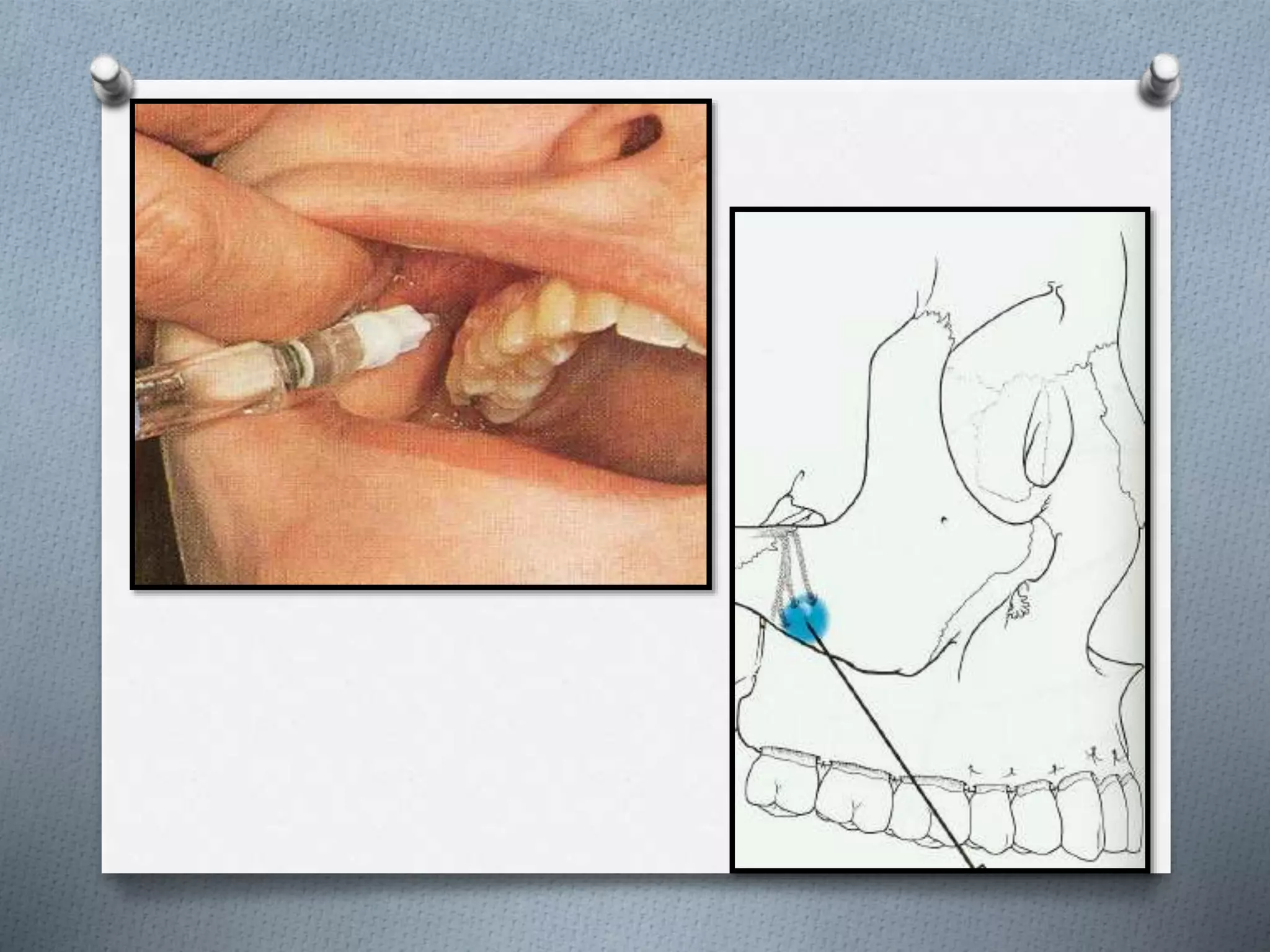
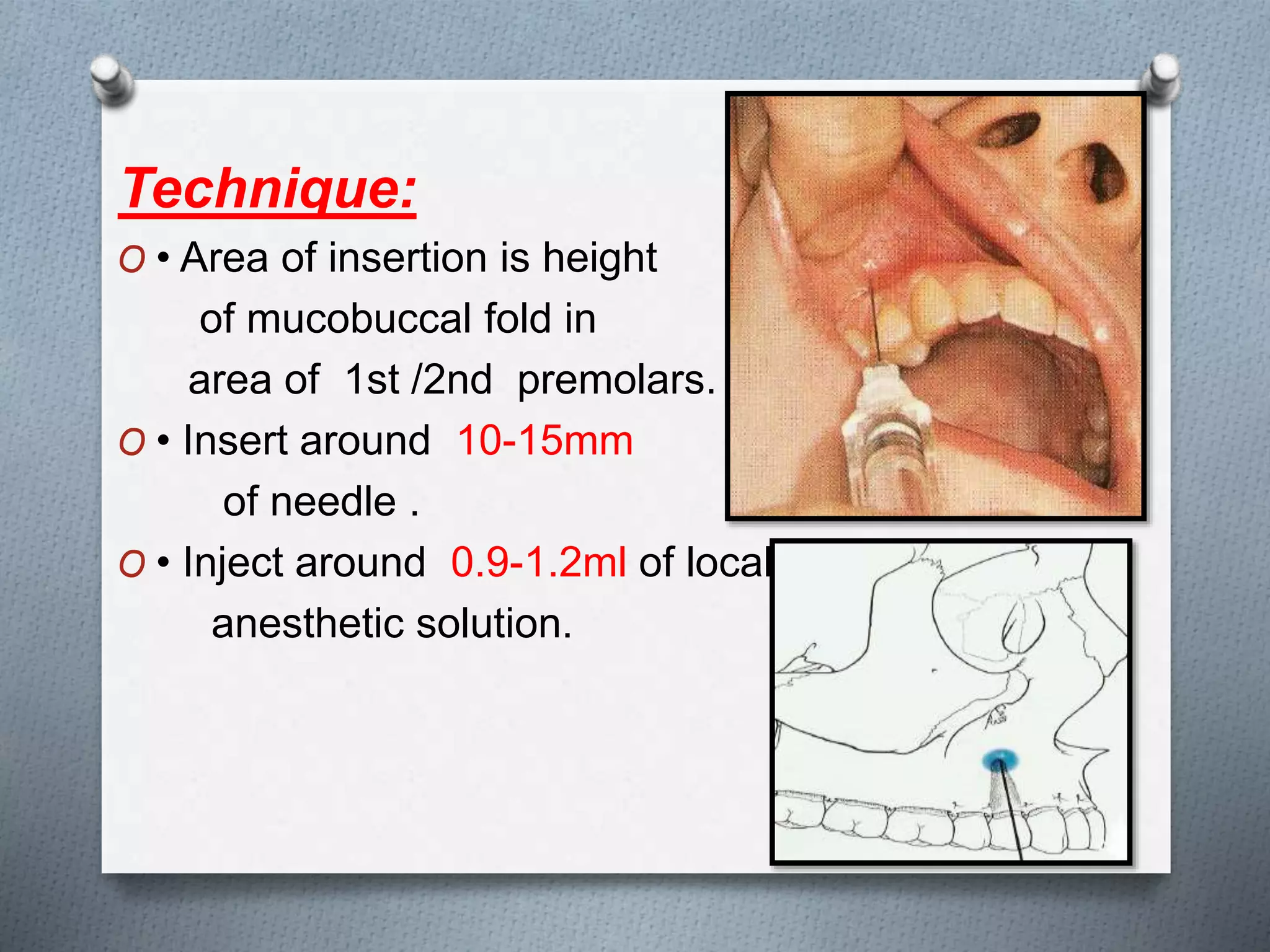
Technique:
O • Area of insertion is height
of mucobuccal fold in
area of 1st /2nd premolars.
O • Insert around 10-15mm
of needle .
O • Inject around 0.9-1.2ml of local
anesthetic solution.
Signs and Symptoms:
Tingling and numbness of upper lip, lower eyelid and side of
nose on the injected side.
O No pain during dental therapy
Failures of Anesthesia:
O Anesthetic solution not deposited high above the apex of the
second premolar.
O Deposition of solution too far from the maxillary bone with the
needle placed in tissues lateral to the height of the
mucobuccal fold.
O Bone of the zygomatic arch at the site of injection preventing
the diffusion of anesthetic.
Complications :
O Quite rare. A hematoma may develop at the site of injection.
Apply pressure with a sterile gauze over the site of swelling
and discoloration for a minimum of 60 seconds.
INFRAORBITAL NERVE
BLOCK
O Used to anesthetize the maxillary 1st and 2nd
premolars, canine, lateral incisor, central incisor,
mesiobuccal root of first molar, corresponding
alveolar bone, soft tissue, upper lip, lower eyelid
and a portion of the nose of same side.
O Combines MSA and ASA blocks
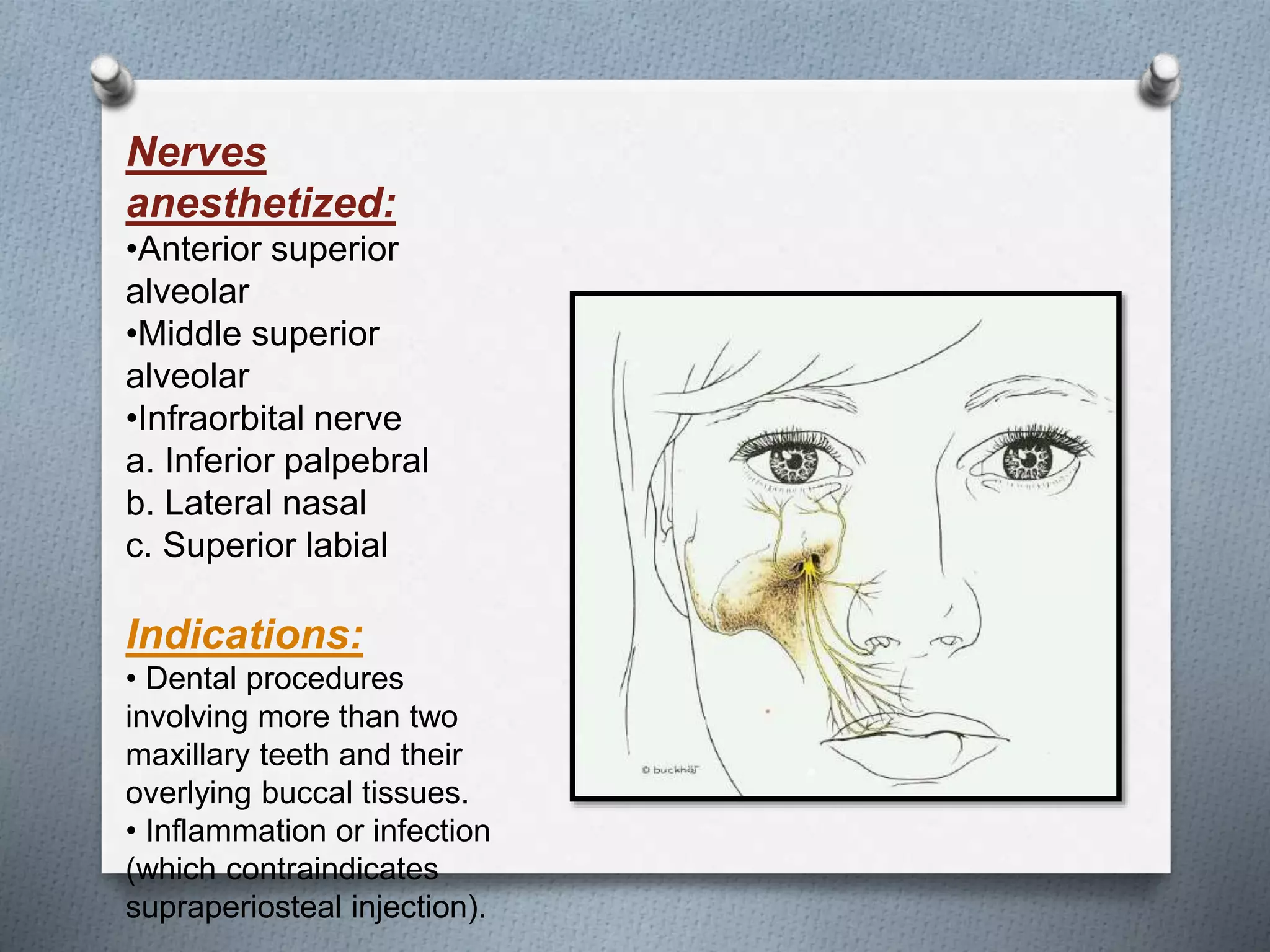
Nerves
anesthetized:
•Anterior superior
alveolar
•Middle superior
alveolar
•Infraorbital nerve
a. Inferior palpebral
b. Lateral nasal
c. Superior labial
Indications:
• Dental procedures
involving more than two
maxillary teeth and their
overlying buccal tissues.
• Inflammation or infection
(which contraindicates
supraperiosteal injection).
Contraindications :
O Discrete treatment areas (one or two teeth only -
supraperiosteal preferred)
O Hemostasis of localized areas, when desirable,
cannot be adequately achieved with this injection.
Positive aspiration: 0.7%
Advantages :
O Comparatively simple technique
O Minimizes the volume of solution used
Disadvantages:
O Psychological: fear
O Anatomical: difficulty defining landmark
Alternatives
O Supraperiosteal or PDL injection of each tooth.
O Infiltration for the periodontium and hard tissues.
O Maxillary nerve block.
ANATOMICAL
LANDMARKS :
O Infraorbital ridge,
O infraorbital depression
O supraorbital notch,
O infraorbital notch,
O anterior teeth and
O pupils of the eyes.
NEEDLE PATHWAY DURING INSERTION:
O Bicuspid approach.
O Central incisor approach
Technique:
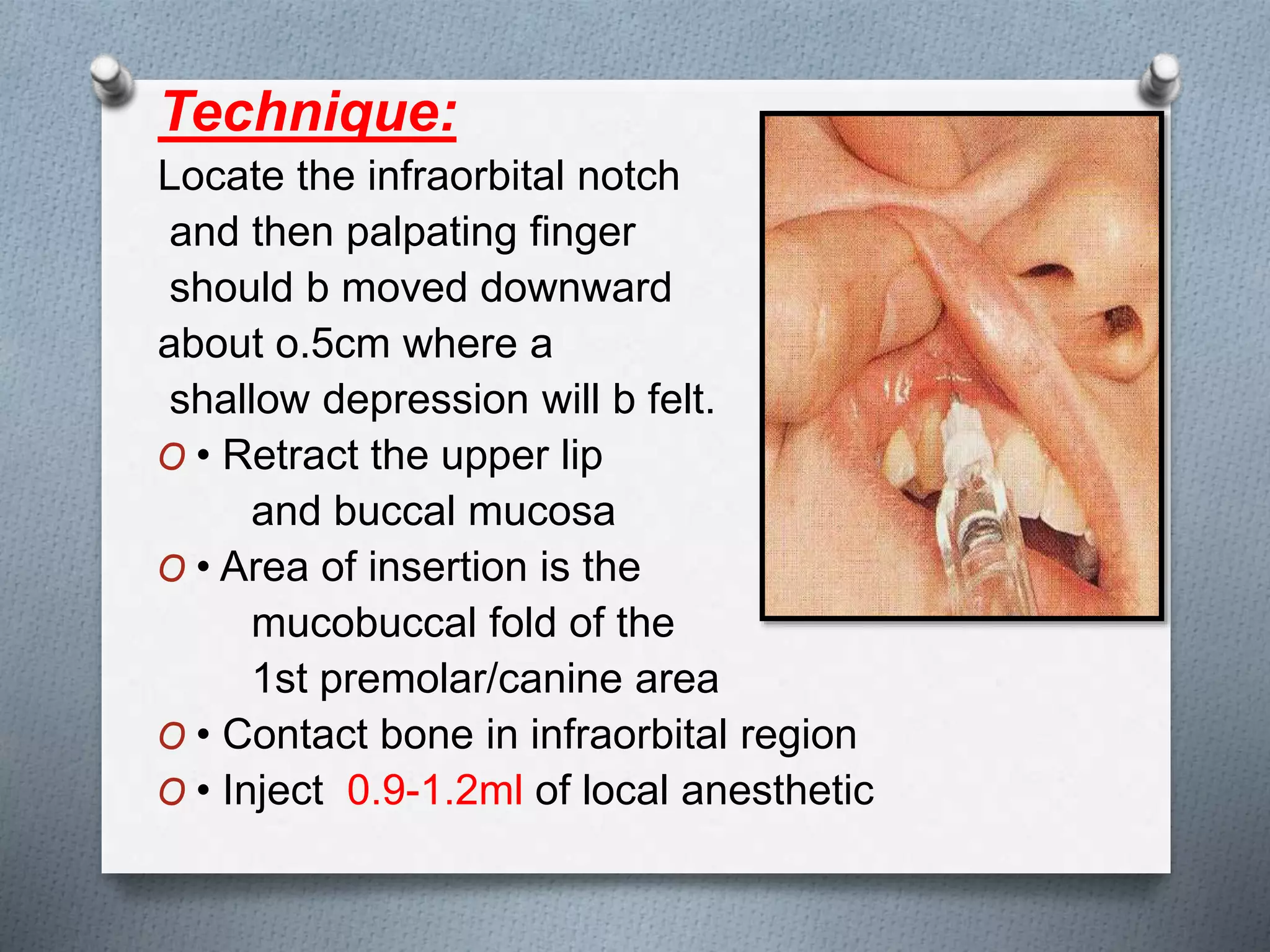
Locate the infraorbital notch
and then palpating finger
should b moved downward
about o.5cm where a
shallow depression will b felt.
O • Retract the upper lip
and buccal mucosa
O • Area of insertion is the
mucobuccal fold of the
1st premolar/canine area
O • Contact bone in infraorbital region
O • Inject 0.9-1.2ml of local anesthetic
Signs and Symptoms:
O Tingling and numbness of upper lip, lower eyelid and side of nose
on the injected side.
O No pain during dental therapy.
O Numbness in teeth and soft tissues along the distribution of ASA
nerve and MSA nerve.
Safety Features:
O Needle contact with bone at the roof of the infraorbital foramen.
O A finger over the infraorbital foramen helps direct the needle
toward die foramen.
Failures of anesthesia:
O Needle contacting bone below (inferior to) the infraorbital
foramen.
O Needle deviation medial or lateral to the infraorbital foramen.
Complications :
O Hematoma (rare) may develop across the lower eyelids and the
tissues between it and the infraorbital foramen. To manage, apply
pressure on the soft tissue over the foramen for 2 to 3 minutes.
GREATER PALATINE NERVE
BLOCK
NERVES ANESTHETIZED : Anterior palatine nerve
as it leaves the greater palatine foramen.
Indications:
O When palatal soft tissue anesthesia is required for
restorative therapy on more than two teeth.
O For pain control during periodontal or oral surgical
procedures involving the palatal soft and hard
tissues.
Contraindications:
O Inflammation or infection at the injection site.
O Smaller areas of therapy (one or two teeth).
AREAS ANESTHETIZED
Posterior portion of the hard palate and overlying
structures up to the first bicuspid area on the side
injected At the first bicuspid area branches of the
nasopalatine nerve will be met.
ANATOMICAL LANDMARKS
a. Second and third maxillary molars.
b. Palatal gingival margin of second and third
maxillary molars.
c. Midline of the palate.
d. A line approximately 1 cm from the palatal
gingival margin toward the midline of the palate.
Technique:
O • Area of insertion is ~1cm
medial from 1st/2nd maxillary molar
on the hard palate.
O The greater palatine foramen is
approached from the opposite side
with 1-inch ,25 gauge needle, which is
kept as near to a right angle as
possible with curvature of the palatine
bone.
O Inject 0.3-0.5ml of local anesthetic
solution.
Signs and Symptoms :
O Numbness in the posterior portion of the palate when
contacted with tongue.
O No pain during dental therapy.
Failures of Anesthesia:
O If local anesthetic is deposited too far anterior to the foramen,
O Anesthesia on the palate in the area of the maxillary first
premolar may prove inadequate because of overlapping
fibers from the nasopalatine nerve.
Complications:
O Ischemia and necrosis of soft tissues when highly
concentrated vasoconstricting solution used for hemostasis
over a prolonged period.
O Hematoma possible but quite rare
O Some patients may be uncomfortable if their soft palate
becomes anesthetized, a distinct possibility when the middle
palatine nerve exists near the injection site.
NASOPALATINE NERVE
BLOCK
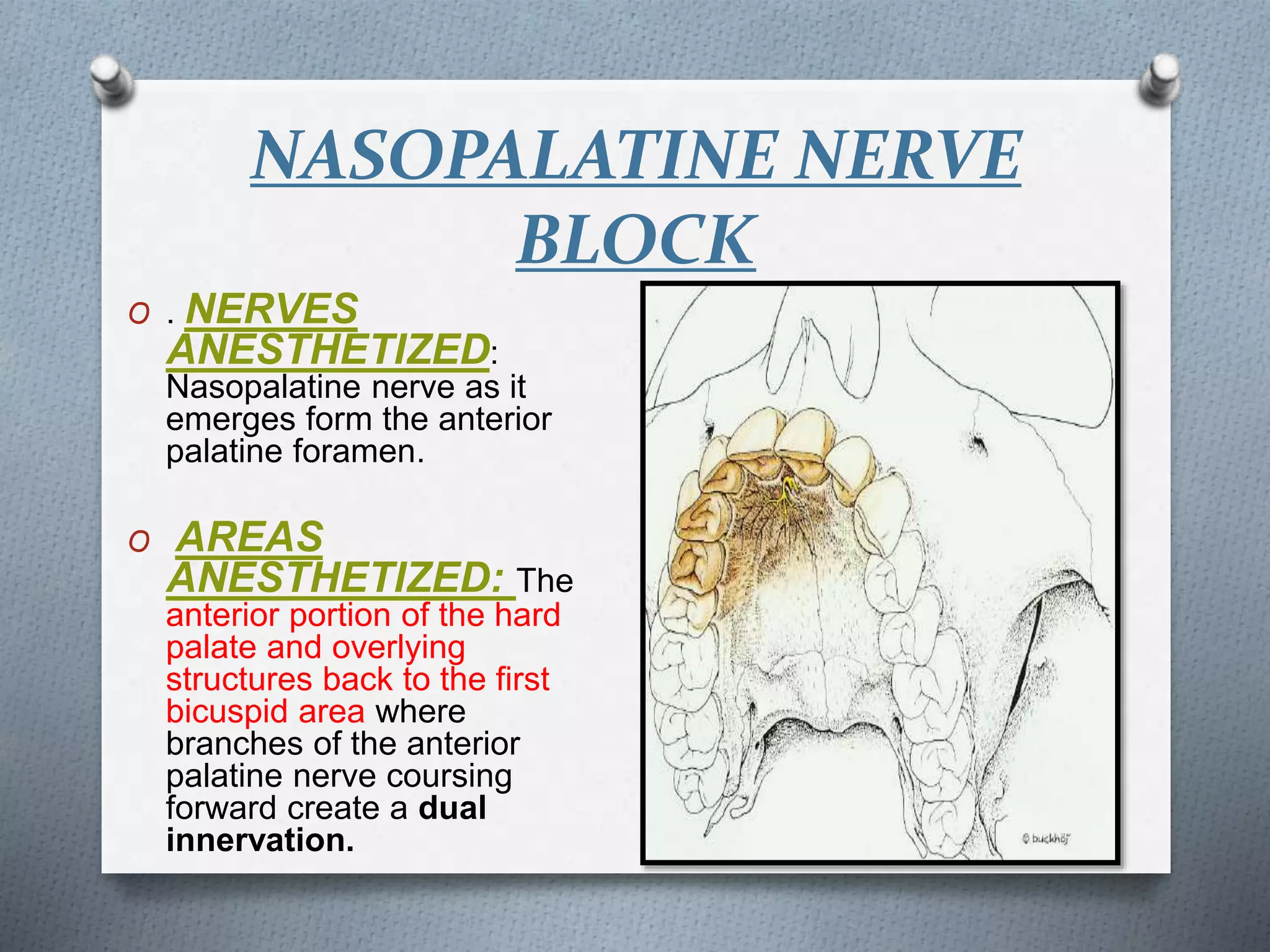
O . NERVES
ANESTHETIZED:
Nasopalatine nerve as it
emerges form the anterior
palatine foramen.
O AREAS
ANESTHETIZED: The
anterior portion of the hard
palate and overlying
structures back to the first
bicuspid area where
branches of the anterior
palatine nerve coursing
forward create a dual
innervation.
Indications:
O When palatal soft tissue anesthesia is
required for restorative therapy on more
than two teeth.
O For pain control during periodontal or oral
surgical procedures involving palatal soft
and had tissues.
Contraindications:
O Inflammation or infection at the injection
site.
O Smaller area of therapy.
ANATOMICAL LANDMARK
O a. Central incisor teeth.
O b. Incisive papilla in the midline of the palate.
Technique:
O • Area of insertion : palatal mucosa just lateral
to the incisive papilla.
O • Depth of penetration is less than 10mm
O • Inject 0.3-0.5ml of local anesthetic solution.
O • Can use pressure over area at time of
injection to decrease pain.
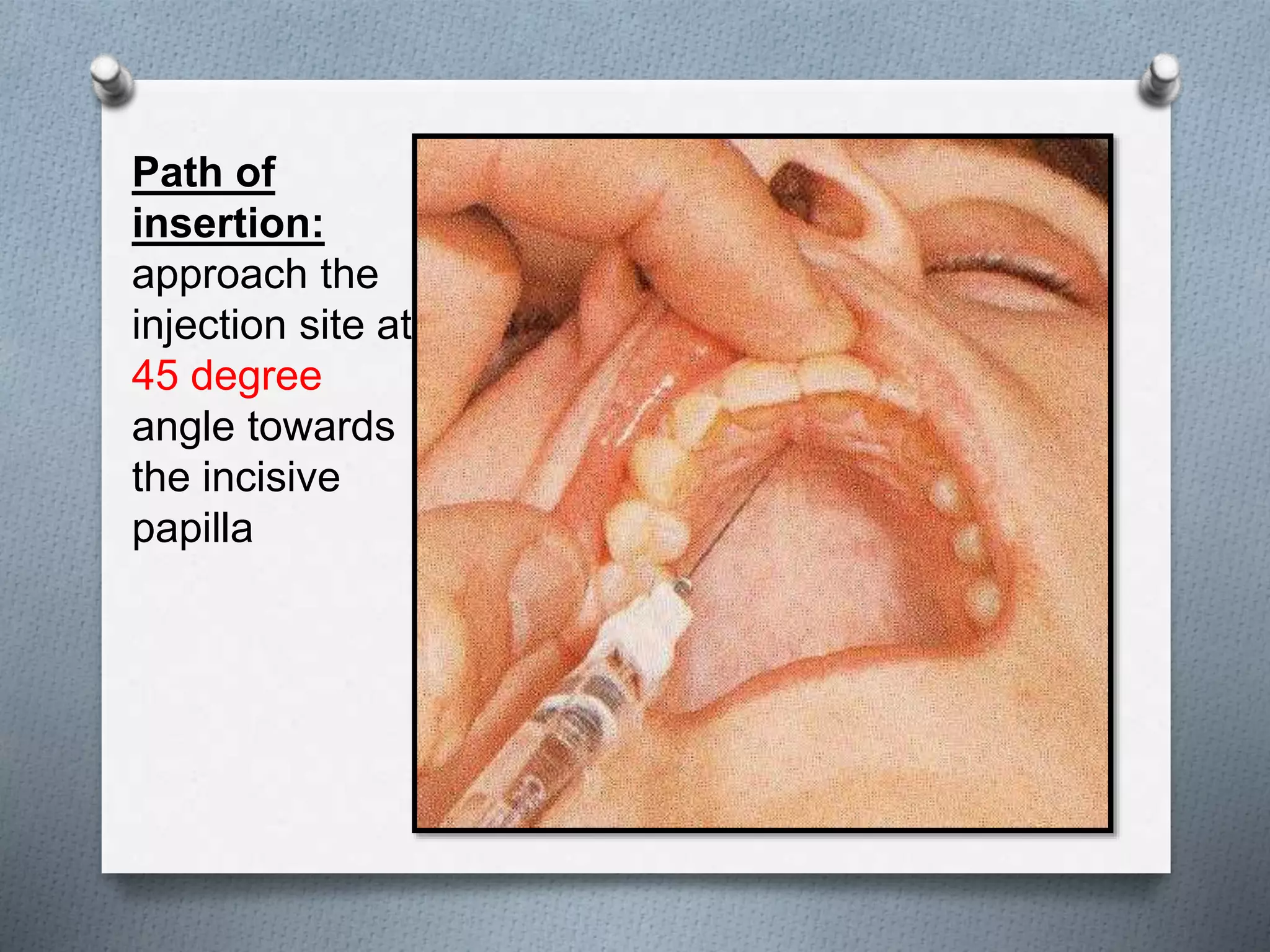
Path of
insertion:
approach the
injection site at
45 degree
angle towards
the incisive
papilla
Advantages:
O Minimizes needle penetrations and volume of solution.
O Minimal patient discomfort from multiple needle
penetrations.
Disadvantages:
O No hemostasis except in the immediate are of injection.
O Potentially the most traumatic intraoral injection.
Positive aspiration: Less than 1%.
Signs and Symptoms:
O Numbness in the anterior portion of the palate when
contacted with tongue.
O No pain during dental therapy
Failures of Anesthesia:
O Unilateral anesthesia
O Inadequate palatal soft tissue anesthesia in the area of
the maxillary canine and first premolar.
O If fibers from the greater palatine nerve overlap those
of the nasopalatine nerve, anesthesia of the soft
tissues palatal to the canine and first premolar could be
inadequate.
Complications:
O Hematoma possible but quite rare
O Necrosis of soft tissues possible when highly
concentrated vasoconstriction solution (e.g.
norepinephrine) is used for hemostasis over a
prolonged period.
O Because of the density of soft tissues, anesthetic
solution may "squirt" back out the needle puncture site
either during administration or after needle withdrawal.
MAXILLARY NERVE BLOCK
NERVES ANESTHETIZED :
Entire maxillary nerve and all its subdivisions
peripheral to the site of the injection
AREAS ANESTHETIZED
a. Maxillary teeth on the affected side
b. Alveolar bone and overlying structures.
c. Hard palate and portions of soft palate.
d. Upper lip, cheek, side of nose and lower eyelid.
ANATOMICAL LANDMARKS
The landmarks will differ according to the technique
used.
O a. High tuberosity technique. Same landmarks as
for the posterior superior alveolar nerve block.
O b. Greater palatine canal technique. Same
landmarks as for locating the greater palatine
foramen to block the anterior palatine nerve.
High tuberosity approach
technique:
O Area of injection is height of mucobuccal fold of
maxillary 2nd molar
O Advance at 45° superior and medial same as in
the PSA block
O Insert needle ~30mm
O Inject 2 to 4 ml of local anesthetic solution
Greater palatine canal technique:
O Area of insertion is greater palatine canal
O Target area is the maxillary nerve in the
pterygopalatine fossa.
O Perform a greater palatine block and wait 3-5
min
O Then insert needle in previous area and pass
the needle into greater palatine foramen.
O Insert to depth of ~30mm
O Inject 2ml of local anesthetic
EXTRAORAL TECHNIQUES
O INFRAORBITAL BLOCK : When the anterior and
middle superior alveolar nerves are to be
anesthetized and the intraoral approach is not
possible because of infection trauma or other
reasons.
Technique:
O Using the available landmarks the dentist should
locate and mark the position of the infraorbital
foramen. The skin and subcutaneous tissues
should be anesthetized by local infiltration.
Anatomical landmarks
Pupil of eye
Infraorbital ridge
Infraorbital notch
Infraorbital depression
MANDIBULAR ANESTHESIA
O Infiltration techniques do not work in the adult
mandible due to the dense cortical bone
O Nerve blocks are utilized to anesthetize the
inferior alveolar, lingual, and buccal nerves
INTRAORAL TECHNIQUES
CLASSICAL INFERIOR
ALVEOALR NERVE
BLOCK:
NERVES ANESTHETIZED:
Inferior alveolar nerve and its
subdivisions mental nerve
,incisive nerve and occasionally
the lingual and buccinator
nerves which are branches of
the mandibular nerve.
AREAS ANESTHETIZED
O a. Body of the mandible and
an inferior portion of the
ramus
O b Mandibular teeth.
O c. Mucous membrane and
underlying tissues anterior to
the first mandibular molar
Indications:
O Procedures on multiple mandibular" teeth in one
quadrant
O When buccal soft tissue anesthesia is required
O When lingual soft tissue anesthesia is required
Contraindications:
O Infection or acute inflammation in the area of
injection
O Patient who might bite either the lip or the tongue -
young child, or physically or mentally handicapped
adult.
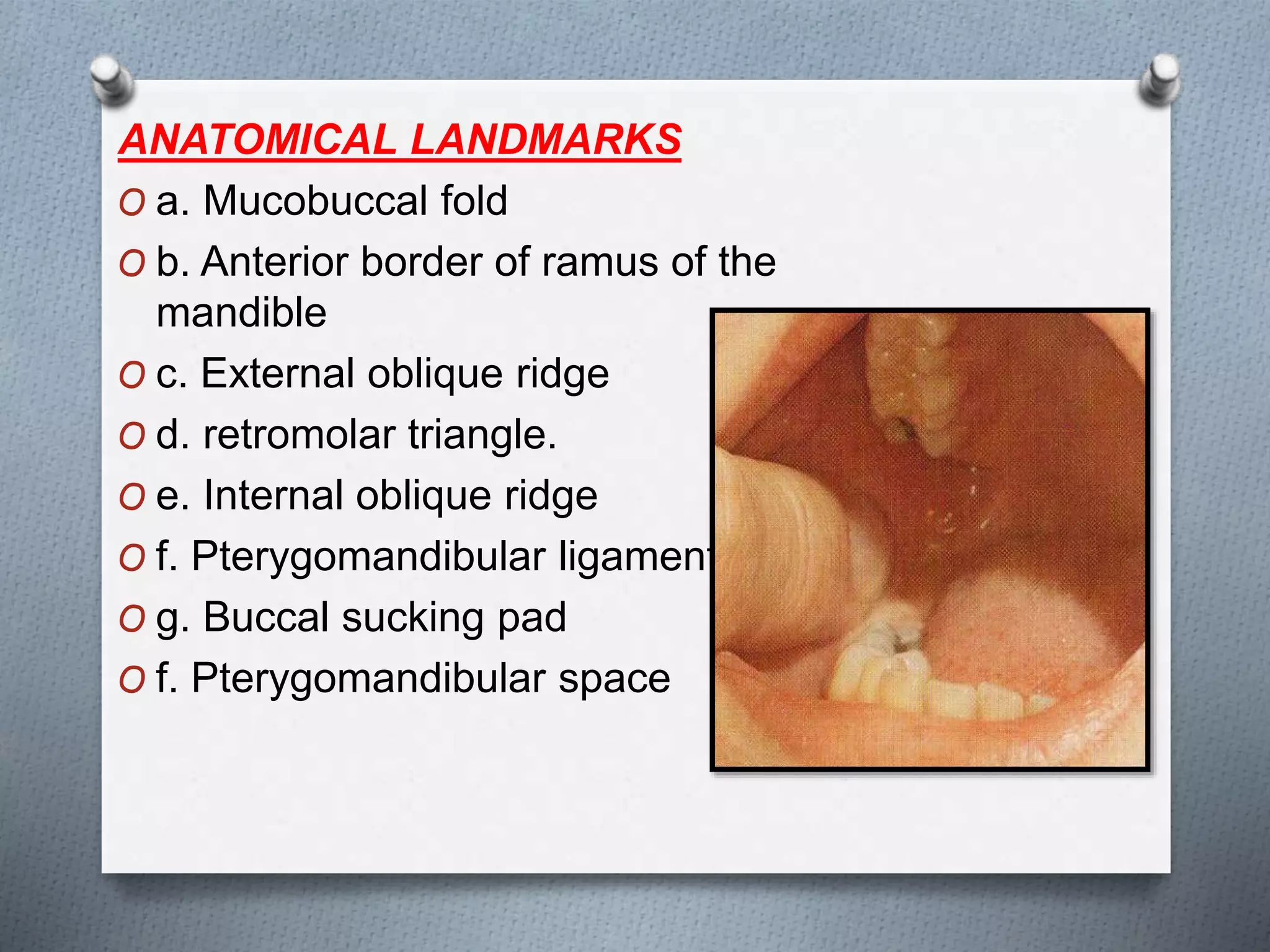
ANATOMICAL LANDMARKS
O a. Mucobuccal fold
O b. Anterior border of ramus of the
mandible
O c. External oblique ridge
O d. retromolar triangle.
O e. Internal oblique ridge
O f. Pterygomandibular ligament
O g. Buccal sucking pad
O f. Pterygomandibular space
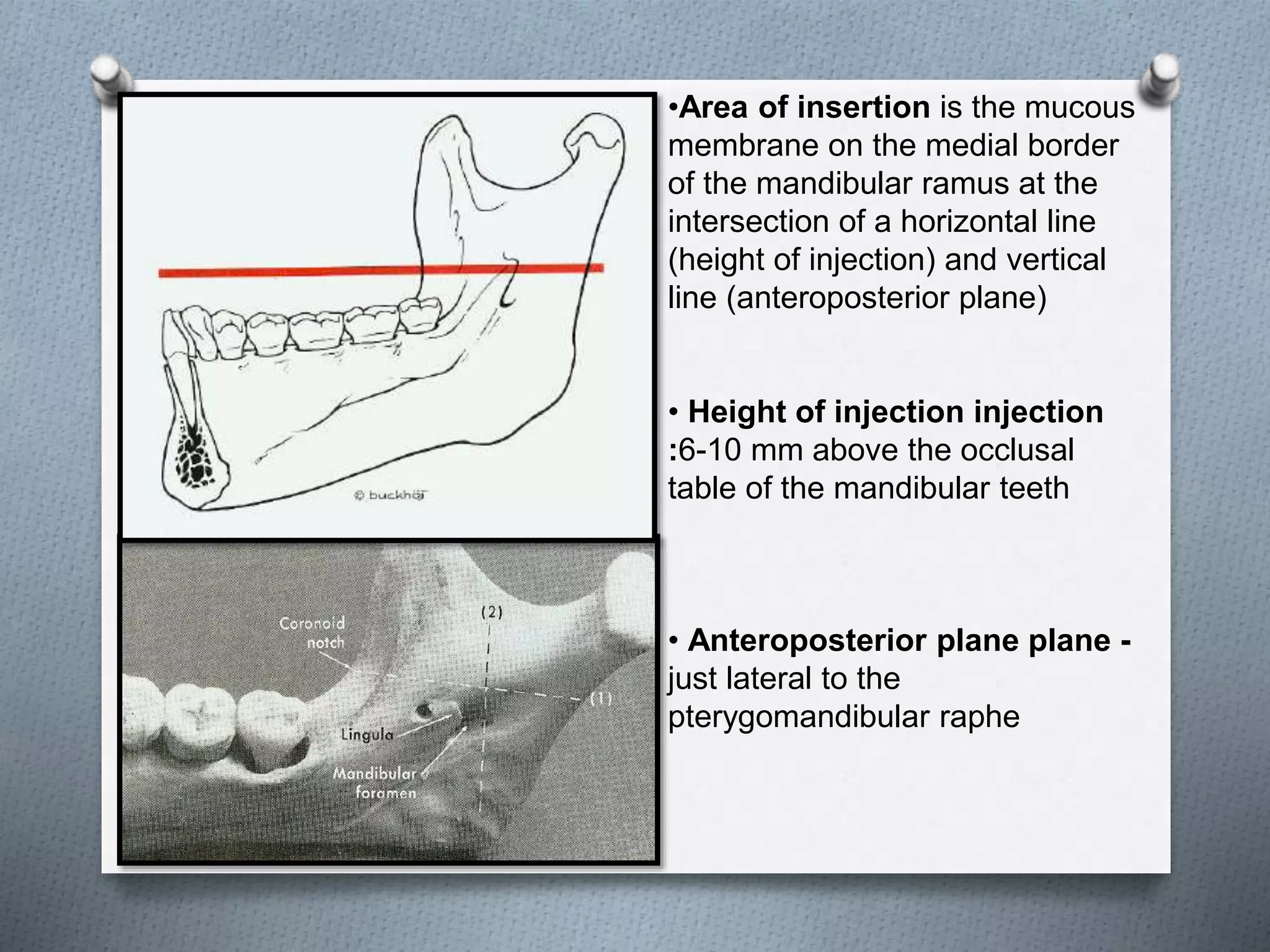
O NEEDLE PATHWAY DURING INSERTION: The
needle passes through mucosa a thin plate of the
buccinator muscle, loose connective tissue and a
variable amount of fat.
•Area of insertion is the mucous
membrane on the medial border
of the mandibular ramus at the
intersection of a horizontal line
(height of injection) and vertical
line (anteroposterior plane)
• Height of injection injection
:6-10 mm above the occlusal
table of the mandibular teeth
• Anteroposterior plane plane -
just lateral to the
pterygomandibular raphe
O Mouth must be open for this technique, best to
utilize mouth prop
O – Depth of injection: 25mm
O – Approach area of injection from contralateral
premolar region.
O – Use the non-dominant hand to retract the
buccal soft tissue (thumb in coronoid notch of
mandible; index finger on posterior border of
extraoral mandible)
O Inject 1- 1.8ml of local anesthetic solution
O – Continue to inject ~0.5ml on removal from
injection site to anesthetize the lingual branch
O – Inject remaining anesthetic into coronoid
notch region of the mandible in the mucous
membrane distal and buccal to most distal
molar to perform a long buccal nerve block
Advantages:
O One injection provides a wide area of anesthesia
Disadvantages:
O Wide area of anesthesia (not necessary for localized
procedures)
O Rate of inadequate anesthesia (15% to 20%).
O Intra oral landmarks not consistently reliable
O Positive aspiration (10 to 15%)
O Lingual and lower lip anesthesia, discomforting to many
patients and possibly dangerous for certain individuals.
O Partial anesthesia possible where a bifid inferior alveolar
nerve and bifid mandibular canals are present.
Symptoms of Anesthesia:
O Tingling and numbers of the lower lip and when the
lingual nerve is affected, the tip of the tongue.
O No pain is felt during dental therapy.
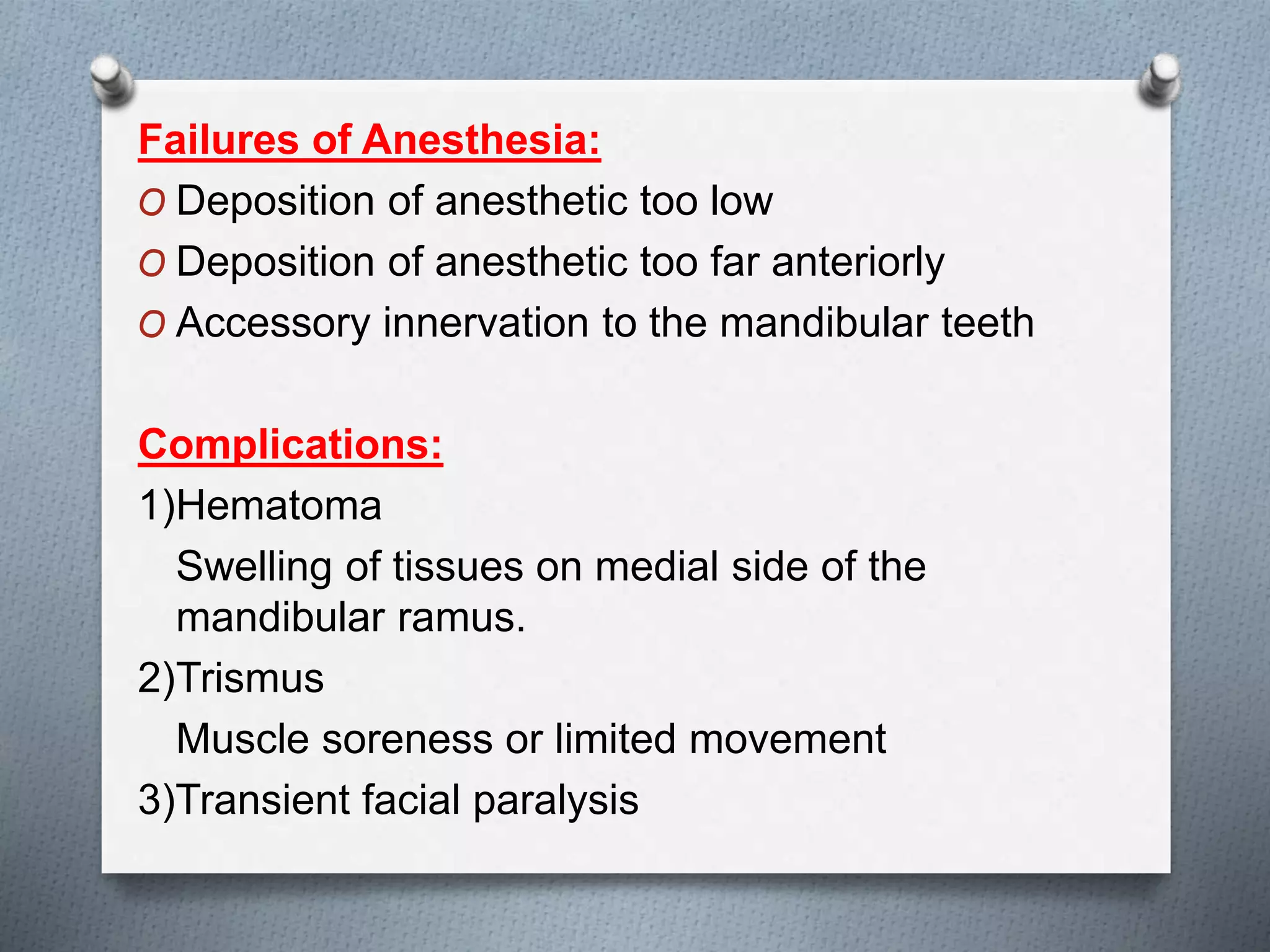
Failures of Anesthesia:
O Deposition of anesthetic too low
O Deposition of anesthetic too far anteriorly
O Accessory innervation to the mandibular teeth
Complications:
1)Hematoma
Swelling of tissues on medial side of the
mandibular ramus.
2)Trismus
Muscle soreness or limited movement
3)Transient facial paralysis
Akinosi closed-mouth mandibular block:
O – Useful technique for infected patients with
trismus, fractured mandibles, mentally handicapped
individuals, children
NERVES ANESTHETIZED: Inferior alveolar and its
subdivisions the mental and incisive nerves plus the
lingual and buccinator nerves which are branches of
the mandibular nerve.
AREAS ANESTHETIZED
O All mandibular hard and soft tissue to the midline
including the floor of the mouth and the anterior
two thirds of the tongue.
Indications:
O Limited mandibular opening
O Multiple procedures on mandibular teeth
O Inability to visualize landmarks for inferior alveolar
nerve block.
Contraindications:
O Infection or acute inflammation in the area.
O Patient who might bite either their lip or tongue.
O Inability to visualize or gain access to the lingual
aspect of the ramus.
ADVANTAGES
1. Atraumatic
2. Patient neet not be able to open the mouth
3. Few post-operative complication e.g trismus
DISADVANTAGES
1. Difficult to visualise the path of the needle and the depth of
insertion.
2. No bony contact
3. Potientially traumatic if needle is too close to periosteum.
ANATOMICAL LANDMARKS
O Occlusal plane of occluding teeth.
O Mucogingival junction of the maxillary molar teeth.
O Anterior border of the ramus.
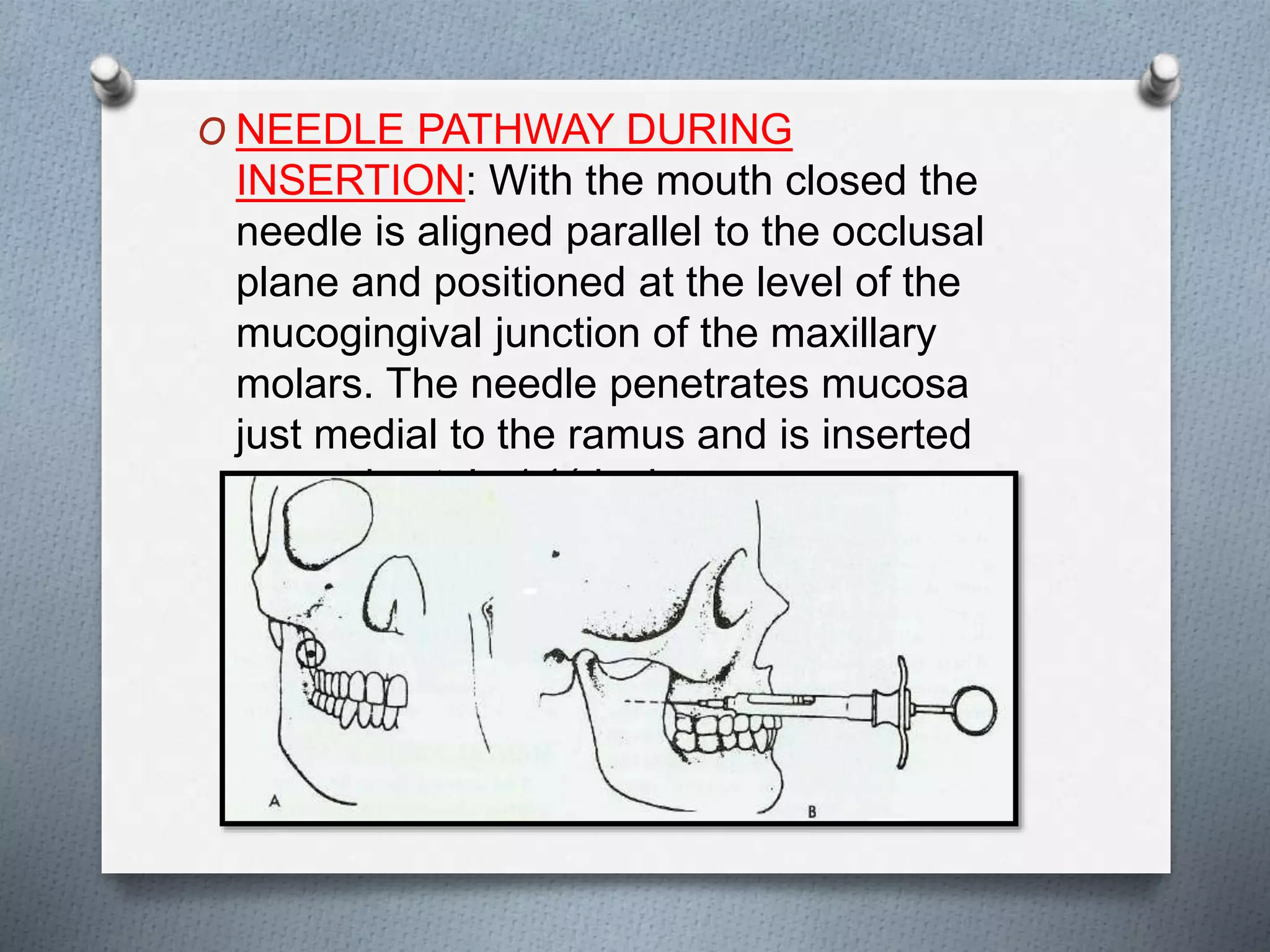
O NEEDLE PATHWAY DURING
INSERTION: With the mouth closed the
needle is aligned parallel to the occlusal
plane and positioned at the level of the
mucogingival junction of the maxillary
molars. The needle penetrates mucosa
just medial to the ramus and is inserted
approximately 1 ¼ inches.
MANDIBULAR NERVE BLOCK
O DESCRIBED BY GOW GATES IN 1973
O NERVES ANESTHETIZED: Mandibular nerve and
its subdivisions including the inferior alveolar,
lingual, buccinator, incisive, mental, mylohyoid. and
auriculotemporal nerves.
O AREA ANESTHETIZED: All mandibular hard and
soft tissues to the midline including the floor of the
mouth and the anterior two thirds of the tongue, the
lingual soft tissue and periosteum, the skin over the
zygoma, the posterior portion of the cheek, the
temporal region and a portion of the external ear.
Indications:
O Multiple procedures on mandibular teeth
O When buccal soft tissue anesthesia, from the third
molar to the midline, is required.
O When lingual soft tissue anesthesia is required
O When a conventional inferior alveolar nerve block is
unsuccessful
Contraindications:
O Infection or acute inflammation in the area of
injection.
O Patients who might bite either their lip or their
tongue, such as young children and physically or
mentally handicapped adults.
O Patients who are unable to open their mouth wide.
Advantages:
O Requires only one injection.
O High success rate (>95%), with experience.
O Minimum aspiration rate.
O Few post injection complications (i.e. trismus).
O Provides successful anesthesia where a bifid inferior
alveolar nerve and bifid mandibular canals are present.
Disadvantages:
O Lingual and lower lip anesthesia is uncomfortable for
many patients.
O The time to onset of anesthesia is relatively longer (5
min).
O Clinical experience is required in order to learn the
technique.
Positive Aspiration: 2%
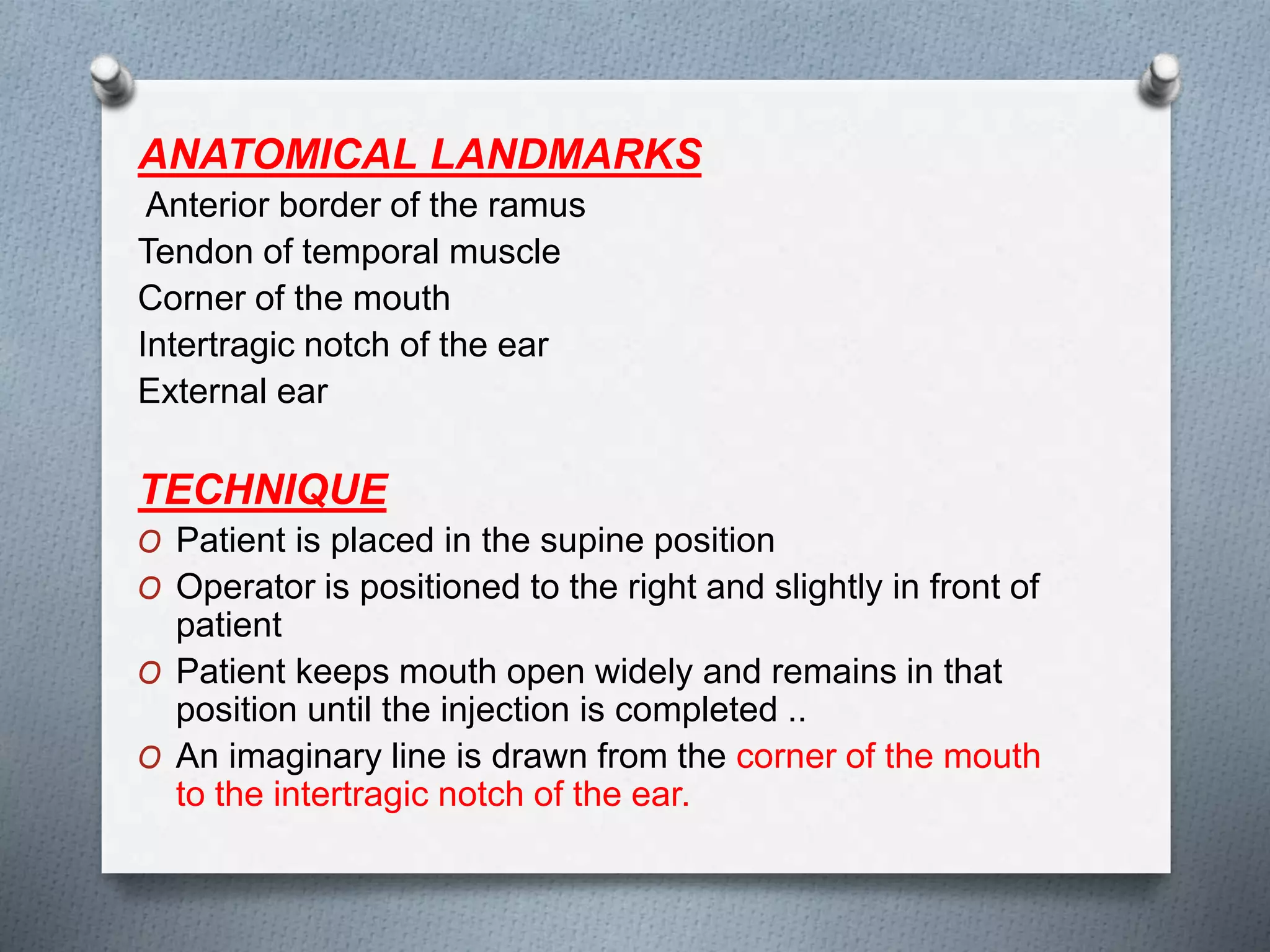
ANATOMICAL LANDMARKS
Anterior border of the ramus
Tendon of temporal muscle
Corner of the mouth
Intertragic notch of the ear
External ear
TECHNIQUE
O Patient is placed in the supine position
O Operator is positioned to the right and slightly in front of
patient
O Patient keeps mouth open widely and remains in that
position until the injection is completed ..
O An imaginary line is drawn from the corner of the mouth
to the intertragic notch of the ear.
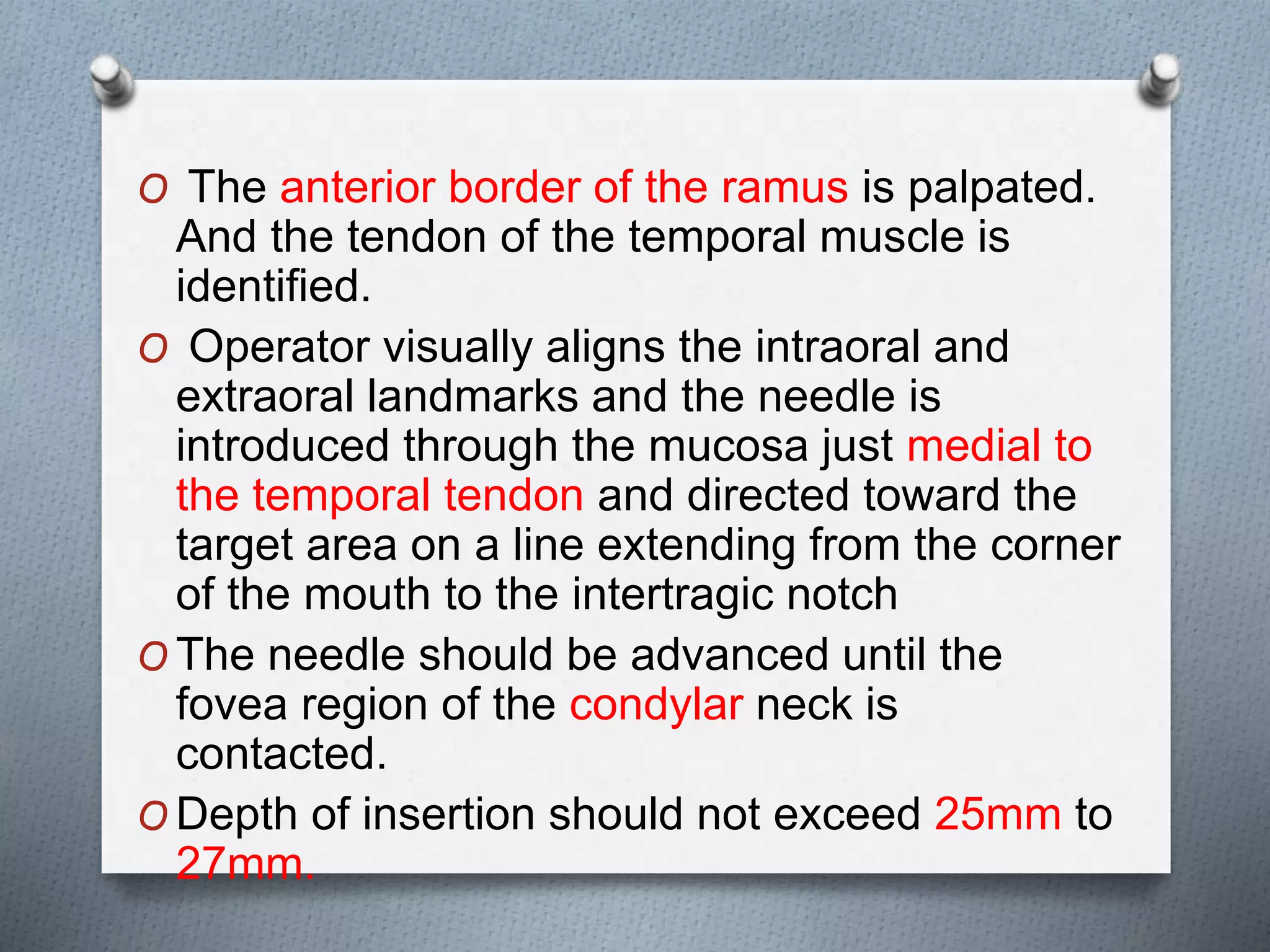
O The anterior border of the ramus is palpated.
And the tendon of the temporal muscle is
identified.
O Operator visually aligns the intraoral and
extraoral landmarks and the needle is
introduced through the mucosa just medial to
the temporal tendon and directed toward the
target area on a line extending from the corner
of the mouth to the intertragic notch
O The needle should be advanced until the
fovea region of the condylar neck is
contacted.
O Depth of insertion should not exceed 25mm to
27mm.
Signs and Symptoms:
O Tingling or numbness of the lower lip indicates anesthesia of the
mental nerve, a terminal branch of the inferior alveolar nerve. It is
also a good indication that the inferior alveolar nerve may be
anesthetized.
O Tingling or numbness of the tongue indicates anesthesia of the
lingual nerve a branch of the posterior division of the mandibular
nerve. It is always present in a successful Gow Gates mandibular
block.
O No pain is felt during dental therapy.
Failures of Anesthesia:
O Too little volume. The greater diameter of the mandibular nerve
may require a larger volume of anesthetic solution.
O Anatomical difficulties. Do not deposit anesthetic unless bone is
contacted
Complications:
O Hematoma (<2% incidence of positive aspiration)
O Trismus (extremely rare)
O Temporary paralysis of cranial nerves III, IV and VI
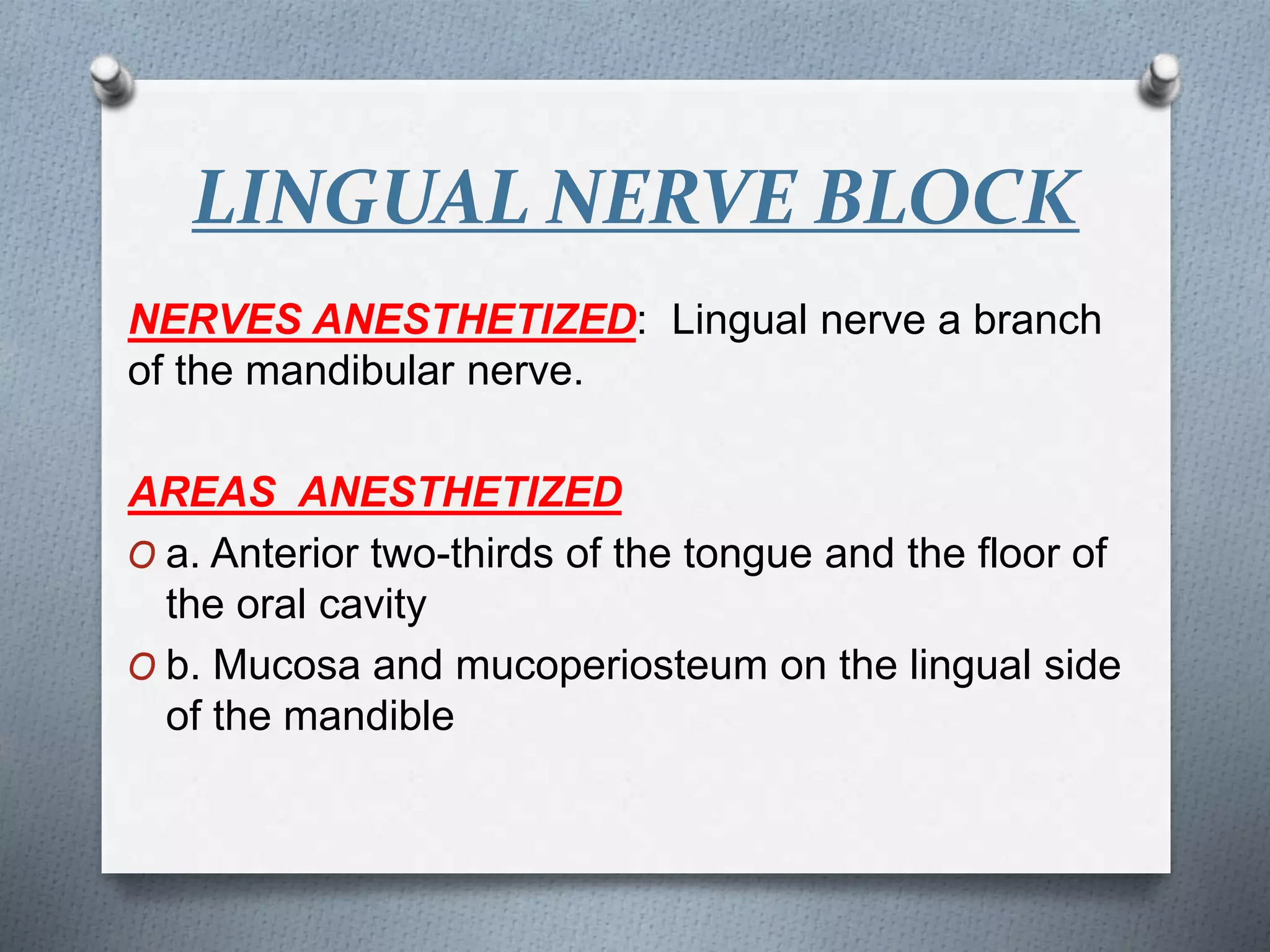
LINGUAL NERVE BLOCK
NERVES ANESTHETIZED: Lingual nerve a branch
of the mandibular nerve.
AREAS ANESTHETIZED
O a. Anterior two-thirds of the tongue and the floor of
the oral cavity
O b. Mucosa and mucoperiosteum on the lingual side
of the mandible
ANATOMICAL LANDMARKS:
O The landmarks are the same as those for the
inferior alveolar nerve
TECHNIQUE:
O The technique is the same as that for the inferior
alveolar nerve as previously described.
SYMPTOMS OF ANESTHESIA:
O Subjective symptoms: Tingling and numbness of
anterior two thirds of the tongue.
O Objective symptoms: Instrumentation necessary to
demonstrate absence of pain sensation.
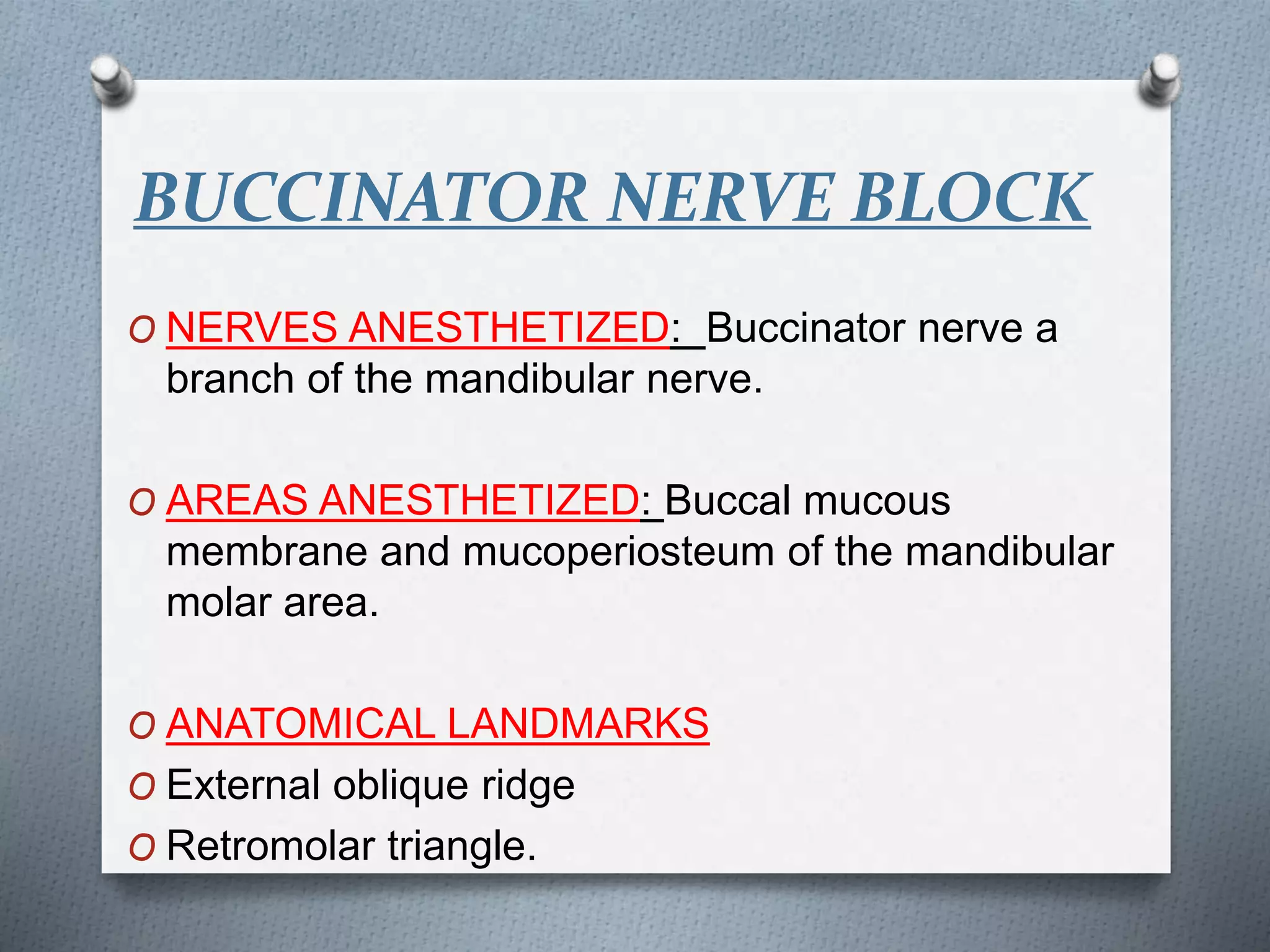
BUCCINATOR NERVE BLOCK
O NERVES ANESTHETIZED: Buccinator nerve a
branch of the mandibular nerve.
O AREAS ANESTHETIZED: Buccal mucous
membrane and mucoperiosteum of the mandibular
molar area.
O ANATOMICAL LANDMARKS
O External oblique ridge
O Retromolar triangle.
TECHNIQUE:
O A 1 inch 25 gauge needle is inserted into the
buccal mucosa just distal to the third molar
and 0.25to 0.5 ml of solution is deposited in
this area. An alternative technique is to insert
the needle and deposit the solution directly
into the retromolar triangle.
O SYMPTOMS:
No subjective symptoms therfore must be
tested by instrumentation.
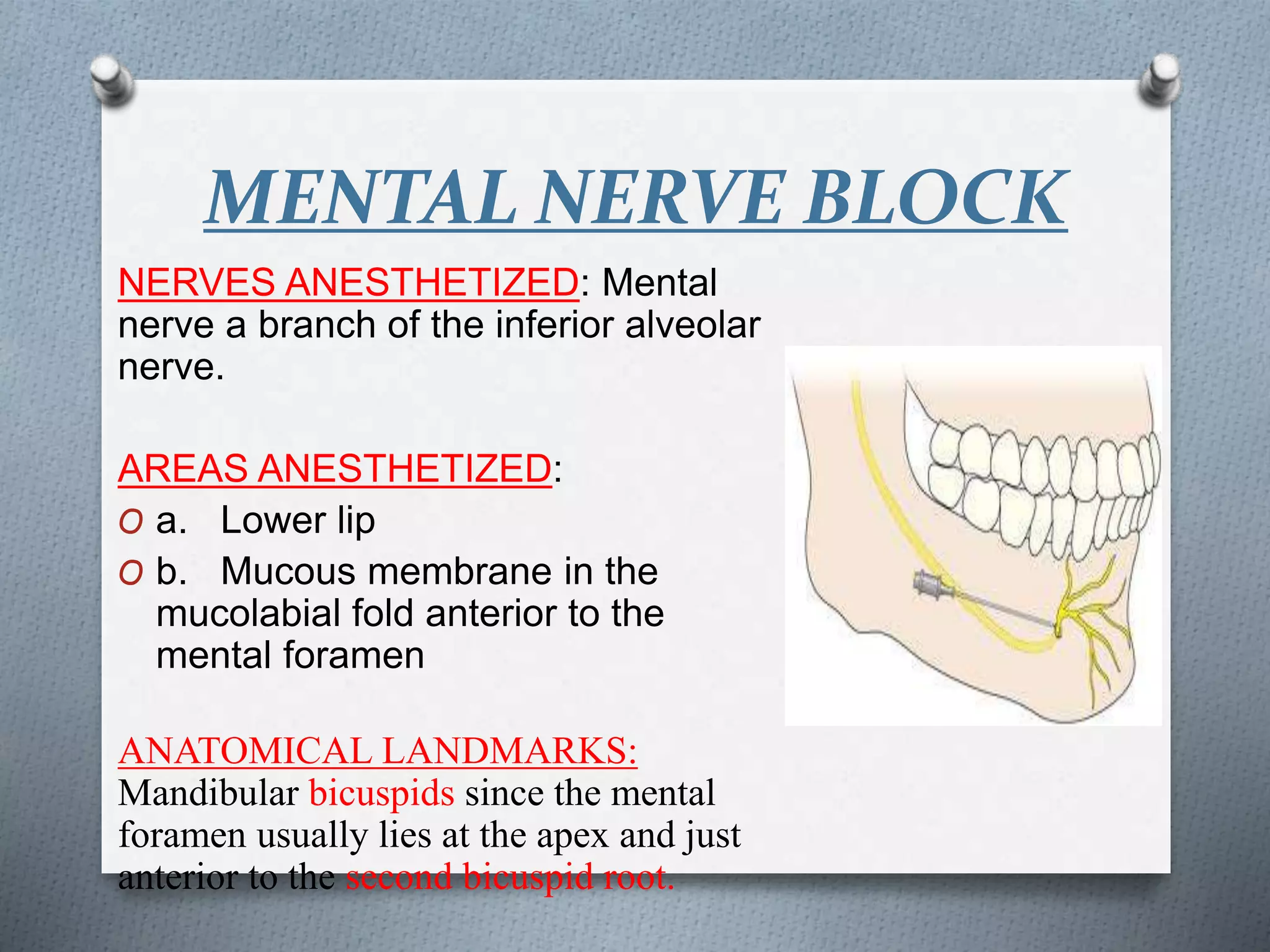
MENTAL NERVE BLOCK
NERVES ANESTHETIZED: Mental
nerve a branch of the inferior alveolar
nerve.
AREAS ANESTHETIZED:
O a. Lower lip
O b. Mucous membrane in the
mucolabial fold anterior to the
mental foramen
ANATOMICAL LANDMARKS:
Mandibular bicuspids since the mental
foramen usually lies at the apex and just
anterior to the second bicuspid root.
Technique:
O • Area of injection
mucobuccal fold at or
anterior to the mental
foramen. This lies between
the mandibular premolars
O • Depth of injection 5-
6mm
O • Inject 0.5-1.0ml of local
anesthesia
O • Massage local
anesthesia into tissue to
manipulate into mental
foramen to anesthetize the
incisive branch.
Indication:
O When buccal soft tissue anesthesia is required
for procedures in mandibular area anterior to the
mental foramen (in case IANB is not indicated).
Contraindications:
O Infection or acute inflammation in the area of
injection.
Advantages:
O High success rate
O Technically easy
Disadvantages:
O Hematoma
Positive aspiration:
5.7%.
Signs and Symptoms:
O Tingling and
numbness of the lower
lip on the injected side.
O No pain during
treatment.
Complications
O 1. Hematoma
INCISIVE NERVE BLOCK
NERVES ANESTHETIZED
a. Incisive nerve
b. Mental nerve
AREAS ANESTHETIZED
a. Mandible and overlying labial structures anterior to
the mental foramen
b. Bicuspids, cuspids and incisors on the affected
side.
c. Lower lip on the affected side.
Indications:
O Dental procedures requiring pulpal anesthesia on
mandibular teeth anterior to the mental foramen
O When inferior alveolar nerve block is not indicated
O When six or eight anterior teeth (e.g. canine to
canine a premolar to premolar) are treated, the
incisive nerve block is recommended in place of
bilateral inferior alveolar nerve blocks.
Contraindications:
O Infection or acute inflammation in the area of
injection.
Advantages:
O Provides pulpal and hard tissue anesthesia
without lingual anesthesia.
Disadvantages:
O Does not provide lingual anesthesia. The lingual tissues must be
injected directly if anesthesia is desired.
O Partial anesthesia may develop at the midline because of nerve fiber
overlap with the opposite side.
Positive aspiration: 5.7%.
Signs and symptoms:
O Tingling and numbness of the lower lip on the injected side.
O No pain during dental therapy.
Failures of anesthesia:
O Inadequate volume of anesthetic solution in the mental foramen.
O Inadequate duration of pressure following injection. It is necessary to
apply firm pressure over the injection site for a minimum of 2 minutes
in order to force anesthetic solution into the mental foramen and to
provide anesthesia of the second premolar, which lies distal to the
foramen.
Complications:
O Hematoma
TECHNIQUE:
O The technique is the same as that for the mental
nerve block. except the needle point should
penetrate into the mental foramen to anesthetize
the incisive nerve adequately. The mental nerve
will automatically be anesthetized at the same
time
EXTRAORAL TECHNIQUE
A) MANDIBULAR NERVE
BLOCK
B) MENTAL NERVE BLOCK
MANDIBULAR NERVE BLOCK
INDICATIONS:
O a. When it is desirable to anesthetize the entire
mandibular nerve and its subdivisions with one
needle insertion and a minimum of anesthetic solution.
O b. When infection or trauma makes anesthesia of the
nerve's subdivisions difficult or impossible.
O c. Diagnostic or therapeutic purposes.
TECHNIQUE
O : The technique is essentially the same as that
used for the block of the maxillary nerve with the
exception that a marker is placed on the needle at
a measured distance of 5 cm .After the needle
contacts the lateral pterygoid plate. It is withdrawn
exactly as in the maxillary block however when
reinserted the needle is directed upward and
slightly posteriorly so that the needle will pass
posterior to the lateral pterygoid plate.
MENTAL NERVE BLOCK
O INDICATIONS: When anesthesia of the mandibular
teeth and labial and buccal supporting structures
anterior to the mental foramen or lower lip is desired
and a block of the inferior alveolar nerve is
contraindicated.
O STRUCTURES INNERVATING:
O Skin
O Subcutaneous tissue
O Triangularis muscle.
O a. The patient should close the mouth in a normal
position and look straightforward.
O b. The supraorbital notch and the infraorbital notch
are palpated and located.
O c With the patient looking straightforward. an
imaginary line drawn from the supraobital notch or
foramen through the pupil of the eye and the
infraorbital notch or foramen if continued
downward pass through the mental foramen
O d. The midway point between the lower border of
the mandible and the gingival margin is estimated
and marked on the imaginary line as previously
stated. This locate the mental foramen.
O e. After this a 2 inch 22 gauge needle is
introduced in a slightly anterior and downward
direction. With gentle probing, the mental
foramen should be located and 1 ml of
anesthetic solution is given.
O Defined as any deviation from the normally expected
pattern during or after the securing of regional
analgesia.
These complications may be classified:
O Primary or secondary.
O Mild or severe.
O Transient or permanent.
Complications may be further divided into two
groups:
I. Those resulting from absorption of the anesthetic
solution.
II. Those attributed to the insertion of the needle
1.Those resulting from absorption of the
anesthetic solution.
O Toxicity.
O Idiosyncrasy.
O Allergy.
O Anaphylactoid reaction
O Infection caused by contamination.
O Local irritation or tissue reactions caused by
solution.
2. Complications attributed due to the insertion
of the needle.
Syncope
Muscle trismus
Pain or hyperalgesia
Edema
Infections
Broken needle
Prolonged anesthesia other than from the anesthetic
solution
Hematoma
Sloughing
O Manifested as the result of overdosage or excessive
administration of a drug.
Patient Factors:
O Age.
O Weight.
O Other drugs.
O Sex.
O Presence of disease.
O Genetics.
O Mental attitude and environment.
Drug Factors:
• Vasoactivity
• Concentration
• Dose
• Route of administration
• Rate of injection
• Vascularity of the injection site
• Presence of vasoconstrictors
Causes:
O Sufficiently high blood stream level to affect vital
centers
O Inadvertent intravascular injection usually coupled with
too rapid deposition of the solution.
O Too large quantity of solution is deposited.
O Too great percentage strength
O Rapid absorption into the bloodstream
O Slow biotransformation
O Slow elimination
Symptoms:
O Usually early central nervous system stimulation
followed by a proportionate degree of depression, (on
occasion central nervous system depression may
appear as the first sign of toxicity).
Cerebral cortical
stimulation
a. Talkativeness
b. Restlessness
c. Apprehension
d. Excitement
e. Convulsions
Medullary stimulation:
Increased blood
pressure
Increased pulse rate
Increased, respiration
Possible nausea and
vomiting
Cerebral cortical
depression
O Lethargy
O Sleepiness
O Unconsciousness
Medullary depression will
usually occur in proportion to
the amount of
medullary stimulation:
• Blood pressure may remain
normal in mild cases or
drop to zero in severe
cases.
• Pulse may range from
normal to weak, thready, or
absent.
• Respiratory changes may
be slight, or the patient may
become apnoeic
MANAGEMENT
O Reassure the patient
O Administer oxygen
O Monitor vital signs
O Administer an anticonvulsant. If venipuncture can be
performed, titrate 5 mg of diazepam/minute until the
clinical signs and symptoms of overdose subside.
O Summon medical assistance. Monitoring the patient's
condition and adhering to the steps of basic life support
are adequate.
O After termination of the reaction, be sure that the patient is
examined by a physician to determine possible causes of
this reaction.
O Do not let the patient leave the dental office alone.
Arrangements should be made for an adult companion.
O Determine the cause of the reaction before proceeding
with therapy requiring additional local anesthetics.
Prevention:
O Aspiration must be performed before injection.
O The smallest possible volume of drug should
be used.
O The weakest efficient percentage strength of
the drug should be used.
O A vasoconstrictor should be employed with the
local anesthetic if not contraindicated.
O The solution should be deposited slowly.
ALLERGY
O Drug allergy is defined as a specific type of hypersensitivity to a drug
or chemical compound brought about by an alteration in the body’s
reaction to an antigenic substance
Signs and Symptoms:
O Dermatological: urticaria and angioedema
O Respiratory Reactions:
O Bronchospasm
O Respiratory distress
O Dyspnea
O Wheezing
O Flushing
O Cyanosis
O Perspiration
O Tachycardia
O Increased anxiety
Generalized Anaphylaxis:
O The most dramatic and acutely life threatening allergic reaction
is generalized anaphylaxis. Clinical death can occur within a few
minutes.
O In fatal anaphylaxis, respiratory and cardiovascular
disturbances predominate and are evident early in the reaction.
Immediate Skin Reactions: Administer IM histamine
blocker; 50 mg diphenhydramine and observe the
patient for 60 min for recurrence.
Bronchial constriction (bronchospasm): Administer
epnephrine or other appropriate bronchodilator via
aerosol inhaler. IM/SC injection 0.3 mg of epinephrine.
Prescribe an oral histamine blocker and complete a
thorough allergy evaluation before subsequent dental
therapy.
O bizarre type of reaction that cannot be classified as
toxic or allergic.
O unknown cause.
O Syncope or fainting is most frequent complication
with local anesthesia.
O This is a form of neurogenic shock and is caused by
cerebral ischemia secondary to a vasodilation or an
increase in the peripheral vascular bed with
corresponding drop in blood pressure.
Predisposing Factors: Psychogenic factors:
O Fright
O Anxiety
O Emotional stress
O Pain, especially of a sudden and unexpected
nature
O The sight of blood or of surgical or other dental
instruments (such as a local anesthetic syringe).
Non-psychogenic factors:
O Sitting in an upright position or standing
O Hunger from dieting or a missed meal
O Exhaustion
O Poor physical condition
O Hot, humid, crowded environment
Clinical Manifestations:
O Feeling of warmth
O pale or ashen-gray skin tone
O Heavy perspiration
O Complaints of feeling "bad" or "faint"
O Nausea
O Blood pressure approximately at baseline
O Tachycardia
O Pupillary dilation
O Yawning
O Hyperpnea
O Coldness in hands and feet
O Hypotension
O Bradycardia
O Visual disturbances
O Dizziness
O Loss of consciousness
O Assess consciousness.
O Position the patient. Placing the patient in the supine
position. A slight elevation of the legs will increase the
return of blood from the periphery.
O Assess and open airway
O Assess circulation. The carotid pulse should be
palpated.
O Administer oxygen.
O Monitor vital signs.
O A respiratory stimulant such as aromatic ammonia may
be crushed between the rescuer's fingers and the patient
allowed to inhale it.
O If bradycardia persists, an anticholinergic such as
atropine (Dose of Atropine 0.5 mg/ml I.M. injection
available in 1 ml vial) may be administered intravenously
or intramuscularly.
O Maintain composure.
MUSCLE TRISMUS
O Motor dysfunction of muscles of mastication is referred as
trismus. It is a common complication with inferior alveolar nerve
block.
O The most common cause of a trismus is trauma to a muscle
during the insertion of the needle, irritating solution, haemorrhage
or low grade infection.
Prevention :
O Use a sharp, sterile, disposable needle.
O Use aseptic technique. Contaminated needles should be
changed immediately.
O Avoid repeat injections and multiple insertions into the same area.
O Use minimum effective volumes of local anesthetic.
Prescribe heat therapy, warm saline rinses, analgesics, and if
necessary, muscle relaxants.
The patient should be advised to initiate physiotherapy consisting of
opening and closing the mouth, as well as lateral exersion of the
mandible for 5 minutes every 3 to 4 hours.
PAIN ON INJECTION
O Pain during or after administration of local anesthesia
may be due to blunt needle. Sharp needles reduces pain
severity.
Prevention:
O The area of penetration should be anesthetized with
topical anesthetic.
O The insertion of the needle should be slow and as
atraumatic as possible.
O Multiple insertions in the same area should be avoided.
O Solutions should be sterile and compatible with the tissue
and they should be injected into tissue very slowly with
little pressure.
O Excessive volumes are avoided and rational
concentration of vasoconstrictors should be used.
BURNING ON INJECTION
Causes :
O pH of solution being deposited into the soft tissues.
O Rapid injection
O Contamination of injected solution.
Prevention and Management:
O Slow injection of solution - ideal rate is 1 ml/min.
O Avoid rapid injection
O Avoid contamination of injected solution with alcohol or
other sterilizing solutions.
Causes:
O Injecting local anesthetic solution into an area of infection.
O However, if deposited under pressure, as in the periodontal
ligament injection, the force of their administration might transport
bacteria into adjacent, healthy tissues, spreading the infection.
Prevention:
O All areas; instruments; needles and solution should be as aseptic
as possible.
O The operators hand should be scrupulously cleaned before
working on each patient.
O All areas should be cleaned with suitable antiseptic before needle
insertion is done
Management:
O Prescribe tablets of penicillin V (250 mg tablets). The patient
takes 500 mg immediately and then 250 mg four times a day until
7 days.
O Erythromycin may be substituted if the patient is allergic to
penicillin.
O This is the most annoying complication of local
anesthesia and also it is one of the easiest to
prevent.
O Do not attempt to force a needle resistance.
O Do not attempt to change the direction of the
needle while it is embedded in the tissue.
O Do not use a needle of too fine a gauge.
O Do not use resterilisable needles.
O Do not attempt injections if you are uncertain
about the anatomy of the area of the techniques
employed.
O Do not insert the needle so far as it is out of sight
in tissue.
When a needle breaks :
Remain calm.
O Instruct the patient not to move. Do not remove your hand
from the patient's mouth ; keep the patient's mouth open.
O If the fragment is visible, try to remove it with a small
hemostat or a Magill intubation forceps
O If the needle is lost (not visible) and cannot be readily
retrieved:
a. Do not proceed with an incision or probing.
b. Calmly inform the patient.
Refer the patient.
O When a needle breaks, consideration should be given to its
immediate removal
a. If it is superficial and easily located through radiological and
clinical examination, then removal by a competent dental
surgeon is possible.
b. If it is located in deeper tissues or is hard to locate, permit it
to remain without an attempt at removal.
O Transient facial nerve paralysis is' commonly caused by the
introduction of local anesthetic solution into the capsule of
parotid gland which is located in the posterior borders of the
ramus of the mandible during an inferior alveolar nerve block
Problem:
O Loss of motor function, to the muscles of facial expression,
lasts upto several hours and patient is unable to close the
eye.
Management:
O Reassure the patient - explain that the situation is transient
and it lasts for few hours.
O Advise the patient to periodically close the upper eyelid to
lubricate the cornea.
O Contact lens should be removed until the muscular
movements occur.
O There is no contraindication in re-anesthetizing the patient to
achieve the mandibular anesthesia.
O Prolonged irritation of gingival soft tissues may lead to
number of unpleasant complications including:
O Epithelial desquamation
O Sterile Abscess secondary to prolonged ischemia
resulting from the use of local anesthesia with
vasoconstrictor.
Prevention:
O Use topical anesthetics as recommended, allow the
solution to contact the mucous membrane for 1-2
minutes to maximize its effectiveness and to minimize
toxicity.
O Do not use vasoconstrictors in over concentrations.
Norepinephrine used in 1:30,000 concentration is most
likely to produce ischaemia.
O Trauma to the lips and tongue is frequently caused by patients
due to inadvertently biting of lips and tongue. This may lead to
swelling and significant pain.
O Usually occurs in children and mentally disabled patients.
Prevention:
O If dental procedures are brief, appropriate duration of local
anesthesia should be selected.
O A cotton role can be placed between the lips and teeth if they are
still anesthetized at the time of discharge.
O Secure it with dental floss wrapped around the teeth.
Management:
O Symptomatic treatment:
O Analgesics for pain
O Antibiotics in the unlikely situation of infection.
O Saline rinses to aid decreasing any swelling that may be present.
O Petroleum jelly or other lubricants to cover the lip lesion and
minimize the irritation.
O Occasionally patients report with ulcerations
around the site of injection with pain and
discomfort.
O The recurrent aphthous stomatitis is most
frequently observed. It develops only on gingiva or
buccal vestibule and is thought to be autoimmune
process.
Management:
O Primary management is symptomatic.
O Topical anesthetic solution can be applied.
O A mixture of equal amounts of diphenhydramine
and milk of magnesia rinsed in the mouth,
effectively coats the ulcerations and provides relief
from pain. Duration of lesion is approximately 1
CONCLUSION
BIBLIOGRAPHY
O Monheim’s local anesthesia & pain control in dental
practice; seventh edition
O Handbook of local anesthesia – Stanley F.
Malamed; 5th edition;
O Textbook of oral & maxillofacial surgery – Neelima
Anil Malik; 2nd edition;
Local anaesthesia final

Local anaesthesia final

  • 1.
    LOCAL ANESTHESIA PRESENTED BY: PRABLEEN ARORA MDS1ST YEAR Dept. OF PERIODONTOLOGY AND ORAL IMPLATOLOGY
  • 2.
    LOCAL ANESTHESIA Defined asa loss of sensation in a circumscribed area of the body caused by depression of excitation in nerve endings or an inhibition of the conduction process in peripheral nerves.
  • 3.
    PAIN O Pain isone of the most commonly experienced symptoms in dentistry and as such is a major concern to the dentist. O It is a protective mechanism, since it is usually manifested when an environmental change occurs that causes injury to the responsive tissue.
  • 4.
    DEFINITION OF PAIN: OAccording to MONHEIM’S : Pain is an unpleasant emotional experience usually initiated by a noxious stimulus and transmitted over a specialized neural network to the central nervous system where it is interpreted as such.
  • 5.
    Theories of pain: OSPECIFICITY THEORY: O This was described by Descrates in 1664 when he conceived of the pain system as a straight- through channel from the skin to brain. O VON FREY in 1894 developed the concept of specific cutaneous receptors for mediation of touch , heat , cold and pain . Free nerve endings were implicated as pain receptors.
  • 6.
    Pattern theory: O Givenby Goldscheider in 1894. O Theory proposes that particular pattern of nerve impulses that evoke pain are produced by summation of sensory input within dorsal horn of the spinal column. O Pain results when total output of the cells exceeds a critical level.
  • 7.
    Gate control theory: OProposed by Melzack and Wall in 1965. O The theory takes into account the relative input of neural impulses along large and small fibres , the small fibres reach the dorsal horn of spinal cord and relay impulses to further cells which transmit them to higher levels. O The large nerve fibres have collateral branches , which carry impulse to substantia gelatinosa where they stimulate secondary neurons.
  • 8.
    O The substantiagelatinosa cells terminate on the smaller nerve fibres just as the latter are about to synapse , thus reducing ongoing activity , the result is: ongoing activity is stopped or the gate is closed. O The theory also propose that large diameter fibers has ability to modulate synaptic transmission within the dorsal horn. O Large diameter fibres transmit signals that are initiated by pressure, vibration and temperature ; small diameter fibres transmit painful sensations.
  • 10.
    PATHWAYS OF PAININ MAXILLOFACIAL REGION: O The fifth cranial nerve or the trigeminal nerve, is the principal sensory nerve of the head region. O Any stimulus in the trigeminal nerve ↓ O Received by both myelinated and non myelinated fibres and conducted as an impulse along afferent fibers of ophthalmic , maxillary and mandibular branches into semilunar or gasserian ganglion
  • 11.
    ↓ O Pain impulsedescends from the pons by spinal tract fibres of trigeminal nerve through the medulla. ↓ O Termination of the tract is at the level of second cervical segment ↓ O Axons of secondary neurons from the spinal nucleus cross the midline & join with fibres of mesencephalic nucleus to form Trigeminal lemniscus or spinothalamic tract
  • 12.
    ↓ O These tractscontinue upward & terminate in posteroventral nucleus of thalamus ↓ O Pain impulse is then mediated by secondary connecting neurons that Project from posteroventral nucleus to posterocentral convolutions of cerebral cortex.
  • 14.
    Receptors of pain: 1)SENSORY RECEPTORS: Sensory input from external stimuli is received by specific peripheral receptors that act as tranducers and transmit pain by nerve action potential along specific nerve pathways towards the central nervous system.
  • 15.
    2) CUTANEOUS RECEPTORS: Threetypes: O a)mechanoreceptors- pacinian corpuscles (respond to vibrations) O b) thermoreceptors O c) nociceptors:-A nerve ending that responds to noxious stimuli that produce tissue damage.
  • 16.
    Free nerve endingsi.e. not enclosed in a capsule O Receptors of fast pain are sensitive to mechanical or thermal stimulus O Receptors of slow pain are sensitive to mechanical and thermal stimuli and also to wide range of chemicals associated with inflammation such as bradykinin , histamine , hydrogen ions , potassium ions.
  • 17.
    O Since painreceptors respond to a wide range of stimulus so called as polymodal. OTypes of nociceptors: O A delta nociceptors O C polymodal nociceptors O C fibre mechanical nociceptors
  • 18.
    Physiology of peripheral nerves: OThe function of the nerve is to carry messages from one part of the body to another. These messages, in the form of electrical potentials are called impulses O Action potentials are transient depolarizations of the membrane that result from a brief increase in permeability of the membrane to sodium and from a delayed increase in permeability to potassium.
  • 19.
    O A nervemembrane possesses a resting potential. This is a negative electrical potential of -70 mV, produced by differences in the concentrations of ions on either side of the membrane. The interior of nerve is negative relative to exterior.
  • 20.
    OStep 1. O Astimulus excites the nerve, leading to: A). An initial phase of slow depolarization. The electrical potential within the nerve becomes slightly less negative. O B. When the falling electrical potential reaches a critical level, an extremely rapid phase of depolarization results. This is termed as threshold potential or firing threshold. O C. This phase of rapid depolarization results in a reversal of the electrical potential across the nerve membrane. The electrical potential of the interior of nerve is now + 40 mV
  • 21.
    OSTEP 2: The electricalpotential gradually becomes more negative inside the nerve cell relative to outside until the original resting potential of -70 mV is again achieved. This is called repolarization. O The entire process requires I millisecond; depolarization takes 0.3 msec ; reploarisation takes 0.7 msec.
  • 22.
    Electrochemistry of nerve conduction: OResting state: In resting state the nerve membrane is O Slightly permeable to sodium ions O Freely permeable to potassium ions O Freely permeable to chloride ions
  • 23.
    O Potassium remainswithin the axoplasm, despite its ability to diffuse freely through the nerve membrane and its concentration gradient, because the negative charge of the nerve membrane restrains the positively charged ions by electrostatic attraction. O Chloride remains outside instead of moving along its concentration gradient into the nerve cell because the opposing, nearly equal electrostatic influence forces outward migration. The net result is no diffusion of chloride through the membrane. O Sodium moves inwardly because both the concentration and the electrostatic gradient favour such migration.
  • 25.
    ODepolarization: O Excitation ofnerve segment leads to an increase in permeability of the cell membrane to sodium ions. O This causes depolarization of the nerve membrane from its resting level to its firing threshold of approximately -50 to -60 mV. O When the firing threshold is reached, membrane permeability to sodium increases dramatically and sodium ions rapidly enter the axoplasm. At the end of depolarization, the electrical potential of the nerve is actually reversed; an electrical potential of + 40 mV exists.
  • 28.
    REPOLARIZATION The action potentialis terminated when the membrane repolarizes. This is caused by the inactivation of the increased permeability to sodium. In many cells, there is efflux of potassium ions leading to more rapid repolarization. & return to its resting potential. The movement of ions is passive because each ion moves along its concentration gradient. After the return of resting potential, a period of metabolic activity begins in which active transfer of sodium ions occurs via the sodium pump. The energy for this pump comes from the oxidative metabolism of ATP.
  • 31.
  • 32.
  • 33.
    HISTORY O Horace Wells,a dentist at Hartford, in the year 1844 first used nitrous oxide for anesthesia in a tooth extraction procedure. O Cocaine was discovered in 1859 by Niemann & was used and demonstrated by Karl Roller on 15th Sept, 1884; who first instilled the drug into the eye. O Hall administered the first inferior alveolar nerve block with cocaine in the same year. The procaine was discovered by Alfred Einhorn in 1905.
  • 34.
    LOCAL ANESTHESIA O Localanesthesia produces loss of sensation without including a loss of consciousness.. O Local Anaesthesia is the local loss of pain, temperature, touch, pressure and all other sensation. O In dentistry, Only loss of pain sensation is desirable.
  • 35.
    INDICATIONS O Extraction ofteeth O Odetenctomy O Alveoloplasty or Alveolectomy O Incision or drainage of abscesses. O Cavity preparation O Pulpotomy or Pulpectomy O Periodontal surgery & gingival surgery O Cyst enucleation / marsupialization
  • 36.
    O Removal ofthe residual infection, small neoplastic growths & salivary stones. O For relief of sore spots of dentures O Treatment of trismus O Diagnostic test of various facial pains especially trigeminal neuralgia O As a treatment therapy of trigeminal neuralgia O In radiography when the patient is gagging due to placement of film in the mouth O For anesthesia of oral cavity for routine surgical procedures like treatment of fractures, growths etc.
  • 37.
    CONTRAINDICATIONS O Allergy tolocal anaesthetic solution O Acute infection O Mentally retarded and non-cooperative children or very young children when the patient is below the age of reasoning. O When the anatomic anomalies make the anesthesia difficult or impossible.
  • 38.
    O Hyperthyroidism -since the local anaesthetics containing vasoconstrictor & can produce crisis. O Liver disorders – The drug is metabolized in the liver. O Renal disorders- As the drug is excreted through the kidneys. O Patients with cardiac problems, especially ischemia, infarction, coronary artery blockade. O Patients with any internal hemorrhage as the drug may elevate the blood pressure & induce fresh hemorrhage because of the vasoconstrictor present. O Major oral surgical procedures should not be undertaken local anesthesia as they are time consuming procedures needing wider area of exposure & one may lose the co- operation of the patient.
  • 39.
    Properties of Ideal localAnesthetic: O Possess a specific and reversible action. O Non-irritant with no permanent damage to tissues. O No Systemic toxicity. O Rapid onset and long duration. O Active Topically or by injection.
  • 40.
    O It shouldhave sufficient penetration to be effective as a topical anaesthetic. O It should not produce allergic reactions. O It should be stable in solution & undergo biotransformation readily within the body. O It should be either sterile / capable of being sterilized by heat without distortion.
  • 41.
    Chemistry OThey are weakbases, insoluble in water converted into soluble salts by adding Hcl for clinical use. OThey are composed of three parts: Aromatic (lipophilic) residue with acidic group R1. Intermediate aliphatic chain, which is either ester or amide link R2. Terminal amino (hydrophilic) group R3 and R4.
  • 42.
    Physiochemical Properties  Theseare very important for local anaesthetic activity. Ionization:  They are weak base and exist partly in an unionized and partly in an ionized form.  The proportion depend on: > The pKa or dissociation constant > The pH of the surrounding medium.  Both ionizing and unionizing are important in producing local anaesthesia.
  • 43.
    Physiochemical Properties (CONT..) OpKa isthe pH at which the ionized and unionized form of an agent are present in equal amounts. O The lower the pKa , the more the unionized form, the greater the lipid solubility. O The higher the pKa , the more the ionized form and the slower the lipid solubility
  • 44.
    Physiochemical Properties(CONT..) O Unionizedform is able to cross the bi-lipid nerve membrane. O The ionized form then blocks conduction. O Some of the unionized inside the cell wall become ionized depending upon the pKa and the intracellular pH (lower than extracellular)
  • 45.
    Physiochemical Properties(CONT..) OIn generalthe amide type have lower pKa, and greater proportion of the drug is present in the lipid-soluble (unionized) form at the physiological pH OThis produces faster onset of action. Lignocaine: 1 – 2 minutes Procaine: 2 – 5 minutes. OThe lower the pKa the faster the onset.
  • 46.
    Physiochemical Properties(CONT..) Partition coefficient: OThis measures the relative solubility of an agent in fat and water. O High numerical value means: >High lipid-soluble >less water-soluble. O More fat solubility, means rapid crossing of the lipid barrier of the nerve sheath. The greater partition coefficient, The faster the onset
  • 47.
    Physiochemical Properties(CONT..) Protein binding: OLocal anaesthetic agents bind with: >α1-acid glycoprotein, which possess high affinity but low capacity. >Albumin, with low affinity but high capacity O The binding is simple, reversible and tend to increase in proportion to the side chain. O Lignocaine is 64% bound, Bupivacaine is 96% O The duration of action is related to the degree of binding. O Lignocaine 15 – 45 minutes, Bupivacaine 6 hours
  • 48.
    Physiochemical Properties(CONT..) Vasodilatory Ability: OMost Local anaesthetics possess a vasodilatory action on blood vessels except Cocaine. O It influence the duration of action of the agent. O Prilocaine is 50% bound to proteins but has a longer duration than Lignocaine (64%) since it possess no strong vasodilatory effect. OAffect the duration of action of the agent.
  • 49.
    Physiochemical Properties(CONT..) Summary: O RapidOnset: Low pKa value– more unionized – Amides Higher Partition coefficient – more lipid soluble O Long duration of action: High protein binding. Low vasodilating property
  • 50.
    Pharmacodynamics: Pharmacological actions O Reversibleblock of conduction in nerve. O Direct relaxation of smooth muscle & inhibition of neuro-muscular transmission in skeletal muscle producing vasodilatation. Intra-arterial procaine reverse arteriospasm during I.V. Sedation..
  • 51.
    Pharmacodynamics: Mechanism of Action: OThe site of action is the nerve cell membrane. THEORIES: OTHE MEMBRANE EXPANSION THEORY ONEUTRALIZATION OF TRANSMEMRANE CHARGE OCALCIUM DISPLACEMENT MEMBRANE OSPECIFIC RECEPTOR HYPOTHESIS
  • 52.
    1) Membrane expansiontheory: O A non-specific mechanism similar to the action of general anaesthetic agents. O Relies upon the lipophilic moiety of local anaesthetic agent. O The molecules of the agent are incorporated into the lipid cell membrane. O This theory postulates that local anesthetic molecules diffuse to hydrophobic regions of excitable membranes , producing general disturbance of bulk membrane structure, expanding some regions of membrane and preventing an increase in permeability to sodium ions. O Local anesthetics can penetrate lipid portion of sodium channels , which lead to inhibition of sodium channels and neural excitation.
  • 53.
    2) NEUTRALIZATION OF TRANSMEMBRANE CHARGE Thishypothesis suggests that the interaction of the anaesthetic agent with the receptor areas results in neutralization of fixed negative charges in the cell membrane such that the potential across the membrane would rise although the recorded resting potential would remain constant. O Electronic currents from adjacent non anaesthetized areas would be insufficient to reduce the transmembrane potential to its threshold level & blockade would occur.
  • 54.
    3)CALCIUM DISPLACEMENT MEMBRANE O Localanaesthetics may act by competitive action with calcium for the same receptor. Thus by displacing calcium, the anaesthetic drug may bind to the receptor with a greater affinity thereby preventing the initiation of depolarization & stabilizing the membrane.
  • 55.
    4) Specific receptor theory: OLocal anaesthetic drug binds to specific receptor within the sodium channel producing physical obstruction to entry of sodium ions. O The act of binding produces a conformational changes within the channel. O It bind to a closed gate and maintain it in the closed position. O It is, then, essential that the nerve fires, and the gate assumes the closed position. (Use- dependant phenomenon )
  • 56.
    How does LAwork? O Local anesthetics interfere with the excitation processes in nerve membrane in one of the following way: O altering the basic resting potential of the nerve membrane. O altering the threshold potential. O decreasing the rate of depolarization. O prolonging the rate of repolarisation.
  • 57.
    O block voltage-dependentsodium channels • reduce the influx of sodium ions O prevents depolarization - block conduction of the action potential.( As the sodium cannot move in nerve cytoplasm thus potassium cannot move out.)
  • 58.
    O The actionaffecting the process of depolarization, leading to failure of propagation of an impulse without affecting the resting potential, is known as Membrane stabilizing effect.
  • 59.
    Sequence of events: ODisplacement of calcium ions from sodium channel receptor sites ↓ O Blockade of sodium channel and a decrease in sodium conductance which leads to ↓ O Depression in the rate of electrical depolarization & ↓ O Failure to achieve threshold potential level along with a lack of development of propagated action potentials called conduction blockade.
  • 60.
    O In thissolution it exists simultaneously as uncharged molecule called base RN and positively charged cation RNH+ O The uncharged lipid soluble free base RN is responsible for diffusion through nerve sheath O The cationic form RNH+ is responsible for binding at receptor site O The relative proportion of solution varies according to the ph of surrounding tissue
  • 61.
    O In thepresence of low ph, solution exists in cationic form RNH+ O In presence of high pH solution exists as free base form RN. O The relative proportion of ionic form depends on dissociation constant or pKa of solution. O pKa is the pH at which a compound is half in ionized form & half in unionized state. The percentage of a given drug existing in either molecular form may be determined from the Henderson – Hasselbalch equation: base Log acid = pH – pKa
  • 62.
    O The unchargedlipid soluble free base form is responsible for diffusion of local anaesthetic through the nerve membrane. O Following penetration of nerve sheath by base form, re- equilibration occurs between base & cation. O Most of the molecules present intracellular revert back to cationic form; the remaining molecules stay in the uncharged free base form. O Within the sodium channel the cationic charged form binds to the receptor & ultimately responsible for the conduction blockade
  • 63.
    CLINICAL SIGNIFICANCE: O Ininfections , the pH of surrounding tissue falls. ↓ O Increase in hydrogen ions in tissue ↓ O Anesthetic solution will spilt and exist at a cationic form ↓ O So it will not be able to penetrate the neural sheath and is rendered ineffective.
  • 64.
    Fate & Metabolism: OAbsorption: OMany factors influence entry of local anaesthetic into the circulation: OVasodilating ability of the drug. OVolume and concentration. OVascularity of the tissues. OThe route of administration. OThe presence of vasoconstrictor
  • 65.
    Composition of local anestheticagent: O Local anesthetic agent O Vasoconstrictor O Reducing agent O Preservative O Fungicide O Salt to make it isotonic O Vehicle
  • 66.
    Local Anesthetic agents OAre drugs that block nerve conduction when applied locally to nerve tissues in appropriate concentrations, acts on any part of the nervous system, peripheral or central and any type of nerve fibres, sensory or motor.
  • 67.
  • 68.
    CLASSIFICATION: O Classified accordingto their chemical structures and the determining factor is the intermediate chain, into two groups: Ester Amide They differ in two important respect: O Their ability to induce hypersensitivity reaction. O Their pharmacokinetics - fate and metabolism
  • 69.
  • 70.
    According to durationof action (Monheim’s-vii edition)  Ultra-short acting anesthetics - Less than 30 min  Procaine without a vasoconstrictor  2- Chloroprocaine without a vasoconstrictor  2% lidocaine without a vasoconstrictor  Short acting anesthetics – 45 to 75 min.  2% Lidocaine with 1:100000 epinephrine  2% mepivacaine with 1:20000 levonordefrin  4% prilocaine when used for nerve block.  Medium acting anesthetics – 90 to 150 min.  4% prilocaine with 1 :200000 epinephine  2% lidocaine and 2% mepivacaine with a vasoconstrictor may produce pulpal anesthesia of this duration  Long acting anesthetiscs -180 min or longer  0.5% bupivacaine with 1: 200000 epinephrine  0.5% or 1.5% etidocaine with 1: 200000 epinephrine
  • 71.
    According to theirability to react with specific receptor sites in the sodium channel (Stanley F.Malamed-2005)  Within the Sodium channel  Tertiary amine local anesthetics  At the outer surface of sodium channel  Tetrodotoxin, saxitoxin  At either activation or inactivation gates  Scorpion venom
  • 72.
    OLocal anesthetics areclassified according to biological site and mode of action- O Agents acting at receptor site on external surface of nerve membrane...Biotoxins eg:tetrodotoxin O Agents acting at receptor site on internal surface of nerve membrane-quaternary ammonium analogues of lidocaine O Agents acting by a receptor-independent physic-chemical mechanism.-benzocaine O Agents acting by combination of receptor and receptor-independent mechanism- articaine,lidocaine,mepivacaine,prilocaine
  • 73.
    According to routeof administration (K.D.Tripathi- V edition) INJECTABLE Low Potency O Procaine O Chloroprocaine Intermediate potency O Lidocaine O Prilocaine High Potency O Tetracaine O Bupivacaine SURFACE ANESTHETIC Soluble O Cocaine O Lidocaine O Tetracaine
  • 74.
    Action of localanesthetic is affected by 2 factors: O 1)Diffusion of the drug through the nerve sheath O 2)Binding at the receptor site O Local anesthetics are available as salts dissolved in sterile water or saline .
  • 75.
    According to origin(Vinod Kapoor- II edition)  Natural - Cocaine  Synthetic nitrogenous compounds  Amino esters of Para Amino Benzoic Acid (PABA)  Procaine  Alkyl esters of PABA  Benzocaine  Amino esters of Meta Amino Benzoic acid (MABA)  Unacaine  Amino – amides  Xylocaine  Bupivacine  Synthetic non nitrogenous compounds • Benzyl alcohol  Miscellaneous drugs  Clove oil  Phenol
  • 76.
    Ester-type drugs Cocaine: O Thefirst and most potent local anaesthetic agent, rarely used because of the problems of misuse. O It is unique in it is ability to produce intense vasoconstriction. Half life 30 minutes. O Dosage: O Used as topical 4 – 10% solution O Maximum dose is 1.5 mg/kg – 100mg max. O Used intranasally during apical surgery.
  • 77.
    Procaine: O The onlyindication for its use in dentistry is in patients with proven allergy to the amide group. O Used intra-arterially, as part of the recognized regimen, to treat the arteriospasm which might occur during intravenous sedation. O It has an excellent vasodilatory properties.
  • 78.
    O Onset &duration of Action: OHas a very short duration (5 minutes) and a long onset time of 10 minutes O Dosages: OThe maximum dose is 6 mg/kg, 400 mg max. OUsed as 2% with 1:80 000 epinephrine to increase efficacy. O Metabolism: ORapidly by plasma esterase.
  • 79.
    Benzocaine: OUsed mainly astopical, due to its poor water solubility, and because of its low toxicity, it is used in concentration up to 20%.
  • 80.
    Fate & Metabolism: OMetabolism of Ester drugs: O Metabolized in plasma by pseudocholinesterase enzyme, and some in the liver. O People, who lack the enzyme, are at risk of an overdose by the ester type local anesthetic O Para-aminobenzoic acid (PABA) is the major metabolite of ester with no anesthetic effect. O It is the agent responsible for ester allergies. O Rapid metabolism procaine half-life is 2 minutes
  • 81.
    Amide-type drugs: Lignocaine (Lidocaine): OSynthesized in 1943 and used in dentistry since 1948 and is also known as Xylocaine O It highly lipophilic (partition coefficient 3) , rapidly absorbed. O Metabolized only in the liver and its metabolites are less toxic with no action. O Has half-life (t0.5) of 90 minutes
  • 82.
    ODosage: O 4.4 mg/kg– 300 mg max when without vasoconstrictor. O 7mg/kg – 500mg max when used with 1:50,000 or 1:100,000 epinephrine O 4 and 10% spray, 2% gel and 5% ointments. OOnset & duration of action: O Rapid onset 2 – 3 minutes
  • 83.
    Prilocaine: O A verypotent local anesthetic and is less toxic than Lignocaine. O It produces less vasodilatation than lignocaine. O Absorbed less rapidly from the site of injection than lignocaine. O Rate of clearance is higher than other amide-types, suggesting extra-hepatic metabolism with relatively low blood concentration. O It’s metabolite o-toluidine lead to methaemo- globinaemia (more than 400 mg in adults)
  • 84.
    O Used eitherplain 4% or 3% combined with 0.03IU/mL of Felypressin as vasoconstrictor. O Onset & Duration: O Slower onset – 4 minutes. O It’s duration of action is similar to Lignocaine. O 4% solution without epinephrine will give 60 min of working anesthesia and when with epinephrine 60-90 min of working anesthesia. O Dosage; O 6.0 mg/kg – max. 400 mg. O Combined with Lignocaine as a topical anesthetic agent to be used prior to vene-section and during dental sedation in children.
  • 85.
    OMepivacaine: Possess the leastvasodilating effect. O Metabolized in the liver and has t0.5 of 120 minutes. O It’s main indication is when local anesthetic without vasoconstrictor is needed. 3% plain is more effective than lignocaine. DOSAGE: 6.6 mg/kg… max: 400mg Available as 3%conc without vasoconstrictor and 2% conc with vasoconstrictor O Onset & duration: O Rapid onset but slightly shorter duration.
  • 86.
    OBupivacaine: O A long-actinglocal anaesthetic agent, with a t0.5 of 160 minutes due to greater binding capacity to plasma protein and tissue proteins O Metabolized in the liver. O Used mainly in Oral surgical procedures for its long-lasting pain control. O Longer onset and longer duration (Regional 6 – 8 hours) O Dosage: O 2mg/kg max 225mg with epinephrine 1:200,000 and 175mg/kg without vasoconstrictor
  • 87.
    OEtidocaine: O A long-actingagent similar to Bupivacaine but with faster onset. O Metabolized in the liver. O Dosage: O 4mg/kg – Max 300 mg without vasoconstrictor O 4.4 mg/kg- max 400 mg with 1:200 000 epinephrine. OLignocaine is the most common used agent both topically and by injection as 2% with or without adrenaline, with a maximum dose of 4.4 mg/kg.
  • 88.
    Fate & Metabolism: OAmide Drugs: O metabolized in the liver, except Prilocaine which undergo some biotransformation in the kidney and lungs. O Normal local anesthetic dose in patient with impaired liver function will result in relative overdosage. O Old age patient shows reduction in liver function Reduce dose
  • 89.
    Vasoconstrictors O Originally addedto reduce systemic uptake in an attempt to limit toxicity. O Prolong the duration O Produces profound anesthesia. O Reduce operative bleeding. O Two types: O Sympathomimetic naturally occurring. O Synthetic polypeptides, Felypressin O Vasoconstrictors in general use are adrenaline, noradrenaline & felypressin.
  • 90.
    Functions: 1) Constrict bloodvessels  decrease blood flow to the surgical site 2) Cardiovascular absorption is slowed  lower anesthetic blood levels 3) Local anesthetic blood levels are lowered  lower risk of toxicity 4) Local anesthetic remains around the nerve for longer periods  increased duration of anesthesia 5) Decreases bleeding
  • 91.
    CLASSIFICATION Catecholamines Noncatecholamines *Epinephrine Amphetamine *NorepinephrineMethamphetamine *Levonordefrin Ephedrine Isoproterenol Mephentermine Dopamine Hydroxyamphetamine Metaraminol Methoxamine Phenylephrine Felypressin  synthetic analogue of vasopressin (ADH);
  • 92.
    OEpinephrine: (Adrenaline) O Usesin dentistry: O Local anaesthetic solution. O Gingival retraction cords. O As life-saving drug in anaphylaxis. O Mechanism of action: O Interact with adrenergic receptors in the vessels O α1 & α2 producing vasoconstriction in skin & Mucous membrane O β2 stimulation causing vasodilatation in skeletal muscles
  • 93.
    OMetabolism: O Appears veryrapidly in the systemic circulation !!! O Exogenously administered epinephrine is metabolized extraneuronal and 1% is excreted in the urine unchanged. ODosage: O 1:100,000 epinephrine is equal to 0.01mg/ml. This conc. Permits the use of 20 ml doses in a healthy patient to reach the max dose of 0.2mg.
  • 94.
    OSystemic effect: O Beinga naturally occurring hormone, it exert a number of physiological responses on the different systems. O The heart: O Has direct and indirect action. O Direct action on β1 receptors increases the rate and force of contraction raising cardiac output. O Indirect action, increase pulse and cardiac output, lead to rise in systolic blood pressure, (not with dental dose)
  • 95.
    OBlood vessels: OContain α1,α2 and β2 adrenoreceptors in the vessels of the skin, mucous membrane and skeletal muscles. Oα1 receptors causes vasoconstriction since they are susceptible to endogenous nor-epinephrine and exogenous epinephrine. Reduce operative bleeding
  • 96.
    Oα2 receptors areonly susceptible to circulating epinephrine. Oβ2 found in the skeletal muscles, and very uncommon in the skin and mucous membrane. β2 stimulation result in vasodilatation, lowering peripheral resistance and a fall in the diastolic blood pressure. (with dental dose)
  • 97.
    OHaemostasis: O The vasoconstrictingeffect. O Adrenaline promote platelets aggregation in the early stages. O Fibrinolytic activity compromise clot stability. OLungs: O Stimulation of β2 receptors in the lung lead to bronchial muscle relaxation, life-saving in bronchial (spasm) constriction during anaphylactic reaction. OWound healing: O Reduced local tissue oxygen tension. O Epinephrine-induced fibrinolysis.
  • 98.
    O The dilutionof vasoconstrictors is commonly referred to as a ratio i.e.1:50,000; 1:100,000; 1:200,000 etc,… O A concentration of 1:1,000 means that there is 1 gram (1000 mg) of solute (drug) contained in 1000 ml (1 L) of solution, therefore, 1:1,000 dilution contains 1000 mg in 1000 ml or 1.0 mg/ml of solution (1000 ug/ml) O The concentration of 1:1,000 is very concentrated (strong); a much more dilute form is used in dentistry for example, 1:50,000 > 1:100,000 > 1:200,000 (1:100,000 = 0.01 mg/1 ml of solution)
  • 100.
    1:50,000 .036 mgepinephrine 1:100,000 .018 mg epinephrine 1:200,000 .009 mg epinephrine 1:50,000 epinephrine is used to stop bleeding in a surgical area; this amount of epinephrine is not used for block anesthesia
  • 101.
    1.8 ml Cartridgeof 2% Lidocaine 1:100,000 epinephrine Maximum Epinephrine: 11 Cartridges Maximum Anesthetic: 300 mg 1.8 ml Cartridge of 2% Lidocaine 1:200,000 epinephrine Maximum Epinephrine: 22 Cartridges Maximum Anesthetic: 300 mg
  • 102.
    The maximum amountof 2% Lidocaine 1:100,000 epinephrine that can be used is 300 mg which is 8.3 cartridges regardless of the patient’s weight; so the maximum epinephrine will only be achieved after you have already surpassed the maximum amount of anesthetic allowable 8.3 cartridges Maximum L.A. permitted=7 mg with vasoconstrictor.
  • 103.
    American Heart Associationsays that the typical concentrations of vasoconstrictors in local anesthetics are not contraindicated in patients with cardiovascular disease so long as aspiration, slow injection and the smallest effective dose is administered. MAXIMUM EPINEPHRINE IN HEART PATIENTS: 0.04 mg (two catridges of 1:100000) Maximum L.A in heart patients=4.4mg
  • 104.
    Contraindications to Using Vasoconstrictors 1)Blood pressure > 200/115 mm Hg 2) Severe cardiovascular disease 3) Acute myocardial infarction in the last 6 months 4) Anginal episodes at rest 5) Cardiac dysrhythmias that are refractory to drug treatment 6) Patient is in a hyperthyroid state of observable distress 7) ASTHMA PATIENTS: Avoid use of anesthesia that contain epinephrine or levonordefrin because of sulfites (may cause wheezing)
  • 105.
    2) Reducing Agent OReducing agent used is 0.5 mg/ml of sodium metabisulfite. It helps in preventing the oxidation of vasoconstrictor by competing with available oxygen in the vial. 3) Preservative O Methyl paraben 1mg/ml is added as a preservative to maintain the stability of solution to increase its shelf life.
  • 106.
    4) Fungicide O Asmall quantity of thymol is added to local anaesthetic solution. 5)Salts O In order to make the local anaesthetic solution isotonic with the body ph, 5.6 mg of sodium chloride is added to each ml of the solution. 6)Vehicle O The anaesthetic agent & other constituents of vial are dissolved in distilled water which is used as a vehicle for making the solution.
  • 108.
    Trigeminal nerve: Sensory divisions: O• Ophthalmic division V1 O • Maxillary division V2 O • Mandibular division V3 Motor division: O • Masticatory- masseter, temporalis, medial and lateral pterygoids O • Mylohyoid O • Anterior belly of the digastric O • Tensor tympani O • Tensor veli palatini
  • 110.
    Maxilary division: O •Exits the cranium via foramen rotundum of the greater wing of the sphenoid. O • Travels at the superior most aspect of the pterygopalatine fossa just posterior to the maxilla Branches divided by location: O – Inter -cranial O – Pterygopalatine O – Infraorbital O – Facial
  • 111.
    OBranches: O – Withinthe cranium- middle meningeal nerve providing sensory innervation to the dura mater O – Within the pterygopalatine fossa- • Zygomatic nerve • Pterygopalatine nerves • Posterior superior alveolar nerve
  • 112.
    OWithin the pterygopalatinefossa- Zygomatic nerve: O • Zygomaticofacial nerve - skin over the prominence of zygomatic bone. O • Zygomaticotemporal nerve - skin over the anterior temporal fossa region Pterygopalatine nerves: O • Serves as communication for the pterygopalatine ganglion and the maxillary nerve O • Carries postganglionic secretomotor fibers through the zygomatic branch to the lacrimal gland
  • 113.
    Pterygopalatine nerves: O Orbitalbranches - supplies periosteum of the orbits and mucous membrane of part of the posterior ethmoidal cells and sphenoid sinus. O Nasal branches – divides into the a. Posterior superior lateral nasal branches: transmits sensory impulse from mucous membrane of the nasal septum and posterior ethmoidal cells. b. Medial or septal branch: transmits sensory impulse from mucous membrane over the vomer.
  • 114.
    O • Palatinebranches- greater (anterior) , middle or posterior palatine nerves O Greater palatine nerve: travels through the pterygopalatine canal and enters the palate via the greater palatine foramen. Lies 1cm medial from 2nd molar region. Supplies major part of hard palate and palatine gingiva. O Middle palatine nerve: emerges from lesser palatine foramen. Supply mucous membrane of soft palate. O Posterior palatine nerve: emerges from lesser palatine foramen. Supply mucous membrane of the tonsillar area.
  • 115.
    Posterior superior alveolarnerve (PSA):branches O Two or three branches leaves the maxillary division just before entereing the inferior orbital fissure. They pass downward and continue on the posterior surface of maxilla. O Runs along the posterolateral wall of maxillary sinus n gives off sensory fibers to mucous membrane of maxillary sinus. O Innervates posterior maxillary alveolus, periodontal ligament, buccal gingiva, and pulpal tissue (only for 1st , 2nd , and 3rd molars)
  • 116.
    Infraorbital canal branches: Middlesuperior alveolar (MSA): • Provides innervation to the maxillary alveolus, buccal gingiva, periodontal ligament, and pulpal tissue for the premolars only Anterior superior alveolar (ASA): • Provides innervation to the maxillary alveolus, buccal gingiva, periodontal ligament, and pulpal tissue for the canines, lateral and central incisors • Branches 6-8mm posterior to the infraorbital nerve exit from infraorbital foramen
  • 118.
    Facial branches: Emerges fromthe infraorbital foramen Branches consist of: O • Inferior palpebral – supplies skin of lower eyelid and its conjunctiva. O • External nasal - lateral skin of nose. O • Superior labial branch – skin n mucous membrane of upper lip.
  • 119.
    Mandibular division: Largest branchof the trigeminal nerve Composed of sensory and motor roots O Sensory root: The large sensory root arises from semilunar ganglion. Fibres distributed to the dura, skin and mucous membrane of chin, cheek and lower lip; The external ear region; parotid gland; temporomandibular articulation; the scalp over the region of temporal bone; lower teeth and gingiva and anterior two third of tongue Motor root: It innervates the muscles of mastication . Supplies the temporal, internal and external pterygoid, masseter, and mylohyoid muscles and the ant. Belly of digastric mucles.
  • 121.
    Branches: O – Thesensory and motor roots emerge from the foramen ovale of the greater wing of the sphenoid O Initially merge outside of the skull and divide about 2-3mm inferiorly. Branches: O • Branches from the undivided nerve. O • Branches from the divided nerve.
  • 122.
    Branches of theundivided nerve: O Nervus spinosus - innervates mastoid cells and dura. O Medial pterygoid- innervates medial pterygoid muscle. O • Branches innervates into Tensor veli palatini Tensor tympani
  • 123.
    BRANCHES FROM THEDIVIDED NERVE Branches of the anterior division: Supplies muscles of mastication, the skin and the mucous membrane of the cheek and the buccal gingiva and lower molars. It passes downward and forward where it divides into: Branches to: Pterygoid nerve Masseter nerve Nerve to the Temporal muscle Buccal nerve
  • 124.
    Buccal nerve (longbuccal and buccinator): O Travels anteriorly and lateral to the lateral pterygoid muscle . O Gives branches to the deep temporal (temporalis muscle), masseter, and lateral pterygoid muscle O •Continues to travel in antero-lateral direction. O At level of the mandibular 3rd molar, branches exit through the buccinator and provide innervation to the skin of the cheek O • Branches also stay within the retromandibular triangle providing sensory innervation to the buccal gingiva of the mandibular molars and buccal vestibule
  • 125.
    Branches of theposterior division: O Travels inferior and medial to the lateral pterygoid. Divisions: OAuriculotemporal O Lingual O Inferior alveolar
  • 126.
    Auriculotemporal Nerve: All sensory OTransverses the upper part of the parotid gland and posterior portion of the zygomatic arch Branches: O Parotid branches: gives off sensory, secretory, vasomotor fibres to the gland. .
  • 127.
    O Articular branches:posteriorpart of temporomandibular joint. O Auricular branches: supply skin of helix and tragus O Meatal branches: supplies skin lining the meatus and tympanic membrane. O Terminal branches: supplies scalp over the temporal region.
  • 128.
    LINGUAL NERVE O Liesbetween ramus and medial pterygoid within the pterygomandibular raphe O • Lies inferior and medial to the mandibular 3rd molar alveolus O • Provides sensation to anterior 2/3rds of tongue , lingual gingiva, floor of mouth mucosa, and occasionally supplies sensory fibres to bicuspids and the first molar teeth.
  • 129.
    INFERIOR ALVEOLAR NERVE O Travelsmedial to the lateral pterygoid and latero- posterior to the lingual nerve O • Enters mandible at the lingula O • Accompanied by the inferior alveolar artery and vein (artery anterior to nerve) O • Travels within the inferior alveolar canal until the mental foramen O • Mylohyoid nerve- motor branch prior to entry into mandibular foramen.
  • 130.
    O Inferior alveolar: O• Provides innervation to the mandibular alveolus , buccal gingiva from premolar teeth anteriorly , and the pulpal tissue of all mandibular teeth on side anestetized. O • Terminal branches O – Incisive nerve- remains within inferior alveolar canal from mental foramen to midline O – Mental nerve- exits mental foramen and divides into 3 branches to innervate the skin of the chin, lower lip and labial mucosa.
  • 131.
  • 132.
    MAXILLARY ANESTHESIA: 3 majortypes of injections can be performed in the maxilla for pain control O Local infiltration O Field block O Nerve block
  • 133.
    Infiltration: In local infiltrationsmall terminal nerve endings in the area of surgery are flooded with local anaesthetic solution, rendering them insensible to pain or preventing them from becoming stimulated & creating an impulse. O Able to be performed in the maxilla due to the thin cortical nature of the bone O Involves injecting to tissue immediately around surgical site
  • 134.
    Field blocks: O Thefield block method of securing regional analgesia consists of depositing a solution in proximity to the larger terminal nerve branches so that the area to be anesthesized is walled off / circumscribed to prevent the central passage of afferent impulses.
  • 135.
    O It ismost commonly confined to the maxilla because the maxilla's porosity lends itself to this method. Blocking the larger terminal branches in the mandible is usually difficult because of its denseness. O Techniques: O paraperiosteal technique - diffusion of anesthetic solution through the periosteum and into the underlying bone. O A 1 inch , 25 gauge needle is inserted through mucous membrane and underlying connective tissue. O 1 – 2 ml of solution is deposited very slowly .
  • 136.
    Interosseous: O injecting directlyinto the bone. O Indications:- O Indicated for maxillary incisors cuspids and bicuspids when middle superior alveolar nerve block or paraperiosteal method is ineffective. Interseptal: Most effective in children and young adults. O A 25 gauge needle is pressed into thin porous interseptal bone on either side of tooth to be anesthesized .The solution is then forced under pressure into cancellous bone from where it is taken up by proximating pericementum and apical nerves.
  • 137.
    Intraligamentary technique: O Foranesthetizing single tooth by injecting local anesthesia into periodontal ligament. O 30 gauge needle is recommended . It is introduced through gingival sulcus into periodontal ligament. Intrapulpal technique: O For those procedures that involve direct instrumentation of the pulp O 25 gauge needle should be wedged firmly into the pulp chamber or root canal
  • 138.
    NERVE BLOCKS O –Thenerve block method of securing regional anesthesia consists of depositing a suitable local anaesthetic solution within close proximity to a main trunk & thus preventing afferent impulses from traveling centrally beyond that point. O Local anesthetic deposited near main nerve trunk and is usually distant from operative site O • Posterior superior alveolar - Infraorbital O • Middle superior alveolar - Greater palatine O • Anterior superior alveolar - Nasopalatine
  • 139.
    POSTERIOR SUPERIOR ALVEOLAR O NERVESANESTHETIZED: Posterior superior alveolar nerve. O AREAS ANESTHETIZED. The maxillary molars with the exception of the mesiobuccal root of the first molar, the buccal alveolar process of the maxillary molars including the overlying structures periosteum connective tissue and mucous membrane.
  • 140.
    Indications: O Treatment involvingtwo or more maxillary molars. O When supraperiosteal injection is contraindicated or has proved ineffective. Contraindication: O When the risk of hemorrhage is too great eg. Hemophilic patient. Advantages: O Atraumatic O High success rate (>95%) O Minimum number of injections required. O Minimizes the total volume of anesthetic solution injected.
  • 141.
    Disadvantages: O Risk ofhematoma, which is usually diffuse. O Technique somewhat arbitrary; no bony landmarks during insertion. O Second injection required for treatment of the first molar (mesiobuccal root) in 2% of patients.
  • 142.
    ANATOMICAL LANDMARKS OMucobuccal foldand its concavity OZygomatic process of the maxilla OInfratemporal surface of the maxilla OAnterior border & coronoid process of the ramus of the mandible OTuberosity of the maxilla
  • 143.
    TECHNIQUE O Area ofinsertion- height of mucobuccal fold between 1st and 2nd molar O • Angle at 45° superiorly and medially No resistance should be felt (if bony contact angle is to medial, reposition laterally). O • Insert about 15-20mm of needle going upward, Inward and backward.
  • 144.
    • Advance theneedle slowly in an upward , inward and backward direction in one movement. Upward: superiorly at 45 degree angle to the occlusal plane Inward: medially toward the midline at a 45 degree angle to the occlusal plane Backward: posteriorly at a 45 degree angle to the long axis of the second molar.
  • 146.
    Signs and Symptoms: Usuallyno symptoms; Absence of pain during therapy. Failures of Anesthesia: . To correct; redirect the needle tip medially. . To correct: Redirect the needle tip superiorly. To correct: Width draw it to the proper depth. Complications O Hematoma O There is no easily accessible area to which pressure can be applied to stop the hemorrhage. O Bleeding continues until the pressure of the extravascular blood is equal to or greater than that of intravascular blood.
  • 147.
    MIDDLE SUPERIOR ALVEOLAR Used toanesthetize the maxillary premolars, corresponding alveolus, and buccal gingival tissue O Present in about 28% of the population . O Used along with infraorbital block. Area anesthetized
  • 148.
    Indications: O When infraorbitalnerve block fails to provide pulpal anesthesia distal to the maxillary canine. O Dental procedures involving both maxillary premolars and mesiobuccal root of maxillary first molar. Contraindications: O Infection or inflammation in the area of injection or needle insertion or drug deposition. Advantages: O Minimizes the number of injections and volume of solution. Positive aspiration: O Negligible (<3%).
  • 149.
    Technique: O • Areaof insertion is height of mucobuccal fold in area of 1st /2nd premolars. O • Insert around 10-15mm of needle . O • Inject around 0.9-1.2ml of local anesthetic solution.
  • 150.
    Signs and Symptoms: Tinglingand numbness of upper lip, lower eyelid and side of nose on the injected side. O No pain during dental therapy Failures of Anesthesia: O Anesthetic solution not deposited high above the apex of the second premolar. O Deposition of solution too far from the maxillary bone with the needle placed in tissues lateral to the height of the mucobuccal fold. O Bone of the zygomatic arch at the site of injection preventing the diffusion of anesthetic. Complications : O Quite rare. A hematoma may develop at the site of injection. Apply pressure with a sterile gauze over the site of swelling and discoloration for a minimum of 60 seconds.
  • 151.
    INFRAORBITAL NERVE BLOCK O Usedto anesthetize the maxillary 1st and 2nd premolars, canine, lateral incisor, central incisor, mesiobuccal root of first molar, corresponding alveolar bone, soft tissue, upper lip, lower eyelid and a portion of the nose of same side. O Combines MSA and ASA blocks
  • 152.
    Nerves anesthetized: •Anterior superior alveolar •Middle superior alveolar •Infraorbitalnerve a. Inferior palpebral b. Lateral nasal c. Superior labial Indications: • Dental procedures involving more than two maxillary teeth and their overlying buccal tissues. • Inflammation or infection (which contraindicates supraperiosteal injection).
  • 153.
    Contraindications : O Discretetreatment areas (one or two teeth only - supraperiosteal preferred) O Hemostasis of localized areas, when desirable, cannot be adequately achieved with this injection. Positive aspiration: 0.7% Advantages : O Comparatively simple technique O Minimizes the volume of solution used Disadvantages: O Psychological: fear O Anatomical: difficulty defining landmark Alternatives O Supraperiosteal or PDL injection of each tooth. O Infiltration for the periodontium and hard tissues. O Maxillary nerve block.
  • 154.
    ANATOMICAL LANDMARKS : O Infraorbitalridge, O infraorbital depression O supraorbital notch, O infraorbital notch, O anterior teeth and O pupils of the eyes. NEEDLE PATHWAY DURING INSERTION: O Bicuspid approach. O Central incisor approach
  • 155.
    Technique: Locate the infraorbitalnotch and then palpating finger should b moved downward about o.5cm where a shallow depression will b felt. O • Retract the upper lip and buccal mucosa O • Area of insertion is the mucobuccal fold of the 1st premolar/canine area O • Contact bone in infraorbital region O • Inject 0.9-1.2ml of local anesthetic
  • 156.
    Signs and Symptoms: OTingling and numbness of upper lip, lower eyelid and side of nose on the injected side. O No pain during dental therapy. O Numbness in teeth and soft tissues along the distribution of ASA nerve and MSA nerve. Safety Features: O Needle contact with bone at the roof of the infraorbital foramen. O A finger over the infraorbital foramen helps direct the needle toward die foramen. Failures of anesthesia: O Needle contacting bone below (inferior to) the infraorbital foramen. O Needle deviation medial or lateral to the infraorbital foramen. Complications : O Hematoma (rare) may develop across the lower eyelids and the tissues between it and the infraorbital foramen. To manage, apply pressure on the soft tissue over the foramen for 2 to 3 minutes.
  • 157.
    GREATER PALATINE NERVE BLOCK NERVESANESTHETIZED : Anterior palatine nerve as it leaves the greater palatine foramen. Indications: O When palatal soft tissue anesthesia is required for restorative therapy on more than two teeth. O For pain control during periodontal or oral surgical procedures involving the palatal soft and hard tissues. Contraindications: O Inflammation or infection at the injection site. O Smaller areas of therapy (one or two teeth).
  • 158.
    AREAS ANESTHETIZED Posterior portionof the hard palate and overlying structures up to the first bicuspid area on the side injected At the first bicuspid area branches of the nasopalatine nerve will be met.
  • 159.
    ANATOMICAL LANDMARKS a. Secondand third maxillary molars. b. Palatal gingival margin of second and third maxillary molars. c. Midline of the palate. d. A line approximately 1 cm from the palatal gingival margin toward the midline of the palate.
  • 160.
    Technique: O • Areaof insertion is ~1cm medial from 1st/2nd maxillary molar on the hard palate. O The greater palatine foramen is approached from the opposite side with 1-inch ,25 gauge needle, which is kept as near to a right angle as possible with curvature of the palatine bone. O Inject 0.3-0.5ml of local anesthetic solution.
  • 161.
    Signs and Symptoms: O Numbness in the posterior portion of the palate when contacted with tongue. O No pain during dental therapy. Failures of Anesthesia: O If local anesthetic is deposited too far anterior to the foramen, O Anesthesia on the palate in the area of the maxillary first premolar may prove inadequate because of overlapping fibers from the nasopalatine nerve. Complications: O Ischemia and necrosis of soft tissues when highly concentrated vasoconstricting solution used for hemostasis over a prolonged period. O Hematoma possible but quite rare O Some patients may be uncomfortable if their soft palate becomes anesthetized, a distinct possibility when the middle palatine nerve exists near the injection site.
  • 162.
    NASOPALATINE NERVE BLOCK O .NERVES ANESTHETIZED: Nasopalatine nerve as it emerges form the anterior palatine foramen. O AREAS ANESTHETIZED: The anterior portion of the hard palate and overlying structures back to the first bicuspid area where branches of the anterior palatine nerve coursing forward create a dual innervation.
  • 163.
    Indications: O When palatalsoft tissue anesthesia is required for restorative therapy on more than two teeth. O For pain control during periodontal or oral surgical procedures involving palatal soft and had tissues. Contraindications: O Inflammation or infection at the injection site. O Smaller area of therapy.
  • 164.
    ANATOMICAL LANDMARK O a.Central incisor teeth. O b. Incisive papilla in the midline of the palate. Technique: O • Area of insertion : palatal mucosa just lateral to the incisive papilla. O • Depth of penetration is less than 10mm O • Inject 0.3-0.5ml of local anesthetic solution. O • Can use pressure over area at time of injection to decrease pain.
  • 165.
    Path of insertion: approach the injectionsite at 45 degree angle towards the incisive papilla
  • 166.
    Advantages: O Minimizes needlepenetrations and volume of solution. O Minimal patient discomfort from multiple needle penetrations. Disadvantages: O No hemostasis except in the immediate are of injection. O Potentially the most traumatic intraoral injection. Positive aspiration: Less than 1%. Signs and Symptoms: O Numbness in the anterior portion of the palate when contacted with tongue. O No pain during dental therapy
  • 167.
    Failures of Anesthesia: OUnilateral anesthesia O Inadequate palatal soft tissue anesthesia in the area of the maxillary canine and first premolar. O If fibers from the greater palatine nerve overlap those of the nasopalatine nerve, anesthesia of the soft tissues palatal to the canine and first premolar could be inadequate. Complications: O Hematoma possible but quite rare O Necrosis of soft tissues possible when highly concentrated vasoconstriction solution (e.g. norepinephrine) is used for hemostasis over a prolonged period. O Because of the density of soft tissues, anesthetic solution may "squirt" back out the needle puncture site either during administration or after needle withdrawal.
  • 168.
    MAXILLARY NERVE BLOCK NERVESANESTHETIZED : Entire maxillary nerve and all its subdivisions peripheral to the site of the injection AREAS ANESTHETIZED a. Maxillary teeth on the affected side b. Alveolar bone and overlying structures. c. Hard palate and portions of soft palate. d. Upper lip, cheek, side of nose and lower eyelid.
  • 169.
    ANATOMICAL LANDMARKS The landmarkswill differ according to the technique used. O a. High tuberosity technique. Same landmarks as for the posterior superior alveolar nerve block. O b. Greater palatine canal technique. Same landmarks as for locating the greater palatine foramen to block the anterior palatine nerve.
  • 170.
    High tuberosity approach technique: OArea of injection is height of mucobuccal fold of maxillary 2nd molar O Advance at 45° superior and medial same as in the PSA block O Insert needle ~30mm O Inject 2 to 4 ml of local anesthetic solution
  • 171.
    Greater palatine canaltechnique: O Area of insertion is greater palatine canal O Target area is the maxillary nerve in the pterygopalatine fossa. O Perform a greater palatine block and wait 3-5 min O Then insert needle in previous area and pass the needle into greater palatine foramen. O Insert to depth of ~30mm O Inject 2ml of local anesthetic
  • 172.
    EXTRAORAL TECHNIQUES O INFRAORBITALBLOCK : When the anterior and middle superior alveolar nerves are to be anesthetized and the intraoral approach is not possible because of infection trauma or other reasons. Technique: O Using the available landmarks the dentist should locate and mark the position of the infraorbital foramen. The skin and subcutaneous tissues should be anesthetized by local infiltration.
  • 173.
    Anatomical landmarks Pupil ofeye Infraorbital ridge Infraorbital notch Infraorbital depression
  • 174.
    MANDIBULAR ANESTHESIA O Infiltrationtechniques do not work in the adult mandible due to the dense cortical bone O Nerve blocks are utilized to anesthetize the inferior alveolar, lingual, and buccal nerves
  • 175.
    INTRAORAL TECHNIQUES CLASSICAL INFERIOR ALVEOALRNERVE BLOCK: NERVES ANESTHETIZED: Inferior alveolar nerve and its subdivisions mental nerve ,incisive nerve and occasionally the lingual and buccinator nerves which are branches of the mandibular nerve. AREAS ANESTHETIZED O a. Body of the mandible and an inferior portion of the ramus O b Mandibular teeth. O c. Mucous membrane and underlying tissues anterior to the first mandibular molar
  • 176.
    Indications: O Procedures onmultiple mandibular" teeth in one quadrant O When buccal soft tissue anesthesia is required O When lingual soft tissue anesthesia is required Contraindications: O Infection or acute inflammation in the area of injection O Patient who might bite either the lip or the tongue - young child, or physically or mentally handicapped adult.
  • 177.
    ANATOMICAL LANDMARKS O a.Mucobuccal fold O b. Anterior border of ramus of the mandible O c. External oblique ridge O d. retromolar triangle. O e. Internal oblique ridge O f. Pterygomandibular ligament O g. Buccal sucking pad O f. Pterygomandibular space
  • 178.
    O NEEDLE PATHWAYDURING INSERTION: The needle passes through mucosa a thin plate of the buccinator muscle, loose connective tissue and a variable amount of fat.
  • 179.
    •Area of insertionis the mucous membrane on the medial border of the mandibular ramus at the intersection of a horizontal line (height of injection) and vertical line (anteroposterior plane) • Height of injection injection :6-10 mm above the occlusal table of the mandibular teeth • Anteroposterior plane plane - just lateral to the pterygomandibular raphe
  • 180.
    O Mouth mustbe open for this technique, best to utilize mouth prop O – Depth of injection: 25mm O – Approach area of injection from contralateral premolar region. O – Use the non-dominant hand to retract the buccal soft tissue (thumb in coronoid notch of mandible; index finger on posterior border of extraoral mandible)
  • 181.
    O Inject 1-1.8ml of local anesthetic solution O – Continue to inject ~0.5ml on removal from injection site to anesthetize the lingual branch O – Inject remaining anesthetic into coronoid notch region of the mandible in the mucous membrane distal and buccal to most distal molar to perform a long buccal nerve block
  • 182.
    Advantages: O One injectionprovides a wide area of anesthesia Disadvantages: O Wide area of anesthesia (not necessary for localized procedures) O Rate of inadequate anesthesia (15% to 20%). O Intra oral landmarks not consistently reliable O Positive aspiration (10 to 15%) O Lingual and lower lip anesthesia, discomforting to many patients and possibly dangerous for certain individuals. O Partial anesthesia possible where a bifid inferior alveolar nerve and bifid mandibular canals are present. Symptoms of Anesthesia: O Tingling and numbers of the lower lip and when the lingual nerve is affected, the tip of the tongue. O No pain is felt during dental therapy.
  • 183.
    Failures of Anesthesia: ODeposition of anesthetic too low O Deposition of anesthetic too far anteriorly O Accessory innervation to the mandibular teeth Complications: 1)Hematoma Swelling of tissues on medial side of the mandibular ramus. 2)Trismus Muscle soreness or limited movement 3)Transient facial paralysis
  • 184.
    Akinosi closed-mouth mandibularblock: O – Useful technique for infected patients with trismus, fractured mandibles, mentally handicapped individuals, children NERVES ANESTHETIZED: Inferior alveolar and its subdivisions the mental and incisive nerves plus the lingual and buccinator nerves which are branches of the mandibular nerve. AREAS ANESTHETIZED O All mandibular hard and soft tissue to the midline including the floor of the mouth and the anterior two thirds of the tongue.
  • 185.
    Indications: O Limited mandibularopening O Multiple procedures on mandibular teeth O Inability to visualize landmarks for inferior alveolar nerve block. Contraindications: O Infection or acute inflammation in the area. O Patient who might bite either their lip or tongue. O Inability to visualize or gain access to the lingual aspect of the ramus.
  • 186.
    ADVANTAGES 1. Atraumatic 2. Patientneet not be able to open the mouth 3. Few post-operative complication e.g trismus DISADVANTAGES 1. Difficult to visualise the path of the needle and the depth of insertion. 2. No bony contact 3. Potientially traumatic if needle is too close to periosteum. ANATOMICAL LANDMARKS O Occlusal plane of occluding teeth. O Mucogingival junction of the maxillary molar teeth. O Anterior border of the ramus.
  • 187.
    O NEEDLE PATHWAYDURING INSERTION: With the mouth closed the needle is aligned parallel to the occlusal plane and positioned at the level of the mucogingival junction of the maxillary molars. The needle penetrates mucosa just medial to the ramus and is inserted approximately 1 ¼ inches.
  • 188.
    MANDIBULAR NERVE BLOCK ODESCRIBED BY GOW GATES IN 1973 O NERVES ANESTHETIZED: Mandibular nerve and its subdivisions including the inferior alveolar, lingual, buccinator, incisive, mental, mylohyoid. and auriculotemporal nerves. O AREA ANESTHETIZED: All mandibular hard and soft tissues to the midline including the floor of the mouth and the anterior two thirds of the tongue, the lingual soft tissue and periosteum, the skin over the zygoma, the posterior portion of the cheek, the temporal region and a portion of the external ear.
  • 189.
    Indications: O Multiple procedureson mandibular teeth O When buccal soft tissue anesthesia, from the third molar to the midline, is required. O When lingual soft tissue anesthesia is required O When a conventional inferior alveolar nerve block is unsuccessful Contraindications: O Infection or acute inflammation in the area of injection. O Patients who might bite either their lip or their tongue, such as young children and physically or mentally handicapped adults. O Patients who are unable to open their mouth wide.
  • 190.
    Advantages: O Requires onlyone injection. O High success rate (>95%), with experience. O Minimum aspiration rate. O Few post injection complications (i.e. trismus). O Provides successful anesthesia where a bifid inferior alveolar nerve and bifid mandibular canals are present. Disadvantages: O Lingual and lower lip anesthesia is uncomfortable for many patients. O The time to onset of anesthesia is relatively longer (5 min). O Clinical experience is required in order to learn the technique. Positive Aspiration: 2%
  • 191.
    ANATOMICAL LANDMARKS Anterior borderof the ramus Tendon of temporal muscle Corner of the mouth Intertragic notch of the ear External ear TECHNIQUE O Patient is placed in the supine position O Operator is positioned to the right and slightly in front of patient O Patient keeps mouth open widely and remains in that position until the injection is completed .. O An imaginary line is drawn from the corner of the mouth to the intertragic notch of the ear.
  • 192.
    O The anteriorborder of the ramus is palpated. And the tendon of the temporal muscle is identified. O Operator visually aligns the intraoral and extraoral landmarks and the needle is introduced through the mucosa just medial to the temporal tendon and directed toward the target area on a line extending from the corner of the mouth to the intertragic notch O The needle should be advanced until the fovea region of the condylar neck is contacted. O Depth of insertion should not exceed 25mm to 27mm.
  • 193.
    Signs and Symptoms: OTingling or numbness of the lower lip indicates anesthesia of the mental nerve, a terminal branch of the inferior alveolar nerve. It is also a good indication that the inferior alveolar nerve may be anesthetized. O Tingling or numbness of the tongue indicates anesthesia of the lingual nerve a branch of the posterior division of the mandibular nerve. It is always present in a successful Gow Gates mandibular block. O No pain is felt during dental therapy. Failures of Anesthesia: O Too little volume. The greater diameter of the mandibular nerve may require a larger volume of anesthetic solution. O Anatomical difficulties. Do not deposit anesthetic unless bone is contacted Complications: O Hematoma (<2% incidence of positive aspiration) O Trismus (extremely rare) O Temporary paralysis of cranial nerves III, IV and VI
  • 194.
    LINGUAL NERVE BLOCK NERVESANESTHETIZED: Lingual nerve a branch of the mandibular nerve. AREAS ANESTHETIZED O a. Anterior two-thirds of the tongue and the floor of the oral cavity O b. Mucosa and mucoperiosteum on the lingual side of the mandible
  • 195.
    ANATOMICAL LANDMARKS: O Thelandmarks are the same as those for the inferior alveolar nerve TECHNIQUE: O The technique is the same as that for the inferior alveolar nerve as previously described. SYMPTOMS OF ANESTHESIA: O Subjective symptoms: Tingling and numbness of anterior two thirds of the tongue. O Objective symptoms: Instrumentation necessary to demonstrate absence of pain sensation.
  • 196.
    BUCCINATOR NERVE BLOCK ONERVES ANESTHETIZED: Buccinator nerve a branch of the mandibular nerve. O AREAS ANESTHETIZED: Buccal mucous membrane and mucoperiosteum of the mandibular molar area. O ANATOMICAL LANDMARKS O External oblique ridge O Retromolar triangle.
  • 197.
    TECHNIQUE: O A 1inch 25 gauge needle is inserted into the buccal mucosa just distal to the third molar and 0.25to 0.5 ml of solution is deposited in this area. An alternative technique is to insert the needle and deposit the solution directly into the retromolar triangle. O SYMPTOMS: No subjective symptoms therfore must be tested by instrumentation.
  • 198.
    MENTAL NERVE BLOCK NERVESANESTHETIZED: Mental nerve a branch of the inferior alveolar nerve. AREAS ANESTHETIZED: O a. Lower lip O b. Mucous membrane in the mucolabial fold anterior to the mental foramen ANATOMICAL LANDMARKS: Mandibular bicuspids since the mental foramen usually lies at the apex and just anterior to the second bicuspid root.
  • 199.
    Technique: O • Areaof injection mucobuccal fold at or anterior to the mental foramen. This lies between the mandibular premolars O • Depth of injection 5- 6mm O • Inject 0.5-1.0ml of local anesthesia O • Massage local anesthesia into tissue to manipulate into mental foramen to anesthetize the incisive branch.
  • 200.
    Indication: O When buccalsoft tissue anesthesia is required for procedures in mandibular area anterior to the mental foramen (in case IANB is not indicated). Contraindications: O Infection or acute inflammation in the area of injection.
  • 201.
    Advantages: O High successrate O Technically easy Disadvantages: O Hematoma Positive aspiration: 5.7%. Signs and Symptoms: O Tingling and numbness of the lower lip on the injected side. O No pain during treatment. Complications O 1. Hematoma
  • 202.
    INCISIVE NERVE BLOCK NERVESANESTHETIZED a. Incisive nerve b. Mental nerve AREAS ANESTHETIZED a. Mandible and overlying labial structures anterior to the mental foramen b. Bicuspids, cuspids and incisors on the affected side. c. Lower lip on the affected side.
  • 203.
    Indications: O Dental proceduresrequiring pulpal anesthesia on mandibular teeth anterior to the mental foramen O When inferior alveolar nerve block is not indicated O When six or eight anterior teeth (e.g. canine to canine a premolar to premolar) are treated, the incisive nerve block is recommended in place of bilateral inferior alveolar nerve blocks. Contraindications: O Infection or acute inflammation in the area of injection. Advantages: O Provides pulpal and hard tissue anesthesia without lingual anesthesia.
  • 204.
    Disadvantages: O Does notprovide lingual anesthesia. The lingual tissues must be injected directly if anesthesia is desired. O Partial anesthesia may develop at the midline because of nerve fiber overlap with the opposite side. Positive aspiration: 5.7%. Signs and symptoms: O Tingling and numbness of the lower lip on the injected side. O No pain during dental therapy. Failures of anesthesia: O Inadequate volume of anesthetic solution in the mental foramen. O Inadequate duration of pressure following injection. It is necessary to apply firm pressure over the injection site for a minimum of 2 minutes in order to force anesthetic solution into the mental foramen and to provide anesthesia of the second premolar, which lies distal to the foramen. Complications: O Hematoma
  • 205.
    TECHNIQUE: O The techniqueis the same as that for the mental nerve block. except the needle point should penetrate into the mental foramen to anesthetize the incisive nerve adequately. The mental nerve will automatically be anesthetized at the same time
  • 206.
    EXTRAORAL TECHNIQUE A) MANDIBULARNERVE BLOCK B) MENTAL NERVE BLOCK
  • 207.
    MANDIBULAR NERVE BLOCK INDICATIONS: Oa. When it is desirable to anesthetize the entire mandibular nerve and its subdivisions with one needle insertion and a minimum of anesthetic solution. O b. When infection or trauma makes anesthesia of the nerve's subdivisions difficult or impossible. O c. Diagnostic or therapeutic purposes.
  • 208.
    TECHNIQUE O : Thetechnique is essentially the same as that used for the block of the maxillary nerve with the exception that a marker is placed on the needle at a measured distance of 5 cm .After the needle contacts the lateral pterygoid plate. It is withdrawn exactly as in the maxillary block however when reinserted the needle is directed upward and slightly posteriorly so that the needle will pass posterior to the lateral pterygoid plate.
  • 209.
    MENTAL NERVE BLOCK OINDICATIONS: When anesthesia of the mandibular teeth and labial and buccal supporting structures anterior to the mental foramen or lower lip is desired and a block of the inferior alveolar nerve is contraindicated. O STRUCTURES INNERVATING: O Skin O Subcutaneous tissue O Triangularis muscle.
  • 210.
    O a. Thepatient should close the mouth in a normal position and look straightforward. O b. The supraorbital notch and the infraorbital notch are palpated and located. O c With the patient looking straightforward. an imaginary line drawn from the supraobital notch or foramen through the pupil of the eye and the infraorbital notch or foramen if continued downward pass through the mental foramen O d. The midway point between the lower border of the mandible and the gingival margin is estimated and marked on the imaginary line as previously stated. This locate the mental foramen.
  • 211.
    O e. Afterthis a 2 inch 22 gauge needle is introduced in a slightly anterior and downward direction. With gentle probing, the mental foramen should be located and 1 ml of anesthetic solution is given.
  • 212.
    O Defined asany deviation from the normally expected pattern during or after the securing of regional analgesia. These complications may be classified: O Primary or secondary. O Mild or severe. O Transient or permanent. Complications may be further divided into two groups: I. Those resulting from absorption of the anesthetic solution. II. Those attributed to the insertion of the needle
  • 213.
    1.Those resulting fromabsorption of the anesthetic solution. O Toxicity. O Idiosyncrasy. O Allergy. O Anaphylactoid reaction O Infection caused by contamination. O Local irritation or tissue reactions caused by solution.
  • 214.
    2. Complications attributeddue to the insertion of the needle. Syncope Muscle trismus Pain or hyperalgesia Edema Infections Broken needle Prolonged anesthesia other than from the anesthetic solution Hematoma Sloughing
  • 215.
    O Manifested asthe result of overdosage or excessive administration of a drug. Patient Factors: O Age. O Weight. O Other drugs. O Sex. O Presence of disease. O Genetics. O Mental attitude and environment.
  • 216.
    Drug Factors: • Vasoactivity •Concentration • Dose • Route of administration • Rate of injection • Vascularity of the injection site • Presence of vasoconstrictors
  • 217.
    Causes: O Sufficiently highblood stream level to affect vital centers O Inadvertent intravascular injection usually coupled with too rapid deposition of the solution. O Too large quantity of solution is deposited. O Too great percentage strength O Rapid absorption into the bloodstream O Slow biotransformation O Slow elimination Symptoms: O Usually early central nervous system stimulation followed by a proportionate degree of depression, (on occasion central nervous system depression may appear as the first sign of toxicity).
  • 218.
    Cerebral cortical stimulation a. Talkativeness b.Restlessness c. Apprehension d. Excitement e. Convulsions Medullary stimulation: Increased blood pressure Increased pulse rate Increased, respiration Possible nausea and vomiting Cerebral cortical depression O Lethargy O Sleepiness O Unconsciousness Medullary depression will usually occur in proportion to the amount of medullary stimulation: • Blood pressure may remain normal in mild cases or drop to zero in severe cases. • Pulse may range from normal to weak, thready, or absent. • Respiratory changes may be slight, or the patient may become apnoeic
  • 219.
    MANAGEMENT O Reassure thepatient O Administer oxygen O Monitor vital signs O Administer an anticonvulsant. If venipuncture can be performed, titrate 5 mg of diazepam/minute until the clinical signs and symptoms of overdose subside. O Summon medical assistance. Monitoring the patient's condition and adhering to the steps of basic life support are adequate. O After termination of the reaction, be sure that the patient is examined by a physician to determine possible causes of this reaction. O Do not let the patient leave the dental office alone. Arrangements should be made for an adult companion. O Determine the cause of the reaction before proceeding with therapy requiring additional local anesthetics.
  • 220.
    Prevention: O Aspiration mustbe performed before injection. O The smallest possible volume of drug should be used. O The weakest efficient percentage strength of the drug should be used. O A vasoconstrictor should be employed with the local anesthetic if not contraindicated. O The solution should be deposited slowly.
  • 221.
    ALLERGY O Drug allergyis defined as a specific type of hypersensitivity to a drug or chemical compound brought about by an alteration in the body’s reaction to an antigenic substance Signs and Symptoms: O Dermatological: urticaria and angioedema O Respiratory Reactions: O Bronchospasm O Respiratory distress O Dyspnea O Wheezing O Flushing O Cyanosis O Perspiration O Tachycardia O Increased anxiety
  • 222.
    Generalized Anaphylaxis: O Themost dramatic and acutely life threatening allergic reaction is generalized anaphylaxis. Clinical death can occur within a few minutes. O In fatal anaphylaxis, respiratory and cardiovascular disturbances predominate and are evident early in the reaction. Immediate Skin Reactions: Administer IM histamine blocker; 50 mg diphenhydramine and observe the patient for 60 min for recurrence. Bronchial constriction (bronchospasm): Administer epnephrine or other appropriate bronchodilator via aerosol inhaler. IM/SC injection 0.3 mg of epinephrine. Prescribe an oral histamine blocker and complete a thorough allergy evaluation before subsequent dental therapy.
  • 223.
    O bizarre typeof reaction that cannot be classified as toxic or allergic. O unknown cause. O Syncope or fainting is most frequent complication with local anesthesia. O This is a form of neurogenic shock and is caused by cerebral ischemia secondary to a vasodilation or an increase in the peripheral vascular bed with corresponding drop in blood pressure.
  • 224.
    Predisposing Factors: Psychogenicfactors: O Fright O Anxiety O Emotional stress O Pain, especially of a sudden and unexpected nature O The sight of blood or of surgical or other dental instruments (such as a local anesthetic syringe). Non-psychogenic factors: O Sitting in an upright position or standing O Hunger from dieting or a missed meal O Exhaustion O Poor physical condition O Hot, humid, crowded environment
  • 225.
    Clinical Manifestations: O Feelingof warmth O pale or ashen-gray skin tone O Heavy perspiration O Complaints of feeling "bad" or "faint" O Nausea O Blood pressure approximately at baseline O Tachycardia O Pupillary dilation O Yawning O Hyperpnea O Coldness in hands and feet O Hypotension O Bradycardia O Visual disturbances O Dizziness O Loss of consciousness
  • 226.
    O Assess consciousness. OPosition the patient. Placing the patient in the supine position. A slight elevation of the legs will increase the return of blood from the periphery. O Assess and open airway O Assess circulation. The carotid pulse should be palpated. O Administer oxygen. O Monitor vital signs. O A respiratory stimulant such as aromatic ammonia may be crushed between the rescuer's fingers and the patient allowed to inhale it. O If bradycardia persists, an anticholinergic such as atropine (Dose of Atropine 0.5 mg/ml I.M. injection available in 1 ml vial) may be administered intravenously or intramuscularly. O Maintain composure.
  • 227.
    MUSCLE TRISMUS O Motordysfunction of muscles of mastication is referred as trismus. It is a common complication with inferior alveolar nerve block. O The most common cause of a trismus is trauma to a muscle during the insertion of the needle, irritating solution, haemorrhage or low grade infection. Prevention : O Use a sharp, sterile, disposable needle. O Use aseptic technique. Contaminated needles should be changed immediately. O Avoid repeat injections and multiple insertions into the same area. O Use minimum effective volumes of local anesthetic. Prescribe heat therapy, warm saline rinses, analgesics, and if necessary, muscle relaxants. The patient should be advised to initiate physiotherapy consisting of opening and closing the mouth, as well as lateral exersion of the mandible for 5 minutes every 3 to 4 hours.
  • 228.
    PAIN ON INJECTION OPain during or after administration of local anesthesia may be due to blunt needle. Sharp needles reduces pain severity. Prevention: O The area of penetration should be anesthetized with topical anesthetic. O The insertion of the needle should be slow and as atraumatic as possible. O Multiple insertions in the same area should be avoided. O Solutions should be sterile and compatible with the tissue and they should be injected into tissue very slowly with little pressure. O Excessive volumes are avoided and rational concentration of vasoconstrictors should be used.
  • 229.
    BURNING ON INJECTION Causes: O pH of solution being deposited into the soft tissues. O Rapid injection O Contamination of injected solution. Prevention and Management: O Slow injection of solution - ideal rate is 1 ml/min. O Avoid rapid injection O Avoid contamination of injected solution with alcohol or other sterilizing solutions.
  • 230.
    Causes: O Injecting localanesthetic solution into an area of infection. O However, if deposited under pressure, as in the periodontal ligament injection, the force of their administration might transport bacteria into adjacent, healthy tissues, spreading the infection. Prevention: O All areas; instruments; needles and solution should be as aseptic as possible. O The operators hand should be scrupulously cleaned before working on each patient. O All areas should be cleaned with suitable antiseptic before needle insertion is done Management: O Prescribe tablets of penicillin V (250 mg tablets). The patient takes 500 mg immediately and then 250 mg four times a day until 7 days. O Erythromycin may be substituted if the patient is allergic to penicillin.
  • 231.
    O This isthe most annoying complication of local anesthesia and also it is one of the easiest to prevent. O Do not attempt to force a needle resistance. O Do not attempt to change the direction of the needle while it is embedded in the tissue. O Do not use a needle of too fine a gauge. O Do not use resterilisable needles. O Do not attempt injections if you are uncertain about the anatomy of the area of the techniques employed. O Do not insert the needle so far as it is out of sight in tissue.
  • 232.
    When a needlebreaks : Remain calm. O Instruct the patient not to move. Do not remove your hand from the patient's mouth ; keep the patient's mouth open. O If the fragment is visible, try to remove it with a small hemostat or a Magill intubation forceps O If the needle is lost (not visible) and cannot be readily retrieved: a. Do not proceed with an incision or probing. b. Calmly inform the patient. Refer the patient. O When a needle breaks, consideration should be given to its immediate removal a. If it is superficial and easily located through radiological and clinical examination, then removal by a competent dental surgeon is possible. b. If it is located in deeper tissues or is hard to locate, permit it to remain without an attempt at removal.
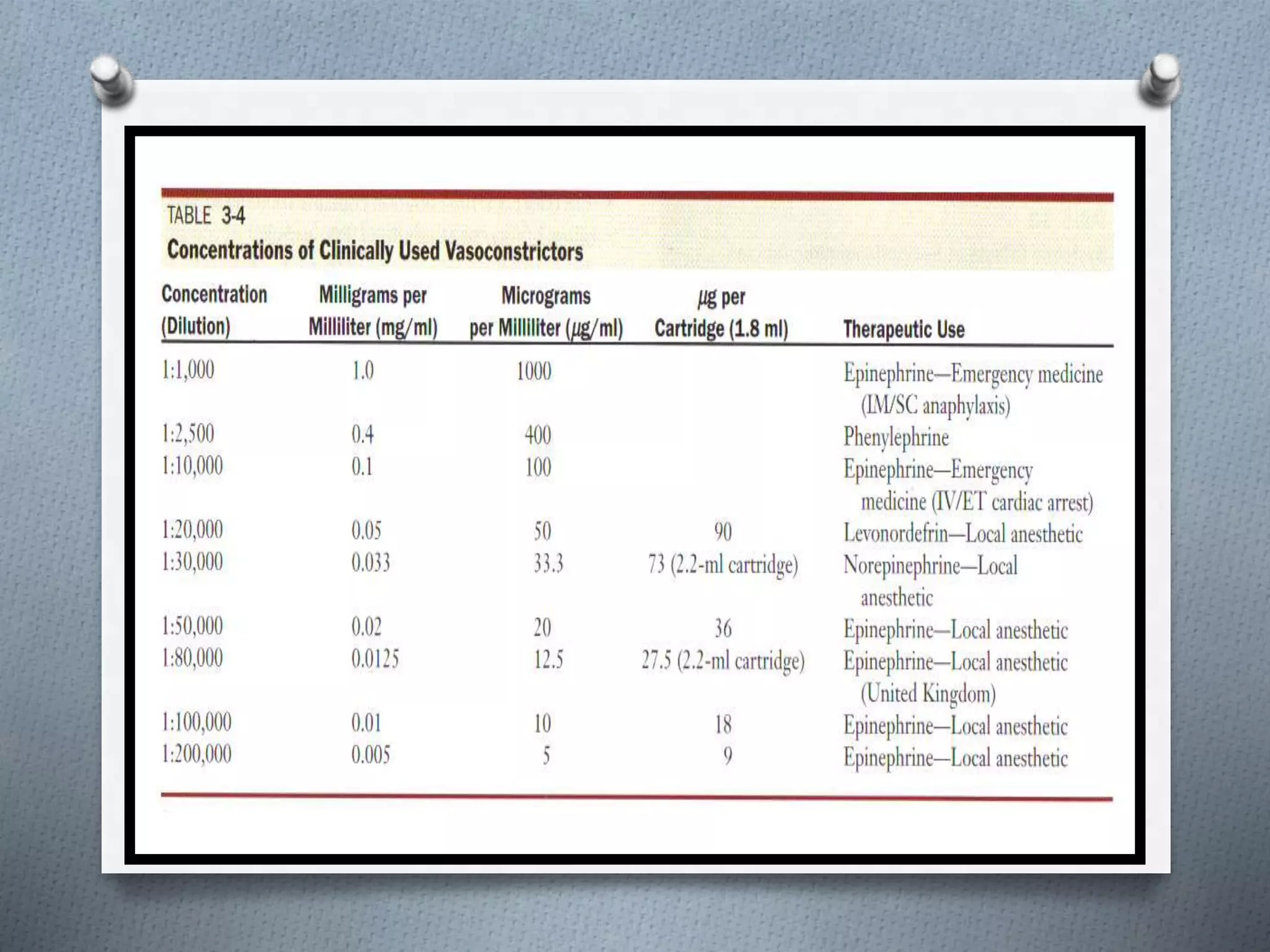
  • 233.
    O Transient facialnerve paralysis is' commonly caused by the introduction of local anesthetic solution into the capsule of parotid gland which is located in the posterior borders of the ramus of the mandible during an inferior alveolar nerve block Problem: O Loss of motor function, to the muscles of facial expression, lasts upto several hours and patient is unable to close the eye. Management: O Reassure the patient - explain that the situation is transient and it lasts for few hours. O Advise the patient to periodically close the upper eyelid to lubricate the cornea. O Contact lens should be removed until the muscular movements occur. O There is no contraindication in re-anesthetizing the patient to achieve the mandibular anesthesia.
  • 234.
    O Prolonged irritationof gingival soft tissues may lead to number of unpleasant complications including: O Epithelial desquamation O Sterile Abscess secondary to prolonged ischemia resulting from the use of local anesthesia with vasoconstrictor. Prevention: O Use topical anesthetics as recommended, allow the solution to contact the mucous membrane for 1-2 minutes to maximize its effectiveness and to minimize toxicity. O Do not use vasoconstrictors in over concentrations. Norepinephrine used in 1:30,000 concentration is most likely to produce ischaemia.
  • 235.
    O Trauma tothe lips and tongue is frequently caused by patients due to inadvertently biting of lips and tongue. This may lead to swelling and significant pain. O Usually occurs in children and mentally disabled patients. Prevention: O If dental procedures are brief, appropriate duration of local anesthesia should be selected. O A cotton role can be placed between the lips and teeth if they are still anesthetized at the time of discharge. O Secure it with dental floss wrapped around the teeth. Management: O Symptomatic treatment: O Analgesics for pain O Antibiotics in the unlikely situation of infection. O Saline rinses to aid decreasing any swelling that may be present. O Petroleum jelly or other lubricants to cover the lip lesion and minimize the irritation.
  • 236.
    O Occasionally patientsreport with ulcerations around the site of injection with pain and discomfort. O The recurrent aphthous stomatitis is most frequently observed. It develops only on gingiva or buccal vestibule and is thought to be autoimmune process. Management: O Primary management is symptomatic. O Topical anesthetic solution can be applied. O A mixture of equal amounts of diphenhydramine and milk of magnesia rinsed in the mouth, effectively coats the ulcerations and provides relief from pain. Duration of lesion is approximately 1
  • 237.
  • 238.
    BIBLIOGRAPHY O Monheim’s localanesthesia & pain control in dental practice; seventh edition O Handbook of local anesthesia – Stanley F. Malamed; 5th edition; O Textbook of oral & maxillofacial surgery – Neelima Anil Malik; 2nd edition;