Dr Ardra B. Thorat
Assistant professor
Dept. of Shalyatantra, YAC. Kodoli
It is used to prevent the perception of pain
by blocking its different pathways such as
 Peripheral nerve fibers
 Nerves
 Plexus
 Ganglion
 Anterior / posterior nerve roots at spinal level
Advantages
 The patient remain conscious and still does not feel
pain
 No pre anesthetic preparation of the patient required
 Complications and unwanted effect of GA are avoided
 Does not required hospitalization
 Blood less field can be produced
Disadvantages
 Not good for uncooperative patients
 Ideal surgical condition not produced
 Hypersensitivity reaction
 May cause nerve injury
 Can not be used in infective area
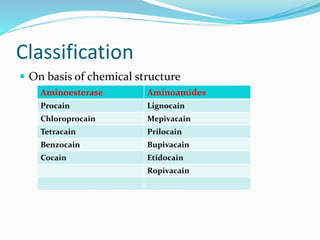
Classification
 On basis of chemical structure
Aminoesterase Aminoamides
Procain Lignocain
Chloroprocain Mepivacain
Tetracain Prilocain
Benzocain Bupivacain
Cocain Etidocain
Ropivacain
Based on duration of action
Short duration low potency
 Chloroprocain
 Procain
Intermediate duration, intermediate potency
 Lignocain
 Mepivacain
 Prilocain
 Cocain
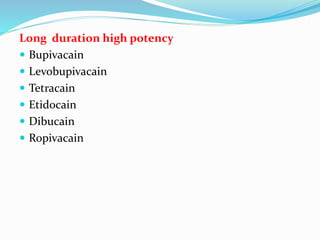
Long duration high potency
 Bupivacain
 Levobupivacain
 Tetracain
 Etidocain
 Dibucain
 Ropivacain
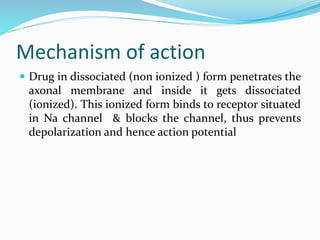
Mechanism of action
 Drug in dissociated (non ionized ) form penetrates the
axonal membrane and inside it gets dissociated
(ionized). This ionized form binds to receptor situated
in Na channel & blocks the channel, thus prevents
depolarization and hence action potential
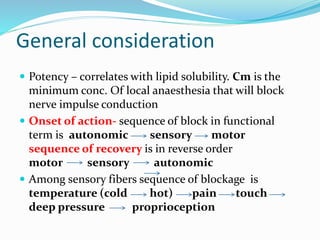
General consideration
 Potency – correlates with lipid solubility. Cm is the
minimum conc. Of local anaesthesia that will block
nerve impulse conduction
 Onset of action- sequence of block in functional
term is autonomic sensory motor
sequence of recovery is in reverse order
motor sensory autonomic
 Among sensory fibers sequence of blockage is
temperature (cold hot) pain touch
deep pressure proprioception
Methods of LA
 Infiltration- local anaesthetic is infiltrated at operation site
 Topical-(surface anaesthesia)-
1. for skin= EMLA cream is used which is mixture of prilocain
5% +lignocain5% in equal amaunts
2. Xylocain spray 4%- at mucous membrane of mouth, pharynx,
larynx
3. Xylocain jelly 2%- catheterization, proctoscopy
4. Cocain drops & tetracain ointment
 Nerve block-drug is injected around the nerve supplying the
operation site
 Field block
 Root block
 Regional intravenous anaesthesia (Beir’s block)
Drugs and preparation
1. Xylocain
a. Plane 1%, 2%
b. With adrenalin 1%, 2%
Lignocaine(Xylocain,Lidocain)
 it is the most commonly used LA
Conc. Used
1. Nerve blocks- 1-2%
2. Urethral procedures (as jelly)- 2%
3. Surface (topical) analgesia- 4% & 10%
4. Spinal- 5%
5. Epidural- 1-2%
6. Intravenous regional analgesia- 0.5%
7. Infiltration block- 1-2%
Metabolism
 Metabolism in liver
 Excreted by Kidney
 T1/2 – 1.6 hrs
Duration of effect
 Without adrenalin - 45 to 60 minutes
 With adrenalin - 2-3 hours
Maximum safe dose –
Without adrenalin -4.5 mg /Kg (maximum 300mg)
With adrenalin =7mg /Kg (maximum 500mg)
Other uses
 Used for treating ventricular tachycardia

Local anaesthesia

  • 1.
    Dr Ardra B.Thorat Assistant professor Dept. of Shalyatantra, YAC. Kodoli
  • 2.
    It is usedto prevent the perception of pain by blocking its different pathways such as  Peripheral nerve fibers  Nerves  Plexus  Ganglion  Anterior / posterior nerve roots at spinal level
  • 3.
    Advantages  The patientremain conscious and still does not feel pain  No pre anesthetic preparation of the patient required  Complications and unwanted effect of GA are avoided  Does not required hospitalization  Blood less field can be produced
  • 4.
    Disadvantages  Not goodfor uncooperative patients  Ideal surgical condition not produced  Hypersensitivity reaction  May cause nerve injury  Can not be used in infective area
  • 5.
    Classification  On basisof chemical structure Aminoesterase Aminoamides Procain Lignocain Chloroprocain Mepivacain Tetracain Prilocain Benzocain Bupivacain Cocain Etidocain Ropivacain
  • 6.
    Based on durationof action Short duration low potency  Chloroprocain  Procain Intermediate duration, intermediate potency  Lignocain  Mepivacain  Prilocain  Cocain
  • 7.
    Long duration highpotency  Bupivacain  Levobupivacain  Tetracain  Etidocain  Dibucain  Ropivacain
  • 8.
    Mechanism of action Drug in dissociated (non ionized ) form penetrates the axonal membrane and inside it gets dissociated (ionized). This ionized form binds to receptor situated in Na channel & blocks the channel, thus prevents depolarization and hence action potential
  • 9.
    General consideration  Potency– correlates with lipid solubility. Cm is the minimum conc. Of local anaesthesia that will block nerve impulse conduction  Onset of action- sequence of block in functional term is autonomic sensory motor sequence of recovery is in reverse order motor sensory autonomic  Among sensory fibers sequence of blockage is temperature (cold hot) pain touch deep pressure proprioception
  • 10.
    Methods of LA Infiltration- local anaesthetic is infiltrated at operation site  Topical-(surface anaesthesia)- 1. for skin= EMLA cream is used which is mixture of prilocain 5% +lignocain5% in equal amaunts 2. Xylocain spray 4%- at mucous membrane of mouth, pharynx, larynx 3. Xylocain jelly 2%- catheterization, proctoscopy 4. Cocain drops & tetracain ointment  Nerve block-drug is injected around the nerve supplying the operation site  Field block  Root block  Regional intravenous anaesthesia (Beir’s block)
  • 11.
    Drugs and preparation 1.Xylocain a. Plane 1%, 2% b. With adrenalin 1%, 2%
  • 12.
    Lignocaine(Xylocain,Lidocain)  it isthe most commonly used LA Conc. Used 1. Nerve blocks- 1-2% 2. Urethral procedures (as jelly)- 2% 3. Surface (topical) analgesia- 4% & 10% 4. Spinal- 5% 5. Epidural- 1-2% 6. Intravenous regional analgesia- 0.5% 7. Infiltration block- 1-2%
  • 13.
    Metabolism  Metabolism inliver  Excreted by Kidney  T1/2 – 1.6 hrs Duration of effect  Without adrenalin - 45 to 60 minutes  With adrenalin - 2-3 hours Maximum safe dose – Without adrenalin -4.5 mg /Kg (maximum 300mg) With adrenalin =7mg /Kg (maximum 500mg)
  • 14.
    Other uses  Usedfor treating ventricular tachycardia