Dr Ardra Thorat
MS (Shalyatantra)
Acid base balance
 Regulation of H+ ion balance is similar in some ways
to the regulation of the other ions in the body, to
achieve Homeostasis.
 Precise regulation of pH (7.35-7.45) is necessary for
normal cellular enzymatic reactions & for normal ionic
conc.
8/7/2020 2Dr Ardra B. Thorat
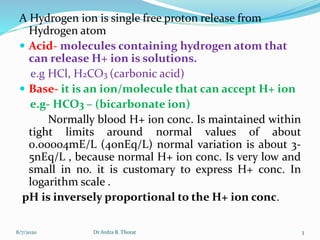
A Hydrogen ion is single free proton release from
Hydrogen atom
 Acid- molecules containing hydrogen atom that
can release H+ ion is solutions.
e.g HCl, H2CO3 (carbonic acid)
 Base- it is an ion/molecule that can accept H+ ion
e.g- HCO3 – (bicarbonate ion)
Normally blood H+ ion conc. Is maintained within
tight limits around normal values of about
0.00004mE/L (40nEq/L) normal variation is about 3-
5nEq/L , because normal H+ ion conc. Is very low and
small in no. it is customary to express H+ conc. In
logarithm scale .
pH is inversely proportional to the H+ ion conc.
8/7/2020 3Dr Ardra B. Thorat
1
pH = log -------- = - log [H+]
[H+]
e.g normal H + ion conc. Is 40nEq/L
(0.00000004 Eq/L) :. Normal pH is
pH= -log[0.00000004]
pH= 7.4
8/7/2020 4Dr Ardra B. Thorat
pH & H+ ion conc. In Body fluids
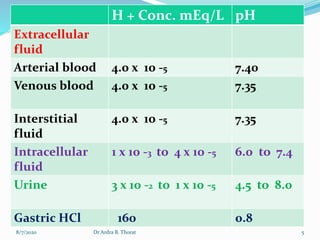
H + Conc. mEq/L pH
Extracellular
fluid
Arterial blood 4.0 x 10 -5 7.40
Venous blood 4.0 x 10 -5 7.35
Interstitial
fluid
4.0 x 10 -5 7.35
Intracellular
fluid
1 x 10 -3 to 4 x 10 -5 6.0 to 7.4
Urine 3 x 10 -2 to 1 x 10 -5 4.5 to 8.0
Gastric HCl 160 0.8
8/7/2020 5Dr Ardra B. Thorat
Acid – Base Terminology
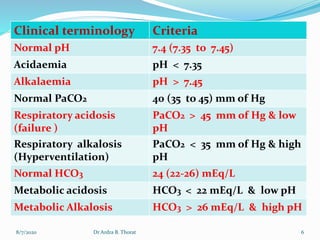
Clinical terminology Criteria
Normal pH 7.4 (7.35 to 7.45)
Acidaemia pH < 7.35
Alkalaemia pH > 7.45
Normal PaCO2 40 (35 to 45) mm of Hg
Respiratory acidosis
(failure )
PaCO2 > 45 mm of Hg & low
pH
Respiratory alkalosis
(Hyperventilation)
PaCO2 < 35 mm of Hg & high
pH
Normal HCO3 24 (22-26) mEq/L
Metabolic acidosis HCO3 < 22 mEq/L & low pH
Metabolic Alkalosis HCO3 > 26 mEq/L & high pH
8/7/2020 6Dr Ardra B. Thorat
Basic physiology of Acid Base
regulation
1. Buffers: buffers are chemical/ any substance which
either release or accept H+
*Buffer + H+ H Buffer
*The Bicarbonate buffer system
CO2 + H2O H2CO3 H+ + HCO3-
*The phosphate buffer system
HCl + NaH2PO4 NaH2PO4 + NaCl
NaOH + NaH2PO4 Na2HPO4 + H2O
*Protein : imp intracellular buffer = H+ + Hb
HHb
8/7/2020 7Dr Ardra B. Thorat
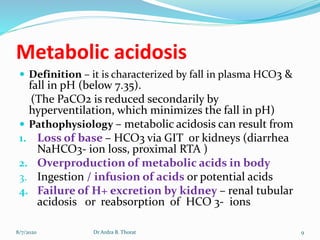
Arterial Blood Sample
<7.4 pH > 7.4
Acidosis Alkalosis
Metabolic Respiratory Metabolic Respiratory
HCO3- PCO2 HCO3- PCO2
< 24 mEq/L > 40mm of Hg >24 mEq/L < 40mm of Hg
Respiratory Renal Respiratory Renal
Compensation Compensation Compensation
Compensation
PCO2 HCO3- PCO2 HCO3-
<40mm of Hg >24 mEq/L > 40mm of Hg < 24 mEq/L
8/7/2020 8Dr Ardra B. Thorat
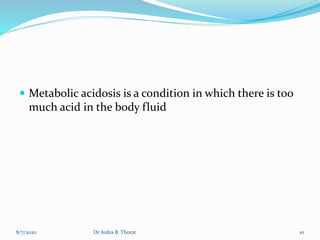
Metabolic acidosis
 Definition – it is characterized by fall in plasma HCO3 &
fall in pH (below 7.35).
(The PaCO2 is reduced secondarily by
hyperventilation, which minimizes the fall in pH)
 Pathophysiology – metabolic acidosis can result from
1. Loss of base – HCO3 via GIT or kidneys (diarrhea
NaHCO3- ion loss, proximal RTA )
2. Overproduction of metabolic acids in body
3. Ingestion / infusion of acids or potential acids
4. Failure of H+ excretion by kidney – renal tubular
acidosis or reabsorption of HCO 3- ions
8/7/2020 9Dr Ardra B. Thorat
 Metabolic acidosis is a condition in which there is too
much acid in the body fluid
8/7/2020 10Dr Ardra B. Thorat
Causes
 It can also occur when the kidneys are not removing
enough acid from the body.
There are several types of metabolic acidosis.
 Diabetic acidosis develops when acidic substances,
known as ketone bodies, build up in the body. This
most often occurs with uncontrolled type 1 diabetes. It
is also called diabetic ketoacidosis (DKA)
 Hyperchloremic acidosis results from excessive loss
of sodium bicarbonate from the body. This can occur
with severe diarrhea.
8/7/2020 11Dr Ardra B. Thorat
 Lactic acidosis results from a buildup of lactic acid. It
can be caused by:
1. Alcohol
2. Cancer
3. Exercising intensely
4. Liver failure
5. Medicines, such as salicylates
6. Prolonged lack of oxygen from shock, heart failure,
or severe anemia
7. Seizures
8/7/2020 12Dr Ardra B. Thorat
 Other causes of metabolic acidosis include:
1. Kidney disease (distal renal tubular acidosis and
proximal renal tubular acidosis)
2. Poisoning by aspirin, ethylene glycol (found in
antifreeze), or methanol
3. Severe dehydration
8/7/2020 13Dr Ardra B. Thorat
Symptoms
 Metabolic acidosis itself most often causes rapid
breathing.
 confused or very tired.
 Severe metabolic acidosis can lead to shock or death.
 In some situations, metabolic acidosis can be a mild,
ongoing (chronic) condition.
8/7/2020 14Dr Ardra B. Thorat
Exams and Tests
 Arterial blood gas
 Basic metabolic panel, (a group of blood tests that
measure sodium and potassium levels, kidney
function, and other chemicals and functions)
 Urine pH
 Urine ketones or blood ketones
 Lactic acid test
 Other tests may be needed to determine the cause of
the acidosis.
8/7/2020 15Dr Ardra B. Thorat
Treatment
 Treatment is aimed at the health problem causing the
acidosis.
 In some cases, sodium bicarbonate (the chemical in
baking soda) may be given to reduce the acidity of the
blood
8/7/2020 16Dr Ardra B. Thorat
Metabolic alkalosis
 Increase sr. HCO3
 High pH
 Causes
 Loss of H + from upper GIT- vomiting
 Urine diuresis
 Addition of Alkali- multiple BT
8/7/2020 17Dr Ardra B. Thorat
c/ f
 CNS- increase neuromuscular excitability,
paraesthesia, light head ache,
 CVS- hypotension, cardiac arrhethmias
 weakness., muscle cramps, postural dizziness
8/7/2020 18Dr Ardra B. Thorat
 Sr. potassium & chloride usually low
 ABG
 Urinary chloride
8/7/2020 19Dr Ardra B. Thorat
Rx
 IV isotonic saline + KCL/ isolyte G
 Stop Treatment H2 inhibitors/ proton pump inhibitors
8/7/2020 20Dr Ardra B. Thorat
Respiratory acidosis
 Respiratory acidosis is a condition that occurs
when the lungs cannot remove all of the
carbon dioxide the body produces.
 This causes body fluids, especially the blood,
to become too acidic.
8/7/2020 21Dr Ardra B. Thorat
Cont..
 is a medical emergency in which decreased ventilation
(hypoventilation) increases the concentration
of carbon dioxide in the blood and decreases the
blood's pH (a condition generally called acidosis).
 Carbon dioxide is produced continuously as the body's
cells respire, and this CO2 will accumulate rapidly if
the lungs do not adequately expel it through alveolar
ventilation.
 Alveolar hypoventilation thus leads to an
increased PaCO2 (a condition called hypercapnia).
The increase in PaCO2 in turn decreases the
HCO3
−/PaCO2ratio and decreases pH.
8/7/2020 Dr Ardra B. Thorat 22
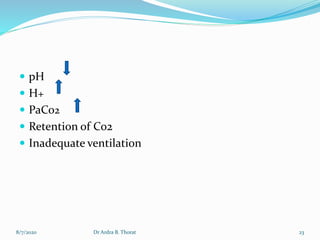
 pH
 H+
 PaCo2
 Retention of Co2
 Inadequate ventilation
8/7/2020 23Dr Ardra B. Thorat
Types of respiratory acidosis
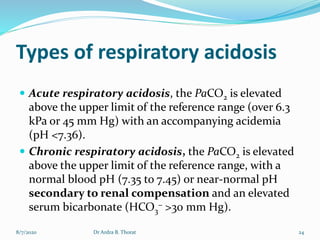
 Acute respiratory acidosis, the PaCO2 is elevated
above the upper limit of the reference range (over 6.3
kPa or 45 mm Hg) with an accompanying acidemia
(pH <7.36).
 Chronic respiratory acidosis, the PaCO2 is elevated
above the upper limit of the reference range, with a
normal blood pH (7.35 to 7.45) or near-normal pH
secondary to renal compensation and an elevated
serum bicarbonate (HCO3
− >30 mm Hg).
8/7/2020 24Dr Ardra B. Thorat
Causes
 Diseases of the airways - asthma and chronic
obstructive lung disease
 Diseases of the chest/ crushing injury
 Diseases affecting the nerves and muscles that
"signal" the lungs to inflate or deflate
 Drugs that suppress breathing (including powerful
pain medicines, such as narcotics, and "downers,"
such as benzodiazepines), especially when combined
with alcohol
 Severe obesity, which restricts how much the lungs
can expand
 Obstructive sleep apnea
8/7/2020 25Dr Ardra B. Thorat
Cont..
 Anaestesia with too much muscle relaxant
 Lung disorder- emphysema, bronchopneumonia,
chronic bronchitis
 Respiratory centre depress by brain
injury/poison/alcohol
8/7/2020 26Dr Ardra B. Thorat
Chronic respiratory acidosis
 This leads to a stable situation, because the kidneys
increase body chemicals, such as bicarbonate, that
help restore the body's acid-base balance.
 Acute respiratory acidosis is a condition in which
carbon dioxide builds up very quickly, before the
kidneys can return the body to a state of balance.
 Some people with chronic respiratory acidosis get
acute respiratory acidosis because an illness makes
their condition worse.

8/7/2020 27Dr Ardra B. Thorat
c/f
 Causes
 systolic & diastolic BP- HTN
 restlessness
8/7/2020 28Dr Ardra B. Thorat
Exams and Tests
 Arterial blood gas, which measures oxygen and carbon
dioxide levels in the blood
 Basic metabolic panel
 Chest x-ray
 CT scan of the chest
 Pulmonary function test
8/7/2020 29Dr Ardra B. Thorat
Treatment
 Adequate ventilation
 Bronchodilator drugs to reverse some types of
airway obstruction
 ET- mechanical ventilation
 Noninvasive positive-pressure ventilation
(sometimes called CPAP or BiPAP) or a breathing
machine, if needed
 Oxygen if the blood oxygen level is low
 Treatment to stop smoking
8/7/2020 30Dr Ardra B. Thorat
Complications
 Poor organ function
 Respiratory failure
 Shock
8/7/2020 31Dr Ardra B. Thorat
Respiratory alkalosis
 Respiratory alkalosis is a condition marked by low
levels of carbon dioxide in the blood due to breathing
excessively.
8/7/2020 32Dr Ardra B. Thorat
Causes
 Anxiety
 High grade Fever
 Hyperventilation-during anesthesia AMBU with
excess muscle relaxant
 High altitude, dry atmosphere.
 CO poisoning
 Pregnancy
 Any lung disease that leads to shortness of breath can
also cause respiratory alkalosis (such as pulmonary
embolism and asthma).
8/7/2020 33Dr Ardra B. Thorat
Symptoms
 Dizziness
 Light-headedness
 Numbness of the hands and feet
 Some risk of respiratory arrest
 Palor
 BP
8/7/2020 34Dr Ardra B. Thorat
Exams and Tests
 Arterial blood gas, which measures oxygen and carbon
dioxide levels in the blood
 Basic metabolic panel
 Chest x-ray
 Pulmonary function test
8/7/2020 35Dr Ardra B. Thorat
Treatment
 Breathing into a paper bag -- or using a mask that
causes you to re-breathe carbon dioxide -- sometimes
helps reduce symptoms.
8/7/2020 36Dr Ardra B. Thorat

Acid- base

  • 1.
    Dr Ardra Thorat MS(Shalyatantra)
  • 2.
    Acid base balance Regulation of H+ ion balance is similar in some ways to the regulation of the other ions in the body, to achieve Homeostasis.  Precise regulation of pH (7.35-7.45) is necessary for normal cellular enzymatic reactions & for normal ionic conc. 8/7/2020 2Dr Ardra B. Thorat
  • 3.
    A Hydrogen ionis single free proton release from Hydrogen atom  Acid- molecules containing hydrogen atom that can release H+ ion is solutions. e.g HCl, H2CO3 (carbonic acid)  Base- it is an ion/molecule that can accept H+ ion e.g- HCO3 – (bicarbonate ion) Normally blood H+ ion conc. Is maintained within tight limits around normal values of about 0.00004mE/L (40nEq/L) normal variation is about 3- 5nEq/L , because normal H+ ion conc. Is very low and small in no. it is customary to express H+ conc. In logarithm scale . pH is inversely proportional to the H+ ion conc. 8/7/2020 3Dr Ardra B. Thorat
  • 4.
    1 pH = log-------- = - log [H+] [H+] e.g normal H + ion conc. Is 40nEq/L (0.00000004 Eq/L) :. Normal pH is pH= -log[0.00000004] pH= 7.4 8/7/2020 4Dr Ardra B. Thorat
  • 5.
    pH & H+ion conc. In Body fluids H + Conc. mEq/L pH Extracellular fluid Arterial blood 4.0 x 10 -5 7.40 Venous blood 4.0 x 10 -5 7.35 Interstitial fluid 4.0 x 10 -5 7.35 Intracellular fluid 1 x 10 -3 to 4 x 10 -5 6.0 to 7.4 Urine 3 x 10 -2 to 1 x 10 -5 4.5 to 8.0 Gastric HCl 160 0.8 8/7/2020 5Dr Ardra B. Thorat
  • 6.
    Acid – BaseTerminology Clinical terminology Criteria Normal pH 7.4 (7.35 to 7.45) Acidaemia pH < 7.35 Alkalaemia pH > 7.45 Normal PaCO2 40 (35 to 45) mm of Hg Respiratory acidosis (failure ) PaCO2 > 45 mm of Hg & low pH Respiratory alkalosis (Hyperventilation) PaCO2 < 35 mm of Hg & high pH Normal HCO3 24 (22-26) mEq/L Metabolic acidosis HCO3 < 22 mEq/L & low pH Metabolic Alkalosis HCO3 > 26 mEq/L & high pH 8/7/2020 6Dr Ardra B. Thorat
  • 7.
    Basic physiology ofAcid Base regulation 1. Buffers: buffers are chemical/ any substance which either release or accept H+ *Buffer + H+ H Buffer *The Bicarbonate buffer system CO2 + H2O H2CO3 H+ + HCO3- *The phosphate buffer system HCl + NaH2PO4 NaH2PO4 + NaCl NaOH + NaH2PO4 Na2HPO4 + H2O *Protein : imp intracellular buffer = H+ + Hb HHb 8/7/2020 7Dr Ardra B. Thorat
  • 8.
    Arterial Blood Sample <7.4pH > 7.4 Acidosis Alkalosis Metabolic Respiratory Metabolic Respiratory HCO3- PCO2 HCO3- PCO2 < 24 mEq/L > 40mm of Hg >24 mEq/L < 40mm of Hg Respiratory Renal Respiratory Renal Compensation Compensation Compensation Compensation PCO2 HCO3- PCO2 HCO3- <40mm of Hg >24 mEq/L > 40mm of Hg < 24 mEq/L 8/7/2020 8Dr Ardra B. Thorat
  • 9.
    Metabolic acidosis  Definition– it is characterized by fall in plasma HCO3 & fall in pH (below 7.35). (The PaCO2 is reduced secondarily by hyperventilation, which minimizes the fall in pH)  Pathophysiology – metabolic acidosis can result from 1. Loss of base – HCO3 via GIT or kidneys (diarrhea NaHCO3- ion loss, proximal RTA ) 2. Overproduction of metabolic acids in body 3. Ingestion / infusion of acids or potential acids 4. Failure of H+ excretion by kidney – renal tubular acidosis or reabsorption of HCO 3- ions 8/7/2020 9Dr Ardra B. Thorat
  • 10.
     Metabolic acidosisis a condition in which there is too much acid in the body fluid 8/7/2020 10Dr Ardra B. Thorat
  • 11.
    Causes  It canalso occur when the kidneys are not removing enough acid from the body. There are several types of metabolic acidosis.  Diabetic acidosis develops when acidic substances, known as ketone bodies, build up in the body. This most often occurs with uncontrolled type 1 diabetes. It is also called diabetic ketoacidosis (DKA)  Hyperchloremic acidosis results from excessive loss of sodium bicarbonate from the body. This can occur with severe diarrhea. 8/7/2020 11Dr Ardra B. Thorat
  • 12.
     Lactic acidosisresults from a buildup of lactic acid. It can be caused by: 1. Alcohol 2. Cancer 3. Exercising intensely 4. Liver failure 5. Medicines, such as salicylates 6. Prolonged lack of oxygen from shock, heart failure, or severe anemia 7. Seizures 8/7/2020 12Dr Ardra B. Thorat
  • 13.
     Other causesof metabolic acidosis include: 1. Kidney disease (distal renal tubular acidosis and proximal renal tubular acidosis) 2. Poisoning by aspirin, ethylene glycol (found in antifreeze), or methanol 3. Severe dehydration 8/7/2020 13Dr Ardra B. Thorat
  • 14.
    Symptoms  Metabolic acidosisitself most often causes rapid breathing.  confused or very tired.  Severe metabolic acidosis can lead to shock or death.  In some situations, metabolic acidosis can be a mild, ongoing (chronic) condition. 8/7/2020 14Dr Ardra B. Thorat
  • 15.
    Exams and Tests Arterial blood gas  Basic metabolic panel, (a group of blood tests that measure sodium and potassium levels, kidney function, and other chemicals and functions)  Urine pH  Urine ketones or blood ketones  Lactic acid test  Other tests may be needed to determine the cause of the acidosis. 8/7/2020 15Dr Ardra B. Thorat
  • 16.
    Treatment  Treatment isaimed at the health problem causing the acidosis.  In some cases, sodium bicarbonate (the chemical in baking soda) may be given to reduce the acidity of the blood 8/7/2020 16Dr Ardra B. Thorat
  • 17.
    Metabolic alkalosis  Increasesr. HCO3  High pH  Causes  Loss of H + from upper GIT- vomiting  Urine diuresis  Addition of Alkali- multiple BT 8/7/2020 17Dr Ardra B. Thorat
  • 18.
    c/ f  CNS-increase neuromuscular excitability, paraesthesia, light head ache,  CVS- hypotension, cardiac arrhethmias  weakness., muscle cramps, postural dizziness 8/7/2020 18Dr Ardra B. Thorat
  • 19.
     Sr. potassium& chloride usually low  ABG  Urinary chloride 8/7/2020 19Dr Ardra B. Thorat
  • 20.
    Rx  IV isotonicsaline + KCL/ isolyte G  Stop Treatment H2 inhibitors/ proton pump inhibitors 8/7/2020 20Dr Ardra B. Thorat
  • 21.
    Respiratory acidosis  Respiratoryacidosis is a condition that occurs when the lungs cannot remove all of the carbon dioxide the body produces.  This causes body fluids, especially the blood, to become too acidic. 8/7/2020 21Dr Ardra B. Thorat
  • 22.
    Cont..  is amedical emergency in which decreased ventilation (hypoventilation) increases the concentration of carbon dioxide in the blood and decreases the blood's pH (a condition generally called acidosis).  Carbon dioxide is produced continuously as the body's cells respire, and this CO2 will accumulate rapidly if the lungs do not adequately expel it through alveolar ventilation.  Alveolar hypoventilation thus leads to an increased PaCO2 (a condition called hypercapnia). The increase in PaCO2 in turn decreases the HCO3 −/PaCO2ratio and decreases pH. 8/7/2020 Dr Ardra B. Thorat 22
  • 23.
     pH  H+ PaCo2  Retention of Co2  Inadequate ventilation 8/7/2020 23Dr Ardra B. Thorat
  • 24.
    Types of respiratoryacidosis  Acute respiratory acidosis, the PaCO2 is elevated above the upper limit of the reference range (over 6.3 kPa or 45 mm Hg) with an accompanying acidemia (pH <7.36).  Chronic respiratory acidosis, the PaCO2 is elevated above the upper limit of the reference range, with a normal blood pH (7.35 to 7.45) or near-normal pH secondary to renal compensation and an elevated serum bicarbonate (HCO3 − >30 mm Hg). 8/7/2020 24Dr Ardra B. Thorat
  • 25.
    Causes  Diseases ofthe airways - asthma and chronic obstructive lung disease  Diseases of the chest/ crushing injury  Diseases affecting the nerves and muscles that "signal" the lungs to inflate or deflate  Drugs that suppress breathing (including powerful pain medicines, such as narcotics, and "downers," such as benzodiazepines), especially when combined with alcohol  Severe obesity, which restricts how much the lungs can expand  Obstructive sleep apnea 8/7/2020 25Dr Ardra B. Thorat
  • 26.
    Cont..  Anaestesia withtoo much muscle relaxant  Lung disorder- emphysema, bronchopneumonia, chronic bronchitis  Respiratory centre depress by brain injury/poison/alcohol 8/7/2020 26Dr Ardra B. Thorat
  • 27.
    Chronic respiratory acidosis This leads to a stable situation, because the kidneys increase body chemicals, such as bicarbonate, that help restore the body's acid-base balance.  Acute respiratory acidosis is a condition in which carbon dioxide builds up very quickly, before the kidneys can return the body to a state of balance.  Some people with chronic respiratory acidosis get acute respiratory acidosis because an illness makes their condition worse.  8/7/2020 27Dr Ardra B. Thorat
  • 28.
    c/f  Causes  systolic& diastolic BP- HTN  restlessness 8/7/2020 28Dr Ardra B. Thorat
  • 29.
    Exams and Tests Arterial blood gas, which measures oxygen and carbon dioxide levels in the blood  Basic metabolic panel  Chest x-ray  CT scan of the chest  Pulmonary function test 8/7/2020 29Dr Ardra B. Thorat
  • 30.
    Treatment  Adequate ventilation Bronchodilator drugs to reverse some types of airway obstruction  ET- mechanical ventilation  Noninvasive positive-pressure ventilation (sometimes called CPAP or BiPAP) or a breathing machine, if needed  Oxygen if the blood oxygen level is low  Treatment to stop smoking 8/7/2020 30Dr Ardra B. Thorat
  • 31.
    Complications  Poor organfunction  Respiratory failure  Shock 8/7/2020 31Dr Ardra B. Thorat
  • 32.
    Respiratory alkalosis  Respiratoryalkalosis is a condition marked by low levels of carbon dioxide in the blood due to breathing excessively. 8/7/2020 32Dr Ardra B. Thorat
  • 33.
    Causes  Anxiety  Highgrade Fever  Hyperventilation-during anesthesia AMBU with excess muscle relaxant  High altitude, dry atmosphere.  CO poisoning  Pregnancy  Any lung disease that leads to shortness of breath can also cause respiratory alkalosis (such as pulmonary embolism and asthma). 8/7/2020 33Dr Ardra B. Thorat
  • 34.
    Symptoms  Dizziness  Light-headedness Numbness of the hands and feet  Some risk of respiratory arrest  Palor  BP 8/7/2020 34Dr Ardra B. Thorat
  • 35.
    Exams and Tests Arterial blood gas, which measures oxygen and carbon dioxide levels in the blood  Basic metabolic panel  Chest x-ray  Pulmonary function test 8/7/2020 35Dr Ardra B. Thorat
  • 36.
    Treatment  Breathing intoa paper bag -- or using a mask that causes you to re-breathe carbon dioxide -- sometimes helps reduce symptoms. 8/7/2020 36Dr Ardra B. Thorat