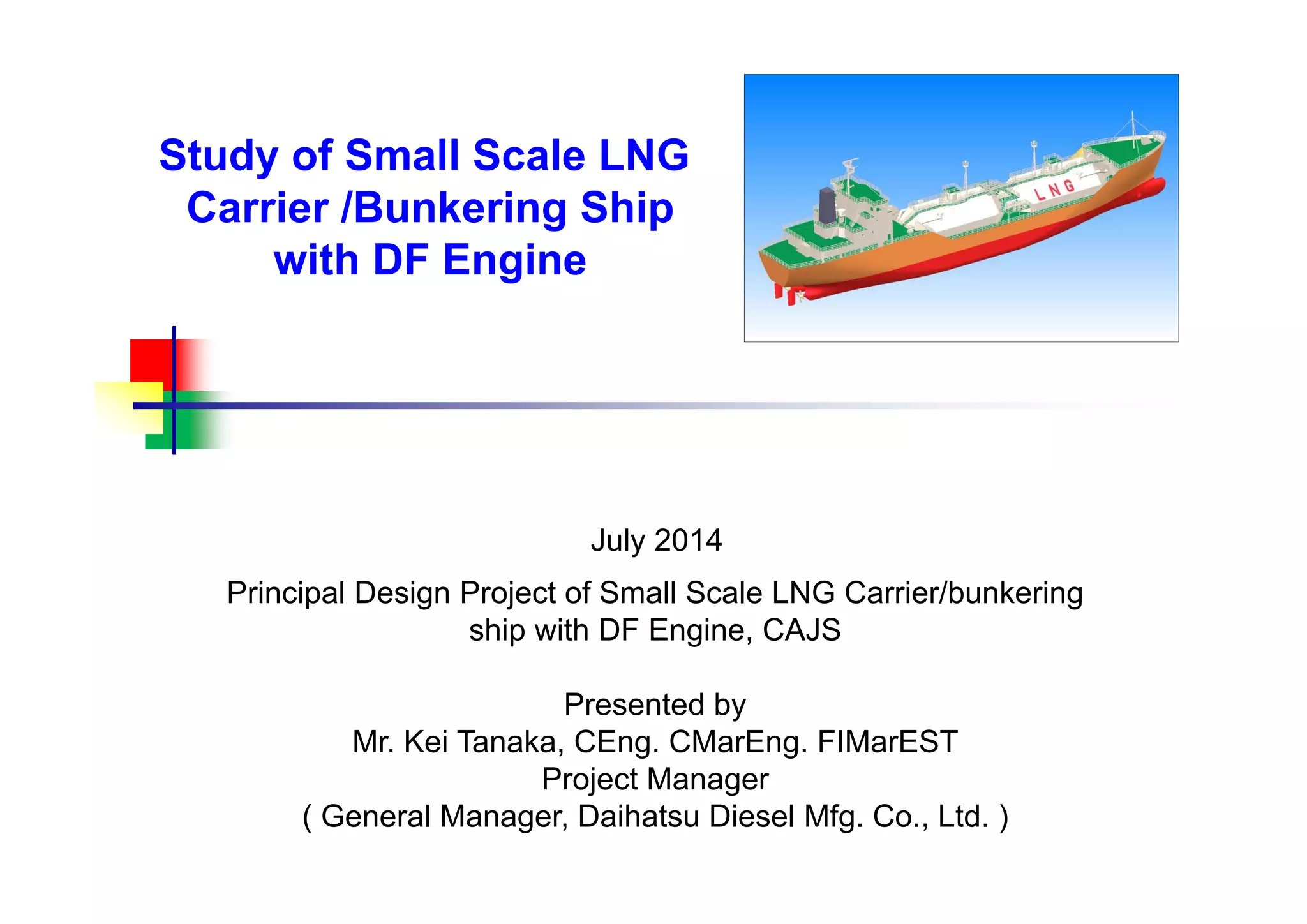
Study of Small Scale LNG
Carrier /Bunkering Ship
with DF Engine
July 2014
Principal Design Project of Small Scale LNG Carrier/bunkering
ship with DF Engine, CAJS
Presented by
Mr. Kei Tanaka, CEng. CMarEng. FIMarEST
Project Manager
( General Manager, Daihatsu Diesel Mfg. Co., Ltd. )
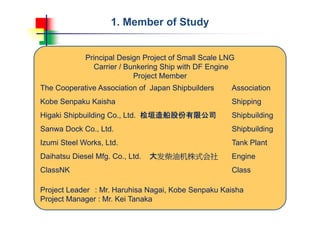
1. Member of Study
Principal Design Project of Small Scale LNG
Carrier / Bunkering Ship with DF Engine
Project Member
The Cooperative Association of Japan Shipbuilders Association
Kobe Senpaku Kaisha Shipping
Higaki Shipbuilding Co., Ltd. 桧垣造船股份有限公司 Shipbuilding
Sanwa Dock Co., Ltd. Shipbuilding
Izumi Steel Works, Ltd. Tank Plant
Daihatsu Diesel Mfg. Co., Ltd. 大发柴油机株式会社 Engine
ClassNK Class
Project Leader : Mr. Haruhisa Nagai, Kobe Senpaku Kaisha
Project Manager : Mr. Kei Tanaka
2.1 Target of Study
Background
NOx
SOx
GHG
Environmental Issue
Natural
Gas
Trans-
port
Oil
Price
Economical Issue
GAS
Fuelled
Ship Gas Fuelled
Ship
Coastal
LNG Carrier
LNG
Bunkering
Ship
Target
Increase
of the
natural
gas use
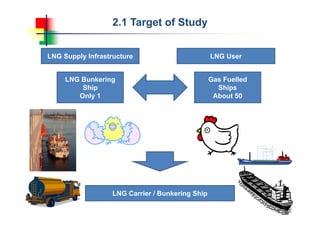
2.1 Target of Study
Gas Fuelled
Ships
About 50
LNG Supply Infrastructure
LNG Bunkering
Ship
Only 1
LNG User
LNG Carrier / Bunkering Ship
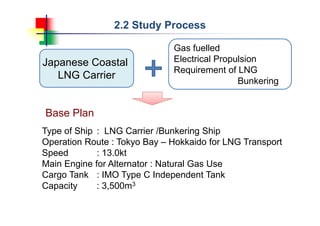
2.2 Study Process
Type of Ship : LNG Carrier /Bunkering Ship
Operation Route : Tokyo Bay – Hokkaido for LNG Transport
Speed : 13.0kt
Main Engine for Alternator : Natural Gas Use
Cargo Tank : IMO Type C Independent Tank
Capacity : 3,500m3
Base Plan
Gas fuelled
Electrical Propulsion
Requirement of LNG
Bunkering
Japanese Coastal
LNG Carrier
3.1 Selection of Engine
Select Dual Fuel Engine
Lean Burn (at Gas Mode) Lean Burn
IMO MARPOL Annex VI
NOx : Tier III Regulation (Required in ECA)
Without SCR Equipment
SOx : No Sulfur Content
Gas & Marine Diesel Oil
Select the Cheaper Fuel
MDO can be use in Emergency
(Long Term Storage)
Gas only
Dual Fuel Gas Fuel only
One LNG Fuel Tank Two LNG Fuel Tanks
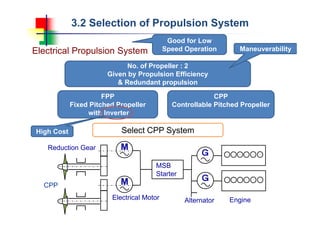
3.2 Selection of Propulsion System
Electrical Propulsion System
Electrical Motor Alternator
MSB
Starter
G
Engine
Reduction Gear
CPP M
M
G
No. of Propeller : 2
Given by Propulsion Efficiency
& Redundant propulsion
FPP
Fixed Pitched Propeller
with Inverter
CPP
Controllable Pitched Propeller
High Cost
Maneuverability
Good for Low
Speed Operation
Select CPP System
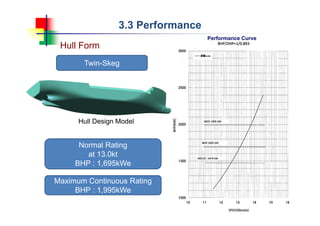
3.3 Performance
Hull Design Model
Hull Form
Twin-Skeg
Normal Rating
at 13.0kt
BHP : 1,695kWe
Performance Curve
Maximum Continuous Rating
BHP : 1,995kWe
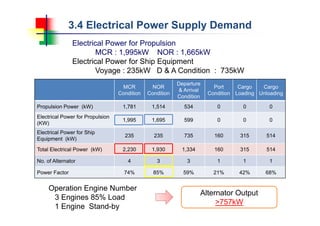
3.4 Electrical Power Supply Demand
MCR
Condition
NOR
Condition
Departure
& Arrival
Condition
Port
Condition
Cargo
Loading
Cargo
Unloading
Propulsion Power (kW) 1,781 1,514 534 0 0 0
Electrical Power for Propulsion
(KW)
1,995 1,695 599 0 0 0
Electrical Power for Ship
Equipment (kW)
235 235 735 160 315 514
Total Electrical Power (kW) 2,230 1,930 1,334 160 315 514
No. of Alternator 4 3 3 1 1 1
Power Factor 74% 85% 59% 21% 42% 68%
Alternator Output
>757kW
Electrical Power for Propulsion
MCR : 1,995kW NOR : 1,665kW
Electrical Power for Ship Equipment
Voyage : 235kW D & A Condition : 735kW
Operation Engine Number
3 Engines 85% Load
1 Engine Stand-by
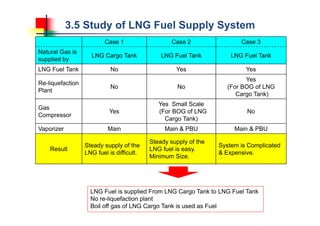
3.5 Study of LNG Fuel Supply System
Case 1 Case 2 Case 3
Natural Gas is
supplied by
LNG Cargo Tank LNG Fuel Tank LNG Fuel Tank
LNG Fuel Tank No Yes Yes
Re-liquefaction
Plant
No No
Yes
(For BOG of LNG
Cargo Tank)
Gas
Compressor
Yes
Yes Small Scale
(For BOG of LNG
Cargo Tank)
No
Vaporizer Main Main & PBU Main & PBU
Result
Steady supply of the
LNG fuel is difficult.
Steady supply of the
LNG fuel is easy.
Minimum Size.
System is Complicated
& Expensive.
LNG Fuel is supplied From LNG Cargo Tank to LNG Fuel Tank
No re-liquefaction plant
Boil off gas of LNG Cargo Tank is used as Fuel
3.6 Diagram of LNG Fuel Supply System
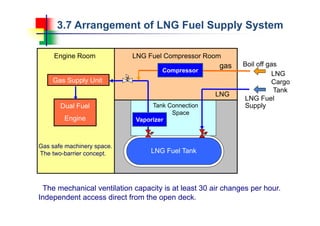
3.7 Arrangement of LNG Fuel Supply System
Tank Connection
Space
LNG Fuel Tank
Dual Fuel
Engine
Gas Supply Unit
LNG Fuel Compressor Room
LNG Fuel
Supply
Boil off gas
Engine Room
The mechanical ventilation capacity is at least 30 air changes per hour.
Independent access direct from the open deck.
LNG
Cargo
Tank
Gas safe machinery space.
The two-barrier concept.
Vaporizer
Compressor
gas
LNG
3.8 Requirement for Bunkering Vessel
ERC
Bunkering
Ship
Gas-fuelled
Ship
Drip Tray
Drip Tray
LNG Transfer
Hose
Fender
Hoseguide
Water Curtain
Hardware
Freeboard height difference
between both ships.
Treatment of Boil-Off-Gas of
Gas fuelled ship.
Mooring of ships.
Software
The bunkering procedure.
The urgent detached mooring
Risk assessment.
Seafarers training, qualification.
LNG transportation regime.
The marine disaster prevention
system.
Image of LNG Bunkering
Detail of bunkering systems should be decided
according to the details of the gas-fuelled ship.
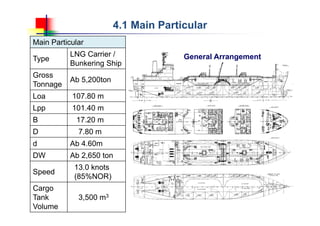
4.1 Main Particular
Main Particular
Type
LNG Carrier /
Bunkering Ship
Gross
Tonnage
Ab 5,200ton
Loa 107.80 m
Lpp 101.40 m
B 17.20 m
D 7.80 m
d Ab 4.60m
DW Ab 2,650 ton
Speed
13.0 knots
(85%NOR)
Cargo
Tank
Volume
3,500 m3
General Arrangement
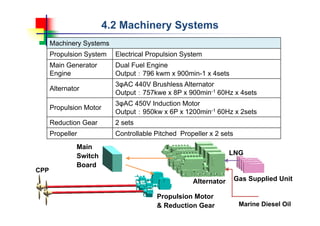
4.2 Machinery Systems
LNG
Marine Diesel Oil
Alternator
Main
Switch
Board
Propulsion Motor
& Reduction Gear
CPP
Gas Supplied Unit
Machinery Systems
Propulsion System Electrical Propulsion System
Main Generator
Engine
Dual Fuel Engine
Output:796 kwm x 900min-1 x 4sets
Alternator
3φAC 440V Brushless Alternator
Output:757kwe x 8P x 900min-1 60Hz x 4sets
Propulsion Motor
3φAC 450V Induction Motor
Output:950kw x 6P x 1200min-1 60Hz x 2sets
Reduction Gear 2 sets
Propeller Controllable Pitched Propeller x 2 sets
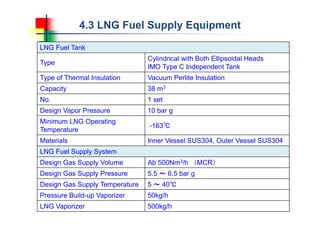
4.3 LNG Fuel Supply Equipment
LNG Fuel Tank
Type
Cylindrical with Both Ellipsoidal Heads
IMO Type C Independent Tank
Type of Thermal Insulation Vacuum Perlite Insulation
Capacity 38 m3
No. 1 set
Design Vapor Pressure 10 bar g
Minimum LNG Operating
Temperature
-163℃
Materials Inner Vessel SUS304, Outer Vessel SUS304
LNG Fuel Supply System
Design Gas Supply Volume Ab 500Nm3/h (MCR)
Design Gas Supply Pressure 5.5 ~ 6.5 bar g
Design Gas Supply Temperature 5 ~ 40℃
Pressure Build-up Vaporizer 50kg/h
LNG Vaporizer 500kg/h
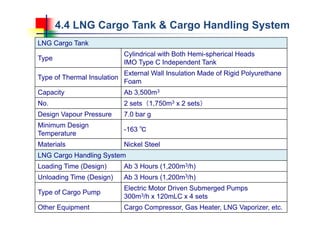
4.4 LNG Cargo Tank & Cargo Handling System
LNG Cargo Tank
Type
Cylindrical with Both Hemi-spherical Heads
IMO Type C Independent Tank
Type of Thermal Insulation
External Wall Insulation Made of Rigid Polyurethane
Foam
Capacity Ab 3,500m3
No. 2 sets(1,750m3 x 2 sets)
Design Vapour Pressure 7.0 bar g
Minimum Design
Temperature
-163 ℃
Materials Nickel Steel
LNG Cargo Handling System
Loading Time (Design) Ab 3 Hours (1,200m3/h)
Unloading Time (Design) Ab 3 Hours (1,200m3/h)
Type of Cargo Pump
Electric Motor Driven Submerged Pumps
300m3/h x 120mLC x 4 sets
Other Equipment Cargo Compressor, Gas Heater, LNG Vaporizer, etc.
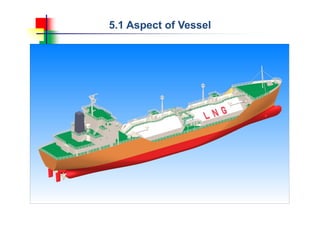
5.1 Aspect of Vessel
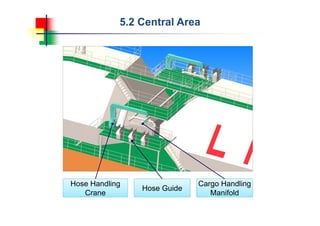
5.2 Central Area
Hose Handling
Crane
Cargo Handling
Manifold
Hose Guide
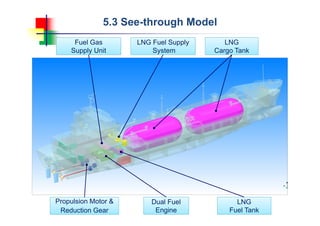
5.3 See-through Model
LNG
Cargo Tank
LNG
Fuel Tank
Dual Fuel
Engine
Propulsion Motor &
Reduction Gear
Fuel Gas
Supply Unit
LNG Fuel Supply
System
LNG Fuel
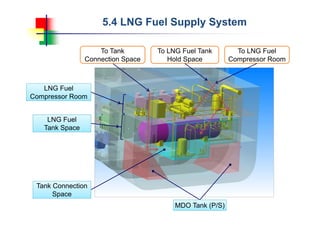
Tank Space
To LNG Fuel
Compressor Room
To Tank
Connection Space
To LNG Fuel Tank
Hold Space
Tank Connection
Space
LNG Fuel
Compressor Room
MDO Tank (P/S)
5.4 LNG Fuel Supply System
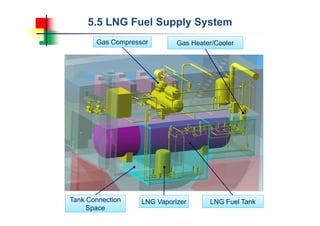
LNG Vaporizer
Gas Compressor Gas Heater/Cooler
LNG Fuel TankTank Connection
Space
5.5 LNG Fuel Supply System
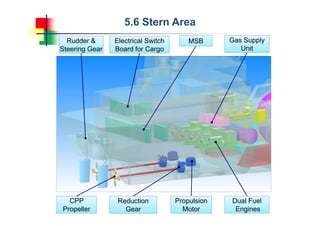
5.6 Stern Area
Propulsion
Motor
Reduction
Gear
CPP
Propeller
Rudder &
Steering Gear
MSBElectrical Switch
Board for Cargo
Dual Fuel
Engines
Gas Supply
Unit
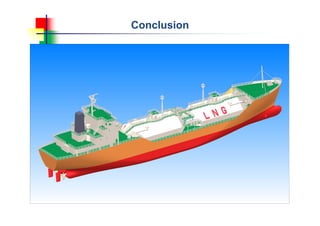
Conclusion
- END -
This project was carried out with the
support of ClassNK as part of the
ClassNK Joint R&D for Industry Program.
Thanks for your Attention!

4 study of_small_scale_lng_carrier

  • 1.
    Study of SmallScale LNG Carrier /Bunkering Ship with DF Engine July 2014 Principal Design Project of Small Scale LNG Carrier/bunkering ship with DF Engine, CAJS Presented by Mr. Kei Tanaka, CEng. CMarEng. FIMarEST Project Manager ( General Manager, Daihatsu Diesel Mfg. Co., Ltd. )
  • 2.
    1. Member ofStudy Principal Design Project of Small Scale LNG Carrier / Bunkering Ship with DF Engine Project Member The Cooperative Association of Japan Shipbuilders Association Kobe Senpaku Kaisha Shipping Higaki Shipbuilding Co., Ltd. 桧垣造船股份有限公司 Shipbuilding Sanwa Dock Co., Ltd. Shipbuilding Izumi Steel Works, Ltd. Tank Plant Daihatsu Diesel Mfg. Co., Ltd. 大发柴油机株式会社 Engine ClassNK Class Project Leader : Mr. Haruhisa Nagai, Kobe Senpaku Kaisha Project Manager : Mr. Kei Tanaka
  • 3.
    2.1 Target ofStudy Background NOx SOx GHG Environmental Issue Natural Gas Trans- port Oil Price Economical Issue GAS Fuelled Ship Gas Fuelled Ship Coastal LNG Carrier LNG Bunkering Ship Target Increase of the natural gas use
  • 4.
    2.1 Target ofStudy Gas Fuelled Ships About 50 LNG Supply Infrastructure LNG Bunkering Ship Only 1 LNG User LNG Carrier / Bunkering Ship
  • 5.
    2.2 Study Process Typeof Ship : LNG Carrier /Bunkering Ship Operation Route : Tokyo Bay – Hokkaido for LNG Transport Speed : 13.0kt Main Engine for Alternator : Natural Gas Use Cargo Tank : IMO Type C Independent Tank Capacity : 3,500m3 Base Plan Gas fuelled Electrical Propulsion Requirement of LNG Bunkering Japanese Coastal LNG Carrier
  • 6.
    3.1 Selection ofEngine Select Dual Fuel Engine Lean Burn (at Gas Mode) Lean Burn IMO MARPOL Annex VI NOx : Tier III Regulation (Required in ECA) Without SCR Equipment SOx : No Sulfur Content Gas & Marine Diesel Oil Select the Cheaper Fuel MDO can be use in Emergency (Long Term Storage) Gas only Dual Fuel Gas Fuel only One LNG Fuel Tank Two LNG Fuel Tanks
  • 7.
    3.2 Selection ofPropulsion System Electrical Propulsion System Electrical Motor Alternator MSB Starter G Engine Reduction Gear CPP M M G No. of Propeller : 2 Given by Propulsion Efficiency & Redundant propulsion FPP Fixed Pitched Propeller with Inverter CPP Controllable Pitched Propeller High Cost Maneuverability Good for Low Speed Operation Select CPP System
  • 8.
    3.3 Performance Hull DesignModel Hull Form Twin-Skeg Normal Rating at 13.0kt BHP : 1,695kWe Performance Curve Maximum Continuous Rating BHP : 1,995kWe
  • 9.
    3.4 Electrical PowerSupply Demand MCR Condition NOR Condition Departure & Arrival Condition Port Condition Cargo Loading Cargo Unloading Propulsion Power (kW) 1,781 1,514 534 0 0 0 Electrical Power for Propulsion (KW) 1,995 1,695 599 0 0 0 Electrical Power for Ship Equipment (kW) 235 235 735 160 315 514 Total Electrical Power (kW) 2,230 1,930 1,334 160 315 514 No. of Alternator 4 3 3 1 1 1 Power Factor 74% 85% 59% 21% 42% 68% Alternator Output >757kW Electrical Power for Propulsion MCR : 1,995kW NOR : 1,665kW Electrical Power for Ship Equipment Voyage : 235kW D & A Condition : 735kW Operation Engine Number 3 Engines 85% Load 1 Engine Stand-by
  • 10.
    3.5 Study ofLNG Fuel Supply System Case 1 Case 2 Case 3 Natural Gas is supplied by LNG Cargo Tank LNG Fuel Tank LNG Fuel Tank LNG Fuel Tank No Yes Yes Re-liquefaction Plant No No Yes (For BOG of LNG Cargo Tank) Gas Compressor Yes Yes Small Scale (For BOG of LNG Cargo Tank) No Vaporizer Main Main & PBU Main & PBU Result Steady supply of the LNG fuel is difficult. Steady supply of the LNG fuel is easy. Minimum Size. System is Complicated & Expensive. LNG Fuel is supplied From LNG Cargo Tank to LNG Fuel Tank No re-liquefaction plant Boil off gas of LNG Cargo Tank is used as Fuel
  • 11.
    3.6 Diagram ofLNG Fuel Supply System
  • 12.
    3.7 Arrangement ofLNG Fuel Supply System Tank Connection Space LNG Fuel Tank Dual Fuel Engine Gas Supply Unit LNG Fuel Compressor Room LNG Fuel Supply Boil off gas Engine Room The mechanical ventilation capacity is at least 30 air changes per hour. Independent access direct from the open deck. LNG Cargo Tank Gas safe machinery space. The two-barrier concept. Vaporizer Compressor gas LNG
  • 13.
    3.8 Requirement forBunkering Vessel ERC Bunkering Ship Gas-fuelled Ship Drip Tray Drip Tray LNG Transfer Hose Fender Hoseguide Water Curtain Hardware Freeboard height difference between both ships. Treatment of Boil-Off-Gas of Gas fuelled ship. Mooring of ships. Software The bunkering procedure. The urgent detached mooring Risk assessment. Seafarers training, qualification. LNG transportation regime. The marine disaster prevention system. Image of LNG Bunkering Detail of bunkering systems should be decided according to the details of the gas-fuelled ship.
  • 14.
    4.1 Main Particular MainParticular Type LNG Carrier / Bunkering Ship Gross Tonnage Ab 5,200ton Loa 107.80 m Lpp 101.40 m B 17.20 m D 7.80 m d Ab 4.60m DW Ab 2,650 ton Speed 13.0 knots (85%NOR) Cargo Tank Volume 3,500 m3 General Arrangement
  • 15.
    4.2 Machinery Systems LNG MarineDiesel Oil Alternator Main Switch Board Propulsion Motor & Reduction Gear CPP Gas Supplied Unit Machinery Systems Propulsion System Electrical Propulsion System Main Generator Engine Dual Fuel Engine Output:796 kwm x 900min-1 x 4sets Alternator 3φAC 440V Brushless Alternator Output:757kwe x 8P x 900min-1 60Hz x 4sets Propulsion Motor 3φAC 450V Induction Motor Output:950kw x 6P x 1200min-1 60Hz x 2sets Reduction Gear 2 sets Propeller Controllable Pitched Propeller x 2 sets
  • 16.
    4.3 LNG FuelSupply Equipment LNG Fuel Tank Type Cylindrical with Both Ellipsoidal Heads IMO Type C Independent Tank Type of Thermal Insulation Vacuum Perlite Insulation Capacity 38 m3 No. 1 set Design Vapor Pressure 10 bar g Minimum LNG Operating Temperature -163℃ Materials Inner Vessel SUS304, Outer Vessel SUS304 LNG Fuel Supply System Design Gas Supply Volume Ab 500Nm3/h (MCR) Design Gas Supply Pressure 5.5 ~ 6.5 bar g Design Gas Supply Temperature 5 ~ 40℃ Pressure Build-up Vaporizer 50kg/h LNG Vaporizer 500kg/h
  • 17.
    4.4 LNG CargoTank & Cargo Handling System LNG Cargo Tank Type Cylindrical with Both Hemi-spherical Heads IMO Type C Independent Tank Type of Thermal Insulation External Wall Insulation Made of Rigid Polyurethane Foam Capacity Ab 3,500m3 No. 2 sets(1,750m3 x 2 sets) Design Vapour Pressure 7.0 bar g Minimum Design Temperature -163 ℃ Materials Nickel Steel LNG Cargo Handling System Loading Time (Design) Ab 3 Hours (1,200m3/h) Unloading Time (Design) Ab 3 Hours (1,200m3/h) Type of Cargo Pump Electric Motor Driven Submerged Pumps 300m3/h x 120mLC x 4 sets Other Equipment Cargo Compressor, Gas Heater, LNG Vaporizer, etc.
  • 18.
  • 19.
    5.2 Central Area HoseHandling Crane Cargo Handling Manifold Hose Guide
  • 20.
    5.3 See-through Model LNG CargoTank LNG Fuel Tank Dual Fuel Engine Propulsion Motor & Reduction Gear Fuel Gas Supply Unit LNG Fuel Supply System
  • 21.
    LNG Fuel Tank Space ToLNG Fuel Compressor Room To Tank Connection Space To LNG Fuel Tank Hold Space Tank Connection Space LNG Fuel Compressor Room MDO Tank (P/S) 5.4 LNG Fuel Supply System
  • 22.
    LNG Vaporizer Gas CompressorGas Heater/Cooler LNG Fuel TankTank Connection Space 5.5 LNG Fuel Supply System
  • 23.
    5.6 Stern Area Propulsion Motor Reduction Gear CPP Propeller Rudder& Steering Gear MSBElectrical Switch Board for Cargo Dual Fuel Engines Gas Supply Unit
  • 24.
  • 25.
    - END - Thisproject was carried out with the support of ClassNK as part of the ClassNK Joint R&D for Industry Program. Thanks for your Attention!