Group 7                  Presentation


Complex Cognitive Processes

Lecturer:     Dr. Nora Mislan

Student:    Mr. Lim Keng Keh
              Ms. Dhinapriya Balachandran
              Ms. Thilakavathy
            Cik. Nurul Afiqah
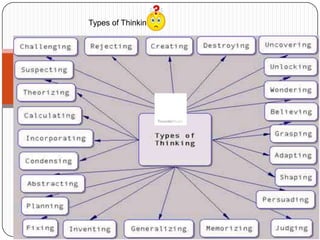
Types of Thinking
Connect 9 dots with only 3 lines


  http://www.youtube.com/watch?v=Rq3ta6SvlTo
Creative Thinking
1.A way of thinking that generates
  something new or different.
2.It involves having a different idea
  that works as well or better than
  previous ideas.
3.It is generative and divergent in
  nature.
4.Divergent means thinking that
  starts from a common point and
  moves outward into a variety of
  perspectives
Critical Thinking
1.A way of thinking that assesses the
  worth and validity of something in
  existent.
2.It involves precise, persistent and
  objective analysis.
3.It is focus and convergent in
  nature.
4. Thinking which process
  information around a common point
  – an attempt to bring thoughts from
  different directions into a union or
     http://www.youtube.com/watch?v=6OLPL5p0
Inductive Thinking
1.This is the process of reasoning
  from parts to the whole, from
  examples to generalizations.
2.Analyzing specific observations to
  reach general conclusions.
3.Works from specific observations
  to broader generalizations and
  theories.
4.Is more open-ended and
  exploratory especially at the
  beginning.
Deductive Thinking
1.This is the process of reasoning
  from the whole to its parts, from
  generalizations to underlying
  concepts to examples.
2.Works from the more general to the
  more specific.
3.Is more close-ended especially at
  the beginning.
Strategic Thinking
1.Can “see” issues, problems and
  opportunities in a larger and
  broader perspective and being able
  to understand the inter-relation of
  all the elements involved so that
  the best course of action could be
  formulated to achieve the desired
  goals.
Match Stick
 Problem

http://www.youtube.com/watch?v=jB6nyt0rLIk&feature=re
lated
Analytical Thinking
1.The abstract separate of a whole
  into its constituent parts in order to
  study the parts and their relations.
2.Separating and distinguishing
  elements of a concept, problem
  and issue in order to understand its
  essential nature and inner
  relationships.
Lateral Thinking
1.The concept was introduced by
  Edward de Bono in 1967 which
  means a way of thinking that
  involves multiple parallel approach.
2.An example of “multiple parallel
  approach” in thinking is Edward de
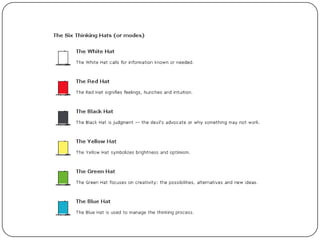
  Bono’s “Six Thinking Hats”.
Match Stick Puzzle


http://www.youtube.com/watch?v=9BwwmheW5uM
LLP1123presentation

LLP1123presentation

  • 1.
    Group 7 Presentation Complex Cognitive Processes Lecturer: Dr. Nora Mislan Student: Mr. Lim Keng Keh Ms. Dhinapriya Balachandran Ms. Thilakavathy Cik. Nurul Afiqah
  • 2.
  • 3.
    Connect 9 dotswith only 3 lines http://www.youtube.com/watch?v=Rq3ta6SvlTo
  • 4.
    Creative Thinking 1.A wayof thinking that generates something new or different. 2.It involves having a different idea that works as well or better than previous ideas. 3.It is generative and divergent in nature. 4.Divergent means thinking that starts from a common point and moves outward into a variety of perspectives
  • 5.
    Critical Thinking 1.A wayof thinking that assesses the worth and validity of something in existent. 2.It involves precise, persistent and objective analysis. 3.It is focus and convergent in nature. 4. Thinking which process information around a common point – an attempt to bring thoughts from different directions into a union or http://www.youtube.com/watch?v=6OLPL5p0
  • 6.
    Inductive Thinking 1.This isthe process of reasoning from parts to the whole, from examples to generalizations. 2.Analyzing specific observations to reach general conclusions. 3.Works from specific observations to broader generalizations and theories. 4.Is more open-ended and exploratory especially at the beginning.
  • 7.
    Deductive Thinking 1.This isthe process of reasoning from the whole to its parts, from generalizations to underlying concepts to examples. 2.Works from the more general to the more specific. 3.Is more close-ended especially at the beginning.
  • 8.
    Strategic Thinking 1.Can “see”issues, problems and opportunities in a larger and broader perspective and being able to understand the inter-relation of all the elements involved so that the best course of action could be formulated to achieve the desired goals.
  • 9.
  • 10.
    Analytical Thinking 1.The abstractseparate of a whole into its constituent parts in order to study the parts and their relations. 2.Separating and distinguishing elements of a concept, problem and issue in order to understand its essential nature and inner relationships.
  • 11.
    Lateral Thinking 1.The conceptwas introduced by Edward de Bono in 1967 which means a way of thinking that involves multiple parallel approach. 2.An example of “multiple parallel approach” in thinking is Edward de Bono’s “Six Thinking Hats”.
  • 13.