Chapter 7Chapter 7
Exploratory Research andExploratory Research and
Qualitative AnalysisQualitative Analysis
Exploratory Research: What It Is
and What It Is Not?
• Exploratory Research is initial research conducted to
clarify and define the nature of a problem.
• Much, but certainly not all, exploratory research
provides qualitative data.
• Alternatively, the purpose of quantitative research is
to determine the quantity or extent of some
phenomenon in the form of numbers.
• Exploratory research may be a single research
investigation or a series of informal studies to
provide background information.
• Does not provide conclusive evidence
• Subsequent research expected
What is Exploratory
Research?
QUANTITATIVEQUANTITATIVE
DATADATA
QUALITATIVEQUALITATIVE
DATADATA
Qualitative VS.
Quantitative Research
• Purpose
– Exploratory versus descriptive and conclusive
• Small versus large samples
• Broad range of questioning versus structured
questions
• Subjective interpretation versus statistical
analysis
Why Conduct Exploratory
Research?
• Diagnose a situation (Situation Analysis)
• Screening of alternatives
– Concept Testing is a form of research that tests
some sort of stimulus as a proxy for a new or
revised program, product, or service.
• Discover new ideas
Concept Testing
• Exploratory research procedure that tests some
sort of stimulus as a proxy for an idea about a
new, revised, or repositioned product, service, or
strategy.
• How is the positioning? How do they see it? Will
people buy it?
• DNI- Find out what customers want/need. What
do they want in a product?
Categories of Exploratory
Research
• Experience surveys
• Secondary data analysis
• Case studies
• Pilot studies
Experience Surveys
• An exploratory research technique in
which individuals who are
knowledgeable about a particular
research problems are surveyed.
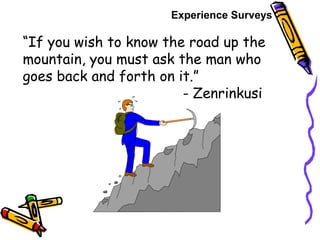
“If you wish to know the road up the
mountain, you must ask the man who
goes back and forth on it.”
- Zenrinkusi
Experience Surveys
Secondary Data Analysis
• Preliminary review of data collected for
another purpose to clarify issues in the
early stages of a research effort.
• Economical
• Quick source for background
information
Case Study Method
• An exploratory research technique that
intensively investigates one or a few
situations similar to the researcher’s
problem situation.
• Investigate in depth
• Careful study
• May require cooperation
Pilot Study
• A collective term used to:
– describe any small scale exploratory study
– uses sampling but does not apply rigorous
standards.
• Types of pilot study include:
– Focus Group Interviews
– Projective Techniques
– In-Depth Interviews
“A man is least himself when he talks
in his own person; when given a mask
he will tell the truth.”
--Oscar Wilde
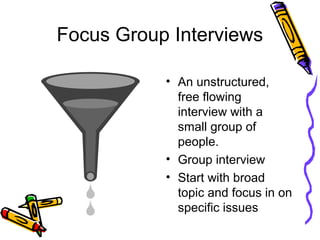
Focus Group Interviews
• An unstructured,
free flowing
interview with a
small group of
people.
• Group interview
• Start with broad
topic and focus in on
specific issues
Advantages of Focus Group
Interview (10 S’s)
• Synergy ….. 2 are better than 1 and 3 are better than 2
• Serendipity …. Luck , coincidence
• Snowballing …. Using each others ideas to move on and refine
• Stimulation …. Encouragement and motivation
• Security …. Members feel support of each other and no fear
• Spontaneity …. Impulsiveness, naturalness
• Specialization …. Experts, field, specialty, interest
• Scrutiny ….. Inspection, analysis, inquiry
• Structure …. Arrangement, formation, composition
• Speed …. Pace, momentum, tempo, swiftness
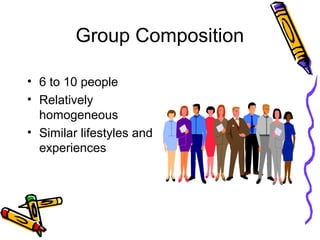
Group Composition
• 6 to 10 people
• Relatively
homogeneous
• Similar lifestyles and
experiences
Environmental Conditions
• A coffee klatch or bull session
atmosphere be established to ensure
that the mood of the sessions will be as
relaxed and natural as possible.
• Easy and conducive for discussion
• Must match participants members status
Outline for a Focus Group
• Establish a rapport
• Begin with broad topic
• Focus in on specific topic
• Generate discussion and interaction
Discussion Guide
• The moderator’s written prefatory
remarks and outline of topics/questions
that will be addressed.
The Moderator
• Develops rapport - helps people relax
• Interacts
• Listens to what people have to say
• Everyone gets a chance to speak
• Maintains loose control and
focuses discussion
• Stimulates spontaneous responses
Advantages of Online
Focus Groups
• Fast
• Inexpensive
• Bring together many participants from
wide-spread geographical areas
• Respondent anonymity
• Transcript automatically recorded
Disadvantages of Online Focus Groups
• Less group interaction
• Absence of tactile stimulation
• Absence of facial expression and body
language
• Moderator’s job is different
Streaming Media
SM- Multimedia content that can be
accesses on the internet without being
downloaded.
Online focus group- People interact via
chat rooms. Harder to snowball their
comments and lose some interaction.
Good: Can be more people, can no
longer
Bad: Only people with internet access
can be a part of it, no body language or
facial expressions, No taste or touch can
be done.
Projective Techniques
• An indirect means of questioning that enables a
respondent to project beliefs and feelings onto a
third party, , onto an inanimate object, or into a
task situation.
– Word Association test is the exploratory research technique
in which the subject is presented with a list of words, one at a
time, and asked to respond with the first word that comes to
mind
Projective Techniques
– Sentence Completion Method is the projective technique in
which respondents are required to complete a number of
partial sentences with the first word or phrase that comes to
mind.
People who drink beer are ______________________
A man who drinks light beer is ___________________
Imported beer is most liked by ___________________
A woman will drink beer when____________________
Projective Techniques
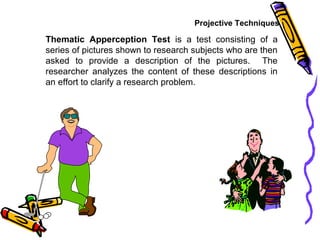
Thematic Apperception Test is a test consisting of a
series of pictures shown to research subjects who are then
asked to provide a description of the pictures. The
researcher analyzes the content of these descriptions in
an effort to clarify a research problem.
Projective Techniques
– Third-person Technique is the exploratory research
technique in which the respondent is asked why a third
person does what he/she does or what he/she thinks about
an object, event, person, or activity. The respondent is
expected to transfer his/her attitudes to the third person.
– Role Playing is an exploratory research technique that
requires the subject to act out someone else’s behavior in a
particular setting.
– Picture Frustration is a version of T.A.T. that uses cartoon
drawing in which the respondent suggests dialogue that the
cartoon characters might make.
Depth Interview
• A relative unstructured, extensive
interview used in the primary stages of
the research process.
A Warning
• The techniques may produce some interesting and
occasionally bizarre, hypotheses about what was
inside a person’s mind.
– A woman is very serious when she bakes a cake
because unconsciously she is going through the
symbolic act of giving birth.
– A many buys convertible as a substitute
“mistress”.
– Men who wear suspenders are reacting to an
unresolved castration complex.

M.br7 expl research

  • 1.
    Chapter 7Chapter 7 ExploratoryResearch andExploratory Research and Qualitative AnalysisQualitative Analysis
  • 2.
    Exploratory Research: WhatIt Is and What It Is Not? • Exploratory Research is initial research conducted to clarify and define the nature of a problem. • Much, but certainly not all, exploratory research provides qualitative data. • Alternatively, the purpose of quantitative research is to determine the quantity or extent of some phenomenon in the form of numbers. • Exploratory research may be a single research investigation or a series of informal studies to provide background information. • Does not provide conclusive evidence • Subsequent research expected
  • 3.
  • 4.
    Qualitative VS. Quantitative Research •Purpose – Exploratory versus descriptive and conclusive • Small versus large samples • Broad range of questioning versus structured questions • Subjective interpretation versus statistical analysis
  • 5.
    Why Conduct Exploratory Research? •Diagnose a situation (Situation Analysis) • Screening of alternatives – Concept Testing is a form of research that tests some sort of stimulus as a proxy for a new or revised program, product, or service. • Discover new ideas
  • 6.
    Concept Testing • Exploratoryresearch procedure that tests some sort of stimulus as a proxy for an idea about a new, revised, or repositioned product, service, or strategy. • How is the positioning? How do they see it? Will people buy it? • DNI- Find out what customers want/need. What do they want in a product?
  • 7.
    Categories of Exploratory Research •Experience surveys • Secondary data analysis • Case studies • Pilot studies
  • 8.
    Experience Surveys • Anexploratory research technique in which individuals who are knowledgeable about a particular research problems are surveyed.
  • 9.
    “If you wishto know the road up the mountain, you must ask the man who goes back and forth on it.” - Zenrinkusi Experience Surveys
  • 10.
    Secondary Data Analysis •Preliminary review of data collected for another purpose to clarify issues in the early stages of a research effort. • Economical • Quick source for background information
  • 11.
    Case Study Method •An exploratory research technique that intensively investigates one or a few situations similar to the researcher’s problem situation. • Investigate in depth • Careful study • May require cooperation
  • 12.
    Pilot Study • Acollective term used to: – describe any small scale exploratory study – uses sampling but does not apply rigorous standards. • Types of pilot study include: – Focus Group Interviews – Projective Techniques – In-Depth Interviews
  • 13.
    “A man isleast himself when he talks in his own person; when given a mask he will tell the truth.” --Oscar Wilde
  • 14.
    Focus Group Interviews •An unstructured, free flowing interview with a small group of people. • Group interview • Start with broad topic and focus in on specific issues
  • 15.
    Advantages of FocusGroup Interview (10 S’s) • Synergy ….. 2 are better than 1 and 3 are better than 2 • Serendipity …. Luck , coincidence • Snowballing …. Using each others ideas to move on and refine • Stimulation …. Encouragement and motivation • Security …. Members feel support of each other and no fear • Spontaneity …. Impulsiveness, naturalness • Specialization …. Experts, field, specialty, interest • Scrutiny ….. Inspection, analysis, inquiry • Structure …. Arrangement, formation, composition • Speed …. Pace, momentum, tempo, swiftness
  • 16.
    Group Composition • 6to 10 people • Relatively homogeneous • Similar lifestyles and experiences
  • 17.
    Environmental Conditions • Acoffee klatch or bull session atmosphere be established to ensure that the mood of the sessions will be as relaxed and natural as possible. • Easy and conducive for discussion • Must match participants members status
  • 18.
    Outline for aFocus Group • Establish a rapport • Begin with broad topic • Focus in on specific topic • Generate discussion and interaction
  • 19.
    Discussion Guide • Themoderator’s written prefatory remarks and outline of topics/questions that will be addressed.
  • 20.
    The Moderator • Developsrapport - helps people relax • Interacts • Listens to what people have to say • Everyone gets a chance to speak • Maintains loose control and focuses discussion • Stimulates spontaneous responses
  • 21.
    Advantages of Online FocusGroups • Fast • Inexpensive • Bring together many participants from wide-spread geographical areas • Respondent anonymity • Transcript automatically recorded
  • 22.
    Disadvantages of OnlineFocus Groups • Less group interaction • Absence of tactile stimulation • Absence of facial expression and body language • Moderator’s job is different
  • 23.
    Streaming Media SM- Multimediacontent that can be accesses on the internet without being downloaded. Online focus group- People interact via chat rooms. Harder to snowball their comments and lose some interaction. Good: Can be more people, can no longer Bad: Only people with internet access can be a part of it, no body language or facial expressions, No taste or touch can be done.
  • 24.
    Projective Techniques • Anindirect means of questioning that enables a respondent to project beliefs and feelings onto a third party, , onto an inanimate object, or into a task situation.
  • 25.
    – Word Associationtest is the exploratory research technique in which the subject is presented with a list of words, one at a time, and asked to respond with the first word that comes to mind Projective Techniques
  • 26.
    – Sentence CompletionMethod is the projective technique in which respondents are required to complete a number of partial sentences with the first word or phrase that comes to mind. People who drink beer are ______________________ A man who drinks light beer is ___________________ Imported beer is most liked by ___________________ A woman will drink beer when____________________ Projective Techniques
  • 27.
    Projective Techniques Thematic ApperceptionTest is a test consisting of a series of pictures shown to research subjects who are then asked to provide a description of the pictures. The researcher analyzes the content of these descriptions in an effort to clarify a research problem.
  • 28.
    Projective Techniques – Third-personTechnique is the exploratory research technique in which the respondent is asked why a third person does what he/she does or what he/she thinks about an object, event, person, or activity. The respondent is expected to transfer his/her attitudes to the third person. – Role Playing is an exploratory research technique that requires the subject to act out someone else’s behavior in a particular setting. – Picture Frustration is a version of T.A.T. that uses cartoon drawing in which the respondent suggests dialogue that the cartoon characters might make.
  • 29.
    Depth Interview • Arelative unstructured, extensive interview used in the primary stages of the research process.
  • 30.
    A Warning • Thetechniques may produce some interesting and occasionally bizarre, hypotheses about what was inside a person’s mind. – A woman is very serious when she bakes a cake because unconsciously she is going through the symbolic act of giving birth. – A many buys convertible as a substitute “mistress”. – Men who wear suspenders are reacting to an unresolved castration complex.