On the Value of User Preferences in
Search-Based Software Engineering:
A Case Study in Software Product Lines
Abdel Salam Sayyad
Tim Menzies
Hany Ammar
West Virginia University, USA
International Conference on Software Engineering
May 23rd, 2013
Sound bites
Feature-based SE
Representation and validation: important
Multi-objective Configuration: interesting
2
Stop tinkering with small stuff!
Minor improvements welcome…
… but not insightful!
Enough with the usual suspects:
NSGA-II, SPEA2, etc.
If user preferences matter
Then the best optimizer understands preferences the best
Roadmap
① Feature-based SE
② Evolutionary Algorithms
③ Experiment & Results
④ Conclusion
Roadmap
① Feature-based SE
② Evolutionary Algorithms
③ Experiment & Results
④ Conclusion
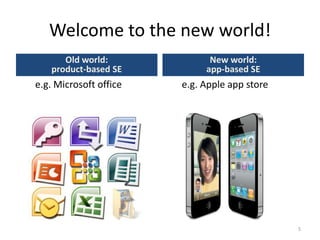
Welcome to the new world!
Old world:
product-based SE
e.g. Microsoft office
New world:
app-based SE
e.g. Apple app store
5
The times, they are a changin’
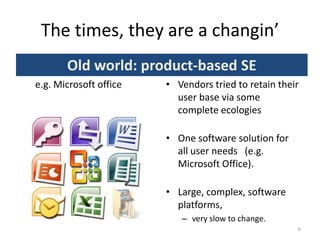
Old world: product-based SE
e.g. Microsoft office
6
• Vendors tried to retain their
user base via some
complete ecologies
• One software solution for
all user needs (e.g.
Microsoft Office).
• Large, complex, software
platforms,
– very slow to change.
The times, they are a changin’
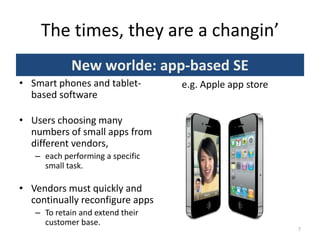
New worlde: app-based SE
• Smart phones and tablet-
based software
• Users choosing many
numbers of small apps from
different vendors,
– each performing a specific
small task.
• Vendors must quickly and
continually reconfigure apps
– To retain and extend their
customer base.
7
e.g. Apple app store
Feature–oriented domain analysis [Kang 1990]
• Feature models = a
lightweight method for
defining a space of options
• De facto standard for
modeling variability
8
Cross-Tree Constraints
What are the user preferences?
• Multi-objective optimization = navigating competing concerns
– Success criteria = choose features that achieve the user preferences!
• Suppose each feature had the following metrics:
1. Boolean USED_BEFORE?
2. Integer DEFECTS
3. Real COST
• Show me the space of “best options” according to the objectives:
1. That satisfies most domain constraints (0 ≤ #violations ≤ 100%)
2. That offers most features
3. That we have used most before
4. Using features with least known defects
5. Using features with least cost
9
Diving deeper
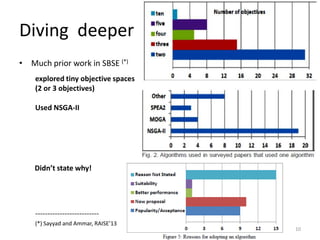
• Much prior work in SBSE (*)
--------------------------
(*) Sayyad and Ammar, RAISE’13
10
explored tiny objective spaces
(2 or 3 objectives)
Used NSGA-II
Didn’t state why!
Roadmap
① Feature-based SE
② Evolutionary Algorithms
③ Experiment & Results
④ Conclusion
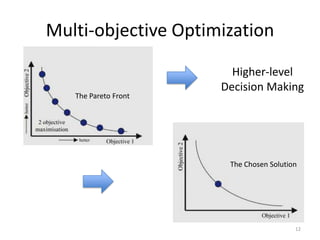
Multi-objective Optimization
12
Higher-level
Decision Making
The Pareto Front
The Chosen Solution
Survival of the fittest
(according to NSGA-II [Deb et al. 2002])
13
Boolean dominance (x Dominates y, or does not):
- In no objective is x worse than y
- In at least one objective, x is better than y Crowd
pruning
Tinkering with small stuff…
ssNSGA-II: steady state [Durillo ‘09+
14
Other Algorithms: Ranking criteria:
NSGA-II
SPEA2 *Zitzler ‘01+ More focus on diversity, with a
new diversity measure.
FastPGA [Eskandari ‘07+
Borrowed criteria from
NSGA-II, and diversity
measure from SPEA2
MOCell (Cellular GA) [Nebro ‘09] NSGA-II
NSGA-IIMOCHC (re-designed selection, crossover,
and mutation) [Nebro ‘07+
Boolean Dominance
Boolean Dominance
Boolean Dominance
Boolean Dominance
Boolean Dominance
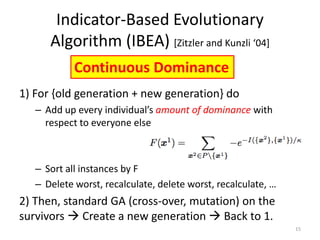
Indicator-Based Evolutionary
Algorithm (IBEA) [Zitzler and Kunzli ‘04+
15
1) For {old generation + new generation} do
– Add up every individual’s amount of dominance with
respect to everyone else
– Sort all instances by F
– Delete worst, recalculate, delete worst, recalculate, …
2) Then, standard GA (cross-over, mutation) on the
survivors  Create a new generation  Back to 1.
Continuous Dominance
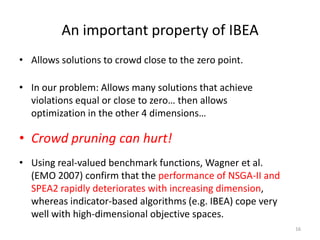
An important property of IBEA
• Allows solutions to crowd close to the zero point.
16
• In our problem: Allows many solutions that achieve
violations equal or close to zero… then allows
optimization in the other 4 dimensions…
• Crowd pruning can hurt!
• Using real-valued benchmark functions, Wagner et al.
(EMO 2007) confirm that the performance of NSGA-II and
SPEA2 rapidly deteriorates with increasing dimension,
whereas indicator-based algorithms (e.g. IBEA) cope very
well with high-dimensional objective spaces.
Roadmap
① Feature-based SE
② Evolutionary Algorithms
③ Experiment & Results
④ Conclusion
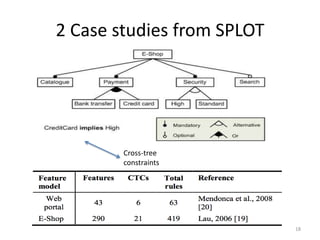
2 Case studies from SPLOT
18
Cross-tree
constraints
Algorithms
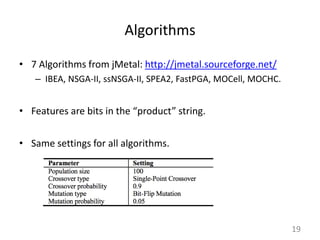
• 7 Algorithms from jMetal: http://jmetal.sourceforge.net/
– IBEA, NSGA-II, ssNSGA-II, SPEA2, FastPGA, MOCell, MOCHC.
19
• Features are bits in the “product” string.
• Same settings for all algorithms.
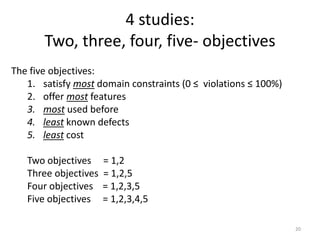
4 studies:
Two, three, four, five- objectives
20
The five objectives:
1. satisfy most domain constraints (0 ≤ violations ≤ 100%)
2. offer most features
3. most used before
4. least known defects
5. least cost
Two objectives = 1,2
Three objectives = 1,2,5
Four objectives = 1,2,3,5
Five objectives = 1,2,3,4,5
21
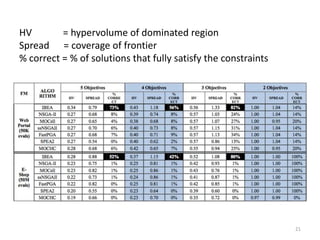
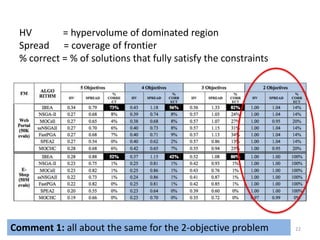
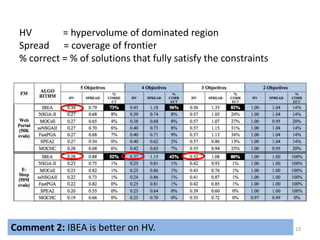
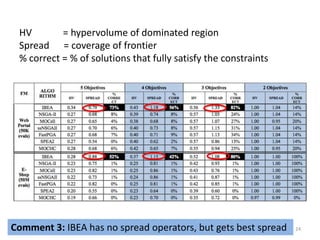
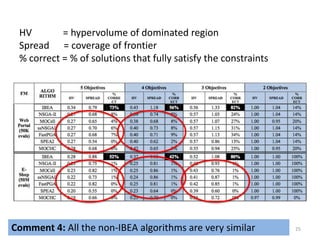
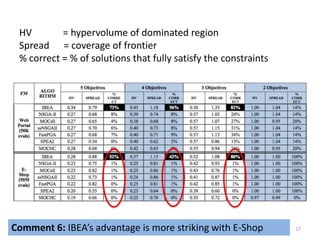
HV = hypervolume of dominated region
Spread = coverage of frontier
% correct = % of solutions that fully satisfy the constraints
22Comment 1: all about the same for the 2-objective problem
HV = hypervolume of dominated region
Spread = coverage of frontier
% correct = % of solutions that fully satisfy the constraints
23Comment 2: IBEA is better on HV.
HV = hypervolume of dominated region
Spread = coverage of frontier
% correct = % of solutions that fully satisfy the constraints
24Comment 3: IBEA has no spread operators, but gets best spread
HV = hypervolume of dominated region
Spread = coverage of frontier
% correct = % of solutions that fully satisfy the constraints
25Comment 4: All the non-IBEA algorithms are very similar
HV = hypervolume of dominated region
Spread = coverage of frontier
% correct = % of solutions that fully satisfy the constraints
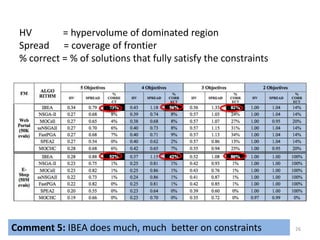
HV = hypervolume of dominated region
Spread = coverage of frontier
% correct = % of solutions that fully satisfy the constraints
26Comment 5: IBEA does much, much better on constraints
HV = hypervolume of dominated region
Spread = coverage of frontier
% correct = % of solutions that fully satisfy the constraints
27Comment 6: IBEA’s advantage is more striking with E-Shop
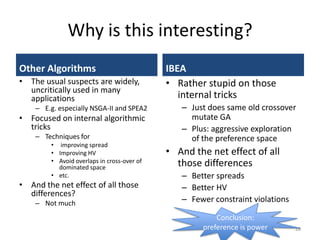
Why is this interesting?
Other Algorithms
• The usual suspects are widely,
uncritically used in many
applications
– E.g. especially NSGA-II and SPEA2
• Focused on internal algorithmic
tricks
– Techniques for
• improving spread
• Improving HV
• Avoid overlaps in cross-over of
dominated space
• etc.
• And the net effect of all those
differences?
– Not much
IBEA
• Rather stupid on those
internal tricks
– Just does same old crossover
mutate GA
– Plus: aggressive exploration
of the preference space
• And the net effect of all
those differences
– Better spreads
– Better HV
– Fewer constraint violations
28
Conclusion:
preference is power
Roadmap
① Feature-based SE
② Evolutionary Algorithms
③ Experiment & Results
④ Conclusion
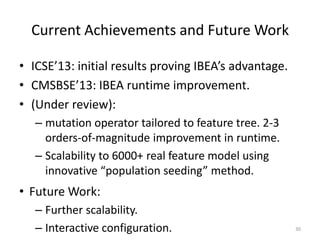
Current Achievements and Future Work
• ICSE’13: initial results proving IBEA’s advantage.
• CMSBSE’13: IBEA runtime improvement.
• (Under review):
– mutation operator tailored to feature tree. 2-3
orders-of-magnitude improvement in runtime.
– Scalability to 6000+ real feature model using
innovative “population seeding” method.
30
• Future Work:
– Further scalability.
– Interactive configuration.
Sound bites
The new age of the app
In this new world: use FODA
(feature-oriented domain analysis)
31
Stop tinkering with small stuff
Many MEOAs have strikingly
similar performance
Enough with the usual suspects:
NSGA-II, SPEA2, etc.
Too much uncritical application of these algorithms
If user preferences matter
Then the best optimizer understands preferences the best
IBEA: aggressive preference exploration
Acknowledgment
This research work was
funded by the Qatar
National Research Fund
(QNRF) under the National
Priorities Research Program
(NPRP)
Grant No.: 09-1205-2-470.

On the Value of User Preferences in Search-Based Software Engineering

  • 1.
    On the Valueof User Preferences in Search-Based Software Engineering: A Case Study in Software Product Lines Abdel Salam Sayyad Tim Menzies Hany Ammar West Virginia University, USA International Conference on Software Engineering May 23rd, 2013
  • 2.
    Sound bites Feature-based SE Representationand validation: important Multi-objective Configuration: interesting 2 Stop tinkering with small stuff! Minor improvements welcome… … but not insightful! Enough with the usual suspects: NSGA-II, SPEA2, etc. If user preferences matter Then the best optimizer understands preferences the best
  • 3.
    Roadmap ① Feature-based SE ②Evolutionary Algorithms ③ Experiment & Results ④ Conclusion
  • 4.
    Roadmap ① Feature-based SE ②Evolutionary Algorithms ③ Experiment & Results ④ Conclusion
  • 5.
    Welcome to thenew world! Old world: product-based SE e.g. Microsoft office New world: app-based SE e.g. Apple app store 5
  • 6.
    The times, theyare a changin’ Old world: product-based SE e.g. Microsoft office 6 • Vendors tried to retain their user base via some complete ecologies • One software solution for all user needs (e.g. Microsoft Office). • Large, complex, software platforms, – very slow to change.
  • 7.
    The times, theyare a changin’ New worlde: app-based SE • Smart phones and tablet- based software • Users choosing many numbers of small apps from different vendors, – each performing a specific small task. • Vendors must quickly and continually reconfigure apps – To retain and extend their customer base. 7 e.g. Apple app store
  • 8.
    Feature–oriented domain analysis[Kang 1990] • Feature models = a lightweight method for defining a space of options • De facto standard for modeling variability 8 Cross-Tree Constraints Cross-Tree Constraints
  • 9.
    What are theuser preferences? • Multi-objective optimization = navigating competing concerns – Success criteria = choose features that achieve the user preferences! • Suppose each feature had the following metrics: 1. Boolean USED_BEFORE? 2. Integer DEFECTS 3. Real COST • Show me the space of “best options” according to the objectives: 1. That satisfies most domain constraints (0 ≤ #violations ≤ 100%) 2. That offers most features 3. That we have used most before 4. Using features with least known defects 5. Using features with least cost 9
  • 10.
    Diving deeper • Muchprior work in SBSE (*) -------------------------- (*) Sayyad and Ammar, RAISE’13 10 explored tiny objective spaces (2 or 3 objectives) Used NSGA-II Didn’t state why!
  • 11.
    Roadmap ① Feature-based SE ②Evolutionary Algorithms ③ Experiment & Results ④ Conclusion
  • 12.
  • 13.
    Survival of thefittest (according to NSGA-II [Deb et al. 2002]) 13 Boolean dominance (x Dominates y, or does not): - In no objective is x worse than y - In at least one objective, x is better than y Crowd pruning
  • 14.
    Tinkering with smallstuff… ssNSGA-II: steady state [Durillo ‘09+ 14 Other Algorithms: Ranking criteria: NSGA-II SPEA2 *Zitzler ‘01+ More focus on diversity, with a new diversity measure. FastPGA [Eskandari ‘07+ Borrowed criteria from NSGA-II, and diversity measure from SPEA2 MOCell (Cellular GA) [Nebro ‘09] NSGA-II NSGA-IIMOCHC (re-designed selection, crossover, and mutation) [Nebro ‘07+ Boolean Dominance Boolean Dominance Boolean Dominance Boolean Dominance Boolean Dominance
  • 15.
    Indicator-Based Evolutionary Algorithm (IBEA)[Zitzler and Kunzli ‘04+ 15 1) For {old generation + new generation} do – Add up every individual’s amount of dominance with respect to everyone else – Sort all instances by F – Delete worst, recalculate, delete worst, recalculate, … 2) Then, standard GA (cross-over, mutation) on the survivors  Create a new generation  Back to 1. Continuous Dominance
  • 16.
    An important propertyof IBEA • Allows solutions to crowd close to the zero point. 16 • In our problem: Allows many solutions that achieve violations equal or close to zero… then allows optimization in the other 4 dimensions… • Crowd pruning can hurt! • Using real-valued benchmark functions, Wagner et al. (EMO 2007) confirm that the performance of NSGA-II and SPEA2 rapidly deteriorates with increasing dimension, whereas indicator-based algorithms (e.g. IBEA) cope very well with high-dimensional objective spaces.
  • 17.
    Roadmap ① Feature-based SE ②Evolutionary Algorithms ③ Experiment & Results ④ Conclusion
  • 18.
    2 Case studiesfrom SPLOT 18 Cross-tree constraints
  • 19.
    Algorithms • 7 Algorithmsfrom jMetal: http://jmetal.sourceforge.net/ – IBEA, NSGA-II, ssNSGA-II, SPEA2, FastPGA, MOCell, MOCHC. 19 • Features are bits in the “product” string. • Same settings for all algorithms.
  • 20.
    4 studies: Two, three,four, five- objectives 20 The five objectives: 1. satisfy most domain constraints (0 ≤ violations ≤ 100%) 2. offer most features 3. most used before 4. least known defects 5. least cost Two objectives = 1,2 Three objectives = 1,2,5 Four objectives = 1,2,3,5 Five objectives = 1,2,3,4,5
  • 21.
    21 HV = hypervolumeof dominated region Spread = coverage of frontier % correct = % of solutions that fully satisfy the constraints
  • 22.
    22Comment 1: allabout the same for the 2-objective problem HV = hypervolume of dominated region Spread = coverage of frontier % correct = % of solutions that fully satisfy the constraints
  • 23.
    23Comment 2: IBEAis better on HV. HV = hypervolume of dominated region Spread = coverage of frontier % correct = % of solutions that fully satisfy the constraints
  • 24.
    24Comment 3: IBEAhas no spread operators, but gets best spread HV = hypervolume of dominated region Spread = coverage of frontier % correct = % of solutions that fully satisfy the constraints
  • 25.
    25Comment 4: Allthe non-IBEA algorithms are very similar HV = hypervolume of dominated region Spread = coverage of frontier % correct = % of solutions that fully satisfy the constraints
  • 26.
    HV = hypervolumeof dominated region Spread = coverage of frontier % correct = % of solutions that fully satisfy the constraints 26Comment 5: IBEA does much, much better on constraints
  • 27.
    HV = hypervolumeof dominated region Spread = coverage of frontier % correct = % of solutions that fully satisfy the constraints 27Comment 6: IBEA’s advantage is more striking with E-Shop
  • 28.
    Why is thisinteresting? Other Algorithms • The usual suspects are widely, uncritically used in many applications – E.g. especially NSGA-II and SPEA2 • Focused on internal algorithmic tricks – Techniques for • improving spread • Improving HV • Avoid overlaps in cross-over of dominated space • etc. • And the net effect of all those differences? – Not much IBEA • Rather stupid on those internal tricks – Just does same old crossover mutate GA – Plus: aggressive exploration of the preference space • And the net effect of all those differences – Better spreads – Better HV – Fewer constraint violations 28 Conclusion: preference is power
  • 29.
    Roadmap ① Feature-based SE ②Evolutionary Algorithms ③ Experiment & Results ④ Conclusion
  • 30.
    Current Achievements andFuture Work • ICSE’13: initial results proving IBEA’s advantage. • CMSBSE’13: IBEA runtime improvement. • (Under review): – mutation operator tailored to feature tree. 2-3 orders-of-magnitude improvement in runtime. – Scalability to 6000+ real feature model using innovative “population seeding” method. 30 • Future Work: – Further scalability. – Interactive configuration.
  • 31.
    Sound bites The newage of the app In this new world: use FODA (feature-oriented domain analysis) 31 Stop tinkering with small stuff Many MEOAs have strikingly similar performance Enough with the usual suspects: NSGA-II, SPEA2, etc. Too much uncritical application of these algorithms If user preferences matter Then the best optimizer understands preferences the best IBEA: aggressive preference exploration Acknowledgment This research work was funded by the Qatar National Research Fund (QNRF) under the National Priorities Research Program (NPRP) Grant No.: 09-1205-2-470.