Living Things and
Non-Living Things
Jenefer Agustina P.Magora
– T III
Masi Elementary School
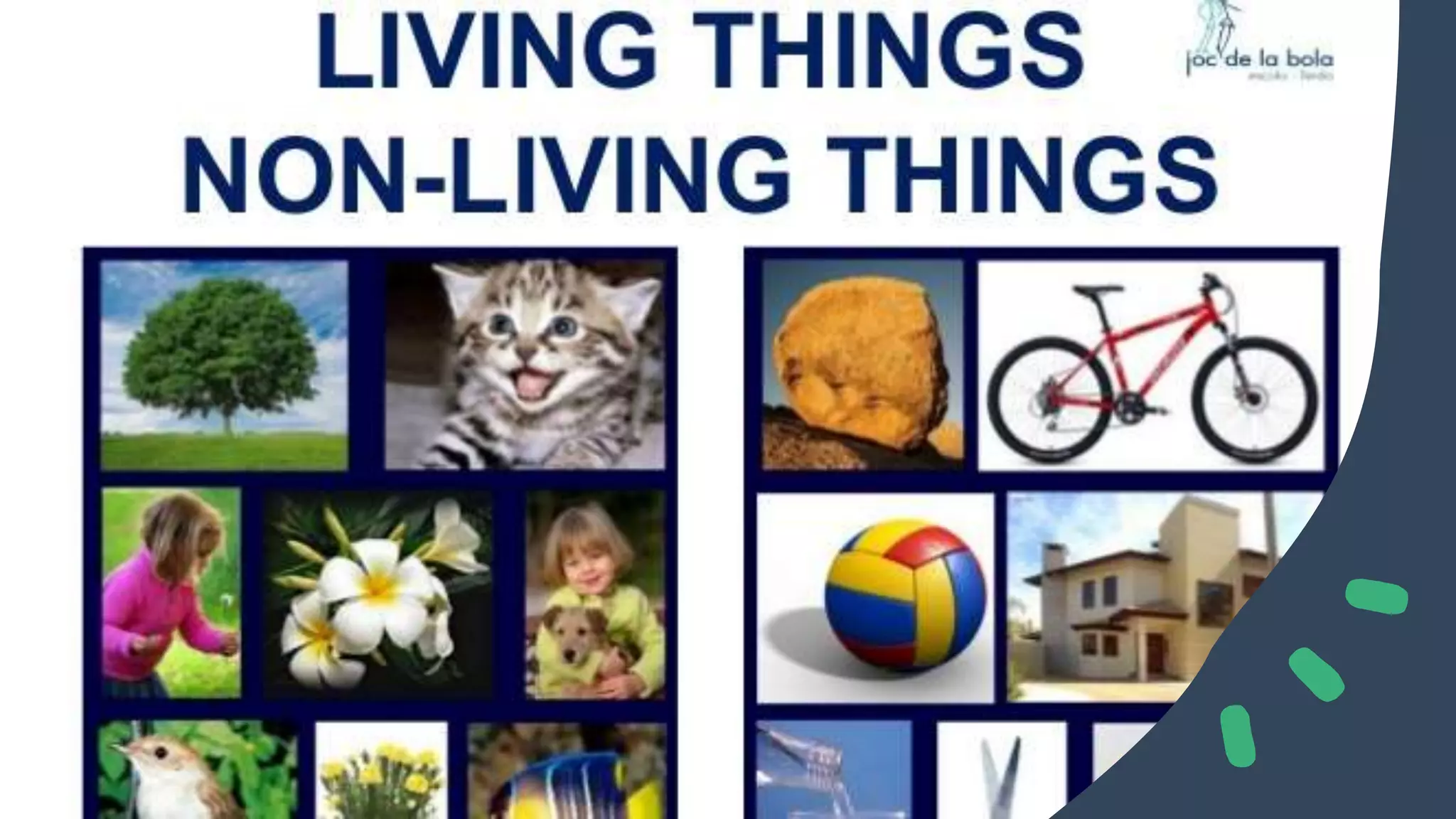
What can you say about the pictures?
Can you group them? How?
What is an ecosystem?
An ecosystem includes all the living things
(plants, animals, and organisms) in a
given area, interacting with each other,
and with their non-living environments
(weather, earth, sun, soil, climate,
atmosphere). In an ecosystem, each
organism has its niche or role to play.
An ecosystem is defined by
the network of interactions
among organisms, and
their environment, they
can be of size but usually
encompass specific, limited
spaces (although some
scientists say that the
entire planet is an
ecosystem).
TYPES OF ECOSYSTEM and EXAMPLES
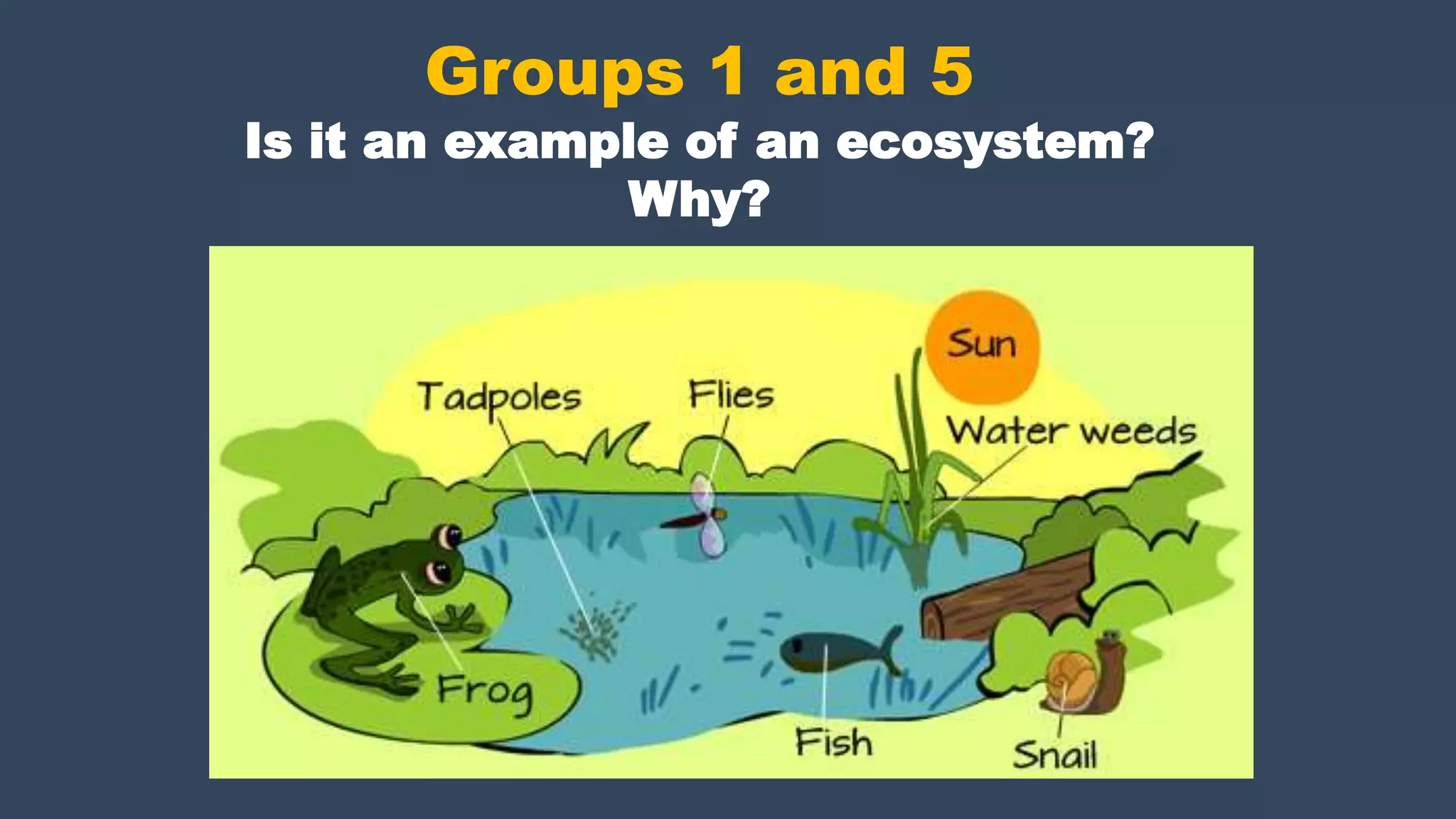
Groups 1 and 5
Is it an example of an ecosystem?
Why?
Groups 2 and 6
Name examples of land ecosystems
you see or heard from the video.
Groups 3 and 4
Name examples of aquatic ecosystem
you see or heard from the video.
What do you expect to see
in a swamp pond and a
desert?
Try to classify living from
non-living things.
WHAT IS A DESERT
ECOSYSTEM?
Desert ecosystems are dry environments with
scarce vegetation, harsh temperatures, and
precipitation of fewer than 10 inches a year.
The humidity in the atmosphere is very low, so
the temperatures are not regulated. Deserts
can be hot and arid or extremely cold.
Desert Ecosystem
WHAT IS A SWAMP
ECOSYSTEM?
A swamp is an area of land permanently
saturated, or filled, with water. Many
swamps are even covered by water. There
are two main types of swamps: freshwater
swamps and saltwater swamps. Swamps are
dominated by trees.
Swamp Ecosystem
Write LT if the things found belong to living things and NLT if
it belongs to non-living things.
1. Trees - LT
2. Table - NLT
3. Cloud - NLT
4. Laptop - NLT
5. Air - NLT
6. Lion - LT
7. Sunlight - NLT
8. Teacher - LT
9. Water - NLT
10. Ballpen - NLT
On your way home,
list down the living
things and non-living
things you see.
THANK YOU FOR
LISTENING!!!

Living Things and grade6 day 1.pptx

  • 1.
    Living Things and Non-LivingThings Jenefer Agustina P.Magora – T III Masi Elementary School
  • 2.
    What can yousay about the pictures? Can you group them? How?
  • 5.
    What is anecosystem? An ecosystem includes all the living things (plants, animals, and organisms) in a given area, interacting with each other, and with their non-living environments (weather, earth, sun, soil, climate, atmosphere). In an ecosystem, each organism has its niche or role to play.
  • 6.
    An ecosystem isdefined by the network of interactions among organisms, and their environment, they can be of size but usually encompass specific, limited spaces (although some scientists say that the entire planet is an ecosystem).
  • 8.
    TYPES OF ECOSYSTEMand EXAMPLES
  • 9.
    Groups 1 and5 Is it an example of an ecosystem? Why?
  • 10.
    Groups 2 and6 Name examples of land ecosystems you see or heard from the video.
  • 11.
    Groups 3 and4 Name examples of aquatic ecosystem you see or heard from the video.
  • 12.
    What do youexpect to see in a swamp pond and a desert? Try to classify living from non-living things.
  • 13.
    WHAT IS ADESERT ECOSYSTEM? Desert ecosystems are dry environments with scarce vegetation, harsh temperatures, and precipitation of fewer than 10 inches a year. The humidity in the atmosphere is very low, so the temperatures are not regulated. Deserts can be hot and arid or extremely cold.
  • 14.
  • 15.
    WHAT IS ASWAMP ECOSYSTEM? A swamp is an area of land permanently saturated, or filled, with water. Many swamps are even covered by water. There are two main types of swamps: freshwater swamps and saltwater swamps. Swamps are dominated by trees.
  • 16.
  • 17.
    Write LT ifthe things found belong to living things and NLT if it belongs to non-living things. 1. Trees - LT 2. Table - NLT 3. Cloud - NLT 4. Laptop - NLT 5. Air - NLT 6. Lion - LT 7. Sunlight - NLT 8. Teacher - LT 9. Water - NLT 10. Ballpen - NLT
  • 20.
    On your wayhome, list down the living things and non-living things you see.
  • 21.