Desert Ecosystem
Deserts arebarren areas of land characterised by extremely high or low temperatures, with low
rainfall and scarce or no vegetation.
Deserts are examples of terrestrial ecosystems, which are found throughout the world. Neither all
deserts are flat, nor do all deserts have cacti or oases. These are regions with a short rainy season. It
is scorching in the daytime, and very cold at night in the desert.
Explore more: Terrestrial Ecosystem
Let us explore more about the types and features of some desert ecosystems.
Types of deserts
Deserts are arid regions with especially low or high temperatures and limited vegetation. Based on
the climate condition, deserts are classified into two types – hot deserts and cold deserts.
The hot and dry desert – Sahara
The Sahara is known as the world’s largest desert, covering over 8.54 million square kilometres. It
is the largest, and the hottest desert in the world.
Sahara desert is located in tropical regions, which are 1,000 m above sea level. It covers a huge part
of North Africa, and eleven other countries – Algeria, Tunisia, Egypt, Mali, Chad, Niger, Western
Sahara, Sudan, Mauritania, Libya and Morocco.
The total area actually measures about 8,600,000 square kilometres, which is 4,800 km
approximately from east to west, and between 800 and 1,200 km from north to south.
The climate in this region is extremely hot, sizzling, and dry, and often receives small quantities of
precipitation throughout the year.
In this hot desert, the days are scorching. During the day, temperatures will rise as high as 45° C to
50° C, heating the bare rocks and the sand. The nights can be extremely cold, with temperatures
going below 0° C, sometimes.
2.
The coldand dry desert of Ladakh
Ladakh is famously known as the cold desert of India. It is found in the high altitudes of the
temperate regions, which lie in the Great Himalayas within the eastern parts of Jammu and Kashmir
and located in the western Himalayas region, within Himachal Pradesh in North India.
The altitude in Ladakh ranges from about 3,000 m in Kargil to 8,000 m in Karakoram. Due to its
high altitude, the climate remains extremely cold and dry. The day temperatures in summer are just
above 0° C and the night temperatures go below –30° C.
The Gangotri glacier along with several other glaciers are found here, along with different rivers
flowing through Ladakh. Among the rivers, Indus is the most important river that flows through
Ladakh.
In Ladakh, there are very few, tiny patches of grasses and shrubs for animals to graze on. Many
poplars, groves of willows and shrubs of the genus Salix are seen in the valleys.
Features and Desert Habitats
The most determining feature of this terrestrial ecosystem is the amount of precipitation it receives,
which is the least compared to other ecosystems.
A desert is an arid or bone-dry region of the landscape where there is little precipitation, hence
living conditions are unfavourable for both flora and fauna. This ecosystem can exist from the
Arctic to the tropics. Not all deserts are hot – some are often windy, while some contain rocks and
others have sand dunes. Flora is a very rare but highly adaptive animal species and insects are found
here.
The soils of the Sahara desert are low in organic matter and are often biologically inactive. The
vegetation in the desert’s ecosystem is generally sparse with scattered concentrations of grasses,
cacti, date palms and acacia.
Because of the extreme dryness and freezing cold in Ladakh, the vegetation is sparse. During the
summer season, beans, turnips, potatoes, peas are sometimes cultivated. Fruit trees such as apricots,
apples, and walnuts bloom in cold deserts.
3.
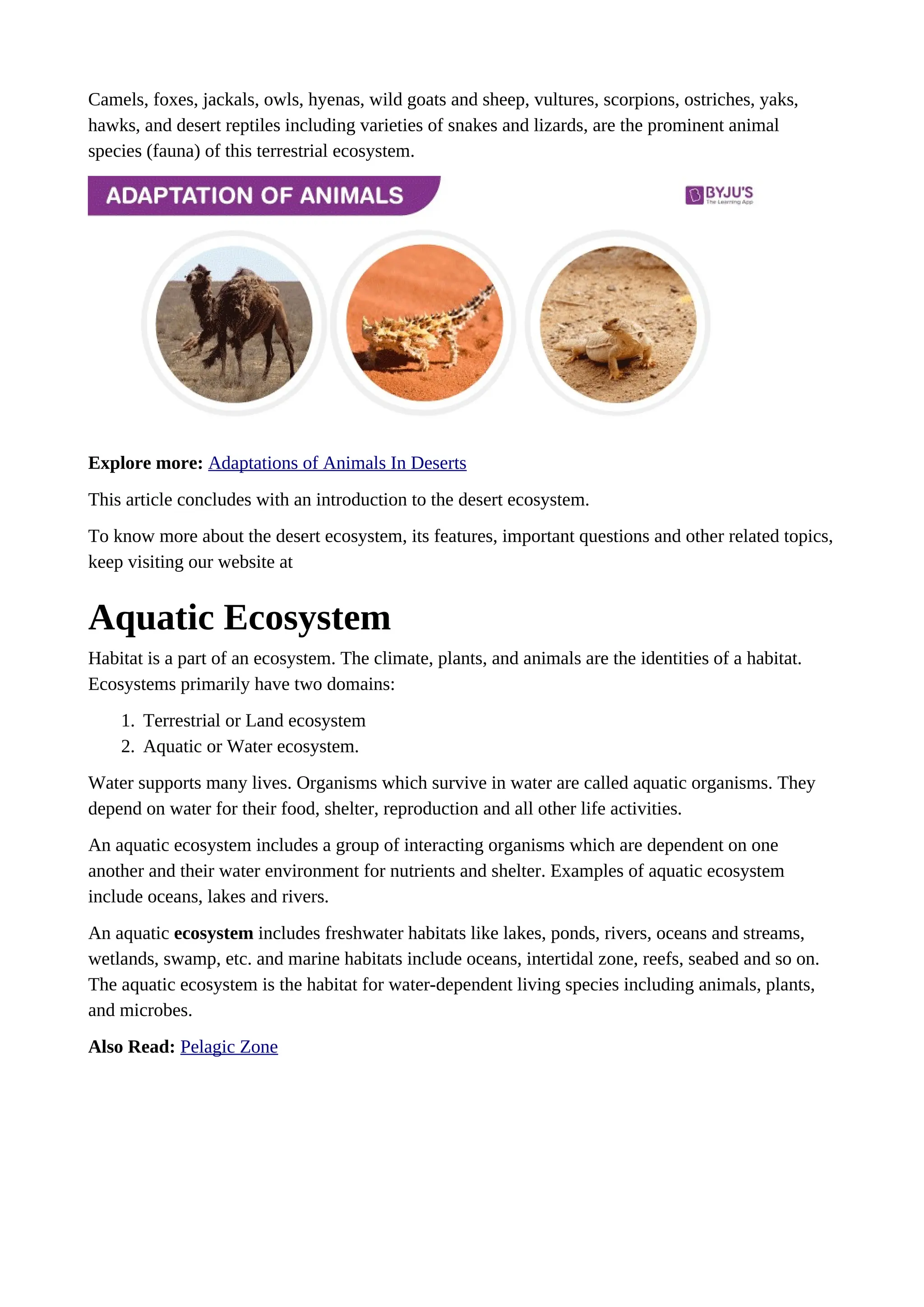
Camels, foxes, jackals,owls, hyenas, wild goats and sheep, vultures, scorpions, ostriches, yaks,
hawks, and desert reptiles including varieties of snakes and lizards, are the prominent animal
species (fauna) of this terrestrial ecosystem.
Explore more: Adaptations of Animals In Deserts
This article concludes with an introduction to the desert ecosystem.
To know more about the desert ecosystem, its features, important questions and other related topics,
keep visiting our website at
Aquatic Ecosystem
Habitat is a part of an ecosystem. The climate, plants, and animals are the identities of a habitat.
Ecosystems primarily have two domains:
1. Terrestrial or Land ecosystem
2. Aquatic or Water ecosystem.
Water supports many lives. Organisms which survive in water are called aquatic organisms. They
depend on water for their food, shelter, reproduction and all other life activities.
An aquatic ecosystem includes a group of interacting organisms which are dependent on one
another and their water environment for nutrients and shelter. Examples of aquatic ecosystem
include oceans, lakes and rivers.
An aquatic ecosystem includes freshwater habitats like lakes, ponds, rivers, oceans and streams,
wetlands, swamp, etc. and marine habitats include oceans, intertidal zone, reefs, seabed and so on.
The aquatic ecosystem is the habitat for water-dependent living species including animals, plants,
and microbes.
Also Read: Pelagic Zone
4.
Types of AquaticEcosystem
Different types of aquatic ecosystems are as follows:
Freshwater Aquatic Ecosystem
They cover only a small portion of earth nearly 0.8 per cent. Freshwater involves lakes, ponds,
rivers and streams, wetlands, swamp, bog and temporary pools. Freshwater habitats are classified
into lotic and lentic habitats. Water bodies such as lakes, ponds, pools, bogs, and other reservoirs
are standing water and known as lentic habitats. Whereas lotic habitats represent flowing water
bodies such as rivers, streams.
Lotic Ecosystems
They mainly refer to the rapidly flowing waters that move in a unidirectional way including the
rivers and streams. These environments harbor numerous species of insects such as beetles,
mayflies, stoneflies and several species of fishes including trout, eel, minnow, etc. Apart from these
aquatic species, these ecosystems also include various mammals such as beavers, river dolphins and
otters.
Lentic Ecosystems
They include all standing water habitats. Lakes and ponds are the main examples of Lentic
Ecosystem. The word lentic mainly refers to stationary or relatively still water. These ecosystems
are home to algae, crabs, shrimps, amphibians such as frogs and salamanders, for both rooted and
floating-leaved plants and reptiles including alligators and other water snakes are also found here.
Wetlands
Wetlands are marshy areas and are sometimes covered in water which has a wide diversity of plants
and animals. Swamps, marshes, bogs, black spruce and water lilies are some examples in the plant
species found in the wetlands. The animal life of this ecosystem consists of dragonflies and
damselflies, birds such as Green Heron and fishes such as Northern Pike.
5,937
5.
Marine Aquatic Ecosystem
Marineecosystem covers the largest surface area of the earth. Two third of earth is covered by
water and they constitute of oceans, seas, intertidal zone, reefs, seabed, estuaries, hydrothermal
vents and rock pools. Each life form is unique and native to its habitat. This is because they have
adaptations according to their habitat. In the case of aquatic animals, they can’t survive outside of
water. Exceptional cases are still there which shows another example of adaptations (e.g.
mudskippers). The marine ecosystem is more concentrated with salts which make it difficult for
freshwater organisms to live in. Also, marine animals cannot survive in freshwater. Their body is
adapted to live in saltwater; if they are placed in less salty water, their body will swell (osmosis).
Ocean Ecosystems
Our planet earth is gifted with the five major oceans, namely Pacific, Indian, Arctic, and the
Atlantic Ocean. Among all these five oceans, the Pacific and the Atlantic are the largest and deepest
ocean. These oceans serve as a home to more than five lakh aquatic species. Few creatures of these
ecosystems include shellfish, shark, tube worms, crab small and large ocean fishes, turtles,
crustaceans, blue whale, reptiles, marine mammals, seabirds, plankton, corals and other ocean
plants.
Coastal Systems
They are the open systems of land and water which are joined together to form the coastal
ecosystems. The coastal ecosystems have a different structure, and diversity. A wide variety of
species of aquatic plants and algae are found at the bottom of the coastal ecosystem. The fauna is
diverse and it mainly consists of crabs, fish, insects, lobsters snails, shrimp, etc.
Plants and animals in an aquatic ecosystem show a wide variety of adaptations which may involve
life cycle, physiological, structural and behavioural adaptations. Majority of aquatic animals are
streamlined which helps them to reduce friction and thus save energy. Fins and gills are the
locomotors and respiratory organs respectively. Special features in freshwater organisms help them
to drain excess water from the body. Aquatic plants have different types of roots which help them to
survive in water. Some may have submerged roots; some have emergent roots or maybe floating
plants like water hyacinths.