Aroosa Manazir
Lecturer
Radiology Deprtment
Afro-Asian Institute affiliated with GCUF
Lahore, Pakistan
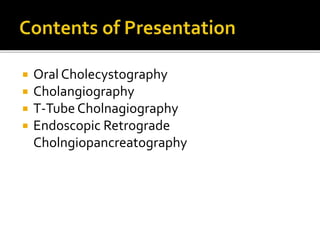
 Oral Cholecystography
 Cholangiography
 T-Tube Cholnagiography
 Endoscopic Retrograde
Cholngiopancreatography
 Radiographic study of
gall bladder and
sometimes biliary
channels too by the
oral administration of
contrast media.
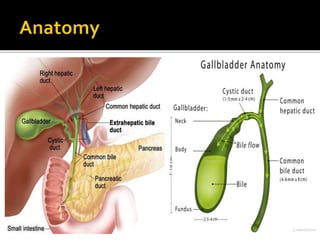
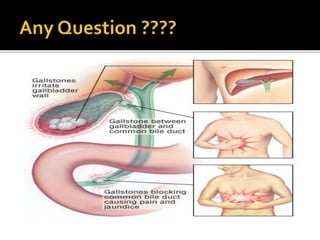
 The gallbladder is a pear-shaped, hollow
structure located under the liver and on the
right side of the abdomen. Its primary
function is to store and concentrate bile, a
yellow-brown digestive enzyme produced by
the liver
 Suspected gallbladder disease
 To determine or rule out the presence of
intermittent obstruction of the bile ducts
 Recurrent biliary disease after biliary surgery
 Inflammation of organ
 Tumors
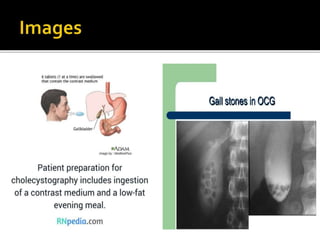
 Gallstones
 Other abnormalities like polyps
 Cystic duct and common bile duct may also
be seen
 Severe hepatorenal disease
 Acute cholecystitis
 Iodine sensitivity
 Pregnancy
 Dehydration
 IV choledogram within previous week
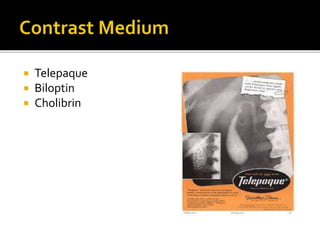
 Telepaque
 Biloptin
 Cholibrin
 Laxative 2 days prior to examination
 Fat containing evening meal on the evening
prior to contrast study
 Prone 20o LAO peliminary film is taken when
appointment is made
 CM is taken with water 14 hours pior to
appointment
 Food is forbidden untill the examination is
completed
 6 tablets of telepaque orally night before the
examination
 A prone oblique view with righr side raised to 200 is
tken after 12-16 hours for GB visulaization
 Then the patient usually lie in the supine position
and appropriate spot films for GB are taken
 Ask the patient to eat fatty meal
 After 30-40 minutes , films are taken to assess the
contractibility of GB and small filling defect (polyp
or stone)
 Cystic and common bile duct is usually seen after
post fatty meal film
 Preliminary film
 Patient Preparation
 Telepaque administration
 X-ay film after 12-16 hours
 Intake of fatty meal
 Another x-ray film after 30-
40 minutes
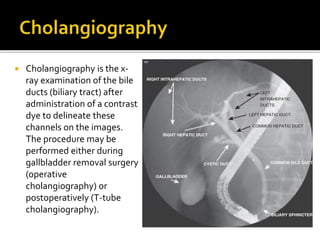
 Cholangiography is the x-
ray examination of the bile
ducts (biliary tract) after
administration of a contrast
dye to delineate these
channels on the images.
The procedure may be
performed either during
gallbladder removal surgery
(operative
cholangiography) or
postoperatively (T-tube
cholangiography).
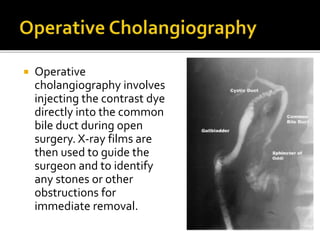
 Operative
cholangiography involves
injecting the contrast dye
directly into the common
bile duct during open
surgery. X-ray films are
then used to guide the
surgeon and to identify
any stones or other
obstructions for
immediate removal.
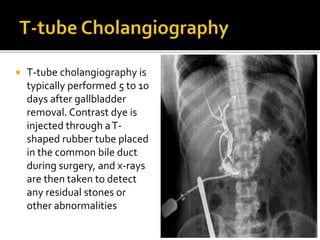
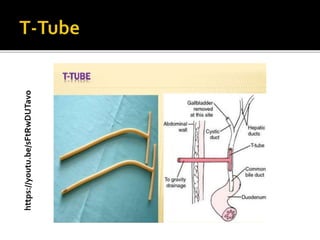
 T-tube cholangiography is
typically performed 5 to 10
days after gallbladder
removal. Contrast dye is
injected through aT-
shaped rubber tube placed
in the common bile duct
during surgery, and x-rays
are then taken to detect
any residual stones or
other abnormalities
https://youtu.be/sFtRwDUTavo
 To exclude biliary tract calculi where
a) operative cholangiography was not
performed
b) the results of operative cholangiography
are not satisfactory or are suspected
 Assesment of biliary leaks following biliary
surgery
 None
 LOCM is preferred
 150mg I ml-1
 20-30 ml
 Antibiotics may be considered if previous
cholangitis or if immunosuppressed
 Coned Supine PA of the right side of the
abdomen
 Performed on or about 10th post-op day prior
to removingT-Tube
 Patient lies supine
 Drainage tube is clamped off near to the
patient and cleanedthoroughly with anti-
septic
 A 23G needle , extension tubing and 20 ml
syringe are assembledand filled with contrast.
 After all air bubbles have been removed , the
needle is inserted into the tubing between
patient and clamp.
 The injection is made under fluoroscopic
control.
 Volume of contrast medium depends on duct
filling.
 In case of liver transplant , only a small
volume is injected (10ml).
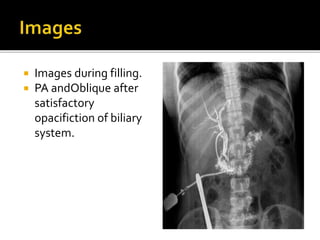
 Images during filling.
 PA andOblique after
satisfactory
opacifiction of biliary
system.
 None
 Due to contrast medium
 Due to technique
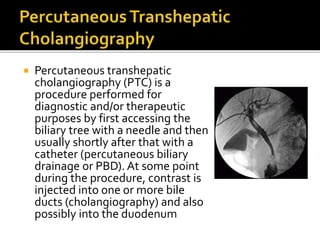
 Percutaneous transhepatic
cholangiography (PTC) is a
procedure performed for
diagnostic and/or therapeutic
purposes by first accessing the
biliary tree with a needle and then
usually shortly after that with a
catheter (percutaneous biliary
drainage or PBD). At some point
during the procedure, contrast is
injected into one or more bile
ducts (cholangiography) and also
possibly into the duodenum
 Prior to therapeutic intervention
 Place a percutaneous biliary stent
 Dilate a post-op biliary stricture
 Stone removal
 To facilitate ERCP
 Rarely for diagnostic purposes
 Bleeding tendency
 Biliary tract sepsis
 LOCM
 150mg ml-1
 20-60 ml
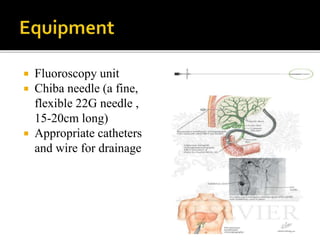
 Fluoroscopy unit
 Chiba needle (a fine,
flexible 22G needle ,
15-20cm long)
 Appropriate catheters
and wire for drainage
 Haemoglobin, platelets and prothrombin
time is checked, corrected if necessary.
 Prophylactic antibiotics e.g: ciprofloxacin
500-750mg oral before and after procedure
 NPO or clear fluids only for 4h prior to
procedure.
 Ensure, patient is well hydrated.
 Sedation and analgesia with oxygen and
monitoring
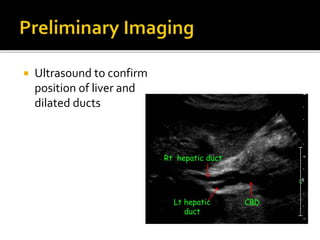
 Ultrasound to confirm
position of liver and
dilated ducts
 Patient lies supine
 Using US , a spot is marked over right or left
lobe of liver (Right lobe = intercostal b/w mid
& ant axillary lines. Left lobe = subcostal ,
left of xiphisternum in epigastrium)
 Marked spot site is anesthetized including
skin, deeper tissue and liver capsule.
 With the help of US or fluoro , Chiba needle is
inserted into the liver during arrested
respiration.
 Stillete is withdrawn and needle is connected
to syring and tubing prefilled with contrast.
 Contrast is injected
 If duct is not entered, withdraw needle to
app2-3cm and then further attemptsare
made by directing the needle cranially,
caudally, anteriorly or posteriorly.
 Excessive parenchymal inj should be avoided.
 If intrahepatic ducts are dilated , bile should
be sent for culture.
 Contrast isinjected to outline the duct
system.
 Don’t overfill obstructed biliary system.
 For diagnostic PTC , only the needle is
removed after suitable images are taken.
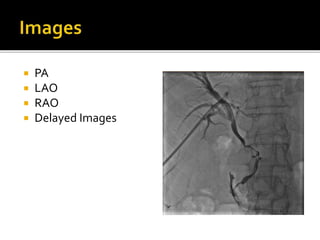
 PA
 LAO
 RAO
 Delayed Images
 Bed rest
 Pulse and BP
measurement half
hourly for 6 hrs.
 Due to contrast
 Due to technique
 Endoscopic — Refers to a tool called an
endoscope, a long, thin (about the width of your
little finger), flexible tube with a camera on the
end.
 Retrograde — Refers to the direction (backward)
in which the endoscope injects a liquid for X-rays
of parts of the GI tract called the bile duct system
and pancreas.
 Cholangio — Refers to the bile duct system.
 Pancreatography — Refers to the pancreas.
 The process of taking these X-rays is known as
cholangiopancreatography.
 Mangement of bile duct stones
 Management of biliary strictures
 Evaluation of ampullary lesions
 Patient unsuitable for MRCP or unavailibility
of endoscopic ultrasound.
 Chronic panreatitis
 Diffuse biliary disease
 Post-cholecystectomy syndrome
 Oesophageal obstruction
 Pyloric stenosis
 Gastric/duodenal obstruction
 Previous gastric surgery
 Severe cardiac/respiratory disease
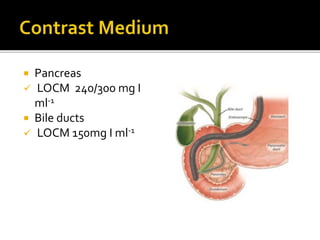
 Pancreas
 LOCM 240/300 mg I
ml-1
 Bile ducts
 LOCM 150mg I ml-1
 Side-viewing endoscope
 Polythene catheters
 Fluoroscopic unit
 NPO 4-6 hrs prior to procedure
 Premedication
 Prophylactic antibiotics
 Prone AP and LAO of upper abdomen
 Patient is sedated until concious sedation is
achieved.
 Pharynx is anasthetized with 50-100mg
Xylocaine spray.
 Patient lies prone or on let side, then
endoscope is introduced.
 Catheter prefilled with contrast is inserted
into ampulla of vater
 A small test contrast injection is made to
check the site of cannulation.
 Both biliary tree and pancreatic duct has to
be opacified , the later should be cannulated
first.
 If bilary obstruction is evidenced, bile is sent
for culture and sensitivity.
 Pancreas
 Prone
 Both posterior obliques
 Bile ducts
 Early filling images (Prone & Supine )
 Images after removal of endoscope
 Delayed images
 NPO until sedation and conciousness is
reversed.
 Pulse , temp and BP half hourly for 6 hrs
 Maintain antibiotics
 Due to contrast medium
 Due to technique
 https://youtu.be/5VgoDJ31V_0
 https://youtu.be/h7gCWo1b7ZA
Liver, biliary tract & pancreas

Liver, biliary tract & pancreas

  • 1.
    Aroosa Manazir Lecturer Radiology Deprtment Afro-AsianInstitute affiliated with GCUF Lahore, Pakistan
  • 3.
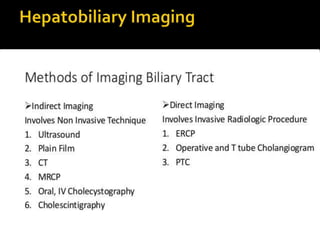
     Oral Cholecystography Cholangiography  T-Tube Cholnagiography  Endoscopic Retrograde Cholngiopancreatography
  • 4.
     Radiographic studyof gall bladder and sometimes biliary channels too by the oral administration of contrast media.
  • 5.
     The gallbladderis a pear-shaped, hollow structure located under the liver and on the right side of the abdomen. Its primary function is to store and concentrate bile, a yellow-brown digestive enzyme produced by the liver
  • 7.
     Suspected gallbladderdisease  To determine or rule out the presence of intermittent obstruction of the bile ducts  Recurrent biliary disease after biliary surgery  Inflammation of organ  Tumors  Gallstones  Other abnormalities like polyps  Cystic duct and common bile duct may also be seen
  • 8.
     Severe hepatorenaldisease  Acute cholecystitis  Iodine sensitivity  Pregnancy  Dehydration  IV choledogram within previous week
  • 9.
  • 10.
     Laxative 2days prior to examination  Fat containing evening meal on the evening prior to contrast study  Prone 20o LAO peliminary film is taken when appointment is made  CM is taken with water 14 hours pior to appointment  Food is forbidden untill the examination is completed
  • 11.
     6 tabletsof telepaque orally night before the examination  A prone oblique view with righr side raised to 200 is tken after 12-16 hours for GB visulaization  Then the patient usually lie in the supine position and appropriate spot films for GB are taken  Ask the patient to eat fatty meal  After 30-40 minutes , films are taken to assess the contractibility of GB and small filling defect (polyp or stone)  Cystic and common bile duct is usually seen after post fatty meal film
  • 13.
     Preliminary film Patient Preparation  Telepaque administration  X-ay film after 12-16 hours  Intake of fatty meal  Another x-ray film after 30- 40 minutes
  • 15.
     Cholangiography isthe x- ray examination of the bile ducts (biliary tract) after administration of a contrast dye to delineate these channels on the images. The procedure may be performed either during gallbladder removal surgery (operative cholangiography) or postoperatively (T-tube cholangiography).
  • 16.
     Operative cholangiography involves injectingthe contrast dye directly into the common bile duct during open surgery. X-ray films are then used to guide the surgeon and to identify any stones or other obstructions for immediate removal.
  • 17.
     T-tube cholangiographyis typically performed 5 to 10 days after gallbladder removal. Contrast dye is injected through aT- shaped rubber tube placed in the common bile duct during surgery, and x-rays are then taken to detect any residual stones or other abnormalities
  • 18.
  • 19.
     To excludebiliary tract calculi where a) operative cholangiography was not performed b) the results of operative cholangiography are not satisfactory or are suspected  Assesment of biliary leaks following biliary surgery
  • 20.
  • 21.
     LOCM ispreferred  150mg I ml-1  20-30 ml
  • 22.
     Antibiotics maybe considered if previous cholangitis or if immunosuppressed
  • 23.
     Coned SupinePA of the right side of the abdomen
  • 24.
     Performed onor about 10th post-op day prior to removingT-Tube  Patient lies supine  Drainage tube is clamped off near to the patient and cleanedthoroughly with anti- septic  A 23G needle , extension tubing and 20 ml syringe are assembledand filled with contrast.
  • 25.
     After allair bubbles have been removed , the needle is inserted into the tubing between patient and clamp.  The injection is made under fluoroscopic control.  Volume of contrast medium depends on duct filling.  In case of liver transplant , only a small volume is injected (10ml).
  • 26.
     Images duringfilling.  PA andOblique after satisfactory opacifiction of biliary system.
  • 27.
  • 28.
     Due tocontrast medium  Due to technique
  • 30.
     Percutaneous transhepatic cholangiography(PTC) is a procedure performed for diagnostic and/or therapeutic purposes by first accessing the biliary tree with a needle and then usually shortly after that with a catheter (percutaneous biliary drainage or PBD). At some point during the procedure, contrast is injected into one or more bile ducts (cholangiography) and also possibly into the duodenum
  • 31.
     Prior totherapeutic intervention  Place a percutaneous biliary stent  Dilate a post-op biliary stricture  Stone removal  To facilitate ERCP  Rarely for diagnostic purposes
  • 32.
     Bleeding tendency Biliary tract sepsis
  • 33.
     LOCM  150mgml-1  20-60 ml
  • 34.
     Fluoroscopy unit Chiba needle (a fine, flexible 22G needle , 15-20cm long)  Appropriate catheters and wire for drainage
  • 35.
     Haemoglobin, plateletsand prothrombin time is checked, corrected if necessary.  Prophylactic antibiotics e.g: ciprofloxacin 500-750mg oral before and after procedure  NPO or clear fluids only for 4h prior to procedure.  Ensure, patient is well hydrated.  Sedation and analgesia with oxygen and monitoring
  • 36.
     Ultrasound toconfirm position of liver and dilated ducts
  • 37.
     Patient liessupine  Using US , a spot is marked over right or left lobe of liver (Right lobe = intercostal b/w mid & ant axillary lines. Left lobe = subcostal , left of xiphisternum in epigastrium)  Marked spot site is anesthetized including skin, deeper tissue and liver capsule.  With the help of US or fluoro , Chiba needle is inserted into the liver during arrested respiration.
  • 38.
     Stillete iswithdrawn and needle is connected to syring and tubing prefilled with contrast.  Contrast is injected  If duct is not entered, withdraw needle to app2-3cm and then further attemptsare made by directing the needle cranially, caudally, anteriorly or posteriorly.  Excessive parenchymal inj should be avoided.  If intrahepatic ducts are dilated , bile should be sent for culture.
  • 39.
     Contrast isinjectedto outline the duct system.  Don’t overfill obstructed biliary system.  For diagnostic PTC , only the needle is removed after suitable images are taken.
  • 40.
     PA  LAO RAO  Delayed Images
  • 41.
     Bed rest Pulse and BP measurement half hourly for 6 hrs.
  • 42.
     Due tocontrast  Due to technique
  • 45.
     Endoscopic —Refers to a tool called an endoscope, a long, thin (about the width of your little finger), flexible tube with a camera on the end.  Retrograde — Refers to the direction (backward) in which the endoscope injects a liquid for X-rays of parts of the GI tract called the bile duct system and pancreas.  Cholangio — Refers to the bile duct system.  Pancreatography — Refers to the pancreas.  The process of taking these X-rays is known as cholangiopancreatography.
  • 46.
     Mangement ofbile duct stones  Management of biliary strictures  Evaluation of ampullary lesions  Patient unsuitable for MRCP or unavailibility of endoscopic ultrasound.  Chronic panreatitis  Diffuse biliary disease  Post-cholecystectomy syndrome
  • 47.
     Oesophageal obstruction Pyloric stenosis  Gastric/duodenal obstruction  Previous gastric surgery  Severe cardiac/respiratory disease
  • 48.
     Pancreas  LOCM240/300 mg I ml-1  Bile ducts  LOCM 150mg I ml-1
  • 49.
     Side-viewing endoscope Polythene catheters  Fluoroscopic unit
  • 50.
     NPO 4-6hrs prior to procedure  Premedication  Prophylactic antibiotics
  • 51.
     Prone APand LAO of upper abdomen
  • 52.
     Patient issedated until concious sedation is achieved.  Pharynx is anasthetized with 50-100mg Xylocaine spray.  Patient lies prone or on let side, then endoscope is introduced.  Catheter prefilled with contrast is inserted into ampulla of vater
  • 53.
     A smalltest contrast injection is made to check the site of cannulation.  Both biliary tree and pancreatic duct has to be opacified , the later should be cannulated first.  If bilary obstruction is evidenced, bile is sent for culture and sensitivity.
  • 54.
     Pancreas  Prone Both posterior obliques  Bile ducts  Early filling images (Prone & Supine )  Images after removal of endoscope  Delayed images
  • 55.
     NPO untilsedation and conciousness is reversed.  Pulse , temp and BP half hourly for 6 hrs  Maintain antibiotics
  • 56.
     Due tocontrast medium  Due to technique
  • 57.