LIVER ABSCESS
Presenter: PIRIYO HABIB PEPI
SR: CLERKSHIP –HOIMA SITE APRIL-JUNE
2025
Objectives;
• Definition
• Types of liver Abscesses
• Etiology
• Pathophysiology//epidemiology
• Clinical manifestations
• Investigations/diagnostic test
• Management
• complications
…
• Liver abscess; refers to a collection of pus within the
liver parenchyma due to an infection leading to the
formation of a cavity.
Types of liver abscess
1. Pyogenic liver abscess-bacterial infection
2. Amoebic liver abscess – parasitic( entamoeba
histolytica)
3. Fungal liver abscess-candida spp
4. hydatid liver abscess-food/water contaminated
with Dog feces.
NB: 1 & 2 are the most common types
Etiology
Pyogenic liver abscess
Biliary tract disease( e.g.
cholangitis,cholecystitis)
Hematogenous spread( e.g. from sepsis)
trauma
Direct extension from adjacent structures
………..
Amoebic liver abscess
Ingestion of cysts from contaminated foods or
water.
• Fungal liver abscess
Immunocompromised state e.g. in patients with
HIV/AIDS, transplant recipients.
Hydatid liver abscess –usually asymptomatic, but
symptoms depend on location, size and mass
effect, symptoms same as pyogenic, CT scan
reveals multiloculated mass; RX; albendazole /
mebendazole.
Pathophysiology
Pyogenic liver abscess
Bacterial invasion leads to localized inflammation,
tissue necrosis, and pus formation.
It’s the most common type of liver abscess and is
more common in immunocompromised as well
seen commonly in male patients of 5th
to 6th
decades who generally present with complaint of
fever with chills followed by abdominal
pain,anorexia,weight loss, fatigue,
jaundice(25%cases)
M:F 1.5 : 1
……
Most common organism causing pyogenic
liver abscess in western countries &
worldwide is E.coli,and in Asian countries its
klebsiella while in children with chronic
granulomatous disease its staph.Aureus.
Note; chronic granulomatous disease is
associated with neutrophillic dysfunction
..
Routes of infection for pyogenic liver disease;
Bile ducts(mc route)
Portal vein
Hepatic artery
Direct extension
….
Bile duct route;
• CBD stones cause obstructions which results in
ascending infections( cholangitis) hence
obstructive jaundice and abscess.
• Most common LFT abnormality is raised
Alkaline phosphatase enzyme(ALP).
…..
Portal vein route
• Infections ascend through Inferior mesenteric
vein - splenic vein- portal vein - liver incase of
diverticulitis. I.e. git sources.
• Or infections ascend through superior
mesenteric vein-portal vein –liver incase of
appendicular perforation following
appendicitis or trauma.
..
Hepatic artery route
• in children with chronic granulomatous
disease there is presence of neutrophilic
dysfunction leading to increased risk of sub
acute bacterial endocarditis(SABE) resulting in
infections running from the heart to the liver
via hepatic artery. The Most common cause of
SABE is staph.Aureus.
• Septicemia and bacteremia
….
Direct extension
• Presence of pyothorax, subdiaphragmatic
abscess or cholecystitis resulting into
perforation of gallbladder and any perinephrinic
abscess leads to liver abscess
NB; in pyogenic liver abscess: Right lobe is more
involved frequently compared to the left lobe.
• Multiloculated abscess>simple/solitary abscess
• 1st
investigation; USG-abdomen, dx: CECT
abdomen; confirmatory dx: aspiration +
culture& sensitivity
…..
b) Amebic liver abscess
• Its caused by Entamoeba histolytica parasite
• Ingested cysts of the parasite release
trophozoites that invade the intestinal
mucosa, enter the blood stream to reach the
liver which either directly injure hepatocytes
or illicit an immune cascade.
….
• Its more common in developing countries, young
patients( 2nd
-3rd
decades) and Alcoholics.
• M>>>F
Rt lobe>> Lt lobe and Mc route of infection- fecal oral route.
The infective stage; Quadrinucleate stage of cyst converts to
octanucleate which finally transforms to the active state in
the liver.
from Amoebic colitis ( flask shaped ulcer seen in amoebic
colitis), the colon amoeba gains entry into smv then via
portal vein into the liver and resultant reddish brown fluid
collection of damaged hepatocytes gives –An chay sauce
appearance of the formed abscess.
…..
• Mc symptom is abdominal pain +/- fever and
jaundice is rare in ALA.
• Mc LFT abnormality is raised PT ( prothrombin
time).
• Simple abscess focus>>> multiple abscess.
• 1st
investigation-USG abdomen.
• Ioc for diagnosis/to confirm the dx is serology
( ELISA testing for Amebic serology or
antibodies)
….
Fungal abscess
• In the immune compromised patients the
fungal spores spread hematogenously to the
liver causing abscess
Clinical manifestations of liver abscess
Common symptoms;
Fever
RUQ abdominal pain(patient looks more
toxic/sickly distinguishes it from cholecystitis
pain).
Jaundice ( in some cases)
Malaise and fatigue
Anorexia and weight loss
..
Signs
Hepatomegaly
Tenderness over the liver or tender
hepatomegaly.
Potential signs of sepsis in severe cases
Diagnostic tests/ investigations
On Complete Blood count
• Elevated WBC count( leukocytosis)
LFT findings
• Elevated liver enzymes ( AST,ALT)
• Elevated alkaline phosphatase enzyme- ALP
• Elevated bilirubin
• Albumin
• Blood culture ( positive in pyogenic LA)
…..
Imaging
Ultrasound: initially to detect abscesses:
Hypoechoeic mass
CT scan: to assess abscess size, number and location:
clustered abscess with peripheral rim enhancement in
pyogenic vs. well defined abscess boundary with
peripheral wall edema in amebic
MRI ; occasionally used for detailed liver imaging
serology
For amebic abscess
1. Indirect hemoagglutination test
2. Enzyme immuno assays for Entamoeba histolytica
antibodies
…
Aspiration and culture
• Percutaneous aspiration of abscess for gram
stain, culture and sensitivity.
• Ideal for pyogenic LA
Management
Medical therapy
Pyogenic abscess
• Broad spectrum antibiotics initially and then
tailored based on culture results.
Amoebic abscess
• Metronidazole or tinidazole followed by luminal
agents to eradicate intestinal cysts e.g. paromycin.
• Metronidazole is the drug of choice; dose 750mg
tds for 10-14 days
• Generally symptoms get resolved within 3-5 days
…..
Indications for Aspiration
1. Symptoms do not improve in 3 to 5 days
2. Abscess size > 5cm
3. Left liver abscess
4. Pregnancy ( metro is not safe in pregnancy}
5. Diagnostic uncertainty
….
Fungal abscess
• Antifungal therapy e.g.. Amphotericin B,
fluconazole.
Drainage
 percutaneous drainage ( guided by USG or CT)
 Surgical drainage if percutaneous drainage fails or
if abscess is large and multiloculated.
Supportive care
 Pain management with analgesics
 Hydration and nutritional support
Complications
Rupture of the abscess into peritoneal cavity>
pleural cavity > pericardial cavity ..i.e. most
common complication seen in amebic abscess.
• Peritoneal cavity leakage-do EX-LAP+ lavage
and drainage.
• Pleural cavity leakage- place ICD/chest tube
insertion
• Pericardial leakage- Needle pericardiocentesis.
….
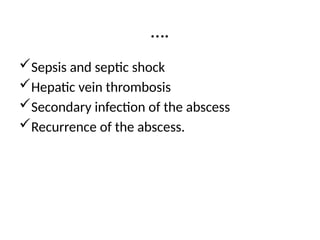
Sepsis and septic shock
Hepatic vein thrombosis
Secondary infection of the abscess
Recurrence of the abscess.
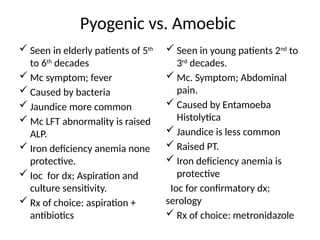
Pyogenic vs. Amoebic
 Seen in elderly patients of 5th
to 6th
decades
 Mc symptom; fever
 Caused by bacteria
 Jaundice more common
 Mc LFT abnormality is raised
ALP.
 Iron deficiency anemia none
protective.
 Ioc for dx; Aspiration and
culture sensitivity.
 Rx of choice: aspiration +
antibiotics
 Seen in young patients 2nd
to
3rd
decades.
 Mc. Symptom; Abdominal
pain.
 Caused by Entamoeba
Histolytica
 Jaundice is less common
 Raised PT.
 Iron deficiency anemia is
protective
Ioc for confirmatory dx;
serology
 Rx of choice: metronidazole
references
• Davidson’s principles and practices of
medicine
• Sabiston text book of surgery 27th
edn.
• NEET PG quick revision guide on liver abscess
2024

LIVER ABSCESS power point presentation slide

  • 1.
    LIVER ABSCESS Presenter: PIRIYOHABIB PEPI SR: CLERKSHIP –HOIMA SITE APRIL-JUNE 2025
  • 2.
    Objectives; • Definition • Typesof liver Abscesses • Etiology • Pathophysiology//epidemiology • Clinical manifestations • Investigations/diagnostic test • Management • complications
  • 3.
    … • Liver abscess;refers to a collection of pus within the liver parenchyma due to an infection leading to the formation of a cavity. Types of liver abscess 1. Pyogenic liver abscess-bacterial infection 2. Amoebic liver abscess – parasitic( entamoeba histolytica) 3. Fungal liver abscess-candida spp 4. hydatid liver abscess-food/water contaminated with Dog feces. NB: 1 & 2 are the most common types
  • 4.
    Etiology Pyogenic liver abscess Biliarytract disease( e.g. cholangitis,cholecystitis) Hematogenous spread( e.g. from sepsis) trauma Direct extension from adjacent structures
  • 5.
    ……….. Amoebic liver abscess Ingestionof cysts from contaminated foods or water. • Fungal liver abscess Immunocompromised state e.g. in patients with HIV/AIDS, transplant recipients. Hydatid liver abscess –usually asymptomatic, but symptoms depend on location, size and mass effect, symptoms same as pyogenic, CT scan reveals multiloculated mass; RX; albendazole / mebendazole.
  • 6.
    Pathophysiology Pyogenic liver abscess Bacterialinvasion leads to localized inflammation, tissue necrosis, and pus formation. It’s the most common type of liver abscess and is more common in immunocompromised as well seen commonly in male patients of 5th to 6th decades who generally present with complaint of fever with chills followed by abdominal pain,anorexia,weight loss, fatigue, jaundice(25%cases) M:F 1.5 : 1
  • 7.
    …… Most common organismcausing pyogenic liver abscess in western countries & worldwide is E.coli,and in Asian countries its klebsiella while in children with chronic granulomatous disease its staph.Aureus. Note; chronic granulomatous disease is associated with neutrophillic dysfunction
  • 8.
    .. Routes of infectionfor pyogenic liver disease; Bile ducts(mc route) Portal vein Hepatic artery Direct extension
  • 9.
    …. Bile duct route; •CBD stones cause obstructions which results in ascending infections( cholangitis) hence obstructive jaundice and abscess. • Most common LFT abnormality is raised Alkaline phosphatase enzyme(ALP).
  • 10.
    ….. Portal vein route •Infections ascend through Inferior mesenteric vein - splenic vein- portal vein - liver incase of diverticulitis. I.e. git sources. • Or infections ascend through superior mesenteric vein-portal vein –liver incase of appendicular perforation following appendicitis or trauma.
  • 11.
    .. Hepatic artery route •in children with chronic granulomatous disease there is presence of neutrophilic dysfunction leading to increased risk of sub acute bacterial endocarditis(SABE) resulting in infections running from the heart to the liver via hepatic artery. The Most common cause of SABE is staph.Aureus. • Septicemia and bacteremia
  • 12.
    …. Direct extension • Presenceof pyothorax, subdiaphragmatic abscess or cholecystitis resulting into perforation of gallbladder and any perinephrinic abscess leads to liver abscess NB; in pyogenic liver abscess: Right lobe is more involved frequently compared to the left lobe. • Multiloculated abscess>simple/solitary abscess • 1st investigation; USG-abdomen, dx: CECT abdomen; confirmatory dx: aspiration + culture& sensitivity
  • 13.
    ….. b) Amebic liverabscess • Its caused by Entamoeba histolytica parasite • Ingested cysts of the parasite release trophozoites that invade the intestinal mucosa, enter the blood stream to reach the liver which either directly injure hepatocytes or illicit an immune cascade.
  • 14.
    …. • Its morecommon in developing countries, young patients( 2nd -3rd decades) and Alcoholics. • M>>>F Rt lobe>> Lt lobe and Mc route of infection- fecal oral route. The infective stage; Quadrinucleate stage of cyst converts to octanucleate which finally transforms to the active state in the liver. from Amoebic colitis ( flask shaped ulcer seen in amoebic colitis), the colon amoeba gains entry into smv then via portal vein into the liver and resultant reddish brown fluid collection of damaged hepatocytes gives –An chay sauce appearance of the formed abscess.
  • 15.
    ….. • Mc symptomis abdominal pain +/- fever and jaundice is rare in ALA. • Mc LFT abnormality is raised PT ( prothrombin time). • Simple abscess focus>>> multiple abscess. • 1st investigation-USG abdomen. • Ioc for diagnosis/to confirm the dx is serology ( ELISA testing for Amebic serology or antibodies)
  • 16.
    …. Fungal abscess • Inthe immune compromised patients the fungal spores spread hematogenously to the liver causing abscess
  • 17.
    Clinical manifestations ofliver abscess Common symptoms; Fever RUQ abdominal pain(patient looks more toxic/sickly distinguishes it from cholecystitis pain). Jaundice ( in some cases) Malaise and fatigue Anorexia and weight loss
  • 18.
    .. Signs Hepatomegaly Tenderness over theliver or tender hepatomegaly. Potential signs of sepsis in severe cases
  • 19.
    Diagnostic tests/ investigations OnComplete Blood count • Elevated WBC count( leukocytosis) LFT findings • Elevated liver enzymes ( AST,ALT) • Elevated alkaline phosphatase enzyme- ALP • Elevated bilirubin • Albumin • Blood culture ( positive in pyogenic LA)
  • 20.
    ….. Imaging Ultrasound: initially todetect abscesses: Hypoechoeic mass CT scan: to assess abscess size, number and location: clustered abscess with peripheral rim enhancement in pyogenic vs. well defined abscess boundary with peripheral wall edema in amebic MRI ; occasionally used for detailed liver imaging serology For amebic abscess 1. Indirect hemoagglutination test 2. Enzyme immuno assays for Entamoeba histolytica antibodies
  • 21.
    … Aspiration and culture •Percutaneous aspiration of abscess for gram stain, culture and sensitivity. • Ideal for pyogenic LA
  • 22.
    Management Medical therapy Pyogenic abscess •Broad spectrum antibiotics initially and then tailored based on culture results. Amoebic abscess • Metronidazole or tinidazole followed by luminal agents to eradicate intestinal cysts e.g. paromycin. • Metronidazole is the drug of choice; dose 750mg tds for 10-14 days • Generally symptoms get resolved within 3-5 days
  • 23.
    ….. Indications for Aspiration 1.Symptoms do not improve in 3 to 5 days 2. Abscess size > 5cm 3. Left liver abscess 4. Pregnancy ( metro is not safe in pregnancy} 5. Diagnostic uncertainty
  • 24.
    …. Fungal abscess • Antifungaltherapy e.g.. Amphotericin B, fluconazole. Drainage  percutaneous drainage ( guided by USG or CT)  Surgical drainage if percutaneous drainage fails or if abscess is large and multiloculated. Supportive care  Pain management with analgesics  Hydration and nutritional support
  • 25.
    Complications Rupture of theabscess into peritoneal cavity> pleural cavity > pericardial cavity ..i.e. most common complication seen in amebic abscess. • Peritoneal cavity leakage-do EX-LAP+ lavage and drainage. • Pleural cavity leakage- place ICD/chest tube insertion • Pericardial leakage- Needle pericardiocentesis.
  • 26.
    …. Sepsis and septicshock Hepatic vein thrombosis Secondary infection of the abscess Recurrence of the abscess.
  • 27.
    Pyogenic vs. Amoebic Seen in elderly patients of 5th to 6th decades  Mc symptom; fever  Caused by bacteria  Jaundice more common  Mc LFT abnormality is raised ALP.  Iron deficiency anemia none protective.  Ioc for dx; Aspiration and culture sensitivity.  Rx of choice: aspiration + antibiotics  Seen in young patients 2nd to 3rd decades.  Mc. Symptom; Abdominal pain.  Caused by Entamoeba Histolytica  Jaundice is less common  Raised PT.  Iron deficiency anemia is protective Ioc for confirmatory dx; serology  Rx of choice: metronidazole
  • 28.
    references • Davidson’s principlesand practices of medicine • Sabiston text book of surgery 27th edn. • NEET PG quick revision guide on liver abscess 2024