Live Interest Meter - Learning from Quantified
Feedback in Mass Lectures


                                                                                     INFORMATIK
                                                                     FZI FORSCHUNGSZENTRUM
V. Rivera-Pelayo, J. Munk, V. Zacharias, and S. Braun
FZI Research Center for Information Technology, Karlsruhe, Germany

LAK Conference 2013 – Leuven, Belgium
10th April 2013
Agenda

 Introduction

 Use Case and Motivation

 Live Interest Meter App

 Tests and User Study

 Conclusions

 Ongoing Work


12.04.2013                  © FZI Forschungszentrum Informatik   2
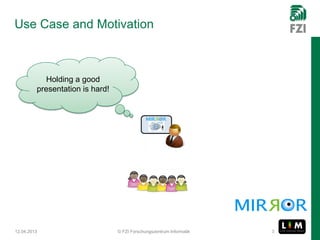
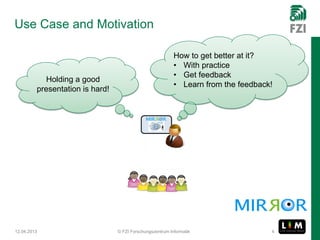
Use Case and Motivation


           Holding a good
         presentation is hard!


12.04.2013                       © FZI Forschungszentrum Informatik   3
Use Case and Motivation

                                                           How to get better at it?
                                                           • With practice
                                                           • Get feedback
           Holding a good
                                                           • Learn from the feedback!
         presentation is hard!


12.04.2013                       © FZI Forschungszentrum Informatik                 4
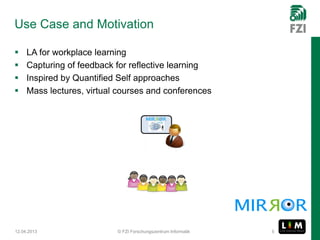
Use Case and Motivation

    LA for workplace learning
    Capturing of feedback for reflective learning
    Inspired by Quantified Self approaches
    Mass lectures, virtual courses and conferences


12.04.2013                 © FZI Forschungszentrum Informatik   5
Use Case and Motivation

    LA for workplace learning
    Capturing of feedback for reflective learning
    Inspired by Quantified Self approaches
    Mass lectures, virtual courses and conferences


12.04.2013                 © FZI Forschungszentrum Informatik   6
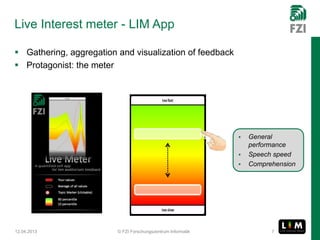
Live Interest meter - LIM App

 Gathering, aggregation and visualization of feedback
 Protagonist: the meter


                                                                 General
                                                                  performance
                                                                 Speech speed
                                                                 Comprehension


12.04.2013               © FZI Forschungszentrum Informatik             7
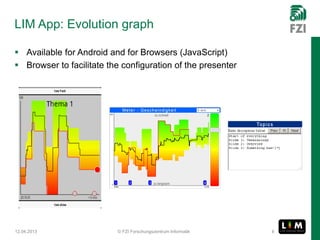
LIM App: Evolution graph

 Available for Android and for Browsers (JavaScript)
 Browser to facilitate the configuration of the presenter


12.04.2013                © FZI Forschungszentrum Informatik   8
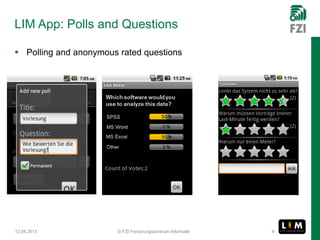
LIM App: Polls and Questions

 Polling and anonymous rated questions


12.04.2013              © FZI Forschungszentrum Informatik   9
LIM App: JavaScript Version


12.04.2013       © FZI Forschungszentrum Informatik   10
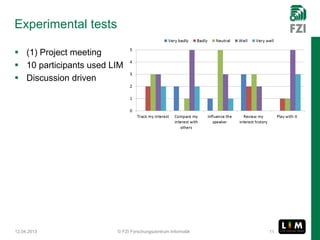
Experimental tests

 (1) Project meeting
 10 participants used LIM
 Discussion driven


12.04.2013              © FZI Forschungszentrum Informatik   11
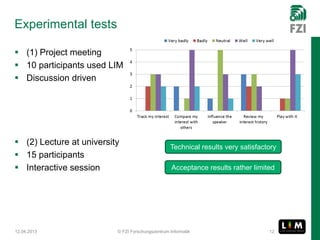
Experimental tests

 (1) Project meeting
 10 participants used LIM
 Discussion driven


 (2) Lecture at university
                                                  Technical results very satisfactory
 15 participants
 Interactive session                              Acceptance results rather limited


12.04.2013                © FZI Forschungszentrum Informatik                      12
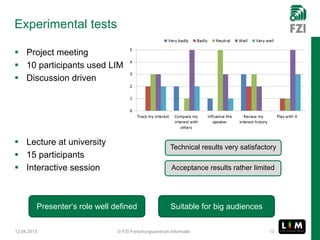
Experimental tests

 Project meeting
 10 participants used LIM
 Discussion driven


 Lecture at university
                                                        Technical results very satisfactory
 15 participants
 Interactive session                                    Acceptance results rather limited


         Presenter‘s role well defined                  Suitable for big audiences

12.04.2013                      © FZI Forschungszentrum Informatik                      13
User Study

 Main goals
        Refine use case
        Guide further development


                In which scenarios and how can the quantification of feedback performed
                 by the LIM App support reflective learning?
                Which features are more appreciated by users, both presenters and
                 audience members?


12.04.2013                          © FZI Forschungszentrum Informatik             14
User Study

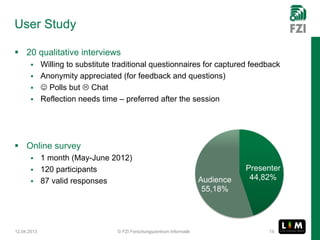
 20 qualitative interviews
        Willing to substitute traditional questionnaires for captured feedback
        Anonymity appreciated (for feedback and questions)
         Polls but  Chat
        Reflection needs time – preferred after the session


 Online survey
        1 month (May-June 2012)
        120 participants                                                       Presenter
        87 valid responses                                          Audience    44,82%
                                                                      55,18%


12.04.2013                      © FZI Forschungszentrum Informatik                    15
User Study – Reaction to feedback


                 What do you consider realistic regarding
             how you can react to the feedback (as presenter)?
12.04.2013              © FZI Forschungszentrum Informatik       16
User Study – Data collection


             64,37 %


                             Data collected live and continuously is
                 better and more significant than only periodically collected data.

12.04.2013                        © FZI Forschungszentrum Informatik             17
User Study – Information needed


  Which information
would the presenters
  like to know about
and which information
 does the audience
  want to evaluate?


12.04.2013              © FZI Forschungszentrum Informatik   18
User Study – Characteristics of the LIM App


             How participants evaluated the LIM App features


12.04.2013            © FZI Forschungszentrum Informatik       19
Conclusion

             78,16 % found the idea behind                   57,47 % would like to test the
               the LIM App very positive                              LIM App

 Readiness of presenters to learn retrospectively
 Motivate students to use the application
 Main concern is distraction


  Applying Learning Analytics to informal workplace learning and
            data gathered during the learning process


12.04.2013                       © FZI Forschungszentrum Informatik                    20
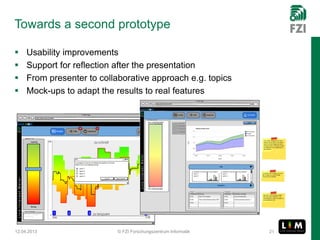
Towards a second prototype

    Usability improvements
    Support for reflection after the presentation
    From presenter to collaborative approach e.g. topics
    Mock-ups to adapt the results to real features


12.04.2013                  © FZI Forschungszentrum Informatik   21
Any questions?

      THANK YOU!
                                                            rivera@fzi.de

                                                            @veronicarp

                                                            vriverapelayo
12.04.2013             © FZI Forschungszentrum Informatik     22
Theoretical Model & Related Work


12.04.2013        © FZI Forschungszentrum Informatik   23
Theoretical background


[1] Applying Quantified Self Approaches to Support Reflective Learning. Verónica Rivera-Pelayo, Valentin Zacharias, Lars Müller,
Simone Braun. Learning Analytics and Knowledge 2012 (LAK 2012), Vancouver, Canada
[2] A Framework for Applying Quantified Self Approaches to Support Reflective Learning. Verónica Rivera-Pelayo, Valentin
Zacharias, Lars Müller, Simone Braun. IADIS International Conference on Mobile Learning (Mlearning 2012), Berlin, Germany
    12.04.2013                                      © FZI Forschungszentrum Informatik                                       24
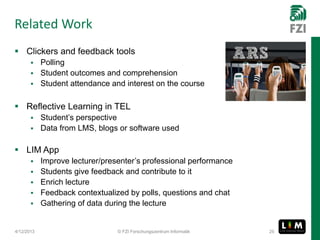
Related Work
 Clickers and feedback tools
        Polling
        Student outcomes and comprehension
        Student attendance and interest on the course


 Reflective Learning in TEL
        Student’s perspective
        Data from LMS, blogs or software used


 LIM App
           Improve lecturer/presenter’s professional performance
           Students give feedback and contribute to it
           Enrich lecture
           Feedback contextualized by polls, questions and chat
           Gathering of data during the lecture


4/12/2013                        © FZI Forschungszentrum Informatik   25
ARS and Clickers
    [1] M. Akbari, G. Böhm, and U. Schroeder. Enabling communication and feedback in mass
     lectures. In ICALT, pages 254{258, 2010.
    [2] M. Bonn, S. Dieter, and H. Schmeck. Kooperationstools der Notebook Universität Karlsruhe
     (TH). In Mobiles Lernen und Forschen, pages 63-71. Klaus David, Lutz Wegener (Hrsg.),
     November 2003.
    [3] J. E. Caldwell. Clickers in the large classroom: Current research and Best-Practice tips. CBE
     Life SciEduc, 6(1):9-20, Mar. 2007.
    [4] D. Duncan and E. Mazur. Clickers in the Classroom: How to Enhance Science Teaching Using
     Classroom Response Systems. Pearson Education, 2005.
    [5] J. Hadersberger, A. Pohl, and F. Bry. Discerning actuality in backstage - comprehensible
     contextual aging. In EC-TEL, volume 7563 of Lecture Notes in Computer Science, pages 126-
     139. Springer, 2012.
    [6] D. Kundisch, P. Herrmann, M. Whittaker, M. Beutner, G. Fels, J. Magenheim, W. Reinhardt, M.
     Sievers, and A. Zoyke. Designing a Web-Based Application to Support Peer Instruction for Very
     Large Groups. In ICIS '12, Research in Progress, Orlando, USA, December 2012.
    [7] G. Rubner. mbclick - an electronic voting system that returns individual feedback. In WMUTE,
     pages 221-222. IEEE, 2012.
    [8] A. Wessels, S. Fries, H. Horz, N. Scheele, and W. Effelsberg. Interactive lectures: Effective
     teaching and learning in lectures using wireless networks. Comput. Hum. Behav., 23(5):2524-
     2537, Sept. 2007.


4/12/2013                             © FZI Forschungszentrum Informatik                     26
Reflective learning in TEL
    [1] R. Ferguson, S. B. Shum, and R. D. Crick. EnquiryBlogger: using widgets to support
     awareness and reflection in a PLE Setting. In ARPLE11, PLE Conference 2011, Southampton,
     UK, 11-13 July, 2011.
    [2] S. Govaerts, K. Verbert, E. Duval, and A. Pardo. The student activity meter for awareness and
     self-reflection. In CHI '12 Extended Abstracts on Human Factors in Computing Systems, pages
     869-884, New York, NY, USA, 2012. ACM.
    [3] J. L. Santos, S. Govaerts, K. Verbert, and E. Duval. Goal-oriented visualizations of activity
     tracking: a case study with engineering students. In 2nd International Conference on Learning
     Analytics and Knowledge, LAK '12, pages 143-152, New York, NY, USA, 2012. ACM.


4/12/2013                             © FZI Forschungszentrum Informatik                     27

Live Interest Meter - Learning from Quantified Feedback in Mass Lectures

  • 1.
    Live Interest Meter- Learning from Quantified Feedback in Mass Lectures INFORMATIK FZI FORSCHUNGSZENTRUM V. Rivera-Pelayo, J. Munk, V. Zacharias, and S. Braun FZI Research Center for Information Technology, Karlsruhe, Germany LAK Conference 2013 – Leuven, Belgium 10th April 2013
  • 2.
    Agenda  Introduction  UseCase and Motivation  Live Interest Meter App  Tests and User Study  Conclusions  Ongoing Work 12.04.2013 © FZI Forschungszentrum Informatik 2
  • 3.
    Use Case andMotivation Holding a good presentation is hard! 12.04.2013 © FZI Forschungszentrum Informatik 3
  • 4.
    Use Case andMotivation How to get better at it? • With practice • Get feedback Holding a good • Learn from the feedback! presentation is hard! 12.04.2013 © FZI Forschungszentrum Informatik 4
  • 5.
    Use Case andMotivation  LA for workplace learning  Capturing of feedback for reflective learning  Inspired by Quantified Self approaches  Mass lectures, virtual courses and conferences 12.04.2013 © FZI Forschungszentrum Informatik 5
  • 6.
    Use Case andMotivation  LA for workplace learning  Capturing of feedback for reflective learning  Inspired by Quantified Self approaches  Mass lectures, virtual courses and conferences 12.04.2013 © FZI Forschungszentrum Informatik 6
  • 7.
    Live Interest meter- LIM App  Gathering, aggregation and visualization of feedback  Protagonist: the meter  General performance  Speech speed  Comprehension 12.04.2013 © FZI Forschungszentrum Informatik 7
  • 8.
    LIM App: Evolutiongraph  Available for Android and for Browsers (JavaScript)  Browser to facilitate the configuration of the presenter 12.04.2013 © FZI Forschungszentrum Informatik 8
  • 9.
    LIM App: Pollsand Questions  Polling and anonymous rated questions 12.04.2013 © FZI Forschungszentrum Informatik 9
  • 10.
    LIM App: JavaScriptVersion 12.04.2013 © FZI Forschungszentrum Informatik 10
  • 11.
    Experimental tests  (1)Project meeting  10 participants used LIM  Discussion driven 12.04.2013 © FZI Forschungszentrum Informatik 11
  • 12.
    Experimental tests  (1)Project meeting  10 participants used LIM  Discussion driven  (2) Lecture at university Technical results very satisfactory  15 participants  Interactive session Acceptance results rather limited 12.04.2013 © FZI Forschungszentrum Informatik 12
  • 13.
    Experimental tests  Projectmeeting  10 participants used LIM  Discussion driven  Lecture at university Technical results very satisfactory  15 participants  Interactive session Acceptance results rather limited Presenter‘s role well defined Suitable for big audiences 12.04.2013 © FZI Forschungszentrum Informatik 13
  • 14.
    User Study  Maingoals  Refine use case  Guide further development  In which scenarios and how can the quantification of feedback performed by the LIM App support reflective learning?  Which features are more appreciated by users, both presenters and audience members? 12.04.2013 © FZI Forschungszentrum Informatik 14
  • 15.
    User Study  20qualitative interviews  Willing to substitute traditional questionnaires for captured feedback  Anonymity appreciated (for feedback and questions)   Polls but  Chat  Reflection needs time – preferred after the session  Online survey  1 month (May-June 2012)  120 participants Presenter  87 valid responses Audience 44,82% 55,18% 12.04.2013 © FZI Forschungszentrum Informatik 15
  • 16.
    User Study –Reaction to feedback What do you consider realistic regarding how you can react to the feedback (as presenter)? 12.04.2013 © FZI Forschungszentrum Informatik 16
  • 17.
    User Study –Data collection 64,37 % Data collected live and continuously is better and more significant than only periodically collected data. 12.04.2013 © FZI Forschungszentrum Informatik 17
  • 18.
    User Study –Information needed Which information would the presenters like to know about and which information does the audience want to evaluate? 12.04.2013 © FZI Forschungszentrum Informatik 18
  • 19.
    User Study –Characteristics of the LIM App How participants evaluated the LIM App features 12.04.2013 © FZI Forschungszentrum Informatik 19
  • 20.
    Conclusion 78,16 % found the idea behind 57,47 % would like to test the the LIM App very positive LIM App  Readiness of presenters to learn retrospectively  Motivate students to use the application  Main concern is distraction Applying Learning Analytics to informal workplace learning and data gathered during the learning process 12.04.2013 © FZI Forschungszentrum Informatik 20
  • 21.
    Towards a secondprototype  Usability improvements  Support for reflection after the presentation  From presenter to collaborative approach e.g. topics  Mock-ups to adapt the results to real features 12.04.2013 © FZI Forschungszentrum Informatik 21
  • 22.
    Any questions? THANK YOU! rivera@fzi.de @veronicarp vriverapelayo 12.04.2013 © FZI Forschungszentrum Informatik 22
  • 23.
    Theoretical Model &Related Work 12.04.2013 © FZI Forschungszentrum Informatik 23
  • 24.
    Theoretical background [1] ApplyingQuantified Self Approaches to Support Reflective Learning. Verónica Rivera-Pelayo, Valentin Zacharias, Lars Müller, Simone Braun. Learning Analytics and Knowledge 2012 (LAK 2012), Vancouver, Canada [2] A Framework for Applying Quantified Self Approaches to Support Reflective Learning. Verónica Rivera-Pelayo, Valentin Zacharias, Lars Müller, Simone Braun. IADIS International Conference on Mobile Learning (Mlearning 2012), Berlin, Germany 12.04.2013 © FZI Forschungszentrum Informatik 24
  • 25.
    Related Work  Clickersand feedback tools  Polling  Student outcomes and comprehension  Student attendance and interest on the course  Reflective Learning in TEL  Student’s perspective  Data from LMS, blogs or software used  LIM App  Improve lecturer/presenter’s professional performance  Students give feedback and contribute to it  Enrich lecture  Feedback contextualized by polls, questions and chat  Gathering of data during the lecture 4/12/2013 © FZI Forschungszentrum Informatik 25
  • 26.
    ARS and Clickers  [1] M. Akbari, G. Böhm, and U. Schroeder. Enabling communication and feedback in mass lectures. In ICALT, pages 254{258, 2010.  [2] M. Bonn, S. Dieter, and H. Schmeck. Kooperationstools der Notebook Universität Karlsruhe (TH). In Mobiles Lernen und Forschen, pages 63-71. Klaus David, Lutz Wegener (Hrsg.), November 2003.  [3] J. E. Caldwell. Clickers in the large classroom: Current research and Best-Practice tips. CBE Life SciEduc, 6(1):9-20, Mar. 2007.  [4] D. Duncan and E. Mazur. Clickers in the Classroom: How to Enhance Science Teaching Using Classroom Response Systems. Pearson Education, 2005.  [5] J. Hadersberger, A. Pohl, and F. Bry. Discerning actuality in backstage - comprehensible contextual aging. In EC-TEL, volume 7563 of Lecture Notes in Computer Science, pages 126- 139. Springer, 2012.  [6] D. Kundisch, P. Herrmann, M. Whittaker, M. Beutner, G. Fels, J. Magenheim, W. Reinhardt, M. Sievers, and A. Zoyke. Designing a Web-Based Application to Support Peer Instruction for Very Large Groups. In ICIS '12, Research in Progress, Orlando, USA, December 2012.  [7] G. Rubner. mbclick - an electronic voting system that returns individual feedback. In WMUTE, pages 221-222. IEEE, 2012.  [8] A. Wessels, S. Fries, H. Horz, N. Scheele, and W. Effelsberg. Interactive lectures: Effective teaching and learning in lectures using wireless networks. Comput. Hum. Behav., 23(5):2524- 2537, Sept. 2007. 4/12/2013 © FZI Forschungszentrum Informatik 26
  • 27.
    Reflective learning inTEL  [1] R. Ferguson, S. B. Shum, and R. D. Crick. EnquiryBlogger: using widgets to support awareness and reflection in a PLE Setting. In ARPLE11, PLE Conference 2011, Southampton, UK, 11-13 July, 2011.  [2] S. Govaerts, K. Verbert, E. Duval, and A. Pardo. The student activity meter for awareness and self-reflection. In CHI '12 Extended Abstracts on Human Factors in Computing Systems, pages 869-884, New York, NY, USA, 2012. ACM.  [3] J. L. Santos, S. Govaerts, K. Verbert, and E. Duval. Goal-oriented visualizations of activity tracking: a case study with engineering students. In 2nd International Conference on Learning Analytics and Knowledge, LAK '12, pages 143-152, New York, NY, USA, 2012. ACM. 4/12/2013 © FZI Forschungszentrum Informatik 27