Content Analysis of
Open-Ended Responses
   LIS 665 Teaching Information Technology Literacy * Dr. Diane Nahl

                    University of Hawaii * LIS Program * Spring 2013
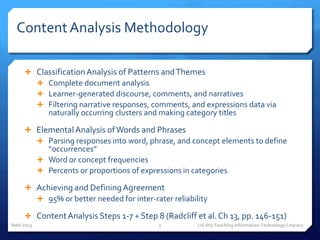
Content Analysis Methodology

      Classification Analysis of Patterns and Themes
        Complete document analysis
        Learner-generated discourse, comments, and narratives
        Filtering narrative responses, comments, and expressions data via
               naturally occurring clusters and making category titles

      Elemental Analysis of Words and Phrases
        Parsing responses into word, phrase, and concept elements to define
              “occurrences”
             Word or concept frequencies
             Percents or proportions of expressions in categories

      Achieving and Defining Agreement
        95% or better needed for inter-rater reliability

      Content Analysis Steps 1-7 + Step 8 (Radcliff et al. Ch 13, pp. 146-151)
Nahl 2013                                      2          LIS 665 Teaching Information Technology Literacy
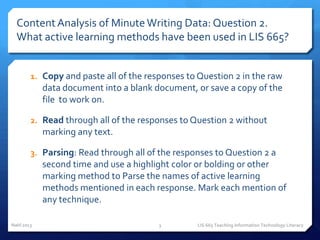
Content Analysis of Minute Writing Data: Question 2.
  What active learning methods have been used in LIS 665?


        1. Copy and paste all of the responses to Question 2 in the raw
            data document into a blank document, or save a copy of the
            file to work on.

        2. Read through all of the responses to Question 2 without
            marking any text.

        3. Parsing: Read through all of the responses to Question 2 a
            second time and use a highlight color or bolding or other
            marking method to Parse the names of active learning
            methods mentioned in each response. Mark each mention of
            any technique.

Nahl 2013                               3        LIS 665 Teaching Information Technology Literacy
Content Analysis of Minute Writing Data: Question 2.
What active learning techniques have been used in LIS 665?


        4. Parsing: Read through a third time to complete marking
             each mention of methods. You might have to mark longer
             phrases if responses describe instead of name methods.
        5.   Filtering: Read through the marked text and determine if
             the methods fall into more specific categories, e.g., models
             are more general than techniques so could form two
             categories. Elements of techniques could form another
             category. It is up to you to decide on the meaningful
             clustering and naming of categories.
        6. Coding: Use different highlight colors to separate parsed
             text into categories.

Nahl 2013                                4         LIS 665 Teaching Information Technology Literacy
Content Analysis of Minute Writing Data: Question 2.
What active learning techniques have been used in LIS 665?


        7.   Categories: Copy and paste the parsed terms into category
             listings on the document.

        8. Inter-rater agreement: Show your categories to one other
             person in class. Discuss any differences you detect in your
             parsed terms, category groupings, and names for
             categories.

        9. Achieving inter-rater agreement: Come to agreement on
             categories and groupings by standardizing a definition for
             what each category stands for and write the definition under
             each category name, above the unique parsed elements.

Nahl 2013                                5         LIS 665 Teaching Information Technology Literacy
Example: Content Analysis for a
        Published Research Article

         An online survey was sent to several librarian lists and Second
            Life librarian groups. The open-ended survey responses were
            analyzed with content analysis and published:
             Ashford, Robin, Beth Kraemer, Denise Cote and Diane Nahl. 2012.
               Academic Librarians and Virtual Information Services in Second Life.
               Journal of Library Innovation (January) 3 (1): 20-47.
               http://www.libraryinnovation.org/article/view/87

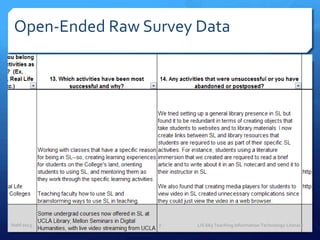
         The following slides (7-12) illustrate portions of the processes
            involved in analyzing the open-ended comments of librarians
            using Second Life in their professional endeavors.


Nahl 2013                                     6           LIS 665 Teaching Information Technology Literacy
Open-Ended Raw Survey Data


Nahl 2013         7    LIS 665 Teaching Information Technology Literacy
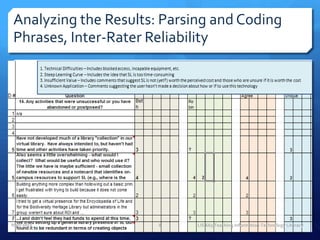
Analyzing the Results: Parsing and Coding
Phrases, Inter-Rater Reliability


Nahl 2013             8     LIS 665 Teaching Information Technology Literacy
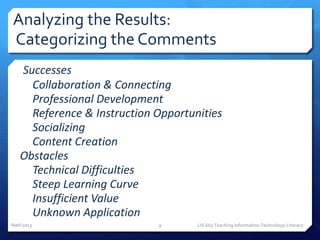
Analyzing the Results:
Categorizing the Comments
1. Successes
   o Collaboration & Connecting
   o Professional Development
   o Reference & Instruction Opportunities
   o Socializing
   o Content Creation
2. Obstacles
   o Technical Difficulties
   o Steep Learning Curve
   o Insufficient Value
   o Unknown Application
Nahl 2013                    9       LIS 665 Teaching Information Technology Literacy
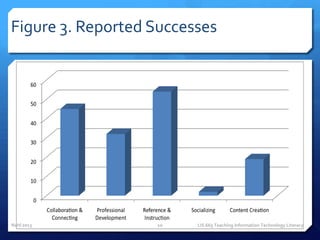
Figure 3. Reported Successes


Nahl 2013          10    LIS 665 Teaching Information Technology Literacy
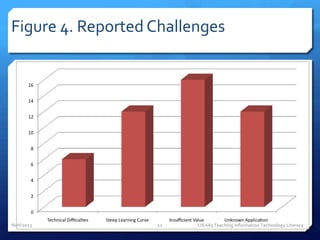
Figure 4. Reported Challenges


Nahl 2013          11    LIS 665 Teaching Information Technology Literacy
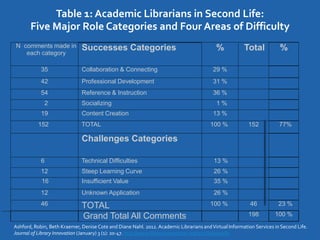
Table 1: Academic Librarians in Second Life:
       Five Major Role Categories and Four Areas of Difficulty
N comments made in            Successes Categories                                         %           Total           %
   each category

            35                Collaboration & Connecting                                 29 %
            42                Professional Development                                   31 %
            54                Reference & Instruction                                    36 %
             2                Socializing                                                  1%
            19                Content Creation                                           13 %
          152                 TOTAL                                                     100 %            152           77%

                              Challenges Categories

            6                 Technical Difficulties                                     13 %
            12                Steep Learning Curve                                       26 %
            16                Insufficient Value                                         35 %
            12                Unknown Application                                        26 %
            46                TOTAL                                                     100 %             46          23 %

                              Grand Total All Comments                                                   198         100 %
Ashford, Robin, Beth Kraemer, Denise Cote and Diane Nahl. 2012. Academic Librarians and Virtual Information Services in Second Life.
Journal of Library Innovation (January) 3 (1): 20-47. http://www.libraryinnovation.org/article/view/87
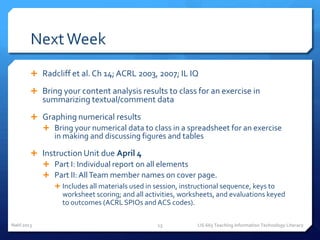
Next Week
         Radcliff et al. Ch 14; ACRL 2003, 2007; IL IQ

         Bring your content analysis results to class for an exercise in
            summarizing textual/comment data
         Graphing numerical results
           Bring your numerical data to class in a spreadsheet for an exercise
              in making and discussing figures and tables

         Instruction Unit due April 4
           Part I: Individual report on all elements
           Part II: All Team member names on cover page.
               Includes all materials used in session, instructional sequence, keys to
                 worksheet scoring; and all activities, worksheets, and evaluations keyed
                 to outcomes (ACRL SPIOs and ACS codes).

Nahl 2013                                       13           LIS 665 Teaching Information Technology Literacy

665 Session10-content analysis-s13

  • 1.
    Content Analysis of Open-EndedResponses LIS 665 Teaching Information Technology Literacy * Dr. Diane Nahl University of Hawaii * LIS Program * Spring 2013
  • 2.
    Content Analysis Methodology  Classification Analysis of Patterns and Themes  Complete document analysis  Learner-generated discourse, comments, and narratives  Filtering narrative responses, comments, and expressions data via naturally occurring clusters and making category titles  Elemental Analysis of Words and Phrases  Parsing responses into word, phrase, and concept elements to define “occurrences”  Word or concept frequencies  Percents or proportions of expressions in categories  Achieving and Defining Agreement  95% or better needed for inter-rater reliability  Content Analysis Steps 1-7 + Step 8 (Radcliff et al. Ch 13, pp. 146-151) Nahl 2013 2 LIS 665 Teaching Information Technology Literacy
  • 3.
    Content Analysis ofMinute Writing Data: Question 2. What active learning methods have been used in LIS 665? 1. Copy and paste all of the responses to Question 2 in the raw data document into a blank document, or save a copy of the file to work on. 2. Read through all of the responses to Question 2 without marking any text. 3. Parsing: Read through all of the responses to Question 2 a second time and use a highlight color or bolding or other marking method to Parse the names of active learning methods mentioned in each response. Mark each mention of any technique. Nahl 2013 3 LIS 665 Teaching Information Technology Literacy
  • 4.
    Content Analysis ofMinute Writing Data: Question 2. What active learning techniques have been used in LIS 665? 4. Parsing: Read through a third time to complete marking each mention of methods. You might have to mark longer phrases if responses describe instead of name methods. 5. Filtering: Read through the marked text and determine if the methods fall into more specific categories, e.g., models are more general than techniques so could form two categories. Elements of techniques could form another category. It is up to you to decide on the meaningful clustering and naming of categories. 6. Coding: Use different highlight colors to separate parsed text into categories. Nahl 2013 4 LIS 665 Teaching Information Technology Literacy
  • 5.
    Content Analysis ofMinute Writing Data: Question 2. What active learning techniques have been used in LIS 665? 7. Categories: Copy and paste the parsed terms into category listings on the document. 8. Inter-rater agreement: Show your categories to one other person in class. Discuss any differences you detect in your parsed terms, category groupings, and names for categories. 9. Achieving inter-rater agreement: Come to agreement on categories and groupings by standardizing a definition for what each category stands for and write the definition under each category name, above the unique parsed elements. Nahl 2013 5 LIS 665 Teaching Information Technology Literacy
  • 6.
    Example: Content Analysisfor a Published Research Article  An online survey was sent to several librarian lists and Second Life librarian groups. The open-ended survey responses were analyzed with content analysis and published:  Ashford, Robin, Beth Kraemer, Denise Cote and Diane Nahl. 2012. Academic Librarians and Virtual Information Services in Second Life. Journal of Library Innovation (January) 3 (1): 20-47. http://www.libraryinnovation.org/article/view/87  The following slides (7-12) illustrate portions of the processes involved in analyzing the open-ended comments of librarians using Second Life in their professional endeavors. Nahl 2013 6 LIS 665 Teaching Information Technology Literacy
  • 7.
    Open-Ended Raw SurveyData Nahl 2013 7 LIS 665 Teaching Information Technology Literacy
  • 8.
    Analyzing the Results:Parsing and Coding Phrases, Inter-Rater Reliability Nahl 2013 8 LIS 665 Teaching Information Technology Literacy
  • 9.
    Analyzing the Results: Categorizingthe Comments 1. Successes o Collaboration & Connecting o Professional Development o Reference & Instruction Opportunities o Socializing o Content Creation 2. Obstacles o Technical Difficulties o Steep Learning Curve o Insufficient Value o Unknown Application Nahl 2013 9 LIS 665 Teaching Information Technology Literacy
  • 10.
    Figure 3. ReportedSuccesses Nahl 2013 10 LIS 665 Teaching Information Technology Literacy
  • 11.
    Figure 4. ReportedChallenges Nahl 2013 11 LIS 665 Teaching Information Technology Literacy
  • 12.
    Table 1: AcademicLibrarians in Second Life: Five Major Role Categories and Four Areas of Difficulty N comments made in Successes Categories % Total % each category 35 Collaboration & Connecting 29 % 42 Professional Development 31 % 54 Reference & Instruction 36 % 2 Socializing 1% 19 Content Creation 13 % 152 TOTAL 100 % 152 77% Challenges Categories 6 Technical Difficulties 13 % 12 Steep Learning Curve 26 % 16 Insufficient Value 35 % 12 Unknown Application 26 % 46 TOTAL 100 % 46 23 % Grand Total All Comments 198 100 % Ashford, Robin, Beth Kraemer, Denise Cote and Diane Nahl. 2012. Academic Librarians and Virtual Information Services in Second Life. Journal of Library Innovation (January) 3 (1): 20-47. http://www.libraryinnovation.org/article/view/87
  • 13.
    Next Week  Radcliff et al. Ch 14; ACRL 2003, 2007; IL IQ  Bring your content analysis results to class for an exercise in summarizing textual/comment data  Graphing numerical results  Bring your numerical data to class in a spreadsheet for an exercise in making and discussing figures and tables  Instruction Unit due April 4  Part I: Individual report on all elements  Part II: All Team member names on cover page.  Includes all materials used in session, instructional sequence, keys to worksheet scoring; and all activities, worksheets, and evaluations keyed to outcomes (ACRL SPIOs and ACS codes). Nahl 2013 13 LIS 665 Teaching Information Technology Literacy