Literary Terms Review
Setting
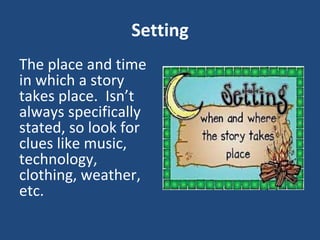
The place and time
in which a story
takes place. Isn’t
always specifically
stated, so look for
clues like music,
technology,
clothing, weather,
etc.
Characters
One of the people, animals or objects in a story.
Static Characters
Static characters
do not change.
They do not
evolve or change
as a result of their
experiences.
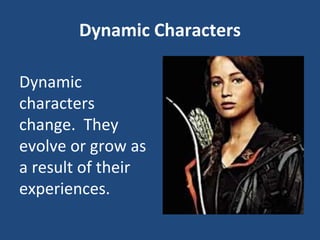
Dynamic Characters
Dynamic
characters
change. They
evolve or grow as
a result of their
experiences.
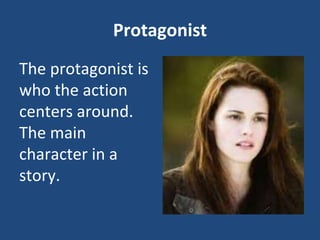
Protagonist
The protagonist is
who the action
centers around.
The main
character in a
story.
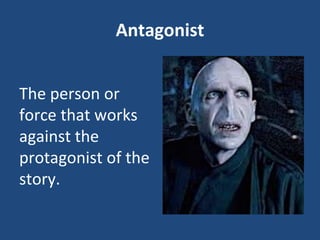
Antagonist
The person or
force that works
against the
protagonist of the
story.
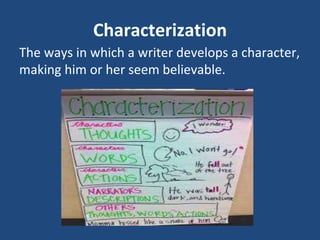
Characterization
The ways in which a writer develops a character,
making him or her seem believable.
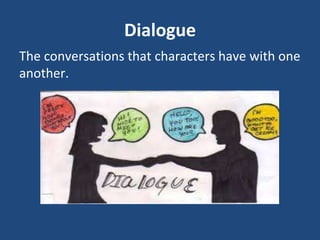
Dialogue
The conversations that characters have with one
another.
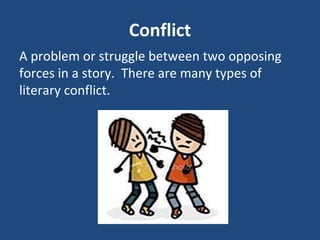
Conflict
A problem or struggle between two opposing
forces in a story. There are many types of
literary conflict.
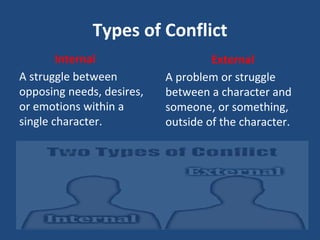
Types of Conflict
Internal
A struggle between
opposing needs, desires,
or emotions within a
single character.
External
A problem or struggle
between a character and
someone, or something,
outside of the character.
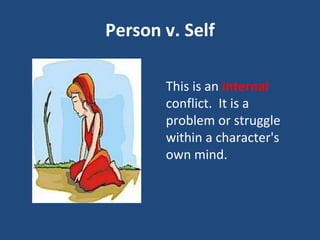
Person v. Self
This is an internal
conflict. It is a
problem or struggle
within a character's
own mind.
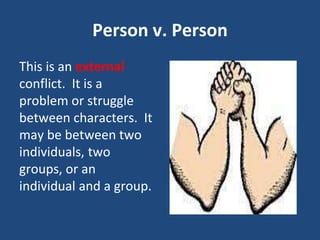
Person v. Person
This is an external
conflict. It is a
problem or struggle
between characters. It
may be between two
individuals, two
groups, or an
individual and a group.
Person v. Nature
This is an external
conflict. It is a
problem or struggle
between a character
and a blizzard,
hurricane, or another
outdoor element.
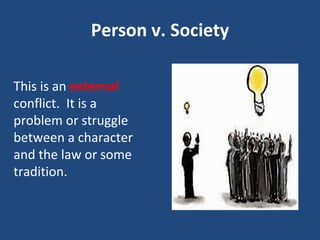
Person v. Society
This is an external
conflict. It is a
problem or struggle
between a character
and the law or some
tradition.
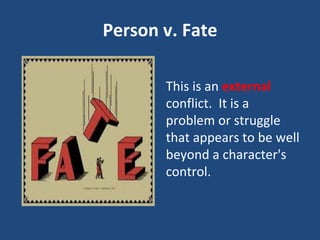
Person v. Fate
This is an external
conflict. It is a
problem or struggle
that appears to be well
beyond a character's
control.
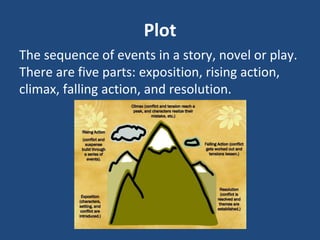
Plot
The sequence of events in a story, novel or play.
There are five parts: exposition, rising action,
climax, falling action, and resolution.
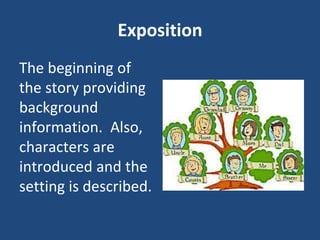
Exposition
The beginning of
the story providing
background
information. Also,
characters are
introduced and the
setting is described.
Rising Action
The events leading up
to the climax. It's the
central part of the
story, during which
various problems arise.
The rising action of a
plot is the series of
events that build up to
create tension and
suspense.
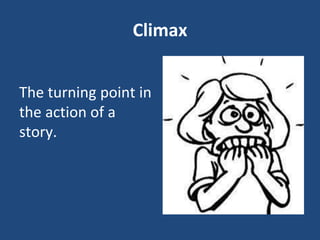
Climax
The turning point in
the action of a
story.
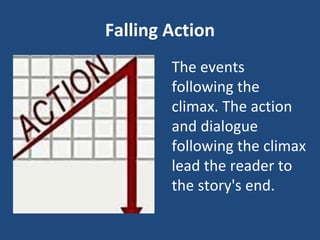
Falling Action
The events
following the
climax. The action
and dialogue
following the climax
lead the reader to
the story's end.
Resolution
The part of the
story in which the
problems are
solved or altered,
and the action
comes to a
satisfying end.
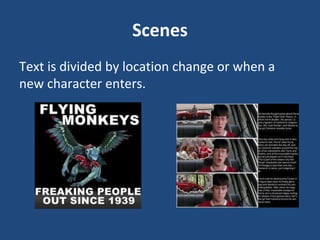
Scenes
Text is divided by location change or when a
new character enters.
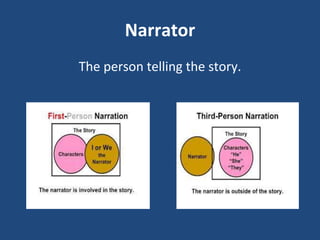
Narrator
The person telling the story.
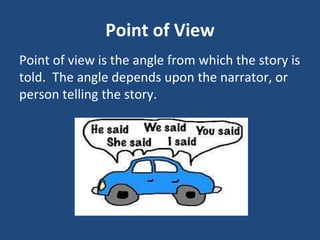
Point of View
Point of view is the angle from which the story is
told. The angle depends upon the narrator, or
person telling the story.
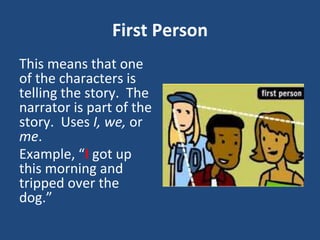
First Person
This means that one
of the characters is
telling the story. The
narrator is part of the
story. Uses I, we, or
me.
Example, “I got up
this morning and
tripped over the
dog.”
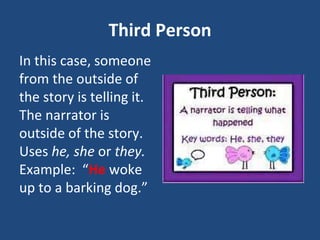
Third Person
In this case, someone
from the outside of
the story is telling it.
The narrator is
outside of the story.
Uses he, she or they.
Example: “He woke
up to a barking dog.”
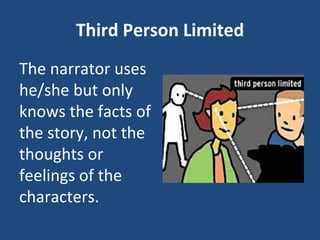
Third Person Limited
The narrator uses
he/she but only
knows the facts of
the story, not the
thoughts or
feelings of the
characters.
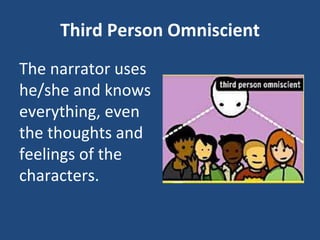
Third Person Omniscient
The narrator uses
he/she and knows
everything, even
the thoughts and
feelings of the
characters.
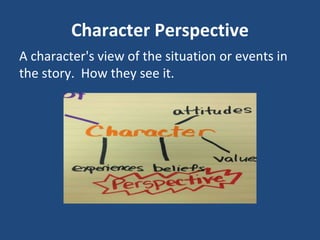
Character Perspective
A character's view of the situation or events in
the story. How they see it.
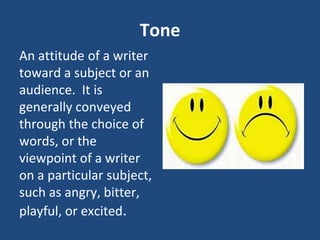
Tone
An attitude of a writer
toward a subject or an
audience. It is
generally conveyed
through the choice of
words, or the
viewpoint of a writer
on a particular subject,
such as angry, bitter,
playful, or excited.
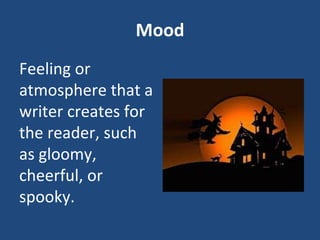
Mood
Feeling or
atmosphere that a
writer creates for
the reader, such
as gloomy,
cheerful, or
spooky.
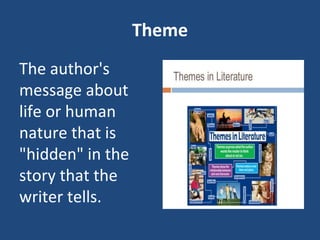
Theme
The author's
message about
life or human
nature that is
"hidden" in the
story that the
writer tells.
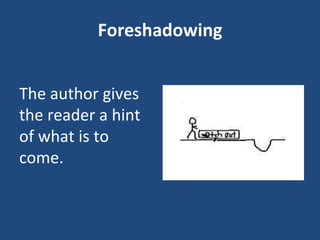
Foreshadowing
The author gives
the reader a hint
of what is to
come.
Flashback
An action that
interrupts the story
to show an event
that happened at
an earlier time,
which is needed to
understand the
story better.
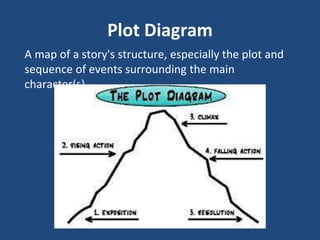
Plot Diagram
A map of a story's structure, especially the plot and
sequence of events surrounding the main
character(s).
Irony
A twist of
circumstances or
unexpected event
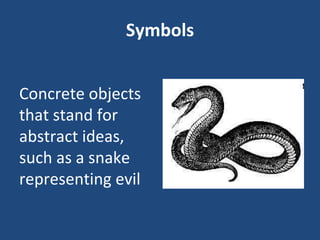
Symbols
Concrete objects
that stand for
abstract ideas,
such as a snake
representing evil
Tension & Suspense
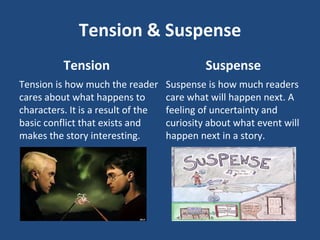
Tension
Tension is how much the reader
cares about what happens to
characters. It is a result of the
basic conflict that exists and
makes the story interesting.
Suspense
Suspense is how much readers
care what will happen next. A
feeling of uncertainty and
curiosity about what event will
happen next in a story.

Literary terms to know