LITERATE
ENVIRONMENT
ANALYSIS
PRESENTATION
Sharon Wood
Walden University

Dr. Davenna Williams
EDUC 6706G The Beginning Reader
PreK-3
February 12, 2011
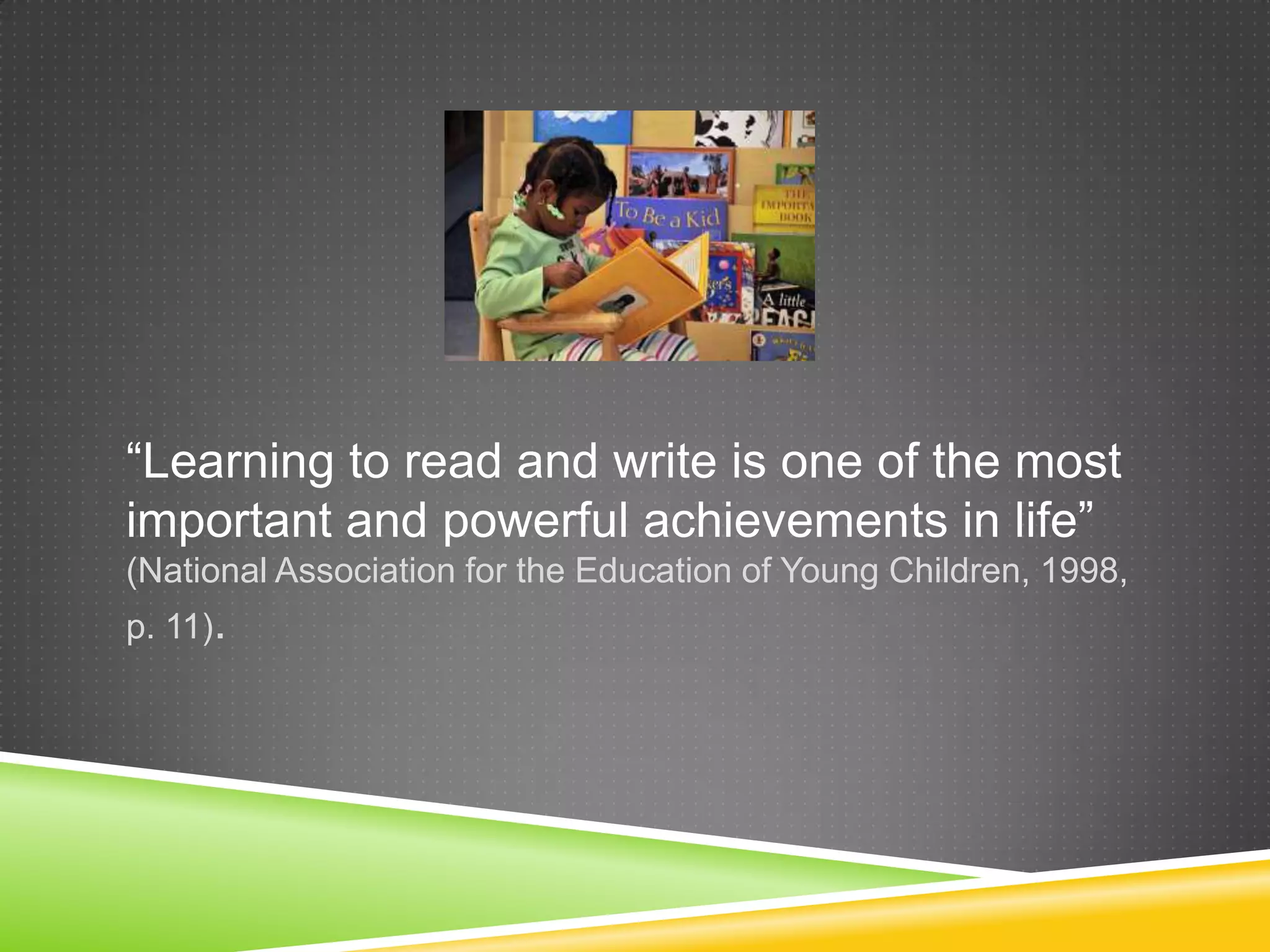
―Learning to read and write is one of the most
important and powerful achievements in life‖
(National Association for the Education of Young Children, 1998,
p. 11).
CREATING A LITERACY-RICH
          ENVIRONMENT
 Getting to Know Literacy Learners
 Selecting Texts
 Literacy Lesson: Interactive Perspective
 Literacy Lesson: Critical and Response Perspectives
 Final Reflections
GETTING TO KNOW
              LITERATE LEARNERS
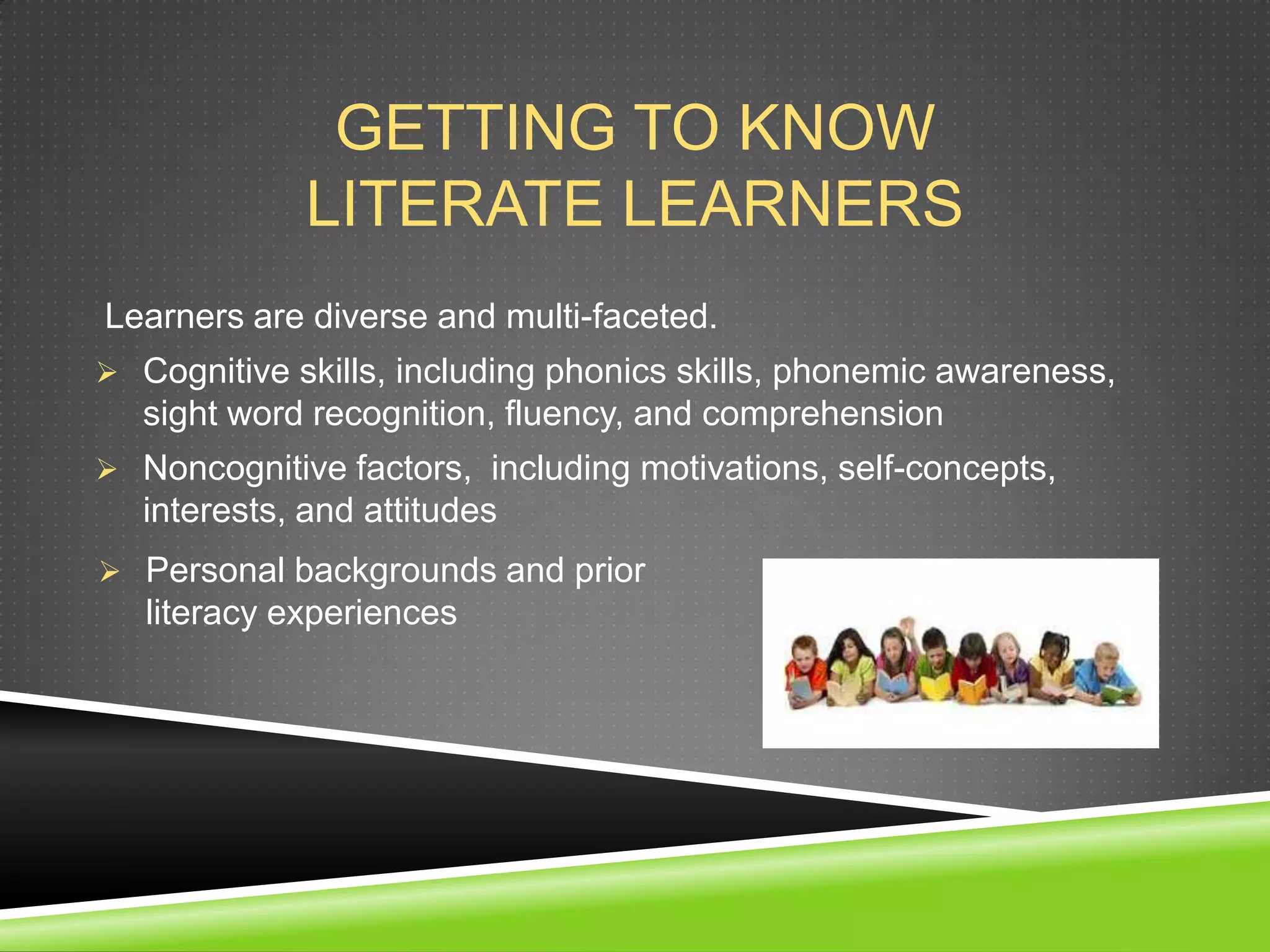
Learners are diverse and multi-faceted.
 Cognitive skills, including phonics skills, phonemic awareness,
   sight word recognition, fluency, and comprehension
 Noncognitive factors, including motivations, self-concepts,
   interests, and attitudes
 Personal backgrounds and prior
   literacy experiences
Teachers must understand personal, cognitive, and
noncognitive aspects of their learners, in order to create
differentiated learning experiences that meet the needs of
diverse students.

Benefits of getting to know learners:
 match texts and instruction to student interests and abilities,
 help students make connections to texts,
 build confidence by allowing students to share expertise,
 build rapport by showing personal interest in students
  (Laureate Education, Inc., 2009b).
In the classroom . . .
 Getting to know students – Casual conversations during play time
  and observations of connections my students made during
  discussions gave me insight into their personal lives and previous
  literacy experiences.
 Cognitive assessments – The Developmental Reading
  Assessment (DRA; Beaver, 1997) allowed me to assess my
  students’ skill levels in the areas of phonics, fluency, and
  comprehension.
 Noncognitive assessments - The Children’s Motivation to Read
  Survey (Mazzoni, Gambrell, & Korkeamaki, 1999) allowed me to
  gather information about my students’ reading activities, attitudes
  about reading, and reading confidence.
At home . . .


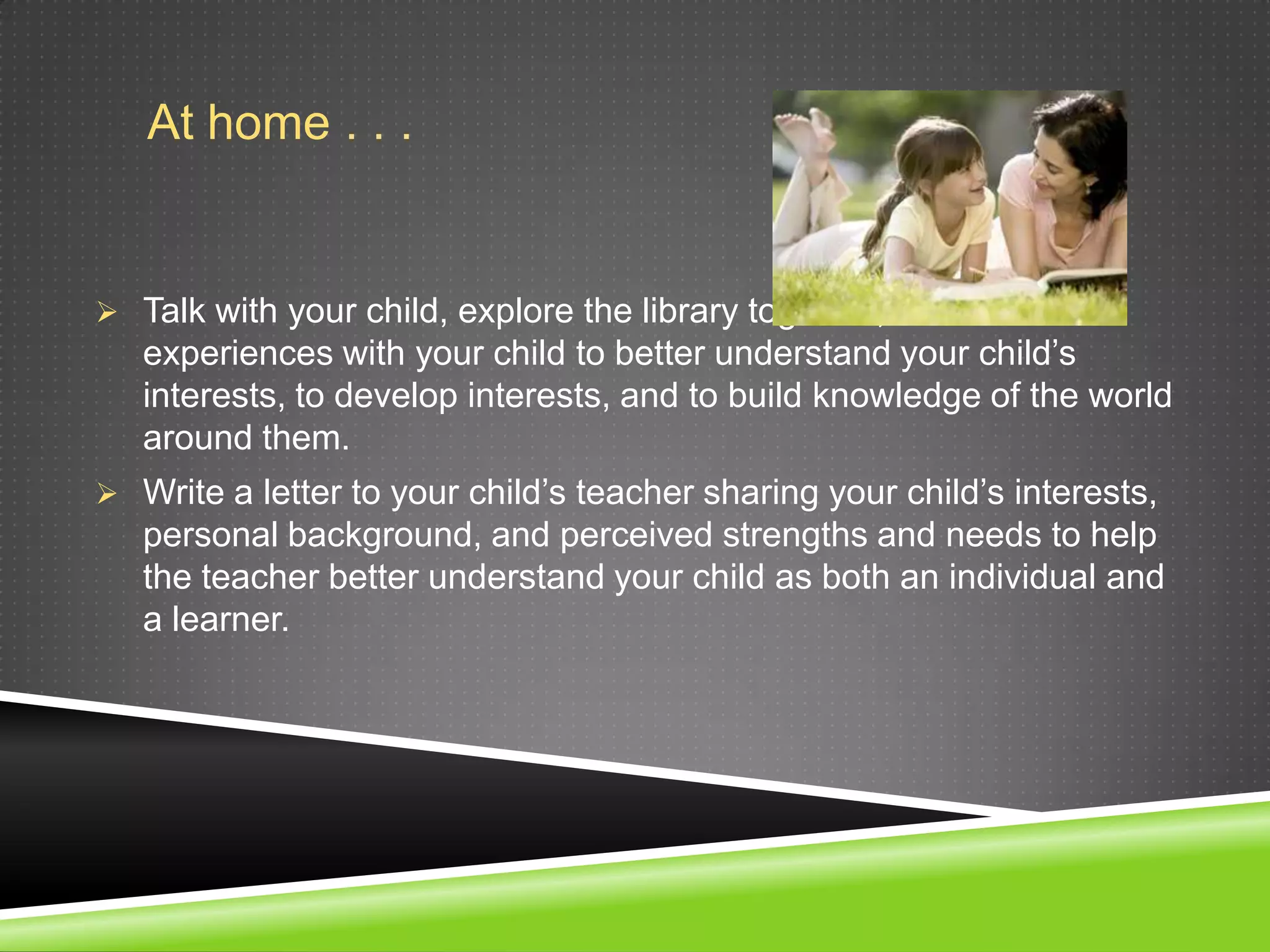
 Talk with your child, explore the library together, and share
   experiences with your child to better understand your child’s
   interests, to develop interests, and to build knowledge of the world
   around them.
 Write a letter to your child’s teacher sharing your child’s interests,
   personal background, and perceived strengths and needs to help
   the teacher better understand your child as both an individual and
   a learner.
SELECTING TEXTS
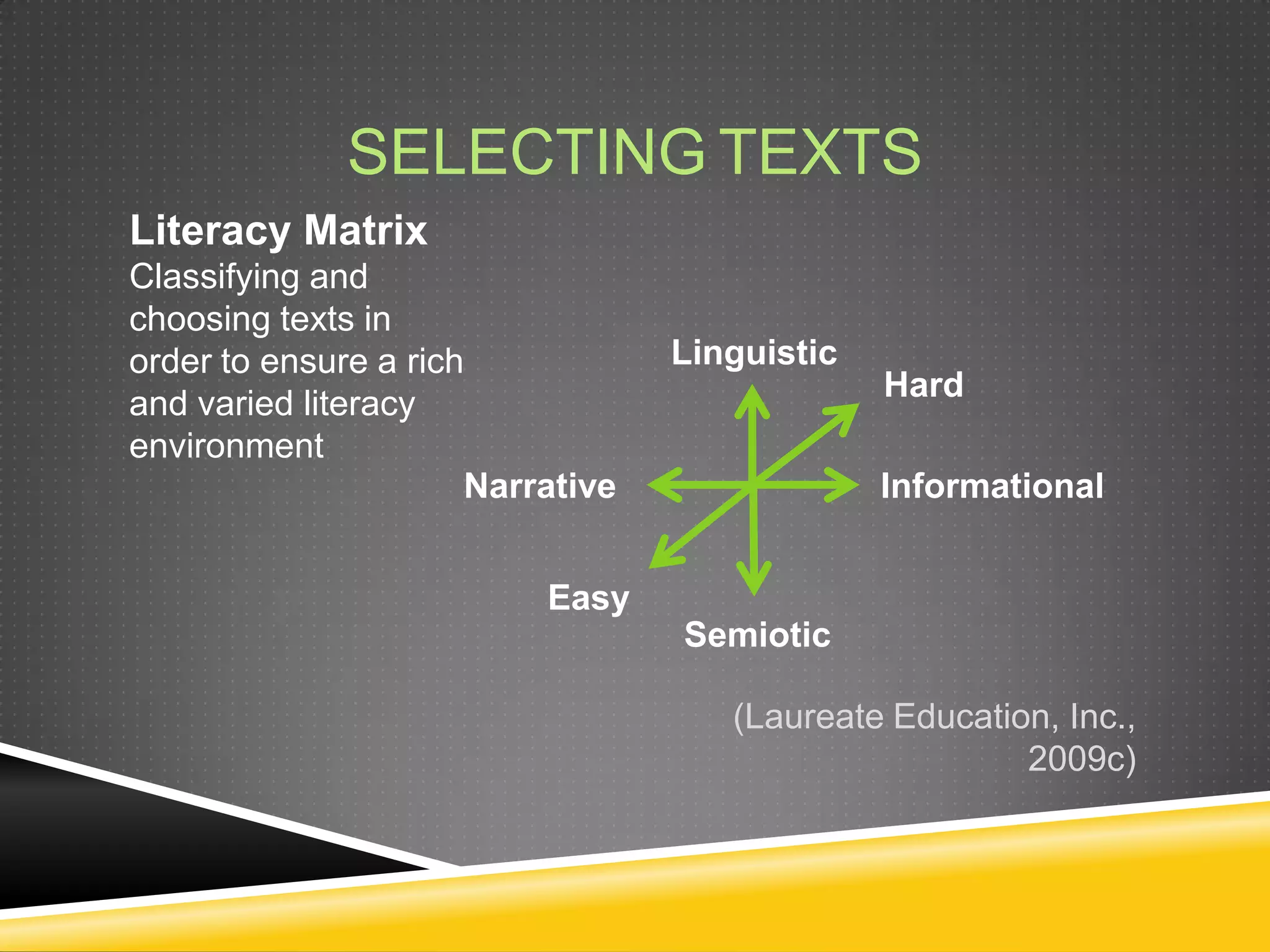
Literacy Matrix
Classifying and
choosing texts in
order to ensure a rich            Linguistic
                                               Hard
and varied literacy
environment
                      Narrative                Informational


                          Easy
                                  Semiotic

                                     (Laureate Education, Inc.,
                                                       2009c)
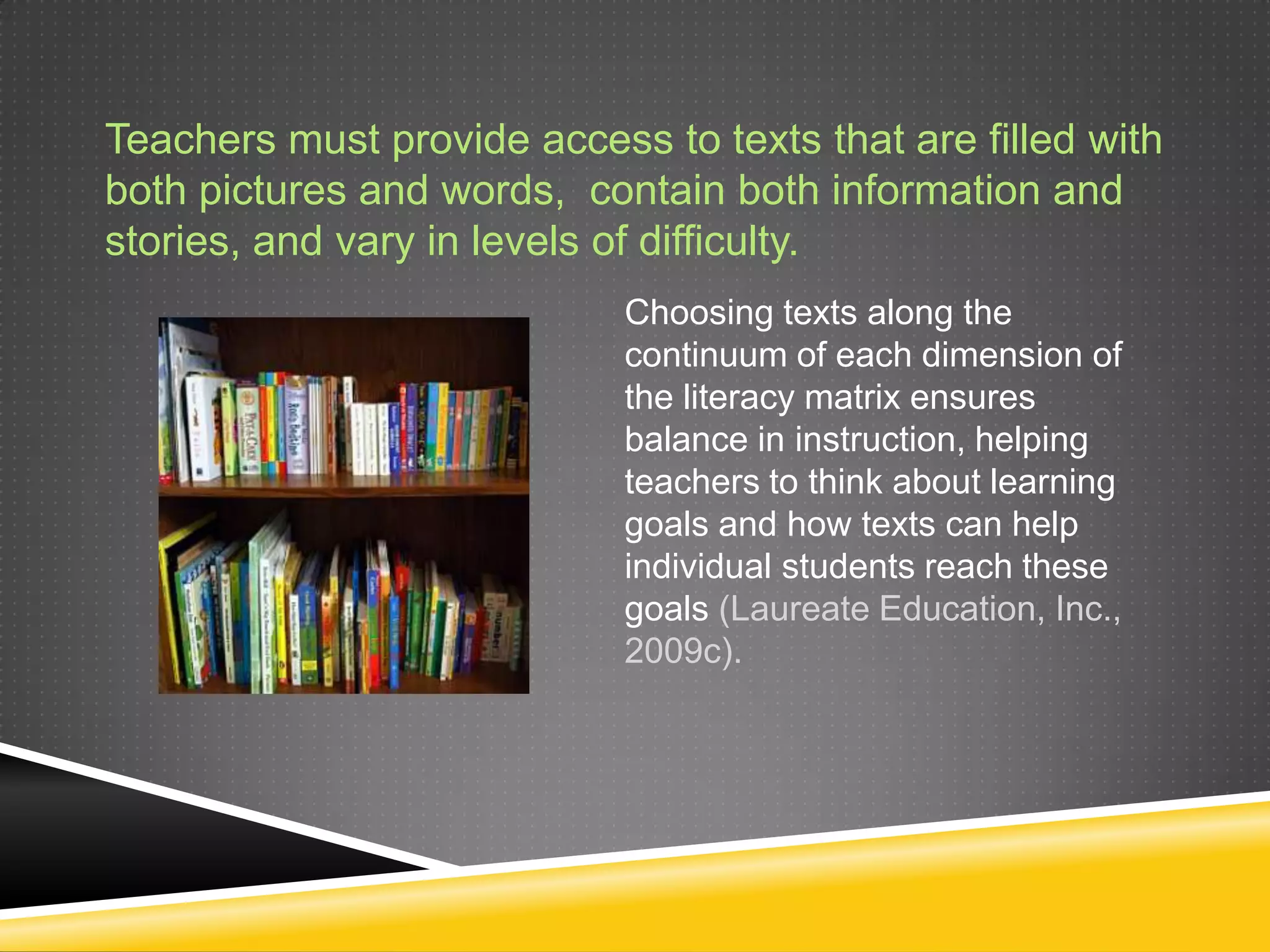
Teachers must provide access to texts that are filled with
both pictures and words, contain both information and
stories, and vary in levels of difficulty.
                            Choosing texts along the
                            continuum of each dimension of
                            the literacy matrix ensures
                            balance in instruction, helping
                            teachers to think about learning
                            goals and how texts can help
                            individual students reach these
                            goals (Laureate Education, Inc.,
                            2009c).
In the classroom . . .
When designing a unit on Harriet Tubman, I chose texts with both
learning goals and learners in mind.
 Making text connections and building subject matter knowledge:
   Harriet Tubman by Abigail Fitzwild (2006) is an informational text
   containing facts and photographs of primary sources.
 Understanding perspectives: The Patchwork Path: A Quilt Map to
   Freedom by Bettye Stroud (2005), a book filled with colorful
   illustrations, is a fictional account of a young girl’s experience on the
   Underground Railroad.
 Decoding skills and making connections: George Washington Carver
   by Katherine Scraper (2002), Lend a Hand by Sue Graves (2005),
   and Who Helps? by Judy Nayer (2000) are leveled readers; each
   individual text was chosen according to the reading abilities of first
   grade students reading below, on, or above grade-level.
 Building background knowledge: Harriet Tubman and the
   Underground Railroad is an informative website created by second
   grade students (http://www2.lhric.org/pocantico/tubman/tubman.html).
At home . . .
When visiting the bookstore or library, encourage your child to
choose a variety of books:
 Books with mostly illustrations, mostly text, and a combination
   of the two
 Story books and information books
 Books that can be read independently, books requiring
  support, and more difficult books that are great as read-alouds
Have a variety of reading materials around the
house, so your child can see you reading books,
magazines, newspapers, and resources on the
computer.
LITERACY LESSON:
      INTERACTIVE PERSPECTIVE
With an understanding of learners and texts, teachers are
prepared to choose the instructional tools that connect texts and
learners, with the aim of developing important reading strategies
and skills. Goals of this perspective include helping students
 become accurate and fluent readers and writers,
 develop the ability to comprehend text,
 become strategic, metacognitive readers and writers
   (Walden, 2011).
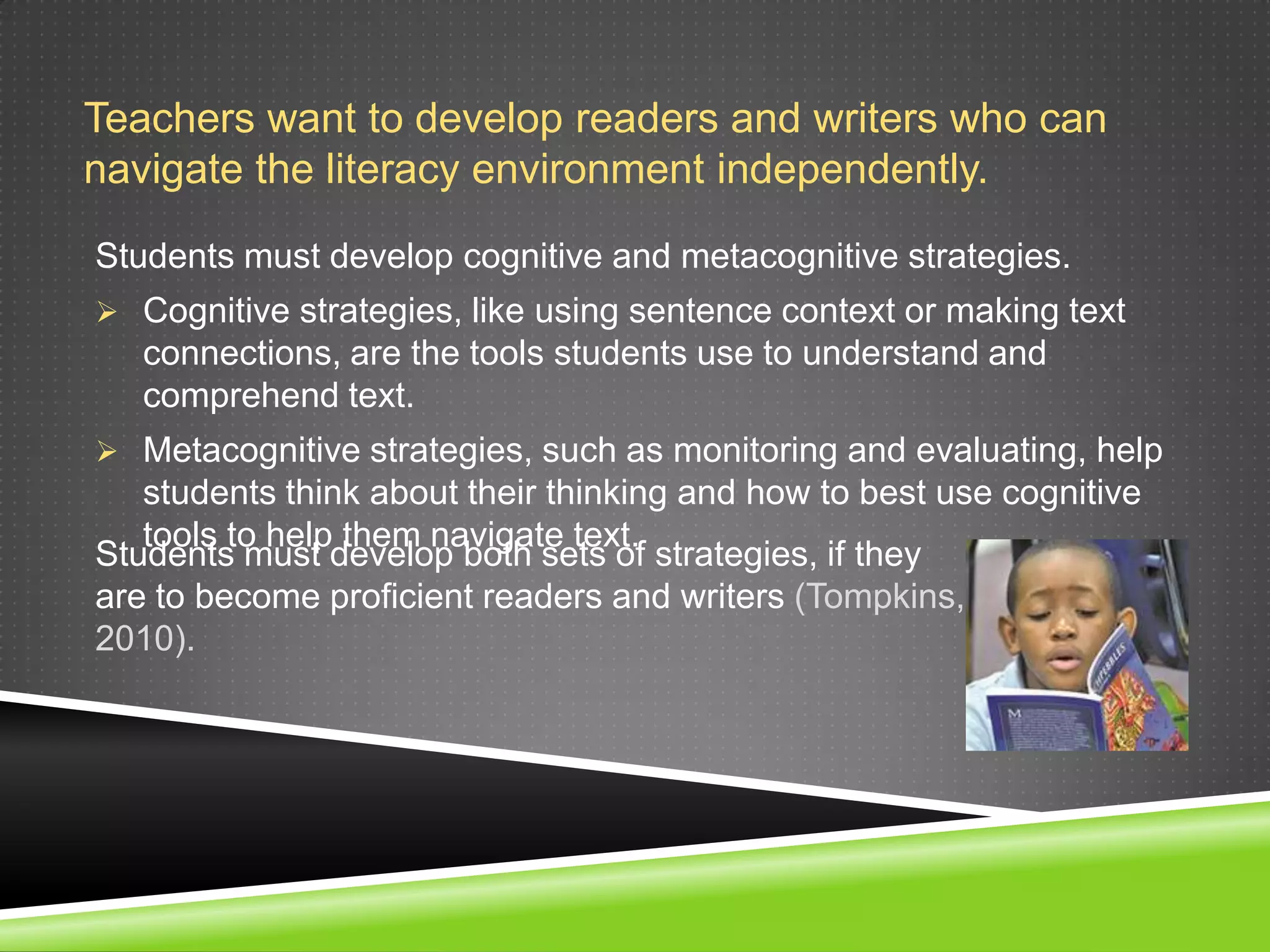
Teachers want to develop readers and writers who can
navigate the literacy environment independently.

Students must develop cognitive and metacognitive strategies.
 Cognitive strategies, like using sentence context or making text
   connections, are the tools students use to understand and
   comprehend text.
 Metacognitive strategies, such as monitoring and evaluating, help
   students think about their thinking and how to best use cognitive
   tools to help them navigate text.
Students must develop both sets of strategies, if they
are to become proficient readers and writers (Tompkins,
2010).
In the classroom . . .
A unit on Harriet Tubman provided a vehicle for interactive lessons
that promoted students’ ability to decode and comprehend text and
grow as strategic readers.
 Interactive read-aloud – I chose to read–aloud an above grade-
   level informational text to allow all students access to important
   facts and ideas about Harriet Tubman. I modeled making text
   connections, explained the importance of these connections to
   helping readers understand text, and provided opportunities for
   students to make their own text connections.
 Guided reading lessons – Instructional level texts that shared
   themes with the read-aloud text were chosen to support a below
   grade-level lesson on short vowel patterns and on and above
   grade-level lessons on using sentence context to decode
   unfamiliar words.
At home . . .
 Support your child when reading unfamiliar words, but encourage
   them to use their knowledge of how words work, illustrations, and
   story context to help them decode words independently.
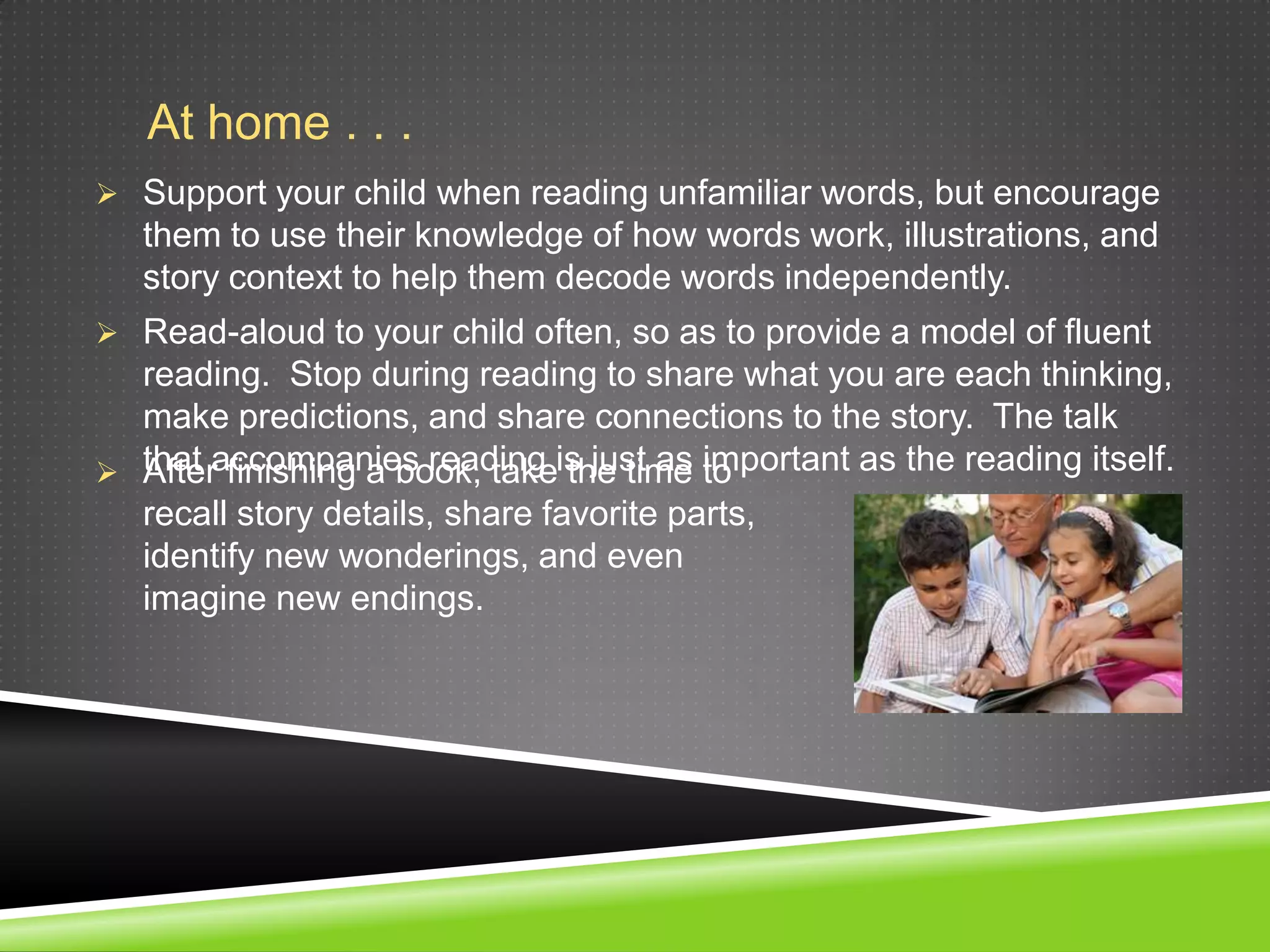
 Read-aloud to your child often, so as to provide a model of fluent
  reading. Stop during reading to share what you are each thinking,
  make predictions, and share connections to the story. The talk
 that accompanies reading is just as to
  After finishing a book, take the time important as the reading itself.
  recall story details, share favorite parts,
  identify new wonderings, and even
  imagine new endings.
LITERACY LESSON: CRITICAL
                 AND RESPONSIVE
                   PERSPECTIVES
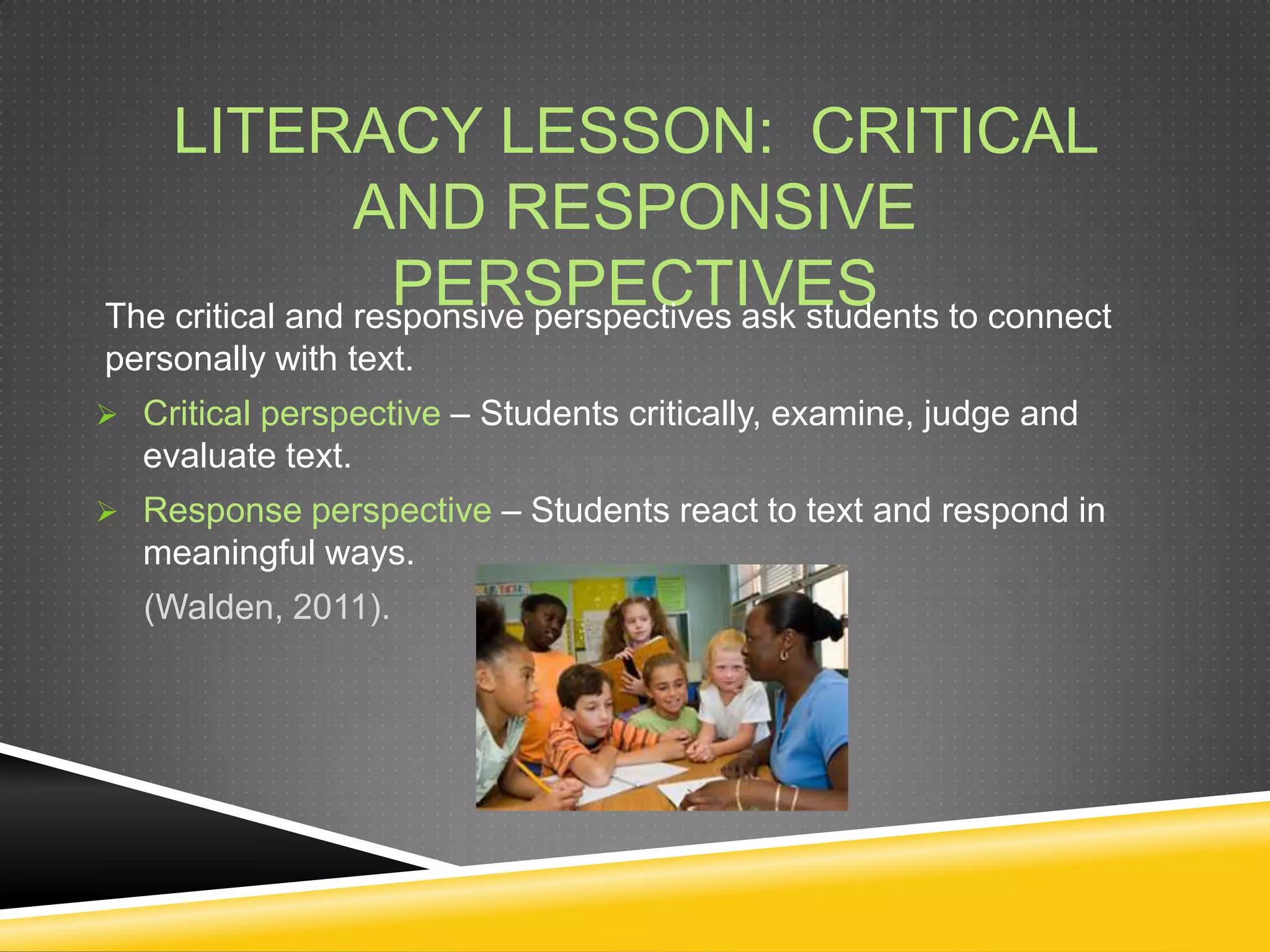
The critical and responsive perspectives ask students to connect
personally with text.
 Critical perspective – Students critically, examine, judge and
   evaluate text.
 Response perspective – Students react to text and respond in
   meaningful ways.
   (Walden, 2011).
Teachers must give students opportunities to make
meaningful connections to text. Reading and writing are
active endeavors that allow learners to grow in their
understanding of both text and themselves.
 The critical perspective values each individual’s personal
  perspective and asks learners to question, examine, and debate
  in order to make meaning of text and its potential impact on
  their world (Molden, 2007). This generates deeper involvement
  with the text.
 The response perspective asks students to respond to text in
  meaningful ways; the result is unique interpretations, as
  students combine what they already know with new discoveries
  (Laureate Education, Inc, 2009d). This leads to a deeper
  understanding of both texts and the processes of reading and
  writing.
In the classroom . . .
An exploration of a fictional text allowed students to examine
text from multiple perspectives in order to understand a
significant historical period and its importance in the readers’
lives.

 Subtext strategy – While reading aloud a fictional account of
  a young girl’s journey on the Underground Railroad,
  students used drama to help them imagine what characters
  might have thought or said. This activity, called the subtext
  strategy, helps students make personal connections,
  develop inferencing skills, and understand perspectives
  different from their own (Clyde, 2003).
 Written response – Students were asked to write a poem,
  with each line prompted by a question word, that allowed
  them to communicate both factual knowledge and emotional
  responses to the material explored.
At home . . .
 Literacy development is nurtured by responsive adults (Laureate
   Education, Inc., 2009a). Engage children in discussions.
   Respond enthusiastically to children’s prompts and invite them to
   join you in conversations.
 Encourage your child to keep a journal. They can draw pictures,
   write words, and/or compose complete sentences to help them
   remember special events or favorite times together.
 When solving childhood conflicts, guide children in seeing the
   situation from others’ perspectives.
 Encourage your child to ask why; then have them predict why
   before looking for an answer together, using resources like the
   library and the internet.
FINAL REFLECTIONS
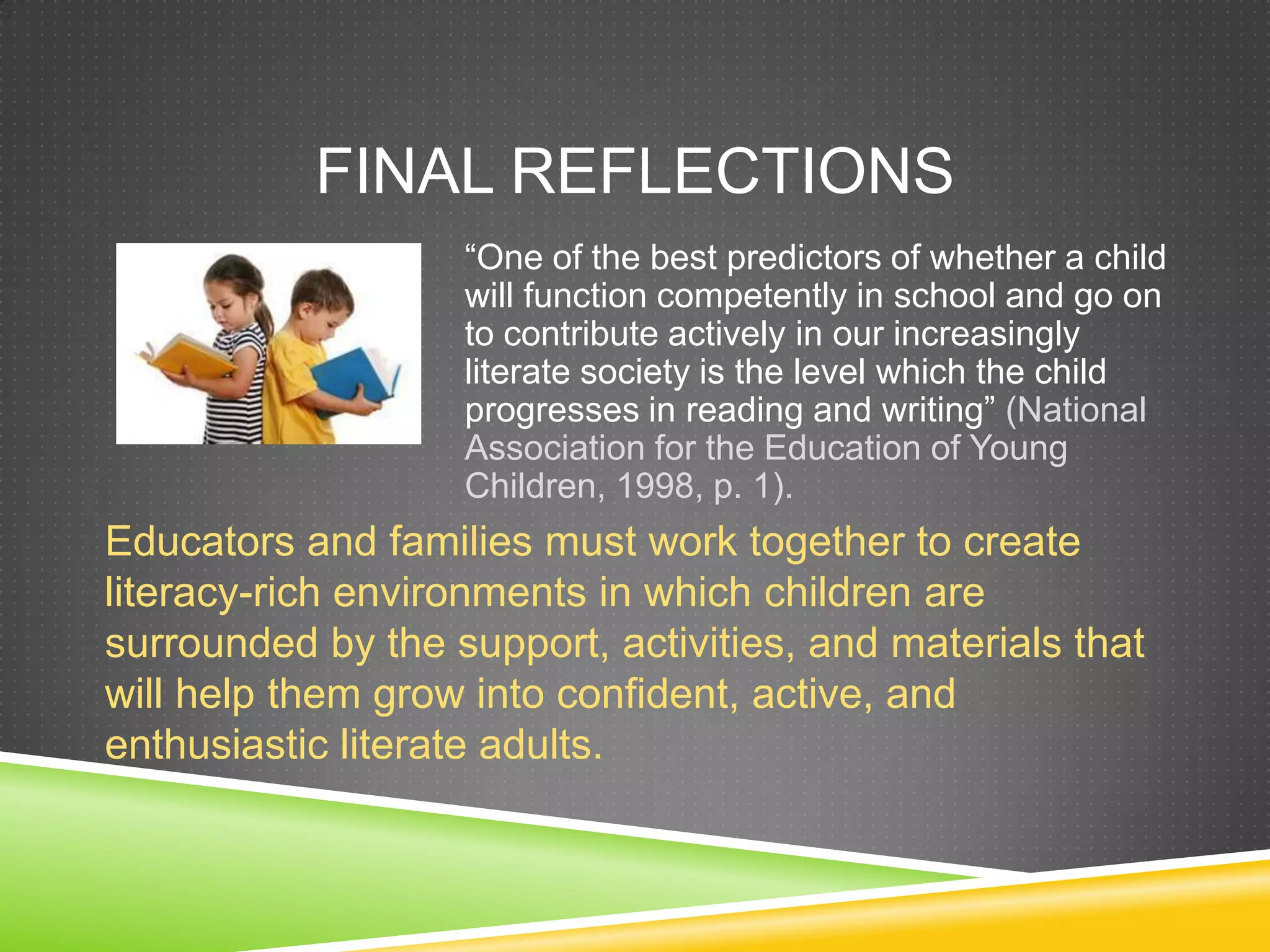
                   ―One of the best predictors of whether a child
                   will function competently in school and go on
                   to contribute actively in our increasingly
                   literate society is the level which the child
                   progresses in reading and writing‖ (National
                   Association for the Education of Young
                   Children, 1998, p. 1).
Educators and families must work together to create
literacy-rich environments in which children are
surrounded by the support, activities, and materials that
will help them grow into confident, active, and
enthusiastic literate adults.
REFERENCES
Beaver, J. (1997). Developmental reading assessment. Parsippany, NJ: Celebration
Press.
Clyde, J. A. (2003). Stepping inside the story world: The subtext strategy—a tool for
          connecting and comprehending. The Reading Teacher, 57(2), 150–160.
Fitzwild, A. (2006). Harriet Tubman. Boston: Houghton Mifflin.
Graves, S. (2005). Lend a hand. Parsippany, NJ: Celebration Press.
Laureate Education, Inc. (Executive Producer). (2009a). 2: Perspectives on early
literacy [DVD]. The beginning reader, PreK–3. Baltimore, MD: Author.
Laureate Education, Inc. (Executive Producer). (2009b). 6: Getting to know your
students [DVD]. The beginning reader, PreK–3. Baltimore, MD: Author.
Laureate Education, Inc. (Executive Producer). (2009c). 10: Analyzing and selecting
texts    [DVD]. The beginning reader, PreK-3. Baltimore, MD: Author.
Laureate Education, Inc. (Executive Producer). (2009d). 22: Response perspective:
Reading- writing connection [DVD]. The beginning reader, PreK-3. Baltimore, MD:
Author.
REFERENCES (CONTINUED)
Mazzoni, S. A., Gambrell, L. B., & Korkeamaki, R. L. (1999). A cross-cultural
perspective of early          literacy motivation. Journal of Reading Psychology, 20,
237-253.
Molden, K. (2007). Critical literacy, the right answer for the reading classroom:
Strategies to      move beyond comprehension for reading improvement. Reading
Improvement, 44(1),             50–56.
National Association for the Education of Young Children. (1998). Learning to read
and write:         Developmentally appropriate practices for young children.
Washington, DC: Author.
Nayar, J. (2000). Who helps? New York: Newbridge Educational Publishing.
Scraper, K. (2002). George Washington Carver. Pelham, NY: Benchmark Education
Company.
Stroud, B. (2005). The patchwork path: A quilt map to freedom. Cambridge, MA:
Candlewick
         Press.
Tompkins, G. E. (2010). Literacy for the 21st century: A balanced approach (5th
ed.). Boston: Allyn & Bacon.

Literate environment analysis presentation

  • 1.
    LITERATE ENVIRONMENT ANALYSIS PRESENTATION Sharon Wood Walden University Dr.Davenna Williams EDUC 6706G The Beginning Reader PreK-3 February 12, 2011
  • 2.
    ―Learning to readand write is one of the most important and powerful achievements in life‖ (National Association for the Education of Young Children, 1998, p. 11).
  • 3.
    CREATING A LITERACY-RICH ENVIRONMENT  Getting to Know Literacy Learners  Selecting Texts  Literacy Lesson: Interactive Perspective  Literacy Lesson: Critical and Response Perspectives  Final Reflections
  • 4.
    GETTING TO KNOW LITERATE LEARNERS Learners are diverse and multi-faceted.  Cognitive skills, including phonics skills, phonemic awareness, sight word recognition, fluency, and comprehension  Noncognitive factors, including motivations, self-concepts, interests, and attitudes  Personal backgrounds and prior literacy experiences
  • 5.
    Teachers must understandpersonal, cognitive, and noncognitive aspects of their learners, in order to create differentiated learning experiences that meet the needs of diverse students. Benefits of getting to know learners:  match texts and instruction to student interests and abilities,  help students make connections to texts,  build confidence by allowing students to share expertise,  build rapport by showing personal interest in students (Laureate Education, Inc., 2009b).
  • 6.
    In the classroom. . .  Getting to know students – Casual conversations during play time and observations of connections my students made during discussions gave me insight into their personal lives and previous literacy experiences.  Cognitive assessments – The Developmental Reading Assessment (DRA; Beaver, 1997) allowed me to assess my students’ skill levels in the areas of phonics, fluency, and comprehension.  Noncognitive assessments - The Children’s Motivation to Read Survey (Mazzoni, Gambrell, & Korkeamaki, 1999) allowed me to gather information about my students’ reading activities, attitudes about reading, and reading confidence.
  • 7.
    At home .. .  Talk with your child, explore the library together, and share experiences with your child to better understand your child’s interests, to develop interests, and to build knowledge of the world around them.  Write a letter to your child’s teacher sharing your child’s interests, personal background, and perceived strengths and needs to help the teacher better understand your child as both an individual and a learner.
  • 8.
    SELECTING TEXTS Literacy Matrix Classifyingand choosing texts in order to ensure a rich Linguistic Hard and varied literacy environment Narrative Informational Easy Semiotic (Laureate Education, Inc., 2009c)
  • 9.
    Teachers must provideaccess to texts that are filled with both pictures and words, contain both information and stories, and vary in levels of difficulty. Choosing texts along the continuum of each dimension of the literacy matrix ensures balance in instruction, helping teachers to think about learning goals and how texts can help individual students reach these goals (Laureate Education, Inc., 2009c).
  • 10.
    In the classroom. . . When designing a unit on Harriet Tubman, I chose texts with both learning goals and learners in mind.  Making text connections and building subject matter knowledge: Harriet Tubman by Abigail Fitzwild (2006) is an informational text containing facts and photographs of primary sources.  Understanding perspectives: The Patchwork Path: A Quilt Map to Freedom by Bettye Stroud (2005), a book filled with colorful illustrations, is a fictional account of a young girl’s experience on the Underground Railroad.  Decoding skills and making connections: George Washington Carver by Katherine Scraper (2002), Lend a Hand by Sue Graves (2005), and Who Helps? by Judy Nayer (2000) are leveled readers; each individual text was chosen according to the reading abilities of first grade students reading below, on, or above grade-level.  Building background knowledge: Harriet Tubman and the Underground Railroad is an informative website created by second grade students (http://www2.lhric.org/pocantico/tubman/tubman.html).
  • 11.
    At home .. . When visiting the bookstore or library, encourage your child to choose a variety of books:  Books with mostly illustrations, mostly text, and a combination of the two  Story books and information books  Books that can be read independently, books requiring support, and more difficult books that are great as read-alouds Have a variety of reading materials around the house, so your child can see you reading books, magazines, newspapers, and resources on the computer.
  • 12.
    LITERACY LESSON: INTERACTIVE PERSPECTIVE With an understanding of learners and texts, teachers are prepared to choose the instructional tools that connect texts and learners, with the aim of developing important reading strategies and skills. Goals of this perspective include helping students  become accurate and fluent readers and writers,  develop the ability to comprehend text,  become strategic, metacognitive readers and writers (Walden, 2011).
  • 13.
    Teachers want todevelop readers and writers who can navigate the literacy environment independently. Students must develop cognitive and metacognitive strategies.  Cognitive strategies, like using sentence context or making text connections, are the tools students use to understand and comprehend text.  Metacognitive strategies, such as monitoring and evaluating, help students think about their thinking and how to best use cognitive tools to help them navigate text. Students must develop both sets of strategies, if they are to become proficient readers and writers (Tompkins, 2010).
  • 14.
    In the classroom. . . A unit on Harriet Tubman provided a vehicle for interactive lessons that promoted students’ ability to decode and comprehend text and grow as strategic readers.  Interactive read-aloud – I chose to read–aloud an above grade- level informational text to allow all students access to important facts and ideas about Harriet Tubman. I modeled making text connections, explained the importance of these connections to helping readers understand text, and provided opportunities for students to make their own text connections.  Guided reading lessons – Instructional level texts that shared themes with the read-aloud text were chosen to support a below grade-level lesson on short vowel patterns and on and above grade-level lessons on using sentence context to decode unfamiliar words.
  • 15.
    At home .. .  Support your child when reading unfamiliar words, but encourage them to use their knowledge of how words work, illustrations, and story context to help them decode words independently.  Read-aloud to your child often, so as to provide a model of fluent reading. Stop during reading to share what you are each thinking, make predictions, and share connections to the story. The talk  that accompanies reading is just as to After finishing a book, take the time important as the reading itself. recall story details, share favorite parts, identify new wonderings, and even imagine new endings.
  • 16.
    LITERACY LESSON: CRITICAL AND RESPONSIVE PERSPECTIVES The critical and responsive perspectives ask students to connect personally with text.  Critical perspective – Students critically, examine, judge and evaluate text.  Response perspective – Students react to text and respond in meaningful ways. (Walden, 2011).
  • 17.
    Teachers must givestudents opportunities to make meaningful connections to text. Reading and writing are active endeavors that allow learners to grow in their understanding of both text and themselves.  The critical perspective values each individual’s personal perspective and asks learners to question, examine, and debate in order to make meaning of text and its potential impact on their world (Molden, 2007). This generates deeper involvement with the text.  The response perspective asks students to respond to text in meaningful ways; the result is unique interpretations, as students combine what they already know with new discoveries (Laureate Education, Inc, 2009d). This leads to a deeper understanding of both texts and the processes of reading and writing.
  • 18.
    In the classroom. . . An exploration of a fictional text allowed students to examine text from multiple perspectives in order to understand a significant historical period and its importance in the readers’ lives.  Subtext strategy – While reading aloud a fictional account of a young girl’s journey on the Underground Railroad, students used drama to help them imagine what characters might have thought or said. This activity, called the subtext strategy, helps students make personal connections, develop inferencing skills, and understand perspectives different from their own (Clyde, 2003).  Written response – Students were asked to write a poem, with each line prompted by a question word, that allowed them to communicate both factual knowledge and emotional responses to the material explored.
  • 19.
    At home .. .  Literacy development is nurtured by responsive adults (Laureate Education, Inc., 2009a). Engage children in discussions. Respond enthusiastically to children’s prompts and invite them to join you in conversations.  Encourage your child to keep a journal. They can draw pictures, write words, and/or compose complete sentences to help them remember special events or favorite times together.  When solving childhood conflicts, guide children in seeing the situation from others’ perspectives.  Encourage your child to ask why; then have them predict why before looking for an answer together, using resources like the library and the internet.
  • 20.
    FINAL REFLECTIONS ―One of the best predictors of whether a child will function competently in school and go on to contribute actively in our increasingly literate society is the level which the child progresses in reading and writing‖ (National Association for the Education of Young Children, 1998, p. 1). Educators and families must work together to create literacy-rich environments in which children are surrounded by the support, activities, and materials that will help them grow into confident, active, and enthusiastic literate adults.
  • 21.
    REFERENCES Beaver, J. (1997).Developmental reading assessment. Parsippany, NJ: Celebration Press. Clyde, J. A. (2003). Stepping inside the story world: The subtext strategy—a tool for connecting and comprehending. The Reading Teacher, 57(2), 150–160. Fitzwild, A. (2006). Harriet Tubman. Boston: Houghton Mifflin. Graves, S. (2005). Lend a hand. Parsippany, NJ: Celebration Press. Laureate Education, Inc. (Executive Producer). (2009a). 2: Perspectives on early literacy [DVD]. The beginning reader, PreK–3. Baltimore, MD: Author. Laureate Education, Inc. (Executive Producer). (2009b). 6: Getting to know your students [DVD]. The beginning reader, PreK–3. Baltimore, MD: Author. Laureate Education, Inc. (Executive Producer). (2009c). 10: Analyzing and selecting texts [DVD]. The beginning reader, PreK-3. Baltimore, MD: Author. Laureate Education, Inc. (Executive Producer). (2009d). 22: Response perspective: Reading- writing connection [DVD]. The beginning reader, PreK-3. Baltimore, MD: Author.
  • 22.
    REFERENCES (CONTINUED) Mazzoni, S.A., Gambrell, L. B., & Korkeamaki, R. L. (1999). A cross-cultural perspective of early literacy motivation. Journal of Reading Psychology, 20, 237-253. Molden, K. (2007). Critical literacy, the right answer for the reading classroom: Strategies to move beyond comprehension for reading improvement. Reading Improvement, 44(1), 50–56. National Association for the Education of Young Children. (1998). Learning to read and write: Developmentally appropriate practices for young children. Washington, DC: Author. Nayar, J. (2000). Who helps? New York: Newbridge Educational Publishing. Scraper, K. (2002). George Washington Carver. Pelham, NY: Benchmark Education Company. Stroud, B. (2005). The patchwork path: A quilt map to freedom. Cambridge, MA: Candlewick Press. Tompkins, G. E. (2010). Literacy for the 21st century: A balanced approach (5th ed.). Boston: Allyn & Bacon.