Creating a Digital Scholarship Unit
at the University of Toronto Scarborough
Sara Allain, Librarian
sallain@utsc.utoronto.ca (@archivalistic)
Kelli Babcock, Special Projects Librarian
kbabcock@utsc.utoronto.ca (@kelllib)
Paulina Rousseau, Digital Scholarship Librarian
prousseau@utsc.utoronto.ca
May 31, 2013
Presentation Overview
Should you?
Could you?
Why on earth would you?
Should You?
Image by Kelli Babcock
Should You?
Response to user needs
Strategic planning
Broader trends within academia
Digital Humanities
"An area of research, teaching, and creation concerned with the
intersection of computing and the disciplines of the humanities.
Developing from the field of humanities computing, digital
humanities embraces a variety of topics ranging from curating online
collections to data mining large cultural data sets.Digital Humanities
currently incorporates both digitized and born-digital materials and
combines the methodologies from the traditional humanities
disciplines as well as social sciences, with tools provided by
computing (such as data visualisation, info retrieval, data mining,
statistics, and text mining) and digital publishing"
~ Wikipedia
ePorte
http://humrp1.utsc.utoronto.ca/ePorte/
DEEDS
http://www.utoronto.ca/deeds/
Could You: Strategic Planning
Accelerate & enhance research
Enrich pedagogical platforms
Create & mobilize unique scholarly collections
To create, preserve and provide access to
digital collections that will inspire and facilitate
research and knowledge creation for the
purposes of teaching and learning.
Could You: DSU Mission
Projects created and maintained by the DSU
will, where possible:
Be accessible as a public good
Be sustainable
Provide for interoperability
Facilitate collaboration amongst scholars at U of
T Scarborough and beyond
Support experimentation
Could You: Core Values
Selection Matrix
Digitization
Handbook
Metadata
Schema
Handbook
Could You: Core Policies
The DSU Team
PAULINA ROUSSEAU
DIGITAL SCHOLARSHIP
LIBRARIAN
PATRICIA LACIVITA
DSU COORDINATOR
ELIZABETH O’BRIEN
PROJECT INITIATOR
SARA ALLAIN
SPECIAL PROJECTS
LIBRARIAN
SARAH FORBES
SCHOLARLY COMMUNICATIONS
LIBRARIAN
KELLI BABCOCK
SPECIAL PROJECTS
LIBRARIAN
The DSU Team
PAM MANN
METADATA ASSISTANT
AMAZING WORK-STUDY
STUDENTS!
Other Projects in the DSU...
http://www.bioline.org.br
https://tspace.library.utoronto.ca/
Could You: Selecting a
Content Management System
• OCLC proprietary
software
• OAIS compliant
• Discoverability
• Standards and
interoperability
• Scalability
Could You: Reinventing
Undergraduate Education
•  The Boyer Commission on Educating
Undergraduates in the Research University
•  Completed in 1998
•  Increasing stress on post-secondary system
in the US
•  Ensuring that undergraduates have an
opportunity to participate in the process of
inquiry, investigation, and discovery
Could You: Benefits for Students
George Kuh, High Impact Educational
Practices
•  Undergraduate Research
•  Collaborative Assignments and Projects
•  Service Learning/Community Based
Learning
L. Spiro, “Why the Digital Humanities?”
http://digitalscholarship.files.wordpress.com/2011/10/dhglca-5.pdf
Could You: Turning “Student
Writers” into “Student Authors”
“It is our experience that the closer we can bring our
students to the real sources of knowledge — the
ancient texts, the archaeological remains, the papyri
and parchment — and the real reward of scholarship
— the joy of producing a piece of work that one knows
will be discovered and read with interest and pleasure
by people we may never meet — the closer we can
bring students to the experience of being true scholars,
working beside other scholars, the more enthusiasm
we find.”
•  Gunda Gunde Manuscript Collection
•  Pilot Collection: Doris McCarthy fonds
•  UTSC Archives Legacy Collection
•  UTSC Photographic Services Collection
Could You: DSU Collections
•  Collaboration with Dr. Michael
Gervers
•  Collection of 219 manuscripts
from the Stephanite Monastery,
Gunda Gunde, Ethiopia
•  Photographs taken by Michael
Gervers and Gordon Belray on a
field trip to Ethiopia
•  Religious texts: biblical texts,
lives of saints, royal chronicles.
•  Many are highly visual, with
elaborate illustrations
Gunda Gunde Manuscript Collection
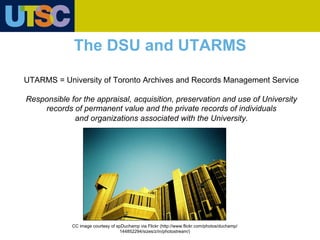
UTARMS = University of Toronto Archives and Records Management Service
Responsible for the appraisal, acquisition, preservation and use of University
records of permanent value and the private records of individuals
and organizations associated with the University.
The DSU and UTARMS
CC image courtesy of spDuchamp via Flickr (http://www.flickr.com/photos/duchamp/
144852294/sizes/z/in/photostream/)
•  Gunda Gunde Manuscript Collection
•  Pilot Collection: Doris McCarthy fonds
•  UTSC Archives Legacy Collection
•  UTSC Photographic Services Collection
Could You: DSU Collections
Pilot Collection: Doris McCarthy fonds
The fonds contains:
•  9 meters of textual records
•  ~15,000 photographic items
•  72 sketches, prints and posters
•  5 sketchbooks
•  38 artifacts
•  46 architectural drawings
•  800+ postcards
•  160 annotated books
•  36 electronic media items
University of Toronto Scarborough Library,
Doris McCarthy fonds, Series L: Photographs - Box 1 (File 1a).
Pilot Collection: Doris McCarthy fonds
University of Toronto Scarborough Library,
Doris McCarthy fonds, various items.
Purpose:
•  Provide access to fragile items that would otherwise be
unavailable to researchers
•  Online access to researchers interested in Doris McCarthy,
Canadian art, literary studies, or gender studies and allow
for curriculum mapping to UTSC courses
Pilot Collection: Doris McCarthy fonds
University of Toronto Scarborough Library,
Doris McCarthy fonds, Sub-series L.1: Photographs - Slides - Box 1 (File 33).
UTSC Archives Legacy Collection
The collection contains:
•  16.3 meters of textual
records
•  ~1600 photographic items
•  82 microforms
•  24 audio-visual items
•  74 books
•  161 artifacts (architectural
plans, maps, posters,
ephemera)
University of Toronto Scarborough Library, UTSC Archives Legacy Collection.
UTSC Archives Legacy Collection
University of Toronto Scarborough Library, UTSC Archives Legacy Collection, various items.
Purpose:
•  Promoting the history of UTSC
•  Preserving the history of UTSC in situ
•  Internal reference for Advancement & Alumni Relations,
for outreach and special events such as retirement parties
UTSC Archives Legacy Collection
UTSC Photographic Services
Collection
•  Currently being processed
•  Transferred to the DSU in
Fall 2012
•  115 binders of negatives,
slides, and contact sheets
•  Approximately 64,000
photographic items in the
collection (slides, negatives,
and photographs)
Collaboration: Nearby History
http://guides.library.utoronto.ca/nearbyhistory
Collaboration: Heritage UofT
http://heritage.utoronto.ca
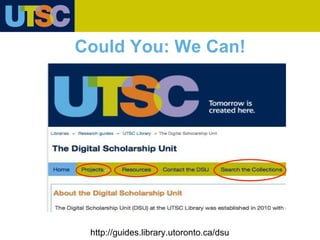
http://guides.library.utoronto.ca/dsu
Could You: We Can!
Search Our Collections
Lessons Learned: CONTENTdm
About:
•  Digital Content Management System
•  Proprietary software developed by OCLC
Advertised as:
•  “A complete solution for digital collections”
•  “Easy to use”
•  “Flexible and fully customizable”
•  “Scalable”
•  “Open, extensible and interoperable”
Lessons Learned: CONTENTdm
http://iplotz.com/
NO UNDO FUNCTION.
Could You: Lessons Learned
DOES NOT GENERATE PERSISTENT URLS!
“When an item is added to a collection in ContentDM, it is assigned an
ID which is used in the URL, i.e.
http://digitalcollections.library.gsu.edu /cdm/singleitem/collection/ajc/id/
805/. However, if, at a later point, you make a change to that item, say
updating the OCR text, adding a note to the Description field, etc - then
a new URL is created. The old URL does not redirect to the new one, it
just dead ends, ironically at an error page with a 200 HTTP request
status header! Wreaks havoc on search engines or any other system
that relies on persistent URLs, as a Linked data system *may* want to
do.”
Wed, 20 Feb 2013 22:27:06 -0500
Subject: Re: Question on CONTENTdm and Linked Data
Could You: Lessons Learned
Other issues:
•  Fill all, Fill up, and Fill down options occasionally get “glitchy”
•  Problems loading OCR files
•  Controlled vocabulary is incredibly slow to load on occaision
•  For compound objects, have to open the detailed view of a record to
enter controlled vocabulary, doesn't "pop up”
•  Table view in client side is not customizable - one size; difficult to
see images when describing them
•  No search and replace capability in client side (only admin side)
•  Editing records on the admin side is incredibly slow because you are
essentially editing them on the OCLC server
Could You: Lessons Learned
Benefits of CONTENTdm:
•  Can import tab-delimited excel spreadsheets into the
client side for quick-fill of metadata fields (i.e. box lists)
•  Export metadata easily (interoperability)
•  Easy OAI-PMH function
Could You: Lessons Learned
Proprietary CMS
vs.
Open source
Could You: Lessons Learned
Why On Earth Would You
Developing an infrastructure within our
institution:
•  Funding
•  Support
•  Culture
Mobilizing special collections at UTSC to
enhance visibility and assisting in the
preservation of faculty and student research.
Why On Earth Would You
Building the capacity for implementing
digitization workflows is expensive, but the
opportunity for outreach is enormous.
We Are… But Why Would You?
Questions?

AAO 2013-05-31 Conference Presentation - Allain, Babcock, Rousseau

  • 1.
    Creating a DigitalScholarship Unit at the University of Toronto Scarborough Sara Allain, Librarian sallain@utsc.utoronto.ca (@archivalistic) Kelli Babcock, Special Projects Librarian kbabcock@utsc.utoronto.ca (@kelllib) Paulina Rousseau, Digital Scholarship Librarian prousseau@utsc.utoronto.ca May 31, 2013
  • 2.
    Presentation Overview Should you? Couldyou? Why on earth would you?
  • 3.
    Should You? Image byKelli Babcock
  • 4.
    Should You? Response touser needs Strategic planning Broader trends within academia
  • 5.
    Digital Humanities "An areaof research, teaching, and creation concerned with the intersection of computing and the disciplines of the humanities. Developing from the field of humanities computing, digital humanities embraces a variety of topics ranging from curating online collections to data mining large cultural data sets.Digital Humanities currently incorporates both digitized and born-digital materials and combines the methodologies from the traditional humanities disciplines as well as social sciences, with tools provided by computing (such as data visualisation, info retrieval, data mining, statistics, and text mining) and digital publishing" ~ Wikipedia
  • 6.
  • 7.
  • 8.
    Could You: StrategicPlanning Accelerate & enhance research Enrich pedagogical platforms Create & mobilize unique scholarly collections
  • 9.
    To create, preserveand provide access to digital collections that will inspire and facilitate research and knowledge creation for the purposes of teaching and learning. Could You: DSU Mission
  • 10.
    Projects created andmaintained by the DSU will, where possible: Be accessible as a public good Be sustainable Provide for interoperability Facilitate collaboration amongst scholars at U of T Scarborough and beyond Support experimentation Could You: Core Values
  • 11.
  • 12.
    The DSU Team PAULINAROUSSEAU DIGITAL SCHOLARSHIP LIBRARIAN PATRICIA LACIVITA DSU COORDINATOR ELIZABETH O’BRIEN PROJECT INITIATOR SARA ALLAIN SPECIAL PROJECTS LIBRARIAN SARAH FORBES SCHOLARLY COMMUNICATIONS LIBRARIAN KELLI BABCOCK SPECIAL PROJECTS LIBRARIAN
  • 13.
    The DSU Team PAMMANN METADATA ASSISTANT AMAZING WORK-STUDY STUDENTS!
  • 14.
    Other Projects inthe DSU... http://www.bioline.org.br https://tspace.library.utoronto.ca/
  • 15.
    Could You: Selectinga Content Management System • OCLC proprietary software • OAIS compliant • Discoverability • Standards and interoperability • Scalability
  • 16.
    Could You: Reinventing UndergraduateEducation •  The Boyer Commission on Educating Undergraduates in the Research University •  Completed in 1998 •  Increasing stress on post-secondary system in the US •  Ensuring that undergraduates have an opportunity to participate in the process of inquiry, investigation, and discovery
  • 17.
    Could You: Benefitsfor Students George Kuh, High Impact Educational Practices •  Undergraduate Research •  Collaborative Assignments and Projects •  Service Learning/Community Based Learning L. Spiro, “Why the Digital Humanities?” http://digitalscholarship.files.wordpress.com/2011/10/dhglca-5.pdf
  • 18.
    Could You: Turning“Student Writers” into “Student Authors” “It is our experience that the closer we can bring our students to the real sources of knowledge — the ancient texts, the archaeological remains, the papyri and parchment — and the real reward of scholarship — the joy of producing a piece of work that one knows will be discovered and read with interest and pleasure by people we may never meet — the closer we can bring students to the experience of being true scholars, working beside other scholars, the more enthusiasm we find.”
  • 19.
    •  Gunda GundeManuscript Collection •  Pilot Collection: Doris McCarthy fonds •  UTSC Archives Legacy Collection •  UTSC Photographic Services Collection Could You: DSU Collections
  • 20.
    •  Collaboration withDr. Michael Gervers •  Collection of 219 manuscripts from the Stephanite Monastery, Gunda Gunde, Ethiopia •  Photographs taken by Michael Gervers and Gordon Belray on a field trip to Ethiopia •  Religious texts: biblical texts, lives of saints, royal chronicles. •  Many are highly visual, with elaborate illustrations Gunda Gunde Manuscript Collection
  • 21.
  • 22.
    UTARMS = Universityof Toronto Archives and Records Management Service Responsible for the appraisal, acquisition, preservation and use of University records of permanent value and the private records of individuals and organizations associated with the University. The DSU and UTARMS CC image courtesy of spDuchamp via Flickr (http://www.flickr.com/photos/duchamp/ 144852294/sizes/z/in/photostream/)
  • 23.
    •  Gunda GundeManuscript Collection •  Pilot Collection: Doris McCarthy fonds •  UTSC Archives Legacy Collection •  UTSC Photographic Services Collection Could You: DSU Collections
  • 24.
    Pilot Collection: DorisMcCarthy fonds The fonds contains: •  9 meters of textual records •  ~15,000 photographic items •  72 sketches, prints and posters •  5 sketchbooks •  38 artifacts •  46 architectural drawings •  800+ postcards •  160 annotated books •  36 electronic media items University of Toronto Scarborough Library, Doris McCarthy fonds, Series L: Photographs - Box 1 (File 1a).
  • 25.
    Pilot Collection: DorisMcCarthy fonds University of Toronto Scarborough Library, Doris McCarthy fonds, various items.
  • 26.
    Purpose: •  Provide accessto fragile items that would otherwise be unavailable to researchers •  Online access to researchers interested in Doris McCarthy, Canadian art, literary studies, or gender studies and allow for curriculum mapping to UTSC courses Pilot Collection: Doris McCarthy fonds University of Toronto Scarborough Library, Doris McCarthy fonds, Sub-series L.1: Photographs - Slides - Box 1 (File 33).
  • 27.
    UTSC Archives LegacyCollection The collection contains: •  16.3 meters of textual records •  ~1600 photographic items •  82 microforms •  24 audio-visual items •  74 books •  161 artifacts (architectural plans, maps, posters, ephemera) University of Toronto Scarborough Library, UTSC Archives Legacy Collection.
  • 28.
    UTSC Archives LegacyCollection University of Toronto Scarborough Library, UTSC Archives Legacy Collection, various items.
  • 29.
    Purpose: •  Promoting thehistory of UTSC •  Preserving the history of UTSC in situ •  Internal reference for Advancement & Alumni Relations, for outreach and special events such as retirement parties UTSC Archives Legacy Collection
  • 30.
    UTSC Photographic Services Collection • Currently being processed •  Transferred to the DSU in Fall 2012 •  115 binders of negatives, slides, and contact sheets •  Approximately 64,000 photographic items in the collection (slides, negatives, and photographs)
  • 31.
  • 32.
  • 33.
  • 34.
  • 35.
  • 36.
    Lessons Learned: CONTENTdm About: • Digital Content Management System •  Proprietary software developed by OCLC Advertised as: •  “A complete solution for digital collections” •  “Easy to use” •  “Flexible and fully customizable” •  “Scalable” •  “Open, extensible and interoperable”
  • 37.
  • 38.
  • 39.
    NO UNDO FUNCTION. CouldYou: Lessons Learned
  • 40.
    DOES NOT GENERATEPERSISTENT URLS! “When an item is added to a collection in ContentDM, it is assigned an ID which is used in the URL, i.e. http://digitalcollections.library.gsu.edu /cdm/singleitem/collection/ajc/id/ 805/. However, if, at a later point, you make a change to that item, say updating the OCR text, adding a note to the Description field, etc - then a new URL is created. The old URL does not redirect to the new one, it just dead ends, ironically at an error page with a 200 HTTP request status header! Wreaks havoc on search engines or any other system that relies on persistent URLs, as a Linked data system *may* want to do.” Wed, 20 Feb 2013 22:27:06 -0500 Subject: Re: Question on CONTENTdm and Linked Data Could You: Lessons Learned
  • 41.
    Other issues: •  Fillall, Fill up, and Fill down options occasionally get “glitchy” •  Problems loading OCR files •  Controlled vocabulary is incredibly slow to load on occaision •  For compound objects, have to open the detailed view of a record to enter controlled vocabulary, doesn't "pop up” •  Table view in client side is not customizable - one size; difficult to see images when describing them •  No search and replace capability in client side (only admin side) •  Editing records on the admin side is incredibly slow because you are essentially editing them on the OCLC server Could You: Lessons Learned
  • 42.
  • 43.
    Benefits of CONTENTdm: • Can import tab-delimited excel spreadsheets into the client side for quick-fill of metadata fields (i.e. box lists) •  Export metadata easily (interoperability) •  Easy OAI-PMH function Could You: Lessons Learned
  • 44.
  • 45.
    Why On EarthWould You Developing an infrastructure within our institution: •  Funding •  Support •  Culture
  • 46.
    Mobilizing special collectionsat UTSC to enhance visibility and assisting in the preservation of faculty and student research. Why On Earth Would You
  • 47.
    Building the capacityfor implementing digitization workflows is expensive, but the opportunity for outreach is enormous. We Are… But Why Would You?
  • 48.