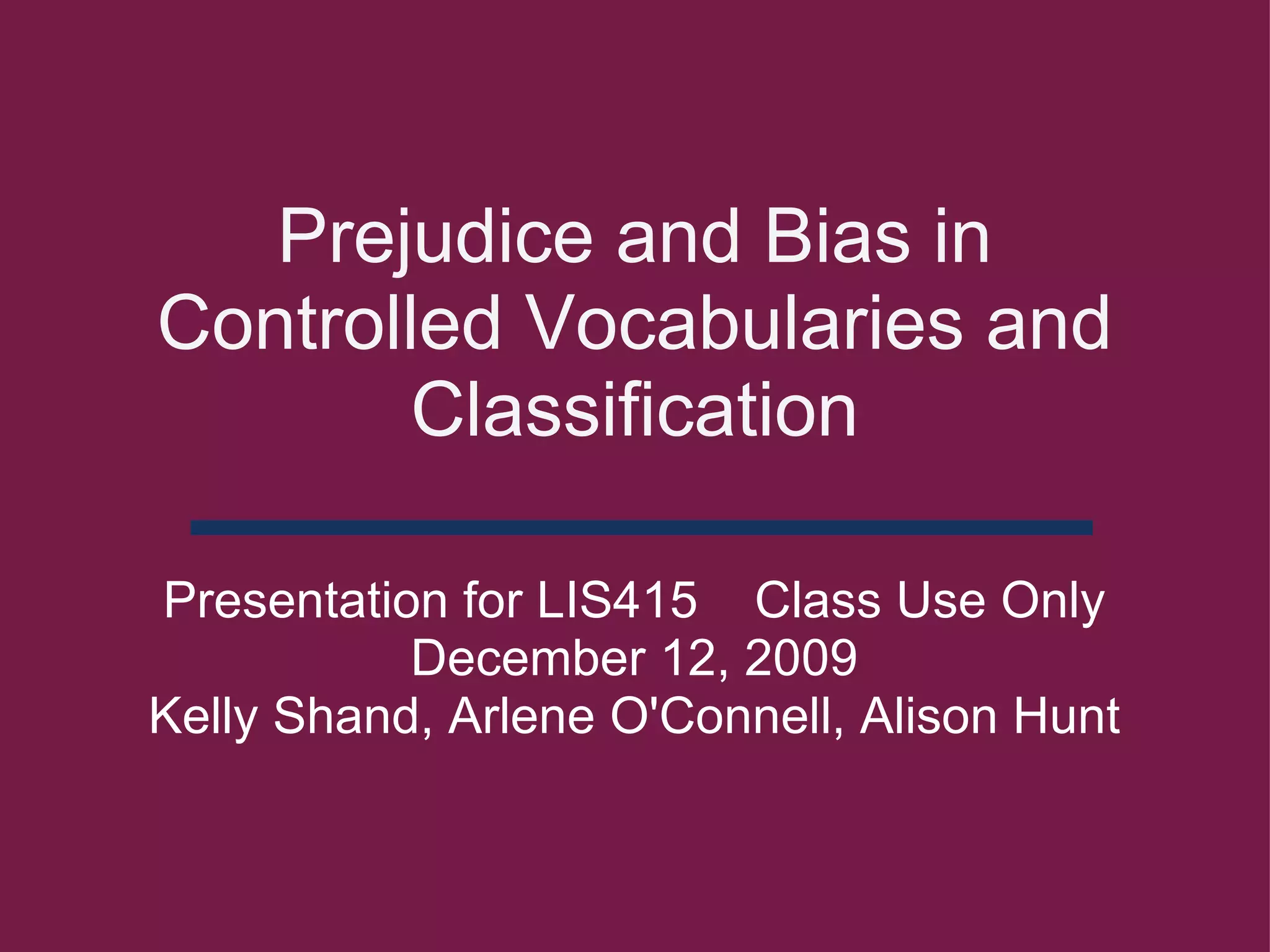
Prejudice and Bias in Controlled Vocabularies and Classification Presentation for LIS415    Class Use Only December 12, 2009 Kelly Shand, Arlene O'Connell, Alison Hunt
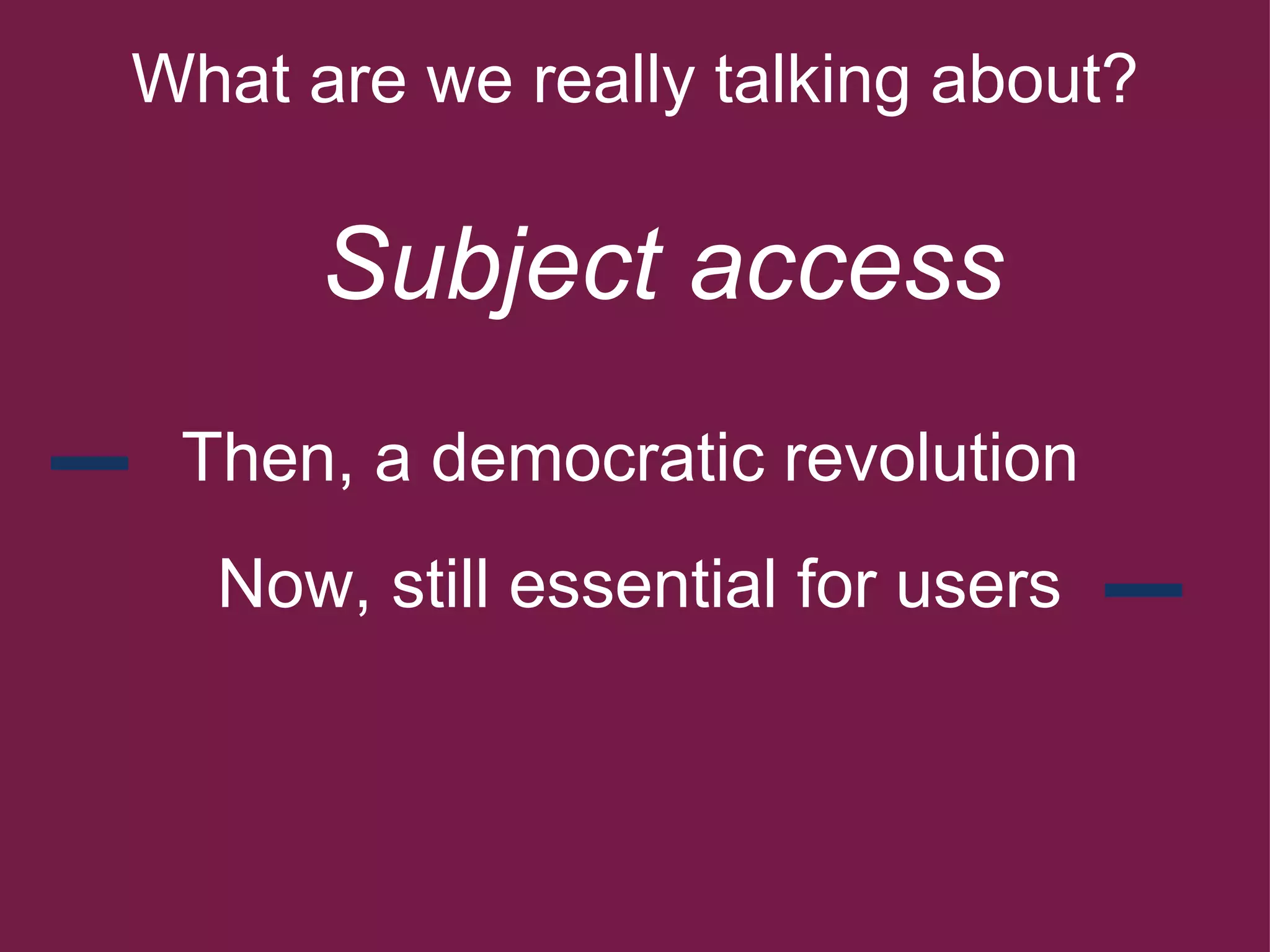
What are we really talking about?    Subject access       Then, a democratic revolution    Now, still essential for users      
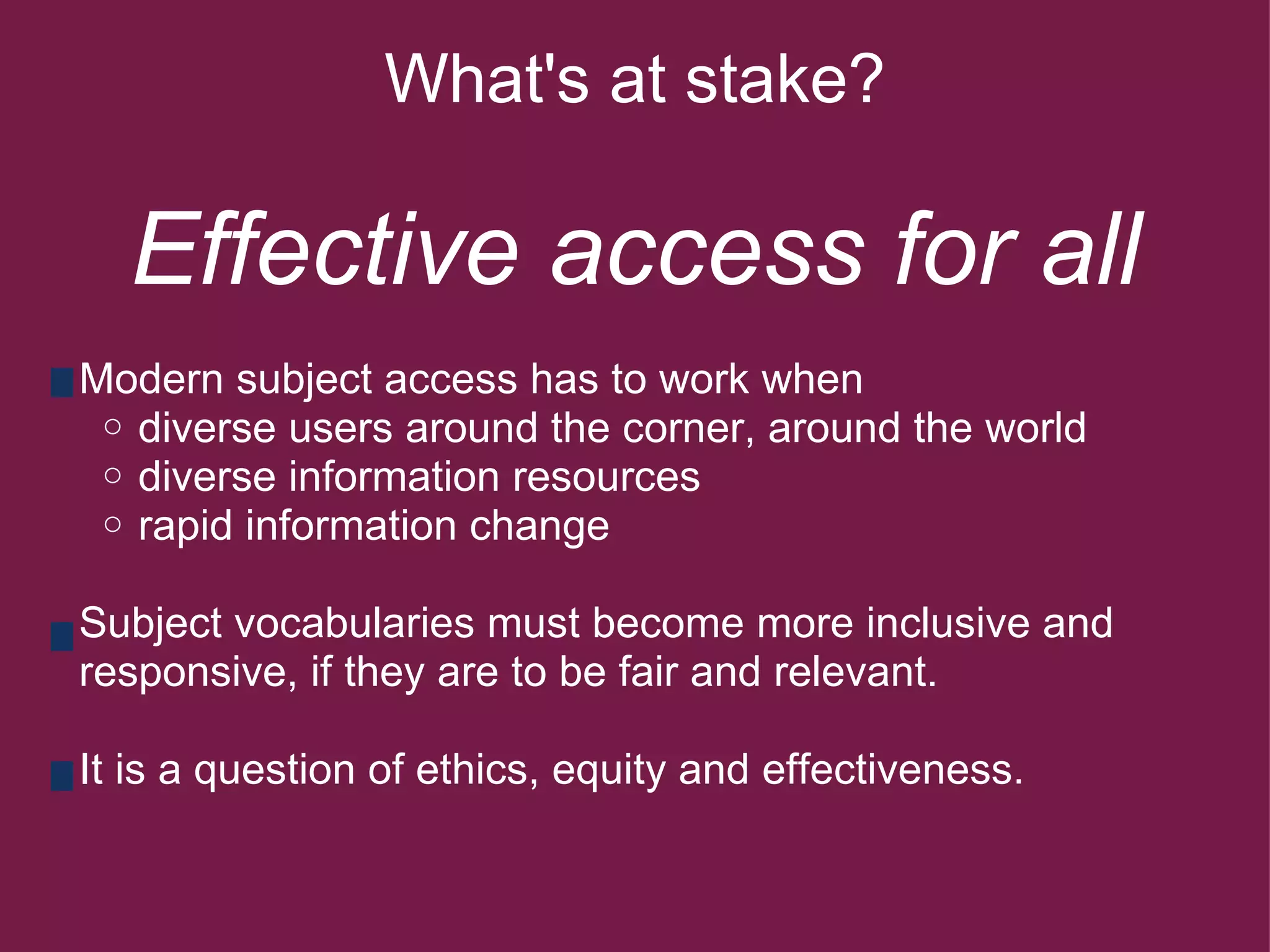
What's at stake?   Effective access for all        Modern subject access has to work when diverse users around the corner, around the world diverse information resources              rapid information change        Subject vocabularies must become more inclusive and      responsive, if they are to be fair and relevant.           It is a question of ethics, equity and effectiveness.  
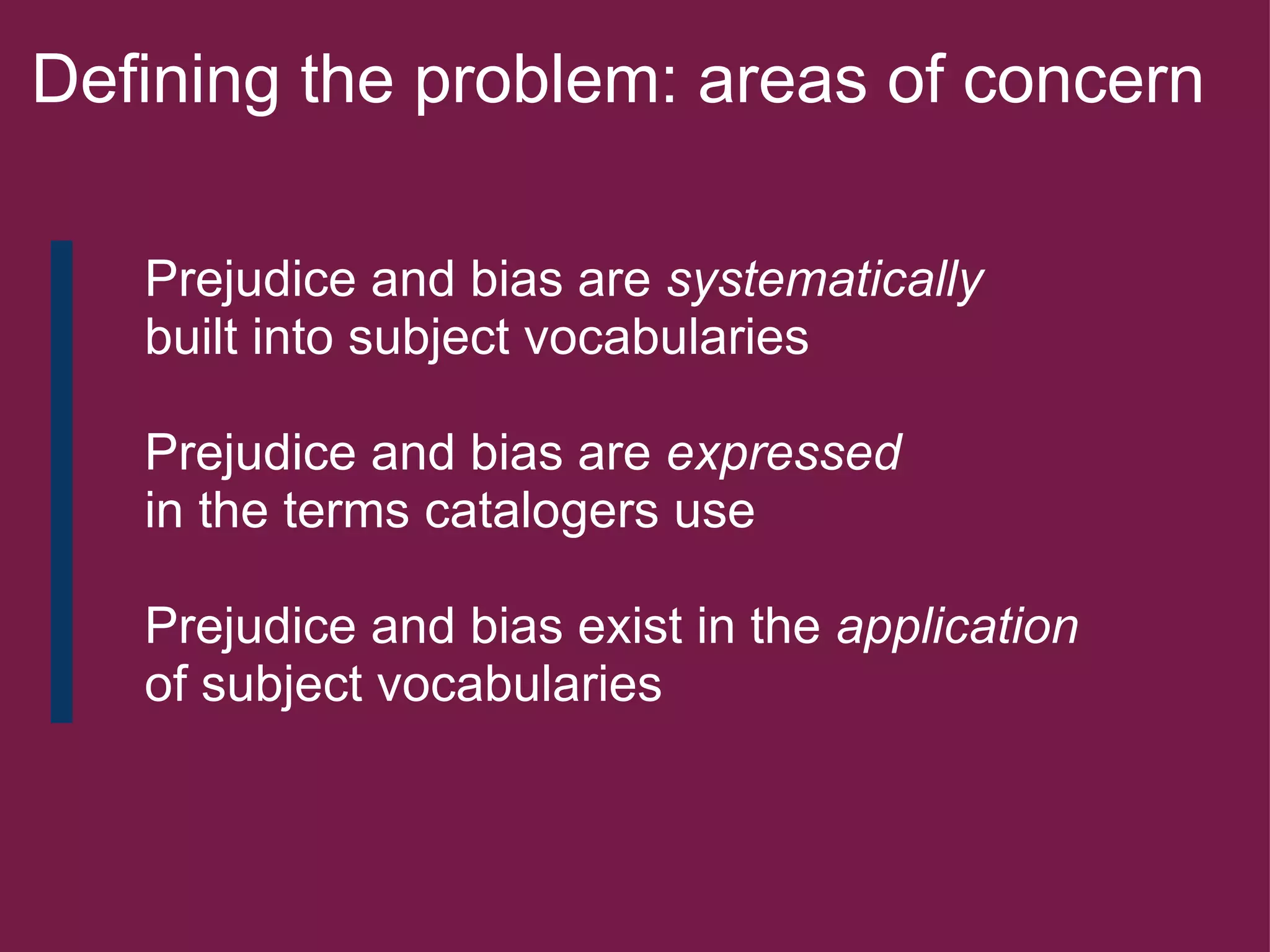
Defining the problem: areas of concern        Prejudice and bias are  systematically        built into subject vocabularies         Prejudice and bias are  expressed        in the terms catalogers use        Prejudice and bias exist in the  application        of subject vocabularies  
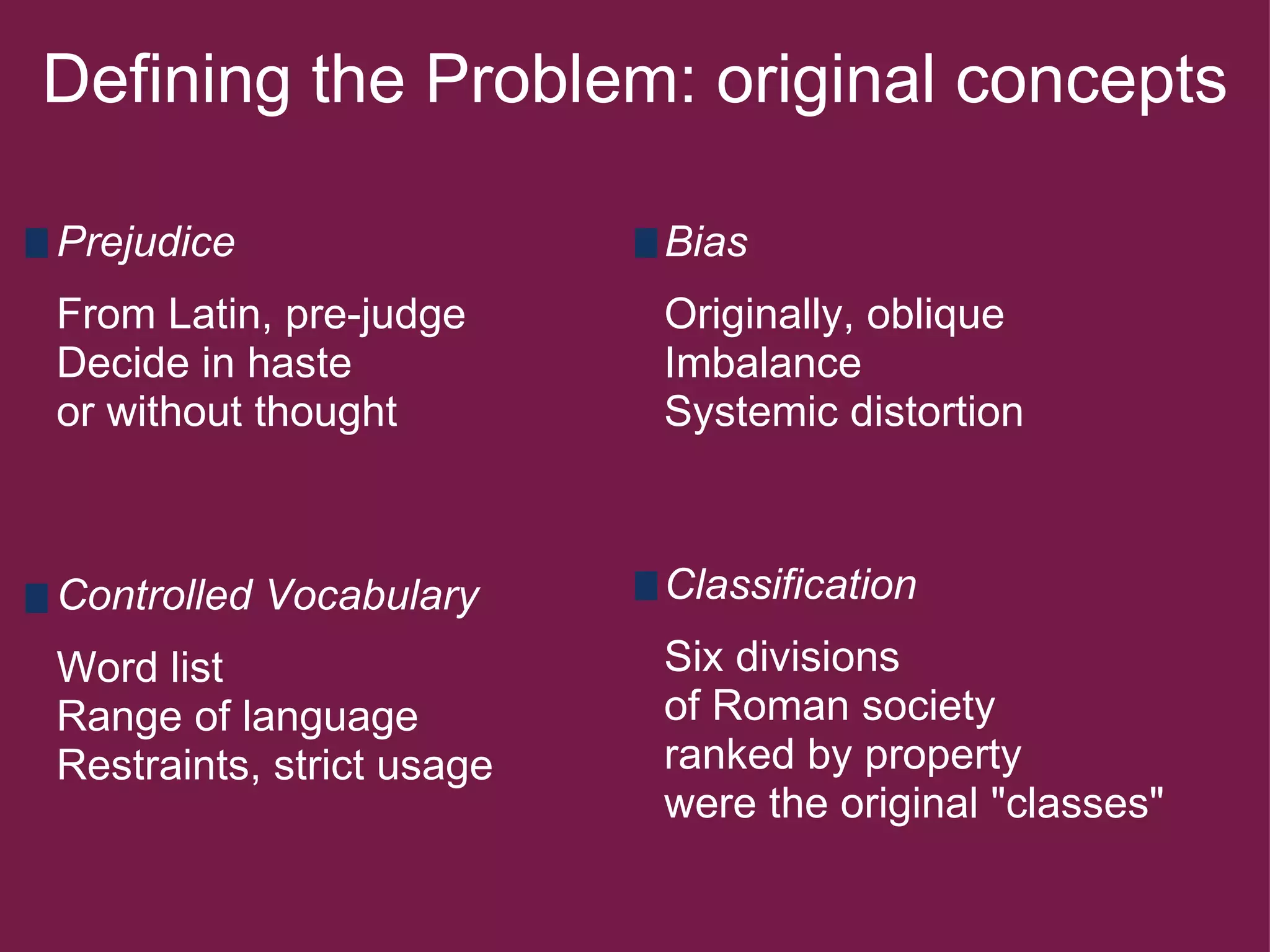
Defining the Problem: original concepts Prejudice   From Latin, pre-judge Decide in haste  or without thought   Bias   Originally, oblique Imbalance Systemic distortion   Controlled Vocabulary   Word list Range of language Restraints, strict usage Classification   Six divisions  of Roman society ranked by property were the original "classes"
Although prejudice and bias are normally considered harmful,  even hateful,   they can be  positive or negative.
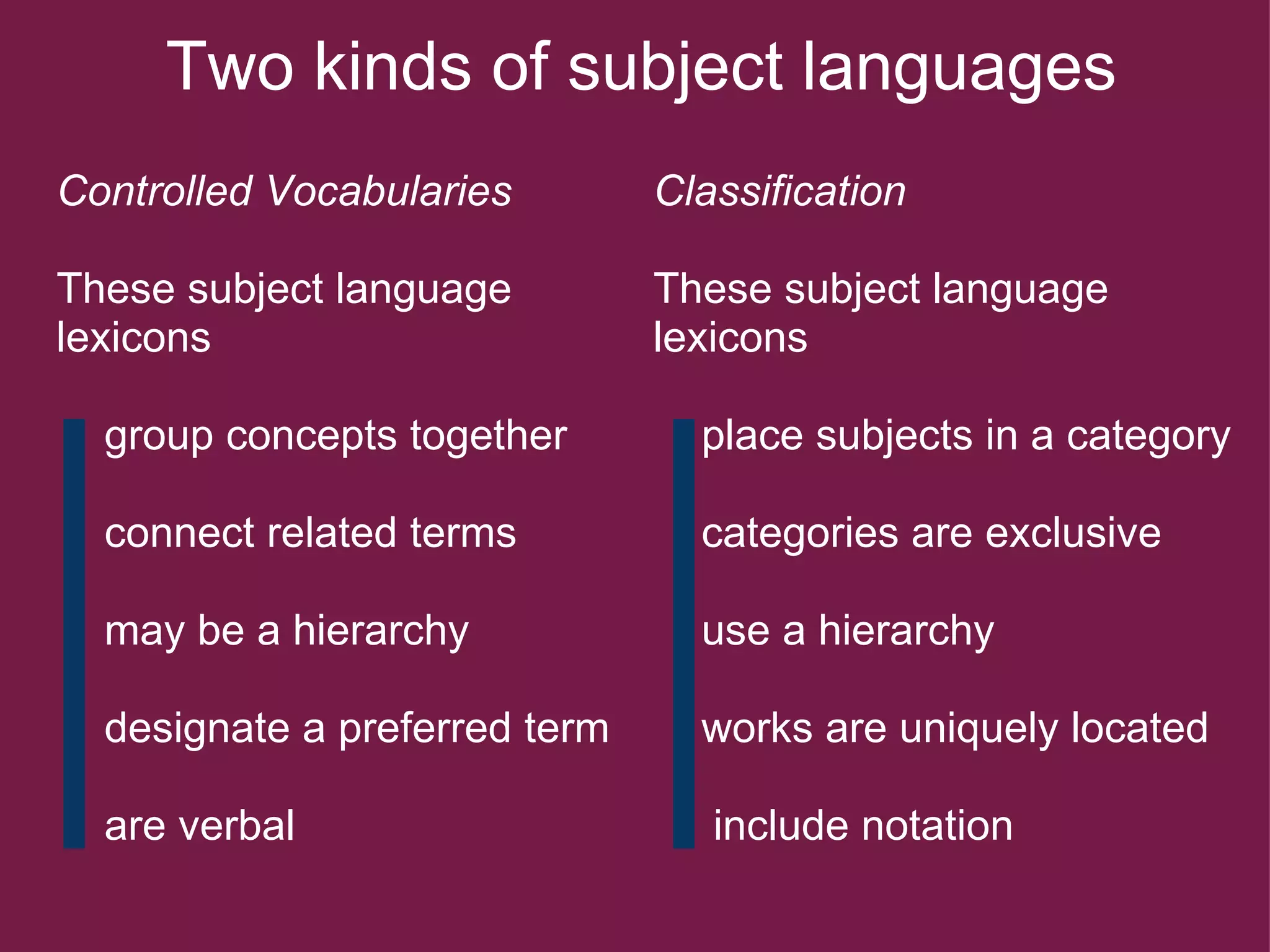
Two kinds of subject languages Controlled Vocabularies   These subject language lexicons         group concepts together        connect related terms        may be a hierarchy        designate a preferred term         are verbal        Classification   These subject language lexicons         place subjects in a category            categories are exclusive        use a hierarchy        works are uniquely located         include notation
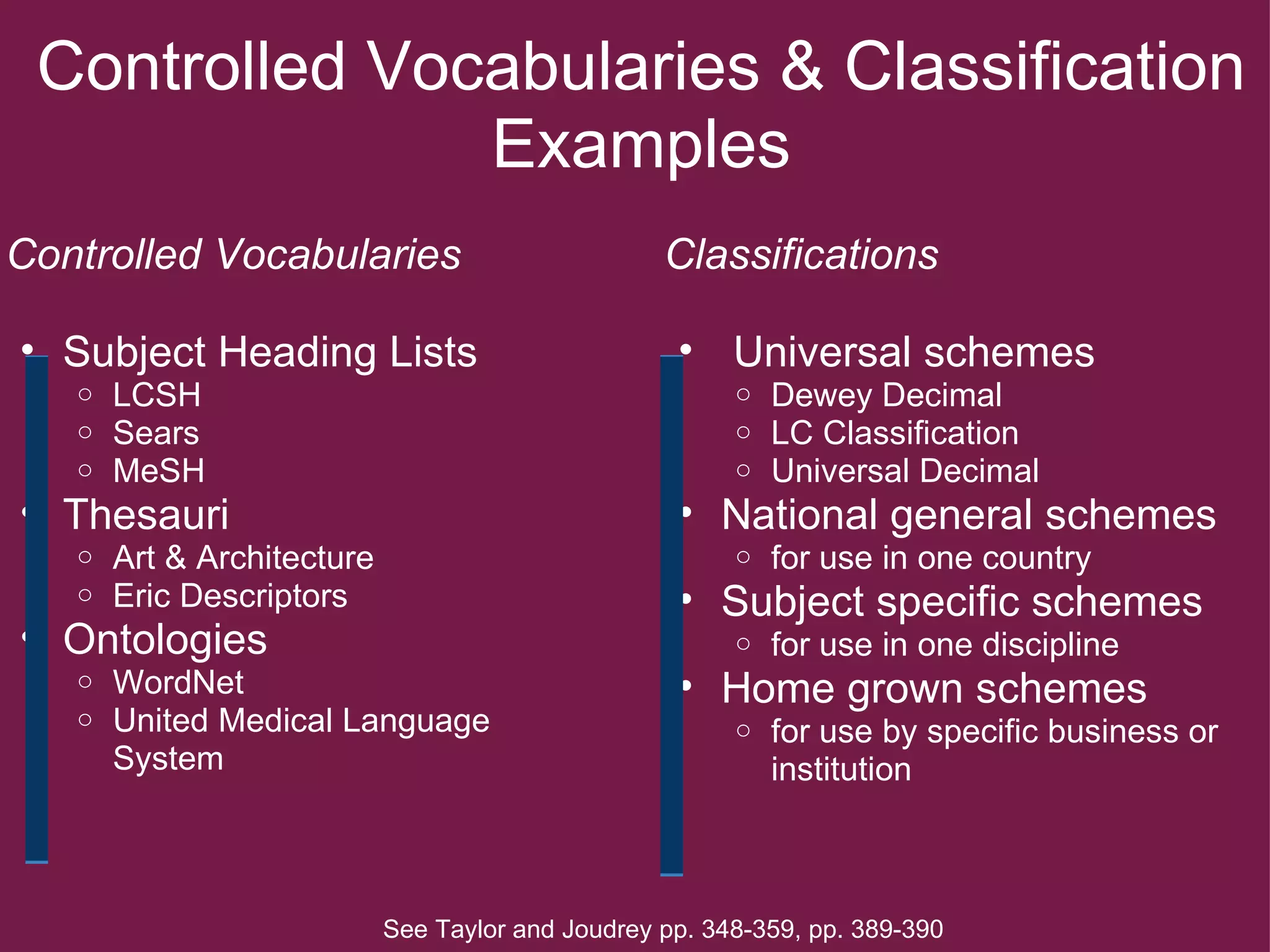
Controlled Vocabularies & Classification Examples Controlled Vocabularies   Subject Heading Lists LCSH Sears MeSH Thesauri Art & Architecture Eric Descriptors Ontologies WordNet United Medical Language System Classifications     Universal schemes Dewey Decimal LC Classification Universal Decimal National general schemes for use in one country Subject specific schemes for use in one discipline Home grown schemes for use by specific business or institution See Taylor and Joudrey pp. 348-359, pp. 389-390
  Name authority files  are controlled vocabularies  in the broadest sense.     They are usually considered separately from subject vocabularies.
Defining the problem: two perspectives   Systemic Issues   Prejudice and bias are inherent, because of basic concepts and principles such as literary warrant and "the reader as focus."  Expression Issues   The terms we choose and how we juxtapose them promote very specific worldviews...and leave other views invisible.
Prejudice and bias within the  system     Language Semantic : The meaning of the element, and of the complete statement. Syntactic : The way in which the language elements are joined together to form statements. Effective  (Pragmatic): Intended or unintended effects statements have on the recipients. Semantic rules tend to be policy matters and likely to vary among vocabularies even within one system. A concept cannot be expressed without language...this is a systemic problem .
Literary Warrant  or  Controlled Vocabulary The Guiding Principal Which Introduces Prejudice and Bias  Controlled vocabulary is a carefully selected list of words and phrases, which are used to tag units of information so that they may be more easily retrieved by a search.   Indexing and retrieval are linked; the indexing language and retrieval technique are interdependent. Effective communication requires that source and receiver understand the message in the same way.
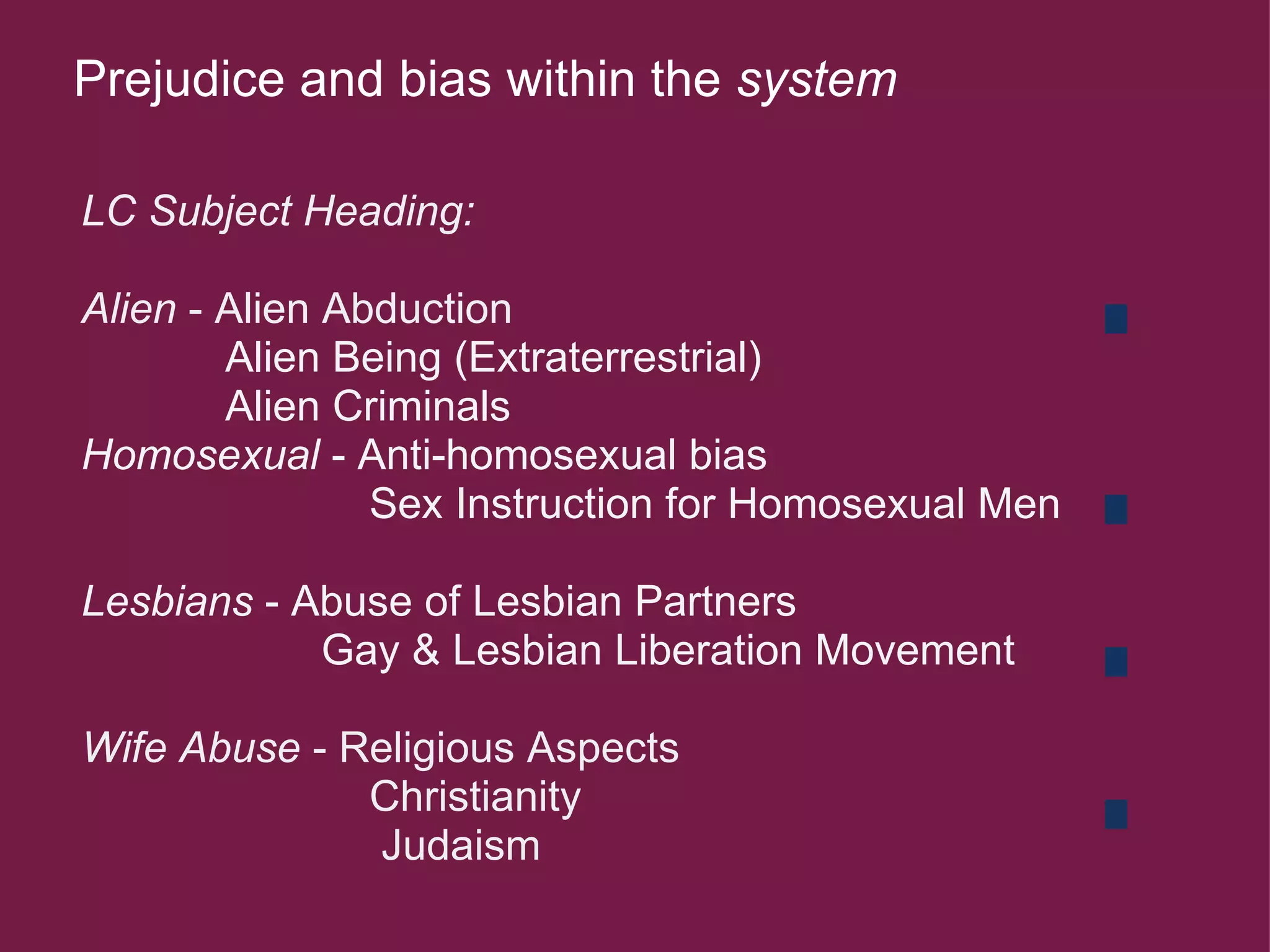
Prejudice and bias within the  system   LC Subject Heading:   Alien  - Alien Abduction               Alien Being (Extraterrestrial)              Alien Criminals   Homosexual  - Anti-homosexual bias                          Sex Instruction for Homosexual Men   Lesbians  - Abuse of Lesbian Partners                      Gay & Lesbian Liberation Movement       Wife Abuse  - Religious Aspects                          Christianity                           Judaism
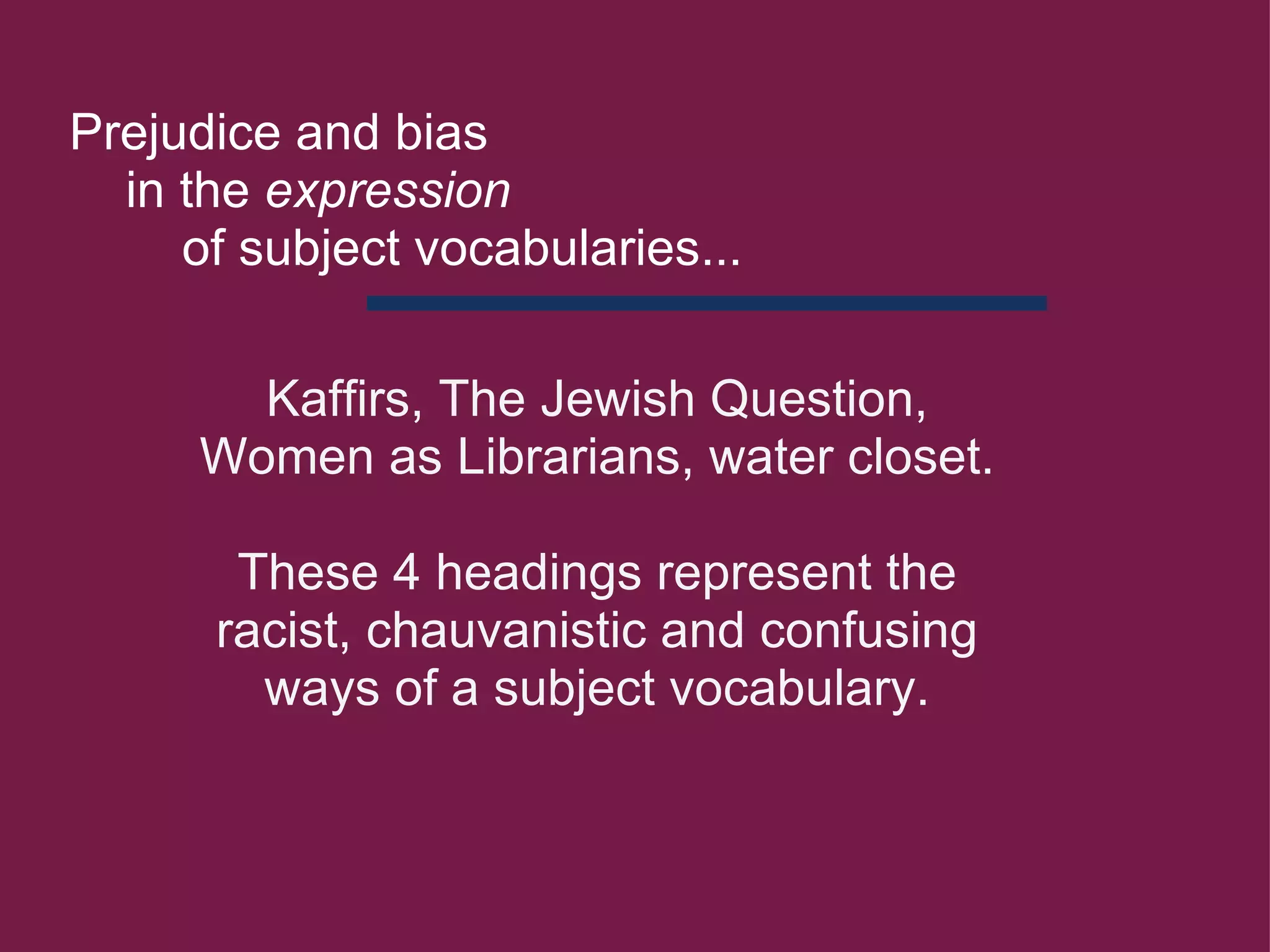
Kaffirs, The Jewish Question, Women as Librarians, water closet.          These 4 headings represent the racist, chauvanistic and confusing ways of a subject vocabulary.     Prejudice and bias       in the  expression            of subject vocabularies...
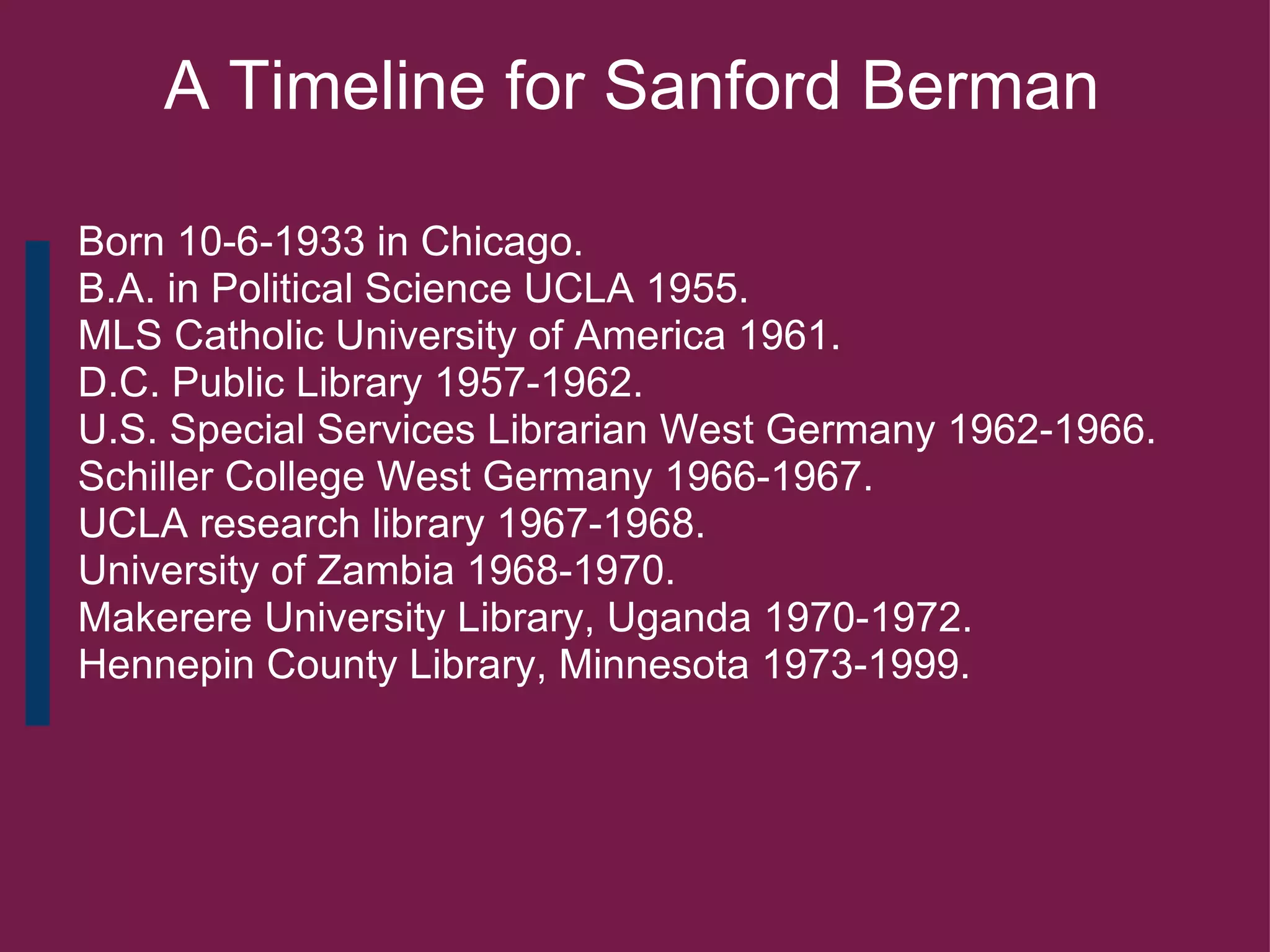
        A Timeline for Sanford Berman           Born 10-6-1933 in Chicago.     B.A. in Political Science UCLA 1955.     MLS Catholic University of America 1961.     D.C. Public Library 1957-1962.     U.S. Special Services Librarian West Germany 1962-1966.     Schiller College West Germany 1966-1967.     UCLA research library 1967-1968.     University of Zambia 1968-1970.     Makerere University Library, Uganda 1970-1972.      Hennepin County Library, Minnesota 1973-1999.    
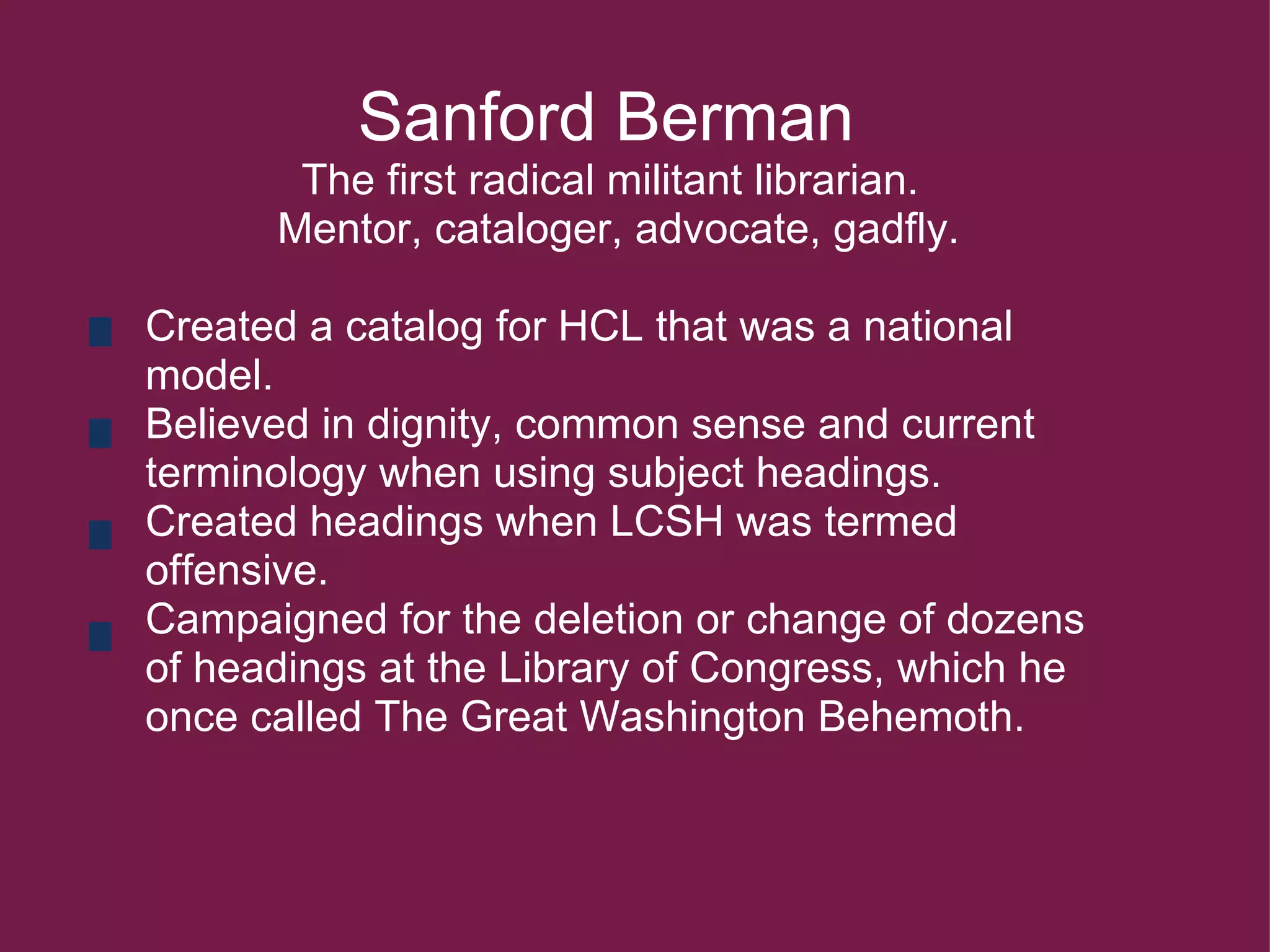
              Sanford Berman               The first radical militant librarian.               Mentor, cataloger, advocate, gadfly.   Created a catalog for HCL that was a national model. Believed in dignity, common sense and current terminology when using subject headings. Created headings when LCSH was termed offensive.   Campaigned for the deletion or change of dozens of headings at the Library of Congress, which he once called The Great Washington Behemoth.      
Yellow Peril  now refers to a comic strip in LCSH instead of Asian Communism   Hansen's Disease   is a See also in refeStreamline vocabulary revision processrring to Leprosy.  One of LC's firm stands against Berman Fossil Man  is now Fossil Hominids   or prehistoric peoples.        
               Fiction Access       The Hennepin County Library catalogers added fictional character names to records for patron access.         You could find Marple, Jane(Fictional Character) to Skywalker, Luke(Fictional character).      The HCL catalog led the way in socially relevent subject headings and ease of use for patrons.  Dignity, common sense, patron access were the components.          When the Library of Congress had problems with social issues as subject headings they went to HCL to see what they had done.
    Berman, Olson, Lawson   Berman advocated for common sense and dignity in subject cataloging.     Olson wrote that a library catalog is reflective of the values of the society that creates it. Therefore subject headings should be changed and adapted along with the society.  The catalog cannot remain static. Lawson thinks that using social tagging as an addition to official subject heading will allow     greater access. It's another way to get the books to the patrons easily.  
What can we do to make subject access more  accurate, fair and effective? Prejudice and bias       in the  application               of subject vocabularies...
      Act Locally     Think globally         
Act Locally   #1 Know the range of the vocabulary        Any vocabulary has inherent limits.        How you use a vocabulary reinforces it.            Using an inauthentic or inaccurate term reinforces it          as a guidepost for future collocation by librarians and          emphasizes it for user vocabularies.       
Act Locally   # 2 Remember: you're a player   Berman and Olson argue too many librarians have ceded subject vocabulary authority to LC.  But it is a negotiation between users, catalogers and language designers.          Petition for changes to the vocabulary   Create headings and collocate as needed   Participate in developing alternatives vocabularies.
Act Locally   # 3 Know your choices   Šauperl's study found two useful approaches        take your time where the vocabulary is weak         use multiple headings to work around       limitations and gaps         
Act Locally   # 3 Know your choices   Other strategies:        collocate relative to more current works and       more diverse collections        classify and develop subject headings at the       same time to get more ideas        consider some form of user links or tags      in the OPAC    
Think Globally  #1 Change your perspective        Go to Zambia.            Use subject access tools in unfamiliar environments            to see distortions and prejudicial assumptions.        Spend time in other disciplines.            Navigation, search and organization are fundamental          issues that have been carefully advanced in several          disciplines, including management and geography.        
Think Globally  #2  Reexamine the givens   Popular usage for ease of access..... If a concept is new or on the fringe, it is better for users to sweat a bit than to have no access or biased context.   Privileged names in authority files..... Why only one? Canada links Anglo and French equivalents.   Specific entry..... Not necessary for all users.  Sometimes people looking for poodles are happy to look for dogs.          
Think Globally  #3 Push the margins          Bridge subject and user vocabularies           Know our users better           Add social tagging data to catalogs           User tags as source for subject vocabularies           More feedback for catalogers        Streamline vocabulary revision process        Move from hierarchy to web          RDA will link to multiple vocabularies          Creation of a mega-Source Vocabulary File            
This access revolution can make subject vocabularies        less prejudiced and biased            inclusive and responsive                effective for everyone.
ONLY CONNECT Prejudice and Bias in Controlled Vocabularies and Classification   Kelly Shand, Arlene O'Connell, Alison Hunt   This presentation for LIS415    was written for class use only  
Bibliography   Battles, Matthew.   Library: an unquiet history .  New York and London: W.W. Norton & Company. 2003   Berman, Sanford.     Prejudices and Antipathies: A Tract on the LC Subject Heads Concerning People.   North Carolina and London:  McFarland & Company, Inc.     1993.   ---.  Words, Meanings, and People.   San Francisco: Inernational Society for General Semantics.  1982.   ---.  Worth Noting: Editorials, Letters, Essays, an Interview, and Bibliography.   North Carolina and London: McFarland & Company, Inc. 1988.   Cataloging Special Materials: Critiques and Innovations.  Ed. Sanford Brown. Pheonix, Arizona: The Oryx Press.  1986.   Chan, Lois Mai.  Library of Congress Subject Headings: Principles and Application.  4th ed. Westport, CT: Libraries Unlimited, 2005.   Catologing Heresy: Challenging the Standard Bibliographic Product.   Based on the Proceedings of the Congress For Librarians, February 18, 1991.  Ed. Bella Hass Weinberg.  New Jersey: Learned Information, Inc. 1992.   Everything you always wanted to know about Sandy Berman but were afraid to ask .  Ed. Chris Dodge and Jan DeSirey. North Carolina: McFarland & Company, Inc. 1995.   Lawson, Karen G.   Mining Social Tagging Data for Enhanced Subject Access for Readers and Researchers.  The Journal of Academic Librarianship vol. 35, no. 6  November 2009, p.574-582.  Elsevier Inc.  
Bibliography  cont.   Olson, Hope A .  " Difference, Culture and Change: The Untapped Potential of LCSH ." Cataloging & Classification Quarterly  29, no. 1  (2000): 53-71.  DOI 10.1300/J104v29n01_04 accessed from Simmons Library November 22, 2009.     ---.  The Power to Name Locating: The limits of subject representation in libraries.  Dordrecht, Boston: Kluwer Academic Publishers. 2002.     ---. " Thinking Professionals: Teaching Critical Cataloguing."  Technical Services Quarterly  15, no. 1 (1997): 51-66. DOI  10.1300/J124v15n01_06 accessed from Simmons Library December 8, 2009.    Olson, Hope A., and John J. Boll.   Subject Analysis in Online Catalogs.   Second Edition.  Englewood, CO: Libraries Unlimited. 2001.   Šauperl, Alenka.  Subject Determination During the Cataloging Process . Lanham, MD: Scarecrow Press. 2002.   Svenonius, Elaine.   The Intellectual Foundation of Information Organization . Cambridge, MA: The MIT Press. 2000.   Taylor, Arlene G. and Daniel N. Joudrey.   The Organization of Information . 3rd ed. Westport, CT: Libraries Unlimited. 2009.   Theory Subject Analysis: A Sourcebook.   Ed. Chan, Lois Mai, Phyllis, A. Richmond, and Elaine Svenonius.  Littleton, CO: Libraries Unlimited, Inc. 1985.   Wright, Alex.  Glut: Mastering Information through the Ages . Ithaca, NY: Cornell University Press. 2007.    

LIS415 Class PBCVC

  • 1.
    Prejudice and Biasin Controlled Vocabularies and Classification Presentation for LIS415    Class Use Only December 12, 2009 Kelly Shand, Arlene O'Connell, Alison Hunt
  • 2.
    What are wereally talking about?   Subject access     Then, a democratic revolution    Now, still essential for users      
  • 3.
    What's at stake?  Effective access for all        Modern subject access has to work when diverse users around the corner, around the world diverse information resources              rapid information change        Subject vocabularies must become more inclusive and      responsive, if they are to be fair and relevant.           It is a question of ethics, equity and effectiveness.  
  • 4.
    Defining the problem:areas of concern        Prejudice and bias are systematically      built into subject vocabularies         Prejudice and bias are expressed      in the terms catalogers use        Prejudice and bias exist in the application      of subject vocabularies  
  • 5.
    Defining the Problem:original concepts Prejudice   From Latin, pre-judge Decide in haste or without thought Bias   Originally, oblique Imbalance Systemic distortion   Controlled Vocabulary   Word list Range of language Restraints, strict usage Classification   Six divisions of Roman society ranked by property were the original "classes"
  • 6.
    Although prejudice andbias are normally considered harmful, even hateful,   they can be positive or negative.
  • 7.
    Two kinds of subjectlanguages Controlled Vocabularies   These subject language lexicons        group concepts together        connect related terms        may be a hierarchy        designate a preferred term        are verbal        Classification   These subject language lexicons        place subjects in a category            categories are exclusive        use a hierarchy        works are uniquely located        include notation
  • 8.
    Controlled Vocabularies &Classification Examples Controlled Vocabularies   Subject Heading Lists LCSH Sears MeSH Thesauri Art & Architecture Eric Descriptors Ontologies WordNet United Medical Language System Classifications     Universal schemes Dewey Decimal LC Classification Universal Decimal National general schemes for use in one country Subject specific schemes for use in one discipline Home grown schemes for use by specific business or institution See Taylor and Joudrey pp. 348-359, pp. 389-390
  • 9.
      Name authorityfiles are controlled vocabularies in the broadest sense.     They are usually considered separately from subject vocabularies.
  • 10.
    Defining the problem:two perspectives   Systemic Issues   Prejudice and bias are inherent, because of basic concepts and principles such as literary warrant and "the reader as focus." Expression Issues   The terms we choose and how we juxtapose them promote very specific worldviews...and leave other views invisible.
  • 11.
    Prejudice and biaswithin the system   Language Semantic : The meaning of the element, and of the complete statement. Syntactic : The way in which the language elements are joined together to form statements. Effective (Pragmatic): Intended or unintended effects statements have on the recipients. Semantic rules tend to be policy matters and likely to vary among vocabularies even within one system. A concept cannot be expressed without language...this is a systemic problem .
  • 12.
    Literary Warrant or Controlled Vocabulary The Guiding Principal Which Introduces Prejudice and Bias Controlled vocabulary is a carefully selected list of words and phrases, which are used to tag units of information so that they may be more easily retrieved by a search.   Indexing and retrieval are linked; the indexing language and retrieval technique are interdependent. Effective communication requires that source and receiver understand the message in the same way.
  • 13.
    Prejudice and biaswithin the system LC Subject Heading:   Alien - Alien Abduction             Alien Being (Extraterrestrial)             Alien Criminals Homosexual - Anti-homosexual bias                         Sex Instruction for Homosexual Men   Lesbians - Abuse of Lesbian Partners                     Gay & Lesbian Liberation Movement     Wife Abuse - Religious Aspects                         Christianity                          Judaism
  • 14.
    Kaffirs, The JewishQuestion, Women as Librarians, water closet.          These 4 headings represent the racist, chauvanistic and confusing ways of a subject vocabulary.     Prejudice and bias      in the  expression          of subject vocabularies...
  • 15.
           A Timeline for Sanford Berman          Born 10-6-1933 in Chicago.     B.A. in Political Science UCLA 1955.     MLS Catholic University of America 1961.     D.C. Public Library 1957-1962.     U.S. Special Services Librarian West Germany 1962-1966.     Schiller College West Germany 1966-1967.     UCLA research library 1967-1968.     University of Zambia 1968-1970.     Makerere University Library, Uganda 1970-1972.     Hennepin County Library, Minnesota 1973-1999.    
  • 16.
                Sanford Berman              The first radical militant librarian.              Mentor, cataloger, advocate, gadfly.   Created a catalog for HCL that was a national model. Believed in dignity, common sense and current terminology when using subject headings. Created headings when LCSH was termed offensive.   Campaigned for the deletion or change of dozens of headings at the Library of Congress, which he once called The Great Washington Behemoth.      
  • 17.
    Yellow Peril  nowrefers to a comic strip in LCSH instead of Asian Communism   Hansen's Disease is a See also in refeStreamline vocabulary revision processrring to Leprosy.  One of LC's firm stands against Berman Fossil Man is now Fossil Hominids or prehistoric peoples.        
  • 18.
                  Fiction Access       The Hennepin County Library catalogers added fictional character names to records for patron access.         You could find Marple, Jane(Fictional Character) to Skywalker, Luke(Fictional character).     The HCL catalog led the way in socially relevent subject headings and ease of use for patrons.  Dignity, common sense, patron access were the components.         When the Library of Congress had problems with social issues as subject headings they went to HCL to see what they had done.
  • 19.
       Berman,Olson, Lawson   Berman advocated for common sense and dignity in subject cataloging.     Olson wrote that a library catalog is reflective of the values of the society that creates it. Therefore subject headings should be changed and adapted along with the society.  The catalog cannot remain static. Lawson thinks that using social tagging as an addition to official subject heading will allow     greater access. It's another way to get the books to the patrons easily.  
  • 20.
    What can wedo to make subject access more accurate, fair and effective? Prejudice and bias      in the application               of subject vocabularies...
  • 21.
         Act Locally     Think globally         
  • 22.
    Act Locally #1 Know the range of the vocabulary        Any vocabulary has inherent limits.        How you use a vocabulary reinforces it.            Using an inauthentic or inaccurate term reinforces it          as a guidepost for future collocation by librarians and          emphasizes it for user vocabularies.       
  • 23.
    Act Locally # 2 Remember: you're a player   Berman and Olson argue too many librarians have ceded subject vocabulary authority to LC.  But it is a negotiation between users, catalogers and language designers.          Petition for changes to the vocabulary   Create headings and collocate as needed   Participate in developing alternatives vocabularies.
  • 24.
    Act Locally # 3 Know your choices   Šauperl's study found two useful approaches        take your time where the vocabulary is weak         use multiple headings to work around      limitations and gaps         
  • 25.
    Act Locally # 3 Know your choices   Other strategies:        collocate relative to more current works and      more diverse collections        classify and develop subject headings at the      same time to get more ideas        consider some form of user links or tags      in the OPAC    
  • 26.
    Think Globally #1 Change your perspective        Go to Zambia.           Use subject access tools in unfamiliar environments          to see distortions and prejudicial assumptions.        Spend time in other disciplines.           Navigation, search and organization are fundamental          issues that have been carefully advanced in several          disciplines, including management and geography.        
  • 27.
    Think Globally #2  Reexamine the givens   Popular usage for ease of access..... If a concept is new or on the fringe, it is better for users to sweat a bit than to have no access or biased context.   Privileged names in authority files..... Why only one? Canada links Anglo and French equivalents.   Specific entry..... Not necessary for all users.  Sometimes people looking for poodles are happy to look for dogs.          
  • 28.
    Think Globally #3 Push the margins          Bridge subject and user vocabularies           Know our users better           Add social tagging data to catalogs           User tags as source for subject vocabularies           More feedback for catalogers        Streamline vocabulary revision process        Move from hierarchy to web          RDA will link to multiple vocabularies          Creation of a mega-Source Vocabulary File            
  • 29.
    This access revolutioncan make subject vocabularies        less prejudiced and biased            inclusive and responsive                effective for everyone.
  • 30.
    ONLY CONNECT Prejudiceand Bias in Controlled Vocabularies and Classification   Kelly Shand, Arlene O'Connell, Alison Hunt   This presentation for LIS415    was written for class use only  
  • 31.
    Bibliography   Battles,Matthew.  Library: an unquiet history .  New York and London: W.W. Norton & Company. 2003   Berman, Sanford.    Prejudices and Antipathies: A Tract on the LC Subject Heads Concerning People.   North Carolina and London:  McFarland & Company, Inc.     1993.   ---. Words, Meanings, and People.   San Francisco: Inernational Society for General Semantics.  1982.   ---. Worth Noting: Editorials, Letters, Essays, an Interview, and Bibliography.   North Carolina and London: McFarland & Company, Inc. 1988.   Cataloging Special Materials: Critiques and Innovations. Ed. Sanford Brown. Pheonix, Arizona: The Oryx Press.  1986.   Chan, Lois Mai. Library of Congress Subject Headings: Principles and Application. 4th ed. Westport, CT: Libraries Unlimited, 2005.   Catologing Heresy: Challenging the Standard Bibliographic Product.  Based on the Proceedings of the Congress For Librarians, February 18, 1991.  Ed. Bella Hass Weinberg.  New Jersey: Learned Information, Inc. 1992.   Everything you always wanted to know about Sandy Berman but were afraid to ask .  Ed. Chris Dodge and Jan DeSirey. North Carolina: McFarland & Company, Inc. 1995.   Lawson, Karen G.  Mining Social Tagging Data for Enhanced Subject Access for Readers and Researchers. The Journal of Academic Librarianship vol. 35, no. 6  November 2009, p.574-582.  Elsevier Inc.  
  • 32.
    Bibliography cont.  Olson, Hope A .  " Difference, Culture and Change: The Untapped Potential of LCSH ." Cataloging & Classification Quarterly 29, no. 1  (2000): 53-71.  DOI 10.1300/J104v29n01_04 accessed from Simmons Library November 22, 2009.     ---. The Power to Name Locating: The limits of subject representation in libraries. Dordrecht, Boston: Kluwer Academic Publishers. 2002.     ---. " Thinking Professionals: Teaching Critical Cataloguing." Technical Services Quarterly 15, no. 1 (1997): 51-66. DOI 10.1300/J124v15n01_06 accessed from Simmons Library December 8, 2009.    Olson, Hope A., and John J. Boll.  Subject Analysis in Online Catalogs.   Second Edition.  Englewood, CO: Libraries Unlimited. 2001.   Šauperl, Alenka. Subject Determination During the Cataloging Process . Lanham, MD: Scarecrow Press. 2002.   Svenonius, Elaine.  The Intellectual Foundation of Information Organization . Cambridge, MA: The MIT Press. 2000.   Taylor, Arlene G. and Daniel N. Joudrey.  The Organization of Information . 3rd ed. Westport, CT: Libraries Unlimited. 2009.   Theory Subject Analysis: A Sourcebook.  Ed. Chan, Lois Mai, Phyllis, A. Richmond, and Elaine Svenonius.  Littleton, CO: Libraries Unlimited, Inc. 1985.   Wright, Alex. Glut: Mastering Information through the Ages . Ithaca, NY: Cornell University Press. 2007.