DIGITAL PUBLIC LIBRARY of
        AMERICA

    Maine Shared Collections
            Strategy
       February 24, 2012
DPLA
   Knowledge is the common property
    of mankind.

   He who receives an idea from me,
    receives instruction himself without
    lessening mine; as he who lights
    his taper at mine, receives light
    without darkening me.

               • Thomas Jefferson
DPLA

       The art of printing…diffuses
       so general a light…that all
       the window shutters
       despotism and priestcraft
       can oppose to keep it out,
       prove insufficient.
                     Benjamin Franklin
DPLA
COPYRIGHT NOTICE attached to recent electronic edition:

Copy: No text selections can be copied from
the book to the clipboard….
Lend: This book cannot be lent to someone else.
Give: This book cannot be given to someone else.
Read aloud: This book cannot be read aloud.


--taken from Lewis Hyde, Common as Air: Revolution, Art, and Ownership, FSG 2010

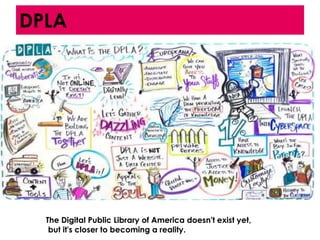
Previous quotes from NYRBlog by Robert Darnton 10/4/10—based on a talk given at the
opening of an off-the-record conference at Harvard on Oct 1, 2010 to discuss the
possibility of creating a National Digital Library.
DPLA a comprehensive library of digitized works that will
be easily accessible to the general public.

DIGITAL PUBLIC LIBRARY OF AMERICA
• large-scale digital public library
 that will make the cultural and
 scientific record available to all.
•      a ‘distributed system,’….it won’t be
    one big database, but a system of
    linked databases scattered all over
    the United States in a way to make
    them perfectly compatible….
DPLA
The Digital Public Library of America, an
  organization dedicated to building a
  large-scale digital public library that
  will make the cultural and scientific
  record available to all.
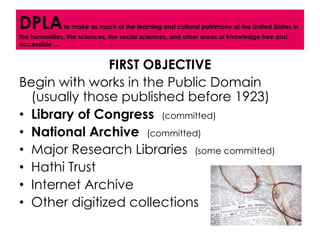
DPLA          to make as much of the learning and cultural patrimony of the United States in
the humanities, the sciences, the social sciences, and other areas of knowledge free and
accessible …


               FIRST OBJECTIVE
Begin with works in the Public Domain
  (usually those published before 1923)
• Library of Congress (committed)
• National Archive (committed)
• Major Research Libraries (some committed)
• Hathi Trust
• Internet Archive
• Other digitized collections
DPLA       Collections Suggested as Possible Candidates for Inclusion in a
                  Digital Public Library of America

                 Already digitized

Amazon
                               National Digital Newspaper program
ARTStor
                               NYPL Digital Gallery
Cursor books
                               Opening History (UIUC)
Europeana and/or non‐U.S.
                               Overdrive
public domain collections
                               Oxford University Press
Flickr Commons
                               Project Gutenberg (other public domain
Google Book Search
                               e‐book sites)
Hathi Trust
                               Public Library of Science (PLoS)
Humanities e‐book project
                               Smithsonian commons
Internet Archive
                               State digital libraries (Texas, California,
JSTOR
                               North Carolina, Massachusetts)
MIT Press (university
                               State Historical Societies
presses)
                               University Press e‐book consortium
Mountain West Digital
Library
DPLA   Collections Suggested as Possible Candidates for Inclusion in a Digital Public
                            Library of America


           Content digitized with federal funding

                      a. Cultural organizations
                       • Library of Congress
                         • National Archives
                      • Smithsonian Institution
                  b. Grant making agencies
         • Institute of Museum and Library Services
         • National Endowment for the Humanities
               • National Science Federation
DPLA
             SECOND OBJECTIVE
The next objective of DPLA is to digitize
  the vast bulk of cultural works that are
  still in copyright — but long out of print.
DPLA

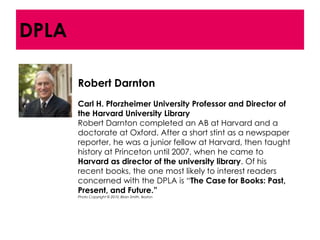
       Robert Darnton
       Carl H. Pforzheimer University Professor and Director of
       the Harvard University Library
       Robert Darnton completed an AB at Harvard and a
       doctorate at Oxford. After a short stint as a newspaper
       reporter, he was a junior fellow at Harvard, then taught
       history at Princeton until 2007, when he came to
       Harvard as director of the university library. Of his
       recent books, the one most likely to interest readers
       concerned with the DPLA is ―The Case for Books: Past,
       Present, and Future.”
       Photo Copyright © 2010, Brian Smith, Boston
DPLA
                                   STEERING COMMITTEE
•   Paul Courant Harold T. Shapiro Professor of Public Policy and Dean of Libraries at the University of
    Michigan
•   Robert Darnton Carl H. Pforzheimer University Professor and Director of the Harvard University
    Library
•   Carla Hayden Chief Executive Officer of the Enoch Pratt Free Library (Baltimore, Maryland)
•   Charles Henry President of the Council on Library and Information Resources (CLIR)
•   Luis Herrera City Librarian for the City and County of San Francisco
•   Susan Hildreth Director of the Institute for Museum and Library Services
•   Brewster Kahle Founder of the Internet Archive
•   Michael A. Keller Ida M. Green University Librarian, Director of Academic Information Resources
    at Stanford University
•   Carl Malamud President, Public.Resource.Org
•   Deanna Marcum Associate Librarian for Library Services at the Library of Congress
•   Maura Marx Director, DPLA Secretariat; Berkman Center Fellow; Executive Director, Open
    Knowledge Commons
•   Jerome McGann John Stewart Bryan University Professor at the University of Virginia
•   Dwight McInvaill Director of the Georgetown County Library (South Carolina)
•   John Palfrey (Chair) Faculty Co-Director at the Berkman Center; Henry N. Ess III Professor of Law
    and Vice Dean of Library and Information Resources at Harvard Law School
•   Peggy Rudd Director and Librarian of the Texas State Library and Archives Commission
•   Amy E. Ryan President of the Boston Public Library
•   Doron Weber (Vice Chair) Vice President, Programs at the Alfred P. Sloan Foundation
DPLA
                  FUNDING
The Sloan Foundation and Arcadia Fund
  $5 million in funding for an intense two-
  year grassroots process to build a
  realistic and detailed workplan for a
  national digital library
ELEMENTS OF THE DPLA
Code
Code is the technical backbone of the
 DPLA. Where possible, the DPLA will
 make use of existing free and open
 source code; all new code funded by
 the DPLA will be free and open source.
ELEMENTS OF DPLA
Metadata
Metadata is a key part of the DPLA
 discovery framework; it describes
 content and resources in the DPLA,
 enables users to find them, and
 connects US holdings to holdings in
 other countries.
ELEMENTS OF DPLA
Content
The DPLA will
• incorporate all media types and formats
• begin with works in the public domain that
  have already been digitized and are
  accessible through other initiatives.
• Further material will be added incrementally
  starting with orphan works and materials that
  are in copyright but out-of-print.
• The DPLA will also explore models for digital
  lending of in-copyright materials.
ELEMENTS OF DPLA
Tools and Services
The DPLA will provide a number of tools and
  services designed to provide enhanced use of
  content. There will also be tools to facilitate
  digitization of and broad public access to
  content. The DPLA platform will be generative
  and open to public innovation to facilitate
  new discovery, encourage new kinds of
  questions, and enable the creation of new
  tools and services, including social sharing
  and networking services, research tools, and
  as-yet unforeseen applications.
ELEMENTS OF DPLA
Community
The DPLA will be designed as a
  participatory platform that facilitates the
  involvement of the public in all aspects of
  its design, development, deployment,
  maintenance, and support. The DPLA will
  actively support the community of users
  and developers that want to reuse and
  extend its content, data, and metadata.
WORKSTREAM (Committees) – DPLA
The Audience & Participation
  workstream will collaborate with each
  of the other workstreams to ensure that
  the DPLA effort considers, anticipates,
  and incorporates, to the extent
  possible, the current and future needs
  of the broadest possible user group.
WORKSTREAM – DPLA
The Content & Scope workstream
will identify a collection development policy by
   confronting questions regarding management of and
   access to distributed materials, research, and data
   curation.
will collect data concerning how many books and other
   materials exist in US libraries and their copyright status,
   and conduct analyses of already-digitized collections
   in the US and abroad.
will also work with the Technical Aspects workstream to
   recommend guidelines on bibliographic data,
   metadata, interoperability, and international
   cooperation.
WORKSTREAM – DPLA
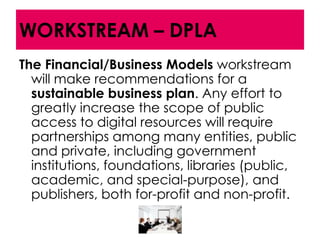
The Financial/Business Models workstream
  will make recommendations for a
  sustainable business plan. Any effort to
  greatly increase the scope of public
  access to digital resources will require
  partnerships among many entities, public
  and private, including government
  institutions, foundations, libraries (public,
  academic, and special-purpose), and
  publishers, both for-profit and non-profit.
WORKSTREAM -- DPLA
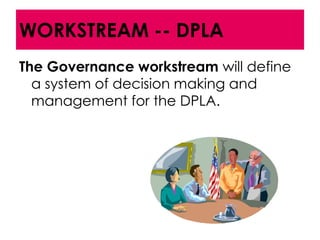
The Governance workstream will define
  a system of decision making and
  management for the DPLA.
WORKSTREAM -- DPLA
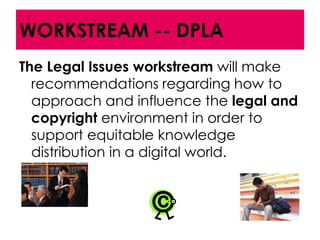
The Legal Issues workstream will make
  recommendations regarding how to
  approach and influence the legal and
  copyright environment in order to
  support equitable knowledge
  distribution in a digital world.
WORKSTREAM -- DPLA
The Technical Aspects workstream will
  make decisions regarding technology
  to be used in the DPLA and will advise
  development of the DPLA prototype.
DPLA -- TIMELINE
October 2010 -- meeting at the Radcliffe
 Institute for Advanced Study
December 2010 – Sloan Foundation and
 Arcadia Fund Award
May 2011 -- Beta Sprint announced to
 seek ideas and models that
 demonstrate how to index and
 provide access to a wide range of
 broadly distributed content
TIMELINE -- DPLA
September 2011-- an independent review
  panel reviewed the beta sprint projects
October 21, 2011 – DPLA Plenary Meeting
October 21, 2011 -- association between
  the DPLA and Europeana announced
April 27, 2012 -- DPLA West
April 2013 – Some version of DPLA running
DPLA -- PRO
We believe that a significant amount of
 cultural heritage content is already
 published in digital form on the Web, but
 is largely hidden and poorly discoverable
 by the general public. In this context, we
 think that the DPLA initiative is well
 positioned to act as a catalyst to virtually
 move large amounts of this content from
 the invisible Web, to the visible and
 interoperable Web.
DPLA -- CON
What astounds me is that libraries seem to
 fail to realize that the realization of a so-
 called "National Digital Library" would
 effectively put most libraries out of
 business and most librarians out of work.
 If all US works were available online from
 one central US location, why, exactly,
 would current library patrons need their
 local library? Why would they vote to
 fund it, or contribute money or books to
 it?
DPLA -- CON
Should the Digital Public Library of
  America protect public libraries’
  franchise and branding by dropping
  the “Public” from the DPLA’s name?
  Some say, ―Most emphatically.”
DPLA


  The Digital Public Library of America doesn't exist yet,
   but it's closer to becoming a reality.

Digital Public Library of America

  • 1.
    DIGITAL PUBLIC LIBRARYof AMERICA Maine Shared Collections Strategy February 24, 2012
  • 2.
    DPLA Knowledge is the common property of mankind. He who receives an idea from me, receives instruction himself without lessening mine; as he who lights his taper at mine, receives light without darkening me. • Thomas Jefferson
  • 3.
    DPLA The art of printing…diffuses so general a light…that all the window shutters despotism and priestcraft can oppose to keep it out, prove insufficient. Benjamin Franklin
  • 4.
    DPLA COPYRIGHT NOTICE attachedto recent electronic edition: Copy: No text selections can be copied from the book to the clipboard…. Lend: This book cannot be lent to someone else. Give: This book cannot be given to someone else. Read aloud: This book cannot be read aloud. --taken from Lewis Hyde, Common as Air: Revolution, Art, and Ownership, FSG 2010 Previous quotes from NYRBlog by Robert Darnton 10/4/10—based on a talk given at the opening of an off-the-record conference at Harvard on Oct 1, 2010 to discuss the possibility of creating a National Digital Library.
  • 5.
    DPLA a comprehensivelibrary of digitized works that will be easily accessible to the general public. DIGITAL PUBLIC LIBRARY OF AMERICA • large-scale digital public library that will make the cultural and scientific record available to all. • a ‘distributed system,’….it won’t be one big database, but a system of linked databases scattered all over the United States in a way to make them perfectly compatible….
  • 6.
    DPLA The Digital PublicLibrary of America, an organization dedicated to building a large-scale digital public library that will make the cultural and scientific record available to all.
  • 7.
    DPLA to make as much of the learning and cultural patrimony of the United States in the humanities, the sciences, the social sciences, and other areas of knowledge free and accessible … FIRST OBJECTIVE Begin with works in the Public Domain (usually those published before 1923) • Library of Congress (committed) • National Archive (committed) • Major Research Libraries (some committed) • Hathi Trust • Internet Archive • Other digitized collections
  • 8.
    DPLA Collections Suggested as Possible Candidates for Inclusion in a Digital Public Library of America Already digitized Amazon National Digital Newspaper program ARTStor NYPL Digital Gallery Cursor books Opening History (UIUC) Europeana and/or non‐U.S. Overdrive public domain collections Oxford University Press Flickr Commons Project Gutenberg (other public domain Google Book Search e‐book sites) Hathi Trust Public Library of Science (PLoS) Humanities e‐book project Smithsonian commons Internet Archive State digital libraries (Texas, California, JSTOR North Carolina, Massachusetts) MIT Press (university State Historical Societies presses) University Press e‐book consortium Mountain West Digital Library
  • 9.
    DPLA Collections Suggested as Possible Candidates for Inclusion in a Digital Public Library of America Content digitized with federal funding a. Cultural organizations • Library of Congress • National Archives • Smithsonian Institution b. Grant making agencies • Institute of Museum and Library Services • National Endowment for the Humanities • National Science Federation
  • 10.
    DPLA SECOND OBJECTIVE The next objective of DPLA is to digitize the vast bulk of cultural works that are still in copyright — but long out of print.
  • 11.
    DPLA Robert Darnton Carl H. Pforzheimer University Professor and Director of the Harvard University Library Robert Darnton completed an AB at Harvard and a doctorate at Oxford. After a short stint as a newspaper reporter, he was a junior fellow at Harvard, then taught history at Princeton until 2007, when he came to Harvard as director of the university library. Of his recent books, the one most likely to interest readers concerned with the DPLA is ―The Case for Books: Past, Present, and Future.” Photo Copyright © 2010, Brian Smith, Boston
  • 12.
    DPLA STEERING COMMITTEE • Paul Courant Harold T. Shapiro Professor of Public Policy and Dean of Libraries at the University of Michigan • Robert Darnton Carl H. Pforzheimer University Professor and Director of the Harvard University Library • Carla Hayden Chief Executive Officer of the Enoch Pratt Free Library (Baltimore, Maryland) • Charles Henry President of the Council on Library and Information Resources (CLIR) • Luis Herrera City Librarian for the City and County of San Francisco • Susan Hildreth Director of the Institute for Museum and Library Services • Brewster Kahle Founder of the Internet Archive • Michael A. Keller Ida M. Green University Librarian, Director of Academic Information Resources at Stanford University • Carl Malamud President, Public.Resource.Org • Deanna Marcum Associate Librarian for Library Services at the Library of Congress • Maura Marx Director, DPLA Secretariat; Berkman Center Fellow; Executive Director, Open Knowledge Commons • Jerome McGann John Stewart Bryan University Professor at the University of Virginia • Dwight McInvaill Director of the Georgetown County Library (South Carolina) • John Palfrey (Chair) Faculty Co-Director at the Berkman Center; Henry N. Ess III Professor of Law and Vice Dean of Library and Information Resources at Harvard Law School • Peggy Rudd Director and Librarian of the Texas State Library and Archives Commission • Amy E. Ryan President of the Boston Public Library • Doron Weber (Vice Chair) Vice President, Programs at the Alfred P. Sloan Foundation
  • 13.
    DPLA FUNDING The Sloan Foundation and Arcadia Fund $5 million in funding for an intense two- year grassroots process to build a realistic and detailed workplan for a national digital library
  • 14.
    ELEMENTS OF THEDPLA Code Code is the technical backbone of the DPLA. Where possible, the DPLA will make use of existing free and open source code; all new code funded by the DPLA will be free and open source.
  • 15.
    ELEMENTS OF DPLA Metadata Metadatais a key part of the DPLA discovery framework; it describes content and resources in the DPLA, enables users to find them, and connects US holdings to holdings in other countries.
  • 16.
    ELEMENTS OF DPLA Content TheDPLA will • incorporate all media types and formats • begin with works in the public domain that have already been digitized and are accessible through other initiatives. • Further material will be added incrementally starting with orphan works and materials that are in copyright but out-of-print. • The DPLA will also explore models for digital lending of in-copyright materials.
  • 17.
    ELEMENTS OF DPLA Toolsand Services The DPLA will provide a number of tools and services designed to provide enhanced use of content. There will also be tools to facilitate digitization of and broad public access to content. The DPLA platform will be generative and open to public innovation to facilitate new discovery, encourage new kinds of questions, and enable the creation of new tools and services, including social sharing and networking services, research tools, and as-yet unforeseen applications.
  • 18.
    ELEMENTS OF DPLA Community TheDPLA will be designed as a participatory platform that facilitates the involvement of the public in all aspects of its design, development, deployment, maintenance, and support. The DPLA will actively support the community of users and developers that want to reuse and extend its content, data, and metadata.
  • 19.
    WORKSTREAM (Committees) –DPLA The Audience & Participation workstream will collaborate with each of the other workstreams to ensure that the DPLA effort considers, anticipates, and incorporates, to the extent possible, the current and future needs of the broadest possible user group.
  • 20.
    WORKSTREAM – DPLA TheContent & Scope workstream will identify a collection development policy by confronting questions regarding management of and access to distributed materials, research, and data curation. will collect data concerning how many books and other materials exist in US libraries and their copyright status, and conduct analyses of already-digitized collections in the US and abroad. will also work with the Technical Aspects workstream to recommend guidelines on bibliographic data, metadata, interoperability, and international cooperation.
  • 21.
    WORKSTREAM – DPLA TheFinancial/Business Models workstream will make recommendations for a sustainable business plan. Any effort to greatly increase the scope of public access to digital resources will require partnerships among many entities, public and private, including government institutions, foundations, libraries (public, academic, and special-purpose), and publishers, both for-profit and non-profit.
  • 22.
    WORKSTREAM -- DPLA TheGovernance workstream will define a system of decision making and management for the DPLA.
  • 23.
    WORKSTREAM -- DPLA TheLegal Issues workstream will make recommendations regarding how to approach and influence the legal and copyright environment in order to support equitable knowledge distribution in a digital world.
  • 24.
    WORKSTREAM -- DPLA TheTechnical Aspects workstream will make decisions regarding technology to be used in the DPLA and will advise development of the DPLA prototype.
  • 25.
    DPLA -- TIMELINE October2010 -- meeting at the Radcliffe Institute for Advanced Study December 2010 – Sloan Foundation and Arcadia Fund Award May 2011 -- Beta Sprint announced to seek ideas and models that demonstrate how to index and provide access to a wide range of broadly distributed content
  • 26.
    TIMELINE -- DPLA September2011-- an independent review panel reviewed the beta sprint projects October 21, 2011 – DPLA Plenary Meeting October 21, 2011 -- association between the DPLA and Europeana announced April 27, 2012 -- DPLA West April 2013 – Some version of DPLA running
  • 27.
    DPLA -- PRO Webelieve that a significant amount of cultural heritage content is already published in digital form on the Web, but is largely hidden and poorly discoverable by the general public. In this context, we think that the DPLA initiative is well positioned to act as a catalyst to virtually move large amounts of this content from the invisible Web, to the visible and interoperable Web.
  • 28.
    DPLA -- CON Whatastounds me is that libraries seem to fail to realize that the realization of a so- called "National Digital Library" would effectively put most libraries out of business and most librarians out of work. If all US works were available online from one central US location, why, exactly, would current library patrons need their local library? Why would they vote to fund it, or contribute money or books to it?
  • 29.
    DPLA -- CON Shouldthe Digital Public Library of America protect public libraries’ franchise and branding by dropping the “Public” from the DPLA’s name? Some say, ―Most emphatically.”
  • 30.
    DPLA TheDigital Public Library of America doesn't exist yet, but it's closer to becoming a reality.

Editor's Notes

  • #6 • A coalition of libraries could be created to provide most of the books readers would want. • A coalition of foundations, universities, and other nonprofit organizations could be formed to cover the costs. • A central organization could be designed to handle the problems of coordination, processing, and preservation.
  • #7 Moreover, we can learn from the experience of other countries. Virtually every developed country has launched some kind of national digital library, and many developing countries are doing the same. They have worked through all sorts of problems and have arrived at viable solutions. If they have not come up with one model that fits countries of all sizes, they have demonstrated that the idea of a national digital library can be put into practice. It is not just true but tried.Here at Harvard, we have conducted a preliminary survey of the projects underway in other nations. We have even located an incipient NDL in Mongolia. The Dutch are now digitizing every Dutch book, pamphlet, and newspaper produced from 1470 to the present. President Sarkozy of France announced last November that he would make f750 million available to digitize the nation’s cultural “patrimony.” And the Japanese Diet voted 12.6 billion yen for a two-year crash program to digitize their entire national library. If the Netherlands, France, and Japan can do it, why can’t the United States?
  • #12 No one has done more to push the idea of DPLA into the public consciousness than Darnton, who has written numerous articles, testified before both houses of Congress, and sought both public and private support to bring this idea into fruition.
  • #22 The combination of business models and mechanisms required to support a successful effort is likely to be complicated and varied, reflecting substantial differences in the primary missions of the participating institutions. How much the effort costs will depend on both technical and organizational needs; this workstream will consider these aspects simultaneously to ensure that there is a sustainable model for the DPLA. Philanthropy will be a good starting point, but the effort must have a business model and a means of drawing on core funding from libraries and governments in order to get to scale. New models for working with publishers will be a component of this project.
  • #23 The DPLA must be as broad, open, and non-partisan as possible. Suggestions that have already been raised include a federated model similar to the Internet Engineering Task Force, a lightweight coalition, a government commission, a new 501(c)(3), or a grafting the system onto a pre-existing structure, such as the Library of Congress or the American Library Association. Questions to address include how best to create coherence out of diversity by erecting one virtual library out of a multiplicity of collections and to which common practices the DPLA should adhere.
  • #24 It will confront issues such as digital lending, orphan works, international works, metadata ownership, strategies for tiered access, and how to deal with vendors and materials under various kinds of restrictions. Questions to address include how best to achieve what is possible in the current copyright environment while considering a package of legal reforms — including model legislation — that will help achieve more in the future. Major issues include the doctrine of first sale in a digital era and orphan works.
  • #25 This work is well underway: efforts began in May 2011 with a meeting on Linked Open Data, followed by a Beta Sprint seeking public input on potential models, which drew more than 60 statements of interest. In June, technical workshop participants drafted a set of key principles for all DPLA technical development. The workstream will determine best practices for state of the art digitization of a wide range of materials. In cooperation with the Content and Scope workstream, it will identify collections to be digitized and will determine costs of doing so at scale. Questions to address include standards, interfaces, APIs, and other technical aspects of digitized content for public usage; and how to improve digital access to books, including eBooks, and other forms of content. Major issues include how best to create a generative DPLA that will provide for the creation of as-yet-unknown forms of use and access.
  • #27 In September 2011, an independent review panel appointed by the DPLA Steering Committee reviewed the betas. Based on the panel’s recommendations, the Steering Committee invited creators of the most promising betas to present their ideas during the first plenary meeting, in October 2011. These betas are:Digital Collaboration for America’s National CollectionsDLF/DCC: DPLA Beta SprintextraMUROSGovernment Publications: Enhanced Access and Discovery throughOpen Linked Data and CrowdsourcingMetadata Interoperability ServicesShelfLife and LibraryCloudThree additional betas that may serve as useful additions to the DPLA’s initial technical foundation were also invited to present:BookwormDPLA Collection Achievements & Profiles SystemWikiCite—A Universal Citation Platform