BY
Fatima Ali
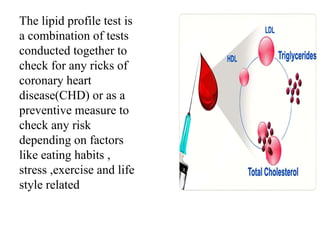
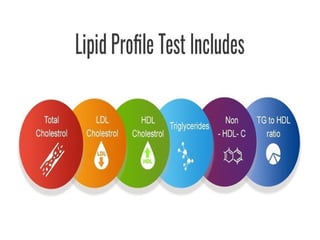
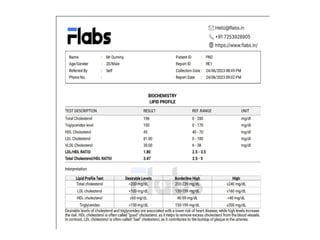
The lipid profile test is
a combination of tests
conducted together to
check for any ricks of
coronary heart
disease(CHD) or as a
preventive measure to
check any risk
depending on factors
like eating habits ,
stress ,exercise and life
style related
Triglycerides:
A triglyceride (TG) are the main conistituents of the body fat in
human
-The level of TG get elevated in obese or diabetic patient
-Level increase from eating extra calories especialy carbohydrate
or drinking alcohol
-Increase level are associated with heart ,blood vessel disease,
fatty liver disease ,pancreatitis ,diabetes and kidney disease
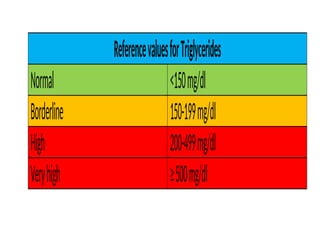
ReferencevaluesforTriglycerides
Normal <150mg/dl
Borderline 150-199mg/dl
High 200-499mg/dl
Veryhigh ≥500mg/dl
Increased triglycerides occur with the following
conditions:
Hyperlipoproteinemia, liver disease, alcoholism,
nephrotic syndrome, renal disease, hypothyroidism,
poorly controlled diabetes mellitus, pancreatitis, glycogen
storage disease (von Gierke’s disease), myocardial
infraction (elevated levels may persist for several
months), gout, Werner’s syndrome, Down’s syndrome and
Anorexia nervosa.
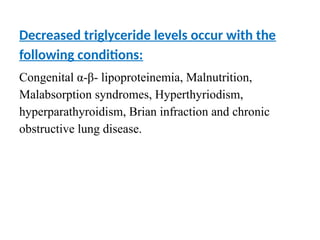
Decreased triglyceride levels occur with the
following conditions:
Congenital α-β- lipoproteinemia, Malnutrition,
Malabsorption syndromes, Hyperthyriodism,
hyperparathyroidism, Brian infraction and chronic
obstructive lung disease.
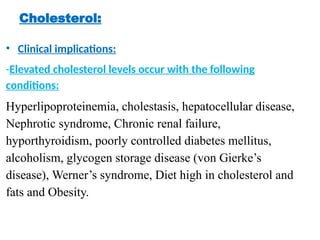
Cholesterol:
• Clinical implications:
-Elevated cholesterol levels occur with the following
conditions:
Hyperlipoproteinemia, cholestasis, hepatocellular disease,
Nephrotic syndrome, Chronic renal failure,
hyporthyroidism, poorly controlled diabetes mellitus,
alcoholism, glycogen storage disease (von Gierke’s
disease), Werner’s syndrome, Diet high in cholesterol and
fats and Obesity.
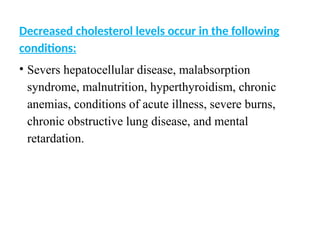
Decreased cholesterol levels occur in the following
conditions:
• Severs hepatocellular disease, malabsorption
syndrome, malnutrition, hyperthyroidism, chronic
anemias, conditions of acute illness, severe burns,
chronic obstructive lung disease, and mental
retardation.
High- Density Lipoprotein Cholesterol
(HDL-C):
HDL-C is a class of lipoproteins produced by the liver and
intestines.
Decreased HDL levels are atherogenic, whereas
elevated HDL levels protect against arthrosclerosis by
removing cholesterol from vessel walls and transporting
it to the liver where it is removed from the body. This is
known as the “reverse cholesterol transport pathway.”
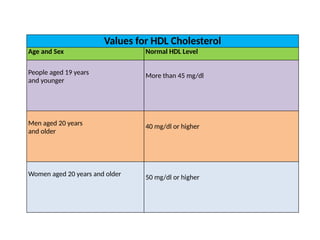
Values for HDL Cholesterol
Age and Sex Normal HDL Level
People aged 19 years
and younger
More than 45 mg/dl
Men aged 20 years
and older
40 mg/dl or higher
Women aged 20 years and older 50 mg/dl or higher
Clinical implications:
Increased HDL-C values occur in the following conditions:
• Familial hyper-α-lipoproteinemia (HDL excess), Chronic
liver disease (cirrhosis, alcoholism, hepatitis), Long term
aerobic or vigorous exercise.
Decreased HDL-C values are associated with increased
risk for CHD and premature CHD and occur in the
following conditions:
• Familial hypo-α-lipoproteinemia (Tangier disease),
Hypertriglyceridemia, poorly controlled diabetes
mellitus, Hepatocellular diseases, cholestasis, and
chronic renal failure
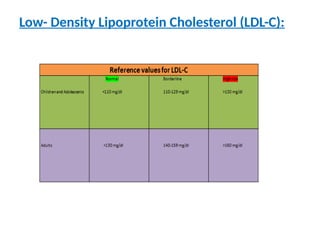
Low- Density Lipoprotein Cholesterol (LDL-C):
Clinical implications:
Increased LDL levels occur in the following
conditions:
• Familial type 2 hyperlipidemia, familial
hypercholesterolemia, diet high in cholesterol and
saturated fat, hypothyroidism, nephrotic syndrome,
Multiple myeloma, diabetes mellitus and chronic
renal failure
Decreased LDL levels occur in the following
conditions:
Hyperlipoproteinemia, hyperthyroidism, chronic
anemia, severe hepatocellular disease, type I
hyperlipidemia, acute stress, inflammatory joint disease,
and chronic pulmonary disease.
Any Questions
?
Thank you

Lipid Profile Laboratory report power point

  • 1.
  • 2.
    The lipid profiletest is a combination of tests conducted together to check for any ricks of coronary heart disease(CHD) or as a preventive measure to check any risk depending on factors like eating habits , stress ,exercise and life style related
  • 5.
    Triglycerides: A triglyceride (TG)are the main conistituents of the body fat in human -The level of TG get elevated in obese or diabetic patient -Level increase from eating extra calories especialy carbohydrate or drinking alcohol -Increase level are associated with heart ,blood vessel disease, fatty liver disease ,pancreatitis ,diabetes and kidney disease
  • 6.
  • 7.
    Increased triglycerides occurwith the following conditions: Hyperlipoproteinemia, liver disease, alcoholism, nephrotic syndrome, renal disease, hypothyroidism, poorly controlled diabetes mellitus, pancreatitis, glycogen storage disease (von Gierke’s disease), myocardial infraction (elevated levels may persist for several months), gout, Werner’s syndrome, Down’s syndrome and Anorexia nervosa.
  • 8.
    Decreased triglyceride levelsoccur with the following conditions: Congenital α-β- lipoproteinemia, Malnutrition, Malabsorption syndromes, Hyperthyriodism, hyperparathyroidism, Brian infraction and chronic obstructive lung disease.
  • 9.
    Cholesterol: • Clinical implications: -Elevatedcholesterol levels occur with the following conditions: Hyperlipoproteinemia, cholestasis, hepatocellular disease, Nephrotic syndrome, Chronic renal failure, hyporthyroidism, poorly controlled diabetes mellitus, alcoholism, glycogen storage disease (von Gierke’s disease), Werner’s syndrome, Diet high in cholesterol and fats and Obesity.
  • 10.
    Decreased cholesterol levelsoccur in the following conditions: • Severs hepatocellular disease, malabsorption syndrome, malnutrition, hyperthyroidism, chronic anemias, conditions of acute illness, severe burns, chronic obstructive lung disease, and mental retardation.
  • 11.
    High- Density LipoproteinCholesterol (HDL-C): HDL-C is a class of lipoproteins produced by the liver and intestines. Decreased HDL levels are atherogenic, whereas elevated HDL levels protect against arthrosclerosis by removing cholesterol from vessel walls and transporting it to the liver where it is removed from the body. This is known as the “reverse cholesterol transport pathway.”
  • 12.
    Values for HDLCholesterol Age and Sex Normal HDL Level People aged 19 years and younger More than 45 mg/dl Men aged 20 years and older 40 mg/dl or higher Women aged 20 years and older 50 mg/dl or higher
  • 13.
    Clinical implications: Increased HDL-Cvalues occur in the following conditions: • Familial hyper-α-lipoproteinemia (HDL excess), Chronic liver disease (cirrhosis, alcoholism, hepatitis), Long term aerobic or vigorous exercise. Decreased HDL-C values are associated with increased risk for CHD and premature CHD and occur in the following conditions: • Familial hypo-α-lipoproteinemia (Tangier disease), Hypertriglyceridemia, poorly controlled diabetes mellitus, Hepatocellular diseases, cholestasis, and chronic renal failure
  • 14.
    Low- Density LipoproteinCholesterol (LDL-C):
  • 15.
    Clinical implications: Increased LDLlevels occur in the following conditions: • Familial type 2 hyperlipidemia, familial hypercholesterolemia, diet high in cholesterol and saturated fat, hypothyroidism, nephrotic syndrome, Multiple myeloma, diabetes mellitus and chronic renal failure
  • 16.
    Decreased LDL levelsoccur in the following conditions: Hyperlipoproteinemia, hyperthyroidism, chronic anemia, severe hepatocellular disease, type I hyperlipidemia, acute stress, inflammatory joint disease, and chronic pulmonary disease.
  • 17.
  • 18.