Hyperlipidemia
Hyperlipidemia
By Dr Muhammad Tufail
PGR Cardiology MMC
Hyperlipidemia
abnormally elevated levels of any or all lipids
and/or lipoproteins in the blood but Plasma
cholesterol and triglyceride are clinically
important because they are major modifiable
risk factors for cardiovascular disease, whilst
severe hypertriglyceridaemia also predisposes
to acute pancreatitis
.
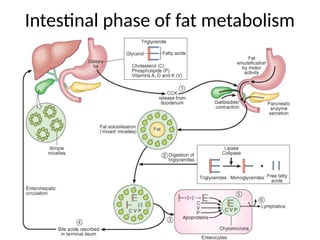
Intestinal phase of fat metabolism
Fat transport and metabolisim
The term 'lipid' refers to substances (including free cholesterol ,
cholesterol ester , phospholipid , triglyceride ) with poor water
solubility therefore to be transport and metabolize should combined
with apolipoproteins to form spherical or disk-shaped lipoprotein
which consist of a hydrophobic core and a hydrophilic coat The
structure of apolipoproteins enables them to act as cell receptor
ligands (by which lipoprotein can attach to the cells ) . Thus, variation
apolipoproteins composition results in the formation of distinct classes
of lipoproteins with different metabolic functions
.
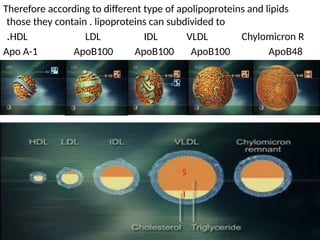
Therefore according to different type of apolipoproteins and lipids
those they contain . lipoproteins can subdivided to
HDL LDL IDL VLDL Chylomicron R
.
Apo A-1 ApoB100 ApoB100 ApoB100 ApoB48
5
1
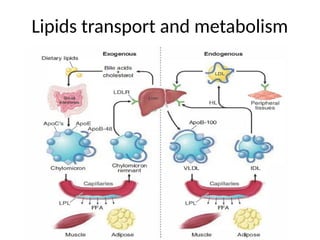
Lipids transport and metabolism
Reverse cholesterol transfer
role of ( HDL )
CONCLUSION AND CLINICAL IMPORTANCE
●
Chylomicron transport fats from the intestinal mucosa to the liver stay
up to 6_10 hours so in fasting state of 12 hour will not detected and
therefore fasting measurement more reliable if fasting 12 hours
.
●
In the liver the chylomicron release triglyceride and some cholesterol
.
●
VLDL carries TG and cholesterol (but contain more TG ) therefore will
elevated markedly especially in hypertriglyceridaemia
●
LDL carries TG and cholesterol (but contain more cholesterol) to the
body's cells therefore markedly elevated in hypercholesterolemia
.
●
When LDL become high , atheroma will form in the vessel and
atherosclerosis will occur
.
●
HDL carry cholesterol to the liver for excretion
●
HDL is able to go and remove cholesterol from the atheroma
●
Atherogenic cholesterol (bad cholesterol) are LDL
●
good cholesterol is HDL
Disorder of hyperlipidemia
1
.
Hypertriglycredemia
2
.
Hypercholesterolemia
3
.
Combined hyperlipidemia
4
.
Some other lipoprotein disorders
Including disorder of HDL_C
1
.
Hypertriglycredemia
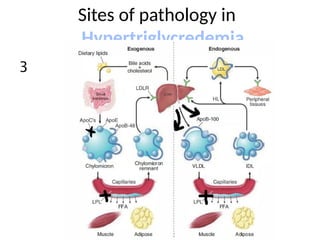
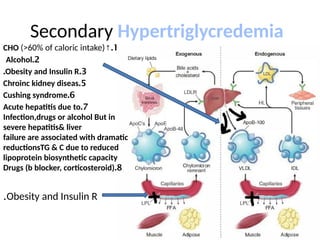
Sites of pathology in
Hypertriglycredemia
3
Hypertriglycredemia
1
.
Primary cause (rare )
2
.
Secondary cause (more common)
Secondary Hypertriglycredemia
1
.
↑
CHO (>60% of caloric intake)
2
.
Alcohol
3
.
Obesity and Insulin R
.
5
.
Chroinc kidney diseas
6
.
Cushing syndrome
7
.
Acute hepatitis due to
Infection,drugs or alcohol But in
severe hepatitis& liver
failure are associated with dramatic
reductionsTG & C due to reduced
lipoprotein biosynthetic capacity
8
.
Drugs (b blocker, corticosteroid)
Obesity and Insulin R
.
Primary Hypertriglyceridemia
1
.
Familial hypertriglycerimia
Mild to moderate ↑ TG
2
.
Hyperchylomicronimia
a.Familial a poC- 11 deficiency
c.Lipoprotein lipase deficiency
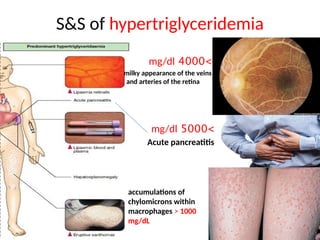
S&S of hypertriglyceridemia
>
4000
mg/dl
milky appearance of the veins
and arteries of the retina
accumulations of
chylomicrons within
macrophages > 1000
mg/dL
>
5000
mg/dl
Acute pancreatitis
2
.
Hypercholesterolemia
Sites of hypercholesterolemia
pcsk protein
Hypercholesterolemia
1
.
Primary cause ( rare but common than
primary hypertriglyceridemia )
2
.
Secondary cause ( common)
Secondary Hypercholesterolemia
Cholestatic liver disease
1
.
↑
trans and saturated FA
2
.
Hypothyroidism
3
.
Pregnancy (not well known)
Others
Hyperparathyroidism
Nephrotic syndrome
Anorexia nervosa
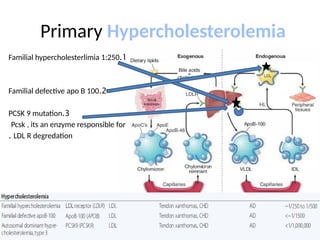
Primary Hypercholesterolemia
1
.
Familial hypercholesterlimia 1:250
2
.
Familial defective apo B 100
3
.
PCSK 9 mutation
Pcsk , its an enzyme responsible for
LDL R degredation
.
S & S of hypercholesterolemia
A major risk of CVD,
including myocardial
infarction and stroke , as
well as total mortality
xanthelasma
Corneal arcus
Not significant if in elderly
3
.
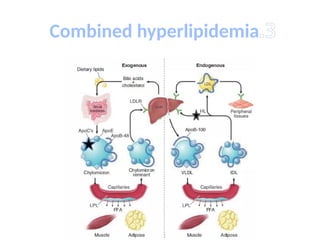
Combined hyperlipidemia
1
.
Familial comined
Hyperlipidemia
(
polygenic
)
Not fully understood
↑
VLDL or both ↑VLDL + LDL or just ↑LDL
↑
apo B 2
.
Dysbetalipoproteinemia
VLDL + - LDL c
3
.
Hepatic lipase deficiency
Familial Combined Hyperlipidemia(Fchl)
FCHL is generally characterized by moderate elevations in
plasma levels of triglycerides (VLDL) and cholesterol
(LDL) and reduced plasma levels of HDL-C.
Approximately 20% of patients who develop CHD under
age 60 (premature coronary heart disease) have FCHL
The presence of a mixed dyslipidemia (TG 200 _ 800
mg/dL and total C 200 _400 mg/dL, usually with HDL-C
levels <40 mg/dL in men and <50 mg/dL in women) and
a family history of hyperlipidemia and/or premature
CHD strongly suggests the diagnosis of FCHL
.
HDL C disorders
1
.
↑
HDL
CETP deficiency
2
.
↓
HDL
A.Hypoalphalipoproteinemia
HDL ↓ variable C & TG
B.LCAT deficiency
HDL ↓ 10 mg
Variable ↑TG
Screening and measurement
Plasma lipid and lipoprotein levels should be
measured in all adults , preferably after a 12-h
overnight fast
Evaluation
cholesterol should be measured
1
-
Children with parents having hyperlipedemia or
CAD that Developed before 55 years
2
-
any adult with 1st degree relative having lipid
disorder or vascular Disorder
.
3
.
Investigation for every patient with clinical
feature of hyperlipidemia
4
.
Screening for primary and secondary prevention
of cardiovascular disease
.
In most clinical laboratories, the cholesterol and TGs
in the plasma are measured enzymatically
,
and then the cholesterol in the supernatant is
measured after precipitation of apoB-containing
lipoproteins to determine the HDL-C. The
LDL-C is then estimated using the following equation
:
VLDL C = TG / 5 ( in VLDL TG : C 5 :1 )
LDL-C = total cholesterol - (TG/5) - HDL-C
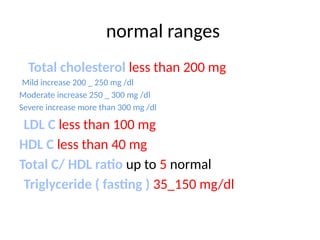
normal ranges
Total cholesterol less than 200 mg
Mild increase 200 _ 250 mg /dl
Moderate increase 250 _ 300 mg /dl
Severe increase more than 300 mg /dl
LDL C less than 100 mg
HDL C less than 40 mg
Total C/ HDL ratio up to 5 normal
Triglyceride ( fasting ) 35_150 mg/dl
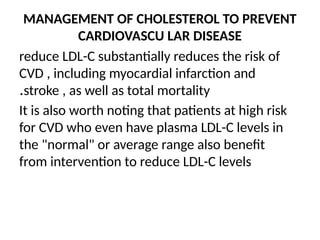
MANAGEMENT OF CHOLESTEROL TO PREVENT
CARDIOVASCU LAR DISEASE
reduce LDL-C substantially reduces the risk of
CVD , including myocardial infarction and
stroke , as well as total mortality
.
It is also worth noting that patients at high risk
for CVD who even have plasma LDL-C levels in
the "normal" or average range also benefit
from intervention to reduce LDL-C levels
1st
Lifestyle
:
1
.
↓
body weight
2
.
↓
saturated fats, trans fats, and cholesterol in
the diet
.
3
.
Regular exercise has relatively little impact on
reducing plasma LDL-C levels , although it
has cardiovascular benefits independent of
LDL lowering
.
Food and additives
4
.
Certain foods and dietary additives are
associated with modest reductions in plasma
cholesterol levels. Plant stanol and sterol
esters interfere with cholesterol absorption
and reduce plasma LDL-C levels by 10% when
taken three times per day
.
PHARMACOLOGICAL INDICATION FOR
HYPERCHOLESTEROLEMIA
Indication
1
.
patients with CHD or risk factors even they have
"average" LDL-C levels
.
2
.
To reduce LDL-C to <100 mg/dL in patients with
established CHD
3
.
all patients with markedly elevated plasma levels of
LDL-C levels (>190 mg/dL)
4
.
plasma LDL-C levels between 130 and 190 mg/dL with
The presence of other risk factors such as a low plasma
level of HDL-C (<40 mg/dL)
2nd
line : Pharmacologic Therapy to ↓ cholesterol
1
.
HMG-CoA reductase inhibitors (statins)
:
Action
:
①
inhibit HMG-CoA reductase , a key enzyme in cholesterol biosynthesis, lead to ↓
cholesterol s
.
②
statins also increase hepatic LDL receptor activity and accelerated clearance of
circulating LDL
Statin ↓LDL c 60% ↓ TG 40% ↑ HDL 10%
Indication
:
Usually one tablet at night (because there is ↑ action
of Hepatic enzyme at night
)
Simvastatin20-40mg/d maximam 80 mg/d
Most useful and dependent way to
indicate statins uses
depend on guidelines of
British coronary prediction risk chart
If more than 20% risk over next 10 years
Statin SE: dyspepsia,headaches,fatigue,and muscle
or joint pains. Severe myopathy and even
rhabdomyolysis occur .The risk of myopathy is
increased in
□
older age
,
□
renal Insufficiency
,
□
co_administration of drugs such as erythromycin,
antifungal agents , immunosuppressive drugs
.
*
Interrupt treatment if
1
.
CK is more than 5–10 times the upper limit of normal
(
NR : m 55_170 u/l , f 30 _ 135 u/l
, )
2
.
elevated with muscle symptoms
3
.
ALT is more than 2–3 times the upper limit
2
.
Cholesterole absorption inhibitor : Ezetimibe , blocks
the intestinal absorption of cholesterol by inhibits
NPC1Ll indicated as a combination with statin or
when statin is intolerated . 10 mg lower LDL C 20%
.
3
.
Bile acid sequestrant (resin) : prevent bile acid
absorption thereby reduce liver content of cholesterol
that lead to ↑ LDL receptor and LDL clearance such
cholestyramine,colestipol and colesevelam
SE : bloating and constipation
.
Because bile acidsequestrants are not systemically
absorbed , the cholesterol-lowering drug of choice in
children and in women of childbearing age , who are
lactating or pregnant
.
LDL c APHERESIS
Patients who remain severely
hypercholesterolemic especially of genetic
cause despite optimally tolerated and
maximam drug therapy are candidates for LDL
apheresis. In this process , the patient plasma
is passed over a column that selectively
removes the LDL and the LDL-depleted plasma
is returned to the patient
.
Hyper Lipidemia and its consequences.pptx

Hyper Lipidemia and its consequences.pptx

  • 1.
  • 2.
    Hyperlipidemia abnormally elevated levelsof any or all lipids and/or lipoproteins in the blood but Plasma cholesterol and triglyceride are clinically important because they are major modifiable risk factors for cardiovascular disease, whilst severe hypertriglyceridaemia also predisposes to acute pancreatitis .
  • 3.
    Intestinal phase offat metabolism
  • 4.
    Fat transport andmetabolisim The term 'lipid' refers to substances (including free cholesterol , cholesterol ester , phospholipid , triglyceride ) with poor water solubility therefore to be transport and metabolize should combined with apolipoproteins to form spherical or disk-shaped lipoprotein which consist of a hydrophobic core and a hydrophilic coat The structure of apolipoproteins enables them to act as cell receptor ligands (by which lipoprotein can attach to the cells ) . Thus, variation apolipoproteins composition results in the formation of distinct classes of lipoproteins with different metabolic functions .
  • 5.
    Therefore according todifferent type of apolipoproteins and lipids those they contain . lipoproteins can subdivided to HDL LDL IDL VLDL Chylomicron R . Apo A-1 ApoB100 ApoB100 ApoB100 ApoB48 5 1
  • 6.
  • 7.
  • 8.
    CONCLUSION AND CLINICALIMPORTANCE ● Chylomicron transport fats from the intestinal mucosa to the liver stay up to 6_10 hours so in fasting state of 12 hour will not detected and therefore fasting measurement more reliable if fasting 12 hours . ● In the liver the chylomicron release triglyceride and some cholesterol . ● VLDL carries TG and cholesterol (but contain more TG ) therefore will elevated markedly especially in hypertriglyceridaemia ● LDL carries TG and cholesterol (but contain more cholesterol) to the body's cells therefore markedly elevated in hypercholesterolemia . ● When LDL become high , atheroma will form in the vessel and atherosclerosis will occur . ● HDL carry cholesterol to the liver for excretion ● HDL is able to go and remove cholesterol from the atheroma ● Atherogenic cholesterol (bad cholesterol) are LDL ● good cholesterol is HDL
  • 9.
    Disorder of hyperlipidemia 1 . Hypertriglycredemia 2 . Hypercholesterolemia 3 . Combinedhyperlipidemia 4 . Some other lipoprotein disorders Including disorder of HDL_C
  • 10.
  • 11.
    Sites of pathologyin Hypertriglycredemia 3
  • 12.
    Hypertriglycredemia 1 . Primary cause (rare) 2 . Secondary cause (more common)
  • 13.
    Secondary Hypertriglycredemia 1 . ↑ CHO (>60%of caloric intake) 2 . Alcohol 3 . Obesity and Insulin R . 5 . Chroinc kidney diseas 6 . Cushing syndrome 7 . Acute hepatitis due to Infection,drugs or alcohol But in severe hepatitis& liver failure are associated with dramatic reductionsTG & C due to reduced lipoprotein biosynthetic capacity 8 . Drugs (b blocker, corticosteroid) Obesity and Insulin R .
  • 14.
    Primary Hypertriglyceridemia 1 . Familial hypertriglycerimia Mildto moderate ↑ TG 2 . Hyperchylomicronimia a.Familial a poC- 11 deficiency c.Lipoprotein lipase deficiency
  • 15.
    S&S of hypertriglyceridemia > 4000 mg/dl milkyappearance of the veins and arteries of the retina accumulations of chylomicrons within macrophages > 1000 mg/dL > 5000 mg/dl Acute pancreatitis
  • 16.
  • 17.
  • 18.
    Hypercholesterolemia 1 . Primary cause (rare but common than primary hypertriglyceridemia ) 2 . Secondary cause ( common)
  • 19.
    Secondary Hypercholesterolemia Cholestatic liverdisease 1 . ↑ trans and saturated FA 2 . Hypothyroidism 3 . Pregnancy (not well known) Others Hyperparathyroidism Nephrotic syndrome Anorexia nervosa
  • 20.
    Primary Hypercholesterolemia 1 . Familial hypercholesterlimia1:250 2 . Familial defective apo B 100 3 . PCSK 9 mutation Pcsk , its an enzyme responsible for LDL R degredation .
  • 21.
    S & Sof hypercholesterolemia A major risk of CVD, including myocardial infarction and stroke , as well as total mortality xanthelasma Corneal arcus Not significant if in elderly
  • 22.
  • 23.
    Combined hyperlipidemia 1 . Familial comined Hyperlipidemia ( polygenic ) Notfully understood ↑ VLDL or both ↑VLDL + LDL or just ↑LDL ↑ apo B 2 . Dysbetalipoproteinemia VLDL + - LDL c 3 . Hepatic lipase deficiency
  • 24.
    Familial Combined Hyperlipidemia(Fchl) FCHLis generally characterized by moderate elevations in plasma levels of triglycerides (VLDL) and cholesterol (LDL) and reduced plasma levels of HDL-C. Approximately 20% of patients who develop CHD under age 60 (premature coronary heart disease) have FCHL The presence of a mixed dyslipidemia (TG 200 _ 800 mg/dL and total C 200 _400 mg/dL, usually with HDL-C levels <40 mg/dL in men and <50 mg/dL in women) and a family history of hyperlipidemia and/or premature CHD strongly suggests the diagnosis of FCHL .
  • 25.
    HDL C disorders 1 . ↑ HDL CETPdeficiency 2 . ↓ HDL A.Hypoalphalipoproteinemia HDL ↓ variable C & TG B.LCAT deficiency HDL ↓ 10 mg Variable ↑TG
  • 26.
    Screening and measurement Plasmalipid and lipoprotein levels should be measured in all adults , preferably after a 12-h overnight fast
  • 27.
    Evaluation cholesterol should bemeasured 1 - Children with parents having hyperlipedemia or CAD that Developed before 55 years 2 - any adult with 1st degree relative having lipid disorder or vascular Disorder . 3 . Investigation for every patient with clinical feature of hyperlipidemia 4 . Screening for primary and secondary prevention of cardiovascular disease .
  • 28.
    In most clinicallaboratories, the cholesterol and TGs in the plasma are measured enzymatically , and then the cholesterol in the supernatant is measured after precipitation of apoB-containing lipoproteins to determine the HDL-C. The LDL-C is then estimated using the following equation : VLDL C = TG / 5 ( in VLDL TG : C 5 :1 ) LDL-C = total cholesterol - (TG/5) - HDL-C
  • 29.
    normal ranges Total cholesterolless than 200 mg Mild increase 200 _ 250 mg /dl Moderate increase 250 _ 300 mg /dl Severe increase more than 300 mg /dl LDL C less than 100 mg HDL C less than 40 mg Total C/ HDL ratio up to 5 normal Triglyceride ( fasting ) 35_150 mg/dl
  • 30.
    MANAGEMENT OF CHOLESTEROLTO PREVENT CARDIOVASCU LAR DISEASE reduce LDL-C substantially reduces the risk of CVD , including myocardial infarction and stroke , as well as total mortality . It is also worth noting that patients at high risk for CVD who even have plasma LDL-C levels in the "normal" or average range also benefit from intervention to reduce LDL-C levels
  • 31.
    1st Lifestyle : 1 . ↓ body weight 2 . ↓ saturated fats,trans fats, and cholesterol in the diet . 3 . Regular exercise has relatively little impact on reducing plasma LDL-C levels , although it has cardiovascular benefits independent of LDL lowering .
  • 32.
    Food and additives 4 . Certainfoods and dietary additives are associated with modest reductions in plasma cholesterol levels. Plant stanol and sterol esters interfere with cholesterol absorption and reduce plasma LDL-C levels by 10% when taken three times per day .
  • 33.
    PHARMACOLOGICAL INDICATION FOR HYPERCHOLESTEROLEMIA Indication 1 . patientswith CHD or risk factors even they have "average" LDL-C levels . 2 . To reduce LDL-C to <100 mg/dL in patients with established CHD 3 . all patients with markedly elevated plasma levels of LDL-C levels (>190 mg/dL) 4 . plasma LDL-C levels between 130 and 190 mg/dL with The presence of other risk factors such as a low plasma level of HDL-C (<40 mg/dL)
  • 34.
    2nd line : PharmacologicTherapy to ↓ cholesterol 1 . HMG-CoA reductase inhibitors (statins) : Action : ① inhibit HMG-CoA reductase , a key enzyme in cholesterol biosynthesis, lead to ↓ cholesterol s . ② statins also increase hepatic LDL receptor activity and accelerated clearance of circulating LDL Statin ↓LDL c 60% ↓ TG 40% ↑ HDL 10% Indication : Usually one tablet at night (because there is ↑ action of Hepatic enzyme at night ) Simvastatin20-40mg/d maximam 80 mg/d Most useful and dependent way to indicate statins uses depend on guidelines of British coronary prediction risk chart If more than 20% risk over next 10 years
  • 35.
    Statin SE: dyspepsia,headaches,fatigue,andmuscle or joint pains. Severe myopathy and even rhabdomyolysis occur .The risk of myopathy is increased in □ older age , □ renal Insufficiency , □ co_administration of drugs such as erythromycin, antifungal agents , immunosuppressive drugs . * Interrupt treatment if 1 . CK is more than 5–10 times the upper limit of normal ( NR : m 55_170 u/l , f 30 _ 135 u/l , ) 2 . elevated with muscle symptoms 3 . ALT is more than 2–3 times the upper limit
  • 36.
    2 . Cholesterole absorption inhibitor: Ezetimibe , blocks the intestinal absorption of cholesterol by inhibits NPC1Ll indicated as a combination with statin or when statin is intolerated . 10 mg lower LDL C 20% . 3 . Bile acid sequestrant (resin) : prevent bile acid absorption thereby reduce liver content of cholesterol that lead to ↑ LDL receptor and LDL clearance such cholestyramine,colestipol and colesevelam SE : bloating and constipation . Because bile acidsequestrants are not systemically absorbed , the cholesterol-lowering drug of choice in children and in women of childbearing age , who are lactating or pregnant .
  • 37.
    LDL c APHERESIS Patientswho remain severely hypercholesterolemic especially of genetic cause despite optimally tolerated and maximam drug therapy are candidates for LDL apheresis. In this process , the patient plasma is passed over a column that selectively removes the LDL and the LDL-depleted plasma is returned to the patient .