Lipid profile
HDL , LDL
(5TH stage)
Lipoprotein are proteins in blood whose main purpose is to
transport cholesterol , triglycerides and other insoluble fats. With
the use of electrophoresis these lipoprotein can be grouped into :
1- Chylomicrons (origin)
2- LDL ( beta- lipoproteins)
3- VLDL (prebeta- lipoproteins )
4- HDL (alpha-lipoproteins)
2- Ultracentrifuge
3- enzymatic kit
• High Density Lipoprotein(HDL) are carries of cholesterol , that
are produced in the liver .
• The main function of HDL is to remove cholesterol for excretion.
Also HDLs prevent cellular uptake of cholesterol and lipids. These
potential actions may be the cause of their protective
cardiovascular characteristics associated with HDLs(good
cholesterol) within the blood.
HDL :
Male > 0.75 mmol/l OR > 45mg/dl
Female > 0.91 mmol/l OR > 55mg/dl
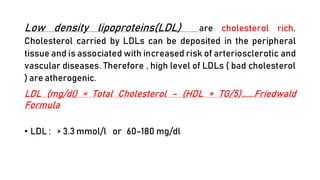
Low density lipoproteins(LDL) are cholesterol rich.
Cholesterol carried by LDLs can be deposited in the peripheral
tissue and is associated with increased risk of arteriosclerotic and
vascular diseases. Therefore , high level of LDLs ( bad cholesterol
) are atherogenic.
LDL (mg/dl) = Total Cholesterol – (HDL + TG/5)…….Friedwald
Formula
• LDL : > 3.3 mmol/l or 60-180 mg/dl
Interferingfactors
• Smoking and alcohol ingestion decrease HDL
• HDLare age and sex dependent
• Oralestrogen therapy show increase HDL anddecrease LDL
While in pregnancy LDL increased
• Steroid , diuretics, beta- blocker decreased HDL levels
• HDLlevel is elevated in hypothyroidism and diminished in hyperthyroidism.
• Specimen
Collect 5- 10 ml venous blood
1-Patient should fast for 12-14hr
2-No alcohol should be consumed for at least 24 hr
3- If possible, stop all medication for at least 24 hr
Increase level of HDL
• Familial lipoproteinemia
• Excessive exercise
Decrease level of HDL
• Familial low HDL
• Hepatocellular disease
(hepatitis or cirrhosis)
• Hypoproteinemia ( nephrotic
syndrome or malnutrition)
mutation in enzyme responsibal for
formation lipid ,apo protine 1
Estimationof HDL-cholesterol
• Principle
The chylomicrons, VLDL and LDL that are contained in the
sample are precipitated by addition of phosphotungesticacid in the
presence of Mg. the supernatant obtained after centrifugation
contains HDL from which the cholesterol can be determined by
using the cholesterol enzymatic kit.
Procedure
R1 : phosphotungestic acid and magnesium chloride.
R2 : standard
• Mix 200 µl of sample and 400 µl of R1 , stand 10 min at room
temperature , centrifuge at 5000 rpm for 10 min, collect the
supernatant and proceed it as a sample in the total cholesterol.
•
• Cigartic smoking effect on LCAT activity and altering the cholesterol
ester transfer protein(CETP)(which exchange cholesterol ester from
HDL2 to VLDL leading to decrease in HDL synthesis .in addition
smoking cause oxidative stress which effect on HDL (become
dysfunction and loss atheroprotection properties)
• Estrogen increase in apo A1 production ( rate of synthesis in
liver)leading to increase in HDL synthesis
• Hyperthyroidism lower HDL because thyroid hormone effect on the
activity of CETP
• Exercise decrease the activity of CETP (increase HDL synthesis) and
increase the activity of LCAT (increase function of HDL)

HDL

  • 1.
    Lipid profile HDL ,LDL (5TH stage)
  • 2.
    Lipoprotein are proteinsin blood whose main purpose is to transport cholesterol , triglycerides and other insoluble fats. With the use of electrophoresis these lipoprotein can be grouped into : 1- Chylomicrons (origin) 2- LDL ( beta- lipoproteins) 3- VLDL (prebeta- lipoproteins ) 4- HDL (alpha-lipoproteins) 2- Ultracentrifuge 3- enzymatic kit
  • 3.
    • High DensityLipoprotein(HDL) are carries of cholesterol , that are produced in the liver . • The main function of HDL is to remove cholesterol for excretion. Also HDLs prevent cellular uptake of cholesterol and lipids. These potential actions may be the cause of their protective cardiovascular characteristics associated with HDLs(good cholesterol) within the blood. HDL : Male > 0.75 mmol/l OR > 45mg/dl Female > 0.91 mmol/l OR > 55mg/dl
  • 4.
    Low density lipoproteins(LDL)are cholesterol rich. Cholesterol carried by LDLs can be deposited in the peripheral tissue and is associated with increased risk of arteriosclerotic and vascular diseases. Therefore , high level of LDLs ( bad cholesterol ) are atherogenic. LDL (mg/dl) = Total Cholesterol – (HDL + TG/5)…….Friedwald Formula • LDL : > 3.3 mmol/l or 60-180 mg/dl
  • 5.
    Interferingfactors • Smoking andalcohol ingestion decrease HDL • HDLare age and sex dependent • Oralestrogen therapy show increase HDL anddecrease LDL While in pregnancy LDL increased • Steroid , diuretics, beta- blocker decreased HDL levels • HDLlevel is elevated in hypothyroidism and diminished in hyperthyroidism. • Specimen Collect 5- 10 ml venous blood 1-Patient should fast for 12-14hr 2-No alcohol should be consumed for at least 24 hr 3- If possible, stop all medication for at least 24 hr
  • 6.
    Increase level ofHDL • Familial lipoproteinemia • Excessive exercise Decrease level of HDL • Familial low HDL • Hepatocellular disease (hepatitis or cirrhosis) • Hypoproteinemia ( nephrotic syndrome or malnutrition) mutation in enzyme responsibal for formation lipid ,apo protine 1
  • 7.
    Estimationof HDL-cholesterol • Principle Thechylomicrons, VLDL and LDL that are contained in the sample are precipitated by addition of phosphotungesticacid in the presence of Mg. the supernatant obtained after centrifugation contains HDL from which the cholesterol can be determined by using the cholesterol enzymatic kit.
  • 8.
    Procedure R1 : phosphotungesticacid and magnesium chloride. R2 : standard • Mix 200 µl of sample and 400 µl of R1 , stand 10 min at room temperature , centrifuge at 5000 rpm for 10 min, collect the supernatant and proceed it as a sample in the total cholesterol. •
  • 9.
    • Cigartic smokingeffect on LCAT activity and altering the cholesterol ester transfer protein(CETP)(which exchange cholesterol ester from HDL2 to VLDL leading to decrease in HDL synthesis .in addition smoking cause oxidative stress which effect on HDL (become dysfunction and loss atheroprotection properties) • Estrogen increase in apo A1 production ( rate of synthesis in liver)leading to increase in HDL synthesis • Hyperthyroidism lower HDL because thyroid hormone effect on the activity of CETP • Exercise decrease the activity of CETP (increase HDL synthesis) and increase the activity of LCAT (increase function of HDL)