Lipid Management in Chronic Kidney Disease PatientsTejas Desai, MDECU Nephrology & HypertensionOffice:  252-744-2113Email:  desait@ecu.eduVersion 1:  9/17/9
Historical ControversiesKnown that for every Δ -40 mg/dL of total cholesterol in patients with pre-existing CAD & without CKD per se, there is a Δ -25-30% risk of MI or CVA Most of these trials did not focus on CKD patientsSome have even excluded CKD patients from their investigations altogether Proceedings of the Royal College of Physicians 1999, Volume 29, pp. 10-15Lancet 2002, Volume 360, pp. 7-22NEJM 2000, Volume 343, pp. 317-326Diabetes Care 1993, Volume 16, pp. 434-444
Historical ControversiesSome have argued that lipid-lowering therapy in CKD and ESRD patients may be harmful if drug effects are not studied firstSome have argued that only 25% of deaths in CKD/ESRD patients are due to MI (75% due to congestive heart failure, arrhythmias, sudden cardiac death)Conditions that are not easily treated with lipid-lowering agents
Intuitively, it makes sense to treat CKD patients with Lipid-lowering agentsAll CKD/ESRD patients are at increased risk for vascular diseaseLipid-lowering agents, such as statins, have shown a benefit inhaltingthe progression of atherosclerotic vascular disease in non-CKD patientsWhy would we not see a similar beneficial effect in CKD/ESRD patients?SHARP Trial
SHARPStudy of Heart and Renal ProtectionA trial designed to look for any benefits of lipid-lowering agents in patients with CKD/ESRDPrefaced by 2 pilot studies to assess safety of statins in CKD patientsUK-HARP I and UK-HARP II
UK-HARP IGoalsAssess biochemical efficacy & safety of simvastatin 20 mg daily in CKD patients for 1 yearEstablish the feasibility of conducting a large-scale randomized control trial*Note:  also assessed the safety of 100 mg of ASA daily in CKD patients for 1 yearAmerican Journal of Kidney Diseases, 2005, Volume 45, Issue 3.
UK-HARP IInclusion CriteriaAnyone > 18 years of ageCKD: Cr > 1.7 mg/dlHD or PD patientsPCP or Nephrologist found no compelling reason to start a statin or a contraindication to oneExclusion Criteria
If the MD felt statin therapy was required
h/o inflammatory muscle disorders, uremia recently, or liver diseaseAmerican Journal of Kidney Diseases, 2005, Volume 45, Issue 3.
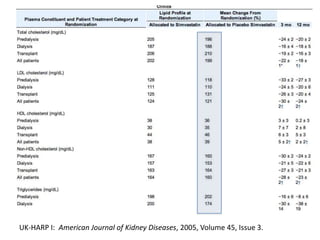
UK-HARP I:  American Journal of Kidney Diseases, 2005, Volume 45, Issue 3.
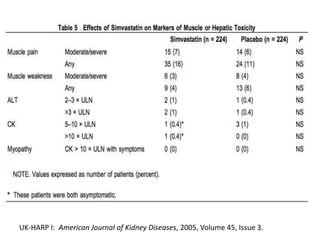
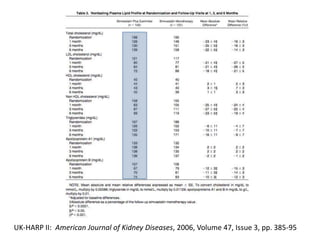
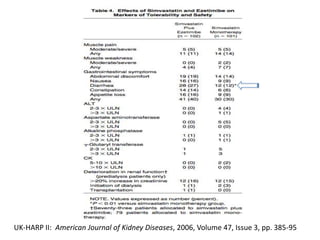
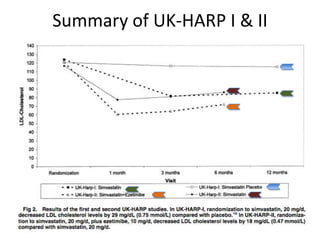
Thus far…UK-HARP I20 mg/dsimvastatin leads to sustained decreases in LDL, total cholesterolNo major differences in side effectsUK-HARP II“a little more greedy”Can the addition of ezetimibe to 20 mg/dsimvastatin lead to even greater reductions in cholesterol in CKD patients?
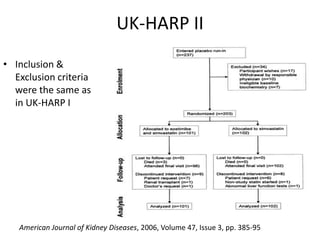
UK-HARP IIInclusion & Exclusion criteria were the same as in UK-HARP IAmerican Journal of Kidney Diseases, 2006, Volume 47, Issue 3, pp. 385-95
UK-HARP II:  American Journal of Kidney Diseases, 2006, Volume 47, Issue 3, pp. 385-95
Summary of UK-HARP I & II
SHARPAim is to study 3000 dialysis patients & 6000 CKD patientsAssess whether lipid-lowering agents can retard the progression of CKD and time to dialysisResults not available as of today
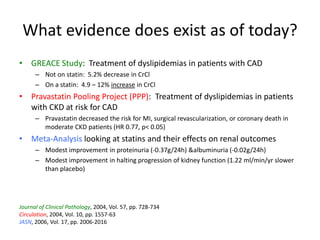
What evidence does exist as of today?GREACE Study:  Treatment of dyslipidemias in patients with CADNot on statin:  5.2% decrease in CrClOn a statin:  4.9 – 12% increase in CrClPravastatin Pooling Project (PPP):  Treatment of dyslipidemias in patients with CKD at risk for CADPravastatin decreased the risk for MI, surgical revascularization, or coronary death in moderate CKD patients (HR 0.77, p < 0.05)Meta-Analysis looking at statins and their effects on renal outcomesModest improvement in proteinuria (-0.37g/24h) & albuminuria (-0.02g/24h)Modest improvement in halting progression of kidney function (1.22 ml/min/yr slower than placebo) Journal of Clinical Pathology, 2004, Vol. 57, pp. 728-734Circulation, 2004, Vol. 10, pp. 1557-63JASN, 2006, Vol. 17, pp. 2006-2016
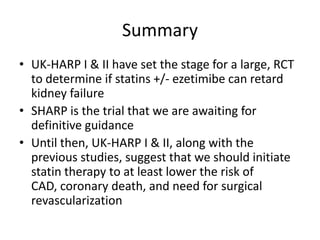
SummaryUK-HARP I & II have set the stage for a large, RCT to determine if statins +/- ezetimibe can retard kidney failureSHARP is the trial that we are awaiting for definitive guidanceUntil then, UK-HARP I & II, along with the previous studies, suggest that we should initiate statin therapy to at least lower the risk of CAD, coronary death, and need for surgical revascularization
Lipid Mgmt In Ckd
Lipid Mgmt In Ckd

Lipid Mgmt In Ckd

  • 1.
    Lipid Management inChronic Kidney Disease PatientsTejas Desai, MDECU Nephrology & HypertensionOffice: 252-744-2113Email: desait@ecu.eduVersion 1: 9/17/9
  • 2.
    Historical ControversiesKnown thatfor every Δ -40 mg/dL of total cholesterol in patients with pre-existing CAD & without CKD per se, there is a Δ -25-30% risk of MI or CVA Most of these trials did not focus on CKD patientsSome have even excluded CKD patients from their investigations altogether Proceedings of the Royal College of Physicians 1999, Volume 29, pp. 10-15Lancet 2002, Volume 360, pp. 7-22NEJM 2000, Volume 343, pp. 317-326Diabetes Care 1993, Volume 16, pp. 434-444
  • 3.
    Historical ControversiesSome haveargued that lipid-lowering therapy in CKD and ESRD patients may be harmful if drug effects are not studied firstSome have argued that only 25% of deaths in CKD/ESRD patients are due to MI (75% due to congestive heart failure, arrhythmias, sudden cardiac death)Conditions that are not easily treated with lipid-lowering agents
  • 4.
    Intuitively, it makessense to treat CKD patients with Lipid-lowering agentsAll CKD/ESRD patients are at increased risk for vascular diseaseLipid-lowering agents, such as statins, have shown a benefit inhaltingthe progression of atherosclerotic vascular disease in non-CKD patientsWhy would we not see a similar beneficial effect in CKD/ESRD patients?SHARP Trial
  • 5.
    SHARPStudy of Heartand Renal ProtectionA trial designed to look for any benefits of lipid-lowering agents in patients with CKD/ESRDPrefaced by 2 pilot studies to assess safety of statins in CKD patientsUK-HARP I and UK-HARP II
  • 6.
    UK-HARP IGoalsAssess biochemicalefficacy & safety of simvastatin 20 mg daily in CKD patients for 1 yearEstablish the feasibility of conducting a large-scale randomized control trial*Note: also assessed the safety of 100 mg of ASA daily in CKD patients for 1 yearAmerican Journal of Kidney Diseases, 2005, Volume 45, Issue 3.
  • 7.
    UK-HARP IInclusion CriteriaAnyone> 18 years of ageCKD: Cr > 1.7 mg/dlHD or PD patientsPCP or Nephrologist found no compelling reason to start a statin or a contraindication to oneExclusion Criteria
  • 8.
    If the MDfelt statin therapy was required
  • 9.
    h/o inflammatory muscledisorders, uremia recently, or liver diseaseAmerican Journal of Kidney Diseases, 2005, Volume 45, Issue 3.
  • 10.
    UK-HARP I: American Journal of Kidney Diseases, 2005, Volume 45, Issue 3.
  • 11.
    UK-HARP I: American Journal of Kidney Diseases, 2005, Volume 45, Issue 3.
  • 12.
    Thus far…UK-HARP I20mg/dsimvastatin leads to sustained decreases in LDL, total cholesterolNo major differences in side effectsUK-HARP II“a little more greedy”Can the addition of ezetimibe to 20 mg/dsimvastatin lead to even greater reductions in cholesterol in CKD patients?
  • 13.
    UK-HARP IIInclusion &Exclusion criteria were the same as in UK-HARP IAmerican Journal of Kidney Diseases, 2006, Volume 47, Issue 3, pp. 385-95
  • 14.
    UK-HARP II: American Journal of Kidney Diseases, 2006, Volume 47, Issue 3, pp. 385-95
  • 15.
    UK-HARP II: American Journal of Kidney Diseases, 2006, Volume 47, Issue 3, pp. 385-95
  • 16.
  • 17.
    SHARPAim is tostudy 3000 dialysis patients & 6000 CKD patientsAssess whether lipid-lowering agents can retard the progression of CKD and time to dialysisResults not available as of today
  • 18.
    What evidence doesexist as of today?GREACE Study: Treatment of dyslipidemias in patients with CADNot on statin: 5.2% decrease in CrClOn a statin: 4.9 – 12% increase in CrClPravastatin Pooling Project (PPP): Treatment of dyslipidemias in patients with CKD at risk for CADPravastatin decreased the risk for MI, surgical revascularization, or coronary death in moderate CKD patients (HR 0.77, p < 0.05)Meta-Analysis looking at statins and their effects on renal outcomesModest improvement in proteinuria (-0.37g/24h) & albuminuria (-0.02g/24h)Modest improvement in halting progression of kidney function (1.22 ml/min/yr slower than placebo) Journal of Clinical Pathology, 2004, Vol. 57, pp. 728-734Circulation, 2004, Vol. 10, pp. 1557-63JASN, 2006, Vol. 17, pp. 2006-2016
  • 19.
    SummaryUK-HARP I &II have set the stage for a large, RCT to determine if statins +/- ezetimibe can retard kidney failureSHARP is the trial that we are awaiting for definitive guidanceUntil then, UK-HARP I & II, along with the previous studies, suggest that we should initiate statin therapy to at least lower the risk of CAD, coronary death, and need for surgical revascularization