Outline
Introduction.
Lipidhandling in body
Pathophysiology of atherosclerosis
Current hypolipidemic drug
Newer hypolipidemic drug
AHA/ACC clinical guidelines
4.
Introduction
• Dyslipidemia isa disorder of Lipid & lipoprotein
metabolism.
• Three primary abnormality are there
Elevated triglyceride(TG)
Elevated LDL cholestrol
Reduced HDL cholestrol
• It is most important modifiable risk factor for CAD.
• Causes for dyslipidemia
1. Primary dyslipidemia
2. Secondary dyslipidemia
Lipoprotein
• Classified in7 claases on basis of density
1. HDL
2. VLDL
3. IDL
4. LDL
5. Chylomicron
TG mainly transported in form of Chylomicron & VLDL.
Cholestrol mainly transported as cholestrol ester in LDL &
HDL.
Lipoprotein Major surface apolipoprotein
Chylomicron B-48,E,C-I,C-II,A-I,A-II
Chylomicron remnant E
VLDL B-100, E, C-I, C-II,
IDL B-100, E
LDL B-100
Lp(a) B-100, (a)
HDL A-I, A-II, A-IV, C-I, C-II, D, E
8.
Lipoprotein containingapo-lipoprotein B as cofactor they
are atherogenic & which contain apo-lipoprotein A as a
cofactor they are non atherogenic.
So atherogenic lipoprotein are
Chylomicron
Chylomicron remnant
VLDL
IDL
LDL
Lp(a)
• Only non atherogenic/antiatherogenic/good cholestrol
lipoprotein is
HDL
Classification of Cholestrol& TG level
LIPID Mg/dl
Total cholestrol
Desirable <200
Borderline high 200-239
High >239
LDL Cholestrol
Optimal <70
Normal <100
Near normal 100-129
Borderline high 130-159
High 160-189
Very high >189
HDL Cholestrol
Low(undesirable) <40 male, <50 female
Normal 40-60
High(desirable) >60
14.
Journal of clinicallipidology 2015
Triglycerides
Physiological 30-70
Normal <150
Borderline high 150-199
High 200-499
Very high >499
15.
Men>40 andwomen>50 years of age or post menopausal.
All patients regardless of age with
Diabetes mellitus
Hypertension
Currently smoking cigarette
Obesity
Family H/O CAD <age 60 in first degree relatives
Inflammatory disease (SLE, RA,Psoriasis etc.)
Chronic renal failure(eGFR<60ml/min/1.73m2)
Evidence of atherosclerosis
HIV infection treated with HAART
Whom to screen for dyslipidemia?
16.
Clinical manifestationof Hyperlipidemia i.e. xanthomas,
premature arcus
Erectile dysfunction.
• Children with a family H/O hypercholestrolemia or
chylomicronemia.
2012 guidelines of the canadian cardiology society
17.
Who should betreated for dyslipidemia ???
• If LDL–C ≥190 mg/dL.
• LDL–C >160 mg/dL and person also has either
Other evidence of genetic hyperlipidemias.
Family history of premature ASCVD with onset <55 years in
a first degree male relative or <65 years in a first degree
female relative.
High sensitivity-C-reactive protein >2 mg/L.
ABI <0.9.
Lifetime risk of ASCVD i.e. ASCVD score >7.5
• TG 200-500 then measure NON HDL-C & if
Non HDL-C >190 then consider for drug therapy.
18.
Note: NON HDL-C= TC – HDL Cholestrol=LDL+VLDL+IDL
TG >500 consider for drug therapy.
Individuals with LDL–C ≥190 mg/dL or triglycerides ≥500
mg/dL should be evaluated for secondary cause of
dyslipidemia.
AHA blood cholestrol guideline 2013
*For thoseat moderate risk, additional testing may be
considered for some patients to assist with decisions about
risk stratification.
†For patients with diabetes plus 1 major ASCVD risk factor,
treating to a non–HDL-C goal of ,100 mg/dL (LDL-C of ,70
mg/dL) is considered a therapeutic option.
‡For patients with chronic kidney disease (CKD) stage 3B
stage 4 the lipid lowering therapy is beneficial but, Stage 5
CKD is a very highrisk condition, but results lipid-altering
therapies have not provided convincing evidence of
reduced ASCVD events in such patients. Therefore, no
treatment goals for lipid therapy have been defined for
stage 5 CKD.
journal of clinical lipidology 2015/AHA guideline 2013
Classification of ASCVD(atherosclerotic
cardiovasculardisease) :
Myocardial infarction or other acute coronary syndrome.
Coronary or other revascularization procedure.
Transient ischemic attack.
Ischemic stroke.
Atherosclerotic peripheral arterial disease
Includes ankle/brachial index of ,0.90
Other documented atherosclerotic diseases such as
Coronary atherosclerosis
Renal atherosclerosis
Aortic aneurysm secondary to atherosclerosis
Carotid plaque, $50% stenosis
23.
• For patientsat low or moderate risk, lifestyle therapy
should be given a trial of at least 3 mo before initiation of
drug therapy.
• For patients at very high risk and selected patients at high
risk (those unlikely to reach goal with lifestyle alone), drug
therapy may be started concurrently with lifestyle therapy.
• Referral to an RDN is recommended to facilitate dietary
modification and to an exercise specialist for guided
instruction on a suitable exercise program.
Recommendation:
24.
• After atherogeniccholesterol targets are achieved with lifestyle
therapies, responses should continue to be monitored at
intervals of 6–12 mo.
• Before initiation of atherogenic cholesterol–lowering drug
therapy, the clinician should discuss with the patient the
treatment objectives, potential ,adverse effects, possible
interactions with other drugs or dietary supplements, lifestyle
and medication adherence, and patient preferences as well as
convey that alternative agents and regimens are available in
the event of side effects.
• First-line cholesterol-lowering drug therapy, unless
contraindicated, is moderate- to high-intensity statin.
• The statin dosage may be increased or the patient switched to
a more efficacious agent, if goal levels of atherogenic
cholesterol are not achieved
25.
• Nonstatin drugtherapy may be considered for patients with
contraindications for, or intolerance to, statin therapy.
• Combination drug therapy with a statin plus a second (or third)
may be considered for patients who have not attained their
atherogenic cholesterol levels after the maximum tolerated
statin dosage has been reached and for those who have
contraindications or are intolerant to statin therapy.
• If drug therapy is used, at least a 30% reduction in atherogenic
cholesterol should be targeted.
• Response to therapy should be monitored within 4–12 mo.
26.
• Patients withvery high TG (500 mg/dL), the primary
objective of therapy is to lower the triglyceride level to ,500
mg/dL to reduce the risk of pancreatitis.
• Patients with high TG (200–499 mg/dL), the primary
objective of therapy is to lower levels of non–HDL-C and
LDL-C to reduce risk for an ASCVD event.
• For the level of TG
TG : 200-499= Statins should be use.
TG: 500-999= TG lowering agent or Statins may be use.
TG: >1000 = TG lowering should be consider.
• patients with severe hypercholesterolemia, an alternative goal
is to lower atherogenic cholesterol levels by at least 50%.
• LDL apheresis may be considered for selected patients.
Pleotropic effect ofstatin:
Reduction in lipoprotein oxidation.
Anti inflammatory property.
Decrease platelet aggregation & formation of thrombi.
Improvement in endothelial function.
Antioxidant property.
Plaque stability.
33.
• Dyspepsia
• Headache
•Fatigue
• Muscle & joint pain
• Myopathy, Rhabdomyolysis
Note: Myopathy is precipitated by older age, renal failure,
drug interfere with metabolism of statins.
In the event of muscle symotoms Plasma CK level should
be measure.
• Elevation of ALT & AST
Note: Checked before starting the therapy & after 2-3 mnth of
start of therapy then anually. Change in therapy should be
consider when level of enzyme > 3times normal.
• Associated with risk of diabetes mellitus.
Side effect of statins
Some important pointregarding individual statin:
Atorvastatin:
Long acting, highest LDL-C lowering, antioxidant,
antinflamatory.
Lovastatin:
First clinically used statin, prodrug, extensive FPM.
Simvastatin:
Prodrug, Extensive FPM, greater rise in HDL.
Pravastatin:
CH lowering effect is less,decrease plaque,decrease fibrinogen.
Rosuvastatin:
Most potent, greater reduction in LDL-C.
Pitvastatin:
Latest, no specific advantage.
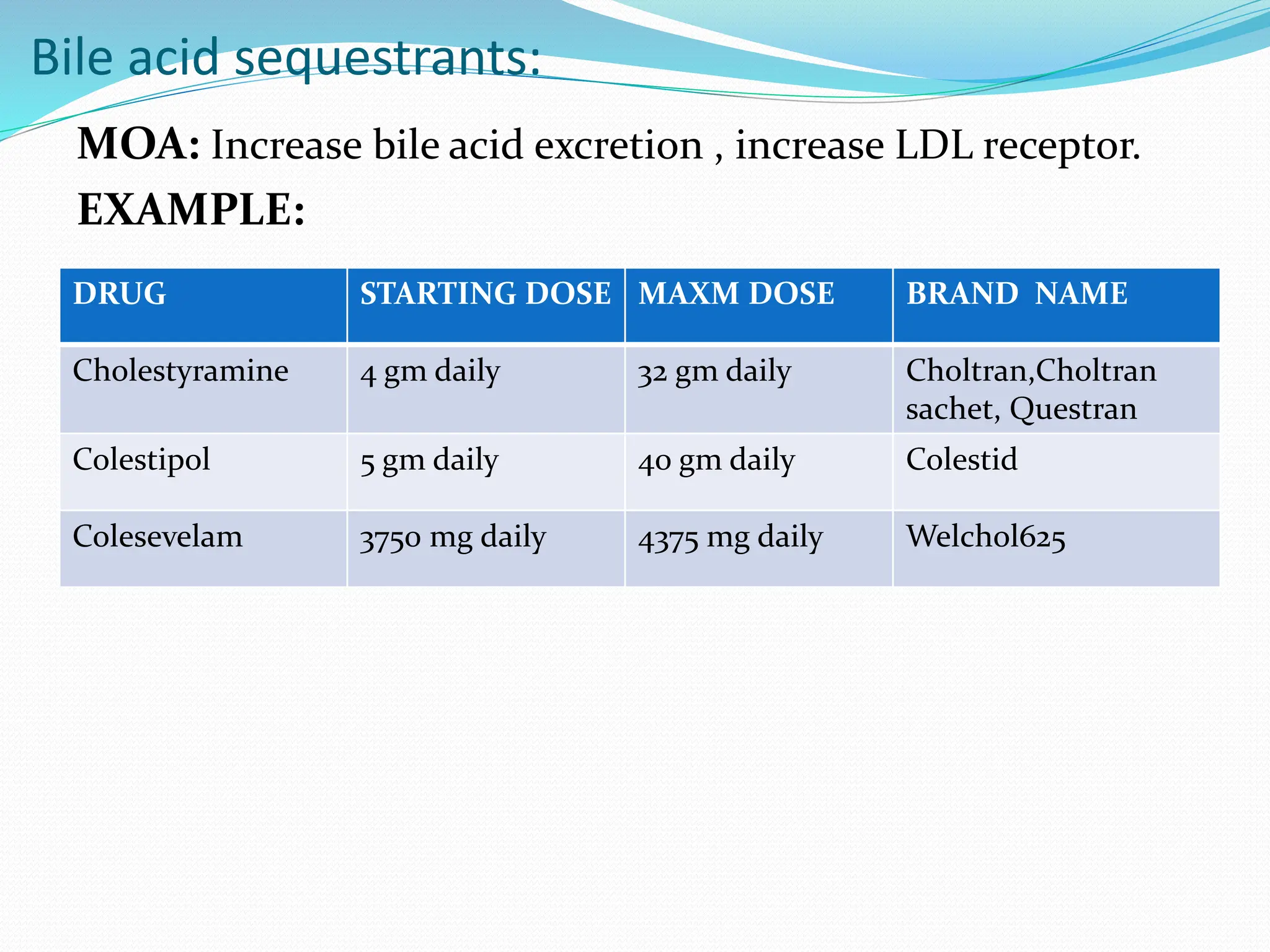
SIDE EFFECT:
Bloating
Constipation
Elevated TG
Some important point :
2nd DOC for dyslipidemia, for statins intolerant patients.
DOC in children, lactating, pregnant, or could become
pregnant women(b/c do not absorb systemically).
Used in combination with a statins.
Hyper-TG limit use.
Secondary effect on CH synthesis – increase VLDL.
42.
NOTE: Usually employedin combination with fibrate, statins.
Most effctive HDL-C raising pharmacological agent.
MOA: dec VLDL & fibrinogen & TG(40%), Inc HDL.
INDICATION : Elevated LDL-C, & TG.
SIDE EFFECT:
Cutaneous flushing.
GI upset
Elevated – glucose, uric acid , LFT
PREPARATION:
Nicotinic acid:
PREPARATION STARTING DOSE MAXM DOSE BRAND
Immidiate release 100 mg tid 1 gm tid Niaspan100
Sustained/Extende
d release
250 mg bid 1.5 gm bid Nialip250/375
NOTE:
Less favourableeffect on clinical outcome, improvement in
microvascular outcome.
FENOFIBRATE:
Reduce fibrinogrn level.
Commonly used in combination with statins(myopathy).
GEMFIBROGIL: Increase risk of myopathy with statin.
BEZAFIBRATE: No myopathy.
INTERACTION:
Increase risk of myositis on statins.
Reduction dose(30%) requirement for patients on warfarin.
45.
EZETIMIBE:
TRADE NAME:
Ezetib10mg, Ezitimide10mg, Ezedoc 10mg.
DOSE: 10 mg daily.
Inhibit CH absorption from intestine by binding to NPC1L1
transporter in intestine.
Indicated for elevated LDL-C.
Unlike resin it causes fall in TG.
Causes elevation in transaminases.
Cholestrol absorption inhibitor:
46.
Omega-3 fatty acid:
Causes increase catabolism of TG.
Indicated in elevated TG.
SIDE EFFECT:
Dyspepsia
Fishy odor to breath.
DRUG STARTING DOSE MAXM DOSE BRAND NAME
Omega-3 acid ethyl
ester
4 gm daily 4 gm daily MAX-OMEGA300/200
Multivite FM Omega
Icosapent ethyl 4 gm daily 4 gm daily Vascepa 1gm
49.
PCSK9 INHIBITOR:
Inhibitproprotein convertase subtilisin/kexin type 9.
Increase LDL receptor density on hepatocyte.
Prevent LDL receptor degredation.
1. ALIROCUMAB
Brand name – Praluent
Dose 1. starting dose : 75 mg s/c twice weekly.
2. maxm dose : 150 mg s/c twice weekly.
INDICATION:
Adjunct to diet & maximally tolerated statin therapy.
Adult with hetrozygous familial hypercholestrolemia.
Clinical ASCVD.
Who require additional lowering of LDL-C.
50.
SIDE EFFECT:
Nosethroat irritation
Injection site reaction & bruising
Flue like symptoms
Diarrhoea, muscle pain
NOTE: Alirocumab is first PCSK9I to be approved in july
2015
51.
2. EVOLOCUMAB:
Brandname : Repatha
Dose: 420 mg s/c once monthly.
FDA approval in 27 aug 2015.
Indication & side effects are same as that of Alirocumab.
3. BOCOCIZUMAB:
Yet not approved by FDA.
52.
Brand name:Kynamro.
DOSE: 200 mg s/c weekly.
Decrease formation of apo-B containing lipoprotein
including LDL-C(40-50%)
Also decrease Lp(a) concentration.
Approved for homozygous familial hypercholestrolemia &
minimising need lipid apheresis.
SIDE EFFECT:
1. Influenza like illness.
2. Injection site reaction .
3. Hepatic steatosis.
Apo B Inhibitor- MIPOMERSEN
53.
MTTP Inhibitor- LOMITAPIDE
Brand name: Juxpid
Dose: 5 mg daily to 60 mg daily.
Inhibit TG transfer to Apo-B48 & Apo B100 in intestine &
liver cells respectively.
Lead to decrease formation chylomicron & VLDL, decrease
VLDL lead to decrease level of LDL.
FDA approval in 2012 for homozygous familial
hypercholestrolemia.
SIDE EFFECT:
1. Increased stool frequency.
2. Hepatic steatosis, elevated tranaminases.
55.
Thyroid hormoneanalog with minimal non hepatic tissue
uptake.
No long term or large study done so far.
No clinical hyper/hypo thyroidism.
S/E: Elevated liver enzyme.
Thyromimetic- EPRORITOME
56.
Lipid apheresis:
Selectiveremoval of LDL, VLDL, Lp(a).
Little pr no effect on other plasma component( HDL, alb,IgG)
Indication:
Familial hypercholestrolemia
Note:- After diet and maximum tolerated drug therapy for
6month 1)LDL level >200 with CAD
2)LDLlevel >300 without CAD
then Lipid apheresis/LDL apheresis is indicated.
57.
1. Best predictorfor future risk of cardiovascular events
among following is:
a) hsCRP
b) Lipoprotein a
c) Homocysteine
d) Interleukin 6
58.
Ans; A hsCRP
CRPwhen measure d by high senstivity assay strongly and
indepenly predict risk of MI, Stroke, PAD,
hsCRP+ TC:HDL-C > hsCRP > TC:HDL-C > Apo B > S.
Amyloid A > LDL-C > TC > IL-6 > Homocysteine > lip(a)
59.
2. The proteinwhich has structural homologywith
plasminogen and is responsible for MI & stroke
a) HDL
b) Lp(a)
c) LDL
d) Homocysteine
60.
Ans : BLp(a)
It is an LDL like plasma lipoprotein consisting of a
cholestrol rich LDL particle with one molecule of Apo-
B 100 and an additional protein Apo(a) apolipoprotein.
It has structural homology to plasminogen but lack any
fibrinolytic activity.
61.
3.Which of thefollowing increases the susceptibility to
coronary artery disease:
a) Type V Hyperlipoproteinemia
b) Von willebrands disease
c) Nephrotic syndrome
d) SLE
62.
Ans. C Nephroticsyndrome
Hyperlipidemia in nephrotic syndrome is a consequences of
increased hepatic lipoprotein synthesis LDL & Cholestrol
increased in majority of patients ,this hyper lipidemia may
accelerate atherosclerosis and progression of renal disease
….…harrision’s
Hyperlipidemia type V not associated with increased LDL
This disorder does not appear to increase risk of CHD either
because large TG rich lipoporotein are not atherogenic or
because only normal amount of LDL can be generated
……………….harrison’s
63.
4. All ofthe following are diatery goal are recommended for
patient with high risk of CHD except
a) Saturated fat < 7% of total cal
b) Total cholestrol < 250 mg/d
c) Polyunsaturated fat upto 10% of total calorie
d) Salt intake < 6 gm/d
64.
Ans. B. Totalcholestrol<250mg/d
NCEP- ATP –III Guidelines
Nutrition Recommended intake
Saturated fat < 7% of total calories
Polyunsaturated fat Upto 10% of total calories
Carbohydrate Up to 20% of total calories
Fibre 20-30 gm/d
Protein Approximately 15% of total calories
Cholestrol < 200 mg /d
Salt < 6gm/d
65.
5. Predisposing factorfor CAD include all except:
a) Homocysteinemia
b) Increase Lipoprotein B
c) Increase Fibrinogen
d) Increase plasminogen activator inhibitor 1
66.
6. After anattack of ACS the lipid profile of the pt will be as
follow:
a) Increase TG & VLDL, Decrease – HDL , LDL, TC
b) Decrease – LDL,VLDL, TG & Increase – HDL
c) Increase – LDL, VLDL, TC & Decrease – HDL, TG
d) All increase
67.
7. Reverse Cholestroltransfer done by:
a) HDL with the help of Apo-A
b) HDL with the help of Apo –B
c) HDL with the help of Apo –C
d) HDL with the help of Apo-E
68.
8. A 64yr old pt of CHD on statin complaining of
Myalgia & decrease urine output what should be next
line of management
a) Reassure the patient continue with same drug
b) Stop the statin and admit the patient
c) Decrease the dose of statin & measure CK level
d) Shift patient to another hypolipidemic drug
69.
9. Which ofthe following statin do not require bed time
dosing
a) Lovastatin
b) Simvastatin
c) Fluvastatin
d) Rosvastatin
70.
10. Which ofthe following combination should be avoided:
a) Atorvastatin + fenofibrate
b) Rosuvastatin+ fenofibrate
c) Simvastatin+ gemfibrozil
d) Simvastatin+ fibroic acid




![PHARMACOTHERAPY POINTERS FOR ATHEROSCLEROSIS [MALAYSIAN CPGs].pdf](https://cdn.slidesharecdn.com/ss_thumbnails/pharmacotherapypointersforatherosclerosismalaysiancpgs-230519014441-00a85dfd-thumbnail.jpg?width=640&height=640&fit=bounds)


