Network Security in
Embedded devices
Serhii Korniienko - Embedded QA engineer
Examples of properties of typical
embedded computers when compared
with general-purpose counterparts are:
• low power consumption
• small size
• rugged operating ranges
• low per-unit cost
• often ‘non-standard‘ solution
Why low-level network testing is a
must in embedded:
• Often custom protocols used to reduce
CPU/RAM/ROM/bandwidth usage
• Low cost
• Timing properties of the program depend heavily
on its environment
• Environment =
+Process or & Memory Hierarchy
+ Operating System, other processes/threads, …
+ Network
+ I/O Devices
+…
Our experience:
1. Requirements
2. Approach
3. Tools
4. Test setup
5. Logs gathering and
analysis
6. Issues
7. Test cases
8. Process
1. Our requirements:
• Low cost – cheapest HW components approved by
customer (BoM < 20$)
• Http and custom UDP support
• Stack: freeRTOS + LwIP
• Rigid requirements on synchronization jitter (PTP)
• IC network switch to build daisy-chained network
structure
• Stable work in heavy loaded network (1Gb
wireshark dump file per minute)
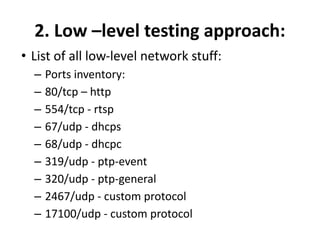
2. Low –level testing approach:
• List of all low-level network stuff:
– Ports inventory:
– 80/tcp – http
– 554/tcp - rtsp
– 67/udp - dhcps
– 68/udp - dhcpc
– 319/udp - ptp-event
– 320/udp - ptp-general
– 2467/udp - custom protocol
– 17100/udp - custom protocol
L4 protocols inventory:
•ICMP
•UDP
•TCP
•IGMP
3. Tools:
1. NMAP – enumeration and packet sending
- sS
- sU
- sO
- sX
- sN
- sF
- sX
- sA
- sY
- --scanflags
3. Tools:
2. Ostinato –packet editing and traffic generation
- Set a value for any field of any protocol
- Open and edit PCAP files, replay and save back
- Support for the most common standard protocols
- Free, Libre, Open-Source Software
3. Tools:
3. LOIC – open-source network stress testing
and denial-of-service attack application
- IC Switch throughput test
4. Test setup
5. Logs gathering and analysis:
The key thing is to gather and analyze all available info from all
system components (switch and microcontroller) to recognize
and eliminate bottlenecks and issues:
- Buffer overflows and underflows
- Queue overflows and underflows
- Protocol/link state changes
- Tx/Rx error counters
- Switch counters
- Error messages
- Power dropdown
- Unauthorized recording
- Voltage levels
- …
6. Issues found:
Issue Web server goes
down during polite
TCP scan
Discovered/
Investigated
NMAP scan
Root cause LwIP configuration issue
Issues found:
Issue Discovered/
investigated
Root cause
Hard-fault occurs if send
fragmented UDP-packet
NMAP/
Wireshark/
Ostinato
LwIP incorrectly reassemble
fragmented UDP packets
Issues found:
Issue Discovered/
investigated
Root
cause
Device can be shutdown by specially crafted
control message
Script/fuzzing Input
validation
issue
Device can turn off it’s power supply and network chip power supply ☺
Issues found:
Issue Device hard-fault if send
abnormally large or small
message on control port -
Discovered/
investigated
LOIC/
Script/fuzzing
Root cause Input validation issue
Issues found:
Issue Discovered/
investigated
Root cause
Sending short ptp packet cause ptp
recalibration and packet loss
NMAP scan
Ostinato
LwIP issue
Issues found:
Issue Discovered/
investigated
Root cause
Network link goes down and Up
during nmap scan
NMAP/
Wireshark/
Ostinato
PSU issue for new IC
switch
Network link goes down during
nmap scan
NMAP/
Wireshark/
Ostinato
unauthorized command
on switch management
interface
Issues found:
Issue Discovered/
investigated
Root
cause
Device become unreachable if send short UDP
packet on port 319/320
NMAP scan
Ostinato
IC switch
issue
All devices in chain become unavailable if perform
UDP flood on port 319/320 of last device in chain
LOIC/Ostinato IC switch
issue
7. Test cases:
Fuzzing!
Test cases:
Test cases:
8. Process:
• Perform low-level testing to
every hardware changes
• Preform low-level testing for
every configuration changes
• Preform low-level testing for
every low-level structures
changes
• Preform low-level testing
periodically
Conclusion:
If you still hesitate about
the necessity to perform
low-level network testing
– go to the issues found
chapter!

Embedded Webinar #17 "Low-level Network Testing in Embedded Devices Development"

  • 1.
    Network Security in Embeddeddevices Serhii Korniienko - Embedded QA engineer
  • 2.
    Examples of propertiesof typical embedded computers when compared with general-purpose counterparts are: • low power consumption • small size • rugged operating ranges • low per-unit cost • often ‘non-standard‘ solution
  • 3.
    Why low-level networktesting is a must in embedded: • Often custom protocols used to reduce CPU/RAM/ROM/bandwidth usage • Low cost • Timing properties of the program depend heavily on its environment • Environment = +Process or & Memory Hierarchy + Operating System, other processes/threads, … + Network + I/O Devices +…
  • 4.
    Our experience: 1. Requirements 2.Approach 3. Tools 4. Test setup 5. Logs gathering and analysis 6. Issues 7. Test cases 8. Process
  • 5.
    1. Our requirements: •Low cost – cheapest HW components approved by customer (BoM < 20$) • Http and custom UDP support • Stack: freeRTOS + LwIP • Rigid requirements on synchronization jitter (PTP) • IC network switch to build daisy-chained network structure • Stable work in heavy loaded network (1Gb wireshark dump file per minute)
  • 6.
    2. Low –leveltesting approach: • List of all low-level network stuff: – Ports inventory: – 80/tcp – http – 554/tcp - rtsp – 67/udp - dhcps – 68/udp - dhcpc – 319/udp - ptp-event – 320/udp - ptp-general – 2467/udp - custom protocol – 17100/udp - custom protocol
  • 7.
  • 8.
    3. Tools: 1. NMAP– enumeration and packet sending - sS - sU - sO - sX - sN - sF - sX - sA - sY - --scanflags
  • 9.
    3. Tools: 2. Ostinato–packet editing and traffic generation - Set a value for any field of any protocol - Open and edit PCAP files, replay and save back - Support for the most common standard protocols - Free, Libre, Open-Source Software
  • 10.
    3. Tools: 3. LOIC– open-source network stress testing and denial-of-service attack application - IC Switch throughput test
  • 11.
  • 12.
    5. Logs gatheringand analysis: The key thing is to gather and analyze all available info from all system components (switch and microcontroller) to recognize and eliminate bottlenecks and issues: - Buffer overflows and underflows - Queue overflows and underflows - Protocol/link state changes - Tx/Rx error counters - Switch counters - Error messages - Power dropdown - Unauthorized recording - Voltage levels - …
  • 13.
    6. Issues found: IssueWeb server goes down during polite TCP scan Discovered/ Investigated NMAP scan Root cause LwIP configuration issue
  • 14.
    Issues found: Issue Discovered/ investigated Rootcause Hard-fault occurs if send fragmented UDP-packet NMAP/ Wireshark/ Ostinato LwIP incorrectly reassemble fragmented UDP packets
  • 15.
    Issues found: Issue Discovered/ investigated Root cause Devicecan be shutdown by specially crafted control message Script/fuzzing Input validation issue Device can turn off it’s power supply and network chip power supply ☺
  • 16.
    Issues found: Issue Devicehard-fault if send abnormally large or small message on control port - Discovered/ investigated LOIC/ Script/fuzzing Root cause Input validation issue
  • 17.
    Issues found: Issue Discovered/ investigated Rootcause Sending short ptp packet cause ptp recalibration and packet loss NMAP scan Ostinato LwIP issue
  • 18.
    Issues found: Issue Discovered/ investigated Rootcause Network link goes down and Up during nmap scan NMAP/ Wireshark/ Ostinato PSU issue for new IC switch Network link goes down during nmap scan NMAP/ Wireshark/ Ostinato unauthorized command on switch management interface
  • 19.
    Issues found: Issue Discovered/ investigated Root cause Devicebecome unreachable if send short UDP packet on port 319/320 NMAP scan Ostinato IC switch issue All devices in chain become unavailable if perform UDP flood on port 319/320 of last device in chain LOIC/Ostinato IC switch issue
  • 20.
  • 21.
  • 22.
  • 23.
    8. Process: • Performlow-level testing to every hardware changes • Preform low-level testing for every configuration changes • Preform low-level testing for every low-level structures changes • Preform low-level testing periodically
  • 24.
    Conclusion: If you stillhesitate about the necessity to perform low-level network testing – go to the issues found chapter!