Operating System
LINUX
 Introduction
 Evolution of Linux
 Linux architecture
 Parts of Linux
 Features of Linux
 Linux Distributions
 Uses
 Conclusion
A free Unix-type operating system developed
under GNU General Public License.
Free and Open source software - meaning
underlying source code may be used ,modified and
distributed either commercially or non-
commercially.
Supports most of the hardware platforms.
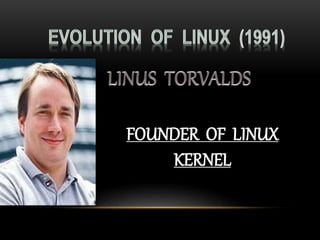
FOUNDER OF LINUX
KERNEL
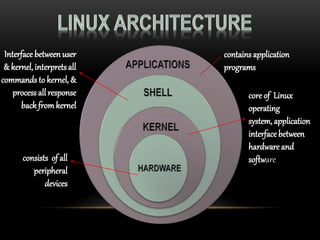
contains application
programs
Interface betweenuser
& kernel, interpretsall
commands to kernel, &
process all response
back fromkernel
core of Linux
operating
system, application
interface between
hardware and
softwareconsists of all
peripheral
devices
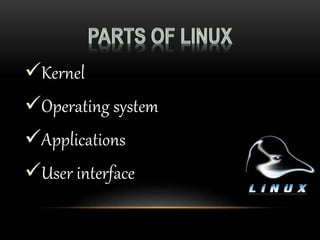
Kernel
Operating system
Applications
User interface
Portable
Open source
Multi-user
Multi-programming
Security
A Distribution, often called distro is a member of the
Linux family of computer operating system.
Includes Linux kernel, supporting utilities and libraries ,
and usually a large amount of application softwares.
Some popular mainstream Linux distributions are –
Debian ,Ubuntu, Linux Mint, Gentoo, Fedora, Arch Linux,
Open SUSE and Red Hat
 Desktops
 Servers, Mainframes and Supercomputers
 Smart devices
 Embedded devices
 Gaming
 Specialized uses – HTPC, digital security, education, in space, etc.
 Old computers
 Government sector
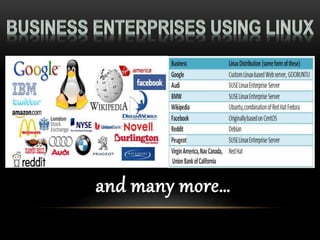
and many more…
 Already successful on many devices, moving towards many other
technological areas,
 Is developing continuously through community driven projects,
 Reason for the growth of cloud computing and popular web 2.0
services like Twitter, Linked In, You Tube, Google, etc.,
 Linux will be increasingly the platform for new technologies.
Huma Parween
BCA SEM I
Guru Nanak College

Linux