LINUX
P R E S E N T E D B Y
M I S S L A L R I N M U A N I , B P O 3 R D Y E A R
OVERVIEW
• WHAT IS LINUX?
• HISTORY
• GNU PROJECT
• BEGINNING OF LINUX
• FEATURES
• LINUX DISTRIBUTIONS
• APPLICATIONS
WHAT IS UNIX?
• Linux is a generic term referring to Unix-like graphical user interface (GUI) based
computer operating systems.
• It is Multi-user, Multitasking, Multiprocessor
• Coexists with other Operating Systems
• Runs on multiple platforms
HISTORY
• In 80’s, Microsoft’s DOS was the dominated OS for PC
• Apple MAC was better, but expensive
• UNIX was much better, but much, much more expensive. Only for minicomputer for
commercial applications
• People was looking for a UNIX based system, which is cheaper and can run on PC
GNU PROJECT
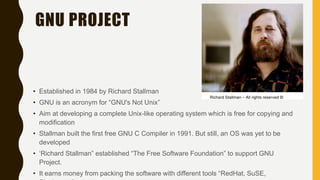
• Established in 1984 by Richard Stallman
• GNU is an acronym for “GNU's Not Unix”
• Aim at developing a complete Unix-like operating system which is free for copying and
modification
• Stallman built the first free GNU C Compiler in 1991. But still, an OS was yet to be
developed
• ‘Richard Stallman” established “The Free Software Foundation” to support GNU
Project.
• It earns money from packing the software with different tools “RedHat, SuSE,
BEGINNING OF LINUX
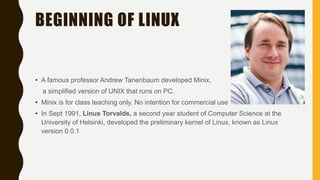
• A famous professor Andrew Tanenbaum developed Minix,
a simplified version of UNIX that runs on PC.
• Minix is for class teaching only. No intention for commercial use
• In Sept 1991, Linus Torvalds, a second year student of Computer Science at the
University of Helsinki, developed the preliminary kernel of Linux, known as Linux
version 0.0.1
FEATURES
• Open Source
• Free.
• Compatibility on most hardware.
• Well documented.
• Customizable.
• Great Graphical interface.
• Firewall is a part of Kernel.
• TCP/IP Networking.
LINUX-FREE SOFTWARE
• Free software, as defined by the FSF (Free
Software Foundation), is a "matter of liberty,
not price." To qualify as free software by FSF
standards, you must be able to:
• Run the program for any purpose you want
to, rather than be restricted in what you can
use it for.
• Share the program with others.
• Improve the program and release those
improvements so that others can use them.
LINUX IS VIRUS FREE!!
Linux is "virus-free" in that there are essentially no viruses
for Linux in the wild.
Linux Provide Security
• As there is a limited access Of user to basic
files and folders, in Linux network it provide
security to user’s privacy.
Without disclosing the secured data
Linux acts as a efficient server.
Linux Provide
Security
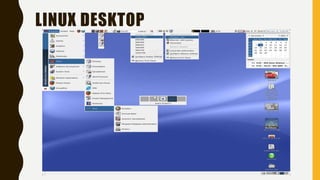
LINUX DESKTOP
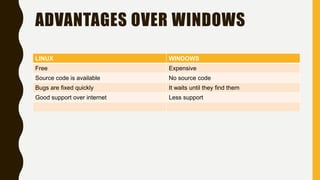
ADVANTAGES OVER WINDOWS
LINUX WINDOWS
Free Expensive
Source code is available No source code
Bugs are fixed quickly It waits until they find them
Good support over internet Less support
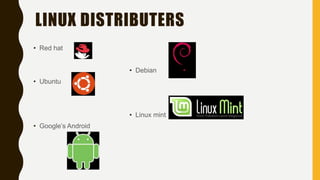
LINUX DISTRIBUTERS
• Red hat
• Debian
• Ubuntu
• Linux mint
• Google’s Android
APPLICATIONS
• Some companies running Linux servers:
• Google
• Cisco
• Panasonic
• Toyota
• U.S army
• FBI
• IBM
• Facebook
• Wikipedia
THANK YOU

Linux

  • 1.
    LINUX P R ES E N T E D B Y M I S S L A L R I N M U A N I , B P O 3 R D Y E A R
  • 2.
    OVERVIEW • WHAT ISLINUX? • HISTORY • GNU PROJECT • BEGINNING OF LINUX • FEATURES • LINUX DISTRIBUTIONS • APPLICATIONS
  • 3.
    WHAT IS UNIX? •Linux is a generic term referring to Unix-like graphical user interface (GUI) based computer operating systems. • It is Multi-user, Multitasking, Multiprocessor • Coexists with other Operating Systems • Runs on multiple platforms
  • 4.
    HISTORY • In 80’s,Microsoft’s DOS was the dominated OS for PC • Apple MAC was better, but expensive • UNIX was much better, but much, much more expensive. Only for minicomputer for commercial applications • People was looking for a UNIX based system, which is cheaper and can run on PC
  • 5.
    GNU PROJECT • Establishedin 1984 by Richard Stallman • GNU is an acronym for “GNU's Not Unix” • Aim at developing a complete Unix-like operating system which is free for copying and modification • Stallman built the first free GNU C Compiler in 1991. But still, an OS was yet to be developed • ‘Richard Stallman” established “The Free Software Foundation” to support GNU Project. • It earns money from packing the software with different tools “RedHat, SuSE,
  • 6.
    BEGINNING OF LINUX •A famous professor Andrew Tanenbaum developed Minix, a simplified version of UNIX that runs on PC. • Minix is for class teaching only. No intention for commercial use • In Sept 1991, Linus Torvalds, a second year student of Computer Science at the University of Helsinki, developed the preliminary kernel of Linux, known as Linux version 0.0.1
  • 7.
    FEATURES • Open Source •Free. • Compatibility on most hardware. • Well documented. • Customizable. • Great Graphical interface. • Firewall is a part of Kernel. • TCP/IP Networking.
  • 8.
    LINUX-FREE SOFTWARE • Freesoftware, as defined by the FSF (Free Software Foundation), is a "matter of liberty, not price." To qualify as free software by FSF standards, you must be able to: • Run the program for any purpose you want to, rather than be restricted in what you can use it for. • Share the program with others. • Improve the program and release those improvements so that others can use them.
  • 9.
    LINUX IS VIRUSFREE!! Linux is "virus-free" in that there are essentially no viruses for Linux in the wild.
  • 10.
    Linux Provide Security •As there is a limited access Of user to basic files and folders, in Linux network it provide security to user’s privacy. Without disclosing the secured data Linux acts as a efficient server. Linux Provide Security
  • 11.
  • 13.
    ADVANTAGES OVER WINDOWS LINUXWINDOWS Free Expensive Source code is available No source code Bugs are fixed quickly It waits until they find them Good support over internet Less support
  • 14.
    LINUX DISTRIBUTERS • Redhat • Debian • Ubuntu • Linux mint • Google’s Android
  • 15.
    APPLICATIONS • Some companiesrunning Linux servers: • Google • Cisco • Panasonic • Toyota • U.S army • FBI • IBM • Facebook • Wikipedia
  • 16.