
Kamal Ahmed
B.Tech, ECE-E
1210412501
 Introduction
 How it Started?
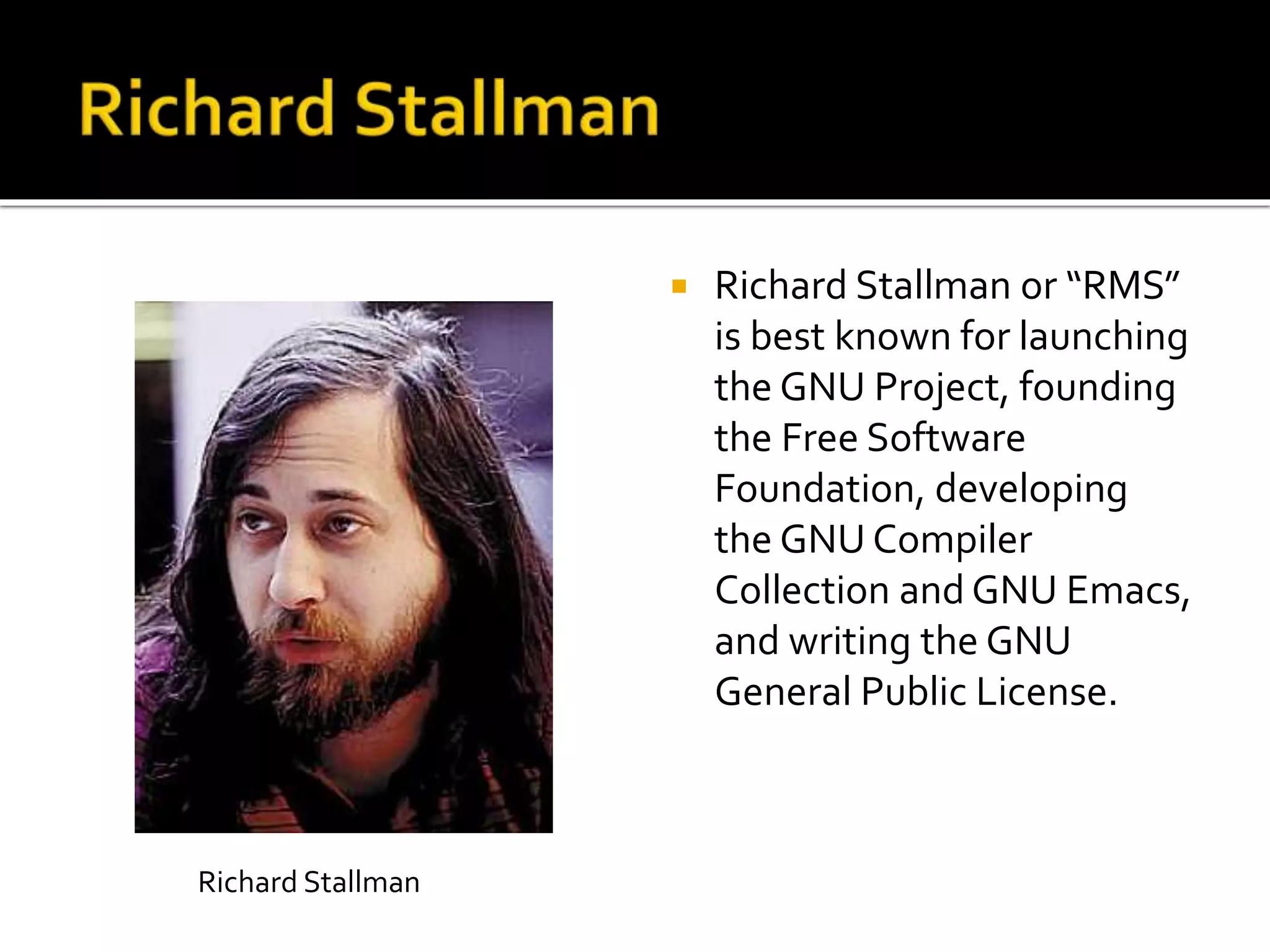
 Richard Stallman
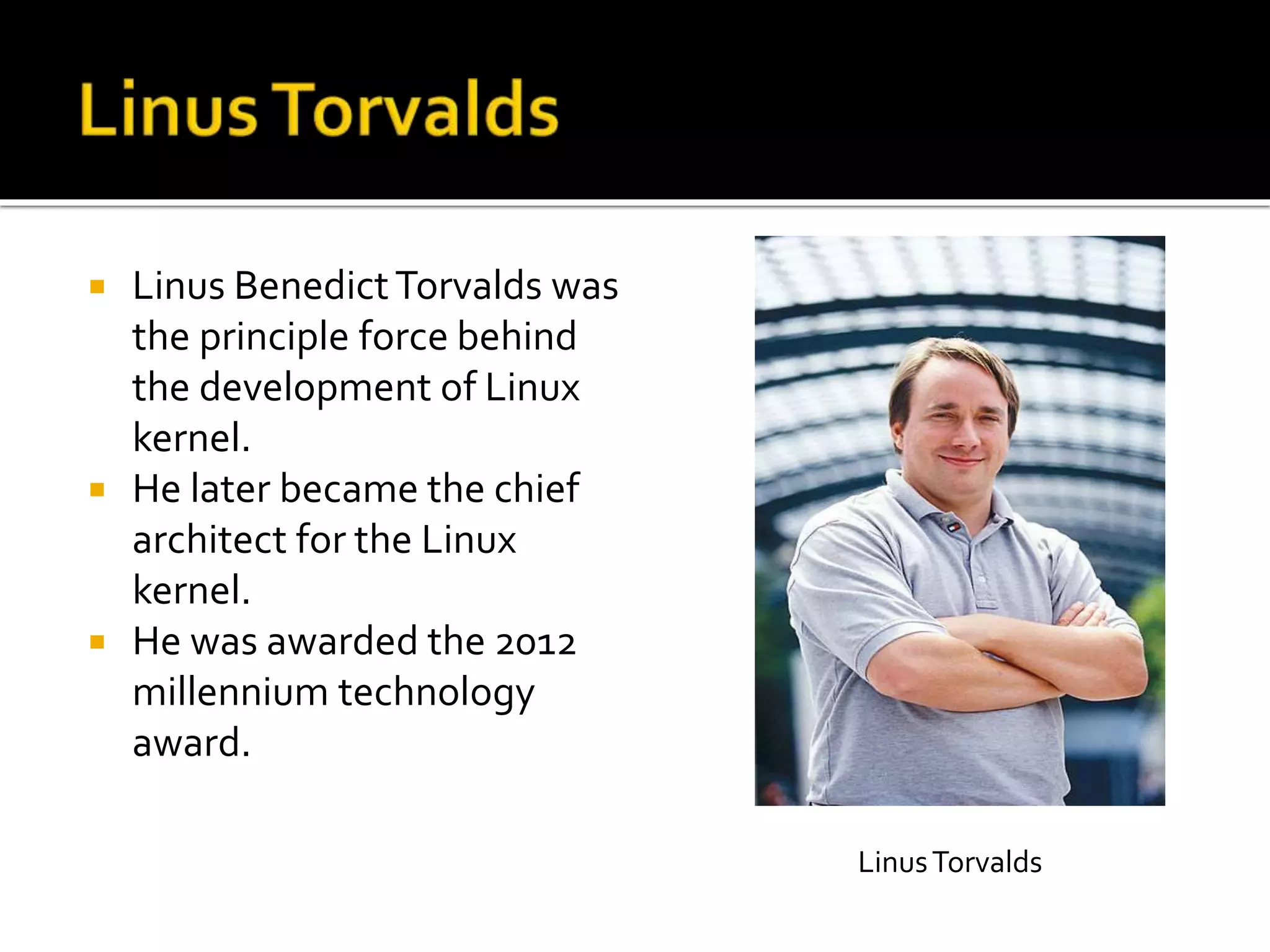
 LinusTorvalds
 BSD
 MINIX
 TUX the Linux Mascot
 Linux today
 Conclusion
 Acknowledgements
 Linux is a Unix-like operating system assembled under the
model of free and open source software.
 Linux was mainly programmed in C and Assembly
languages.
 The development of Linux started in the early 80’s when
Richard Stallman started the GNU project.
 Linux was first originally developed as a free operating
system for Intel x86 processors, today more than 90% of the
worlds fastest super computers use a version of Linux as the
OS.
 Unix:-
 The Unix operating system was conceived and implemented
in 1969 at AT&T’s Bell Laboratories in United States by Ken
Thompson, Dennis Ritchie, Douglas Mcllory, Joe Ossanna.
 It was first released in 1971 and was initially entirely written
in assembly language. Later in 1973 Unix was rewritten in C
by Dennis Ritchie (with exceptions to kernel and I/O).
 In 1984 AT&T divested itself of Bell Labs. Free of legal glitch
Bell labs started selling Unix as a proprietary software.
 Unix grew quickly and became widely adopted in
educational institutions and businesses.
 The GNU:-
 The GNU project started in 1983 by Richard Stallman, Had
the goal of creating a “Complete UNIX-compatible software
system” composed entirely of free software.
 The development started in 1984 when Richard Stallman
quit his job in MIT in order to make GNU a free software and
so that no one could claim its ownership or interfere with its
distribution as free software.
 In October 1985 Richard Stallman started the free software
foundation that even today exists for open source and free
software.
 Richard Stallman or “RMS”
is best known for launching
the GNU Project, founding
the Free Software
Foundation, developing
the GNU Compiler
Collection and GNU Emacs,
and writing the GNU
General Public License.
Richard Stallman
 Linus BenedictTorvalds was
the principle force behind
the development of Linux
kernel.
 He later became the chief
architect for the Linux
kernel.
 He was awarded the 2012
millennium technology
award.
LinusTorvalds
 BSD stands for Berkeley Software Distribution. Also known
as the Berkeley Unix.
 This was developed by the California University in the late
80’s.Though not publicly released till 1992 due to legal
complications.
 BSD is another UNIX-like operating system just like Linux
though released after Linux. LinusTorvalds himself said that
he wouldn't have developed the Linux kernel if 386BSD
would have been available at that time.
 An abridged 12,000 lines of source code in C. MINIX is
another UNIX-like OS based on micro kernel and inspired by
Linux.
 MINIX stands for Mini Unix. Developed solely by Andrew S.
Tanenbaum in 1987, it was used for educational and research
purposes only.
 MINIX is now available under the BSD license fromApril
2000.
 MINIX has released 5 versions of it so far.
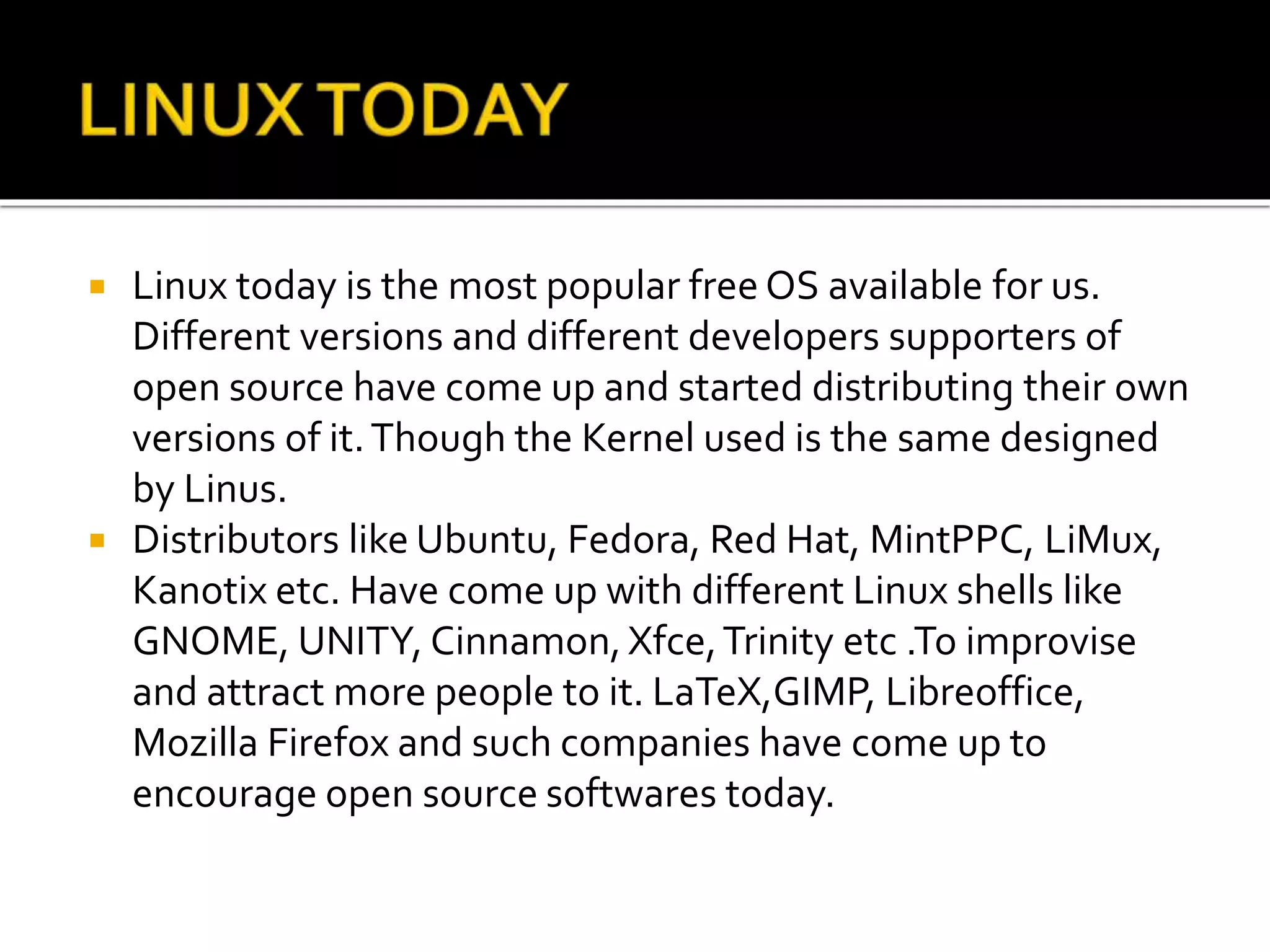
 Tux was designed by Larry Ewing in
1996.Though the penguin was originally
the idea of LinusTorvalds.
 Tux the penguin is generally believed to
be the mascot of Linux.Though there are
many other depictions for it.
 Many video games for Linux were made
onTux like SuperTux, SuperTux Kart etc.
 Various other mascots likeTuz were used
throughout the past few years in order to
promote Linux.
 Linux today is the most popular free OS available for us.
Different versions and different developers supporters of
open source have come up and started distributing their own
versions of it.Though the Kernel used is the same designed
by Linus.
 Distributors like Ubuntu, Fedora, Red Hat, MintPPC, LiMux,
Kanotix etc. Have come up with different Linux shells like
GNOME, UNITY, Cinnamon,Xfce,Trinity etc .To improvise
and attract more people to it. LaTeX,GIMP, Libreoffice,
Mozilla Firefox and such companies have come up to
encourage open source softwares today.
 The market share of Linux is constantly growing with people
moving away from windows servers.The Microsoft CEO
Steve Ballmer in 2008 accepted that 60% of the servers run
on Linux where as only 40% run onWindows.
 Since 2009 Google has provided funding for theWINE
project. (WINE- Windows Under Linux)
 Though there is a lot of progress in the servers.The
individual desktop ownership share of Linux is less than
1.74% where asWindows owns about 85%.
 About 90% of the top 500 Supercomputers run on a version
of Linux, in which all of the top 10 run on Linux.
 The GNU/Linux is the world’s biggest supporter of free
software.
 Richard Stallman, LinusTorvalds have contributed more than
20 years of their lifetime in order to support and bring about
a change in the modern world.
 The Free software Foundation (FSF) started by Richard
Stallman today has billions of free applications contributed
by millions of followers.
Linux and its history

Linux and its history

  • 1.
  • 2.
     Introduction  Howit Started?  Richard Stallman  LinusTorvalds  BSD  MINIX  TUX the Linux Mascot  Linux today  Conclusion  Acknowledgements
  • 3.
     Linux isa Unix-like operating system assembled under the model of free and open source software.  Linux was mainly programmed in C and Assembly languages.  The development of Linux started in the early 80’s when Richard Stallman started the GNU project.  Linux was first originally developed as a free operating system for Intel x86 processors, today more than 90% of the worlds fastest super computers use a version of Linux as the OS.
  • 4.
     Unix:-  TheUnix operating system was conceived and implemented in 1969 at AT&T’s Bell Laboratories in United States by Ken Thompson, Dennis Ritchie, Douglas Mcllory, Joe Ossanna.  It was first released in 1971 and was initially entirely written in assembly language. Later in 1973 Unix was rewritten in C by Dennis Ritchie (with exceptions to kernel and I/O).  In 1984 AT&T divested itself of Bell Labs. Free of legal glitch Bell labs started selling Unix as a proprietary software.  Unix grew quickly and became widely adopted in educational institutions and businesses.
  • 5.
     The GNU:- The GNU project started in 1983 by Richard Stallman, Had the goal of creating a “Complete UNIX-compatible software system” composed entirely of free software.  The development started in 1984 when Richard Stallman quit his job in MIT in order to make GNU a free software and so that no one could claim its ownership or interfere with its distribution as free software.  In October 1985 Richard Stallman started the free software foundation that even today exists for open source and free software.
  • 6.
     Richard Stallmanor “RMS” is best known for launching the GNU Project, founding the Free Software Foundation, developing the GNU Compiler Collection and GNU Emacs, and writing the GNU General Public License. Richard Stallman
  • 7.
     Linus BenedictTorvaldswas the principle force behind the development of Linux kernel.  He later became the chief architect for the Linux kernel.  He was awarded the 2012 millennium technology award. LinusTorvalds
  • 9.
     BSD standsfor Berkeley Software Distribution. Also known as the Berkeley Unix.  This was developed by the California University in the late 80’s.Though not publicly released till 1992 due to legal complications.  BSD is another UNIX-like operating system just like Linux though released after Linux. LinusTorvalds himself said that he wouldn't have developed the Linux kernel if 386BSD would have been available at that time.
  • 10.
     An abridged12,000 lines of source code in C. MINIX is another UNIX-like OS based on micro kernel and inspired by Linux.  MINIX stands for Mini Unix. Developed solely by Andrew S. Tanenbaum in 1987, it was used for educational and research purposes only.  MINIX is now available under the BSD license fromApril 2000.  MINIX has released 5 versions of it so far.
  • 11.
     Tux wasdesigned by Larry Ewing in 1996.Though the penguin was originally the idea of LinusTorvalds.  Tux the penguin is generally believed to be the mascot of Linux.Though there are many other depictions for it.  Many video games for Linux were made onTux like SuperTux, SuperTux Kart etc.  Various other mascots likeTuz were used throughout the past few years in order to promote Linux.
  • 12.
     Linux todayis the most popular free OS available for us. Different versions and different developers supporters of open source have come up and started distributing their own versions of it.Though the Kernel used is the same designed by Linus.  Distributors like Ubuntu, Fedora, Red Hat, MintPPC, LiMux, Kanotix etc. Have come up with different Linux shells like GNOME, UNITY, Cinnamon,Xfce,Trinity etc .To improvise and attract more people to it. LaTeX,GIMP, Libreoffice, Mozilla Firefox and such companies have come up to encourage open source softwares today.
  • 13.
     The marketshare of Linux is constantly growing with people moving away from windows servers.The Microsoft CEO Steve Ballmer in 2008 accepted that 60% of the servers run on Linux where as only 40% run onWindows.  Since 2009 Google has provided funding for theWINE project. (WINE- Windows Under Linux)  Though there is a lot of progress in the servers.The individual desktop ownership share of Linux is less than 1.74% where asWindows owns about 85%.  About 90% of the top 500 Supercomputers run on a version of Linux, in which all of the top 10 run on Linux.
  • 14.
     The GNU/Linuxis the world’s biggest supporter of free software.  Richard Stallman, LinusTorvalds have contributed more than 20 years of their lifetime in order to support and bring about a change in the modern world.  The Free software Foundation (FSF) started by Richard Stallman today has billions of free applications contributed by millions of followers.