9/30/2013 1
What Is Linux...
Linus Torvalds was the chief developer of the project.
Released on 5th October, 1991 .
Since beginning it was released as a free and open source.
Linux is available in multiple languages and is supported by multiple platforms.
Monolithic Kernel is an distinct feature which distinguishes it from other Operating
Systems.
9/30/2013 2
Evolution Of Linux….
9/30/2013 3
UNIX
[1971]
• Developed at AT&T’s Labs by team lead by Dennis Ritchie and Ken Thompson.
• It’s Source Code was used for basic development of the project
GNU
[1988]
• The project was started by Richard Stallman.
• It provided the concept of free software to Linux Project .
• GNU General Public License was included in the Linux for purpose of issuing
license to the free user.
MINIX
[1990]
• Project was started by S.Tanenbaum and Linus Torvalds.
• Development of Linux Kernel was started during MINIX designing.
• Applications written for MINIX were used in Linux.
The Design…
Linux derives much of its basic design from principles
established in Unix.
Linux uses a monolithic kernel, which handles process
control, networking, and peripheral and file system access.
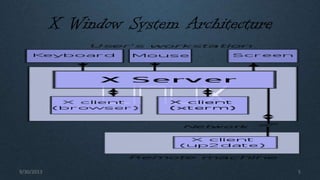
The GUI used by most Linux systems is built on top of an
implementation of the X Window System.
9/30/2013 4
X Window System Architecture
9/30/2013 5
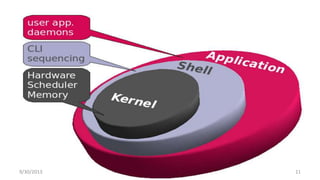
Linux Interface….
Users operate a Linux-based system through two possible
methods provided.
CLI(Command Line Interface)
Shell is used for the purpose of implementing CLI.
Controls attached to the associated hardware(Used in
embedded systems).
9/30/2013 6
THE KERNEL….
The Linux kernel was released under the GNU General Public
License version 2 .
Development started with a task switcher in Intel 80386 assembly
language and a terminal driver.
Being a free software there have been many modulations and changes
based on the user and developers’ suggestions.
9/30/2013 7
KERNEL ARCHITECTURE...
Linux is written in the version of the C programming
language.
Device drivers and kernel extensions run in kernel
space(Ring O).
Linux enables separate execution of graphics
system ,separate from the kernel .
9/30/2013 8
FEATURES OF LINUX KERNEL…
Kernel possesses an ability to interrupt a task executing kernel code and
perform provides pre-emptive scheduling.
The Pre-emption patch improves latency, increases responsiveness, and
makes Linux more suitable for real-time applications.
Kernel provides a high portability to the OS , hence can be used for a
wide range of products i.e. , from Mainframe computers to the hand held
devices.
9/30/2013 9
Kernel Features….
Pre emption
Portability
Kernel Panic
Kernel Oops
9/30/2013 10
9/30/2013 11
LINUX DISTRIBUTIONS….
Linux source code has been distributed on the basis of the package
management system used , they are basically divided into 3 categories.
Debian based
Gentoo based
Pacman based
9/30/2013 12
DEBIAN BASED DISTRIBUTIONS…
Debian GNU/Linux is a distribution that emphasizes on free software.
It is supported on multiple hardware platforms.
Debian distributions use the .deb package format and
the dpkg package manager.
Knoppix , Linux Mint , Ubuntu are popular examples of Debian based
Linux distribution.
9/30/2013 13
Gentoo Based Distributions…
It is designed to have highly optimized and frequently
updated software.
These distributions use the Portage package management
system .
Gentoox , Sabayon Linux , Chrome OS are popular examples
of gentoo based OS.
9/30/2013 14
Pacman Based Distributions..
They use the Pacman package manager.
They are capable of resolving dependencies and
automatically downloading and installing all necessary
packages.
Arch Linux , Frugalware Linux , Parabola Linux are the most
successful distributions of this type.
9/30/2013 15
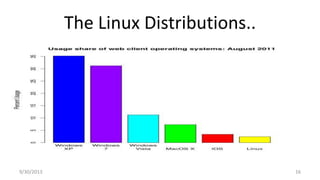
The Linux Distributions..
9/30/2013 16
THE LINUX FOUNDATION…
Founded in 2007 by the merger of the Open Source Development
Lab (OSDL) and the Free Standards Group (FSG).
It promotes, protects, and standardizes Linux by providing a comprehensive
set of services to compete effectively with closed platforms.
It is constituted by 102 corporate members and multitude of individual
members who certify the new development done in the Linux code.
It also provide funds for the purpose of research and development in Linux.
9/30/2013 17
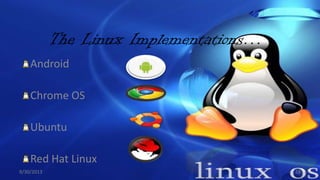
The Linux Implementations…
Android
Chrome OS
Ubuntu
Red Hat Linux
9/30/2013 18

Linux

  • 1.
  • 2.
    What Is Linux... LinusTorvalds was the chief developer of the project. Released on 5th October, 1991 . Since beginning it was released as a free and open source. Linux is available in multiple languages and is supported by multiple platforms. Monolithic Kernel is an distinct feature which distinguishes it from other Operating Systems. 9/30/2013 2
  • 3.
    Evolution Of Linux…. 9/30/20133 UNIX [1971] • Developed at AT&T’s Labs by team lead by Dennis Ritchie and Ken Thompson. • It’s Source Code was used for basic development of the project GNU [1988] • The project was started by Richard Stallman. • It provided the concept of free software to Linux Project . • GNU General Public License was included in the Linux for purpose of issuing license to the free user. MINIX [1990] • Project was started by S.Tanenbaum and Linus Torvalds. • Development of Linux Kernel was started during MINIX designing. • Applications written for MINIX were used in Linux.
  • 4.
    The Design… Linux derivesmuch of its basic design from principles established in Unix. Linux uses a monolithic kernel, which handles process control, networking, and peripheral and file system access. The GUI used by most Linux systems is built on top of an implementation of the X Window System. 9/30/2013 4
  • 5.
    X Window SystemArchitecture 9/30/2013 5
  • 6.
    Linux Interface…. Users operatea Linux-based system through two possible methods provided. CLI(Command Line Interface) Shell is used for the purpose of implementing CLI. Controls attached to the associated hardware(Used in embedded systems). 9/30/2013 6
  • 7.
    THE KERNEL…. The Linuxkernel was released under the GNU General Public License version 2 . Development started with a task switcher in Intel 80386 assembly language and a terminal driver. Being a free software there have been many modulations and changes based on the user and developers’ suggestions. 9/30/2013 7
  • 8.
    KERNEL ARCHITECTURE... Linux iswritten in the version of the C programming language. Device drivers and kernel extensions run in kernel space(Ring O). Linux enables separate execution of graphics system ,separate from the kernel . 9/30/2013 8
  • 9.
    FEATURES OF LINUXKERNEL… Kernel possesses an ability to interrupt a task executing kernel code and perform provides pre-emptive scheduling. The Pre-emption patch improves latency, increases responsiveness, and makes Linux more suitable for real-time applications. Kernel provides a high portability to the OS , hence can be used for a wide range of products i.e. , from Mainframe computers to the hand held devices. 9/30/2013 9
  • 10.
  • 11.
  • 12.
    LINUX DISTRIBUTIONS…. Linux sourcecode has been distributed on the basis of the package management system used , they are basically divided into 3 categories. Debian based Gentoo based Pacman based 9/30/2013 12
  • 13.
    DEBIAN BASED DISTRIBUTIONS… DebianGNU/Linux is a distribution that emphasizes on free software. It is supported on multiple hardware platforms. Debian distributions use the .deb package format and the dpkg package manager. Knoppix , Linux Mint , Ubuntu are popular examples of Debian based Linux distribution. 9/30/2013 13
  • 14.
    Gentoo Based Distributions… Itis designed to have highly optimized and frequently updated software. These distributions use the Portage package management system . Gentoox , Sabayon Linux , Chrome OS are popular examples of gentoo based OS. 9/30/2013 14
  • 15.
    Pacman Based Distributions.. Theyuse the Pacman package manager. They are capable of resolving dependencies and automatically downloading and installing all necessary packages. Arch Linux , Frugalware Linux , Parabola Linux are the most successful distributions of this type. 9/30/2013 15
  • 16.
  • 17.
    THE LINUX FOUNDATION… Foundedin 2007 by the merger of the Open Source Development Lab (OSDL) and the Free Standards Group (FSG). It promotes, protects, and standardizes Linux by providing a comprehensive set of services to compete effectively with closed platforms. It is constituted by 102 corporate members and multitude of individual members who certify the new development done in the Linux code. It also provide funds for the purpose of research and development in Linux. 9/30/2013 17
  • 18.
    The Linux Implementations… Android ChromeOS Ubuntu Red Hat Linux 9/30/2013 18