Linux
Content Page
1. Linus Torvalds
2. The History Of Linux
3. Creation
4. Naming
5. Official Mascot
6. Competition from Microsoft
7. Performance & Application
8. Reference Page
Linus Torvalds
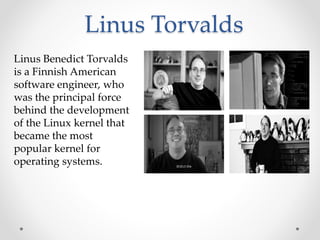
Linus Benedict Torvalds
is a Finnish American
software engineer, who
was the principal force
behind the development
of the Linux kernel that
became the most
popular kernel for
operating systems.
The history of Linux
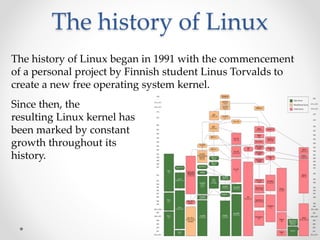
The history of Linux began in 1991 with the commencement
of a personal project by Finnish student Linus Torvalds to
create a new free operating system kernel.
Since then, the
resulting Linux kernel has
been marked by constant
growth throughout its
history.
Creation
In 1991, while attending the
University of Helsinki,
Torvalds became curious
about operating systems[29]
and frustrated by the
licensing of MINIX, which at
the time limited it to
educational use only.[28] He
began to work on his own
operating system kernel,
which eventually became the
Linux kernel.
Naming
Linus Torvalds had wanted to
call his invention Freax, a
portmanteau of free, "freak",
and "x" (as an allusion to
Unix). During the start of his
work on the system, he stored
the files under the name
"Freax" for about half of a
year.
Official mascot
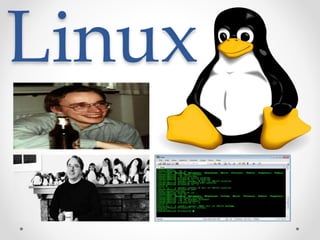
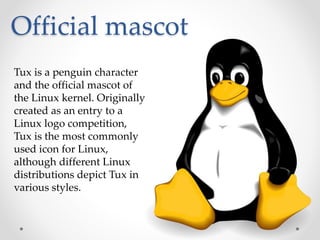
Tux is a penguin character
and the official mascot of
the Linux kernel. Originally
created as an entry to a
Linux logo competition,
Tux is the most commonly
used icon for Linux,
although different Linux
distributions depict Tux in
various styles.
Competition from
Microsoft
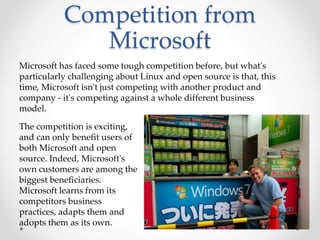
Microsoft has faced some tough competition before, but what's
particularly challenging about Linux and open source is that, this
time, Microsoft isn't just competing with another product and
company - it's competing against a whole different business
model.
The competition is exciting,
and can only benefit users of
both Microsoft and open
source. Indeed, Microsoft's
own customers are among the
biggest beneficiaries.
Microsoft learns from its
competitors business
practices, adapts them and
adopts them as its own.
Performance &
Application
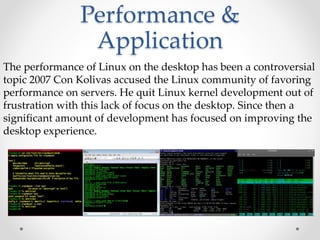
The performance of Linux on the desktop has been a controversial
topic 2007 Con Kolivas accused the Linux community of favoring
performance on servers. He quit Linux kernel development out of
frustration with this lack of focus on the desktop. Since then a
significant amount of development has focused on improving the
desktop experience.
Reference Page
https://en.wikipedia.org/wiki/History_of_Linux
https://www.google.ae/search?q=his+linux&espv=2&biw=1440&bih=716&tbm
https://en.wikipedia.org/wiki/Linus_Torvalds
https://en.wikipedia.org/wiki/Linux#Performance_and_applications

Linux Presentation

  • 1.
  • 2.
    Content Page 1. LinusTorvalds 2. The History Of Linux 3. Creation 4. Naming 5. Official Mascot 6. Competition from Microsoft 7. Performance & Application 8. Reference Page
  • 3.
    Linus Torvalds Linus BenedictTorvalds is a Finnish American software engineer, who was the principal force behind the development of the Linux kernel that became the most popular kernel for operating systems.
  • 4.
    The history ofLinux The history of Linux began in 1991 with the commencement of a personal project by Finnish student Linus Torvalds to create a new free operating system kernel. Since then, the resulting Linux kernel has been marked by constant growth throughout its history.
  • 5.
    Creation In 1991, whileattending the University of Helsinki, Torvalds became curious about operating systems[29] and frustrated by the licensing of MINIX, which at the time limited it to educational use only.[28] He began to work on his own operating system kernel, which eventually became the Linux kernel.
  • 6.
    Naming Linus Torvalds hadwanted to call his invention Freax, a portmanteau of free, "freak", and "x" (as an allusion to Unix). During the start of his work on the system, he stored the files under the name "Freax" for about half of a year.
  • 7.
    Official mascot Tux isa penguin character and the official mascot of the Linux kernel. Originally created as an entry to a Linux logo competition, Tux is the most commonly used icon for Linux, although different Linux distributions depict Tux in various styles.
  • 8.
    Competition from Microsoft Microsoft hasfaced some tough competition before, but what's particularly challenging about Linux and open source is that, this time, Microsoft isn't just competing with another product and company - it's competing against a whole different business model. The competition is exciting, and can only benefit users of both Microsoft and open source. Indeed, Microsoft's own customers are among the biggest beneficiaries. Microsoft learns from its competitors business practices, adapts them and adopts them as its own.
  • 9.
    Performance & Application The performanceof Linux on the desktop has been a controversial topic 2007 Con Kolivas accused the Linux community of favoring performance on servers. He quit Linux kernel development out of frustration with this lack of focus on the desktop. Since then a significant amount of development has focused on improving the desktop experience.
  • 10.