Linked Data and the OpenART ProjectTate, 7th October 2011Julie Allinson, University of YorkRichard StephensSteve Baylissand Martin Dow, Acuity Unlimited
“The term Linked Data refers to a set of best practices for publishing and connecting structured data on the Web.”“the Semantic Web is the goal or end result… Linked Data provides the means to reach that goal”From ‘Linked Data: The Story So Far’ - Heath, Bizer and Berners-Lee 2009
The goal of Linked Data is to enable people to share structured data on the Web as easily as they can share documents today.Bizer/Cyganiak/Heath Linked Data Tutorial, linkeddata.org
Haven’t we been putting linked data on the web for years?The web is full of data, yes, but structure in traditional web pages is largely ‘formatting’
And the ‘links’ are pretty unintelligent
Databases, search interfaces, XML etc are not really integrated into the web, just on it
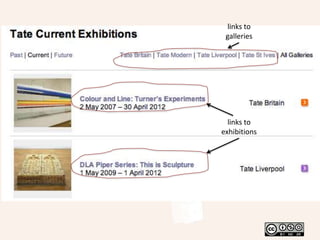
Web 2.0 services tend to work against a fixed set of sourceslinks to gallerieslinks to exhibitions
Linked dataLinked data is about identifying the ‘real-world’ things we want to describeand exposing rich information about these ‘things’in the form of linkslinked data applications operate on top of this unbound structured web of informationthe www as one big database
RDFRDF (Resource Description Framework) is a way of modelling data, conceptually (as graphs)it links things, not just documentsand creates ‘typed’ linksallows us to say meaningful things about entitiesand the relationships between them
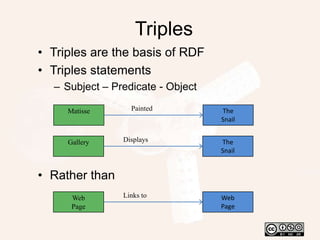
TriplesTriples are the basis of RDFTriples statementsSubject – Predicate - ObjectRather thanDisplaysPaintedLinks toThe SnailThe SnailGalleryMatisseWeb PageWeb Page
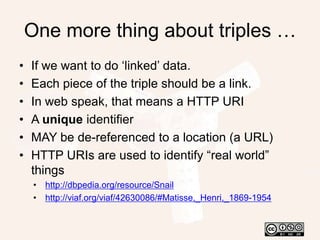
One more thing about triples …If we want to do ‘linked’ data.Each piece of the triple should be a link.In web speak, that means a HTTP URIA unique identifier
MAY be de-referenced to a location (a URL)HTTP URIs are used to identify “real world” thingshttp://dbpedia.org/resource/Snailhttp://viaf.org/viaf/42630086/#Matisse,_Henri,_1869-1954
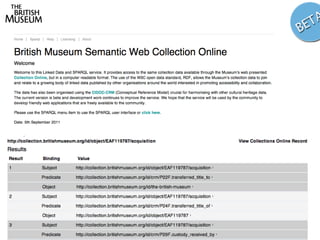
LinkedThe job of OpenART is to expose dataBut linking is where it gets interestingAnd where the (potential) value for linked data starts to show
Some Examples …
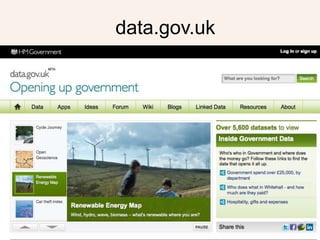
data.gov.ukOfficially launched 21st January 2010
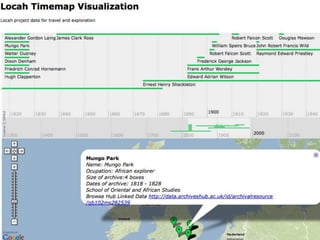
Visualisation PrototypeUsing Timemap – Googlemaps and Similehttp://code.google.com/p/timemap/Early stages with thisWill give location and ‘extent’ of archive.Will link through to Archives Hub
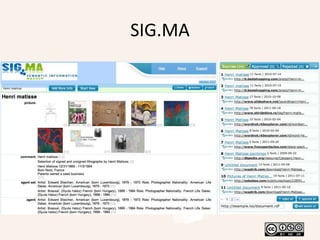
SIG.MA
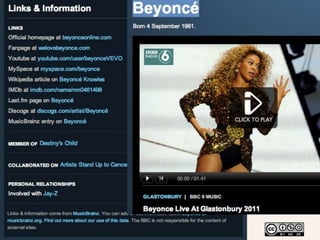
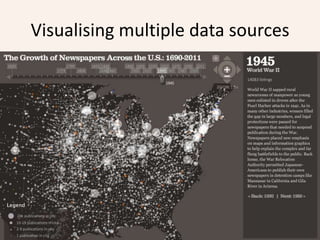
Visualising multiple data sources
For discussion?Quality and TrustLicensingControl and Loss of ControlHype CurveOther approaches
OpenART : Open metadata for Art Research at the TateJISC funded      part of their Infrastructure for Resource Discovery Strand6 months (March to July) – short!£30k – cheap!Building on the (much bigger) York’s History of Art Department and Tate’s Court Country City project funded by the AHRC.The Digital Library are leading OpenART and providing technical development to Court Country CityAcuity Unlimited are working with us on OpenART.
Doing what?designing and exposing linked open [meta]data for an important research dataset entitled "The London Art World 1660-1735", created as part of the AHRC funded Court, Country, City: British Art 1660 – 1735 project
And again, doing what?‘The London Art World 1660-1735’ is set of spreadsheets, the result of several years research into Sources (sale catalogues, newspaper adverts) of information about Sales, People, and Places (and the things being sold)from the periodThe Digital Library is already helping put this information on the web.OpenART is extending this to create ‘linked open data’.
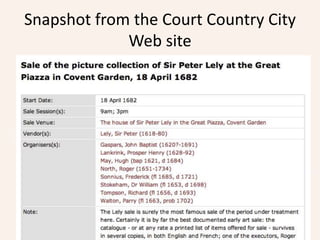
Snapshot from the Court Country City Web site
OpenART - in briefTake the spreadsheetsAnaylse them and model into an ontologyDecide how to create the linked data and how to expose it to the webExperiment a bitTest and validate the ontologyCreate the data and expose
Describing things with ontologiesan ontology is a standardized representation of knowledge as a set of concepts within a domain, and the relationships between those concepts. It can be used to reason about the entities within that domain, and may be used to describe the domain (wikipedia)or,  put another way “a way of describing things in a way other people/machines can understand” (me)
There are many ontologies out thereDublin Core is a simple ontology for describing web resourcesGeonames describes placesFor OpenART we have used two core event-based ontologiesDolce Ultra-lite Linked events (LODE)and have extended these for the domain
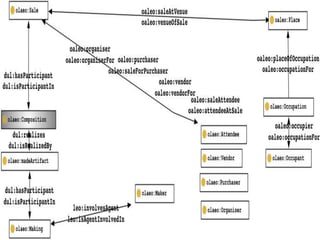
Example!Much of the OpenART data set is about art sales, which are ‘events’Linked Events Ontology has a class for ‘Event’Which we have specialized to create an OpenART class for ‘Sale’DUL has a class for ‘Social Agent’ (or person)Which is a superclass for  our term ‘Organiser’
Lost yet?What this means is that we can describe our dataset for a very narrow domain (people researching the art market)But it can be generalised and understood much more widelyBecause our narrow classes are members of broader, more general classes used in standard ontologies
Example (again)!Linked Events Ontology has a class for ‘Event’Which we have specialized to create an OpenART class for ‘Sale’Someone only looking for ‘art sales’ in 1670 can answer their research questionSomeone looking for ‘events’ in 1670 could infer from our ‘Sale’ class that these sales are also events

Linked Data and the OpenART project

  • 1.
    Linked Data andthe OpenART ProjectTate, 7th October 2011Julie Allinson, University of YorkRichard StephensSteve Baylissand Martin Dow, Acuity Unlimited
  • 2.
    “The term LinkedData refers to a set of best practices for publishing and connecting structured data on the Web.”“the Semantic Web is the goal or end result… Linked Data provides the means to reach that goal”From ‘Linked Data: The Story So Far’ - Heath, Bizer and Berners-Lee 2009
  • 3.
    The goal ofLinked Data is to enable people to share structured data on the Web as easily as they can share documents today.Bizer/Cyganiak/Heath Linked Data Tutorial, linkeddata.org
  • 4.
    Haven’t we beenputting linked data on the web for years?The web is full of data, yes, but structure in traditional web pages is largely ‘formatting’
  • 5.
    And the ‘links’are pretty unintelligent
  • 6.
    Databases, search interfaces,XML etc are not really integrated into the web, just on it
  • 7.
    Web 2.0 servicestend to work against a fixed set of sourceslinks to gallerieslinks to exhibitions
  • 8.
    Linked dataLinked datais about identifying the ‘real-world’ things we want to describeand exposing rich information about these ‘things’in the form of linkslinked data applications operate on top of this unbound structured web of informationthe www as one big database
  • 9.
    RDFRDF (Resource DescriptionFramework) is a way of modelling data, conceptually (as graphs)it links things, not just documentsand creates ‘typed’ linksallows us to say meaningful things about entitiesand the relationships between them
  • 10.
    TriplesTriples are thebasis of RDFTriples statementsSubject – Predicate - ObjectRather thanDisplaysPaintedLinks toThe SnailThe SnailGalleryMatisseWeb PageWeb Page
  • 11.
    One more thingabout triples …If we want to do ‘linked’ data.Each piece of the triple should be a link.In web speak, that means a HTTP URIA unique identifier
  • 12.
    MAY be de-referencedto a location (a URL)HTTP URIs are used to identify “real world” thingshttp://dbpedia.org/resource/Snailhttp://viaf.org/viaf/42630086/#Matisse,_Henri,_1869-1954
  • 13.
    LinkedThe job ofOpenART is to expose dataBut linking is where it gets interestingAnd where the (potential) value for linked data starts to show
  • 14.
  • 15.
  • 16.
    Visualisation PrototypeUsing Timemap– Googlemaps and Similehttp://code.google.com/p/timemap/Early stages with thisWill give location and ‘extent’ of archive.Will link through to Archives Hub
  • 18.
  • 19.
  • 21.
    For discussion?Quality andTrustLicensingControl and Loss of ControlHype CurveOther approaches
  • 22.
    OpenART : Openmetadata for Art Research at the TateJISC funded part of their Infrastructure for Resource Discovery Strand6 months (March to July) – short!£30k – cheap!Building on the (much bigger) York’s History of Art Department and Tate’s Court Country City project funded by the AHRC.The Digital Library are leading OpenART and providing technical development to Court Country CityAcuity Unlimited are working with us on OpenART.
  • 23.
    Doing what?designing andexposing linked open [meta]data for an important research dataset entitled "The London Art World 1660-1735", created as part of the AHRC funded Court, Country, City: British Art 1660 – 1735 project
  • 24.
    And again, doingwhat?‘The London Art World 1660-1735’ is set of spreadsheets, the result of several years research into Sources (sale catalogues, newspaper adverts) of information about Sales, People, and Places (and the things being sold)from the periodThe Digital Library is already helping put this information on the web.OpenART is extending this to create ‘linked open data’.
  • 25.
    Snapshot from theCourt Country City Web site
  • 26.
    OpenART - inbriefTake the spreadsheetsAnaylse them and model into an ontologyDecide how to create the linked data and how to expose it to the webExperiment a bitTest and validate the ontologyCreate the data and expose
  • 27.
    Describing things withontologiesan ontology is a standardized representation of knowledge as a set of concepts within a domain, and the relationships between those concepts. It can be used to reason about the entities within that domain, and may be used to describe the domain (wikipedia)or, put another way “a way of describing things in a way other people/machines can understand” (me)
  • 28.
    There are manyontologies out thereDublin Core is a simple ontology for describing web resourcesGeonames describes placesFor OpenART we have used two core event-based ontologiesDolce Ultra-lite Linked events (LODE)and have extended these for the domain
  • 29.
    Example!Much of theOpenART data set is about art sales, which are ‘events’Linked Events Ontology has a class for ‘Event’Which we have specialized to create an OpenART class for ‘Sale’DUL has a class for ‘Social Agent’ (or person)Which is a superclass for our term ‘Organiser’
  • 30.
    Lost yet?What thismeans is that we can describe our dataset for a very narrow domain (people researching the art market)But it can be generalised and understood much more widelyBecause our narrow classes are members of broader, more general classes used in standard ontologies
  • 31.
    Example (again)!Linked EventsOntology has a class for ‘Event’Which we have specialized to create an OpenART class for ‘Sale’Someone only looking for ‘art sales’ in 1670 can answer their research questionSomeone looking for ‘events’ in 1670 could infer from our ‘Sale’ class that these sales are also events

Editor's Notes

  • #4 Has been described as a ‘data commons’, or more usually a Web of Data.