UKOLN is supported  by: The Dublin Core Application Profile for Scholarly Works ( www. ukoln .ac. uk /repositories/ ) Knowledge Exchange Workshop 16 th  January 2007, SURF, Utrecht Julie Allinson Repositories Research Officer UKOLN, University of Bath www.bath.ac.uk
Functional requirements (selection) richer metadata set - consistent metadata support for added-value services unambiguous method of identifying full-text(s) consider version identification and most appropriate copy of a version open access materials support browse based on controlled vocabularies OpenURL link servers support citation analysis (in line with dc-citation WG recommendations) identification of the research funder and project code identification of the repository or other service making available the copy date available date of modification of a copy, to locate the latest version
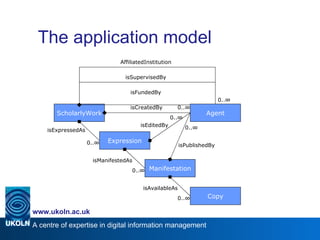
Entity-Relationship Model The model says what things are being described the set of  entities  that we want to describe and the key  relationships  between those entities FRBR (Functional Requirements for Bibliographic Records) provides the basis for our model a model for the entities that  bibliographic records  are intended to describe FRBR models the world using 4 key entities: Work, Expression, Manifestation and Item A  work  is a distinct intellectual or artistic creation. A work is an abstract entity  An  expression  is the intellectual or artistic realization of a work A  manifestation  is the physical embodiment of an expression of a work.  An  item  is a single exemplar of a manifestation. The entity defined as item is a concrete entity. but we’ve applied it’s model to  scholarly works
The application model ScholarlyWork Expression 0..∞ isExpressedAs Manifestation isManifestedAs 0..∞ Copy isAvailableAs 0..∞ isPublishedBy 0..∞ 0..∞ isEditedBy 0..∞ isCreatedBy 0..∞ isFundedBy isSupervisedBy AffiliatedInstitution Agent
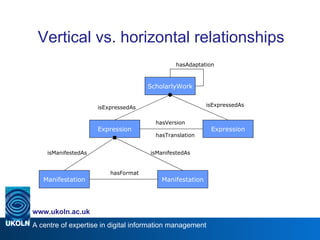
Vertical vs. horizontal relationships ScholarlyWork Expression isExpressedAs Expression isExpressedAs Manifestation Manifestation isManifestedAs isManifestedAs hasFormat hasVersion hasTranslation hasAdaptation
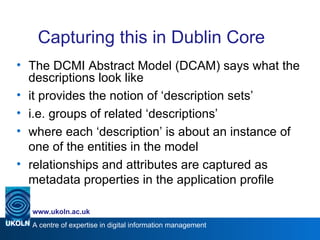
Capturing this in Dublin Core The DCMI Abstract Model (DCAM) says what the descriptions look like it provides the notion of ‘description sets’ i.e. groups of related ‘descriptions’ where each ‘description’ is about an instance of one of the entities in the model relationships and attributes are captured as metadata properties in the application profile
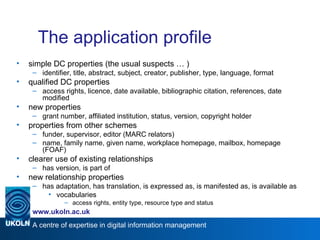
The application profile simple DC properties (the usual suspects … ) identifier, title, abstract, subject, creator, publisher, type, language, format qualified DC properties access rights, licence, date available, bibliographic citation, references, date modified new properties grant number, affiliated institution, status, version, copyright holder properties from other schemes funder, supervisor, editor (MARC relators)  name, family name, given name, workplace homepage, mailbox, homepage (FOAF) clearer use of existing relationships has version, is part of new relationship properties has adaptation, has translation, is expressed as, is manifested as, is available as vocabularies  access rights, entity type, resource type and status
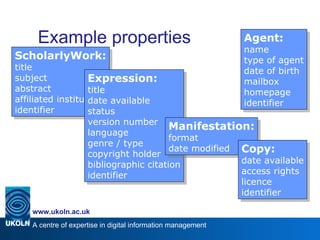
Example properties ScholarlyWork: title subject abstract affiliated institution identifier Agent: name type of agent date of birth mailbox homepage identifier Expression: title date available status version number language genre / type copyright holder bibliographic citation identifier Manifestation: format date modified Copy: date available access rights licence identifier
Interoperability Dumb-down we still need to be able to create simple DC descriptions for OAI-PMH we have chosen to dumb-down to separate simple DC descriptions of the ScholarlyWork and each Copy simple DC about the ScholarlyWork corresponds to previous guidance simple DC about each Copy useful for getting to full-text, e.g. by Google XML schema http://www.ukoln.ac.uk/repositories/digirep/index/Eprints_DC_XML
Thoughts on the approach … this approach is guided by the functional requirements identified and the primary use case of richer, more functional, metadata it also makes it easier to rationalise ‘traditional’ and ‘modern’ citations traditional citations tend to be made between eprint ‘expressions’ hypertext links tend to be made between eprint ‘copies’ (or ‘items’ in FRBR terms) a complex underlying model may be manifest in relatively simple metadata and/or end-user interfaces existing repositories or information systems may well capture this level of detail currently – but use of simple DC stops them exposing it to others!

Dublin Core Application Profile for Scholarly Works KE

  • 1.
    UKOLN is supported by: The Dublin Core Application Profile for Scholarly Works ( www. ukoln .ac. uk /repositories/ ) Knowledge Exchange Workshop 16 th January 2007, SURF, Utrecht Julie Allinson Repositories Research Officer UKOLN, University of Bath www.bath.ac.uk
  • 2.
    Functional requirements (selection)richer metadata set - consistent metadata support for added-value services unambiguous method of identifying full-text(s) consider version identification and most appropriate copy of a version open access materials support browse based on controlled vocabularies OpenURL link servers support citation analysis (in line with dc-citation WG recommendations) identification of the research funder and project code identification of the repository or other service making available the copy date available date of modification of a copy, to locate the latest version
  • 3.
    Entity-Relationship Model Themodel says what things are being described the set of entities that we want to describe and the key relationships between those entities FRBR (Functional Requirements for Bibliographic Records) provides the basis for our model a model for the entities that bibliographic records are intended to describe FRBR models the world using 4 key entities: Work, Expression, Manifestation and Item A work is a distinct intellectual or artistic creation. A work is an abstract entity An expression is the intellectual or artistic realization of a work A manifestation is the physical embodiment of an expression of a work. An item is a single exemplar of a manifestation. The entity defined as item is a concrete entity. but we’ve applied it’s model to scholarly works
  • 4.
    The application modelScholarlyWork Expression 0..∞ isExpressedAs Manifestation isManifestedAs 0..∞ Copy isAvailableAs 0..∞ isPublishedBy 0..∞ 0..∞ isEditedBy 0..∞ isCreatedBy 0..∞ isFundedBy isSupervisedBy AffiliatedInstitution Agent
  • 5.
    Vertical vs. horizontalrelationships ScholarlyWork Expression isExpressedAs Expression isExpressedAs Manifestation Manifestation isManifestedAs isManifestedAs hasFormat hasVersion hasTranslation hasAdaptation
  • 6.
    Capturing this inDublin Core The DCMI Abstract Model (DCAM) says what the descriptions look like it provides the notion of ‘description sets’ i.e. groups of related ‘descriptions’ where each ‘description’ is about an instance of one of the entities in the model relationships and attributes are captured as metadata properties in the application profile
  • 7.
    The application profilesimple DC properties (the usual suspects … ) identifier, title, abstract, subject, creator, publisher, type, language, format qualified DC properties access rights, licence, date available, bibliographic citation, references, date modified new properties grant number, affiliated institution, status, version, copyright holder properties from other schemes funder, supervisor, editor (MARC relators) name, family name, given name, workplace homepage, mailbox, homepage (FOAF) clearer use of existing relationships has version, is part of new relationship properties has adaptation, has translation, is expressed as, is manifested as, is available as vocabularies access rights, entity type, resource type and status
  • 8.
    Example properties ScholarlyWork:title subject abstract affiliated institution identifier Agent: name type of agent date of birth mailbox homepage identifier Expression: title date available status version number language genre / type copyright holder bibliographic citation identifier Manifestation: format date modified Copy: date available access rights licence identifier
  • 9.
    Interoperability Dumb-down westill need to be able to create simple DC descriptions for OAI-PMH we have chosen to dumb-down to separate simple DC descriptions of the ScholarlyWork and each Copy simple DC about the ScholarlyWork corresponds to previous guidance simple DC about each Copy useful for getting to full-text, e.g. by Google XML schema http://www.ukoln.ac.uk/repositories/digirep/index/Eprints_DC_XML
  • 10.
    Thoughts on theapproach … this approach is guided by the functional requirements identified and the primary use case of richer, more functional, metadata it also makes it easier to rationalise ‘traditional’ and ‘modern’ citations traditional citations tend to be made between eprint ‘expressions’ hypertext links tend to be made between eprint ‘copies’ (or ‘items’ in FRBR terms) a complex underlying model may be manifest in relatively simple metadata and/or end-user interfaces existing repositories or information systems may well capture this level of detail currently – but use of simple DC stops them exposing it to others!

Editor's Notes

  • #2 Give a little bit of background, when, who, who funded, scope, process and deliverables