SWORD  Simple Web-service Offering Repository Deposit Julie Allinson 25th March 2009, British Library
SWORD Quick Introduction Vision: “lowering barriers to deposit” Simple Web service Offering Repository Deposit Aims to provide a standard mechanism for ‘doing deposit’ into repositories JISC funded project started 2007, continuation funding for SWORD 2 from June 2008
What is it? A lightweight protocol for deposit A profile of the Atom Publishing Protocol Implementations of SWORD in IntraLibrary, Fedora, DSpace and Eprints repositories SWORD clients – web-based, desktop, MS Office plugin, Facebook, widgets
Motivations – why? no standard interface for tagging, packaging or authoring tools to upload objects into a repository no standard interface for transferring digital objects between repositories no way to deposit into more than one repository with one ‘click’ no way of initiating a deposit workflow from outside a repository system
The Project Partners SWORD partners: UKOLN, University of Bath and University of York (Project Management) – Adrian Stevenson & Julie Allinson University of Aberystwyth (DSpace, Fedora, & clients) –  Stuart Lewis, Neil Taylor, Glen Robson, Richard Jones University of Southampton (EPrints) – Les Carr, Seb Francois Intrallect (IntraLibrary) – Sarah Currier, Andrew Robson, Martin Morrey Jim Downing – standards development
Use Cases Deposit from a Desktop/Online tool Multiple deposit - e.g. deposit to institutional and (mandated) funders’ repository with one action  Machine deposit - e.g. automated deposit from a laboratory machine  Migration/transfer - e.g. to a preservation service  Mediated deposit - e.g. deposit by a nominated representative, to additional repositories
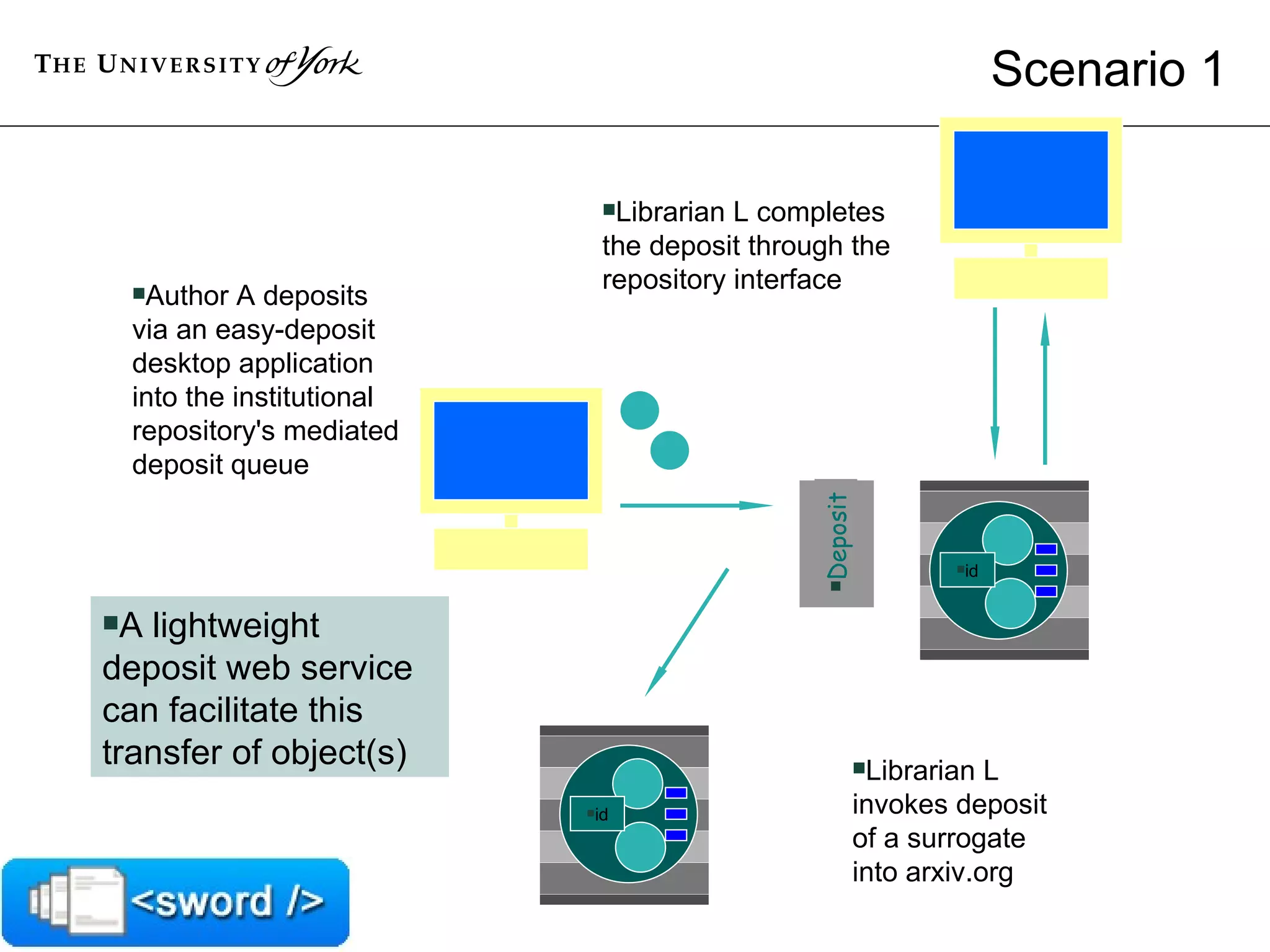
Scenario 1 A lightweight deposit web service can facilitate this transfer of object(s) Librarian L completes the deposit through the repository interface id Librarian L invokes deposit of a surrogate into arxiv.org Deposit id Author A deposits via an easy-deposit desktop application into the institutional repository's mediated deposit queue
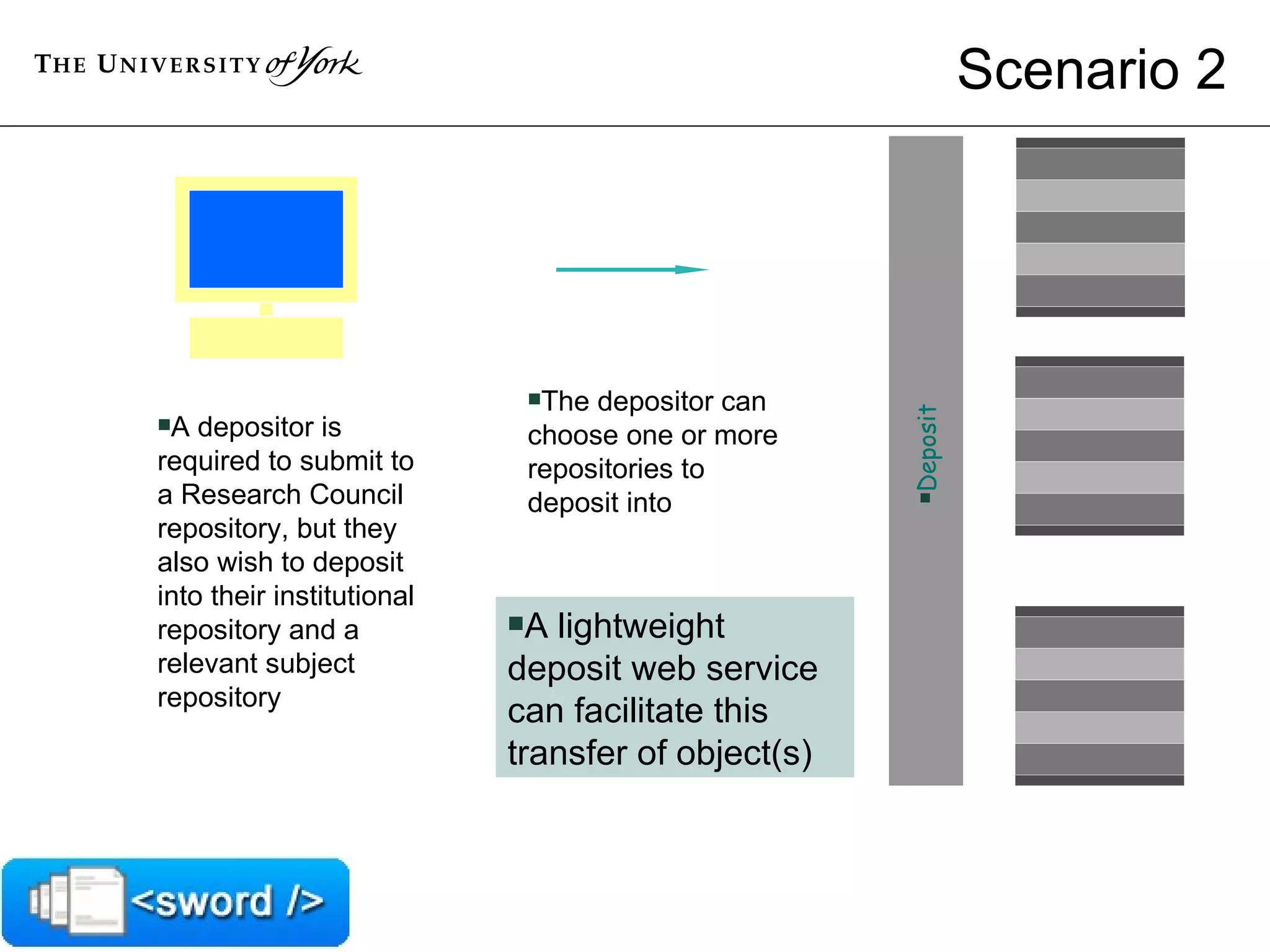
Scenario 2 A lightweight deposit web service can facilitate this transfer of object(s) Deposit The depositor can choose one or more repositories to deposit into A depositor is required to submit to a Research Council repository, but they also wish to deposit into their institutional repository and a relevant subject repository
SWORD AtomPub Profile
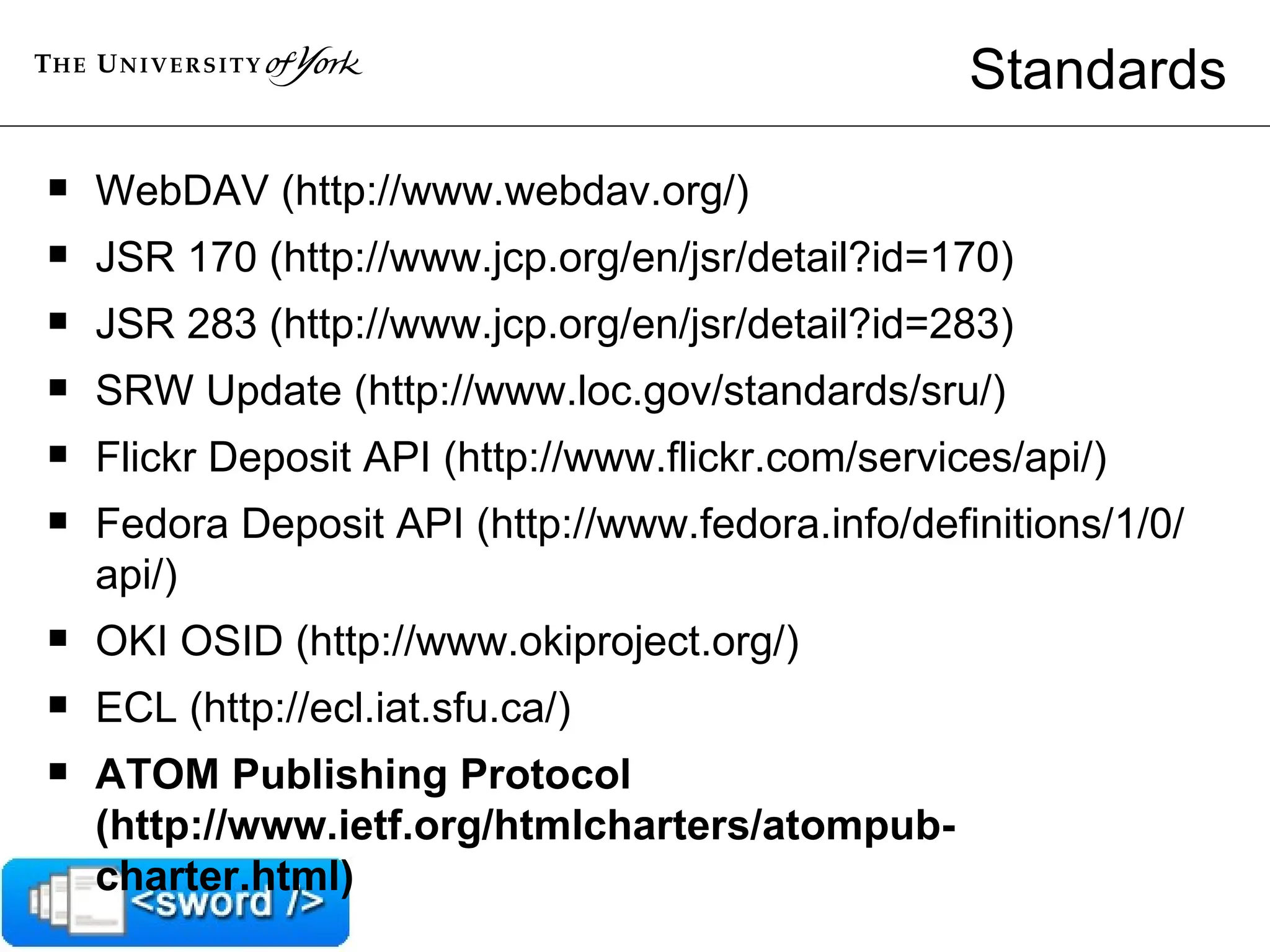
Standards WebDAV (http://www.webdav.org/)  JSR 170 (http://www.jcp.org/en/jsr/detail?id=170)  JSR 283 (http://www.jcp.org/en/jsr/detail?id=283)  SRW Update (http://www.loc.gov/standards/sru/)  Flickr Deposit API (http://www.flickr.com/services/api/)  Fedora Deposit API (http://www.fedora.info/definitions/1/0/api/)  OKI OSID (http://www.okiproject.org/)  ECL (http://ecl.iat.sfu.ca/)  ATOM Publishing Protocol (http://www.ietf.org/htmlcharters/atompub-charter.html)
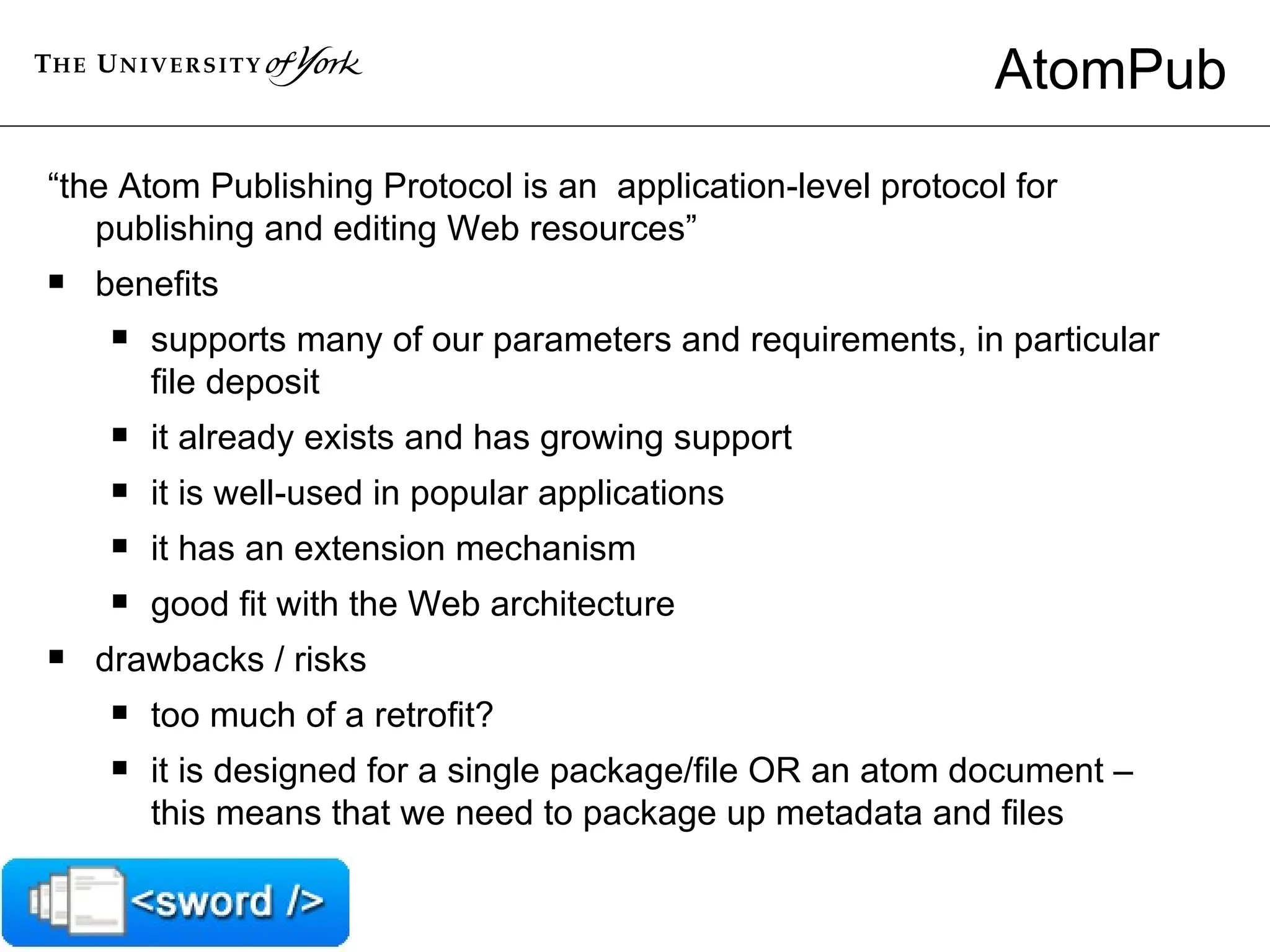
AtomPub “ the Atom Publishing Protocol is an  application-level protocol for publishing and editing Web resources” benefits  supports many of our parameters and requirements, in particular file deposit it already exists and has growing support  it is well-used in popular applications it has an extension mechanism  good fit with the Web architecture drawbacks / risks  too much of a retrofit?  it is designed for a single package/file OR an atom document – this means that we need to package up metadata and files
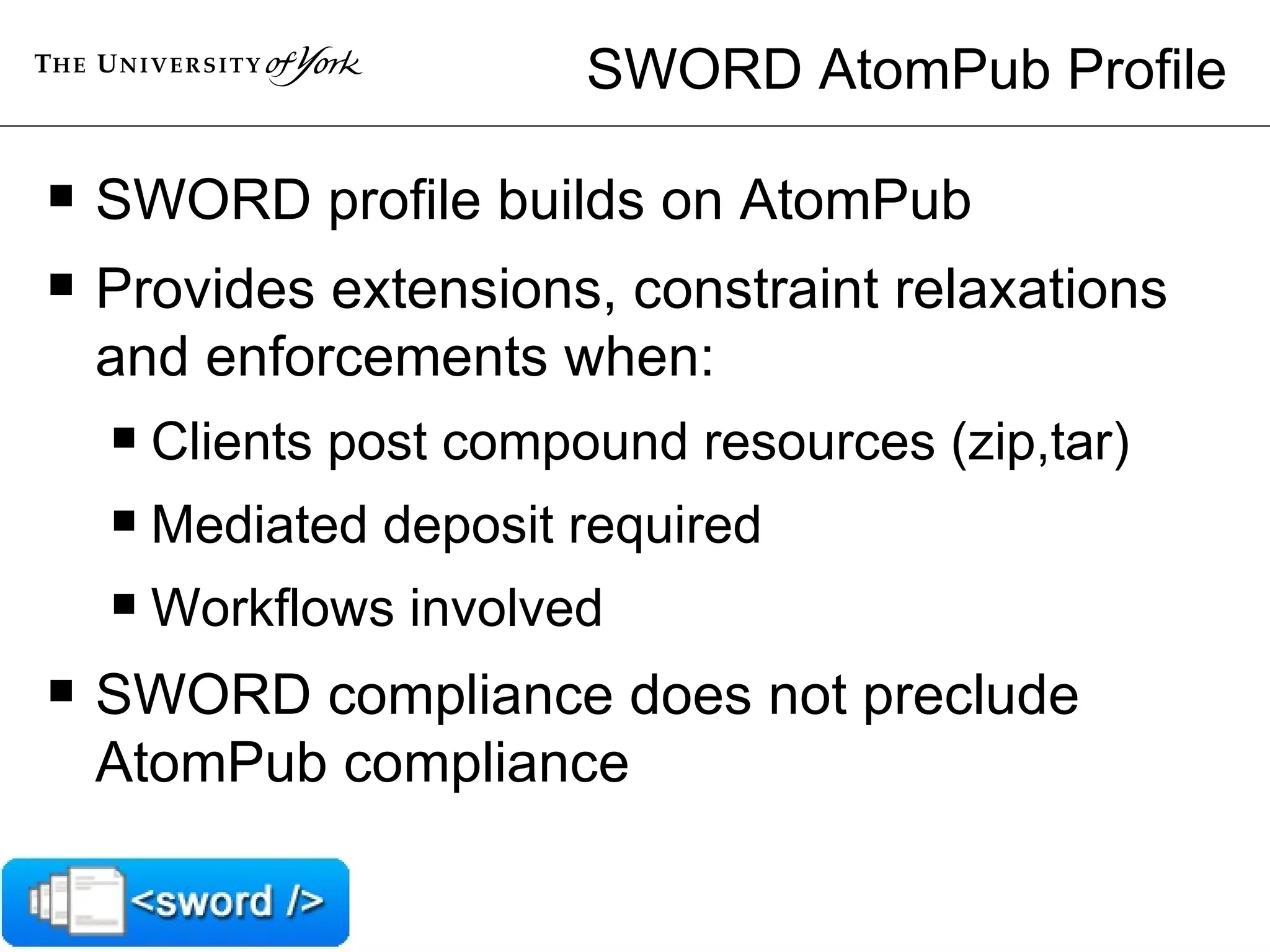
SWORD AtomPub Profile SWORD profile builds on AtomPub Provides extensions, constraint relaxations and enforcements when: Clients post compound resources (zip,tar) Mediated deposit required Workflows involved SWORD compliance does not preclude AtomPub compliance
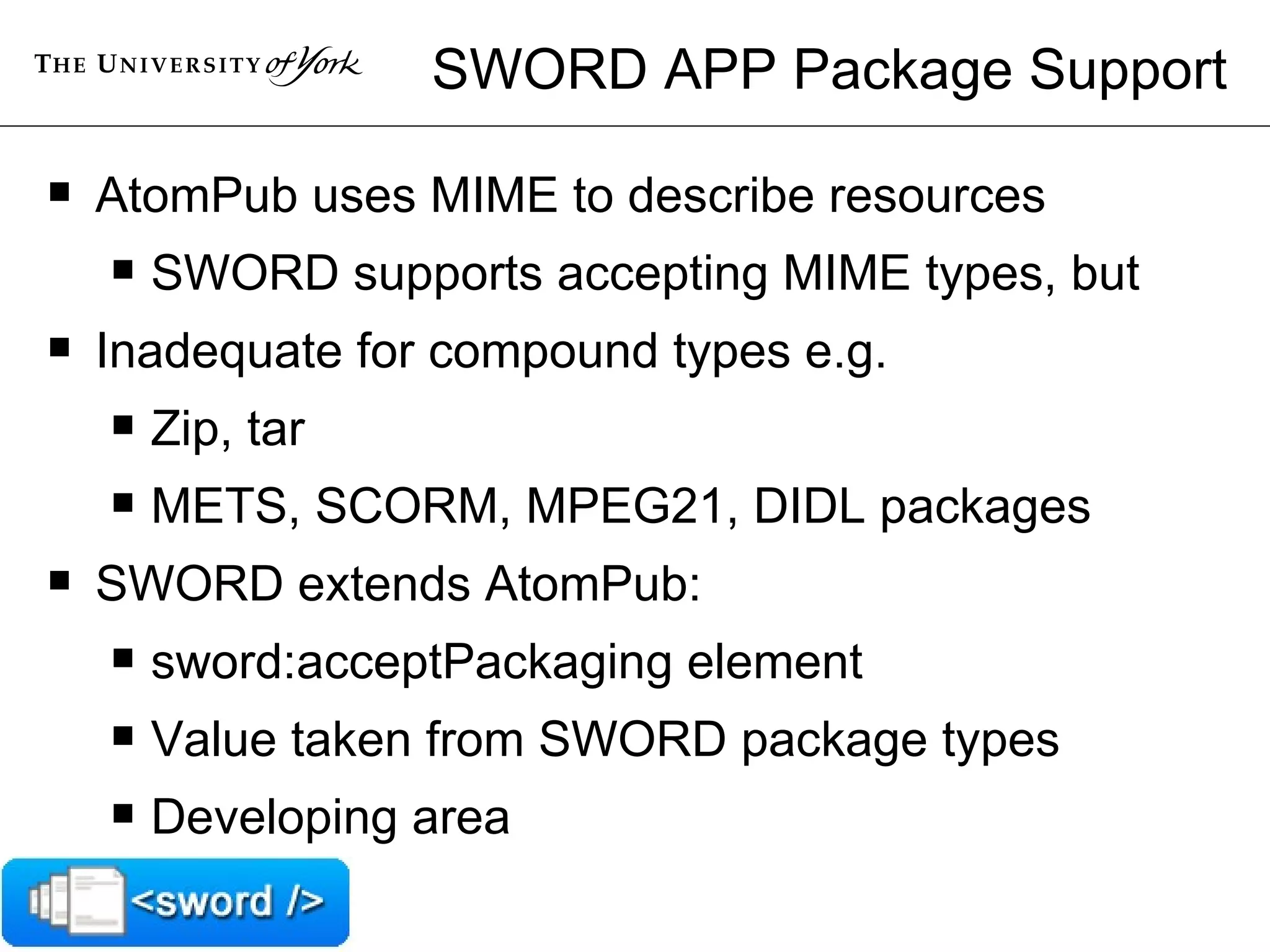
SWORD APP Package Support AtomPub uses MIME to describe resources SWORD supports accepting MIME types, but Inadequate for compound types e.g. Zip, tar METS, SCORM, MPEG21, DIDL packages SWORD extends AtomPub: sword:acceptPackaging element Value taken from SWORD package types Developing area
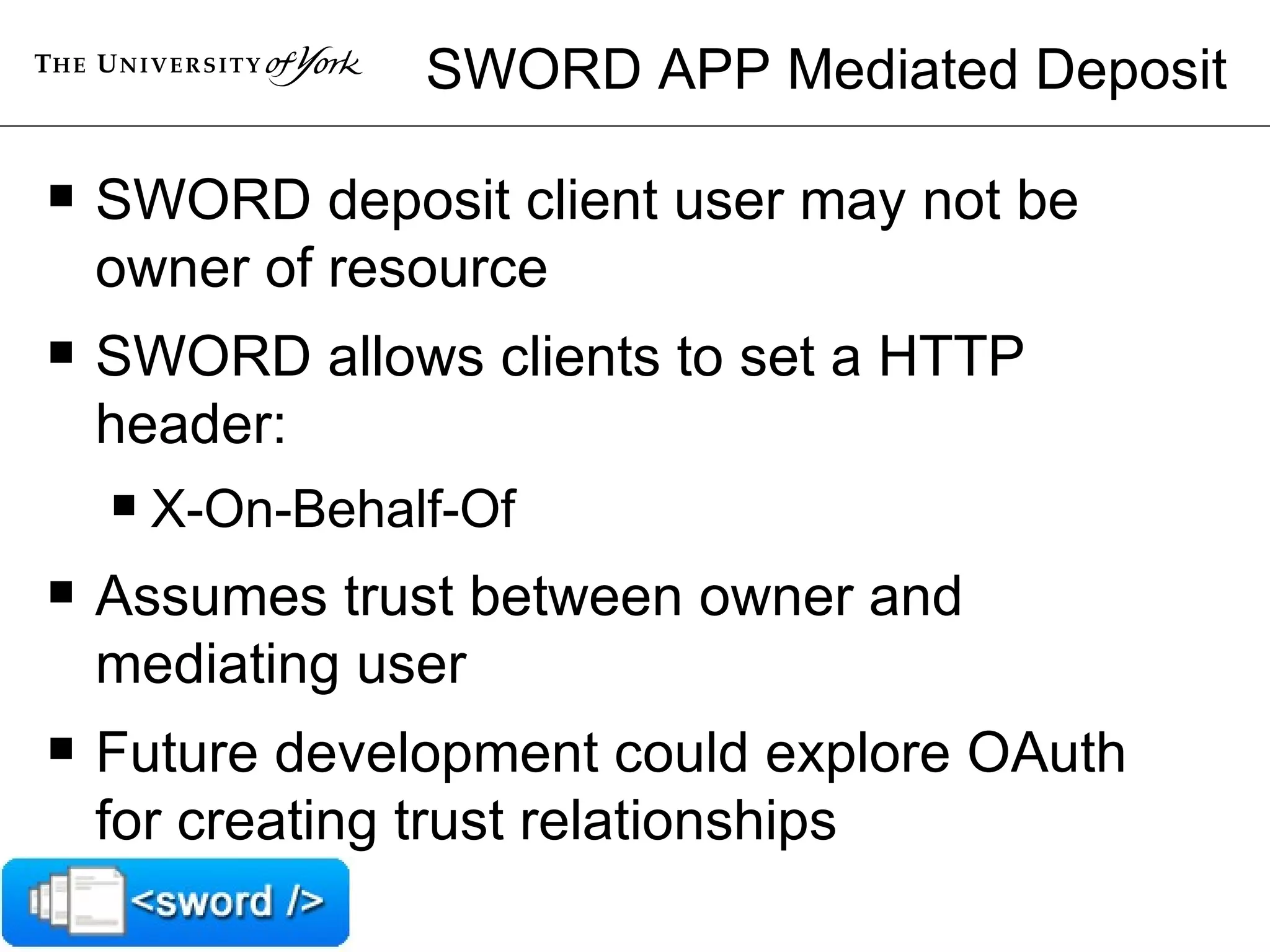
SWORD APP Mediated Deposit SWORD deposit client user may not be owner of resource SWORD allows clients to set a HTTP header: X-On-Behalf-Of Assumes trust between owner and mediating user Future development could explore OAuth for creating trust relationships
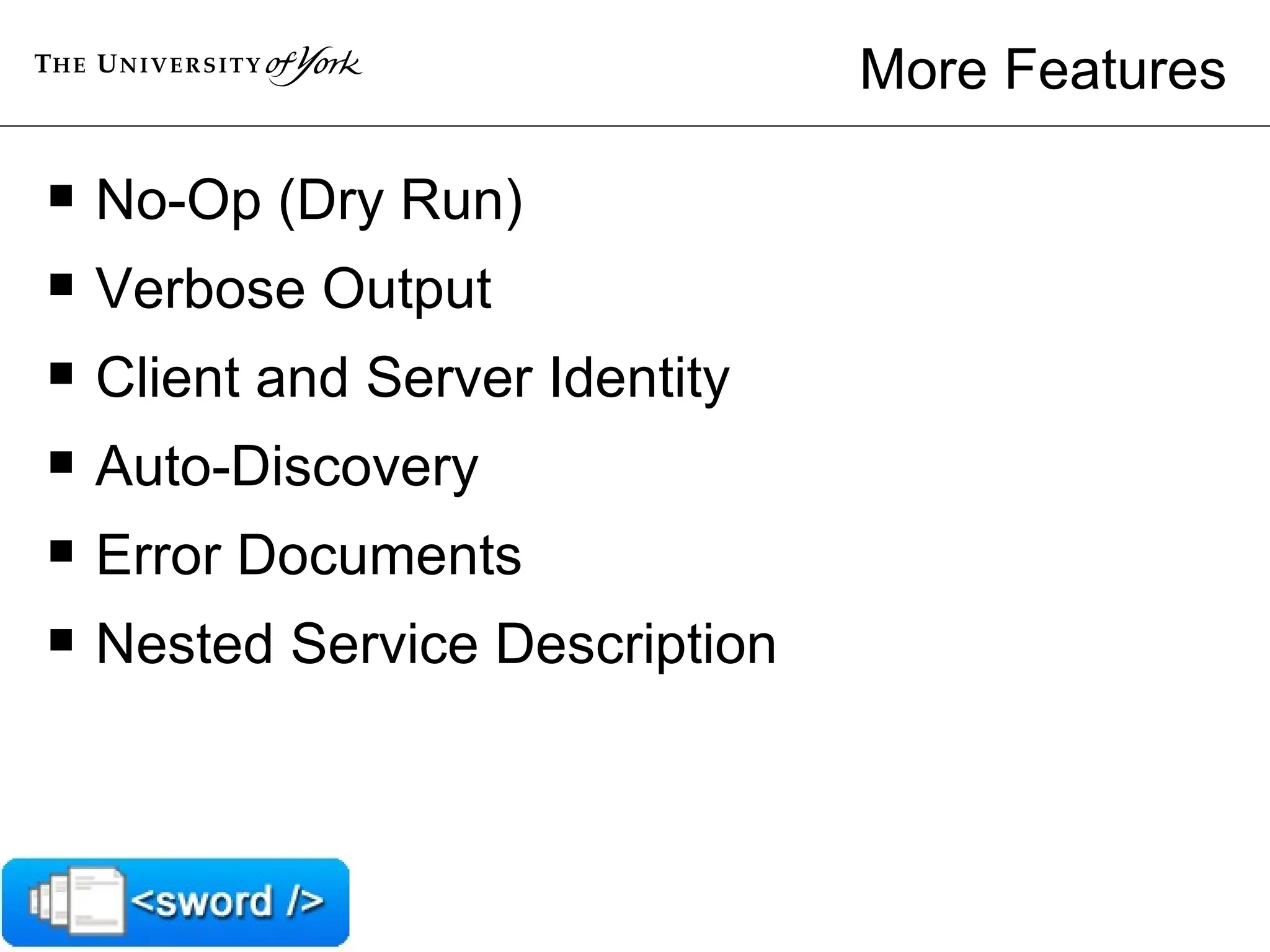
More Features No-Op (Dry Run) Verbose Output Client and Server Identity Auto-Discovery Error Documents Nested Service Description
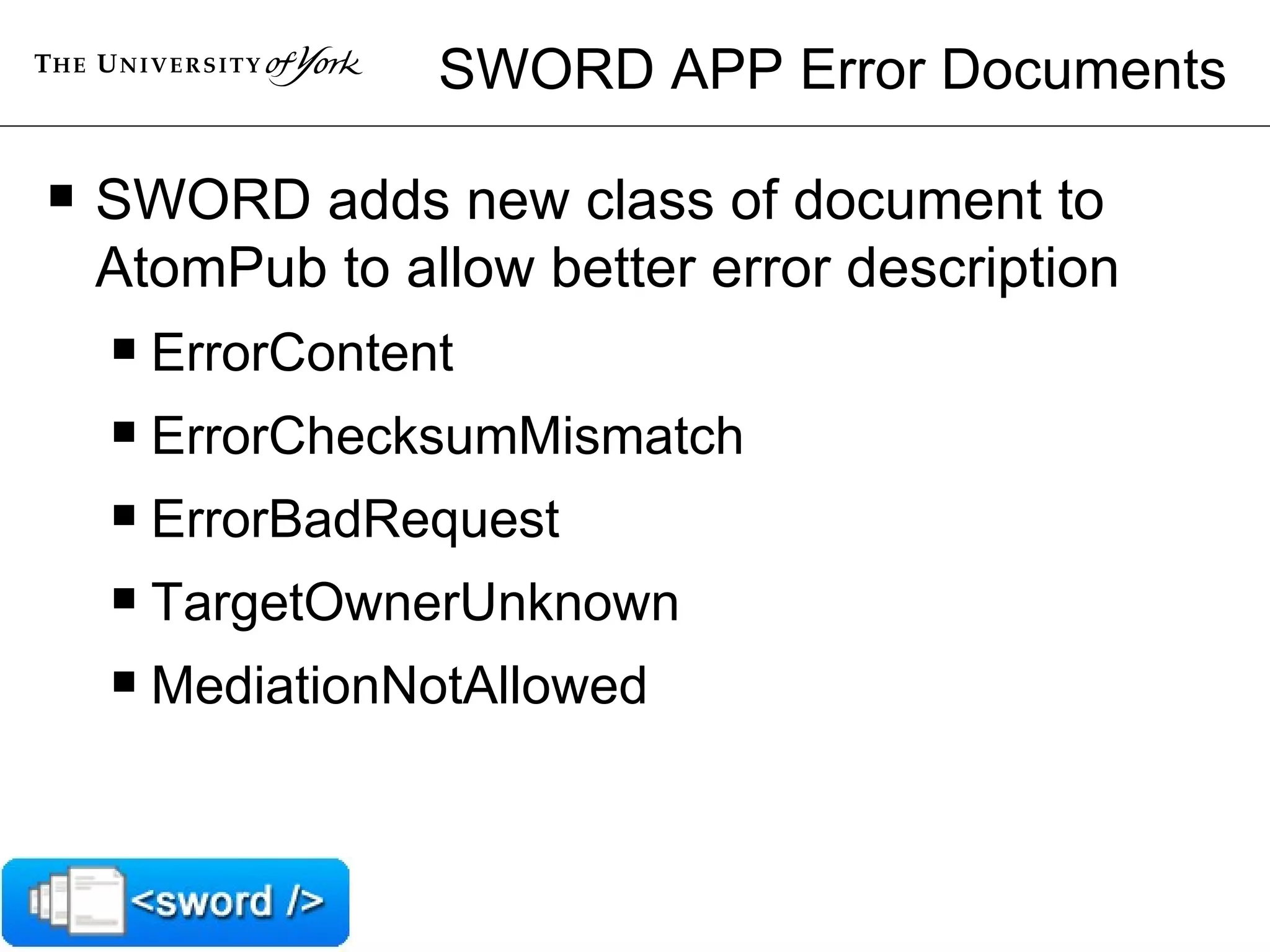
SWORD APP Error Documents SWORD adds new class of document to AtomPub to allow better error description ErrorContent ErrorChecksumMismatch ErrorBadRequest TargetOwnerUnknown MediationNotAllowed
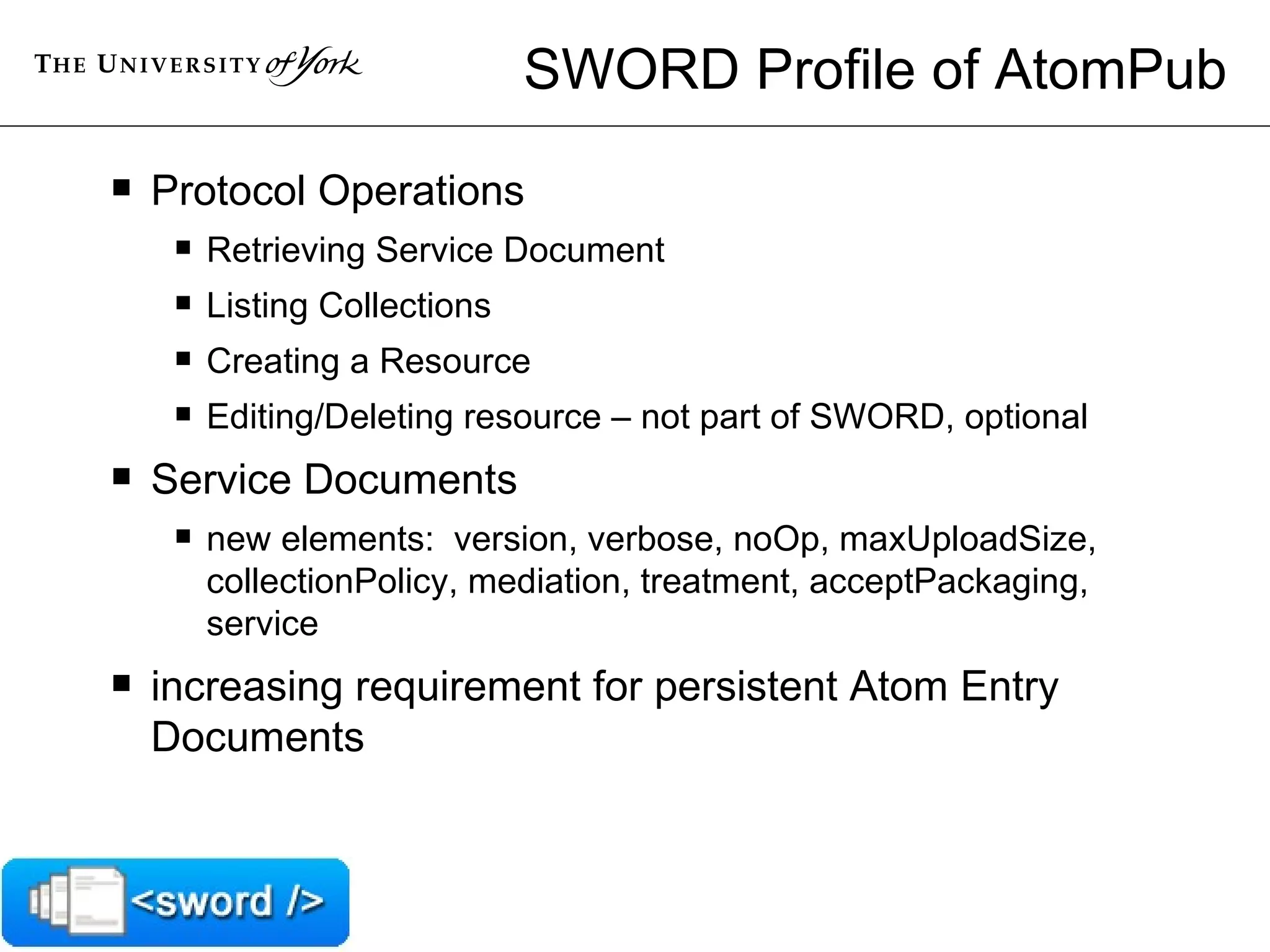
SWORD Profile of AtomPub Protocol Operations Retrieving Service Document Listing Collections Creating a Resource Editing/Deleting resource – not part of SWORD, optional Service Documents new elements:  version, verbose, noOp, maxUploadSize, collectionPolicy, mediation, treatment, acceptPackaging, service increasing requirement for persistent Atom Entry Documents
How it Works Issue HTTP requests (GET, POST) from client to SWORD interface GET Service Document (explain/discover) POST ATOM document or file/package to collection URI  HTTP response and ATOM document is returned  HTTP basic authentication should be supported
SWORD In Use
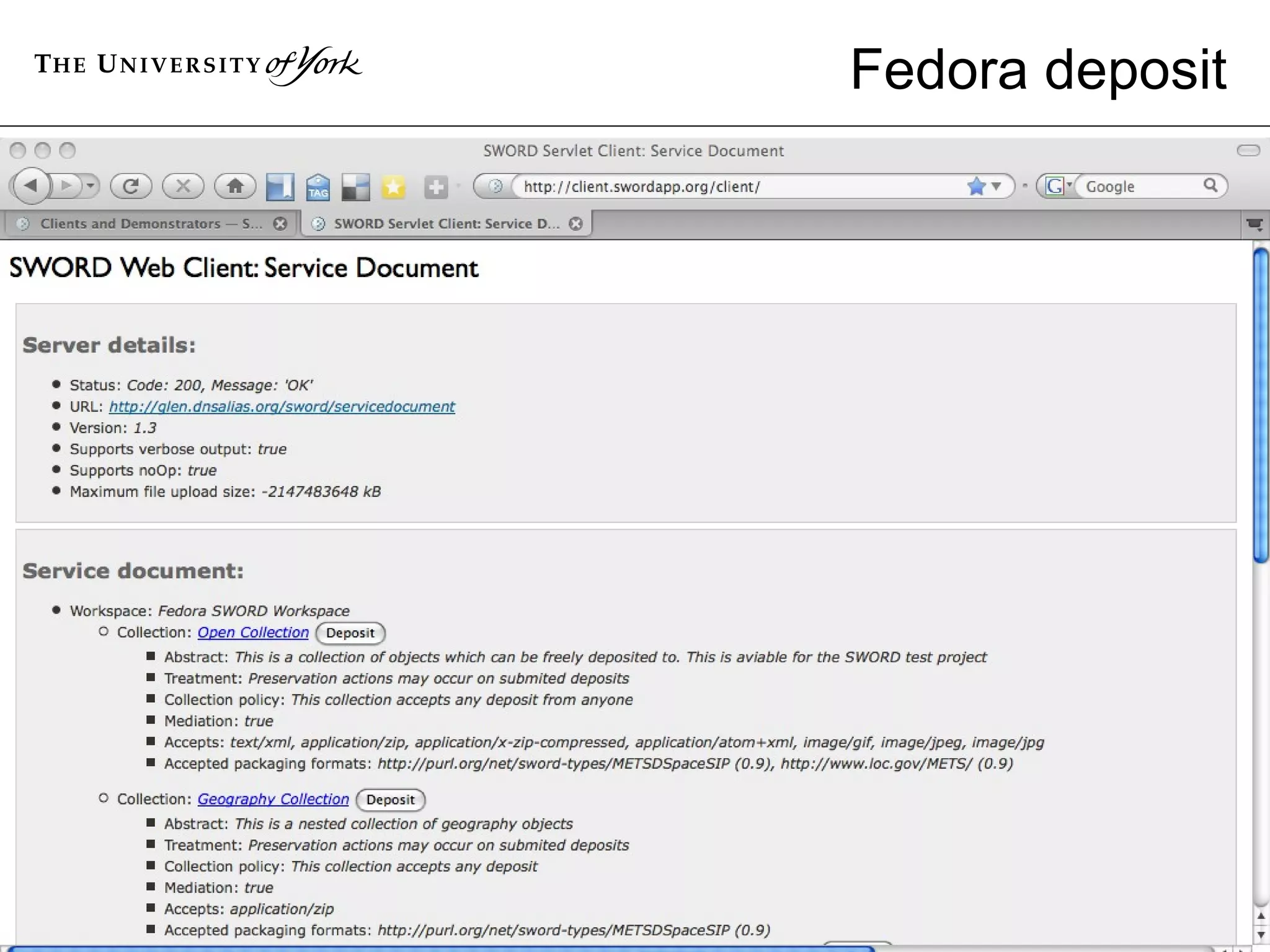
Implementations Repository implementations  DSpace  EPrints  IntraLibrary  Fedora  Client implementations  command-line, desktop and web clients Facebook Client Deposit from within MS Word & Powerpoint Feedforward / FOREsite and others Java, PHP and .NET libraries
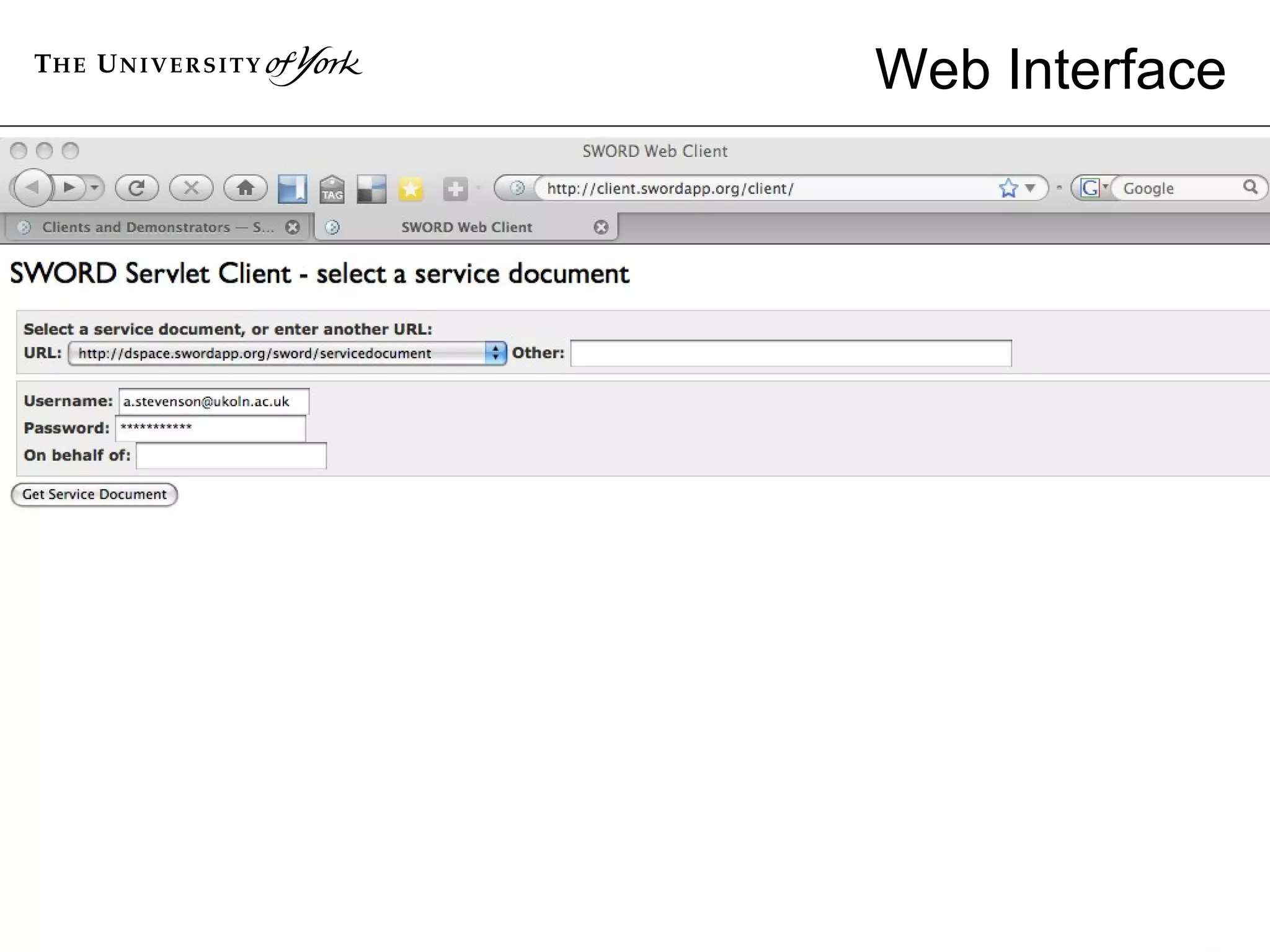
Web Interface
Fedora deposit
Fedora Deposit response
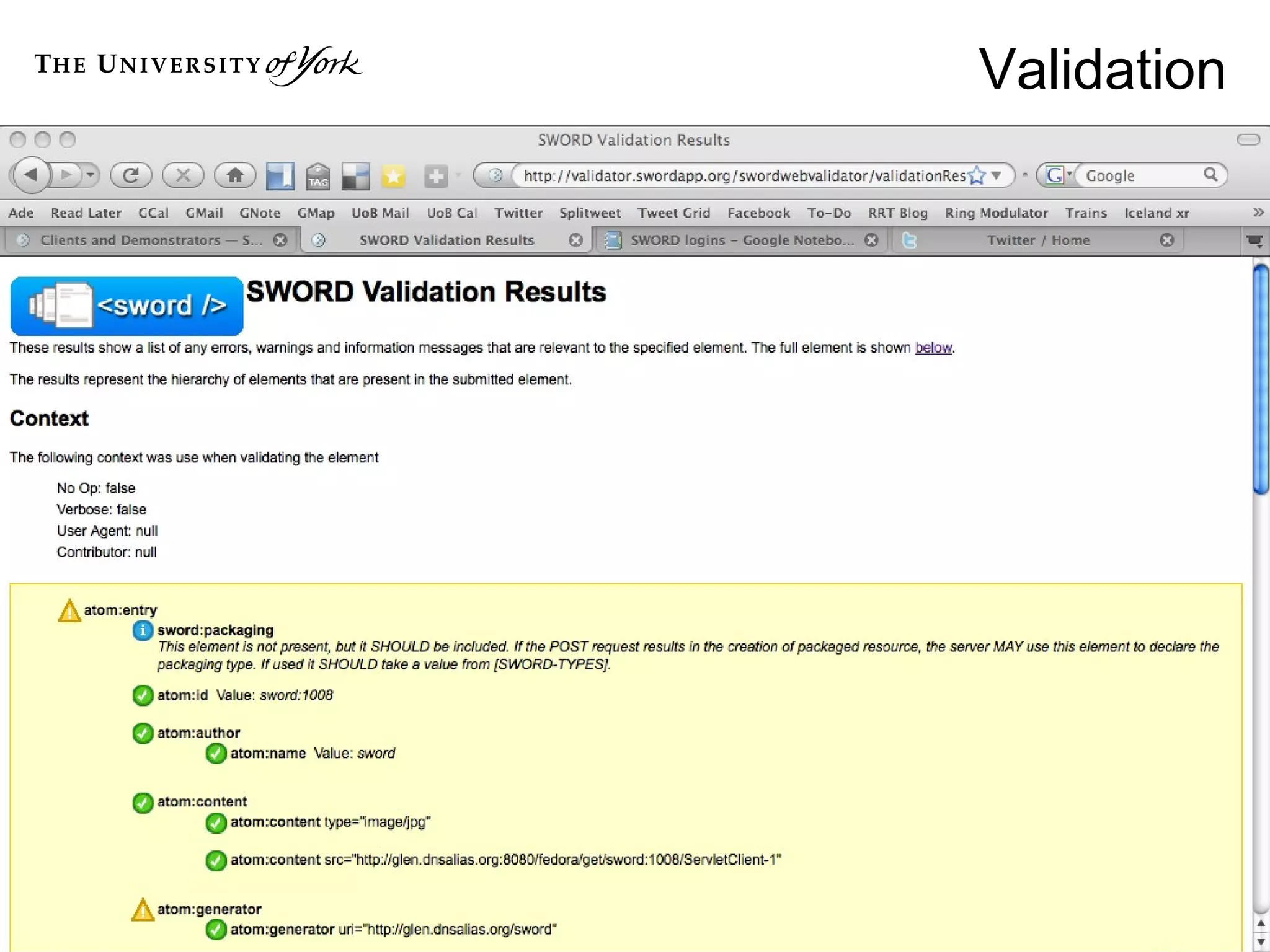
Validation
SWORD in use In addition to the case study implementations:  Feedforward has already implemented  ICE project is looking at SWORD  DSpace and EPrints installations already exist  Microsoft eChemistry work  OAI-ORE - FOREsite work  more are planned  NISO activity around deposit Collaberation with Nature Publishing Group possible York – funded project around SWORD
More Info and Contact SWORD Website: http://www.swordapp.org General queries: Adrian Stevenson [email_address] Technical queries: sword sourceforge list [email_address]
OAI-ORE Object Re-use and Exchange Julie Allinson 25th March 2009, British Library
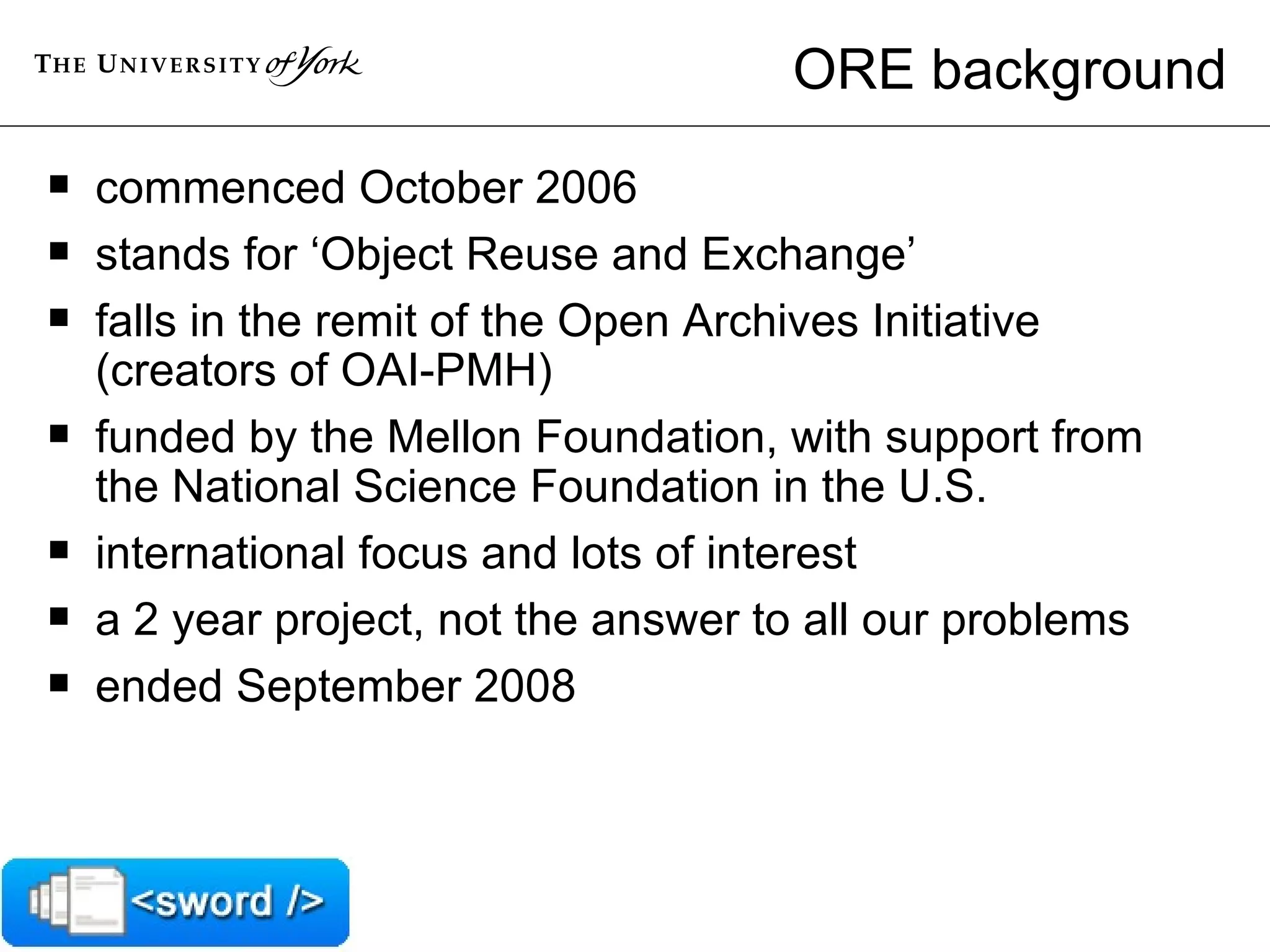
ORE background commenced October 2006 stands for ‘Object Reuse and Exchange’ falls in the remit of the Open Archives Initiative (creators of OAI-PMH) funded by the Mellon Foundation, with support from the National Science Foundation in the U.S. international focus and lots of interest a 2 year project, not the answer to all our problems ended September 2008
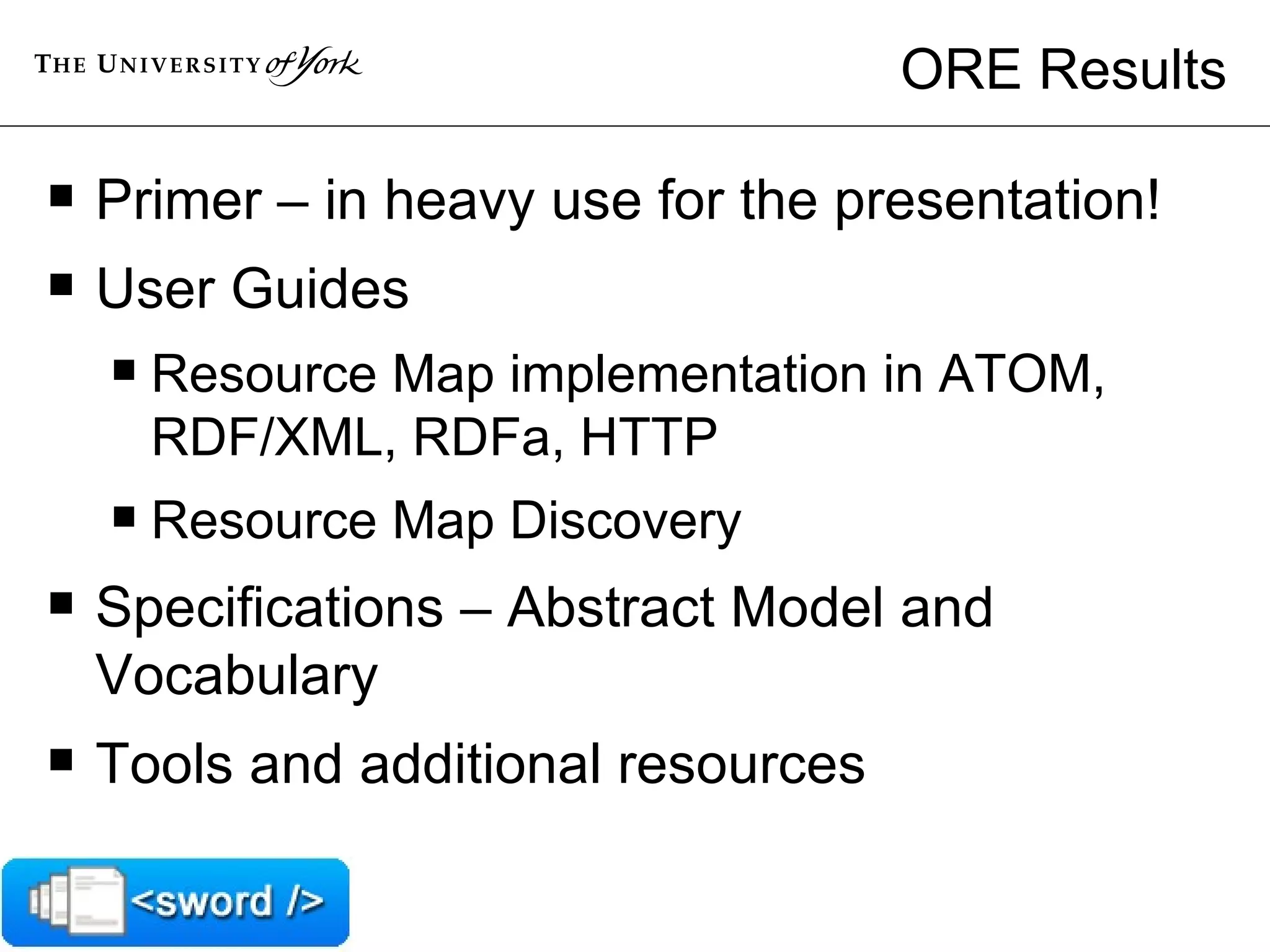
ORE Results Primer – in heavy use for the presentation! User Guides Resource Map implementation in ATOM, RDF/XML, RDFa, HTTP Resource Map Discovery Specifications – Abstract Model and Vocabulary Tools and additional resources
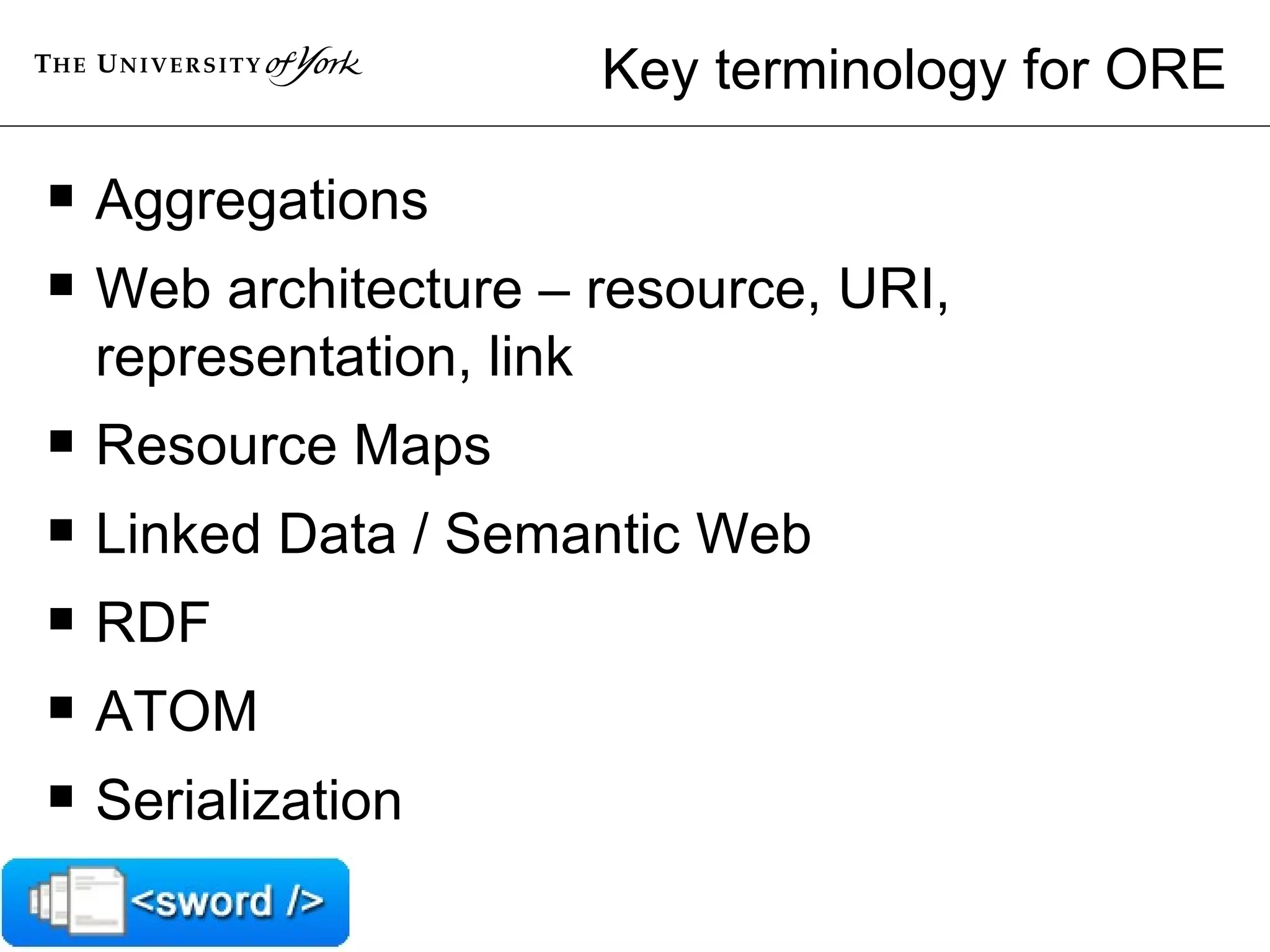
Key terminology for ORE Aggregations Web architecture – resource, URI, representation, link Resource Maps Linked Data / Semantic Web RDF ATOM Serialization
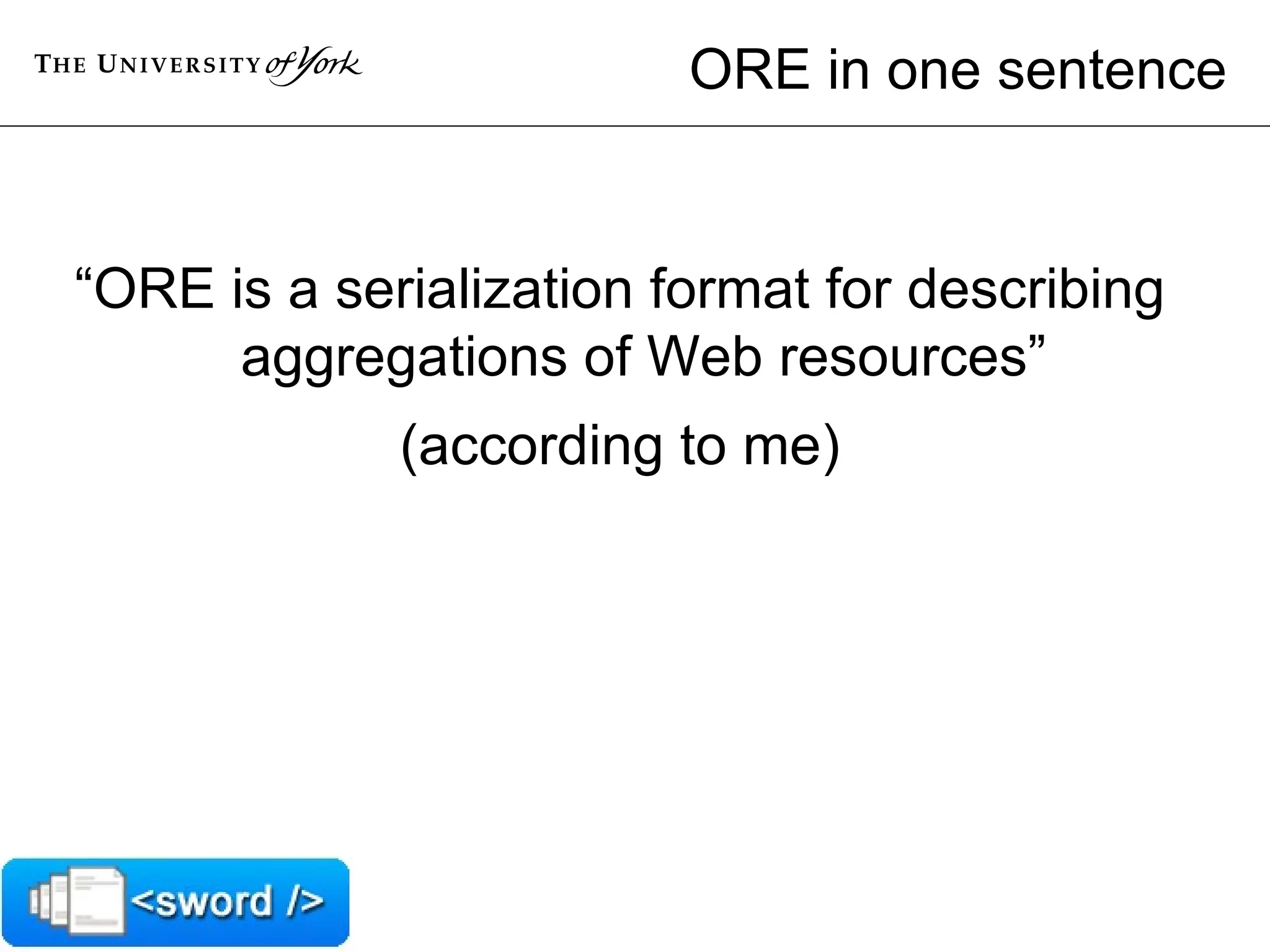
ORE in one sentence “ ORE is a serialization format for describing aggregations of Web resources” (according to me)
Relationship to OAI-PMH OAI-ORE is NOT a replacement for OAI-PMH OAI-PMH will continue to exist as one approach to interoperability OAI-PMH  metadata-centric OAI-ORE will complement with richer functionality, when this is desirable  OAI-ORE is  resource centric
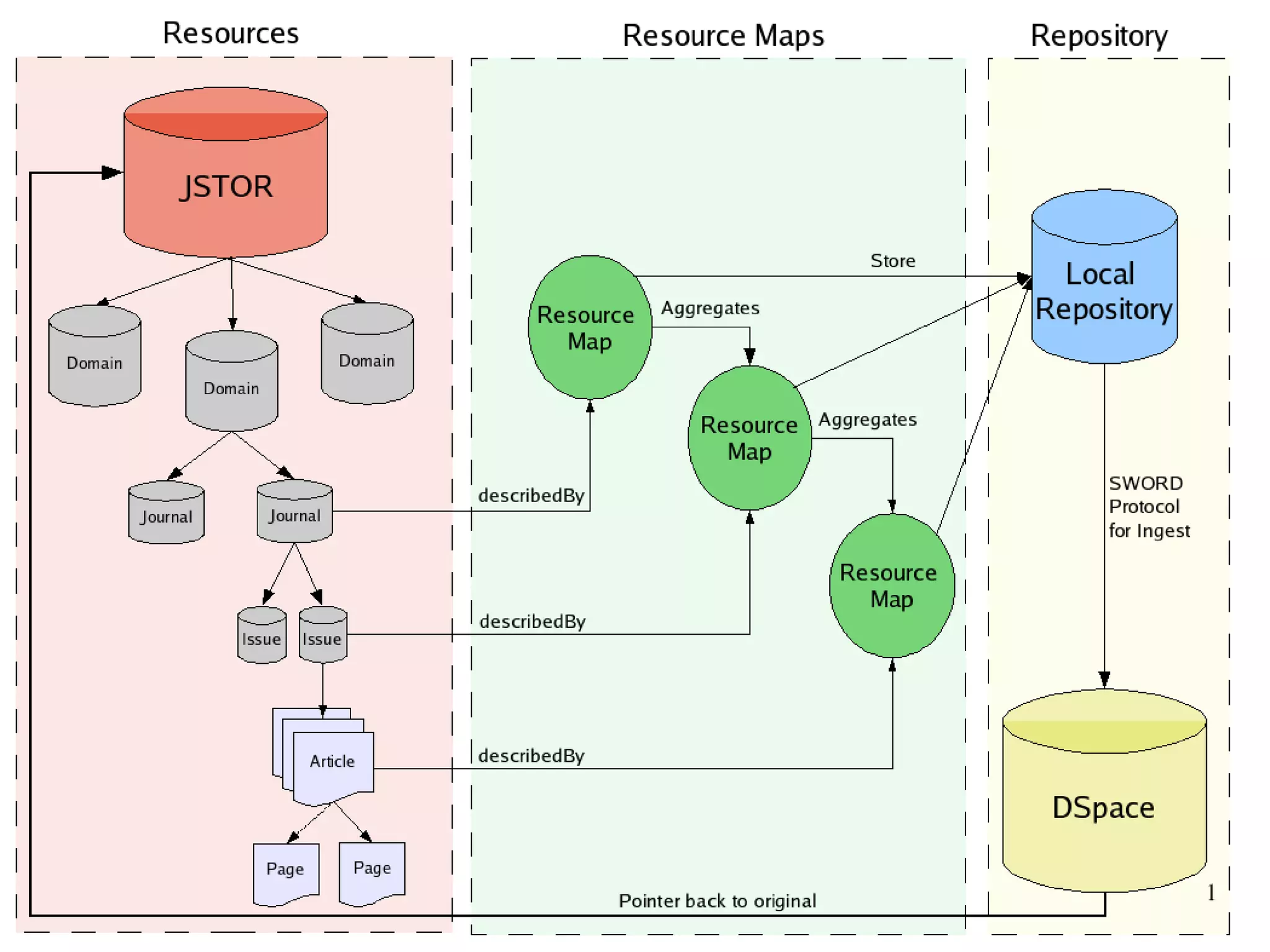
An example The ForeSite toolkit “ Libraries for constructing, parsing, manipulating and serializing OAI-ORE Resource Maps” Demonstrator created Resource Maps of journals in JSTOR, delivered as ATOM documents via SWORD DSpace interface
 
 
That’s it.

Sword Bl 0903[1]

  • 1.
    SWORD SimpleWeb-service Offering Repository Deposit Julie Allinson 25th March 2009, British Library
  • 2.
    SWORD Quick IntroductionVision: “lowering barriers to deposit” Simple Web service Offering Repository Deposit Aims to provide a standard mechanism for ‘doing deposit’ into repositories JISC funded project started 2007, continuation funding for SWORD 2 from June 2008
  • 3.
    What is it?A lightweight protocol for deposit A profile of the Atom Publishing Protocol Implementations of SWORD in IntraLibrary, Fedora, DSpace and Eprints repositories SWORD clients – web-based, desktop, MS Office plugin, Facebook, widgets
  • 4.
    Motivations – why?no standard interface for tagging, packaging or authoring tools to upload objects into a repository no standard interface for transferring digital objects between repositories no way to deposit into more than one repository with one ‘click’ no way of initiating a deposit workflow from outside a repository system
  • 5.
    The Project PartnersSWORD partners: UKOLN, University of Bath and University of York (Project Management) – Adrian Stevenson & Julie Allinson University of Aberystwyth (DSpace, Fedora, & clients) – Stuart Lewis, Neil Taylor, Glen Robson, Richard Jones University of Southampton (EPrints) – Les Carr, Seb Francois Intrallect (IntraLibrary) – Sarah Currier, Andrew Robson, Martin Morrey Jim Downing – standards development
  • 6.
    Use Cases Depositfrom a Desktop/Online tool Multiple deposit - e.g. deposit to institutional and (mandated) funders’ repository with one action Machine deposit - e.g. automated deposit from a laboratory machine Migration/transfer - e.g. to a preservation service Mediated deposit - e.g. deposit by a nominated representative, to additional repositories
  • 7.
    Scenario 1 Alightweight deposit web service can facilitate this transfer of object(s) Librarian L completes the deposit through the repository interface id Librarian L invokes deposit of a surrogate into arxiv.org Deposit id Author A deposits via an easy-deposit desktop application into the institutional repository's mediated deposit queue
  • 8.
    Scenario 2 Alightweight deposit web service can facilitate this transfer of object(s) Deposit The depositor can choose one or more repositories to deposit into A depositor is required to submit to a Research Council repository, but they also wish to deposit into their institutional repository and a relevant subject repository
  • 9.
  • 10.
    Standards WebDAV (http://www.webdav.org/) JSR 170 (http://www.jcp.org/en/jsr/detail?id=170) JSR 283 (http://www.jcp.org/en/jsr/detail?id=283) SRW Update (http://www.loc.gov/standards/sru/) Flickr Deposit API (http://www.flickr.com/services/api/) Fedora Deposit API (http://www.fedora.info/definitions/1/0/api/) OKI OSID (http://www.okiproject.org/) ECL (http://ecl.iat.sfu.ca/) ATOM Publishing Protocol (http://www.ietf.org/htmlcharters/atompub-charter.html)
  • 11.
    AtomPub “ theAtom Publishing Protocol is an application-level protocol for publishing and editing Web resources” benefits supports many of our parameters and requirements, in particular file deposit it already exists and has growing support it is well-used in popular applications it has an extension mechanism good fit with the Web architecture drawbacks / risks too much of a retrofit? it is designed for a single package/file OR an atom document – this means that we need to package up metadata and files
  • 12.
    SWORD AtomPub ProfileSWORD profile builds on AtomPub Provides extensions, constraint relaxations and enforcements when: Clients post compound resources (zip,tar) Mediated deposit required Workflows involved SWORD compliance does not preclude AtomPub compliance
  • 13.
    SWORD APP PackageSupport AtomPub uses MIME to describe resources SWORD supports accepting MIME types, but Inadequate for compound types e.g. Zip, tar METS, SCORM, MPEG21, DIDL packages SWORD extends AtomPub: sword:acceptPackaging element Value taken from SWORD package types Developing area
  • 14.
    SWORD APP MediatedDeposit SWORD deposit client user may not be owner of resource SWORD allows clients to set a HTTP header: X-On-Behalf-Of Assumes trust between owner and mediating user Future development could explore OAuth for creating trust relationships
  • 15.
    More Features No-Op(Dry Run) Verbose Output Client and Server Identity Auto-Discovery Error Documents Nested Service Description
  • 16.
    SWORD APP ErrorDocuments SWORD adds new class of document to AtomPub to allow better error description ErrorContent ErrorChecksumMismatch ErrorBadRequest TargetOwnerUnknown MediationNotAllowed
  • 17.
    SWORD Profile ofAtomPub Protocol Operations Retrieving Service Document Listing Collections Creating a Resource Editing/Deleting resource – not part of SWORD, optional Service Documents new elements: version, verbose, noOp, maxUploadSize, collectionPolicy, mediation, treatment, acceptPackaging, service increasing requirement for persistent Atom Entry Documents
  • 18.
    How it WorksIssue HTTP requests (GET, POST) from client to SWORD interface GET Service Document (explain/discover) POST ATOM document or file/package to collection URI HTTP response and ATOM document is returned HTTP basic authentication should be supported
  • 19.
  • 20.
    Implementations Repository implementations DSpace EPrints IntraLibrary Fedora Client implementations command-line, desktop and web clients Facebook Client Deposit from within MS Word & Powerpoint Feedforward / FOREsite and others Java, PHP and .NET libraries
  • 21.
  • 22.
  • 23.
  • 24.
  • 25.
    SWORD in useIn addition to the case study implementations: Feedforward has already implemented ICE project is looking at SWORD DSpace and EPrints installations already exist Microsoft eChemistry work OAI-ORE - FOREsite work more are planned NISO activity around deposit Collaberation with Nature Publishing Group possible York – funded project around SWORD
  • 26.
    More Info andContact SWORD Website: http://www.swordapp.org General queries: Adrian Stevenson [email_address] Technical queries: sword sourceforge list [email_address]
  • 27.
    OAI-ORE Object Re-useand Exchange Julie Allinson 25th March 2009, British Library
  • 28.
    ORE background commencedOctober 2006 stands for ‘Object Reuse and Exchange’ falls in the remit of the Open Archives Initiative (creators of OAI-PMH) funded by the Mellon Foundation, with support from the National Science Foundation in the U.S. international focus and lots of interest a 2 year project, not the answer to all our problems ended September 2008
  • 29.
    ORE Results Primer– in heavy use for the presentation! User Guides Resource Map implementation in ATOM, RDF/XML, RDFa, HTTP Resource Map Discovery Specifications – Abstract Model and Vocabulary Tools and additional resources
  • 30.
    Key terminology forORE Aggregations Web architecture – resource, URI, representation, link Resource Maps Linked Data / Semantic Web RDF ATOM Serialization
  • 31.
    ORE in onesentence “ ORE is a serialization format for describing aggregations of Web resources” (according to me)
  • 32.
    Relationship to OAI-PMHOAI-ORE is NOT a replacement for OAI-PMH OAI-PMH will continue to exist as one approach to interoperability OAI-PMH metadata-centric OAI-ORE will complement with richer functionality, when this is desirable OAI-ORE is resource centric
  • 33.
    An example TheForeSite toolkit “ Libraries for constructing, parsing, manipulating and serializing OAI-ORE Resource Maps” Demonstrator created Resource Maps of journals in JSTOR, delivered as ATOM documents via SWORD DSpace interface
  • 34.
  • 35.
  • 36.