TEACHING ENGLISH IN THE
ELEMENTARY GRADES
(LANGUAGE ARTS)
Course Description
This course will emphasize English as a second
language teaching with main focus on
language teaching methodologies to improve
knowledge on the structure and fluency in the
English language, and literacy skills, through
listening, speaking, reading, writing and viewing.
LANGUAGE ARTS
TEACHING
What is Language?
What is Language?
• Language is a complex and dynamic system of
communication used by humans to express
thoughts, emotions, ideas, and information. It
consists of sounds, symbols, and rules that are
used to convey meaning between individuals.
Language can be spoken, written, or signed, and it
serves as a fundamental tool for human interaction
and social connection.
Key Aspects of Language
Phonology: The study of the sounds used in a language. Phonology
deals with the way sounds function within a particular language or
languages, including the rules for their combination and
pronunciation.
Morphology: The study of the structure and formation of words.
Morphology examines how words are formed from smaller units of
meaning called morphemes, such as prefixes, suffixes, and root
words.
Syntax: The set of rules that govern the structure of sentences.
Syntax involves the arrangement of words and phrases to create
meaningful sentences, determining how different parts of speech
interact.
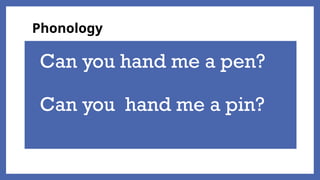
Can you hand me a pen?
Can you hand me a pin?
Phonology
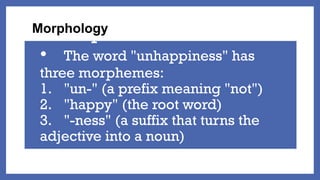
Example:
• The word "unhappiness" has
three morphemes:
1. "un-" (a prefix meaning "not")
2. "happy" (the root word)
3. "-ness" (a suffix that turns the
adjective into a noun)
Morphology
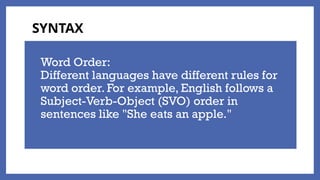
Word Order:
Different languages have different rules for
word order. For example, English follows a
Subject-Verb-Object (SVO) order in
sentences like "She eats an apple."
SYNTAX
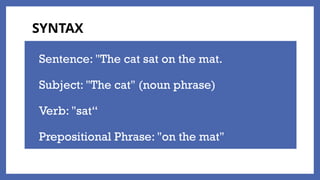
Sentence: "The cat sat on the mat.
Subject: "The cat" (noun phrase)
Verb: "sat“
Prepositional Phrase: "on the mat"
SYNTAX
Key Aspects of Language
Semantics: The study of meaning in language. Semantics
focuses on the meanings of words, phrases, sentences, and
texts, and how these meanings are understood and interpreted.
Pragmatics: The study of how language is used in context.
Pragmatics examines how language is used in different social
situations, considering factors like tone, intention, and the
relationship between speakers.
Key Aspects of Language
Language as a Cultural Tool: Language is deeply
connected to culture, serving as a means to transmit
traditions, beliefs, and values. It reflects the social and
cultural norms of a community and helps shape identity.
Language Evolution and Diversity: Language is not static;
it evolves over time, influenced by social, political, and
technological changes. There are thousands of languages
spoken worldwide, each with unique structures, sounds, and
vocabularies.
Key Aspects of Language
Language Acquisition: The process by which humans learn
language. This can occur naturally in childhood as a first
language (L1) or later in life as a second or additional
language (L2). Language acquisition involves cognitive,
social, and environmental factors.
GENERAL PRINCIPLES
IN LANGUAGE ARTS
TEACHING
Principle No. 1
Give Priority to Sounds
Principle No. 2
 Present language is Basic Sentence
Patterns:
• Present, and have the student’s memories, basic
sentence patterns used in day-to-day conversation.
From small utterances the students can easily pass on
the longer sentences. Every language follows certain
basic patterns, especially on the syntactic level of
language instruction.
Principle No. 3
 Language Patterns as Habits:
• Real language ability is at the habit level. It does not
just mean knowing about the language. Make
language patterns as habit through intensive pattern
practice in variety of situations. Repetition is one
principle in language learning.
Principle No. 4
 Imitation:
• Imitation is an important principle of language learning.
No learner by himself ever invented language. Good
speech is the result of imitating good models. The
model should be intelligible. To a language teacher,
using poetry in teaching is a common practice.
Principle No. 5
 Controlled Vocabulary:
• Vocabulary should be kept under control. Vocabulary
should be taught and practiced only in the context of
real situations. This way, meaning will be clarified and
reinforced.
Principle No. 6
 The Oral Way:
• Experts believe that the oral way is the surest way to language
learning. Prof. Kittson rightly observes, “Learning to speak a
language is always the shortest road to learning to read and
write it.” Prof Palmer also writes, “We should refrain from
reading and writing any given material until we have learned to
use its spoken form.”
Principle No. 7
 Priorities of Language Skills:
• Listening (with understanding), speaking, reading, writing and
viewing are the four fundamental skills. Listening and speaking
are primary skills, while reading and writing are secondary
skills. Reading and writing are reinforcement skills. They
reinforce what has been learnt through understanding and
speaking. In fact, understanding and speaking speed up the
reading process. Writing should be introduced after reading.
Principle No. 8
 Language Habit through Language
Using:
• A language is best learnt through use in different contexts and
situations. Prof. Eugene A. Nida rightly observes, "Language
learning means plunging headlong into a series of completely
different experiences. It means exposing oneself to situations
where the use of language is required."
Principle No. 9
 Use Mother Tongue Sparingly:
• The mother tongue should be sparingly and judiciously
used during teaching English. Of course, at the early stage
some explanation will have to be given in the pupil’s
mother tongue. Student mustn't use their mother tongue in
the classroom.

LESSON 1 GENERAL PRINCIPLES IN LANGUAGE ARTS TEACHING.pptx

  • 1.
    TEACHING ENGLISH INTHE ELEMENTARY GRADES (LANGUAGE ARTS)
  • 2.
    Course Description This coursewill emphasize English as a second language teaching with main focus on language teaching methodologies to improve knowledge on the structure and fluency in the English language, and literacy skills, through listening, speaking, reading, writing and viewing.
  • 3.
  • 4.
  • 5.
    What is Language? •Language is a complex and dynamic system of communication used by humans to express thoughts, emotions, ideas, and information. It consists of sounds, symbols, and rules that are used to convey meaning between individuals. Language can be spoken, written, or signed, and it serves as a fundamental tool for human interaction and social connection.
  • 6.
  • 7.
    Key Aspects ofLanguage Phonology: The study of the sounds used in a language. Phonology deals with the way sounds function within a particular language or languages, including the rules for their combination and pronunciation. Morphology: The study of the structure and formation of words. Morphology examines how words are formed from smaller units of meaning called morphemes, such as prefixes, suffixes, and root words. Syntax: The set of rules that govern the structure of sentences. Syntax involves the arrangement of words and phrases to create meaningful sentences, determining how different parts of speech interact.
  • 8.
    Can you handme a pen? Can you hand me a pin? Phonology
  • 9.
    Example: • The word"unhappiness" has three morphemes: 1. "un-" (a prefix meaning "not") 2. "happy" (the root word) 3. "-ness" (a suffix that turns the adjective into a noun) Morphology
  • 10.
    Word Order: Different languageshave different rules for word order. For example, English follows a Subject-Verb-Object (SVO) order in sentences like "She eats an apple." SYNTAX
  • 11.
    Sentence: "The catsat on the mat. Subject: "The cat" (noun phrase) Verb: "sat“ Prepositional Phrase: "on the mat" SYNTAX
  • 12.
    Key Aspects ofLanguage Semantics: The study of meaning in language. Semantics focuses on the meanings of words, phrases, sentences, and texts, and how these meanings are understood and interpreted. Pragmatics: The study of how language is used in context. Pragmatics examines how language is used in different social situations, considering factors like tone, intention, and the relationship between speakers.
  • 13.
    Key Aspects ofLanguage Language as a Cultural Tool: Language is deeply connected to culture, serving as a means to transmit traditions, beliefs, and values. It reflects the social and cultural norms of a community and helps shape identity. Language Evolution and Diversity: Language is not static; it evolves over time, influenced by social, political, and technological changes. There are thousands of languages spoken worldwide, each with unique structures, sounds, and vocabularies.
  • 14.
    Key Aspects ofLanguage Language Acquisition: The process by which humans learn language. This can occur naturally in childhood as a first language (L1) or later in life as a second or additional language (L2). Language acquisition involves cognitive, social, and environmental factors.
  • 15.
  • 16.
    Principle No. 1 GivePriority to Sounds
  • 17.
    Principle No. 2 Present language is Basic Sentence Patterns: • Present, and have the student’s memories, basic sentence patterns used in day-to-day conversation. From small utterances the students can easily pass on the longer sentences. Every language follows certain basic patterns, especially on the syntactic level of language instruction.
  • 18.
    Principle No. 3 Language Patterns as Habits: • Real language ability is at the habit level. It does not just mean knowing about the language. Make language patterns as habit through intensive pattern practice in variety of situations. Repetition is one principle in language learning.
  • 19.
    Principle No. 4 Imitation: • Imitation is an important principle of language learning. No learner by himself ever invented language. Good speech is the result of imitating good models. The model should be intelligible. To a language teacher, using poetry in teaching is a common practice.
  • 22.
    Principle No. 5 Controlled Vocabulary: • Vocabulary should be kept under control. Vocabulary should be taught and practiced only in the context of real situations. This way, meaning will be clarified and reinforced.
  • 23.
    Principle No. 6 The Oral Way: • Experts believe that the oral way is the surest way to language learning. Prof. Kittson rightly observes, “Learning to speak a language is always the shortest road to learning to read and write it.” Prof Palmer also writes, “We should refrain from reading and writing any given material until we have learned to use its spoken form.”
  • 24.
    Principle No. 7 Priorities of Language Skills: • Listening (with understanding), speaking, reading, writing and viewing are the four fundamental skills. Listening and speaking are primary skills, while reading and writing are secondary skills. Reading and writing are reinforcement skills. They reinforce what has been learnt through understanding and speaking. In fact, understanding and speaking speed up the reading process. Writing should be introduced after reading.
  • 25.
    Principle No. 8 Language Habit through Language Using: • A language is best learnt through use in different contexts and situations. Prof. Eugene A. Nida rightly observes, "Language learning means plunging headlong into a series of completely different experiences. It means exposing oneself to situations where the use of language is required."
  • 26.
    Principle No. 9 Use Mother Tongue Sparingly: • The mother tongue should be sparingly and judiciously used during teaching English. Of course, at the early stage some explanation will have to be given in the pupil’s mother tongue. Student mustn't use their mother tongue in the classroom.

Editor's Notes

  • #3 Are your classroom colors different than what you see in this template? That’s OK! Click on Design -> Variants (the down arrow) -> Pick the color scheme that works for you! Feel free to change any “You will…” and “I will…” statements to ensure they align with your classroom procedures and rules!
  • #15 Are your classroom colors different than what you see in this template? That’s OK! Click on Design -> Variants (the down arrow) -> Pick the color scheme that works for you! Feel free to change any “You will…” and “I will…” statements to ensure they align with your classroom procedures and rules!