Heaviside’s Unit Step Function
Introduction
The Unit Step Function(HeavisideFunction)
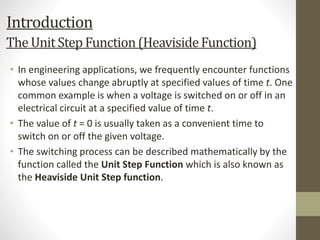
• In engineering applications, we frequently encounter functions
whose values change abruptly at specified values of time t. One
common example is when a voltage is switched on or off in an
electrical circuit at a specified value of time t.
• The value of t = 0 is usually taken as a convenient time to
switch on or off the given voltage.
• The switching process can be described mathematically by the
function called the Unit Step Function which is also known as
the Heaviside Unit Step function.
Heaviside’s Unit Step Function
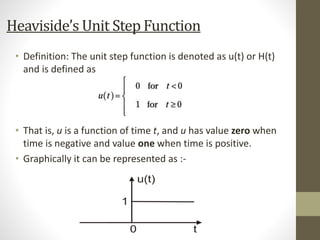
• Definition: The unit step function is denoted as u(t) or H(t)
and is defined as
• That is, u is a function of time t, and u has value zero when
time is negative and value one when time is positive.
• Graphically it can be represented as :-
Laplace transform of Unit Step function H(t)
By definition of Laplace transform
𝐿 𝑓 𝑡 = 𝑓 𝑠 = 0
∞
𝑒−𝑠𝑡 𝑓 𝑡 𝑑𝑡
𝐿[𝑢 𝑡 ] = 𝑢̅ 𝑠 = 0
∞
𝑒−𝑠𝑡 𝑢 𝑡 𝑑𝑡
= 0
∞
𝑒−𝑠𝑡
1𝑑𝑡
= −
1
𝑠
0 − 1
=
1
𝑠
∴ 𝑳 𝒖 𝒕 = 𝒖 𝒔 =
𝟏
𝒔
Shifted Unit Step Function
• In many circuits, waveforms are applied at specified intervals
other than t = 0.
• Such a function may be described using the shifted /delayed
unit step function.
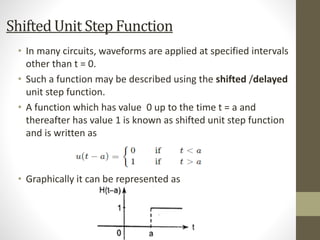
• A function which has value 0 up to the time t = a and
thereafter has value 1 is known as shifted unit step function
and is written as
• Graphically it can be represented as
Laplace Transform of Shifted
Unit Step Function H(t - a)
• 𝐿 𝐻 𝑡 − 𝑎 = 0
∞
𝑒−𝑠𝑡 𝐻 𝑡 − 𝑎 𝑑𝑡
= 0
𝑎
𝑒−𝑠𝑡 𝐻 𝑡 − 𝑎 𝑑𝑡 + 𝑎
∞
𝑒−𝑠𝑡 𝐻 𝑡 − 𝑎 𝑑𝑡
= 𝑎
∞
𝑒−𝑠𝑡
1 𝑑𝑡
= −
1
𝑠
(0 − 𝑒−𝑠𝑎)
∴ 𝑳[𝑯 𝒕 − 𝒂 ] =
𝒆−𝒂𝒔
𝒔
Unit Impulse Function
Rectangular Pulse
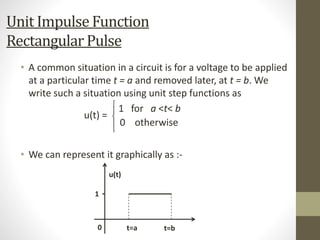
• A common situation in a circuit is for a voltage to be applied
at a particular time t = a and removed later, at t = b. We
write such a situation using unit step functions as
1 for a <t< b
• We can represent it graphically as :-
0 otherwise
u(t) =
t=a t=b0
1
u(t)
Laplace Transform of Impulse Function
• 𝐿[𝑢 𝑡 ] = 0
∞
𝑒−𝑠𝑡 𝑓 𝑡 𝑑𝑡
= 0
𝑎
𝑒−𝑠𝑡
𝑢 𝑡 𝑑𝑡 + 𝑎
𝑏
𝑒−𝑠𝑡
𝑢 𝑡 𝑑𝑡 + 𝑏
∞
𝑒−𝑠𝑡
𝑢 𝑡 𝑑𝑡
= 0
𝑎
𝑒−𝑠𝑡 (0) + 𝑎
𝑏
𝑒−𝑠𝑡 𝑢 𝑡 𝑑𝑡 + 𝑏
∞
𝑒−𝑠𝑡 (0)
= 𝑎
𝑏
𝑒−𝑠𝑡
∴ 𝑳[𝒖 𝒕 ] = −
𝟏
𝒔
[𝒆−𝒔𝒕 − 𝒆−𝒂𝒔]
Representation of a function using
Heaviside’s Functions
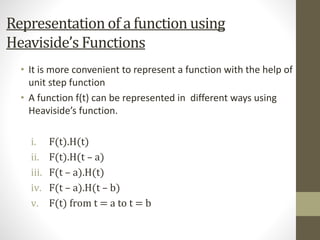
• It is more convenient to represent a function with the help of
unit step function
• A function f(t) can be represented in different ways using
Heaviside’s function.
i. F(t).H(t)
ii. F(t).H(t – a)
iii. F(t – a).H(t)
iv. F(t – a).H(t – b)
v. F(t) from t = a to t = b
Case 1 : F(t).H(t)
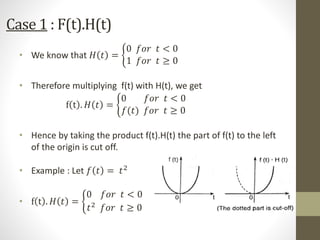
• We know that 𝐻 𝑡 =
0 𝑓𝑜𝑟 𝑡 < 0
1 𝑓𝑜𝑟 𝑡 ≥ 0
• Therefore multiplying f(t) with H(t), we get
f t . 𝐻 𝑡 =
0 𝑓𝑜𝑟 𝑡 < 0
𝑓(𝑡) 𝑓𝑜𝑟 𝑡 ≥ 0
• Hence by taking the product f(t).H(t) the part of f(t) to the left
of the origin is cut off.
• Example : Let 𝑓 𝑡 = 𝑡2
• f t . 𝐻 𝑡 =
0 𝑓𝑜𝑟 𝑡 < 0
𝑡2
𝑓𝑜𝑟 𝑡 ≥ 0
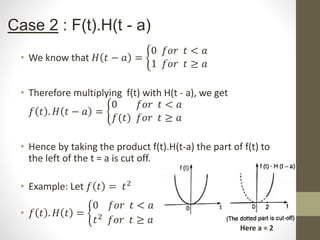
Case 2 : F(t).H(t - a)
• We know that 𝐻 𝑡 − 𝑎 =
0 𝑓𝑜𝑟 𝑡 < 𝑎
1 𝑓𝑜𝑟 𝑡 ≥ 𝑎
• Therefore multiplying f(t) with H(t - a), we get
𝑓 𝑡 . 𝐻 𝑡 − 𝑎 =
0 𝑓𝑜𝑟 𝑡 < 𝑎
𝑓(𝑡) 𝑓𝑜𝑟 𝑡 ≥ 𝑎
• Hence by taking the product f(t).H(t-a) the part of f(t) to
the left of the t = a is cut off.
• Example: Let 𝑓 𝑡 = 𝑡2
• 𝑓 𝑡 . 𝐻 𝑡 =
0 𝑓𝑜𝑟 𝑡 < 𝑎
𝑡2 𝑓𝑜𝑟 𝑡 ≥ 𝑎
Here a = 2
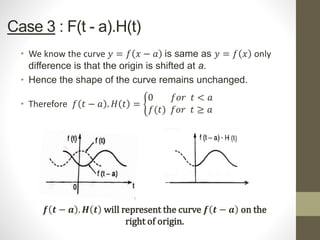
Case 3 : F(t - a).H(t)
• We know the curve 𝑦 = 𝑓 𝑥 − 𝑎 is same as 𝑦 = 𝑓 𝑥 only
difference is that the origin is shifted at a.
• Hence the shape of the curve remains unchanged.
• Therefore 𝑓 𝑡 − 𝑎 . 𝐻 𝑡 =
0 𝑓𝑜𝑟 𝑡 < 𝑎
𝑓(𝑡) 𝑓𝑜𝑟 𝑡 ≥ 𝑎
𝒇 𝒕 − 𝒂 . 𝑯 𝒕 will represent the curve 𝒇 𝒕 − 𝒂 on the
right of origin.
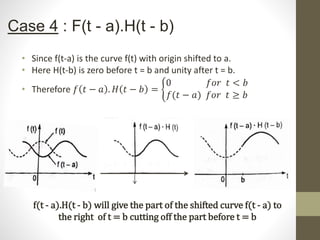
Case 4 : F(t - a).H(t - b)
f(t - a).H(t - b) will give the part of the shifted curve f(t - a) to
the right of t = b cutting off the part before t = b
• Since f(t-a) is the curve f(t) with origin shifted to a.
• Here H(t-b) is zero before t = b and unity after t = b.
• Therefore 𝑓 𝑡 − 𝑎 . 𝐻 𝑡 − 𝑏 =
0 𝑓𝑜𝑟 𝑡 < 𝑏
𝑓(𝑡 − 𝑎) 𝑓𝑜𝑟 𝑡 ≥ 𝑏
Case 5 : Representation of the part of the
curve f(t) from t = a to t = b
• We see that H(t-a) is a unit function on the right of t=a and H(t-b)
on the right of t=b.
• So the function [H(t-a)- H(t-b)] is zero before t=a and after t=b.
• Therefore here H(t)= 𝐻 𝑡 =
1 𝑓𝑜𝑟 𝑎 < 𝑡 < 𝑏
0 𝑜𝑡ℎ𝑒𝑟𝑤𝑖𝑠𝑒
Hence the only remaining part of f(t). [H(t-a)- H(t-b)] is between
t=a and t=b called as filter function.
Applications of Heaviside’s Unit
Step Function
Where do we use it?
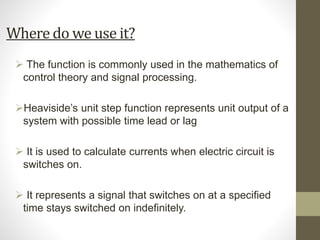
 The function is commonly used in the mathematics of
control theory and signal processing.
Heaviside’s unit step function represents unit output of a
system with possible time lead or lag
 It is used to calculate currents when electric circuit is
switches on.
 It represents a signal that switches on at a specified
time stays switched on indefinitely.
How do we use it?
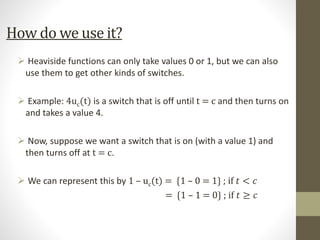
 Heaviside functions can only take values 0 or 1, but we can also
use them to get other kinds of switches.
 Example: 4uc(t) is a switch that is off until t = c and then turns on
and takes a value 4.
 Now, suppose we want a switch that is on (with a value 1) and
then turns off at t = c.
 We can represent this by 1 – uc(t) = {1 – 0 = 1} ; if 𝑡 < 𝑐
= {1 – 1 = 0} ; if 𝑡 ≥ 𝑐

Heaviside's function

  • 1.
  • 2.
    Introduction The Unit StepFunction(HeavisideFunction) • In engineering applications, we frequently encounter functions whose values change abruptly at specified values of time t. One common example is when a voltage is switched on or off in an electrical circuit at a specified value of time t. • The value of t = 0 is usually taken as a convenient time to switch on or off the given voltage. • The switching process can be described mathematically by the function called the Unit Step Function which is also known as the Heaviside Unit Step function.
  • 3.
    Heaviside’s Unit StepFunction • Definition: The unit step function is denoted as u(t) or H(t) and is defined as • That is, u is a function of time t, and u has value zero when time is negative and value one when time is positive. • Graphically it can be represented as :-
  • 4.
    Laplace transform ofUnit Step function H(t) By definition of Laplace transform 𝐿 𝑓 𝑡 = 𝑓 𝑠 = 0 ∞ 𝑒−𝑠𝑡 𝑓 𝑡 𝑑𝑡 𝐿[𝑢 𝑡 ] = 𝑢̅ 𝑠 = 0 ∞ 𝑒−𝑠𝑡 𝑢 𝑡 𝑑𝑡 = 0 ∞ 𝑒−𝑠𝑡 1𝑑𝑡 = − 1 𝑠 0 − 1 = 1 𝑠 ∴ 𝑳 𝒖 𝒕 = 𝒖 𝒔 = 𝟏 𝒔
  • 5.
    Shifted Unit StepFunction • In many circuits, waveforms are applied at specified intervals other than t = 0. • Such a function may be described using the shifted /delayed unit step function. • A function which has value 0 up to the time t = a and thereafter has value 1 is known as shifted unit step function and is written as • Graphically it can be represented as
  • 6.
    Laplace Transform ofShifted Unit Step Function H(t - a) • 𝐿 𝐻 𝑡 − 𝑎 = 0 ∞ 𝑒−𝑠𝑡 𝐻 𝑡 − 𝑎 𝑑𝑡 = 0 𝑎 𝑒−𝑠𝑡 𝐻 𝑡 − 𝑎 𝑑𝑡 + 𝑎 ∞ 𝑒−𝑠𝑡 𝐻 𝑡 − 𝑎 𝑑𝑡 = 𝑎 ∞ 𝑒−𝑠𝑡 1 𝑑𝑡 = − 1 𝑠 (0 − 𝑒−𝑠𝑎) ∴ 𝑳[𝑯 𝒕 − 𝒂 ] = 𝒆−𝒂𝒔 𝒔
  • 7.
    Unit Impulse Function RectangularPulse • A common situation in a circuit is for a voltage to be applied at a particular time t = a and removed later, at t = b. We write such a situation using unit step functions as 1 for a <t< b • We can represent it graphically as :- 0 otherwise u(t) = t=a t=b0 1 u(t)
  • 8.
    Laplace Transform ofImpulse Function • 𝐿[𝑢 𝑡 ] = 0 ∞ 𝑒−𝑠𝑡 𝑓 𝑡 𝑑𝑡 = 0 𝑎 𝑒−𝑠𝑡 𝑢 𝑡 𝑑𝑡 + 𝑎 𝑏 𝑒−𝑠𝑡 𝑢 𝑡 𝑑𝑡 + 𝑏 ∞ 𝑒−𝑠𝑡 𝑢 𝑡 𝑑𝑡 = 0 𝑎 𝑒−𝑠𝑡 (0) + 𝑎 𝑏 𝑒−𝑠𝑡 𝑢 𝑡 𝑑𝑡 + 𝑏 ∞ 𝑒−𝑠𝑡 (0) = 𝑎 𝑏 𝑒−𝑠𝑡 ∴ 𝑳[𝒖 𝒕 ] = − 𝟏 𝒔 [𝒆−𝒔𝒕 − 𝒆−𝒂𝒔]
  • 9.
    Representation of afunction using Heaviside’s Functions • It is more convenient to represent a function with the help of unit step function • A function f(t) can be represented in different ways using Heaviside’s function. i. F(t).H(t) ii. F(t).H(t – a) iii. F(t – a).H(t) iv. F(t – a).H(t – b) v. F(t) from t = a to t = b
  • 10.
    Case 1 :F(t).H(t) • We know that 𝐻 𝑡 = 0 𝑓𝑜𝑟 𝑡 < 0 1 𝑓𝑜𝑟 𝑡 ≥ 0 • Therefore multiplying f(t) with H(t), we get f t . 𝐻 𝑡 = 0 𝑓𝑜𝑟 𝑡 < 0 𝑓(𝑡) 𝑓𝑜𝑟 𝑡 ≥ 0 • Hence by taking the product f(t).H(t) the part of f(t) to the left of the origin is cut off. • Example : Let 𝑓 𝑡 = 𝑡2 • f t . 𝐻 𝑡 = 0 𝑓𝑜𝑟 𝑡 < 0 𝑡2 𝑓𝑜𝑟 𝑡 ≥ 0
  • 11.
    Case 2 :F(t).H(t - a) • We know that 𝐻 𝑡 − 𝑎 = 0 𝑓𝑜𝑟 𝑡 < 𝑎 1 𝑓𝑜𝑟 𝑡 ≥ 𝑎 • Therefore multiplying f(t) with H(t - a), we get 𝑓 𝑡 . 𝐻 𝑡 − 𝑎 = 0 𝑓𝑜𝑟 𝑡 < 𝑎 𝑓(𝑡) 𝑓𝑜𝑟 𝑡 ≥ 𝑎 • Hence by taking the product f(t).H(t-a) the part of f(t) to the left of the t = a is cut off. • Example: Let 𝑓 𝑡 = 𝑡2 • 𝑓 𝑡 . 𝐻 𝑡 = 0 𝑓𝑜𝑟 𝑡 < 𝑎 𝑡2 𝑓𝑜𝑟 𝑡 ≥ 𝑎 Here a = 2
  • 12.
    Case 3 :F(t - a).H(t) • We know the curve 𝑦 = 𝑓 𝑥 − 𝑎 is same as 𝑦 = 𝑓 𝑥 only difference is that the origin is shifted at a. • Hence the shape of the curve remains unchanged. • Therefore 𝑓 𝑡 − 𝑎 . 𝐻 𝑡 = 0 𝑓𝑜𝑟 𝑡 < 𝑎 𝑓(𝑡) 𝑓𝑜𝑟 𝑡 ≥ 𝑎 𝒇 𝒕 − 𝒂 . 𝑯 𝒕 will represent the curve 𝒇 𝒕 − 𝒂 on the right of origin.
  • 13.
    Case 4 :F(t - a).H(t - b) f(t - a).H(t - b) will give the part of the shifted curve f(t - a) to the right of t = b cutting off the part before t = b • Since f(t-a) is the curve f(t) with origin shifted to a. • Here H(t-b) is zero before t = b and unity after t = b. • Therefore 𝑓 𝑡 − 𝑎 . 𝐻 𝑡 − 𝑏 = 0 𝑓𝑜𝑟 𝑡 < 𝑏 𝑓(𝑡 − 𝑎) 𝑓𝑜𝑟 𝑡 ≥ 𝑏
  • 14.
    Case 5 :Representation of the part of the curve f(t) from t = a to t = b • We see that H(t-a) is a unit function on the right of t=a and H(t-b) on the right of t=b. • So the function [H(t-a)- H(t-b)] is zero before t=a and after t=b. • Therefore here H(t)= 𝐻 𝑡 = 1 𝑓𝑜𝑟 𝑎 < 𝑡 < 𝑏 0 𝑜𝑡ℎ𝑒𝑟𝑤𝑖𝑠𝑒 Hence the only remaining part of f(t). [H(t-a)- H(t-b)] is between t=a and t=b called as filter function.
  • 15.
  • 16.
    Where do weuse it?  The function is commonly used in the mathematics of control theory and signal processing. Heaviside’s unit step function represents unit output of a system with possible time lead or lag  It is used to calculate currents when electric circuit is switches on.  It represents a signal that switches on at a specified time stays switched on indefinitely.
  • 17.
    How do weuse it?  Heaviside functions can only take values 0 or 1, but we can also use them to get other kinds of switches.  Example: 4uc(t) is a switch that is off until t = c and then turns on and takes a value 4.  Now, suppose we want a switch that is on (with a value 1) and then turns off at t = c.  We can represent this by 1 – uc(t) = {1 – 0 = 1} ; if 𝑡 < 𝑐 = {1 – 1 = 0} ; if 𝑡 ≥ 𝑐