Motion and
Its Types
SCIHYPE LEARNERS
Motion And Its Definition
Motion refers to the change in position of an object over time. It is described in terms of
displacement, distance, velocity, acceleration, and time. For example, when a car moves from one
place to another, it is in motion.
Understanding Motion
Definition of Motion
Motion is the change in position of an object over time. It is a fundamental
concept in physics that helps us understand the behavior of objects in space.
Significance of Motion
Motion is crucial in describing the physical world and is essential in
various scientific disciplines. It enables us to study forces, energy, and
interactions between objects.
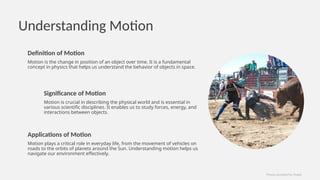
Applications of Motion
Motion plays a critical role in everyday life, from the movement of vehicles on
roads to the orbits of planets around the Sun. Understanding motion helps us
navigate our environment effectively.
Photos provided by Pexels
Types of Motion
Linear Motion
Linear motion occurs when an object
moves in a straight line. It is
characterized by constant velocity or
acceleration and is commonly
observed in activities like running or
falling objects.
Rotational Motion
Rotational motion involves the circular
movement of an object around an axis.
Examples include the spinning of a
wheel or the rotation of the Earth on
its axis.
Oscillatory Motion
Oscillatory motion is a repetitive back-
and-forth movement around a central
point. It is seen in phenomena like
pendulum swings or vibrations in a
guitar string.
Characteristics of Linear Motion
Velocity and Acceleration
Linear motion involves a constant velocity if the speed remains the same or
constant acceleration if the velocity changes over time. These factors dictate the
motion's speed and direction.
Distance and Displacement
In linear motion, distance refers to the total path length covered by an object,
while displacement is the change in position from the starting point to the
ending point.
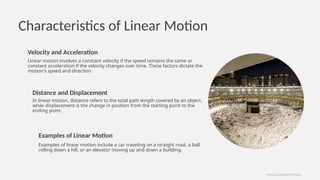
Examples of Linear Motion
Examples of linear motion include a car traveling on a straight road, a ball
rolling down a hill, or an elevator moving up and down a building.
Photos provided by Pexels
Characteristics of Rotational Motion
Axis of Rotation
Rotational motion occurs around an axis, which is an
imaginary line passing through the center of rotation.
Objects spin or rotate relative to this axis.
Angular Velocity
Angular velocity measures how quickly an object rotates
around an axis. It is analogous to linear velocity but
pertains to rotational motion.
Real-World Applications
Rotational motion is prevalent in phenomena like the
spinning of a merry-go-round, the turning of a key in a
lock, or the rotation of Earth on its axis.
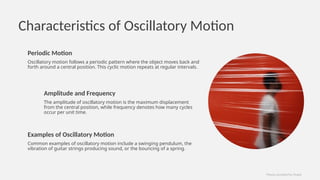
Characteristics of Oscillatory Motion
Periodic Motion
Oscillatory motion follows a periodic pattern where the object moves back and
forth around a central position. This cyclic motion repeats at regular intervals.
Amplitude and Frequency
The amplitude of oscillatory motion is the maximum displacement
from the central position, while frequency denotes how many cycles
occur per unit time.
Examples of Oscillatory Motion
Common examples of oscillatory motion include a swinging pendulum, the
vibration of guitar strings producing sound, or the bouncing of a spring.
Photos provided by Pexels
Motion Type Description Examples
Linear Motion Objects move in a straight line. Car on a highway
Rotational Motion Objects spin or rotate around an axis. Spinning top
Oscillatory Motion Back-and-forth motion around a central point. Swinging pendulum
Comparison of Motion Types

Motion and Its Types and their use .pptx

  • 1.
  • 2.
    Motion And ItsDefinition Motion refers to the change in position of an object over time. It is described in terms of displacement, distance, velocity, acceleration, and time. For example, when a car moves from one place to another, it is in motion.
  • 3.
    Understanding Motion Definition ofMotion Motion is the change in position of an object over time. It is a fundamental concept in physics that helps us understand the behavior of objects in space. Significance of Motion Motion is crucial in describing the physical world and is essential in various scientific disciplines. It enables us to study forces, energy, and interactions between objects. Applications of Motion Motion plays a critical role in everyday life, from the movement of vehicles on roads to the orbits of planets around the Sun. Understanding motion helps us navigate our environment effectively. Photos provided by Pexels
  • 4.
    Types of Motion LinearMotion Linear motion occurs when an object moves in a straight line. It is characterized by constant velocity or acceleration and is commonly observed in activities like running or falling objects. Rotational Motion Rotational motion involves the circular movement of an object around an axis. Examples include the spinning of a wheel or the rotation of the Earth on its axis. Oscillatory Motion Oscillatory motion is a repetitive back- and-forth movement around a central point. It is seen in phenomena like pendulum swings or vibrations in a guitar string.
  • 5.
    Characteristics of LinearMotion Velocity and Acceleration Linear motion involves a constant velocity if the speed remains the same or constant acceleration if the velocity changes over time. These factors dictate the motion's speed and direction. Distance and Displacement In linear motion, distance refers to the total path length covered by an object, while displacement is the change in position from the starting point to the ending point. Examples of Linear Motion Examples of linear motion include a car traveling on a straight road, a ball rolling down a hill, or an elevator moving up and down a building. Photos provided by Pexels
  • 6.
    Characteristics of RotationalMotion Axis of Rotation Rotational motion occurs around an axis, which is an imaginary line passing through the center of rotation. Objects spin or rotate relative to this axis. Angular Velocity Angular velocity measures how quickly an object rotates around an axis. It is analogous to linear velocity but pertains to rotational motion. Real-World Applications Rotational motion is prevalent in phenomena like the spinning of a merry-go-round, the turning of a key in a lock, or the rotation of Earth on its axis.
  • 7.
    Characteristics of OscillatoryMotion Periodic Motion Oscillatory motion follows a periodic pattern where the object moves back and forth around a central position. This cyclic motion repeats at regular intervals. Amplitude and Frequency The amplitude of oscillatory motion is the maximum displacement from the central position, while frequency denotes how many cycles occur per unit time. Examples of Oscillatory Motion Common examples of oscillatory motion include a swinging pendulum, the vibration of guitar strings producing sound, or the bouncing of a spring. Photos provided by Pexels
  • 8.
    Motion Type DescriptionExamples Linear Motion Objects move in a straight line. Car on a highway Rotational Motion Objects spin or rotate around an axis. Spinning top Oscillatory Motion Back-and-forth motion around a central point. Swinging pendulum Comparison of Motion Types